163 résultats
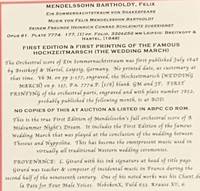
184812803<b>Rarity. First Edition First Printing of the famous Wedding March. The orchestral score was first published July 1848 by Breitkopf & Hartel Leipzig Germany. No printed date as customary at that time. Vb M. on pp 3-177 engraved the Hochzeitmarsch WEDDING MARCH on p.137 P.n. 7774.P. 178 blank. GM and JF. FIRST PRINTING of the orchestral parts engraved and with plate number 7852 probably published the following month is at BOD. NO COPIES OF THIS AT AUCTION AS LISTED IN ABPC CD ROM. <br />This is the true First Edition of Mendelssohn's full orchestral score of A MIDSUMMER NIGHT'S DREAM. It includes the FIRST EDITION of the famous Wedding March that was played at the conclusion of the wedding between Theseus and Hyppolita. This has become the omnipresent music used in virtually ALL traditional Western wedding ceremonies. PROVENANCE L. Girard with his ink signature at head of the title page. Girard was teacher and composer of identical music in France during the second half of the 19th century. One of his noted works was in his Chant de La Paix For Four Male Voices. HobokenX Fuld 633. Krause X!! 6. TRULY RARE≥</b> Breitkopf & Hartel hardcover books
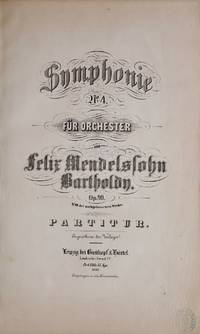
185126616Leipzig: Breitkopf & Härtel PN 8347 1851. Octavo. Early half dark red calf with marbled boards spine in gilt-ruled compartments with titling gilt. 1f. title 193 i blank pp. Engraved.<br/><br/>Publisher's handstamp to lower margin of title; ownership signature in black ink of Florence Bertha Thomas dated February 1863 or 1868 to front free endpaper; two additional dates in the same hand to front pastedown possibly referring to performance dates. <br/><br/>Binding rubbed; lower portion of upper hinge slightly cracked. Occasional very light foxing. First Edition of the "Italian" Symphony. Hoboken 10 no. 284. Catalog of the Mendelssohn Papers in the Bodleian Library Oxford III no. 734. Felix Mendelssohn Bartholdy Leipzig catalog no. 152. Wehner MWV pp. 225-226 no. 16. Muller-Reuter I p. 73. Fuld p. 556.<br/><br/>Mendelssohn finished his "Italian" Symphony in Berlin on March 13 1833 conducting its first performance in London on May 13 1833 at a London Philharmonic Society concert. The first edition of the full score was not published until after the composer's death. Breitkopf & Härtel [PN] 8347 unknown books
185140958Leipzig . London: Breitkopf & Härtel . Ewer & Co. PN 8347 1851. Octavo. Contemporary dark green morocco-backed dark green cloth boards with monogrammatic device gilt to upper incorporating musical instruments. 1f. recto title verso blank 193 i blank pp. Engraved throughout. <br /> <br /> Small publisher's oval handstamp and Ewer & Co.'s blindstamp to lower outer corner of title; decorative handstamp of "The Wandering Minstrels" to blank verso of title; "Presented by" handstamp followed by signature "Hon: S. Egerton" to upper margin of first page of music. <br /> <br /> With performance markings mostly dynamics with occasional articulations in lead and blue pencil.<br /> <br /> Binding slightly worn and bumped; upper hinge partially split; endpapers browned. Occasional minor browning and staining.<br /> <br /> A very good copy overall. First Edition. MWV pp. 225-226 no. 16. Hoboken 10 no. 284. Catalog of the Mendelssohn Papers in the Bodleian Library III 734. Felix Mendelssohn Bartholdy Leipzig catalog 152. Müller-Reuter I p. 73. Fuld p. 556.<br /> <br /> Mendelssohn finished his "Italian" Symphony in Berlin on 13 March 1833 conducting its first performance in London on 13 May 1833 at a London Philharmonic Society concert. The first edition of the full score was not published until after the composer's death. <br /> <br /> "The Italian sojourn of 1830 provided the raw musical material for the Italian Symphony finished and performed in London in 1833 revised the following year but published only posthumously as Symphony no.4 in 1851. For Julius Benedict the brightly scored opening was 'warmed with the balmy air of a southern clime'. The slow movement profitably compared to the 'Marche des pèlerins' from Berlioz's nearly contemporaneous Harold en Italie begins with a haunting modal melody evidently meant to depict a religious ceremony or procession. The third movement was probably inspired by Goethe's humorous poem Lilis Park. The finale labelled 'Saltarello' begins with a characteristic hopping figure reminiscent of the saltarellos Mendelssohn heard in Rome and Naples but then introduces in its development a new conjunct figure intended according to William Rockstro as a tarantella; the two are juxtaposed in the closing bars of the score." R. Larry Todd in Grove Music Online<br /> <br /> "The Wandering Minstrels were an amateur orchestra of forty or so players drawn from the ranks of the aristocracy and military. The Earl of Wilton and his sons were leading lights in the orchestra and for many years the Earl's younger son the Honourable Seymour Egerton was conductor and president.<br /> <br /> The Wandering Minstrels conscientiously documented their activities. Their albums of posters photographs and concert programmes shine a light on a little-studied aspect of musical life in the 19th century: concerts given by noble amateurs. The albums provide information on the music performed the structure of the concerts and Victorian programming habits and show which composers - and which musical works - were popular. Mendelssohn and Gounod were the most popular composers by a long way." British Library website music blog 17 August 2012. Breitkopf & Härtel ... Ewer & Co. [PN 8347] unknown
183918717Leipsic: Breitkopf & Härtel PNs 6022 6023 6024 1839. Folio. Unbound as issued. Engraved.<br/>I: 13 11 11 9 pp.<br/>II: 13 11 11 11 pp. <br/>III: 15 13 13 13 pp. <br/><br/>With fine decorative titles printed in sepia to each quartet. <br/><br/>Staining mostly marginal to first few leaves of first quartet including title and outer edges of third quartet otherwise very good copies. First Editions. Very scarce. Not in Krause. Müller-Reuter I pp. 131-133. Hoboken 10: 201 202 203. <br/><br/>"One of the most gifted and versatile prodigies Mendelssohn stood at the forefront of German music during the 1830s and 40s as conductor pianist organist and above all composer. His musical style fully developed before he was 20 drew upon a variety of influences including the complex chromatic counterpoint of Bach the formal clarity and gracefulness of Mozart and the dramatic power of Beethoven and Weber." <br/><br/>"The three quartets op.44 written during the idyllic period of Mendelssohn's honeymoon and first year of marriage show signs of a Classical tendency." R. Larry Todd in Grove Music Online. Breitkopf & Härtel [PNs 6022, 6023, 6024] unknown books
184537452Leipzig: F. A. Brockhaus 1845. First edition. Hardcover. g. Small Octavo ca. 4200pp. Original half leather over dark green pebbled cloth. Marbled endpapers and edges. Portrait lithograph of Mendelssohn by Frisch with tissue guard. Edited by Prof. Dr. G. B. Mendelssohn based on original prints and handwritings in seven volumes. Vol. 1: Biography and philosophical writings Vol. 2: Metaphysical writings Vol. 3: Correspondence and smaller writings Vol. 4.1: Smaller writings and correspondence Vol. 4.2: Correspondence. Vol. 5: Correspondence. Vol. 6: Ritual Laws of the Jews and various translations. Vol. 7: Mendelssohn's translation of the Five Books of Moses. Moses Mendelssohn was a German Jewish philosopher and practicing orthodox Jew. His ideas are credited with contributing significantly to the 'Jewish enlightenment' of the 18th and 19th centuries the Haskalah. Text in German fracture. Binding rubbed. Some volumes with professional repair at gutters starting a back gutter of volume 2 and 3. Volumes dusty and marbled edges faded. Moderate sporadic foxing of book blocks. Bindings and interior in overall good condition. F. A. Brockhaus hardcover
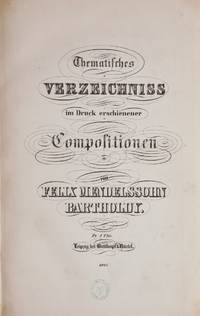
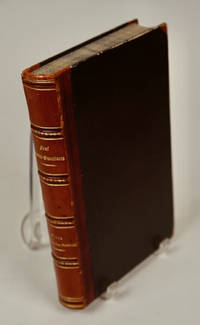
184340969Leipzig: Breitkopf & Härtel PN 6925 1843. Octavo. Full 19th century dark green textured cloth with ruled border gilt "C.C.P" gilt to upper decorative device blindstamped to lower. 1f. recto title verso blank 63 "Compositionen ohne Ausgabe einer Opuszahl" i blank 65-83 i "Dedicationen der Werke Felix Mendelssohn-Bartholdy's" pp. Title lithographed catalogue engraved. Small publisher's oval handstamp to foot of title. Occasional annotations in pencil. Scattered staining mostly minor; small tear to upper blank margin of p. 63 repaired with archival tape to verso. OCLC 1477534799. <br /> <br /> Together with:<br /> Zweite Abtheilung. Unbound. 1f recto title verso "Bemerkung." pp. 39 i blank. 41-44. Title worn and slightly foxed and stained with tear repaired with archival tape to verso; small tears to edges. Not in OCLC.<br /> <br /> First Edition.<br /> <br /> Bound with: <br /> CHOPIN<br /> Thematisches Verzeichnis der im Druck erschienen Compositionen von Friedrich Chopin. Leipzig . Paris . London: Breitkopf & Härtel . Brandus & Co. . Wessel & Co. PN 8497 ca. 1853. 1f. recto title verso blank i-iii "Inhalt. I. Werke mit Opuszahl. II. Werke ohne Opuszhal. III. Portraits. IV. Über Chopin" iv "Dedicationen" 31 i blank 33-35 i blank pp. A few "x" marks in contemporary manuscript. Occasional minor staining and foxing. <br /> <br /> First Edition. OCLC 29298462.<br /> <br /> Binding slightly worn rubbed and bumped; spine lacking with inner edges of boards reinforced with black tape. Breitkopf & Härtel [PN 6925] unknown
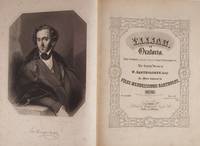
184740967London . Bonn: Ewer & Co. Newgate Strt. . N. Simrock 1847. Large folio. Full maroon cloth with dark red leather title label gilt to spine. 1f. recto blank verso frontispiece 1f. recto engraved title within decorative border verso blank 1f. recto index verso blank iv typeset libretto 279 i blank pp. Text in English. Music engraved. Small format single-page list of errata bound in following title.<br /> <br /> The fine frontispiece portrait engraving of the composer is by A.H. Payne and W.C. Wrankmore after Hildebrand.<br /> <br /> Occasional annotations in pencil including instrument names and tempo indications. <br /> <br /> Binding slightly worn rubbed and bumped. Light uniform browning; frontispiece slightly foxed and creased at lower outer corner; foxing mainly to margins; minor soiling to blank margins of title; occasional minor soiling to lower outer corners. First English edition first issue with "Newgate Strt." address published in the same year as the first German edition published by Simrock in Bonn. MWV A25. Catalogue of the Mendelssohn Papers in the Bodleian Library III 362. Hoboken 10 253. <br /> <br /> Elijah to a libretto by J. Schubring was first performed in Birmingham England on 26 August 1846; Schubring also collaborated with Mendelssohn on his earlier oratorio St. Paul.<br /> <br /> "Mendelssohn was not the only 19th-century composer to revive the oratorio but his two completed works St Paul 1836 and Elijah 1846 were the only representatives of his time to achieve lasting popularity. . With few exceptions Mendelssohn's other sacred works lie largely in the shadow of St Paul and Elijah. .<br /> <br /> One of the most gifted and versatile prodigies Mendelssohn stood at the forefront of German music during the 1830s and 40s as conductor pianist organist and above all composer. His musical style fully developed before he was 20 drew upon a variety of influences including the complex chromatic counterpoint of Bach the formal clarity and gracefulness of Mozart and the dramatic power of Beethoven and Weber.<br /> <br /> Mendelssohn's emergence into the first rank of 19th-century German composers coincided with efforts by music historiographers to develop the concept of a Classic-Romantic dialectic in 18th and 19th-century music. To a large degree his music reflects a fundamental tension between Classicism and Romanticism in the generation of German composers after Beethoven." R. Larry Todd in Grove Music Online. Ewer & Co. Newgate Strt. ... N. Simrock unknown
184136202Leipzig: Breitkopf & Härtel PNs 5542 5543 5544 1841. 1f. recto lithographic title verso blank 78; 1f. recto lithographic title verso blank 52 pp.; 1f. recto lithographic title verso blank 66 pp. Music engraved throughout. <br/><br/>First Editions later issues of all three works. MWV P3 op. 21; MWV P7 op. 26; MWV P5 op. 27. Krause 135 143 146. Hoboken first issues only. <br/><br/>Bound with: <br/>Op. 32. Ouverture zum Märchen von der schönen Melusine . Partitur . Pr. 1 Rthlr. 20 Ngr. Leipzig: Breigkopf & Härtel PN 5688 ca. 1857. 1f. recto title verso blank 72 pp. Engraved. First Edition later issue. Hoboken 10 181. Krause 149. <br/><br/>Bound with:<br/>Op. 95. Ouverture zu Ruy Blas für grosses Orchester . Op. 95. Pr. 2 Thlr. Partitur No. 24 der nachgelassen Werke. Leipzig: Fr. Kistner PN 1837 1851-52. 1f. recto title verso blank 64 pp. Engraved. First Edition. Hoboken 10 290. Krause 153. <br/><br/>19th century mid-tan morocco-backed dark brown textured paper boards raised bands on spine with titling gilt marbled edges light blue endpapers narrow blue silk ribbon marker. <br/><br/>Binding slightly worn rubbed and bumped. Minor internal wear. An attractive copy of all five of Mendelssohn's concert overtures. <br/><br/>"One of the most gifted and versatile prodigies Mendelssohn stood at the forefront of German music during the 1830s and 40s as conductor pianist organist and above all composer. His musical style fully developed before he was 20 drew upon a variety of influences including the complex chromatic counterpoint of Bach the formal clarity and gracefulness of Mozart and the dramatic power of Beethoven and Weber.<br/><br/>Mendelssohn's emergence into the first rank of 19th-century German composers coincided with efforts by music historiographers to develop the concept of a Classic-Romantic dialectic in 18th and 19th-century music. To a large degree his music reflects a fundamental tension between Classicism and Romanticism in the generation of German composers after Beethoven." R. Larry Todd in Grove Music Online. Breitkopf & Härtel [PNs 5542, 5543, 5544] unknown books
183850610London: Longman Orme Brown and Longmans 1838. First edition. Hardcover. Good condition. Octavo. ix 329 371pp. Bound in green pebbled cloth with gilt lettering on spine. Marbled edges. Gray endpapers. With preface by the translator Vindiciae Judaeorum: or a letter by Rabbi Manasseh Ben Israel and Mendelssohn's preface to the German translation of "Vindiciae Judaeorum" notes on Mendelssohn's reply remarks on Mendelssohn and a short catalogue of Ben Israel works in volume one. Mendelssohn's "Jerusalem: A Treatise on Ecclesiastical Authority and Judaism" in volume two. Light wear along edges of binding and lightly rubbed. Starting at dedication page of volume one. Longman, Orme, Brown and Longmans hardcover
184136202Leipzig: Breitkopf & Härtel PNs 5542 5543 5544 1841. 1f. recto lithographic title verso blank 78; 1f. recto lithographic title verso blank 52 pp.; 1f. recto lithographic title verso blank 66 pp. Music engraved throughout. <br /> <br /> First Editions later issues of all three works. MWV P3 op. 21; MWV P7 op. 26; MWV P5 op. 27. Krause 135 143 146. Hoboken first issues only. <br /> <br /> Bound with: <br /> Op. 32. Ouverture zum Märchen von der schönen Melusine . Partitur . Pr. 1 Rthlr. 20 Ngr. Leipzig: Breitkopf & Härtel PN 5688 ca. 1857. 1f. recto title verso blank 72 pp. Engraved. First Edition later issue. Hoboken 10 181. Krause 149. <br /> <br /> Bound with:<br /> Op. 95. Ouverture zu Ruy Blas für grosses Orchester . Op. 95. Pr. 2 Thlr. Partitur No. 24 der nachgelassen Werke. Leipzig: Fr. Kistner PN 1837 1851-52. 1f. recto title verso blank 64 pp. Engraved. First Edition. Hoboken 10 290. Krause 153. <br /> <br /> 19th century mid-tan morocco-backed dark brown textured paper boards raised bands on spine with titling gilt marbled edges light blue endpapers narrow blue silk ribbon marker. <br /> <br /> Binding slightly worn rubbed and bumped. Minor internal wear. An attractive copy of all five of Mendelssohn's concert overtures. <br /> <br /> "One of the most gifted and versatile prodigies Mendelssohn stood at the forefront of German music during the 1830s and 40s as conductor pianist organist and above all composer. His musical style fully developed before he was 20 drew upon a variety of influences including the complex chromatic counterpoint of Bach the formal clarity and gracefulness of Mozart and the dramatic power of Beethoven and Weber.<br /> <br /> Mendelssohn's emergence into the first rank of 19th-century German composers coincided with efforts by music historiographers to develop the concept of a Classic-Romantic dialectic in 18th and 19th-century music. To a large degree his music reflects a fundamental tension between Classicism and Romanticism in the generation of German composers after Beethoven." R. Larry Todd in Grove Music Online. Breitkopf & Härtel [PNs 5542, 5543, 5544] unknown
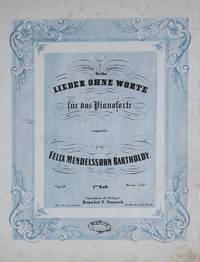
185140954Bonn . Paris . London: bei N. Simrock . bei M. Schlesinger . chez J. A. Novello PN 3041 1851. 1f. recto title verso blank 3-17 i blank pp. First German edition later issue "chez" rather than "bei" J. A. Novello. MWV SD5 p. 470. Krause 216. Hoboken 10 150.<br /> <br /> Bound with:<br /> Sechs Lieder Ohne Worte Componirt und Fräulein Elise von Woringen zugeeignet . Op. 30. IItes. Heft . Eigenthum der Verleger . Pr. 3 Frs. Bonn . London . Paris: bei N. Simrock . chez N. Mori . chez Schönenberger PN 3204 ca. 1851. 1f. recto title verso blank 3-19 i blank pp. First German edition later issue. MWV SD9 p. 472. Krause 220. Hoboken 10 177.<br /> <br /> Bound with:<br /> Sechs Lieder Ohne Worte für das Pianoforte . componirt und Fräulein Rosa von Woringen zugeeignet . Op. 38. IIItes. Heft . Preis 3 Frs. Bonn . London: bei N. Simrock . bei J. A. Novello PN 3383 ca. 1851. 1f. recto title verso blank 3-19 i blank pp. First German edition later issue. MWV SD9 p. 472. Krause 220. Hoboken 10 177.<br /> <br /> Bound with:<br /> Sechs Lieder Ohne Worte für das Pianoforte . componirt und Fräulein Sophÿ Horsleÿ zugeeignet . Op. 53 . IVtes. Heft . Preis 4 Frs. Bonn . London . Paris: bei N. Simrock . Chez Ewer & Co. . Chez Lemoine PN 3935 1841. 1f. recto title verso blank 3-25 i blank pp. First German edition later issue. MWV SD23 p. 478. Krause 227. Hoboken 10 222.<br /> <br /> Bound with:<br /> Sechs Lieder Ohne Worte für das Pianoforte . componirt und Frau Dr. Clara Schumann geb. Wieck zugeeignet . Op. 62. . Vtes. Heft . Preis 3 Frs 50c. Bonn . Lyon . Mailand . London: bei N. Simrock . bei Benacci & Peschier . bei J. Lucca . bei Ewer & Co. PN 4343 ca. 1860. 1f. recto title verso blank i blank 4-19 i blank pp. First Edition early issue. MWV SD29 p. 481. Krause 231. Hoboken 10 237.<br /> <br /> Bound with:<br /> Sechs Lieder Ohne Worte für das Pianoforte . componirt und Fräulein Sophie Rosen zugeeignet . Op. 67. . VItes. Heft . Preis 3 Frs 50c. Bonn . Mailand . Paris . London: bei N. Simrock . bei J. Ricordi . bei M. Schlesinger . bei Ewer & Co. PN 4478 1845. 1f. recto title verso blank i blank 4-21 i blank pp. First Edition early issue. MWV SD32 p. 482. Krause 236. Hoboken 10 245. <br /> <br /> 6 volumes. Folio. Contemporary black cloth-backed dark blue boards with titling in manuscript to upper. Titles lithographed on blue ground within decorative blue border music engraved. <br /> <br /> Provenance<br /> Heinrich Dorn 1800-1892 noted conductor composer music critic and teacher of the Schumanns with "H. Dorn" in manuscript to upper outer corner of upper board with his small oval handstamp "H. Dorn Coeln" and handstamp "M. Schloss in Coeln" to foot of titles. <br /> <br /> Binding slightly worn and soiled with small stains to upper. Some minor foxing soiling small stains and showthrough heavier to some leaves; small dampstain to blank lower margin of final half of volume; inner margins occasionally reinforced; some minor paper repairs. "One of the most gifted and versatile prodigies Mendelssohn stood at the forefront of German music during the 1830s and 40s as conductor pianist organist and above all composer. His musical style fully developed before he was 20 drew upon a variety of influences including the complex chromatic counterpoint of Bach the formal clarity and gracefulness of Mozart and the dramatic power of Beethoven and Weber.<br /> <br /> Mendelssohn's emergence into the first rank of 19th-century German composers coincided with efforts by music historiographers to develop the concept of a Classic-Romantic dialectic in 18th and 19th-century music. To a large degree his music reflects a fundamental tension between Classicism and Romanticism in the generation of German composers after Beethoven. .<br /> <br /> The origins of the Lieder ohne Worte of which Mendelssohn published 36 pieces in six volumes between 1832 and 1845 two more volumes followed posthumously remain couched in mystery. Among his earliest piano lieder was one in E♭ written for Fanny's birthday in 1828 Fanny herself composed numerous examples of the genre; the idea of creating songlike piano pieces may have originated in a game Fanny and Felix played in which they apparently added texts to piano pieces. Then too the critical thought of A.B. Marx who explored in his writings of the 1820s the expressive potential and 'definiteness' of instrumental music was not without impact. Most of the lieder fall into three groups pianistic parallels to the vocal categories of solo songs duets and partsongs. The meaning of the new genre perplexed Mendelssohn's contemporaries. Schumann suggested that the composer had produced texted lieder but then suppressed the texts; when the composer's cousin Marc-André Souchay offered to give some of the lieder fanciful titles Mendelssohn replied that he had intended each lied 'just as it stands'. Only a small number of the lieder bear titles from Mendelssohn e.g. the three called Venetianisches Gondellied or his circle e.g. the 'Frühlingslied'; nevertheless later in the 19th century a host of insipid titles accrued to the lieder contributing to the view of Mendelssohn as a composer of overtly sentimental piano music for the parlour." R. Larry Todd in Grove Music Online<br /> <br /> Dorn "studied the piano singing and composition in Königsberg made several long journeys throughout Germany during which he met Weber in Dresden and completed his studies with Ludwig Berger Bernhard Klein and Zelter in Berlin where his first opera Rolands Knappen was produced successfully in 1826. At the same time he became a co-editor of the Berliner allgemeine Muzikzeitung for which he wrote a spirited defence of the beleaguered Gaspare Spontini. Over the next two decades he built a solid reputation as a conductor of opera holding theatre posts at Königsberg 1828 Leipzig 1829-32 where he taught counterpoint to the young Schumann Hamburg 1832 Riga 1834-43 and Cologne 1844-8. He organized the first music festival of the Russian Baltic provinces in Riga 1836 and directed the Lower Rhine music festivals 1844-7. His most prestigious appointment in 1849 after Nicolai's death was as co-conductor with Wilhelm Taubert of the Berlin Hofoper. After his retirement from that post in 1869 he remained active in Berlin for many years as a teacher and writer." Adelyn Peck Leverett revised by Christopher Fifield in Grove Music Online. bei N. Simrock ... bei M. Schlesinger ... chez J. A. Novello [PN 3041] unknown
184440519Leipzig: Fr. Kistner PN 1400 1844. Folio. Modern mid-green boards with original publisher's wrappers laid down to both boards title label gilt to spine. 1f. recto title verso printed excerpt from a letter from Goethe to Mendelssohn 5- 91 i blank pp. Text in German. Engraved. <br /> <br /> With the overture arranged for piano 4-hands. <br /> <br /> Annotations in pencil to several leaves. <br /> <br /> Binding worn and soiled; corners bumped; wrappers with minor loss; free front endpaper slightly creased. Slightly worn and foxed; some corners with minor soiling; blank inner margin of title reinforced with narrow strip of paper; blank lower outer corner of title and following leaf repaired; several leaves with tape repairs to blank margins. Ex-library with small handstamp of the Städische Bühnen Erfurt Bibliothek to verso of title. First Edition. MWV D3 p. 78. Catalogue of the Mendelssohn Papers in the Bodleian Library Oxford III 372. Hoboken Collection Vol. 10 232. Krause pp. 19 28. <br /> <br /> A secular cantata with text by Goethe the present work treats efforts by the Druids to practice their springtime pagan rituals in the face of rising Christian forces. The original version was completed in 1831 first performed at the home of Mendelssohn's parents and then publicly on 10 January 1833 in Berlin at the Sing-Akademie conducted by the composer. It was later revised in 1843 as a programmatic overture.<br /> <br /> "The highlights of the 1843 subscription concerts included the première of the revised version of Die erste Walpurgisnacht on 2 February; among the audience was Berlioz then in the midst of his first concert tour who praised the score for its 'apparent confusion that is art perfected'." R. Larry Todd in Grove Music Online. Fr. Kistner [PN 1400] unknown
183018718Leipzig Paris: Frédéric Hofmeister Simon Richault PN 1515 1830. Folio. Unbound as issued. 9; 9; 9; 7 pp. Engraved. Title to viola part. <br /> <br /> Some very light wear and soiling; two small binder's holes to inner blank margins. In very good condition overall. First Edition. Catalogue of the Mendelssohn Papers in the Bodleian Library III 604. Hoboken 10 130. Not in Krause. <br /> <br /> "One of the most gifted and versatile prodigies Mendelssohn stood at the forefront of German music during the 1830s and 40s as conductor pianist organist and above all composer. His musical style fully developed before he was 20 drew upon a variety of influences including the complex chromatic counterpoint of Bach the formal clarity and gracefulness of Mozart and the dramatic power of Beethoven and Weber .<br /> <br /> Between 1827 and 1847 he composed six string quartets and had begun work on a seventh at the end of his life. . The first two op. 13 in A minor 1827 and op. 12 in Eb 1829 show a rapprochement with the late quartets of Beethoven. To the Swedish musician Adolf Lindblad Mendelssohn explained his concern for the organic relationship of the various movements to the whole. In op. 12 the opening of the first movement is brought back to conclude the finale." R. Larry Todd in Grove Music Online. Frédéric Hofmeister, Simon Richault [PN] 1515 unknown
187024169<p><strong>1870 Felix Mendelssohn Songs Without Words Romantic Piano MUSIC German Lieder</strong></p><p>Felix Mendelssohn was a 19th-century Romantic composer known for his symphonies famed oratorios chamber music and incidental music. One of his most recognized works perhaps his most iconic is '<em>Songs Without Words'</em>. In 1829 Mendelssohn began working a series of piano solo works which were similar in style to the German 'lieder' or song; however Mendelssohn instead of including a vocal line had the melody played by the piano itself thus making these songs 'songs without words'. </p><p>This edition of Mendelssohn's famed '<em>Songs'</em> includes the 5 of the books each with six songs along with a number of separate piano works that were not organized with an opus number. Works found in this edition include:</p><p><!-- if !supportLists-->· <!--endif-->Book 2 Op. 30</p><p><!-- if !supportLists-->· <!--endif-->Book 4 Op. 53</p><p><!-- if !supportLists-->· <!--endif-->Book 5 Op. 62</p><p><!-- if !supportLists-->· <!--endif-->Book 6 Op. 67</p><p><!-- if !supportLists-->· <!--endif-->Book 7 Op. 85</p><p><!-- if !supportLists-->· <!--endif-->Likely not by Mendelssohn – these 3 do not appear in complete lists of Mendelssohn works</p><p><!-- if !supportLists-->o <!--endif-->Andante in F-sharp minor Fr. 1.50</p><p><!-- if !supportLists-->o <!--endif-->Allegro Vivace in E major</p><p><!-- if !supportLists-->o <!--endif-->"Barcarola" Allegro non troppo A major</p><p><!-- if !supportLists-->· <!--endif-->Scherzo in B minor WoO 2</p><p>Item number: #24169</p><p>Price: $499</p><p>MENDELSSOHN Felix</p><p><strong><em>Songs Without Words</em></strong></p><p>London: Chez J.A. Novello Bonn bei N. Simrock ca. 1870.</p><p><u>Details</u>: </p><p><!-- if !supportLists-->· <!--endif-->Collation: complete with all pages</p><p><!-- if !supportLists-->o <!--endif-->Each musical piece with separate pagination </p><p><!-- if !supportLists-->· <!--endif-->Language: German </p><p><!-- if !supportLists-->· <!--endif-->Binding: Leather; tight and secure</p><p><!-- if !supportLists-->· <!--endif-->Size: ~13in X 10in 33cm x 25cm</p><p>Our Guarantee:</p><p>Very Fast. Very Safe. Free Shipping Worldwide.</p><p>Customer satisfaction is our priority! Notify us with 7 days of receiving and we will offer a full refund without reservation!</p><p>24169</p><p>Photos available upon request. </p> J.A. Novello Bonn bei N. Simrock hardcover
183018718Leipzig Paris: Frédéric Hofmeister Simon Richault PN 1515 1830. Folio. Unbound as issued. 9; 9; 9; 7 pp. Engraved. Title to viola part. <br/><br/>Some very light wear and soiling; two small binder's holes to inner blank margins. In very good condition overall. First Edition. Not in Krause. Mendelssohn Papers III 604. Hoboken 10 130. <br/><br/>"One of the most gifted and versatile prodigies Mendelssohn stood at the forefront of German music during the 1830s and 40s as conductor pianist organist and above all composer. His musical style fully developed before he was 20 drew upon a variety of influences including the complex chromatic counterpoint of Bach the formal clarity and gracefulness of Mozart and the dramatic power of Beethoven and Weber ." <br/><br/>" . Between 1827 and 1847 he composed six string quartets and had begun work on a seventh at the end of his life . The first two op. 13 in A minor 1827 and op. 12 in Eb 1829 show a rapprochement with the late quartets of Beethoven. To the Swedish musician Adolf Lindblad Mendelssohn explained his concern for the organic relationship of the various movements to the whole. In op. 12 the opening of the first movement is brought back to conclude the finale . " R. Larry Todd in Grove Music Online. Frédéric Hofmeister, Simon Richault [PN] 1515 unknown books
185136203London: Messrs. Robert Cocks. & Co . PNs 9621-9626 1851. Oblong folio. Full 19th century teal blue cloth with publisher's yellow printed rectangular title label to upper. 1f. recto title verso blank 88 pp. Engraved with "Engraved by W. Davidson" printed to foot of final page.<br/><br/>Binding quite worn rubbed bumped and shaken; spine frayed; bookplate removed from front pastedown. Slightly worn browned and soiled; small hole to blank upper margin of title with manuscript date of 1937 and flourish beneath. Re-issue of the first edition published by Coventry & Hollier in 1845. MWV SD31 W56 57 58 59 60 61. Not in Mendelssohn Papers Vol. III. Wehner W56-61. OCLC one copy only in the U.S. at the Eastman School of Music and 3 copies in the U.K. <br/><br/>"Mendelssohn was one of the finest organists of his day . The Six Organ Sonatas op.65 1845 teeming with artful fugues and chorales summarize and epitomize Mendelssohn's rediscovery of Bach and may have inspired Schumann's six fugues on B-A-C-H op.60.<br/><br/>"One of the most gifted and versatile prodigies Mendelssohn stood at the forefront of German music during the 1830s and 40s as conductor pianist organist and above all composer. His musical style fully developed before he was 20 drew upon a variety of influences including the complex chromatic counterpoint of Bach the formal clarity and gracefulness of Mozart and the dramatic power of Beethoven and Weber.<br/><br/>Mendelssohn's emergence into the first rank of 19th-century German composers coincided with efforts by music historiographers to develop the concept of a Classic-Romantic dialectic in 18th and 19th-century music. To a large degree his music reflects a fundamental tension between Classicism and Romanticism in the generation of German composers after Beethoven." R. Larry Todd in Grove Music Online. Messrs. Robert Cocks. & Co ... [PNs 9621-9626] unknown books
183028108Leipsic: Breitkopf & Härtel PN 4980 1830. Folio. Disbound. Violino 1: 1f. title 3 "Thema": song op. 9 no. 1 for voice and piano 4-13 i blank pp.; Violino 2: 9 i blank pp.; Viola: 10 pp.; Violoncello: 8 pp. Title lithographed; music engraved. <br /> <br /> Somewhat soiled and foxed; dampstained and with binder's holes to inner margin; contemporary signature "Lemke" in ink trimmed and "2" in manuscript at upper right corner of title; "F. Mendelssohn" in ink in another hand to upper right corner of first page of each part. First Edition. MWV R22 p. 276. Hoboken 10 132 spelled "Quator" and with publisher's handstamp to title. <br /> <br /> "One of the most gifted and versatile prodigies Mendelssohn stood at the forefront of German music during the 1830s and 40s as conductor pianist organist and above all composer. His musical style fully developed before he was 20 drew upon a variety of influences including the complex chromatic counterpoint of Bach the formal clarity and gracefulness of Mozart and the dramatic power of Beethoven and Weber." <br /> <br /> ". Between 1827 and 1847 he composed six string quartets and had begun work on a seventh at the end of his life. The first two op. 13 in A minor 1827 and op. 12 in Eb 1829 show a rapprochement with the late quartets of Beethoven. To the Swedish musician Adolf Lindblad Mendelssohn explained his concern for the organic relationship of the various movements to the whole. In op. 13 the quintessential thematic material is drawn from the lied Frage op. 9 no. 1 with explicit quotations from the song in the outer and more hidden references in the inner movements of the quartet." R. Larry Todd in Grove Music Online. Breitkopf & Härtel [PN 4980] unknown
183329636Bonn: N. Simrock PN 3045 1833. Folio. Unbound. <br /> <br /> Violino 1mo: 1 title 2-13 i blank<br /> Violino 2do: 11 i blank<br /> Viola 1ma: 11 i blank<br /> Viola 2da: 11 i blank<br /> Violoncello: 11 i blank pp. <br /> <br /> Engraved throughout. <br /> <br /> Slightly worn and browned; binder's hole to upper inner margin; early manuscript initial "A" and the number "5" to first page of music of each part. First Edition. Scarce. Wehner p. 275. Catalogue of the Mendelssohn papers III 634. Hoboken 10 144. <br /> <br /> "One of the most gifted and versatile prodigies Mendelssohn stood at the forefront of German music during the 1830s and 40s as conductor pianist organist and above all composer. His musical style fully developed before he was 20 drew upon a variety of influences including the complex chromatic counterpoint of Bach the formal clarity and gracefulness of Mozart and the dramatic power of Beethoven and Weber." <br /> <br /> "Of the two string quintets the first op. 18 in A begins with a graceful Mozartian theme somewhat reminiscent of the Clarinet Quintet K581. The use of fugal writing and in the original minuet intricate double canons imbued the first version of this work with a severely academic quality; in 1832 Mendelssohn replaced the minuet with the emotionally charged Intermezzo in memory of Eduard Ritez." R. Larry Todd in Grove Music Online. N. Simrock [PN 3045] unknown
183028108Leipsic: Breitkopf & Härtel PN 4980 1830. Folio. Disbound. Violino 1: 1f. title 3 "Thema": song op. 9 no. 1 for voice and piano 4-13 i blank pp.; Violino 2: 9 i blank pp.; Viola: 10 pp.; Violoncello: 8 pp. Title lithographed; music engraved. <br/><br/>Somewhat soiled and foxed; dampstained and with binder's holes to inner margin; contemporary signature "Lemke" in ink trimmed and "2" in manuscript at upper right corner of title; "F. Mendelssohn" in ink in another hand to upper right corner of first page of each part. First Edition. MWV R22 p. 276. Hoboken 10 132 spelled "Quator" and with publisher's handstamp to title. <br/><br/>"One of the most gifted and versatile prodigies Mendelssohn stood at the forefront of German music during the 1830s and 40s as conductor pianist organist and above all composer. His musical style fully developed before he was 20 drew upon a variety of influences including the complex chromatic counterpoint of Bach the formal clarity and gracefulness of Mozart and the dramatic power of Beethoven and Weber." <br/><br/>". Between 1827 and 1847 he composed six string quartets and had begun work on a seventh at the end of his life. The first two op. 13 in A minor 1827 and op. 12 in Eb 1829 show a rapprochement with the late quartets of Beethoven. To the Swedish musician Adolf Lindblad Mendelssohn explained his concern for the organic relationship of the various movements to the whole. In op. 13 the quintessential thematic material is drawn from the lied Frage op. 9 no. 1 with explicit quotations from the song in the outer and more hidden references in the inner movements of the quartet." R. Larry Todd in Grove Music Online. Breitkopf & Härtel [PN 4980] unknown books
183329636Bonn: N. Simrock PN 3045 1833. Folio. Unbound. <br/><br/>Violino 1mo: 1 title 2-13 i blank<br/>Violino 2do: 11 i blank<br/>Viola 1ma: 11 i blank<br/>Viola 2da: 11 i blank<br/>Violoncello: 11 i blank pp. <br/><br/>Engraved throughout. <br/><br/>Slightly worn and browned; binder's hole to upper inner margin; early manuscript initial "A" and the number "5" to first page of music of each part. First Edition. Scarce. Wehner p. 275. Catalogue of the Mendelssohn papers III 634. Hoboken 10 144. <br/><br/>"One of the most gifted and versatile prodigies Mendelssohn stood at the forefront of German music during the 1830s and 40s as conductor pianist organist and above all composer. His musical style fully developed before he was 20 drew upon a variety of influences including the complex chromatic counterpoint of Bach the formal clarity and gracefulness of Mozart and the dramatic power of Beethoven and Weber." <br/><br/>"Of the two string quintets the first op. 18 in A begins with a graceful Mozartian theme somewhat reminiscent of the Clarinet Quintet K581. The use of fugal writing and in the original minuet intricate double canons imbued the first version of this work with a severely academic quality; in 1832 Mendelssohn replaced the minuet with the emotionally charged Intermezzo in memory of Eduard Ritez." R. Larry Todd in Grove Music Online. N. Simrock [PN 3045] unknown books
184028338AB1840. London Ewer / Addison / Beale and others c.1840 - 1863. Folio. c 180 pages. Modern Hardcover beautiful half morocco with gilt lettering on spine and marbled paper covered boards. Original Softcover engraved scores bound in. Very good condition with only minor signs of external wear. Only three of the scores with some tears one with a dampstain ! Overall an extremely attractive compilation of Mendelssohn's work in a recent mster-binding. Highly collectable and a beautiful gift ! Ask for multiple images. paperback
183326802Bonn: N. Simrock PN 3041 1833. Folio. Disbound. 1 title 2-17 i blank pp. Engraved. <br/><br/>With overpaste of Magazyn van Muziek en Instrumenten von L. Plattner Rotterdam.<br/><br/>Signature "B. P. Manus" to upper right corner of title. Occasional fingering in pencil.<br/><br/>Slightly soiled and browned; minimally foxed; spine frayed; small stains to title; stain to lower margin of final blank page; signature very slightly trimmed. First German edition first issue. Rare. Wehner Sammeldruck 5 individual pieces listed as U86 U80 U89 U73 U90 U78. Not in the Catalogue of the Mendelssohn Papers in the Bodleian Library Vol. III. The first edition was published by Novello in London in 1832.<br/><br/>Two collections of works by Felix Mendelssohn-Bartholdy were published with this opus number by different publishers: the present Lieder ohne Worte and six songs published in Leipzig by Breitkopf & Härtel in 1833. Beginning with the complete edition by Rietz 1874-1877 scholarship has assigned "op. 19a" to the songs and "op. 19b" to the Lieder ohne Worte contradicting chronology. N. Simrock [PN 3041] unknown books
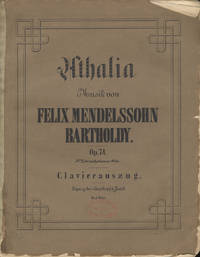
185135153Leipzig: Breitkopf & Härtel PN 7899 1851. RIETZ Julius 1812-1877 arr. Folio. Modern half brown morocco with marbled boards decorative cut paper label to upper with manuscript titling in dark red ink. 1f. recto title verso blank 3-93 i blank pp. Engraved. Text in German and French.<br/><br/>Small publisher's handstamp to blank lower margin of title.<br/><br/>Binding slightly worn and rubbed; hinges reinforced with narrow strip of black tape. Slightly browned; edges of title reinforced with archival tape. First Edition. Wehner MWV M 16 p. 213. Krause 8. Ward Jones III 316. Not in Hoboken.<br/><br/>Mendelssohn composed his incidental music for a production of Jean Racine's Athalie 1691 commissioned by King Friedrich Wilhelm IV of Prussia. It was staged for the court at the Charlottenburg Palace in Berlin on 1 December 1845. <br/><br/>"Though little-known today the music for Athalie merits performance. Especially striking are Mendelssohn's paraphrases of chorales including Ach Gott vom Himmel sieh' darein and in a scene in which the high priest Joad describes a vision of the New Jerusalem Vom Himmel hoch.<br/><br/>One of the most gifted and versatile prodigies Mendelssohn stood at the forefront of German music during the 1830s and 40s as conductor pianist organist and above all composer. His musical style fully developed before he was 20 drew upon a variety of influences including the complex chromatic counterpoint of Bach the formal clarity and gracefulness of Mozart and the dramatic power of Beethoven and Weber.<br/><br/>Mendelssohn's emergence into the first rank of 19th-century German composers coincided with efforts by music historiographers to develop the concept of a Classic-Romantic dialectic in 18th and 19th-century music. To a large degree his music reflects a fundamental tension between Classicism and Romanticism in the generation of German composers after Beethoven." R. Larry Todd in Grove Music Online. Breitkopf & Härtel [PN 7899] unknown books
187736206Leipzig: Breitkopf & Härtel PN 8335 1877. Folio. Original publisher's dark brown wrappers with titling within decorative border. 1 recto title verso blank 3-57 i blank pp. Engraved.<br /> <br /> Wrappers slightly worn and soiled. Occasional light foxing; some leaves detached and frayed at edges. First Edition of this arrangement. MWV L6 p. 196. Rare no copies located outside of Germany. Not in Krause the Catalogue of the Mendelssohn Papers in the Bodleian Library or Hoboken.<br /> <br /> Heimkehr aus der Fremde to a libretto by Karl Klingemann was first performed privately in Berlin on 26 December 1829; its first public performance took place in Leipzig on 10 April 1851. <br /> <br /> "Mendelssohn's deft command of orchestral colour is evident throughout the work and his ability to create charming effects with the simplest of means is impressive." Clive Brown in Grove Dictionary of Opera<br /> <br /> "One of the most gifted and versatile prodigies Mendelssohn stood at the forefront of German music during the 1830s and 40s as conductor pianist organist and above all composer. His musical style fully developed before he was 20 drew upon a variety of influences including the complex chromatic counterpoint of Bach the formal clarity and gracefulness of Mozart and the dramatic power of Beethoven and Weber.<br /> <br /> Mendelssohn's emergence into the first rank of 19th-century German composers coincided with efforts by music historiographers to develop the concept of a Classic-Romantic dialectic in 18th and 19th-century music. To a large degree his music reflects a fundamental tension between Classicism and Romanticism in the generation of German composers after Beethoven." R. Larry Todd in Grove Music Online. Breitkopf & Härtel [PN 8335] unknown
184336196Leipzig: Breitkopf & Härtel PN 6929 1843. Oblong folio. Disbound. 1 lithographic title within decorative floral border 2 blank 3-17 pp. Engraved. <br /> <br /> Small oval publisher's stamp to lower margin of title; early signature in pencil to lower outer corner.<br /> <br /> Slightly worn and soiled; trimmed; spine and inner margins of outer leaves reinforced with paper tape; publisher's stamp incomplete. First Edition. Published in the same year as editions in France and England with precedence unestablished. MWV SD26 K104 103 93 106 114 and 108. Hoboken 10 228 title illustrated on p. 117. Krause 122. <br /> <br /> "One of the most gifted and versatile prodigies Mendelssohn stood at the forefront of German music during the 1830s and 40s as conductor pianist organist and above all composer. His musical style fully developed before he was 20 drew upon a variety of influences including the complex chromatic counterpoint of Bach the formal clarity and gracefulness of Mozart and the dramatic power of Beethoven and Weber.<br /> <br /> Mendelssohn's emergence into the first rank of 19th-century German composers coincided with efforts by music historiographers to develop the concept of a Classic-Romantic dialectic in 18th and 19th-century music. To a large degree his music reflects a fundamental tension between Classicism and Romanticism in the generation of German composers after Beethoven." R. Larry Todd in Grove Music Online. Breitkopf & Härtel [PN 6929] unknown