1 713 résultats
RO50045141AUGENER'S. NON DATE. In-4. Broché. Etat d'usage, Plats abîmés, Dos abîmé, Quelques rousseurs. 139 pages de partitions. Dos renforcé. Quelques déchirures aux extrémités des pages.. . . . Classification Dewey : 780.26-Partitions
1945RO50058621DELRIEU. 1945. In-4. En feuillets. Etat d'usage, Couv. légèrement passée, Dos satisfaisant, Intérieur acceptable. 3 pages de partitions. Chefs d'oeuvre de la musique présentés en transcriptions faciles pour le piano par J. Antiga et Eric Attica. Tampon sur la première page.. . . . Classification Dewey : 780.26-Partitions
RO50065884Editions peters. Non daté. In-4. Broché. Bon état, Couv. défraîchie, Dos abîmé, Intérieur frais. 102 pages de partitions en noir et blanc.. . . . Classification Dewey : 780.26-Partitions
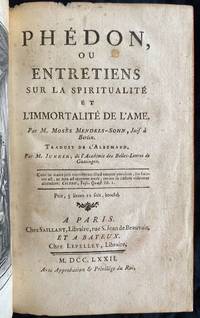
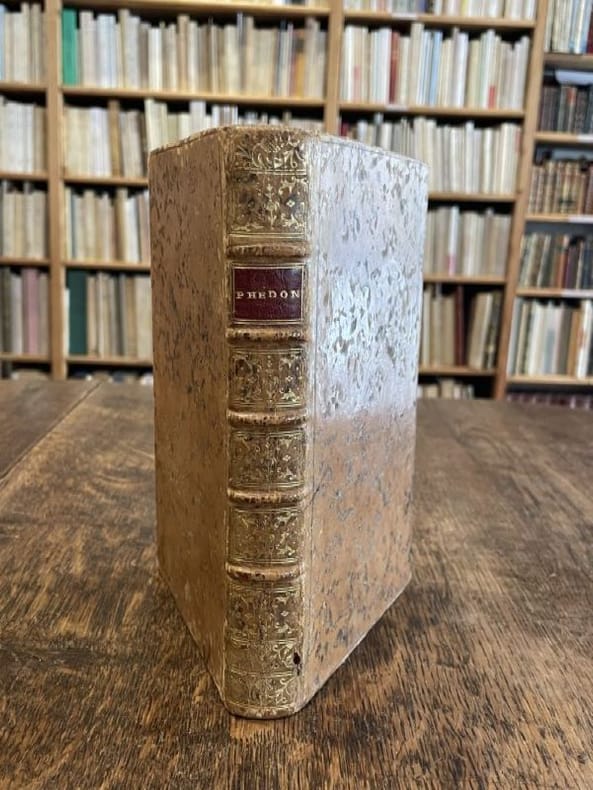
177243257Paris et Bayeux chez Saillant et Lepelley 1772. 1st French-language edition. Period full leather binding with gilt spine and red edges with original marbled endpapers 8vo. Includes frontis copperplate etching. XXIV 342 1 pages. “Traduit de l’Allemand par M. Junker de l’Académie des Belles-Lettres de Goettingen.â€<br> This first French edition appeared 5 years after the first German edition of 1767<br> <br> "Phaedon or On the Immortality of the Soul" Phaedon Oder Ueber Die Unsterblichkeit Der Seele In Drey Gespraechen is one of Mendelssohn's 1729-1786 most famous publications establishing his reputation as the "German Socrates of Berlin." It is a philosophical interpretation of the Platonic dialogue "Phaedo" and is preceded by a biography on "The Life and Character of Socrates." The important German-Jewish philosopher was one of the most important representatives of the Enlightenment in Prussia and throughout Germany.<br> <br> Mendelssohn's Phaedon is a “classic of rational psychology on the immortality of the human soul a defining work by this leading enlightenment philosopher who launched the Jewish thinking of the modern age" with his tribute to Socrates modeled on Plato's dialogue the Phaedo.<br> Mendelssohn used Plato's famous dialogue the Phaedo as a model to publish Phädon oder über die Unsterblichkeit der Seele. With this seminal work "he reached the heights of fame" Wigoder Dictionary of Jewish Biography 342. <br> The work unites Mendelssohn's "paean to Socrates with an elaboration of the dreadful personal moral and political implications if a person's life is her 'highest good'… <br> This 'classic of rational psychology' as Dilthey put it also contains an argument for the simplicity and immortality of the human soul explicitly singled out for criticism by Kant in the 2nd edition of the Critique of Pure Reason. Mendelssohn supports the notion that the soul is simple and thus indestructible by noting that certain features of the soul namely the unifying character of consciousness and the identity of self-consciousness cannot be derived from anything composite whether those composite parts be capable or not of thinking… <br> As for the human soul's fate after death Mendelssohn appeals to divine goodness and providence which perhaps explains why following the publication of the Phaedo he finds himself needing to revisit the proofs for God's existence" Stanford Encyclopedia.<br> According to Mendelssohn’s modern biographer Alexander Altmann “The work that would establish Mendelssohn's world-wide renown and win him the title 'the German Socrates' was the dialogue Phaedon which was published in 1767. In this work he presented Socratic wisdom from the mouth of the ancient philosopher but in the language of the Enlightenment that is in his own words as a modern philosopher. <br> The work drew both praise and criticism but was on the whole popular in intellectual circles. It demonstrates Mendelssohn's unique ability as a Jew to be comfortable in the realm of both classical and enlightened philosophy not to mention languages. David Sorkin remarks ‘What is ironic is that Mendelssohn was known and revered as much for the quality of his prose as for his thought.†<br> Mendelssohn was himself often referred to as the German Plato or the German Socrates. <br> And “As a Jew living in Germany Moses Mendelssohn 1729-1786 stands at a pivotal point in the history of Jewish emancipation in Europe. There were Jews before him who had access to the corridors of power in Germany and elsewhere in Europe but Mendelssohn represents the first to be socially accepted to a significant extent within enlightened German culture without converting. <br> He not only conformed to the culture of the German Enlightenment in many ways but also helped shape the culture through his philosophical contributions. At the same time Mendelssohn refused to turn away from traditional Judaism. He attempted to become a full- fledged member of society during the emergence of modern Europe while remaining a proponent of Judaism as a revealed religion. Moreover he sought to use his place of influence to encourage Jewish acculturation in Germany and to speak on behalf of the emancipation of Jewish people…. <br> The traditional mentality of the European Jews prior to Mendelssohn's time included a kind of resignation to the incompatibility of Jewish learning and 'worldly' philosophy. This resignation contributed to Jewish cultural isolation. Alfred Jospe describes the conundrum in which a Jew found himself if he wished to enter the culture of the non-Jewish world: The Jew could gain access to the culture of the world only by rebelling against the traditional repudiation of all mundane wisdom. <br> It is just at this point that Mendelssohn broke the mold. He not only acquired modern German culture but did so by means of his understanding of and contributions to the philosophy that shaped that culture. In his monumental biographical study Alexander Altmann focuses as much on Mendelssohn's philosophy and his answers to contemporary critics as he does on the details of the events and influences of his life. Altmann states with appropriate admiration that “Considering the state of degradation in which the Jewish population lived in eighteenth-century Germany. Mendelssohn's rise to fame and his acceptance into the republic of letters was an amazing feat of personal achievement.†<br> The amazing feature of Mendelssohn's achievement is that he accomplished it as an avowedly traditional Jew. Mendelssohn has been rightly described as a rabbinic scholar but he made his reputation in non-Jewish intellectual circles as a literary critic and philosopher….with the help of both Gotthold Lessing and the Berlin publisher Friedrich Nicolai he was accepted into the inner circle of the Berlin Aufklärung. <br> His essays reviews and translations earned him tremendous status among German intellectuals. <br> The favorable comparison made by Lessing between the quintessential German poet Goethe and Mendelssohn is a mark of the esteem in which he was held. ‘Lessing told Friedrich Heinrich Jacobi that once Goethe regained his reason he would be hardly more than an ordinary man. At the very same time he said of Mendelssohn that he was the most lucid thinker the most excellent philosopher and the best literary critic of the century’" Clark 2005. P. 57-58. <br> OCLC: 19939219. <br> Very light edgewear to front endpapers touch of spotting a gorgeous copy in the original leather binding with tooled gilt spine with raised bands and leather label. Beautiful and scarce. B KH-10-30-RLB-’e. Paris et Bayeux, chez Saillant et Lepelley unknown
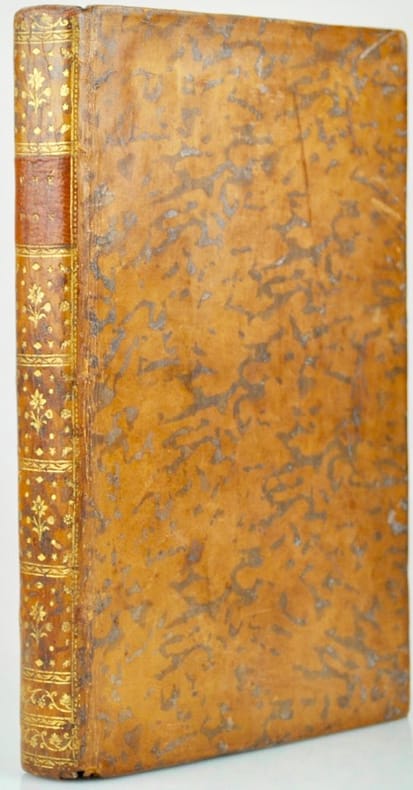
177214851A Paris Saillant 1772. Cont. full mottled calf. Back worn as the golddecoration is nearly gone. Engraved frontisp. XXIV3422 pp. A few lvs. slightly browned otherwise internally fine. <br/><br/><em>Scarce first French edition. </em> unknown
2012817173.Gpaperback. Good. Access codes and supplements are not guaranteed with used items. May be an ex-library book. paperback
72412Editions Alcuin 2000, broché, 196pp; traduction de M. Junker - très bon état
2000184009Editions Alcuin Editions Alciun, 2000. In-8 broché de 195 pages. Bon état
177254813Paris et Bayeux Saillant et Lepelley 1772 1 vol. Relié in-8, veau fauve écaille, dos à nerfs, pièce de titre de maroquin rouge, caissons ornés de fleurons et dentelle dorés avec double filet en encadrement, coupes filetées, coiffes guillochées, tranches rouges, XXIV + 342 + (2) pp. Edition originale française ornée d'un beau frontispice d'après Monet, gravé par Ménil. Précédé d'une vie de Socrate, cet essai est composé en trois dialogues, à la manière du "Phédon" de Platon, à partir de la correspondance de Mendelssohn avec son ami Thomas Abbt. Infime galerie de ver au dos en pied, sinon très bon exemplaire en reliure d'époque avec ex-libris gravé Cazenove.
177214851A Paris, Saillant, 1772. Cont. full mottled calf. Back worn as the golddecoration is nearly gone. Engraved frontisp. XXIV,342,(2) pp. A few lvs. slightly browned, otherwise internally fine.
177235627BBParis, Saillant 1772. 8°: 2 n.n. Bl., XXIV S., 342 S., 1 Bl. Privileg. Mit gestochenem Frontispiz. Interimsbroschur der Zeit mit Marmorpapierbezügen.
177242123A Paris, chez Saillant et à Bayeux, chez Lepelley, 1772. In-8 de 1 frontispice gravé, (4)-XXIV-342-(2) pp., veau marbré glacé, dos lisse orné, pièce de titre en maroquin rouge (reliure de l'époque).
1385675071.Ghardcover. Good. Access codes and supplements are not guaranteed with used items. May be an ex-library book. hardcover
1385154926.Ghardcover. Good. Access codes and supplements are not guaranteed with used items. May be an ex-library book. hardcover
0266680429.Ghardcover. Good. Access codes and supplements are not guaranteed with used items. May be an ex-library book. hardcover
1333806876.Gpaperback. Good. Access codes and supplements are not guaranteed with used items. May be an ex-library book. paperback
3743366592.Gpaperback. Good. Access codes and supplements are not guaranteed with used items. May be an ex-library book. paperback
1017652252.Ghardcover. Good. Access codes and supplements are not guaranteed with used items. May be an ex-library book. hardcover
101765722X.Gpaperback. Good. Access codes and supplements are not guaranteed with used items. May be an ex-library book. paperback
3742804170.Gpaperback. Good. Access codes and supplements are not guaranteed with used items. May be an ex-library book. paperback
178041625Karlsruhe, Schmiederische Buchhandlung (Schmieder), o. J. (um 1780). 8°. 5 Bll., 52; 224 S., Ppbd. d. Zt. m. handschriftl. Rückentitel.
3787318704.Gpaperback. Good. Access codes and supplements are not guaranteed with used items. May be an ex-library book. paperback
19846555like new. unknown
1776190450Frankfurt & Leipzig.: No publisher. 1776. Publisher’s plain wraps paper spine label with handwritten title. . Very good untrimmed in the wraps. 8vo. 19.5x12 cm. German text. Mendelssohn’s musing on the immortality of the soul. weight: 0.4 lb. Engraved frontis. No publisher. paperback