54 318 résultats
2 voll. (su 3) In 8° cm 21x13 pp. 308; 443 ,leg. coeva mz pelle con nerv. e ricchi fregi impr. in oro al d. . Secondo e terzo volume del celebre viaggio riguardante l'Italia. Terzo volume con cerniere fessurate. Piatti marezzati guardie controsguardie marezzate così come i tagli. In modo particolare il secondo volume : Padova, biblioteca di Santa Giustina, Ferrara, Cento, Bologna, Modena, Parma, Mantova, Cremona etc. .; il terzo volume : Firenze, Pisa Livorno, Ravenna , Napoli. Prima edizione
5 vol. in-8, pp. (4), IV, 487; (4), 307; (4), 443; (4), 359; (4), 316; attraente leg. del tempo m. pelle, tit. e fregi oro ai dorsi. Prima edizione di opera dettagliatissima sull'Italia peninsulare, con particolare attenzione alla descrizione delle opere d'arte, ma anche alla letteratura ed alla storia. Valery amava molto l'Italia, alla quale dedicò anche altre analoghe opere (''Voyages en Corse, à l'ile d'Elbe et en Sardaigne'', 1837). Nella prefazione afferma: «Je souhaite que ce Journal, écrit sous l'admirable ciel de cette contrée, en présence des lieux illustrés par ses grands hommes, à l'aspect de ses chefs-d'oeuvre, puisse servir à la faire mieux voir et à la faire aimer, car il faut l'aimer pour la bien connaître». Bellissimo esempl.. Fossati-Bellani registra ediz. posteriori: 1838 e 1844. Pine-Coffin, 826.9 erra nel dire ''the original was published in Brussels 1835''. Manca a Cremonini..
5 voll. in 8, pp. IV + 487 + (1b); 307 + (1b); 443 + (1b); 359 + (1b); 315 + (1) di errata. Qualche abrasione ai dorsi e al rivestimento dei piatti, lieve mancanza alla cerniera anteriore del V volume, peraltro opera in ottime condizioni legata in mz. pl. coeva con tasselli ai dorsi e fregi oro. Ed. orig. del racconto del viaggio in Italia compito dall'A. che arrivo' fino alla costiera amalfitana. Interessanti e utili le tavole analatiche alla fine dell'ultimo volume con l'elenco alfabetico dei luoghi e dei nomi citati. Antoine Claude Pasquin Valery e' 'una figura ingiustamente confinata ai margini della grande letteratura francese, autore di questa pregevole guida di viaggio sull'Italia, un'opera che, nell?Ottocento, divenne il piu' fedele 'compagnon de route' del viaggiatore romantico... L'amore incondizionato per l'Italia, espresso nel libro, ha contribuito a consacrare il suo successo, proprio nel momento in cui il nostro paese era la meta indiscussa del viaggiatore colto. Ne sono testimonianza le immediate e numerose ristampe, opera soprattutto delle case editrici belghe che, attraverso edizioni contraffatte, concorsero ad accrescere la popolarita' di Valery' (Cristiana Candellero, Universita' degli Studi di Torino, tesi di laurea).
1 Vol. In-8 m. pelle, piatti marm. Dorso spellato. Cerniere usurate pag. 606 su doppia col PROG 16567 CATT_ATT 27
In-8 p. (mm. 212x124), 5 volumi, mz. pelle coeva, tit. oro al dorso (uno restaur.) con decoraz. oro e a secco, tagli azzurri, pp. (4),IV,487; (4),307; (4),443; (4),359; (4),315. L’Autore dipinge con grande attenzione un quadro artistico, letterario e sociale che include le principali città d’Italia fino a Napoli. "Prima edizione" di una delle più complete guide del Bel Paese, spesso ristampata. Antoine Claude Pasquin, meglio noto con le pseudonimo di Valery (1789-1847), fu bibliotecario reale al palazzo di Versailles e scrisse opere assai significative sull'Italia e la Corsica. Cfr. Fossati Bellani,I,538 per le edizioni del 1838 e 1844. Solo qualche lieve uniforme arross., altrimenti esempl. ben conservato, con dedica autografa di Valery all’occhietto del 1° volume.
In 8 gr. pp. (2) + II + 606. M. pl. coeva con abrasioni alle cuffie e agli ang. Nota descrizione storico-geografica dell'Italia.
Bruxelles, Louis Hauman et Compagnie, 1835, in-8, bella legatura coeva in piena pelle blu scuro con titolo impresso in oro sul piatto anteriore, nome dell'autore sul dorso e luogo ed anno di edizione sul piatto posteriore, pp. (4), II, 606. Bell'esemplare.
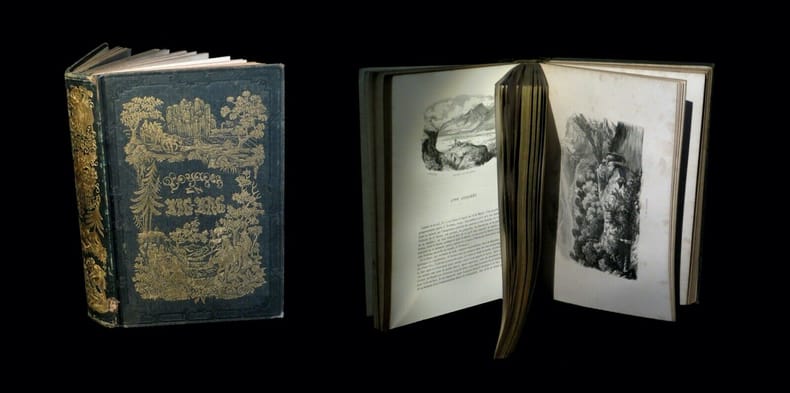
184622794Paris, chez J. J. Dubochet, 1846. Un fort vol. au format pt in-4 (273 x 178 mm) de 1 f. bl., 1 f. n.fol., 1 frontispice gravé n.fol., viii - 418 pp., 1 f. n.fol. et 1 f. bl. Reliure d'édition de demi-chagrin ébène, plats à l'imitation de chagrin dont chacun s'agrémente de filets stylisés et fleurons romantiques à froid, large composition figurative doré au centre, dos lisse à l'identique, lequel est agrémenté de filets gras à froid en tête et queue, titre doré, tranches dorées. (Haarhaus).
In-4°, legatura ottocentesca in mezza pelle con titoli su tassetto, pp. VIII-542(2). Circa trecento vignette nel testo, e 54 incisioni su tavole fuori testo. Mancanze al tassello e altre abrasioni al dorso; fioriture sparse. Nel complesso buon esemplare. Prima edizione di questo classico del grande autore svizzero.
Limoges, Eugène Ardant et Cie., s.a. (1898). Folio; 308 pp., 1 h., Con 109 viñetas del autor entre el texto. Encuadernación original en tela estampada con motivos florales, de corte modernista.
In-8° pp. XV-504, legatura in tela con titolo al dorso. con lievi scoloriture e vecchi timbri all'interno. Tomo IX delle opere.
19634588Couverture souple Editions du Revenandray 1963 Lausanne 21,5x16 cm
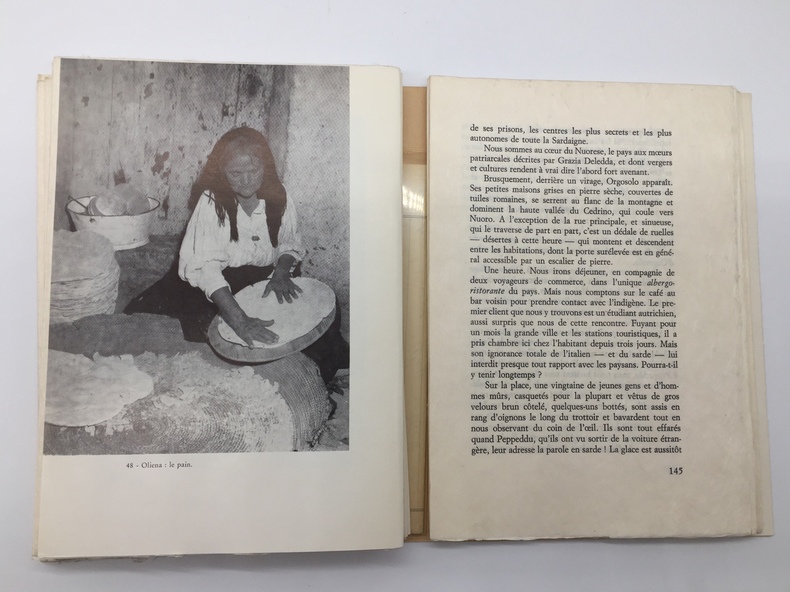
1983R160137788LA PALATINE. 20 AVRIL 1983. In-8. Cartonné. Bon état, Couv. convenable, Dos satisfaisant, Intérieur acceptable. 235 pages. Nombreuses photos en noir et blanc hors texte de Carlos FREIRE. Ouvrage de bibliothèque avec une couverture plastique transparente sur la couverture originale.Tampons de bibliothèque sur la page de titre. Une étiquette de code en pied du dos.. Avec Jaquette. . . Classification Dewey : 945-Italie
198375860La Palatine 1983 In-8. Reliure éditeur sous jaquette, 236 pp. Illustrations en noir. Jaquette un peu ternie, néanmoins intérieur frais, bon état d’occasion.
2003114912L’insulaire 2003 In-8 broché sous jaquette 24 cm sur 17. 590 pages. Jaquette en assez bon état. Bon état d’occasion.
78639aafParis, Garnier Frères, Libraires-Editeurs, s.d. (vers 1860), in-8vo, 418 p, rousseurs, reliure en demi-cuir et papier marbré. Charnière int. faible.
142189aafParis, Garnier Frères, Libraires-Editeurs, 1873, pt. in-8vo, frontispice + p. de titre + 418 p,, reliure en demi-cuir et papier marbré. Dos orné.
183227396n.p.: Original Manuscript 1832 1833 1834 1835. Original Manuscript in French of the travels by General Despans-CubiÄres to Italy over the course of four years. The text includes significant considerations of military affairs the mention and discussion of famous personages as well as historical observations and political affairs . 4to the manuscripts now bound into a binding of terra-cotta paper over marbled boards with a hand-calligraphed label to the upper cover and the titles in black to the spine panel. 534 pp. A fine and beautifully preserved collection of manuscripts written over four years. A UNIQUE AND INTERESTING MANUSCRIPT BY ONE OF THE MOST FAMOUS GENERALS IN ALL OF FRENCH HISTORY. 'Amédée Louis de CubiÄres was the illegitimate son of the Marquis Louis Pierre de CubiÄres page to Louis XV and squire to Louis XVI then in 1815 of Louis XVIII by Madame Guesnon de Bonneuil née Michelle Sentuary.<br> He served in the Austerlitz Prussian and Polish campaigns being mentioned in dispatches at Austerlitz and wounded at Jena 1806. Promoted to lieutenant on 30 November 1806 he received the cross of the Légion d'honneur at Eylau 1807. Aide-de-camp to general Morand from 12 January 1808 he followed him in the Austrian campaign of 1809 the French invasion of Russia in 1812 and the 1813 German campaign. He fought with distinction at Eckmühl and rose to captain at Essling 7 June 1809. He assisted at the battle of Wagram 6 July 1809 and had three horses shot from under him at the battle of Borodino. Napoleon I of France made him an officer of the Légion d’honneur in reward for his good conduct in the 1813 campaign in which he had become chef de bataillon promoted 3 October 1813.<br> On Napoleon's return from Elba in 1815 colonel de CubiÄres was made colonel Å• la suite to the 1st Light Infantry Regiment of which the titular colonel was Beurnonville. According to Jolyet Napoleon reviewed this regiment on the day after his arrival back in Paris on 21 March and asked who was its commander. CubiÄres replied "Sir it is colonel de Beurnonville ; but he is ill." Napoleon replied "Beurnonville is not sick - it is you colonel CubiÄres who shall nevertheless take command of the 1st Light Infantry". In 1815 Despans-CubiÄres fought with his regiment at Waterloo and was wounded at Quatre-Bras and at Mont-Saint-Jean.<br> According to Jolyet CubiÄres was "the most valiant soldier and the best man-of-war that I have known. With this he brought a remarkable beauty a brilliant spirit and a generous and independent love".<br> Promoted to commander of the Légion d’honneur 21 March 1831 he was made commander-in-chief of the French troops which landed at Ancona in the Papal States 9 February 1832 to occupy the town in reprisal for Austrian intervention at Bologna. Returning to France in 1837 with the rank of lieutenant-general he next became Minister for War in the 1839 transitional government 31 March-13 May 1839 then in Adolphe Thiers's second cabinet 1 March-29 October 1840. He attached his name to Paris's fortifications to the decision to write a history of all France's regiments since Francis I and to the organisation of the chasseurs of Vincennes. Made a peer of France on 7 November 1839 he took part in the discussions of the Chambre des pairs on taxes and roads before being raised to grand officer of the Légion d’honneur on 27 April 1840.<br> When the 1844 novel The Count of Monte Cristo was published - according to Librairie Générale Française 1995 its character of Fernand Mondego was inspired by general Despans-CubiÄres. On 17 August 1852 he won a decree of rehabilitation at the Court of Appeal at Rouen after an earlier trial on charges of corruption and was allowed to retire as a général de division on 1 January 1853 Original Manuscript hardcover
Due volumi di cm. 23, pp. xlviii (4) 370 (4); xix (1) 518 (4). Con un fac-simile ed illustrazioni f.t. Solida ed elegante legatura del tempo in mezza pelle con punte, dorsi a piccole punte con titoli in oro. Ottima conservazione e stampato su carta di qualità particolarmente buona. Esemplare appartenuto a Walter Ashburner con suo timbro di possesso. Quest'ultimo (1864-1936) fu professore di giurisprudenza a Oxford e tra coloro che, sul fronte inglese insieme a Edward Hutton, Herbert Trench, Lina Waterfield e altri, contribuirono a fondare la collezione del British Institute.
2 voll. In-8° (24 x 18 cm). XLVIII, 375 pp. 1 tav. doppia XIX, 518 pp. Mezza pelle coeva. Ottimo esemplare. Memorie dei viaggi compiuti dal filosofo e giurista francese, tra il 1727 ed il 1730 in numerosi paesi europei, Austria, Ungheria, Italia, Germania, Olanda e Inghilterra, contenute in manoscritti inediti custoditi nell'archivio familiare. Di grande interesse sono le annotazioni relative alle condizioni socio-economiche dei paesi visitati.
98261Roma, A. Marzi, 1910. 24 x 14, sans pagination, nombreuses illustrations en N/B, broché (agrafé), bon état.
11723Paris, Maradan, an VIII ; 6 volumes in-8 de VIII - (II) - 311pp. et 2 planches ; (4) - 280pp. et 3 planches dépliantes; (4) - 291pp.; (4) - 272pp.; 2 planches dépliantes; (4) - 309pp.; (4) - 215pp. Orné au total de 7 planches dépliantes.On a relié à la fin de l'Avertissement du traducteur, avant l'Introduction, un feuillet supplémentaire titré Avertissement des traducteurs (pages ntées V-VI), rétablissant ainsi la réalité de la traduction qui est également due à Amaury Duval.
3313PARIS, Plon - collection "Feux crisés, ames et Terres étrangères" - In-8 - Broché - 1928 - E.O., tirage limité sur alfa - Préface & Notes VII & 184 pages - Très propre
PARIS, Plon - collection "Feux crisés, ames et Terres étrangères" - In-8 - Broché - 1928 - E.O., tirage limité sur alfa - Préface & Notes VII & 184 pages - Très propre
49801Paris Gide fils, Libraire 1816 in 8 (22x13,5) 2 volumes reliures demi basane fauve de l'époque, dos lisse orné de faux nerfs dorés, pièces de titre et de tomaison de cuir noir (la pièce de tomaison du tome 2 est en partie manquante. Tome 1: 358 pages, avec 2 figures gravées hors texte. Tome 2: 381 pages [1], avec 2 figures gravées hors texte une carte gravée dépliante, trace de mouillure claire sur les 2 premiers cahiers, et auréole sur le bas de la marge interne du dernier cahier. John Mawe, 1764-1829. Jean Baptiste Benoît Eyriès, 1767-1846. Première édition française, traduite par Eyriès. Complet des 5 planches dont une carte dépliante. Bon exemplaire, tel quel ( Photographies sur demande / We can send pictures of this book on simple request )