1 286 résultats
br. Si innamorato: della vita, dell'idea del femminile, della sua città, del suo lavoro, del mondo,della gente,del leggere, della poesia ,di Dio... Non stiamo parlando di un ragazzo ignaro della vita e perciò carico di entusiasmante giovanile ottimismo, ma di un uomo maturo, un medico che si confronta quotidianamente con problematiche pesanti e che riesce, nonostante tutto, a cogliere intorno a sé tanta bella poesia.
Cm.17,5x25,9 + margini. Bella veduta panoramica animata. Non comune.
Immaginetta sacra in cromolitografia della Santissima Vergine del Rosario di Pompei. Al verso preghiera. Senza data ma dei primi del novecento. Resto di etichetta al verso. In buone condizioni. In 24. Dim. cm 11,5x7. Holy image of chromolytography of Very Holy Virgin of Rosario in Pompei. Not dated but of the first years of 1900. Piece of label in the verso. In good conditions.
guida con pianta della città, libro e video cassetta. book , maps and videocassette, new.
(Roma), E.N.I.T. - Ferrovie dello Stato, s.d., in-16, mz. tela edit., pp. (8), 43, (1), 24, 46, (2), 28, 48, 44. Numerose ill. in b.n. nel t. Testi, tradotti, di: P. Ducati, G. Calza, A. Maiuri, A. Marzullo.
1905GITg113Paris Secrétariat du Comité des Pélerinages en terre Sainte 1905. In-8 broché 14pp imprimées sur 2 colonnes (liste des pélerins Français et de diverses nationalités) 4 feuillets indépendants (programme du pélerinage, excursions, prix des places, dispositions spéciales, avis divers). 4 illustrations dans les feuillets de programme.
185847524Naples, 1858. Small 8vo. Contemp. modest hcloth. Handwritten titlelabel on spine. LVI,194 pp., 1 folded engraved plan (Maison de Marcus Lucretius) and 1 large folded lithographed plan of Pompei ""Nouveau Plan de Pompéi"". Internally clean and fine. Asmall stamp on titlepage.
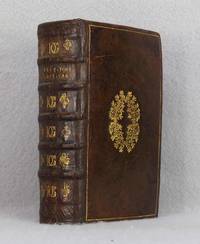
1583ST15026Paris: Arnold Sittart 1584; Heidelberg: Peter Santandrea 1583. 178 x 111 mm. 7 x 4 3/8". 14 p.l. cccix pp. 13 leaves last blank; lxxv 10 ccxvi 22 pp.; 2 leaves 84 pp.; 1 1-196 18 pp.; 62 pp. Two works in several parts bound in one volume. With annotations and commentary by Antonio Augustin Joseph Scaliger and Fulvio Orsini. <br/> Pleasing contemporary calf covers with central gilt wreath of olive branches raised bands spine panels gilt with cipher "D C G" at center flanked by a palmette and a vegetal trefoil gilt titling bottom panel with "OD" and "I8" on either side of the cipher. Printers' devices on the title pages decorative woodcut initials and headpieces. Front pastedown with what appear to be early library shelf markings; one page with neat early marginalia. Adams V-590 and F-390. Covers slightly marked spine with a bit of superficial crackling and with one short crack in the middle of bottom panel the text with faint browning and isolated minor soiling a few leaves with long shallow creases not affecting legibility otherwise in excellent condition the binding solid and without significant wear and the leaves generally clean fresh and smooth.<br/> <br/> This glossary of recondite Latin words and phrases was no doubt bound for a contemporary bibliophile with an extensive library. The "OD" and "I8" at the bottom of the spine appear to be the indication of a shelf location--not something frequently encountered on spines of this period. This designation and the location notation on the front pastedown that clearly relates to it "Arm. 0. Tab 4. Loc. 18" suggest a library of some complexity and an educated owner who believed in careful organization. While we have not been able to identify "D C G" she would seem also to have been a person of taste and good sense. The binding is attractively decorated while still being practical for scholarly use. The work itself has gone through a number of changes of fortune. The story begins when Verrius who lived in the time of Augustus compiled a valuable work full of information on everything from grammar to mythology. Unfortunately his text has been largely lost; the authentic fragments fill only the first few leaves of our volume. His work was epitomized by Festus a ca. third century scholar but Festus was not a very good epitomizer and to make matters worse all of his entries have been lost up to the letter "M." Luckily an epitome of the epitome from "A" to "Z" had been made by Paul the Deacon in the eighth century. Valuing the handbook for its information on the writing of correct Latin Renaissance scholars went to work on this puzzle in the 15th century and a first version of Paul was published by Zarotus in Milan in 1471. Later scholars published Festus and the great French classicist Joseph Scaliger 1540-1609 was largely responsible for bringing definitive order out of chaos. His scholarly edition reconstructs the work of Festus as far as one can filling in the gaps caused by missing pages in the manuscript with conjectures and rectified material from Paul. Peter Santandrea unknown
16135Paris, Petit Palais, janvier - mars 1973, 1 br., couverture illustrée. in-4 carré, 158 pages, texte sur 2 colonnes, illustrations, planches photos dont 1 en double-pages ;
1983LFA-126722488Un ouvrage de 70 pages, format 195 x 270 mm, illustré, relié cartonnage couleurs, publié en 1983, Splendeurs du Monde, bon état
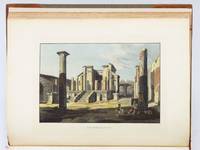
1824ST17496-014Zurich: by the author and Henry Fuessli and Comp 1824-25. FIRST EDITION. 445 x 325 mm. 17 1/2 x 12 3/4". 26 leaves of descriptive text. Lacking title page and dedication.Commentary by art historian Johann Jacob Horner. <br/> Modern tan half morocco over olive green buckram raised bands spine panels with gilt ornament red morocco label. 24 FINE AQUATINT VIEWS COLORED BY A CONTEMPORARY HAND. Brunet III 357. Text pages variably foxed from a little to very but somehow THE LOVELY PLATES IN FINE CLEAN CONDITION--fresh and bright with pleasing coloring in an unworn sympathetic binding.<br/> <br/> This is a rare complete colored set of Hüber's famed views of Pompeii much sought-after by armchair travellers after excavations uncovered that urban time capsule in the late 18th century. The German-born Hüber 1787-1871 settled in Naples in his early 20s studying landscape painting with Dutch émigré painter Jacob Philipp Hackert 1737-1807 who was known for his lush scenes often featuring ruins. His arrival in the region coincided with the occupation of Naples by the French who accelerated the excavations underway at Pomepii which had been buried by the eruption of Vesuvius in 79 A.D. The rapid burial of the city in volcanic ash had captured a moment in time and the opportunity to see a well-preserved example of life in the ancient Roman Empire caught in medias res drew eager travellers on the Grand Tour of the Continent. Hüber's well-executed views often picture these tourists and their contemporary dress contrasts sharply with the classical ruins. Lord Napier in his "Notes on Modern Painting at Naples" 1855 credits Hüber for introducing the use of watercolors to the meticulously drawn landscapes then being produced. This innovation is displayed in the hand-colored plates here which were also issued in uncolored state. Napier was correct to appreciate the value of adding colors which increases both the drama of the views and the pleasure of the viewer. Because the attractive sets with color were often broken up complete volumes of the colored plates are rarely seen for sale: we could trace just three such copies sold at auction as listed in RBH and ABPC the two best ones were the Feltrinelli copy which sold for $14330 in 2001 and the Donaueschingen copy fetching $13750 in 2014. Ours does not have the distinguished provenance attached to those copies and it lacks two preliminary leaves but the text is present and most important the lovely colored plates are in fine condition. by the author and Henry Fuessli and Comp unknown
Milano, Electa, 1993, 4to (cm. 28 x 20,5) brossura con copertina illustrata a colori, pp. 211 completamente illustrato in nero e a colori (in ottimo stato, firma di possesso) .
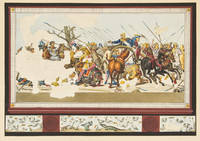
185056925Italian 1850. Each plate 8-1/2 x 10-1/2 in. and smaller is tipped to a larger sheet; two are entirely uncolored another only partially. 1 vols. Folio. Bound together in three quarter red morocco by Pawson & Nicholson Philadelphia with their ticket. Rebacked in goatskin original spine laid down inner hinges reinforced with period cloth. Each plate 8-1/2 x 10-1/2 in. and smaller is tipped to a larger sheet; two are entirely uncolored another only partially. 1 vols. Folio. A superb collection of lovely lithographed images which in many instances are so delicately and minutely colored as to be indistinguishable from watercolor drawings - and indeed several of them we believe to be entirely original drawings - each in the style of the ancient art of Pompeii in its frescoes geometric mosaics and ceramics. There are scenes of mythological figures e.g. a satyr cavorting with a goat; scenes of purely decorative nature suggestive of Pompeian vase art against a black gloss background; domestic scenes of husband wife and children; cupids; pastoral scenes; fish and game; and several images of an openly erotic nature suggestive of the relaxed style of Pompeiian attitudes toward nudity. unknown
182158446London: Roswell and Martin 1821. Second edition. Profusely illustrated with engravings maps and two folding plans. xxxi 275 pp. 1 vols. Thick 4to 25 x 16 cm. Three-quarter red morocco marbled boards ornate gilt spine t.e.g. Extremities rubbed portion of spine label chipped off some very faint foxing. Plates clean. Very Good. Second edition. Profusely illustrated with engravings maps and two folding plans. xxxi 275 pp. 1 vols. Thick 4to 25 x 16 cm. Roswell and Martin unknown
Milano, Treves, 1873, 24 agosto, articolo e una illustrazione a piena pagina, stralcio de "L'Illustrazione popolare". - !! ATTENZIONE !!: Con il termine estratto (o stralcio) intendiamo riferirci ad un fascicolo contenente un articolo di rivista, sia che esso sia stato stampato a parte utilizzando la stessa composizione sia che provenga direttamente da una rivista. Le pagine sono indicate come "da/a", ad esempio: 229/231 significa che il testo è composto da tre pagine. Quando la rivista di provenienza non viene indicata é perchè ci è sconosciuta. - !! ATTENTION !!: : NOT A BOOK : “estratto” or “stralcio” means simply a few pages, original nonetheless, printed in a magazine. Pages are indicated as in "from” “to", for example: 229/231 means the text comprises three pages (229, 230 and 231). If the magazine that contained the pages is not mentioned, it is because it is unknown to us.
Verona, 1935, 8vo brossura con copertina illustrata a colori, pp. 235 con num.me fig. col. n.t. (tutte di Pompei)
Milano, Treves, 1873, 23 novembre, articolo e due illustrazioni a piena pagina, stralcio de "L'Illustrazione popolare". - !! ATTENZIONE !!: Con il termine estratto (o stralcio) intendiamo riferirci ad un fascicolo contenente un articolo di rivista, sia che esso sia stato stampato a parte utilizzando la stessa composizione sia che provenga direttamente da una rivista. Le pagine sono indicate come "da/a", ad esempio: 229/231 significa che il testo è composto da tre pagine. Quando la rivista di provenienza non viene indicata é perchè ci è sconosciuta. - !! ATTENTION !!: : NOT A BOOK : “estratto” or “stralcio” means simply a few pages, original nonetheless, printed in a magazine. Pages are indicated as in "from” “to", for example: 229/231 means the text comprises three pages (229, 230 and 231). If the magazine that contained the pages is not mentioned, it is because it is unknown to us.
Milano, 1893, maggio 14, bella copertina litografica illustrata a colori in fascicolo originale completo di pp. 8 De “La Tribuna – Supplemento illustrato della Domenica”
Cinque vedute grandi e meno, seconda metà '800.
Quindici foto all'albumina, 1890 circa, su cartoncini rigidi di cm. 7 x 10,5 con angoli arrotondati. Tutte :
Foto all'albumina, 1880 circa, cm. 20 x 25 su cartoncino. N. 1294
Foto all'albumina, 1870 circa, cm. 20 x 25. N. 437
Foto all'albumina, 1880 circa, cm. 19,5 x 24,5 su cartoncino.