2 422 résultats
Dyveke Helsted, Henrik PeJacket very worn book O.K. unknown
0364773995.Ghardcover. Good. Access codes and supplements are not guaranteed with used items. May be an ex-library book. hardcover
0656511745.Ghardcover. Good. Access codes and supplements are not guaranteed with used items. May be an ex-library book. hardcover
1528557417.Gpaperback. Good. Access codes and supplements are not guaranteed with used items. May be an ex-library book. paperback
0260345946.Ghardcover. Good. Access codes and supplements are not guaranteed with used items. May be an ex-library book. hardcover
0260167223.Ghardcover. Good. Access codes and supplements are not guaranteed with used items. May be an ex-library book. hardcover
1397188693.Ghardcover. Good. Access codes and supplements are not guaranteed with used items. May be an ex-library book. hardcover
0260827819.Ghardcover. Good. Access codes and supplements are not guaranteed with used items. May be an ex-library book. hardcover
0265735289.Gpaperback. Good. Access codes and supplements are not guaranteed with used items. May be an ex-library book. paperback
0656166762.Ghardcover. Good. Access codes and supplements are not guaranteed with used items. May be an ex-library book. hardcover
1984ABE-516414282Milan: Electa 1984. 1984. 4to. pp. 150. 169 illus. numerous colour. wrs. dw. Exhib. Cat. F. Soft cover. [Milan]: Electa, [1984]. Paperback
A9781240067985Paperback / softback. New. paperback
B9781240067985Paperback / softback. New. paperback
0656512717.Ghardcover. Good. Access codes and supplements are not guaranteed with used items. May be an ex-library book. hardcover
0260087076.Ghardcover. Good. Access codes and supplements are not guaranteed with used items. May be an ex-library book. hardcover
191300284400Minneapolis Mn.: Rome G. Brown 1913 " Address before the Tennessee State Bar Association at its annual meeting at Memphis June 26 1913" Revised from Commencement Address before graduating class of the law school of the University of South Dakota given at Vermillion South Dakota June 11th 1913 24 pgs 9''x6''. 9''x6''. First Edition Third Printing. Soft cover. Very Good/No Jacket. Rome G. Brown paperback
0265261295.Ghardcover. Good. Access codes and supplements are not guaranteed with used items. May be an ex-library book. hardcover
133459354X.Gpaperback. Good. Access codes and supplements are not guaranteed with used items. May be an ex-library book. paperback
C--8510Brand New. Brand New! Fast Delivery US Edition and ship within 24-48 hours. Deliver by FedEx UPS & USPS and we do not accept APO and PO BOX Addresses. Order can be delivered worldwide within 7-12 days and we do have flat rate for up to 2LB. Extra shipping charges will be requested if the Book weight is more than 5 LB. This Item May be shipped from India. unknown
1104630265.Gpaperback. Good. Access codes and supplements are not guaranteed with used items. May be an ex-library book. paperback
1165925168.Gpaperback. Good. Access codes and supplements are not guaranteed with used items. May be an ex-library book. paperback
4877Engraved allegorical frontis. by Augustin Saint-Aubin. xxxii 299 5 pp. 8vo orig. wrappers uncut. Paris: Didot & Knapen 1773.<br/> <br/> First edition and a lovely copy in original state of an uncommon book; this is one of Romé’s first publications. It is a description “of the metallic ores of his own mineral cabinet in which he discussed the origin metamorphosis and paragenesis of each.â€â€“D.S.B. XI p. 521. Earlier he had catalogued the mineralogical curiosities in the cabinet of Pedro Francisco Davila and for several years found steady employment by preparing at least fourteen other mineralogical catalogues. In all the descriptions in the present work Romé stresses the importance of crystalline form and that this form is the chief characteristic by which minerals may be classified. <br/> <br/> Romé 1736-90 by formulating the law of constancy of interfacial angles established crystallography as the basis of mineralogy. <br/> <br/> The attractive frontispiece drawn by Saint-Aubin depicts two putti one examining ores under a microscope and the other stoking a furnace. Preserved in a box. <br/> <br/> â§ Yves Laissus “Les Cabinets d’Histoire Naturelle†in René Taton ed. Enseignement et diffusion des sciences en France au dix-huitième siècle p. 669–“un véritable manuel de minéralogie.†Schuh Mineralogy & Crystallography: A Biobibliography 1469 to 1920 4154–“Very scarce. In this collection catalog the famous French crystallographer fully describes about 750 metallic minerals from his own cabinet. Included are specimens consisting of pure metals as well as natural alloys and combinations with sulfur. Basic division is based upon the principle metals and semi-metals contained in the described specimens and include gold silver copper iron tin lead mercury antimony zinc bismuth cobalt arsenic and sulfur. Under each of these headings the specimens are divided based upon their form and chemical composition. For each item described notes on the origin associated minerals locality size and the estimated weight of contained precious metals is presented. The catalog is well referenced and if a particular specimen was given to Romé the supplier’s name is included in the description.â€. unknown
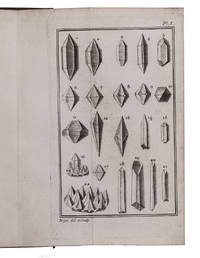
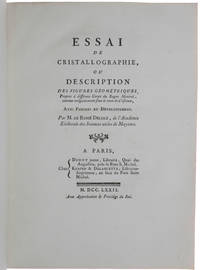
1772899Paris: Didot Jeune; Knapen & Delaguette 1772. <br /> <br /> A landmark work in the history of mineralogy and crystallography by Jean-Baptiste Louis Romé de l'Isle 1736-1790 one of the principal founders of scientific crystallography. Published in Paris in 1772 Essai de Cristallographie represents one of the earliest systematic attempts to classify minerals according to the geometry of their crystal forms rather than solely by chemical composition or external appearance. Romé de l'Isle sought to demonstrate that crystals obey fixed geometric laws helping establish crystallography as a rigorous scientific discipline during the Enlightenment. The work discusses numerous classes of crystals including quartz mica feldspars zeolites metallic crystals pyrites and gemstones accompanied by detailed geometric analyses and descriptions.<br /> <br /> Particularly notable are the engraved folding tables and plates illustrating crystal forms polyhedra and geometric developments. These illustrations provided one of the earliest visual systems for understanding mineral structures and became highly influential among eighteenth-century natural philosophers mineralogists and geologists. The volume includes an extensive bibliography of earlier authors on crystallization and mineralogy reflecting Romé de l'Isle's attempt to synthesize contemporary scientific knowledge. Also present is an attractive engraved armorial bookplate of Lord Sandys adding desirable provenance and evidence of ownership by an eighteenth-century British noble family. A highly important scientific work that marks the transition from descriptive mineralogy to the quantitative study of crystal geometry.<br /> <br /> Condition & Binding: Bound in contemporary full calf with gilt roll-tooled borders marbled endpapers and all edges gilt. Binding remains attractive and solid showing moderate rubbing scuffing and wear to boards corners and spine. Spine lettering has largely faded though decorative tooling remains partially visible. Internally remarkably clean and bright for the period with light scattered foxing and occasional minor spotting. Folding engraved plates and the large folding crystallographic table appear present and in very good condition with no significant tears observed in the supplied photographs. Overall- very good. Didot Jeune; Knapen & Delaguette unknown
1772L3LEN89INLTKParis 1772. 8vo. Didot Knapen & Delaguette Contemporary mottled calf gold-tooled spine with red title-label red edges marbled endpapers. With 2 folding letterpress tables and 10 folding engraved plates I-X. XXXII 427 2 1 blank pp. First edition of an influential work on geometrical crystallography by the French mineralogist Jean-Baptiste Louis Romé de l'Isle 1736-1790 one of the founders of modern crystallography. "In 1772 he published his first important technical work a one volume essay on crystallography in which he identified 110 crystal forms. This was a major expansion upon the work of Linnaeus . The Essai made Romé de l'Isle a prominent name among Parisian scientists of his day" Wilson. Romé is best known for his "law of constancy of interfacial angles" now the first law of crystal habit. The preliminaries contain an annotated bibliography by the author of the principal works on crystals. The plates depict numerous crystal forms as well as some geometric figures.Occasionally some very faint foxing or a small spot. Binding only slightly rubbed along the extremities. Overall in very good condition.l Hoover 2681; Ward & Carozzi 1906; Wilson The history of mineral collecting p. 52. unknown
17725371Paris: Didot jeune and Knapen & Delaguette 1772. First edition. <p>First edition a magnificent and very rare large paper copy both larger and printed on thicker paper than the octavo issue of one of the fundamental works of modern crystallography; it appeared 12 years before Haüy's Essai d'une Théorie sur la Structure des Cristaux. "Very scarce. The Cristallographie ranks as one of the great contributions to the science of crystals. In it Roméde L'Isle attempted to make a comprehensive classification of crystals" Schuh.</p>. A FUNDAMENTAL WORK OF MODERN CRYSTALLOGRAPHY - VERY RARE LARGE PAPER COPY. <p>First edition a magnificent and very rare large paper copy both larger and printed on thicker paper than the octavo issue of one of the fundamental works of modern crystallography; it appeared 12 years before Haüy's Essai d'une Théorie sur la Structure des Cristaux. Romé de L'Isle established that various shapes of crystals of the same natural or artificial substance are all closely related to each other. Measurements he took with a goniometer enabled him to determine that the angles between corresponding faces of a crystal are always the same which earlier had only been described in specific cases in particular by Niels Steno this is often described as the first law of crystallography. In addition he demonstrated that these angles are a characteristic of mineral type introduced the concept of truncation and also enlarged the crystallographic vocabulary. He "identified 110 crystal forms drawing upon Linnaeus who had listed forty and described in minute detail the minerals that exhibited them. He subdivided the various substances into salts stones pyrites and metallic minerals stating that he agreed with Linnaeus that geometrical form is the chief characteristic by which minerals may be classified. Also like Linnaeus he held that saline principles imprinted their own geometrical form upon the earthy constituent of each mineral" DSB. "Very scarce. The Cristallographie ranks as one of the great contributions to the science of crystals. In it Romé de L'Isle attempted to make a comprehensive classification of crystals. By the time he wrote his volume he was extremely familiar with the subject and this work greatly surpassed all previous works in scope and detail. To apply his classification he adopted a morphological approach in which he attempted to relate the diverse forms of crystals of the same substance. As a general morphological concept he introduced the idea of the 'primitive form'. All crystals of the same inorganic substance no matter how different in appearance had a fundamental and common geometrical form - the primitive form - to which their actual crystal shapes related . In this first edition of the Cristallographie Romé de L'Isle identifies 110 crystal forms by which minerals crystallize. Grouped under each of these shapes are describe the minerals that exhibit similar habits including the approximate angles between crystal faces. These forms were all derived from a common saline ingredient in every mineral that worked at a molecular level" Schuh. Pages xii-xxviii contain an annotated bibliography of the principal works on crystals. The only large paper copy listed by ABPC/RBH is the Norman-Freilich copy but our copy is significantly larger than even that copy 265 x 205mm versus 249 x 193mm.</p> <br /> <p>"Romé the son of a lieutenant in the cavalry studied humanities at the Collège Ste. Barbe in Paris. In 1756 he entered the Royal Corps of Artillery and Engineering which he accompanied as a secretary to the French Indies in the following year. From 1758 until 1761 he was in the enclave of Pondicherry French India. When it fell to the English in 1761 Romé was taken prisoner and transported to China where he stayed until 1764 when he returned to France" DSB. </p> <br /> <p>"Romé de L'Isle had started collecting minerals during his travels as a naval officer. Back in Paris after the Indian Wars he was introduced into mineralogy by the apothecary chemist and mineralogist Balthazar Georges Sage 1740-1824 who became his friend. It was very fashionable at the time in Paris to have a mineral collection. The owner of an important private collection Pedro Francisco Davila wanted to sell his. At Sage's suggestion he asked Romé de L'Isle to draw up the inventory. Romé made a very thorough job of it the inventory running up to three thick volumes. This was his first work on mineralogy published in 1767 Catalogue systématique et raisonné des curiosités de la nature et de 1'art qui composent le cabinet de M. Davila. It gave him the opportunity to study crystalline forms in detail and led to his Essai de Cristallographie 1772 .</p> <br /> <p>"The context of the time was not very favourable for such studies for had not the famous French naturalist Buffon written in his Natural history of Minerals volume 1 1783: 'One has pretended that rhombohedra constitute a specific character of calcareous spar without being attention to the fact that some vitreous or metallic substances also crystallize in rhombohedra and that if calcareous spar does crystallize often in rhombohedra it also takes different other forms; and our crystallographers when trying to borrow from geometricians the way to transform a rhombohedron into an octahedron a pyramid or a lens have done nothing more than substitute ideal combinations to the real facts of Nature. This crystallization in rhombohedra like all others will never have a specific character. Not only is there no crystalline form common to different substances but conversely there are few substances which do not present different crystallization forms as shown by the prodigious variety of forms of calcareous spar itself' .</p> <br /> <p>"In the preface Romé noted that 'of the curious phenomena of the mineral kingdom those which struck him most were the regular and constant forms taken by some bodies designated by the name of crystals.' He was encouraged by the works of Linnaeus he added to undertake the study of the angular forms of crystals and of their transformations. Their polyhedral shape was only known from the Ancients only for quartz diamond and a few others and Romé widely extended this observation. Minerals were divided by him into four classes: salts stony pyritic and metallic. For each mineral the most frequent forms observed are described with a reference to Linnaeus's classification in Systema naturae . Steno's ideas relative to the growth of quartz layer by layer are quoted at length and Romé de L'Isle felt that they could be applied to all crystals. The book was a success acclaimed by Linnaeus himself and brought international fame to Romé de L'Isle . The importance of Romé de L'Isle's work was stressed by Haüy who wrote Leçons de Physique 1795: 'To the exact descriptions he gave of the crystalline forms he added the measure of the angles and which was essential showed that these angles were constant for each variety. In one word his crystallography was the fruit of an immense work almost entirely new and most precious for its usefulness.'</p> <br /> <p>"Romé de L'Isle was also the first mineralogist to give a rational description of twins . He described for instance the dovetail twin of gypsum and the feldspars twins. He introduced the term macle to designate a crystal in which 'one half is produced by the inversion in the opposite sense of the other half of the same crystal' - a property which he demonstrated by the concordance of angles" Authier pp. 313-6. </p> <br /> <p>"Romé's friendship with Sage brought him membership in a number of learned societies including the academies of Mainz Stockholm Berlin and St. Petersburg. But it did him no service with the Paris Académie des Sciences which rejected him on the ostensible grounds that he was a mere 'catalogue maker.' It is likely that Romé's controversies with Buffon also played a part in his rebuff by the Academy" DSB.</p> <br /> <p>Freilich sale 460; Hoover 2681; Norman 1847; Schuh Mineralogy & Crystallography: A Bibliography 1469 to 1920 4151; Ward & Carozzi 1906; Wellcome IV p. 553. Authier Early Days of X-ray Crystallography 2013. </p> <br/> <br/> 4to 265 x 205 mm pp. v viii-xxxii 427 3 including half-title with 2 folding letterpress tables and 10 folding engraved plates. Contemporary calf spine gilt in compartments with red morocco lettering-piece red edges. Didot jeune and Knapen & Delaguette unknown