9 236 résultats
168880629London: for James Knapton 1688. First Edition in English. Small 4to 21cm. Later marbled paper-covered boards with gilt morocco spine label; vi70pp. Mild external aging and wear; text quite fresh a few leaves trimmed close at top edge but with no loss of printed area; easily Very Good. A most attractive copy. <br /> <br /> A celebrated account of suffering under the Portuguese Inquisition. Dellon a French medical doctor and naturalist settled at Daman on the western coast of India around 1673 where he began a private medical practice. Within a year he was taken prisoner by the Inquisition accused among other crimes of blaspheming against the adoration of the crucifix. He was transported to Goa where he was held for two years under harsh conditions before being shipped to Lisbon where he was finally released in 1675. This account of Dellon's sufferings first appeared in Leiden 1687; in Paris a year later then rapidly went into English German and Dutch translations. Howgego: "Although long regarded purelyi as a work of propaganda recent research has testified to its accuracy." HOWGEGO I:304. WING D941. for James Knapton unknown
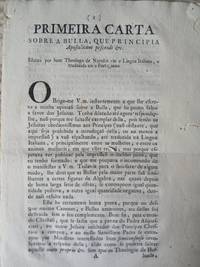
GD87<p>Cartas aprócrifas críticas ao 'Apostolicum pascendi'" de 1765 em defesa dos Jesuítas provavelmente escritas a mando do Marquês de Pombal para se contrapor à defesa do papa Clemente XIV dos jesuítas. Raríssima publicação. Nenhum exemplar registrado no Brasl. 44 páginas. Século XVIII. Impressão original com marcas d ´água. Documento foi periciado por aquivo público e foi constatada sua autenticidade e que sua origem não provém de nenhum arquivo público. Coleção Graphos Arte.</p><p>Apocryphal letters critical of the 'Apostolicum pascendi'" from 1765 in defense of the Jesuits probably written at the behest of the Marquis of Pombal to counter Pope Clement XIV's defense of the Jesuits. Very rare publication. No copy registered in Brazil. 44 pages. 18th century. Original print with watermarks. Document was examined by public archive and its authenticity was confirmed and that its origin does not come from any public archive. Graphos Arte Collection.</p>
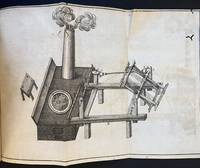
17874368Lisbon: press of the Royal Academy of Sciences 1787. Narrow 4to 209 x 118 mm. 8 xiii 3 175 pages. Title-leaf fol. 2 present in duplicate. Folding engraved plate of a mechanical silk loom; titles with woodcut arms of the Portuguese Royal Academy of Sciences woodcut and typographic headpieces occasional slight discoloration small wormtrack in the folding plate. Contemporary cat’s-paw polished sheep covers with gilt border spine in six gold-tooled compartments the second gilt lettered edges gilt and gauffered recased endpapers renewed defect in top spine compartment a dozen small wormholes. Provenance: António Romão dos Passos 1866-1951 signature in ink Antonio Passos / agronomo or Anto R. Passos scrawled across both titles the first with price note and on six text leaves. <br /> <br /> Only edition of a comprehensive overview of the Portuguese silk industry by the judicial magistrate of the Moncorvo district and author of several works on political economy and history of law. José Antonio de Sá d. 1819 a native of Bragança was an important proponent of modernization of the industry and later served as director of the Royal Silk Factory Real Fábrica das Sedas founded in 1802 in Lisbon. He was one of the earliest members of the Academia Real das Sciencias of Lisbon.<br /> <br /> Silkworms were raised in Portugal as early as the 13th century. Sericulture and silk production were concentrated in the northeastern province of Trás-os-Montes its largest center being the city of Bragança which from the 15th to 17th century was known throughout Europe for its luxurious velvets. Because of the lack of government support for industry frequent wars and above all the persecutions of the Inquisition which decimated an industry in all sectors of which Jews or converted Jews cristãos-novos played a major role Portuguese silk production suffered from intermittent crises and was even periodically decimated. Starting in the 1770s efforts to revive the industry began to have an effect: <br /> <br /> “By the end of the 18th century the Trás-os-Montes silk industry had dragged itself out of the crisis that had begun in 1750-1755 coinciding with the last incursion of the Inquisition into Bragança and embarked upon a period of great development accompanying the industrial expansion that was then taking place not only in that particular region but throughout the Portuguese kingdom. After the Inquisition’s systematic persecution of businessmen weavers and throwers had finally come to an end the continuity and expansion of the silk industry seemed to be a viable prospect. In the last two decades of the 18th century a remarkable process of modernization took place thanks to the efforts of the businessmen involved in this economic activity such as António José Lopes Fernandes who installed 200 silk looms in Bragança magistrates such as José António de Sá and Pereira de Barros and politicians such as Martinho de Melo e Castro and Rodrigo de Sousa Coutinho the latter being the Portuguese ambassador to Piedmont Italy. These efforts included the adoption of Piedmontese methods and techniques namely the organzine mill and the spinning-jenny the most advanced ones at that time in Europe in an operation led by experts coming to Portugal from that Italian region.†Sousa p. 6<br /> <br /> Sá’s work is in three parts. The first part comprises an overview of the history of silk production starting with Antiquity and summaries of the industry and government policies toward it in other countries followed by a detailed recommendation with responses to projected objections that the Portuguese government undertake a campaign to plant mulberry trees and promote the industry generally. Part two is a treatise on the silkworm and part three a technical survey of “the art of silk spinning.†Explained in the text pp. 142-148 is the letter- and number-keyed engraving of a rather fanciful machine showing a vat for softening the cocoons heating on the left from which a thread-unwinding mechanism feeds a loom on the right. <br /> <br /> The reason for the duplicated title-leaf in this copy is not clear. Perhaps one functioned as an upper wrapper — but as both titles are preceded by a half-title that appears unlikely. The book collector Antonio Romão dos Passos b. February 28 1866 was an engineer and agronomist. Other books from his library all on practical subjects are recorded; four are digitized by the Biblioteca Nacional Digital de Portugal. One a treatise on hemp has a similar indelicately scrawled signature across the title. <br /> <br /> OCLC gives six US locations. Innocencio Diccionario bibliographico portuguez IV: 246 no. 2658; Kress Luso-Brazilian Economic Literature Before 1850 p. 4. Cf. F. Sousa “The Silk Industry In Trás-Os-Montes During The Ancient Regime†E Journal of Portuguese History Vol. 3 no. 2 Winter 2005 digitized. press of the Royal Academy of Sciences unknown
1862R98154Paris, Louis Vivès 1862-1868 Ouvrage tout complet en 22 tomes, ensemble +/- 12.000 pp., 23cm., texte en Français, reliures cart. uniformes en très bon état (dos en velin blanc, pièces de tomaison rouges avec titre doré), texte frais avec très peu de rousseurs, cachet (surtout sur les fausses pages de titre et au verso des p.d.t.), volume 22 contient "Table générale des matières", bon ensemble, poids: 20kg., [Louis de Grenade O.P., 1505 Grenade (Espagne), +1588 Lisbonne, théologien et prédicateur], R98154
Ouvrage tout complet en 22 tomes, ensemble +/- 12.000 pp., 23cm., texte en Français, reliures cart. uniformes en très bon état (dos en velin blanc, pièces de tomaison rouges avec titre doré), texte frais avec très peu de rousseurs, cachet (surtout sur les fausses pages de titre et au verso des p.d.t.), volume 22 contient "Table générale des matières", bon ensemble, poids: 20kg., [Louis de Grenade O.P., 1505 Grenade (Espagne), +1588 Lisbonne, théologien et prédicateur], R98154
37933Paris,chez Denné jeune en 1797. 2 vols.in-8 en reliure d'époque. Voyage à travers les Provinces d'Entre-Douro et Minho, de Beira, d'Estramadure et d'Alenteju, dans les années 1789 et 1790. Contenant des Observations sur les Moeurs, les Usages, le Commerce, les Edifices publics, les Arts, les Antiquités, ... de ce Royaume. Ouvrage en français traduit par Jacques Murphy. 23 planches dépliantes. 218 et 290 pages. Bon exemplaire avec qques rousseurs et mouillures.
17388764Amsterdam, H. du Sauzet, 1738. 2 tomes en un volume in-12 de [8]-228; [4]-241-[3] pages, plein veau brun, dos à nerfs orné de filets et fleurons dorés, pièce de titre beige, roulette dorée sur les coupes, tranches rouges. Coins à peine frottés, tache d'encre p. 63 du tome 2.
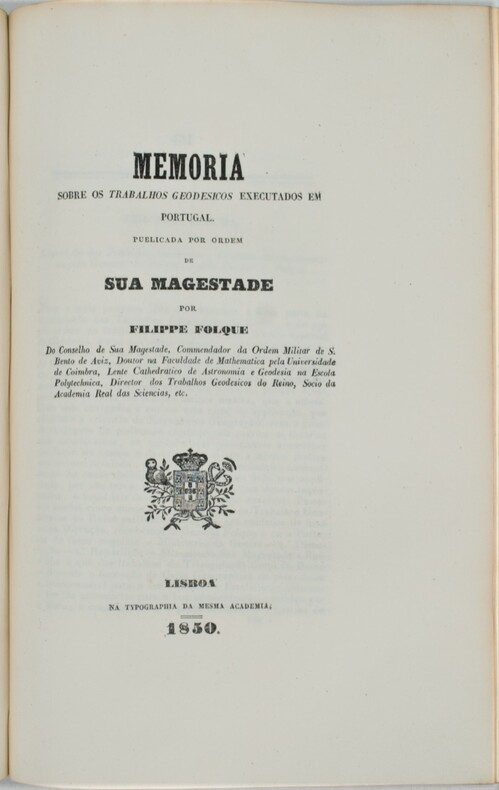
1841PHO-1220Lisboa. Na Typografia da Academia Real das Sciencias. 1841-1852 , grand et fort in-4 (31x22) ,de 859pp. (1841;3ff-1-166pp,1849;2ff-167-490pp,1850;1f-491-656,1852;657-859pp) et illustré de 8 cartes et planches dépliantes (certaines brunies),relié demi veau , dos orné avec auteur et titre , ex-dono manuscrit au titre à Vincendon-Desmoulin (cartographe de Dumont d’Urville sur l’Astrolabe), cachet .
1376255London: Printed for the Oriental Translation Fund of Great Britain and Ireland, John Murray and Parbury, Allen & Co., 1833 in-8, xvi (la pagination commence à la page VI mais l'ouvrage est bien complet)-181 pages. Reliure percaline verte d'édition, pièce de titre imprimée au dos, bel exemplaire. Première traduction en anglais du Tohfut-ul-Mujahideen, écrit à la fin du 16e siècle, en réaction aux attaques des Portugais contre les musulmans de la côte de Malabar.
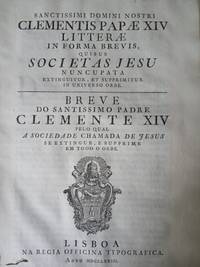
GD86<p>Breve do Santíssimo Padre Clemente XIV pelo qual A Sociedade Chamada de Jesus Se extingue e suprime em Todo Orbe. Publicado por Na Officina Typografica Lisboa Primeira edição Portuguesa. 1773 . Muito raro. Documento de grande importância histórica. Textos em latim e português 46 páginas. Impressão original com marcas d ´água. Documento foi periciado por aquivo público e foi constatada sua autenticidade e que sua origem não provém de nenhum arquivo público. Coleção Graphos Arte.</p><p>Brief of the Most Holy Father Clement XIV by which the Society Called Jesus is extinguished and suppressed throughout the World. Published by Na Officina Typografica Lisbon First Portuguese edition. 1773 . Very rare. Document of great historical importance. Texts in Latin and Portuguese 46 pages. Original print with watermarks. The document was examined by a public archive and its authenticity was confirmed and that its origin does not come from any public archive. Graphos Art Collection.</p>
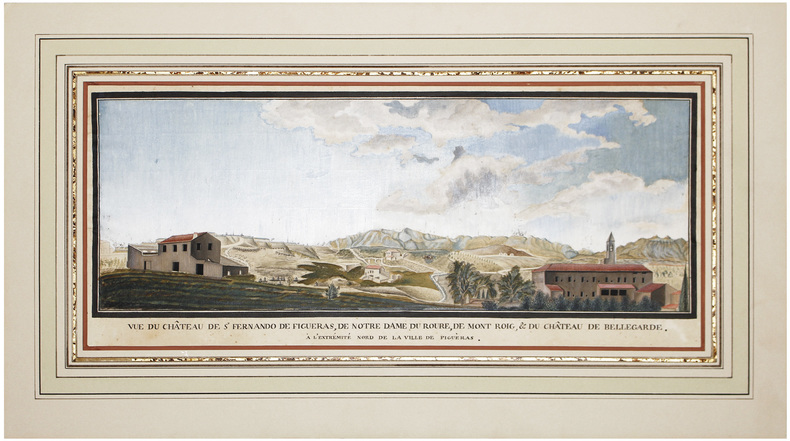
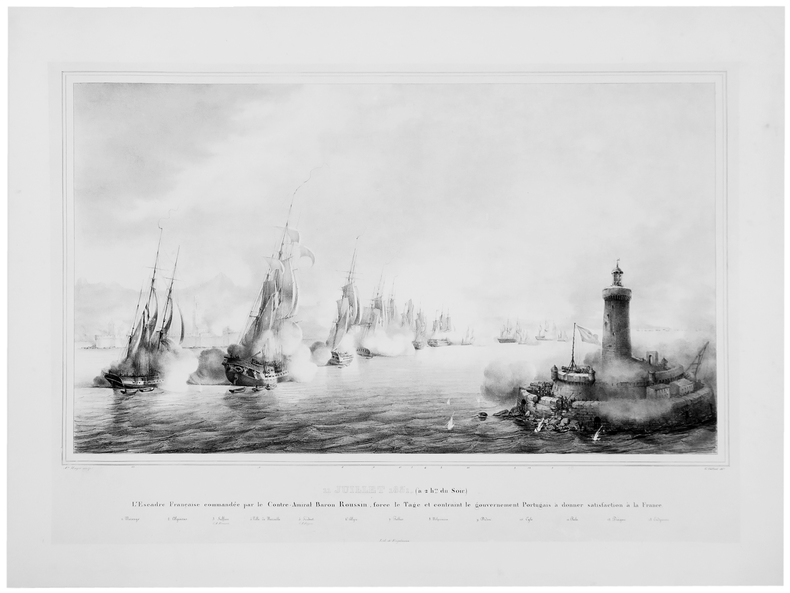
1794LBW-6573[1794 ?]. 20,5 x 46,5 cm ; monté sous passe-partout.
182212181Lisboa: Impresa Nacional 1822. Lisboa Imprensa Nacional 1822. En 8º mayor. 100 pp. Encuadernación en cartoné tejuelo de piel en el plano superior con letrerÃa dorada. Primera edición de la primera Constitución Portuguesa votada en Cortes extraordinarias y constituyentes el 23 de Septiembre de 1822 y aceptada por el rey D. João VI en octubre del mismo año. Considerada como un triunfo de los liberales contenÃa 240 artÃculos en su mayorÃa inspirados cuando no directamente copiados de la constitución española de 1812: cesión de soberanÃa al pueblo e independencia de los poderes legislativo ejecutivo y judicial. Esta es la Constitución que los Andradas y otros diputados brasileños se negaron a firmar. Bien acogida en un principio por los brasileños supuso al final el detonante de la independencia de Brasil. Varios dÃas antes de la publicación del "Suplemento" en Lisboa las Cortes declararon el gobierno brasileño subordinado a la constitución lo que fue rechazado por los representantes brasileños quienes comandados por Andradas declararon la independencia de Brasil en 1822. Inscripción en tinta en la portada ligeras manchas ocasionales papel ligeramente tostado. Impresa Nacional unknown
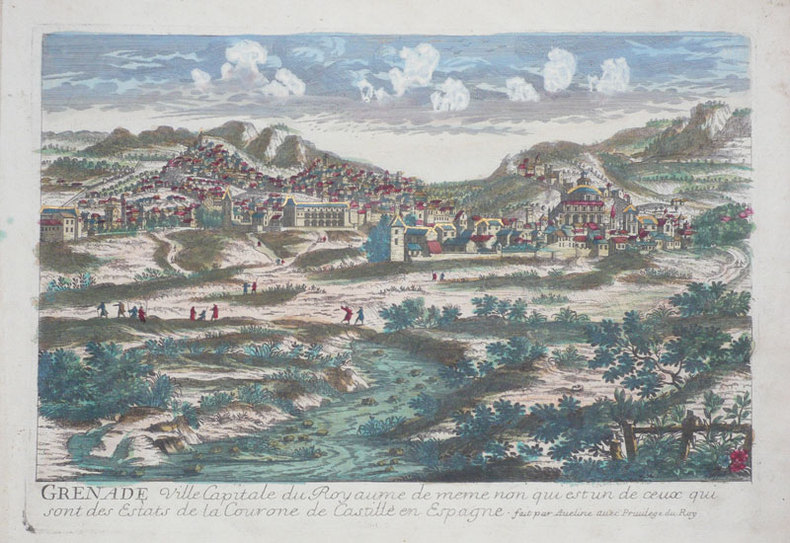
1690LBW-946[circa 1690]. 215 x 313 mm.
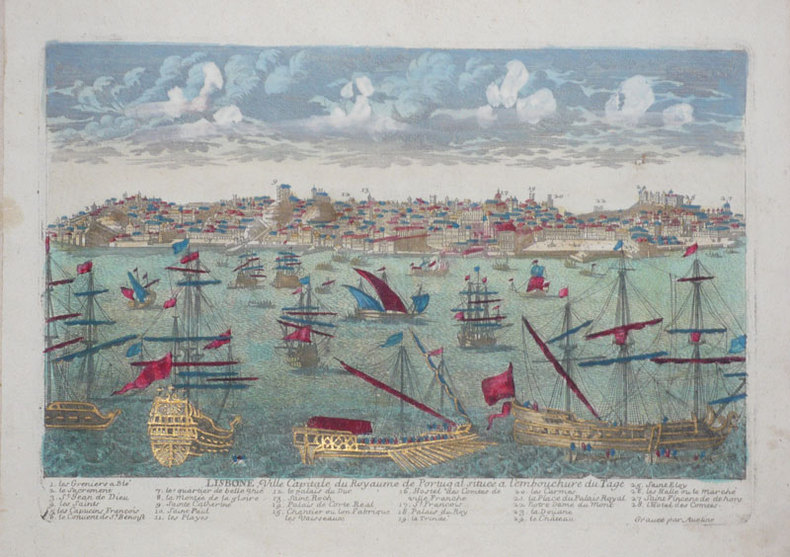
1690LBW-945[circa 1690]. 210 x 305 mm.
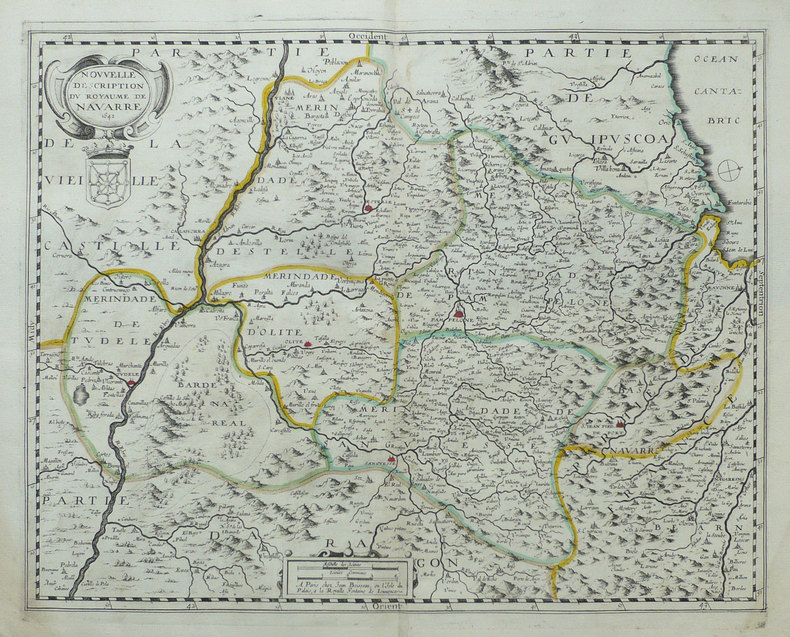
1642LBW-1490Paris, 1642. 375 x 480 mm.
1742208961742 Au Havre de Grace chez la Veuve de Guillaume Gruchet, Imprimeur & marchand libraire 1742; Avec privilege du Roy, IN8 reliure moderne demi chagrin tabac a coins,dos a nerfs,exemplaire rogné ,court de marge,(4) ff., 415 pp., + table non chiffrée,19 pp., nombreuses figures de contours et 68 cartes gravées sur bois dans le texte.Complet,mouillures claires en bas de quelques dizaines de feuillets,quelques ratures anciennes dans l’epitre,sinon frais,.rare edition.
In-12°, raccolta di dieci opuscoli, legatura in pelle coeva, nervature e tassello e titolo in oro al dorso, tagli in rosso, buona copia, ex libris alla carta di guardia di contropiatto superiore. 1) Relaçaõ abbreviada da Republica, que os Religiosos Jesuitas das Provincias de Portugal, e Hespanha, estabeleceraõ nos Dominios Ultramarinos das Duas Monarchias...Relation abregée concernant la République...pp.68 2) Recueil de pièces, pour servir d’addition & de preuve à la Relation abregée concernant la République établie par les Jésuites dans les Domaines d’outre mer...XV, 91; 3) Second recueil de pieces, concernant les usurpations des Jésuites dans l’Amérique espagnole & portugaise...40pp; 4) Mémoires pour servir d’addition & d’éclaircissement à la relation abregée, &c. qu’on vient de donner au public, sur l’abominable conduite des Jésuites, dans les pays & domaines d’outre-mer dépendans des Royaumes d’Espagne & de Portugal...30pp; 5) Lettres en forme de bref, de N.S. P. le Pape Benoist XIV, par lesquelles, de son propre mouvement, il établit & constitue l’Eminentissime et Reverendissime François de Saldanha, Cardinal Diacre de la Sainte Eglise Romaine...(1), 24pp; 6) Decret du Card. Saldanha, pour la réforme des Jésuites de Portugal & des domaines qui en dépendent. Du 15 mai 1758 (trad. Pierre Olivier Pinault) (1), V, 2-17; 7) Lettre de Monsieur l’Archevêque d’Utrecht à un ecclésiastique de France: au sujet des affaires présentes de l’Eglise...31pp; 8) Très-humbles et très-respectueuses remontrances que présentent au Roi, notre très-honoré & Souverain Seigneur, le gens tenans sa Cour de Parlement de Normandie...42pp; 9) Très-humbles et très-respectueuses remontrances que présentent au Roi, notre très-honoré & Souverain Seigneur, le gens tenans sa Cour de Parlement à Rouen...34pp; 10) Discours prononces dans l’Academie Françoise, le lundi 10 Mars 1760 a la reception de M. Le Franc de Pompignan...27pp Si tratta di una raccolta di opuscoli di vario soggetto, i primi sei dei quali riguardano la cattiva gestione dei gesuiti nei territori spagnoli e portoghesi d’oltremare e le relative lettere di lagnanze dirette alle autorità ecclesiastiche, l’intervento di Benedetto XIV in proposito con la nomina di Francisco De Saldanha a cardinale di Lisbona e la riforma della Compagnia di Gesù in Portogallo ad opera di questi. Il settimo opuscolo è una lettera scritta dall’Arcivescovo di Utrecht ad un ecclesiastico francese ignoto, in cui il prelato tratta delle questioni correnti nella Chiesa, tra cui il giansenismo. Gli opuscoli ottavo e nono sono rimostranze che il Parlamento normanno indirizzò a Luigi XVI riguardo l’imposizione di nuove imposte, mentre l’ultimo opuscolo è il discorso d’insediamento tenuto da Monsignor Le Franc de Pompignac davanti all’Accademia di Francia e il discorso in risposta a questo tenuto da M. Dupré de Saint Maure, Presidente dell’Accademia. In-12 °, collection of ten pamphlets, contemporary calf binding, bands, label and gilt title on the spine, red edges, good copy, ex libris on the endpaper (back side). It is a collection of pamphlets of various subjects, the first six of which concern the mismanagement of the Jesuits in the Spanish and Portuguese overseas territories and the related letters of complaints addressed to the ecclesiastical authorities, the intervention of Benedict XIV in this matter with the appointment of Francisco De Saldanha as cardinal of Lisbon and the reform of the Society of Jesus in Portugal made by him. The seventh pamphlet is a letter written by the Archbishop of Utrecht to an unknown French clergyman, in which the prelate deals with current issues in the Church, including Jansenism. The eighth and ninth pamphlets are grievances that the Norman Parliament addressed to Louis XVI regarding the imposition of new taxes, while the last pamphlet is the inauguration speech given by M. Le Franc de Pompignac before the French Academy and the speech in response to this given by M. Dupré de Saint Maure, President of the Academy.
175641867A La Haye, chez Philanthrope, 1756. In-12 de X-216 pp., cartonnage d'attente couvert d'un papier imprimé de réemploi.
In-4°; cc.14 (di cui la seconda è bianca), 365 carte num. Capilettera incisa su legno. Marca tipografica al frontespizio (In cornice fig.: una stella cometa con sette stelle tra le punte. Intorno alla coda nastro con il motto: Inter omnes.) . Manca ultima carta con timbro tipografico. Note manoscritte di possesso, datate 1740 e 1926. piccoli segni di tarli nell’ultime carte e macchie di umidità. Legatura in pergamena.
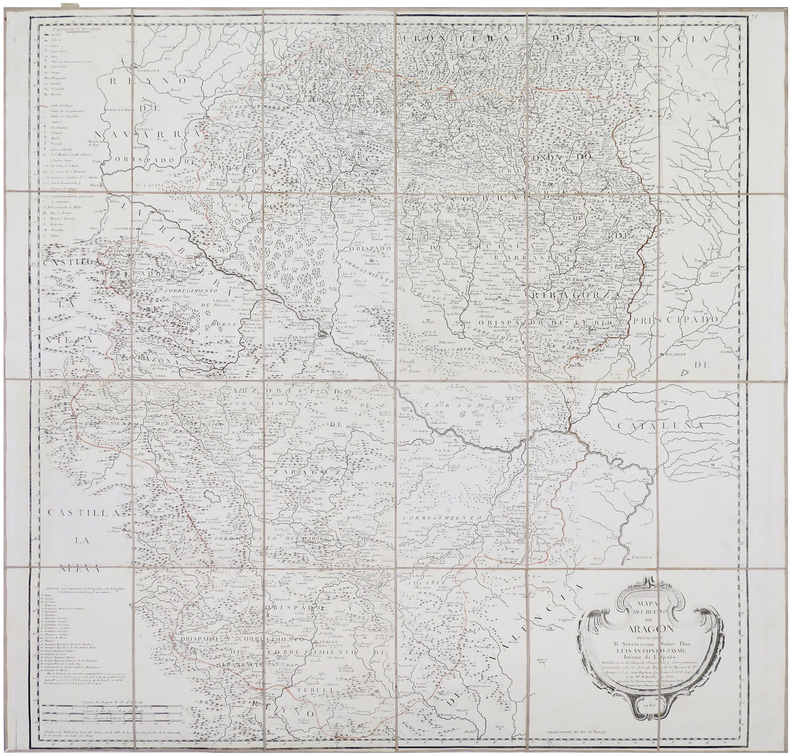
1765LBW-8661Madrid, 1765. En 24 sections montées sur toile et repliées, formant une carte de 805 x 832 mm ; étiquette de l'éditeur parisien Charles Picquet au dos, onglet de vélin numéroté en manuscrit.
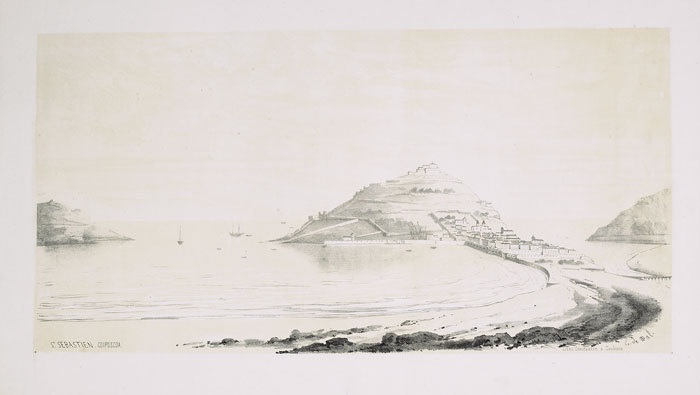
1843LBW-653Toulouse 1843 230 x 455 mm.
1750LBW-4129[circa 1750]. 362 x 506 mm.
XXX, (2) pp. ; in- 4° (36x23 cm), Graziose calcografie al frontespizio, all’incipit (firmata Angelo Campanella) e al colophon. Su carta forte, estremamente marginoso e ben conservato.
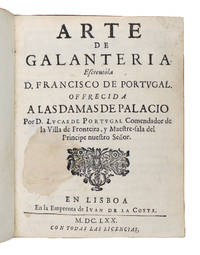
167012054Lisboa: Juan de la Costa 1670. 178x139mm. 7x5½". Lisboa Juan de la Costa 1670. En 4º 178 x 139mm. 12 128 pp. Encuadernación del siglo dieciocho en holandesa pergamino tejuelo en piel en la lomera con letrerÃa dorada. Primera edición de este apreciado libro de poesÃa portuguesa dedicado a la galanterÃa el único tratado sobre este tema publicado en el siglo diecisiete. El libro se escribió en 1628 pero no se publicó hasta 1670. El autor escribió el libro basándose en sus vivencias en la corte madrileña de Felipe IV pero mirando con nostalgia el pasado de la antigua corte portuguesa. La obra ofrece todo el ceremonial de la galanterÃa en un cancionero. Dice Palau: "cuentos alegorÃas dichos agudos sentencias chistesen prosa con intercalados en verso". Francisco de Portugal 1585-1632 era descendiente de Vasco de Gama y I Conde de Vimioso. Se publicó una segunda edición en 1682. Buen ejemplar. Juan de la Costa hardcover