New YorkABAA
4 242 résultats
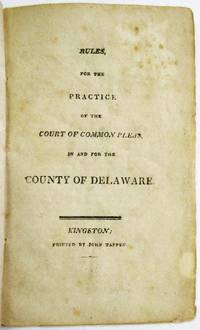
181732011Kingston NY: Printed by John Tappen 1817. 21 3 blanks pp. Stitched lightly worn faint rubberstamp on blank verso of title leaf. Very Good.<br/><br/> This evidently unrecorded item prints the original rules for the August 1813 Term; with amendments through the February Term 1817. Permissible fees and costs are enumerated.<br/>Not located on OCLC as of May 2015. Not in American Imprints Sabin Harv. Law Cat. Cohen. Printed by John Tappen unknown books
176427759New York: Printed by John Holt 1764. 4to. Disbound with scattered spotting. The complete copy is paginated 2 iv 68 pp. Our copy lacks the half title half the title leaf which obliterates 'The Report.Tried' and the final page title page and final page supplied in facsimile. Else Good. <br/><br/> The case is significant for its assertion of the primacy of the jury system in colonial America. Publication occurred to emphasize to New Yorkers "the pernicious Consequences" of British interference with local juries "by a Method entirely new unconstitutional and illegal."<br/> Forsey had sued Cunningham for an assault and battery; a jury of their peers found for Forsey and assessed damages against Cunningham. Unhappy with the large amount of damages Cunningham sought an appeal. He did not claim that the trial court committed any errors of law; he simply argued that the jury had misconstrued the facts. Allowing the appeal would have diminished the role of the jury in favor of appellate judges' assertions of their royal prerogatives. Nevertheless Lieutenant Governor Cadwalader Colden permitted Cunningham to appeal. New Yorkers in 1764 already angered by British control of local affairs found this interference with the role of the jury intolerable. They challenged Colden's decision to allow the appeal; in late 1765 the New York Assembly agreed. <br/>Shipton & Mooney 41438. Bristol B2464. NAIP w021834 6 including the AAS copy which is defective. Cohen 11975. Printed by John Holt unknown books
9083New-York. Time inc.. 1931. Douze fascicules in-4 (36x28). 130 pages environ par volume. Brochés, couvertures Illustrées.
19120159-C1912/13. Radierung um 1912/13, links unten signiert, verso betitelt ?Nr. 339 New York, Wolkenkratzer von Brooklyn aus II. (nachts)?. 14,9:21 cm. Nicht mehr bei Fortlage/Schwarz; Rusel 342 R. Vorzüglicher Abdruck auf breitrandigem Bütten.- Der Blick geht über den East River auf das jenseitige Ufer mit den nächtlich beleuchteten Gebäuden Manhattans. Von den auf dem Fluß liegenden Booten steigen Qualmwolken auf, in denen sich das Licht fängt.
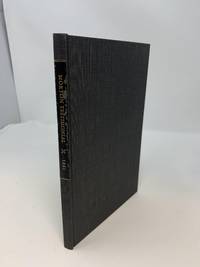
186183848Boston: George C. Rand & Avery 1861. First Edition. Hardcover. Very Good. The original 1861 publication of the testimonial of "The Medical Profession of Philadelphia New York and Boston rebound in black cloth with gilt-lettered and slightly chipped spine label 56pp. Text clean pages evenly toned. The last pages are in effect forms requesting monies for Dr. Morton and his family. William T. G. Morton 1819-1868 was a surgeon dentist in Hartford Connecticut who claimed to be the first person to perform surgical anethesia on a patient's tumor in 1846. "Morton immediately patented ether hoping to retain its use exclusively for himself. Later he made repeated appeals to the American Congress for financial recompense for his 'invention'. Morton's instructor the chemist and geologist Charles Thomas Jackson said it was he who had made the discovery and had suggested that Morton should try it out. Horace Wells the dentist from Hartford Connecticut put forward his well-substantiated claim to have produced anaesthesia two years earlier with nitrous oxide. It is sad that such an epoch-making event should have been followed by 20 years of acrimony vituperation and litigation between three contestants each claiming to have originated anaesthesia." Journal of the Royal Society of Medicine May 2020 pp 226-227. George C. Rand & Avery hardcover
Boards with light edgewear. Front hinge started. Front map dog eared ; 16mo 6" - 7" tall; 1057 pages
2023Discovery-9783031143229Palgrave Macmillan 2023. Paperback. New. Palgrave Macmillan paperback
2023Discovery-9783031143229Palgrave Macmillan 2023. Paperback. New. Palgrave Macmillan paperback
18925333New York, N. Y. Plattdütsche Post, 1892. 227 S., 14 Bll. (Anzeigen). 11 Porträts. 8°. OLwd. (kl. Gebrssprn.).
Moses King, 1906. In 4to cm. 38 x 26, bella legatura editoriale de luxe, con piatti massicci, arrotondati, in tela rossa con piatti illustrati a colori, pp. 96 con disegni e numerosissime illustrazioni fotografiche. Bella edizione di questo noto ma sempre ricercatissimo testo riccamente illustrato che celebra il panorama urbano di New York, già metropoli.
1944004015Paris Denoël 1944 In-8 Broché, couverture rempliée
Veduta della Borsa di New York e piazza antistante da scena di vita quotidiana. Stampata su fondino seppia entro doppio filetto, pubblicata by Goupil, Vibert & Co. New York & Paris. Piccolo restauro al margine in basso
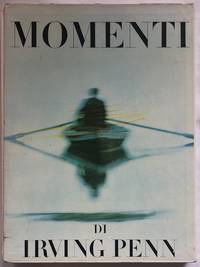
1960232699Milano: Editoriale Domus 1960. Rilegato tela sovracoperta custodia cloth dust jacket slip-case. Molto buono Very Good. <em>Otto saggi in immagini e parole di Irving Penn</em>. Introduzione di Alexander Liberman. Stesura del testo di Rosemary Blackmon. Numerose fotografie in nero e a colori anche a piena e doppia pagina eseguite per Vogue nel corso di una lunga collaborazione. Allegato un <strong>quartino sciolto</strong> con i dati tecnici per le fotografie a colori insieme alle miniature delle fotografie pubblicate in volume. Cm 34x255. pp. 184. Molto buono Very Good. Custodia leggermente sciupata ai bordi. Sovracoperta con una piccolissima mancanza all'angolo inferiore Dust jacket with a very small paper missing at the bottom corner. Case slightly frayed at the edges. Prima edizione italiana First Italian Edition. <em>"Alcune sue trovate - per esempio quella di tirare le fila del tappeto - sono intese a rompere la levigatezza dell'emulsione fotografica. Gli <strong>angoli </strong>in cui fa posare i suoi soggetti sono il risultato della sua ricerca di una resa personale dello spazio e lo scopo delle sue pose talvolta rigide delle sue <strong>deformazioni</strong> è"; quello di creare una <strong>tensione visuale</strong>: sono queste alcune delle manifestazioni esteriori dell'aspirazione di Penn a fare della fotografia un'arte creativa. Pioniere nell'uso del colore Penn si staccò dai fotografi da studio che avevano troppo a lungo imitato il chiaroscuro dei pittori e portò" alla fotografia l'uso del <strong>colore puro</strong> incontaminato da ombre: la "nota alta" di Penn ovvero il colore puro è"; così" stata l'affermazione di come i fotografi creativi avessero a disposizione nuovi mezzi di espressione".</em> Editoriale Domus, hardcover
29443New York, The Museum of Modern Art, 1968. In-8, reliure métallique avec les plats montés sur des charnières, premier plat orné d'une composition en couleurs en relief conçue par le designer Anders Osterlin représentant l'entrée du musée d'Art moderne de New York d'après une photographie d'Alicia Legg (reliure de l'éditeur).
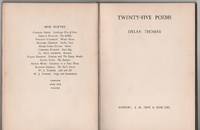
1936107931London: J. M. Dent & Sons Ltd. 1936. Rilegato hardback. Molto buono Very Good. . 16mo. pp. 48. Molto buono Very Good. Firma di appartenenza anonima alla prima pagina bianca Anonymous signature on the first blank page. Prima edizione First Edition. <strong><em>Secondo libro dell'Autore</em></strong> J. M. Dent & Sons Ltd., hardcover
191741258Washington D.C.: Published by the United States Coast and Geodetic Survey 1917. Large folding nautical chart printed on heavy paper stock. Colored with minor wear. A rare original coastal survey of Long Island including Old Field Strongs Neck Port Jefferson Mt. Sinai Miller Place and Sound Beach as well as designated anchorage points.<br/> <br/> Established by President Thomas Jefferson in 1807 as the Survey of the Coast the U.S. Coast and Geodetic Survey was the United States' first civilian scientific agency. This agency has followed its mission to survey the U.S. coastline create nautical charts of the coast and help increase maritime safety since its founding and has often played fascinating roles in significant chapters of U.S. history. It served in all theaters of the Civil War in the service of the Union Army and Navy pioneered acoustic exploration in the wake of the sinking of the Titanic and during WWI it worked to detect enemy submarines. In addition this agency worked to survey and produce detailed maps and renderings of the U.S. coast. These nautical survey maps commonly referred to as "T-sheets" provide fascinating insights into the history of the United States coastline which has and will continue to shift. These maps are the most important data source for understanding the physical and ecological characteristics of the U.S. shoreline. The present map is a highly detailed and accurate sea chart of Long Island and an important historical view of developing New York. Published by the United States Coast and Geodetic Survey unknown
191741257Washington D.C.: Published by the United States Coast and Geodetic Survey 1917. Large folding nautical chart printed on heavy paper stock. Colored. A rare original coastal survey of Long Island including Eaton's Neck Sunken Meadow State Park Northport Stony Brook Old Field and designated anchorage points.<br/> <br/> Established by President Thomas Jefferson in 1807 as the Survey of the Coast the U.S. Coast and Geodetic Survey was the United States' first civilian scientific agency. This agency has followed its mission to survey the U.S. coastline create nautical charts of the coast and help increase maritime safety since its founding and has often played fascinating roles in significant chapters of U.S. history. It served in all theaters of the Civil War in the service of the Union Army and Navy pioneered acoustic exploration in the wake of the sinking of the Titanic and during WWI it worked to detect enemy submarines. In addition this agency worked to survey and produce detailed maps and renderings of the U.S. coast. These nautical survey maps commonly referred to as "T-sheets" provide fascinating insights into the history of the United States coastline which has and will continue to shift. These maps are the most important data source for understanding the physical and ecological characteristics of the U.S. shoreline. The present map is a highly detailed and accurate sea chart of Long Island and an important historical view of developing New York. Published by the United States Coast and Geodetic Survey unknown
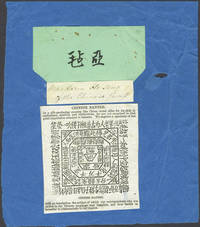
184724931New York 1847. Ephemera. Very good condition. Signature of crew member of the 'Keying' the first ship from China ever to dock in New York City identified as "the Mandarin: He Sing Xi Sheng". The ship moored off the Battery in Manhattan in July 1847 much to the anger of the crew which had signed on for a voyage to Singapore and Batavia only. However the ship was a smashing success with 4000 visitors paying 25 cents each to board the vessel and gaze at the crew and ship. P.T. Barnum got in on the action by exhibiting a replica and claiming some of the crew were the original Chinese. 'Keying' sailed on to Boston and London and was noted in the press as the first junk to round the Cape of Good Hope or to have sailed in British waters. He Sing was still on board: "The ROYAL CHINESE JUNK "KEYING" manned by a Chinese Crew. Visitors received by a Mandarin of rank and Chinese Artist of celebrity. The Illustrated London News 29 July 1848. He Sing's signature in black ink on blue card with period pen inscription on white paper below "Mandarin He Sing of the Chinese Junk". with Clipping from the Illustrated London News showing a "Chinese Banner" with an invitation to readers to assist in its translation an early version of crowd sourcing. Signature 3 3/4" x 2 1/2"; the clipping 3 1/4 x 3 1/2". Laid down on blue album paper at some stage excised from a period scrap album small perforation at right side perhaps when something was removed from verso. unknown
1836WRCAM7300Hartford: Case and Waters 1836. Colored folding map 22 x 15 3/4 inches. Original 12mo. gilt calf binding. Map cracking and splitting on some folds one portion detached but present. Else good. An inset shows the profile of the "Levels in the Grand Erie Canal." Another shows the course of the Hudson River in detail. Case and Waters unknown books
18140009023New York: I. Riley 1814. First edition. Hardcover. Good. 16mo 254 pages contemporary full sheep red spine label tidal lines inside and on top cover. Scarce <br/><br/> Bitting p. 604; not in Gabler . A wide range of advice and recipes including beverages and how to cook fish at sea. I. Riley hardcover
ria9780323763325_inpHardback. New. New Book; Fast Shipping from UK; Not signed; Not First Edition; N/A hardcover
0162-Co.J. Kaltnadel und Vernis mou, auf Bütten, links unten signiert, verso bezeichnet ?Nr. 323 New York, Fabriken am Hudson?. 14,3:19,4 cm.
19120157-C1912/13. Radierung und Vernis mou, um 1912/1913, signiert, verso bezeichnet ?Nr. 319 New York Monument Grant und Wolkenkratzer?. 11:15 cm. Erschienen in: Amerika, Berlin 1922. Rusel 334 R. ? Breitrandiger Abdruck mit zartem Plattenton auf Bütten. Etwas fleckig, Knickfalte in der Ecke rechts oben geglättet. Das Monument Grant ist das Mausoleum von Ulysses Grant (1822 ? 1885), des Oberbefehlshabers der Nordstaatenarmee während des Bürgerkrieges und späteren US-Präsidenten.
11691Both on letterheads of the Syndicate Publishing Company New York. Adair's letter: 2 December 1914. Wright's letter: 30 March 1915. The letters provide a fascinating insight into the development of the transatlantic publishing industry. They are closely typed with single spacing and both centre around Walton's employment situation and his complaints about the sending over from America of 'Mr. Russell' about whose 'absolute worthlessness to the business' he complains. Adair's letter: 2pp. 4to. Good on lightly-aged paper. The firm has 'not the slightest doubt' that what Walton has said in his 'confidential communication' is 'entirely sincere': 'We feel it is just such a letter as a really big man having the interest of his employers at heart would right. sic' They have complete confidence in Russell's 'integrity honesty etc.' but acknowledge that it is important 'that he expenses of the London Office be kept down to the last notch'. Russell is 'familiar with so many things that have been done in this country and the manner in whcih either successes or failures have been made out of them' and is 'rather expert in figuring out the cheapest way to do things . A great many firms go to pieces not because they have not made money but for the reason that they failed to save any of that made'. Wright's letter: 3pp. 4to. Good on lightly-aged paper with slight damage not affecting the legibility of the text to the third of its three leaves. He has delayed replying to Walton's letter as he 'wanted to take sufficient time to think over our London situation more carefully and to definitely make up my own mind as to what would be for the best interests of the business'. He is not surprised that 'Mr. Starmer' has made Walton 'a liberal offer': 'there are plenty of other newspaper men in England who would not be slow to recognise your ability and to make you a satisfactory proposition'. Walton is highly qualified 'to handle the large and successful papers'. Wright lays out the plans he has for Walton: 'I have away down deep in my heart a great degree of interest in yourself and I have taken up the matter of your future with my associates with the idea in mind that at the proper time you will be given a connection with the company in a way that will be highly satisfactory to you; in fact I would not be at all surprised if an opportunity of absolute control of the English company would be given you'. In the meantime Walton's salary of £750 will be continued and he will be assisted by a 'traveling man'. 'You have been with our company going on two years. You have seen evidenced in Sheffield and one or two other towns what our plan of operation is worth and at such time as the war is over and things settle down to calm conditions you will in my opinion be able to produce results over there that will be highly gratifying to everybody interested.' He considers that England is not 'in nearly as serious a condition' as America: 'in fact I believe that business has been affected as much if not more in certain lines in the United States than it has in England'. On the question of Russell's 'absolute worthlessness to the business it would seem that backed up with a college education coupled with what he has learned in knocking about this country for fifteen or twenty years that he ought to be able in time and under the proper tuition of one more capable to at least earn a respectable part of his salary.' Both on letterheads of the Syndicate Publishing Company, New York. Adair's letter: 2 December 1914. Wright's letter: 30 March 19 unknown
1883JC111671883. Hardcover. Very Good. Mottled blue cloth black calf backstrip; oblong 175 x 127; contains 18 pencil drawings most of them titled and dated. It includes landscapes of the Catskill Mountains; studies of clouds waterfalls and tree and rock formations; a farm scene; "The great whist game" image of 4 men at a table playing cards; "Prairie Fire in Dakota Night" the artist was very well-traveled; and 5 portraits. Spine tips chipped; edges of boards lightly scuffed; a few leaves neatly excised; one leaf loose laid-in. Nicely acccomplished works most of them on one side of the leaf therefore removable and suitable for display. <br/><br/>Harley DeWitt Nichols 1859-1939 was born in Barton Wisconsin. He began his education in art as early as 11 years of age. His first job putting his talent and training to use came in the form of an apprenticeship with the Milwaukee firm Marr & Richards where he stayed for 3 years drawing and engraving on wood. The subsequent years included many moves from Milwaukee to Chicago and later to New York where he studied at ASL and was encouraged by Professor Packard to pursue a career as an illustrator at a European school. Nichols left for Munich in October 1885 to attend the Royal Academy where he studied under Heckel became a member of the American Club and socialized with Carl von Marr the clubs president. He went to London for a little while and worked as an illustrator. By 1893 hed returned to New York working mostly in advertising and illustrating for Harpers Weekly and Century magazines. He helped organize the New York Water Color Club. Nichols didnt curb his parapatetic lifestyle until he moved to Laguna Beach California in 1894. The art community in Los Angeles was in its infancy but he got a teaching job at the Echo Mountain summer school and he was inspired by the scenery of Yosemite Monterey San Juan Capistrano and other locations in southern California. He stayed in Laguna Beach until his death in 1939. hardcover