8 986 résultats
192054088Santa Ana CA: Orange County Board of Supervisors ca. 1920. Oblong 32 mo. 4 x 3.75 in. 16 pp unpaginated. Aqua-tinted photo-illustrated title 7 aqua-tinted photo plates 1 map on verso of rear cover. Die-cut orange lithograph softcovers in shape of orange w/ stem NF copy. First edition of this remarkably scarce and inventive land promotion for Orange County CA following World War I. This nicely illustrated piece details the large Valencia orange groves the nearby beaches paved boulevards the advantages to automobile tourists and historic missions. The map includes the major cities and towns in Orange County including Santa Ana Garden Grove Tustin Smeltzer Wintersburg Talbert Cypress Fullerton and others. Worldcat locates 1 copy Yale. Orange County Board of Supervisors, paperback
19209297Milwaukee: The H.S.Co 1920. 5.5" x 7". Pink floral boards backed in green cloth with silver decoration and title some edge wear and stain to rear cover very good. About 100 black and white photos pasted in a few are loose or detached completely four photos were taller than the album pages so the edges have worn very good overall. <br /> <br /> Personal photo album featuring about 100 candid photos outside the family home and travel to California and Colorado. Many family members are present but its notable that the vacation photos feature women playing on the beach buried in the sand climbing on rock and standing atop the Rocky Mountains. Not all photos are labeled but the following locations are identifiable: <br /> <br /> <br /> in California: San Bernadino and Orange<br /> <br /> in Colorado: Rocky Mountain National Park Fairmount Cemetery in Denver Denver Paper Mill Grand Lake Glen Cove at Pikes Peak Leadville National Forest Holy Cross National Forest<br /> the Platte River. The H.S.Co unknown

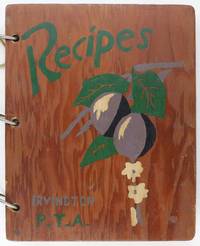
19413740Irvington Ca: May 1941. Very good. 6150pp. Original wooden boards decoratively illustrated and lettered in green gray and black paint on the front board reading "Recipes Irvington P.T.A." and bound by three separate rings. Text uniformly toned with several leaves detached but present a few with minor chipping. An exceedingly rare DIY cookbook produced by the Irvington Parent-Teachers Association just before the outbreak of World War II. The recipes were compiled by Irma T. Bond "not for culinary instruction as is the case for most cook books - but for the purpose of permitting members to exchange their favorite recipes." The contents page lists the recipes in roughly alphabetical order beginning with Appetizers Bread Crepe Suzette and Cakes and ending with Salads Soups Vegetables and then "How to Cook a Husband" "Household Hints" and "Quantity Cooking." Each of the recipes generally presented two per page includes the name of its contributor. OCLC records just a single copy of this ephemeral pre-war school-related cook book at UCLA. May unknown
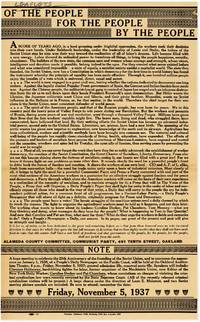
193787419Oakland: Alameda County Committee Communist Party 1937. First Edition. Original printed broadside with text offset printed in black on beige stock measuring 28cm x 45.25cm 11" x 17.75". A few old folds smoothed out some very subtle toning to extremities with a brief notation written at upper left margim; Near Fine. <br /> <br /> Broadside printed by the Alameda County Committee of the Communist Party printing a lengthy statement celebrating the anniversary of the founding of the Soviet Union followed by a two-fold announcement regarding a huge celebratory meeting on Friday November 5 1937 and the appearance on January 1 1938 of the People's Daily Newspaper on the West Coast. Speakers were to include Clarence Hathaway then editor of the New York Daily Worker Caroline Decker and Pat Chambers. Not separately listed in OCLC. Alameda County Committee, Communist Party unknown
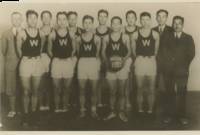
1927List3428California 1927. Photograph measuring approximately 6 ¾ x 10 inches. Unevenly trimmed top edge; some folding at lower corners; excellent contrast with extensive pencil caption verso. Very good to excellent. A portrait of the Waseda University basketball team from 1927; according to its manuscript caption the photo was taken following their defeat by the University of California team at the Oakland Auditorium on a tour of the Pacific coast. The sport invented in Massachusetts in 1891 with a Japanese student partaking in the first game was brought to Japan as early as 1902 by American missionaries.1 A New York Times article from the time reports that Waseda University was the first Japanese basketball team to come to the US following the success of its baseball team’s tour; and that there was “much interest†in the Japanese players’ strategy of “cat-like swiftnessâ€.2<br /> <br /> 1 Tetsuji Kakiyama “Challenging established theory: History of Japanese Basketball†Research Outreach April 10 2023.<br /> 2 “JAPANESE FIVE PLANS TRIP; Waseda University Seeks Games With California and Others†The New York Times October 7 1927 33. unknown
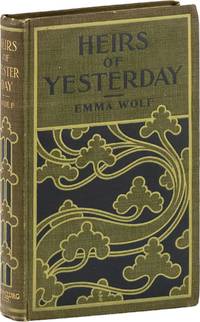
190087914Chicago: A.C. McClurg & Co 1900. First Edition. First printing. 12mo 18cm. Publisher's decorated cloth; 2871pp; one page of ads for Wolf's previous two novels published by McClurg. A brilliant copy with just a trace of wear at spine ends and board corners; some barely perceptible sunning to spine internally tight and clean. Very Near Fine and most unusual thus. <br /> <br /> The author's fourth novel a Jewish-American "problem" novel dealing with assimilation and faith among members of San Francisco's middle-class Reform Jewish community. Wolf 1865-1932 though largely forgotten today was widely read during her lifetime; in addition to dozens of contributions to popular periodicals she published five novels several of which went into numerous reprints. Her first novel Other Things Being Equal 1892 was for many decades regarded as the first Jewish-American women's novel only supplanted in 2017 with the rediscovery of Cora Wilburn's serialized novel Cosella Wayne 1867. Like Wolf's other works Heirs of Yesterday is noteworthy for its frankness regarding Jewish identity and the persistence of antisemitism - whether overt or unspoken - in all strata of American society. WRIGHT III:6044. A.C. McClurg & Co unknown
193458588New York: The Macmillan Company 1934. First Edition. First Printing. Octavo 20.25cm; beige cloth with titles stamped in light brown on spine and front cover; black topstain; dustjacket; viii430pp. "Dave Washburn a dedicated Communist attempts to organize exploited California cannery workers thrown out of work by mechanization. The whole town of Caldwell is destroyed when the local dam is dynamited but Dave escapes presumably to organize other workers more successfully. The capitalists in the novel are morally despicable the workers confused and powerless because they have not yet learned to take power by organized collective action" BLAKE p. 251. BAIRD 69; HANNA 114; RIDEOUT p. 296. The Macmillan Company unknown
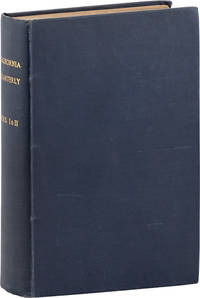
195163391Los Angeles: California Quarterly 1951-3. Eight original octavo issues comprising the first two years of publication bound together in plain cloth with gilt spine title; original card wrappers bound in. Each issue 64pp; illus. A clean tightly-bound volume with the individual issues clean and unmarked; about Fine. <br /> <br /> Well-preserved run of this important West Coast literary journal which collected the work of many writers on the left at a time when they were under fire from the House Un-American Activities Committee. Of singular importance is the first published appearance in the Summer 1953 issue of Michael Wilson's screenplay for the suppressed classic Salt of the Earth one of the truly great works in the pantheon of labor filmmaking and one of very few works of the period to portray Mexican-American workers in a positive light. The movie was produced in 1954 directed by Herbert Biberman but effectively disappeared after all but a dozen theaters nationwide refused to screen it. The screenplay published here includes numerous still images from the as-yet unreleased film with additional brief essays by Biberman Paul Jarrico the producer and Rosaura Revueltas who starred as "Esperanza." <br /> <br /> Other contributors to these eight issues include a host of mid-century radical and experimental writers including Edwin Rolfe Aimé Césaire Thomas McGrath B. Traven Pablo Neruda Eve Merriam John Oliver Killens a very early appearance in the Spring 1952 issue Philip Bonosky Nelson Algren and many others. For the first few issues Lawrence Spingarn was listed as Editor in Chief but by Spring 1951 Sanora Babb had taken over most editorial duties. California Quarterly unknown
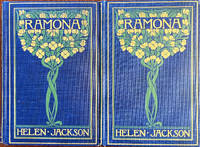
190063607Boston: Little Brown & Co. 1900. Two vols. 8vo. xxv 5 310; 6 308 pp. Both titles in red & black. Frontisp. in both vols numerous plates colour plates w/ titled & extra tissue guards from drawings by Sandham. Uniformly bound in blue decorated publisher’s cloth Arts & Crafts motif cover art on both vols. by Amy Sacker w/ initials at the lower fore-edge t.e.g. dark brown clay-sized endpapers t.e.g. slight shelfwear still a NF set. First Monterey Edition of this classic novel championing the plight of the American Indian in Southern California which Jackson herself called “sugar-coating of the pill†of her polemical mission to engender in Americans a reconsideration of the genocide and land theft outrages against the Indigenous Peoples in California. Issued following her groundbreaking and searing “Century of Dishonor†and “Report of the Condition and Needs of the Mission Indians of California†in 1881 & 1883 she hoped to persuade a change in public policy and opinion but unfortunately she was without a “genuine sympathizer†among the whites in the entire West and even Teddy Roosevelt who included her among the ‘hysterical sentimentalists.†Jackson’s 1830-1885 Ramona became a runaway cultural phenomenon and not only inspired in popular conception a fantasy vision of Mission California but became a costume drama rather than the biting history of her “Century of Dishonor.†See: Matthew Wills Helen Hunt Jackson’s Ramona Did What Her Nonfiction Couldn’t JSTOR Daily Nov. 4 2019; Zamorano 80 No. 46; Elaine Katz Women & The American West 1988 141-145. Little, Brown & Co,. hardcover
1882WRCAM44230San Francisco 1882. 2093pp. printed in double columns. Original pictorial wrappers bound into original green cloth gilt. Cloth a bit shelfworn. Quite clean internally. Very good overall. An informative collection of articles about the counties of California geared toward the prospective emigrant including articles on various agricultural subjects. First published in 1881 this popular now scarce text went through five editions in the course of a decade. COWAN p.92. hardcover books
1944MSC16513California Department of Agriculture. Good with no dust jacket. 1944. Hardcover. California Brand Book for 1944. Hard cover published by California Dept. of Agriculture in 1944. No dust jacket. Tan covers with black lettering. Spine is wrinkled and creased with wear at the ends. Covers have some scuffing and some small stains. Corners are bumped and worn with some fraying. Inside both front and back covers and front endpaper have multiple stamps from ranches in the Bakersfield area. Front inner hinge is split before the table of contents page and rear inner hinge is partially split after last page in index. Book is in good condition. 8vo 582 pages 1.1 lb.; 8vo 8" - 9" tall; 582 pages . California Department of Agriculture hardcover
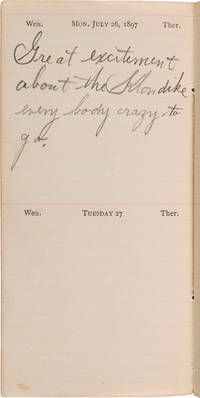
1897WRCAM55055San Francisco and Sonoma County Ca. 1897. 276pp. comprised of 52 printed pages with the remainder being diary space completed in manuscript irregularly filled out. Narrow 12mo. Limp brown wallet-style leather diary with flap and elastic closure loop a.e.g. Some wear and loss to leather at flap folds text block starting to crack minor tanning to paper. Overall very good. A very readable daybook from an unidentified young man living in Northern California in the late 1800s. Our unidentified diarist is laconic - he provides an entry for 216 days in 1897 with daily entries from January 1 to June 11 then more sporadically after that - and many entries are a variation on "Worked. Fine weather." But some days he is more forthcoming and describes trips to the Sutro baths; attending balls at Pioneer Hall and Foresters Hall; contracting a case of the mumps; starting and then quitting night school; and the night Bob Fitzsimmons knocked out "Gentleman Jim" Corbett. He mentions friends his work in a store in the city unloading fruit in particular bananas watermelon and Japanese oranges traveling to Berkeley and Oakland and the plowing and planting he does at home possibly in Sonoma County. Of particular interest is his entry for July 26 in which he writes "Great excitement about the Klondike every body crazy to go." And not long after he mentions that two of his friends have bought tickets and are headed to Alaska. One entry notes a trip made by three friends to Yosemite. In the front pocket of the diary is a check dated August 3 1896 to the Sacramento textile shop Wasserman Davis & Co. signed by J.W. Kasebery although no connection has been made between Kasebery and the diarist. <br> <br> Excelsior Diaries came into fashion in the late 19th century providing an almanac of sorts customized to various regions and then a half page space for brief daily reflections. In this case the stock pages include a calendar for 1897; routes of travel distances rates etc. from San Francisco; tide tables for San Francisco San Pedro Astoria and Port Townsend; postage rates; weights and measures; and varied trivia. <br> <br> A interesting perspective on 1897 in the Bay Area. hardcover books
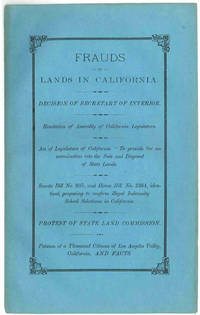
1876WRCAM44135No place but probably Washington 1876. 10pp. Original printed blue wrappers. Fine. A relatively scarce collection of documents protesting the Department of the Interior's decision to overrule the California initiative to limit land sales to 320 acres per person. The federal government is accused of bending to the will of monopolists. Included is the decision of the Secretary of the Interior resolutions and acts passed by the California legislature the protest of the state land commission and a "petition of a thousand citizens of Los Angeles Valley." Though assembled by attorneys in Los Angeles it seems that this pamphlet was meant to be distributed to legislators in Washington DC hence our attribution of the place of publication. COWAN p.221. unknown books
1876WRCAM44135ANo place but probably Washington 1876. 10pp. Original printed blue wrappers. Light wear to lower outer page edges. Near fine. A relatively scarce collection of documents protesting the Department of the Interior's decision to overrule the California initiative to limit land sales to 320 acres per person. The federal government is accused of bending to the will of monopolists. Included is the decision of the Secretary of the Interior resolutions and acts passed by the California legislature the protest of the state land commission and a "petition of a thousand citizens of Los Angeles Valley." Though assembled by attorneys in Los Angeles it seems that this pamphlet was meant to be distributed to legislators in Washington D.C. hence our attribution of the place of publication. COWAN p.221. unknown books
70653A holographic diary and journal written in 1914 by a young California woman from Rio Bravo California a former settlement in Kern County along the Santa Fe railroad near Bakersfield. The 50-page journal begins on January 30 1914 with its author 15-year-old Rosy Luella Thomas writing about her daily activities. The entries run through February 14 and center on going to school playing with friends and doing odd chores around the property where she lives with her sister and aunt. February 2 1914: "Monday I got up at seven o' clock. We were hurrying around so as not to be late for school. Then we went out and brushed and harnessed the horse. Â After breakfast we got ready and went to school. But we were around 10 minutes late. We got home late from school and we had to get in wood and get supper and we went to bed about half past eight." Following the diary entries is a 30-page original story Thomas titled "Rosilie and Her Dog" about a young girl who becomes lost on her way home from school and misses her parents and her dog whose name is Sleipnir presumably named after the eight-legged horse of Odin in Norse mythology. In the story the young woman was eight years old when she stumbled into a mountain cottage fell asleep and was later awoken by the owner of the house George who was so taken with her beauty he never wanted her to leave. She lived with him in chaste domestic bliss for several years until she grew into a young woman. In time Rosilie was reunited with her dog and her parents who instantly took a liking to George so they all moved to her parents' house and later to the city. "They had many happy hours talking together of how they met and the little old cabin" she wrote at the conclusion of her story. "Sleipnir was still living and was lying on the hearth rug in a beautiful house. In their old age when they would talk of the little brown cottage way up in the hills George would sing to Rosalie 'Your hair was then a golden but now a silver hew and we have lived together all these years we two.'" According to ancestry records it appears Rosy's father William died in 1909 and her mother Dovie who subsequently remarried and had two more children died in 1912. By the time of the writing of this journal and story Rosy was an orphan. Just a year later at the age of 16 she married John Duns a man 10 years her senior who worked in the oil fields around Bakersfield. They had two children and Rosy died in 1938. Written on ruled line paper and hand stitched into tan paper wraps with the words "A Young Girl's Diary" handwritten in the cover. The covers are worn a bit stained and edgeworn and the contents are overall in very good condition. unknown books
1876223044San Francisco 1876. 1876. Thin 8vo. 63 pages. Original green/gray wrappers stamped in black. Fine. No signatures or bookplates. The defendants included Leland Stanford Collis P. Huntington Mark Hopkins Charles Crocker Wells Fargo & Co. and various other railroad companies. Rocq 11164. Not is Cowan. Soft cover. [San Francisco, 1876]. paperback books
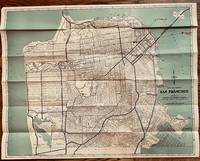
1949471Los Angeles: California State Automobile Association 1949. 25 1/2 x 20 1/2. Very good. Beautifully laid out map of San Francisco. The map fills the entire page and the highways are clear and distinct. Red arrow for the St. Francis Hotel. Another arrow in red for the Union Square Garage. Looks like the titles are typewritten and the arrows red pencilled. Very attractive. There is a smaller map of downtown on the verso The is a copy in the rare book map collection at Yale. California State Automobile Association unknown
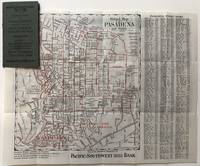
1923958Los Angeles: Franklin P. Borgnis 1923. Very good. Folding map 9.5 x 11.75 inches. Original printed wrappers. Very light wear to wraps. A couple of small separations along fold lines. A small but attractive double-sided folding map that depicts the street layout of Pasadena as well as well as the major motor routes in the Los Angeles region. The map of Pasadena is quite detailed and delineates the principal roads of the city in red. It also provides a street index to the right of the map. The other side of the sheet prints a "Motor and Relief Map of Southern California" which provides a bird's-eye view of the region south of the San Gabriel Mountains as well as two small insets of the routes from San Diego to Los Angeles and Los Angeles to San Francisco. The map was distributed as a promotional by local branches of the Pacific-Southwest Trust & Savings Bank. We locate only one copy at the Pasadena Public Library. Franklin P. Borgnis unknown books
1907309Monrovia Ca: Press of the Monrovia News 1907. Very good. 24pp. Original printed wrappers. Light edge wear to wraps. Light tanning occasional foxing. Scarce illustrated promotional for the community of Monrovia California just east of Pasadena. The booklet contains numerous photographic illustrations of nearby natural sights and town architecture as well as street scenes featuring early automobiles. Several leaves of text expound on the advantages of the town -- "Schools unexcelled anywhere. Churches of all leading denominations. No Saloons." OCLC locates five copies at Berkeley Azusa Pacific UCLA the California State Library and Yale. Press of the Monrovia News unknown books
1907683San Francisco: Southern Pacific Company 1907. Near fine. 24pp. Original pictorial wrappers stapled. Minor wear. Booklet promoting the Southern Pacific Railway and highlights along its route. With a map and numerous images of the handsome Southern California scenery. Southern Pacific Company unknown books
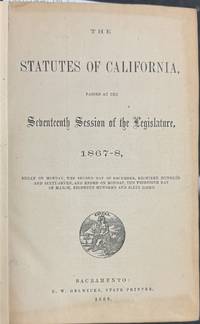
186840410Sacramento: D. W. Gelwicks State Printer 1868. lxix 3 909 i.e. 809 3 blanks 40 pp. Pages 796-809 wrongly numbered 896-909. A clean and Very Good text bound in modern legal buckram with gilt-lettered morocco spine title. Inner front hinge strengthened bookplate remnant on front pastedown.<br /> <br /> A gargantuan compilation including the Constitution of California and in the final forty pages the Treasurer's Report.<br /> OCLC 251179045 1- U MN 647108269 1- U MI as of September 2024. D. W. Gelwicks, State Printer unknown
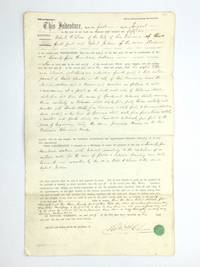
73807Original mortgage document made between Robert P. Chase and inventor Egbert Putnam Judson on August 1 1856 for the purchase of "that certain parcel of land situated in the city of San Francisco near the Mission Dolores . commencing at a point on the south west side of Valencia street sixty five feet from the corner of Sparks and Valencia streets running thence northerly on Valencia street sixty-five feet thence westerly and parallel with Sparks street five hundred sixty feet to Guerrero street - thence southerly on the line of Guerrero street sixty five feet thence easterly parallel with Sparks street one hundred and sixty five feet to the place of beginning being the same premises known as the San Francisco Chemical Works." The initial agreement was for the sum of $2500; however a holographic addenda on the verso dated September 20 1858 and signed by both Judson and Chase records an outstanding balance of $3275.<br/><br/>Printed on one quarter of a 16 ½ x 13 ½" sheet which folds to roughly 3 ½" x 8 ¼". In addition to holographic addenda a blue paper onlay signed by notary Charles Halsey appears on the verso along with a holographic notation by George F. Kohler Deputy County Controller. The document is creased from prior folds with some minor soiling to two outer panels.<br/><br/>A native of Syracuse New York Egbert Putnam Judson 1812-93 traveled to San Francisco in 1850 to try his luck in the mines. He is said to have founded the first assay works in San Francisco in 1852 and was a principal organizer of the San Francisco Chemical Works later Judson & Sheppard. His interest in the manufacture of acids led to experiments with explosives and in August 1867 three pounds of dynamite were made at his plant and used in a trial blast of boulders. This was the first instance of the manufacture and use of dynamite in the United States after the invention of that explosive by Alfred Nobel in 1866. The trial was so successful that it led to the formation of the Giant Powder Company the same month.<br/><br/>Judson a director of the Giant company continued to operate the San Francisco Chemical Works which supplied acid to the Giant company and soon thereafter formed the Judson Powder Company in Kenvil New Jersey. On June 3 1873 he patented his "Giant Powder No. 2" patent no. 139468 which was manufactured successfully by both companies. Essentially the first high explosive blasting powder to supplant gunpowder "Giant powder" was for a long time a synonym for dynamite in the United States. Judson was the first to meet the need for an explosive which though powerful would be more "gentle" in action than a blasting powder producing a heaving rather than a shattering effect. Later in 1882 he founded the Judson Manufacturing Co. building bridges and structural steel with machine shops foundry and pattern shops and bolt and nut shops. The company had operations in Emeryville and Oakland California respectively. unknown books
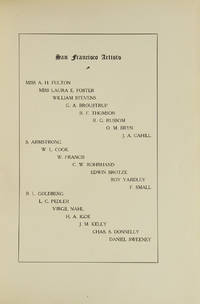
1906253099Portland Or: E.A. Thomson 1906. Almost all pages containing a full-page caricature of a particular person. 302pp. 1 vols. 4to. Original leatherette gilt. Binding a bit rubbed especially along the spine and the edges. Very clean internally. Very good overall. Green folding cloth case gilt leather label. Almost all pages containing a full-page caricature of a particular person. 302pp. 1 vols. 4to. A marvelous collection of caricatures of turn of the century California notables mostly politicians lawyers bankers businessmen and railroad magnates. Most are San Franciscans but others pictured are from Los Angeles Oakland Sacramento and Stockton. The illustrations were done by twenty-two different artists. A great collection of portraits of men once famed now diminished in memory. Cowan p.101 E.A. Thomson unknown books
1855WRCAM50101Sacramento 1855. xv1326pp. plus folding table. Modern buckram gilt leather labels. Minor soiling library shelf label on spine. Faint library ink stamp and embossed blindstamp on titlepage paper remnants on titlepage minor foxing. Very good. An early volume of session laws printed in Sacramento in 1855 and comprising the session laws for the sixth California legislature. The folding table compiles state Treasury receipts from January 1 through June 1854. Many laws relating to Gold Rush activities. Rare with only five copies in OCLC. OCLC 80461435. hardcover books
1874WRCAM48099Oakland 1874. Handbill 8 3/4 x 4 1/2 inches printed on yellow paper. Old light folds else fine. Scarce handbill advertising a night's entertainment at the Dietz Opera House the first theatre in Oakland located at the corner of Webster and 12th Streets. Shows began there around 1874 and continued until 1905 and the theatre hosted stars such as Buffalo Bill and Sarah Bernhardt. Along with McDonough & Earnshaw's Royal Marionettes and the Christy Minstrels part three of the night's entertainment is a performance called "Sports of the Fantoccini" composed of Chinese bell ringers and "Brigham Young and Family." In an 1896 SAN FRANCISCO CALL article about theatrical manager Mark Thall he claims to have been present for McDonough and Earnshaw shows at the theatre "with the first company that opened the old Dietz Opera- house" a date he places at 1870. But since shows did not begin at the Dietz until around 1874 we place the printing of this broadside at that date. unknown books