[California]Biblio.com
8 987 résultats
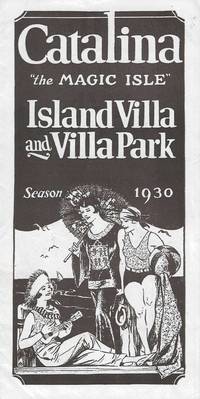
78835Scarce promotional piece for the Island Villa and Villa Park on Santa Catalina Island California which billed itself as the "largest one floor hotel in the world!" Comprised of more than 1250 "bungalettes" or cozy cabins on the European plan the resort was a cornerstone of William Wrigley Jr.'s plan to develop and promote the island for the tourist trade. This illustrated brochure includes per night and per week pricing and descriptions of local attractions like the newly built Casino and the Catalina Country Clubhouse and Golf Course. Also provides information on the Catalina Steamship Service ticket offices motor transit stages and service from the Santa Monica Bay District. Printed on a 13" x 6 1/2" sheet of white stock which folds to 3 1/8 x 6 1/2" 8 panels. Features a two-panel bird's eye map 5 photographic illustrations and 2 drawings. Light toning to the rear panel; otherwise very good. OCLC locates no holdings. unknown
192863340Los Angeles CA: Jake Zeitlin Books 567 Hope Street 1928. 12mo. 48 pp unpaginated. Art Deco grasshopper motif logo on front cover light dustsoiling minor shelfwear still a VG bright copy from the library of Anne Bobrow 1916-1996 longtime cataloguer with Zeitlin & Ver Brugge 1948-1986 and then with B & L Rootenberg Rare Books. First edition of this first fine & rare books catalogue from the famed Los Angeles bookseller who issued this just three months after setting up his bookstore in a space designed by Frank Lloyd Wright in April 1928 at 567 Hope Street. Zeitlin 1902-1987. At the time the ever confident Zeitlin had already published his first poetry attracted the friendship of Carl Sandburg and within a short time at the end of the 1920’s attracted a coterie of local writers painters photographers printers graphic designers and architects drawn in by his Grasshopper sign which adorned the store. The Western Americana section in this sports such items as Paul Allen’s Lewis & Clark 1814 No. 2 for $ 40.00; Brooks & Bryant Among the Gold-finders 1849 No. 8 for $ 10.00; Greenhow’s Memoir 1840 No. 22 for $ 32.50; and a superb copy of Manly’s Death Valley in ‘49 1894 No. 29 for 15.00. Also featured wre Frank Harris’s 2 vol. Oscar Wilde 1916 limited edition inscribed with 4 original letters for $ 85.00 and the splendid Nonesuch Press Divine Comedy 1928 for $ 100.00. Jake Zeitlin, Books, 567 Hope Street, unknown
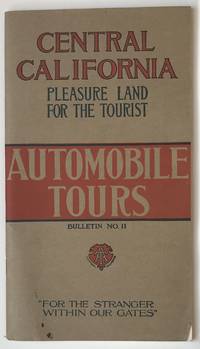
1915947San Francisco: Tourist Association of Central California 1915. Very good. 64pp. Original printed wrappers stapled. Small chip to lower corner of front wrap. Internally clean. An uncommon guide to potential automobile excursions from the Bay Area published for visitors to the Panama-Pacific International Exposition held in San Francisco during 1915. The text describes over twenty routes and the attractions to be enjoyed along them and is accompanied by maps for each tour and numerous halftone illustrations of motorists exploring the California countryside in their cars. Fewer than ten copies in OCLC mostly in California institutions. Tourist Association of Central California unknown
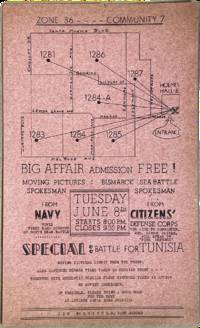
77124Broadside invitation from Zone Warden Jim McQuiston to a gathering of Zone 36 Community 7 of the Citizens' Defense Corps in Hollywood on June 8 1943. A spokesman from the U.S. Navy was scheduled to provide a vivid first-hand account of fighting in the South Seas and Mrs. Carrol Oliver a Citizens' Defense Corps aide was to speak on fire defense. The event was free but attendees were encouraged to bring "a good book for the boys" at Advance Naval Base Hospital".<br /> <br /> In the early days of the Second World War air raids and other assaults on populated areas in Europe generated fears that similar attacks could happen in the United States. On May 20 1941 more than six months before the United States entered the war President Franklin D. Roosevelt set up the Office of Civilian Defense OCD to coordinate non-military state and federal measures to protect citizens in a war-related emergency. The OCD organized the United States Citizens' Defense Corps to recruit and train volunteers to perform essential tasks.<br /> <br /> Featuring a block map of Zone 36 which was bordered by Santa Monica Boulevard on the north and Melrose Avenue on the south this single-sided notice is printed on 8 1/2" x 14" red paper that is a bit faded with some very minor chipping along the edges. OCLC locates no holdings. unknown
197762372Corona del Mar CA: Trans-Anglo Books 1977. 4to. 168 pp. Double-page illustrated title in red & black. With over 100 of photo & text illustrations throughout. Brown boards gilt lettering photo-illustrated endpapers w/ d.j. cover art by Spencer Crump price-clipped slight shelfwear NF/NF copy. Fourth edition of this well-illustrated history of 19th-Century Los Angeles whose rise was spurred by the Cerro Gordo and Panamint silver mines and the Southern Pacific Railroad. Included are sections on the exploits of Tiburcio Vasquez the notorious Chinese-American Massacre by supposedly law-abiding citizens and more. Trans-Anglo Books, hardcover
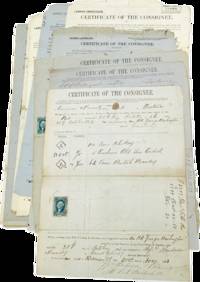
80033A group of 18 Landing Certificates containing the “Oath of the Master and Mate†and recording the type and amount of goods that arrived at the Port of Victoria from San Francisco in 1863. The documents contain signatures of various ship captains crew and consuls. Some contain official seals and tax stamps. Goods range from 100 cases of whiskey to cases of clothing refined sugar and opera glasses. <br /> <br /> Each of the documents is signed by Allen Francis 1815-1886 the U.S. Consul at Victoria Vancouver Island who was appointed to the post in 1862 by President Abraham Lincoln. He held the post throughout the American Civil War.<br /> <br /> At this time consuls were appointed to every major foreign port and played an important role for American ships in foreign ports. Before Francis appointment there had never been a consulate on the Pacific Coast of British North America. But once the war was underway British and U.S. relations deteriorated and President Lincoln needed a trusted representative to keep a vigilant eye on the British governor and Southern sympathizers on Vancouver Island and in British Columbia. “Francis’s activities far exceeded the normal responsibilities of such a political office. He maintained a network of spies in Victoria employed to keep him abreast of any pro-Confederate activity on either Vancouver Island or in British Columbia with its transitory population of American miners from the now-divided states.†James Robbins Jewell Thwarting Southern Schemes and British Bluster in the Pacific Northwest University of California Press 2015.<br /> <br /> The documents are generally legal size printed in black on lightweight white or light blue paper with handwritten information. Some general edgewear mild toning and creases from prior folds. unknown
1902List2824El Dorado County California 1902. Sixteen items mainly letters and descriptions of mining claims which total thirty-seven handwritten pages. Of the written pages: one 7 ½ x 7 ½ inch three 8 x 5 inch twenty 8 x 10 inch seven 8 x 12 ½ inch and six 8 x 14 inch. Items date between 1879 and 1902 with seven items undated. One empty envelope from “Brinckmann Quartz Crusher and Furnace Company†and one souvenir ribbon for the Placerville “Admission Day Celebration†by the Native Sons of the Golden West 1898. Some items with tearing and staining mostly not affecting legibility; overall very good to near fine. James Ireland c.1830–deceased worked as a mining broker in the late 19th century in California. Records suggest that he was an immigrant from Scotland meaning that he was probably not a member of the Native Sons of the Golden West despite the ribbon in this collection; a fraternal organization celebrating the California Gold Rush the Native Sons did not offer membership to those born outside the state until 2024. Ireland seemed to have lived in San Francisco and Oakland but his mining interests were in El Dorado County. Most famously the home of Sutter’s Mill the county currently has nearly 2600 mines on record with the USGS and sits near the northern end of the “Mother Lode†of gold-bearing quartz that runs along 120 miles of the Sierra Nevadas.<br /> <br /> Offered here is a small collection of Ireland’s materials relating to various mining prospects mainly descriptions of mines presumably for soliciting interest in purchasing them. These include the Church Union and Red Rover mines outside of Diamond Springs the Dry Gulch gravel mine near Pleasant Valley the Argonaut mine in Greenwood and the Sly Park gravel mine probably near Pollock Pines. The descriptions give details about the locations whether the land is under patent what improvements there are the mine’s per-ton financials likely costs for necessary improvements like mills and so on. <br /> <br /> Some material pertains to mines that Ireland seemed to already own or have financial stakes in. In Shingle Springs he managed to purchase a mine for “no moneyâ€; the previous owners were “not at all anxious to sell at the figures agreed upon†but conceded that “if the money is paid within the time agreed upon the mine shall be yours†September 23 1879. Ireland also owned or managed at least one mine in Nashville though in 1879 he seems to have left his worker there in the lurch. The worker John R. Davies writes:<br /> <br /> “I am geting on very slow you know that one man cannot do two mens work in mining and I have to Go and Borrow Powder fuse when I want to put a Blast . Most of my things at Nashville Powder drills coal which I left there when I left are gone. I Expect Also to have some Money here for the first of the Month. I shall want $25.00 here to Pay my Bills at the store the Balance you will Pay to my wife on my Order and I hope that you will do it Punctualy for she needs it and I have Earned it. you did not Pay her according to our agreement at first.†May 30 1879<br /> <br /> Of interest to scholars of Californian gold mining after the gold rush especially for its detailed descriptions of lesser-known mining claims. unknown
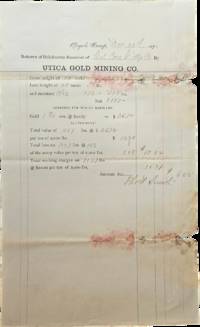
1898List3118Calaveras County California 1898. Seventy-two documents. Most sheets measure about 14 x 16 inches and are folded in half. Folded some with tears and water damage; overall very good to excellent. The Utica Mining Company was owned by mining moguls Alvinza Hayward Charles D. Lane and W.S. Hobart and ran mines in Calaveras County California. This area located on a portion of the Mother Lode had been an exceptionally productive gold mining district; its productivity declined in the latter half of the 19th century until new techniques especially in hard rock mining created a “Second Gold Rush†in the late 1880s that lasted until World War I.1 The Utica company owned two mines with nine claims—the Utica mine and the Gold Cliff mine—and employed about 250 men at its peak. It also owned the water source in the town of Angels Camp and some claimed essentially ran a company town there.2 Among multiple other accidents and controversies it was alleged after a cave-in that killed seventeen miners that Utica’s owners had known that a disaster was likely and had failed to act.3<br /> <br /> Offered here is a collection of documents mainly payrolls of the Utica Mining Company dating between 1889 and 1898. There are also receipts for goods and services including from D. D. Demarest who owned the Altaville Foundry and reports on sulphurets. Payrolls are organized by which jobs the men worked milling ditch work etc. Employees are identified mostly by full names except for one: “Chinaman†who appears on several early 1889 documents. However the company seemed to have hired a second Chinese laborer by July of that year as he and his compatriot are identified by name: Ah Fun and Ah Sing. According to the Calaveras Heritage Council there was a lively community of Chinese miners just outside Angels Camp in the midcentury though it declined precipitously as the century went on particularly following the 1882 Chinese Exclusion Act.1<br /> <br /> Of interest to historians of mining in central California.<br /> <br /> 1 Judith Marvin “Angels Camp†Calaveras History https://www.calaverashistory.org/angels-camp 2011.<br /> 2 “C.D. Lane’s Address†Daily Miner-Transcript September 8 1896 2.<br /> 3 “Entombed Alive. Dreadful Disaster in a California Quartz Mine†The El Paso Journal December 28 1889 6. unknown
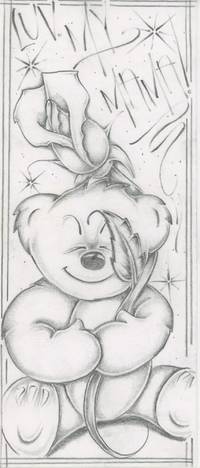
2015List3213California 2015. Eighty letters ten artworks and two photographs. Anonymized for writers’ and their families’ privacy with more information available on request. Overall excellent. Offered here is a collection of letters and art sent from people incarcerated in the California State Prison system primarily from a husband “P.†and wife “A.†to P’s mother and stepfather. <br /> <br /> A. who served a shorter sentence than P. worked as an inmate-firefighter. Currently about twenty to thirty percent of California’s firefighters are incarcerated people and about ten percent of those are women; they work cutting the fireline receiving little compensation and at a significantly higher risk of injury than both their non-incarcerated counterparts and other prison laborers. They also are not eligible to become firefighters upon release due to California’s laws about both employment and EMT certification following a felony conviction.1 A. writes of her training:<br /> <br /> “I’ve been training for camp. Its realy realy hard. This has got to be the hardest thing I’ve ever done in my life. Well Im gonna make this my last trip to prison well I hope so anyway.†January 12 2009<br /> <br /> She also writes from the field that “Its very hard and dangerouse but I guess Im used to it†June 6 2009 with later letters giving more detailed descriptions; for instance:<br /> <br /> “Im not in San Diego right now because my crew and my cousins crew got sent to all the fires that are up North = we left on the 4th and we’ve been on the road and to a couple of fires since I don’t know when we are going back but Im making money! yesterday I worked a 24 hour shift and we got back to have our down time to rest this morning. Its very tireing and hard I felt like I was hiking forever! Right know Im up in Shasta County its beautif up here and I’ve never been this far from home befor.†August 14 2009<br /> <br /> A. wanted to save up to buy a car. She wrote that firefighting is “hard work for a dollar a day†December 14 2009—in 2023 the inmate-firefighter pay rate was raised to an astounding 16 to 74 cents per hour with a maximum daily rate of $5.80 to $10.24.2<br /> <br /> P. on a longer sentence in various higher-security facilities grappled with boredom loneliness and the bureaucracy involved in trying to contact his wife and family. The prisons where he was incarcerated were frequently on lockdown for months at a time including the Corcoran Substance Abuse Treatment Facility which locked down in June of 2009 following a gang-related riot. He often describes being hungry and not allowed to go to the commissary either because of lockdowns or just because “there not letting Hispanics go†January 30 2011.<br /> <br /> One way he seemed to have dealt with his circumstances was through art. Over time his package requests—incarcerees can only be sent packages through approved third-party vendors which contract with prisons—included alongside toothpaste and deodorant art supplies and even a typewriter and books on “how to properly write a novel†January 30 2011. He mentions copying drawings and the reader can see him experiment with different handwriting styles in the letters and on envelopes. The art in the collection includes greeting cards with teddy bear clown—a common character in Chicano art—and nature motifs; a Las Vegas Raiders butterfly signed “E†most likely by P.’s cellmate Ernie for whom drawing is a “little hustle to make money for food and supplies†January 30; and a pair of beaded earrings that P. bought for $10 “to some Indian here†August 25 2010.<br /> <br /> Of interest to scholars of outsider art and incarceration in the California prison system.<br /> <br /> 1 Carly Tolin “Fighting More Than Fires: California’s Inmate Firefighting System Needs Reform†The Georgetown Environmental Law Review February 6 2025.<br /> 2 Doug Melville “Inmates Can Make Up Nearly A Third Of Those Fighting California Fires†Forbes January 9 2025. unknown
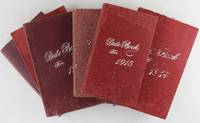
19163823San Diego 1916. Very good. Eight volumes totaling 2635 pages and approximately 85000 words with individual daily entries ranging from a single line to an entire page. Six volumes octavo final two volumes twelvemo all matching "Date Book" annual diaries uniformly bound in matching limp red cloth. Varying levels of rubbing edge wear and insect damage to cloth. Internally clean with occasional related newspaper clippings pasted in. A prime example of "history from below" comprised of eight manuscript diaries recording the daily activities observations thoughts and feelings of a young man living in San Diego for 2635 of the 2920 days that occurred from January 1 1909 through December 31 1916. Allen H. Wright was originally from Rome New York where he returns at least once in the time period covered by the present diaries but the diaries otherwise wholly pertain to Wright’s life in San Diego over an eight-year period. During this time Wright worked a variety of jobs such as shoe salesman freelance journalist with numerous specific mentions of article submissions mentioned here and City Clerk of San Diego. Wright was married to Florence Wright and the couple had two children - Allyn and Helen. Wright balanced his work life with family activities such as picnics trips to the beach visits to San Diego harbor where they witness the arrival of Mexican Japanese and other ships vacations across California and more. He also kept busy socially attending church and recording numerous instances of the meetings of his stamp club the “Floating Society†the New York State Society the “Men’s Club†and other organizations. In addition Wright makes numerous mentions of visitations letters received and news from back home in New York and other places.<br /> <br /> Considering Wright’s voluminous number of diary entries there are necessarily many thousands of subjects events names and more covered by him. A very small sampling of entries from just the first diary relate a wide variety of experience including: the robbery of the local library Wright’s attendance at the local Congregational Church to witness the anniversary exercises of the Chinese and Japanese missions the visit of a “young Mexican†to Wright’s house who asked to buy some flowers for the funeral of a baby the details of a day spent at the Ringling Brothers circus and parade the arrival of a copy of McCarthy’s “Lincoln’s Plan of Reconstruction†that Wright won from an Anderson Galleries book auction and information on other books and autographs he buys including California history works and legions more.<br /> <br /> Wright's life was relatively peaceful with much content recorded here on daily activities talks and sermons heard at his church “I heard Rev. Madison C. Peters the noted divine talk on what the Jew has done for American civilization†and so forth but naturally he also puts down his thoughts on some important and notable historical events. On April 15 1912 Wright writes: "News came today of the wrecking of the great ocean liner 'Titanic' on her first trip from Southampton to New York." In April of the next year Wright attended a lecture of the famed Arctic explorer Frederick Cook who referred to Admiral Peary as “a liar thief and murderer†as Cook claimed that “he himself has been cheated out of the honors which rightly belong to him as the true discoverer of the North Pole.†In January 1916 Wright “heard Upton Sinclair the novelist and author of ‘The Jungle’ talk on ‘After the War’ at the Open Forum. He is not an orator by any means but is argumentative in his utterances. A much more youthful man than I expected to see. Some of his socialist brethren here differed with him.†Wright had attended a speech by Teddy Roosevelt the year before also centered around World War I: "His main plea was for preparedness for war." The threat of the First World War was growing at that time but the event comes off as rather remote in Wright's account of a mostly quiet life in Southern California.<br /> <br /> Another military event which occurred very close to Wright’s home city was the Mexican Revolution which he makes several mentions of in his diaries beginning in August 1913: “Late tonight a special train brought in about 500 Mexican refugees from the frontier at El Paso Texas and Nogales Arizona who had been ordered here by the war department under escort of U.S. troops. Col. Emilio Kosterlitsky sic head of the rurales and Col. J.M. Reyes of the regular Mexican army are among those in the party.†Wright also notes further interactions with refugees the landing of American troops in Vera Cruz in April 1914 which he hopes won’t squelch a real estate deal for himself the arrival of “over a thousand marines†set to train on North Island in July 1914 the attack on a garrison in Tijuana by “the Villa troops†in December 1914 and more.<br /> <br /> Managing elections and oversight of voting was apparently a significant part of Wright's position as City Clerk. In a typical entry from November 1911 he reports "A total vote of 4380 was gotten out including a large percentage of women who thus had their first crack at the ballot." Earlier that same year Wright mentions sending out “2200 sample ballots†and promises to “get off as many more tomorrow.†The next year Wright reports that “for the first time in my voting experience I voted for the Democratic electors for president and for a Democrat ‘Billy’ Kettner of this city for Congress.†Wright was also privy to details regarding local government and political maneuverings as well as the economics of city development and various bond issues.<br /> <br /> A voluminous manuscript record of "ordinary" life in Southern California in the first decade-and-a-half of the 20th century with about 2600 daily entries over the eight years covered providing an opportunity for much deeper research into Wright’s time and place. unknown
193052081San Francisco: W.P. Fuller & Co. ca. 1930. 4to. 16 pp unpaginated. Numerous colour illustrations black & white illustrations comic strips diagrams. Colour-illustrated softcovers minor dustsoiling shelfwear slight soiling front cover pencil annotations back cover still VG copy from the library of Henry A. Heider 1892-1969 and Russell E. Heider 1919-2005 Portland OR carpenters & building contractors. First edition of this nicely illustrated Jazz Age colour guide for the home using W.P. Fuller Company’s paints. This informative guide details the dangers of cheap paint and that the family home must be carefully maintained with paint instructions for Spanish style stucco homes shingled homes English Tudor revival style including sample colour schemes for the homes. In addition it describes the exterior paints interior paints and other Fuller products. Fuller was also one of the largest suppliers of glass on the West Coast and has included a detailed section on the latest thing in bathrooms -- Carrara structural glass which gives bathrooms a sense of spaciousness. Originally founded by W.P. Fuller in 1851 during the gold rush it was established as Whittier Fuller & Co. in 1867 in San Francisco and finally incorporated as W.P. Fuller & Co. in 1894. No copies located in Worldcat. W.P. Fuller & Co., paperback
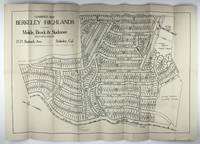
19132082Berkeley: Meikle Brock & Skidmore 1913. Very good. Folding map approximately 18 x 26 inches. A couple of short separations at fold points. Contemporary manuscript docketing on blank verso. Light tanning. An early 20th-century cadastral map that shows block and lot numbers property dimensions railroads partial land ownership and more in a new subdivision north of Berkeley here called Berkeley Highlands and now known as Kensington. The depicted area is bounded generally by Arlington Road Highland Avenue Purdue Avenue Beloit Avenue and Yale Avenue oriented with north to left. Land development companies had bought most of the Kensington area by 1911 when it was first surveyed. The area was named "Kensington" in 1911 by Robert Brousefield a surveyor who had lived in the London borough of South Kensington at one time. The Berkeley Highlands with most streets named for colleges and universities was subdivided slightly later than Berkeley Park and Kensington Park. The map was produced for Meikle Brock & Skidmore the agents who developed this land in the East Bay Hills and then sold the lots. <br /> <br /> The map is also notable for its notation in the lower right corner of the “Private Estate of George Shima." Shima was a Japanese immigrant who became the first Japanese American millionaire His assets were valued $ 18 million in 1920. At one point he produced about 85% of the state's potato crop which earned him the nickname "The Potato King." His business success did not bring him respite from racism however. In 1912 he moved to his new home in this Berkeley neighborhood where he lived in regal fashion employing a retinue of servants and also purchased the adjoining lot and converted it into a garden adorned with rare shrubs and flowers imported from Europe and Asia. Despite being the subject of hundreds such newspaper headlines as "Yellow Peril in College Town" Shima became active in the community donating $500 to the local YMCA and gradually won over his neighbors. Still the opposition he encountered led him that same year to become the first president of the Japanese Association of America and to unsuccessfully fight the passing of the California Alien Land Law of 1913 which was written to prevent Asians from owning land. Scarce we locate copies at Berkeley and Yale. Meikle, Brock & Skidmore unknown
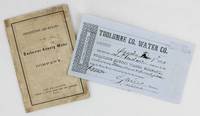
18642880San Francisco: Towne & Bacon 1864. Good. 16pp. plus printed receipt completed in manuscript. 16mo. Original tan printed wrappers. Light dampstaining and soiling. Corners of each leaf and some edges reinforced with tape. Minor soiling and later ink stamp on receipt. An ephemeral production outlining the articles of incorporation of the Tuolumne County Water Company together with a receipt for water rents dated 1853. First incorporated in 1852 the Tuolumne County Water Company was founded to funnel the waters of the Stanislaus River "to the various ravines gulches flats and other localities in the County of Tuolumne to be used for mining mechanical manufacturing and other purposes". The decline in mining in the area led to the decline in water revenues resulting in dissolution at the start of the 20th century. An important and early piece of California's tortured history with water. A handful of copies in OCLC. Towne & Bacon unknown
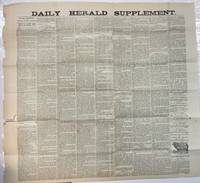
187540463Los Angeles 1875. Elephant folio broadside Supplement for 6 June 1875. 21-1/2" x 23-1/4." Printed in nine columns each column separated by a rule. Old folds one tear at inner blank margin just grazing a letter or two. Very Good. Numerous constitutional provisions printed including the Declaration of Rights Suffrage Education and others. <br /> <br /> "Heavily based on other state constitutions the 1848 California Constitution proved inadequate to meet the long-term needs of the flourishing new state. Political leaders tried to amend the document via constitutional convention and the amendment process; however during the 30 years which followed statehood all three constitutional convention ballot proposals failed to win voter support and of the many constitutional amendments proposed only three became law. Finally in 1877 the state legislature again submitted the question of convening a Constitutional Convention to the voters this time it passed" online Pacificus web site 'A Brief History of the California Constitution'. unknown
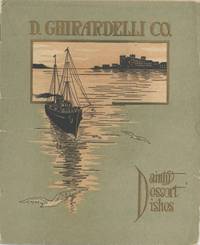
19006830San Francisco: Ghirardelli Chocolate Company 1900. Stapled booklet 15 x 12.5 cm. 16 pages. Illustrated and printed in halftone throughout in black red and gray. FIRST EDITION. A collection of recipes for chocolate ice cream cookies puddings jumbles kisses and more. “Chocolate Bretzles†and “Chocolate Africans†are among the more interesting inclusions. Publisher’s stapled illustrated and blind-embossed wrappers with some light edgewear. Otherwise fine. Scarce. OCLC locates five copies. Ghirardelli Chocolate Company unknown
194358524Pomona CA: Frashers Inc. 1943. Oblong 12mo. 3.75 x 2.5 in. 12 miniature Real Photo Postcards w/ text w/in the negative preserved in original mailing portfolio die-cut window on recto canceled stamp & address on verso minor dustsoiling shelfwear to portfolio still NF set of RPPC’s from the library of George Stein 1914-1988 stationed at Camp Haan in World War II and was a longtime driver and heavy equipment operator for the Clark County Highway Dept. son of Gran Duchy of Luxembourg immigrant farmers and later builder in Vancouver WA. This complete miniature set of Real Photo Postcards shot by the iconic California photographer includes such images as “20 Mule Team Borax Wagonsâ€; “Furnace Creek Campâ€; “Salt Pool and the Devil’s Golf Courseâ€; “Death Valley Scottyâ€; “Mushroom Rockâ€; and others. Frasher 1888-1955 opened a commercial photography studio with his wife Josephine Angel in 1912 with her shooting portraits and Frasher traveling Eastern California by automobile in the 1920’s and 1930’s on photographic expeditions. He would eventually produce over 60000 negatives and his stock-in-trade Real Photo Postcards were very popular. See: Peter Hiller Visions of the West; The Photographic Legacy of Burton Frasher Sr. Postcard History March 30 2020. Frashers, Inc., unknown
192770051Oakland: Horwinski Printing Co. 1927. First edition. Octavo. 8 pp. Two page of photographs showing construction; portraits on inside front wrapper; view of bridge on rear wrapper. publisher's printed and illustrated wrappers stapled. A very good copy.The bridge of course is no longer present having been recently torn down with a modern replacement. The Carquinez Bridge is actually two bridges. The original crossing opened in 1927 and to accommodate the ever-increasing traffic flow on Interstate 80 Caltrans in 1958 constructed a parallel bridge to function as the eastbound span. The original span was replaced in 2003 by a graceful new suspension bridge which carries westbound vehicular traffic across the Carquinez Strait as well as bicycles and pedestrians on a bicycle and pedestrian pathway.The new bridge is named for the late Bay Area iron worker Al Zampa who helped construct the original Carquinez Bridge as well as other Bay Area toll bridges. No copies listed in OCLC/WorldCat. Horwinski Printing Co. unknown
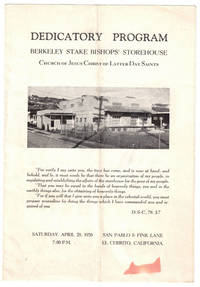
55143Printed by the Q--Four Press A Priesthood Project operated by the Fourth Quorum of Elders of the Berkeley Stake. Very good. 4pp. Program 12 1/2" x 9" folded vertically through the center. Small orange stain in bottom fore-edge corner of front wrap. Printed by the Q--Four Press, A Priesthood Project operated by the Fourth Quorum of Elders, of the Berkeley Stake unknown
194563931San Diego CA: Del Mar Turf Club Frye & Smith 1945. 12mo. 6 pp unpaginated. triptych which opens into 10.5 x 6.5 in pictorial map printed in blue & black self-printed softcovers front cover art of Bing & Pat on the phone map on back cover w/ small annotation in ink indicating “My Home†pointing at Encinitas CA. First edition thus of this delightful pictorial map/brochure celebrating the Summer racing season at the beautiful Del Mar Turf Club horse track as World War II drew to a close. Found in 1937 by many Hollywood stars in partnership but headed by Bing Crosby & Pat O’Brien who were ardent horse racing enthusiasts and drew tremendous attention to the racetrack considered one of the best in the country. The 1938 Seabiscuit and Ligaroti match race had raised tremendous awareness and interest in the racetrack and was largely closed and repurposed for use as a B-17 tail assembly plant however this brochure touts their return in 1945. Worldcat locates 1 copy UCSD. Del Mar Turf Club, [Frye & Smith], paperback
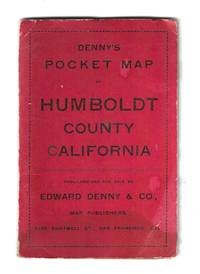
190878141San Francisco: Edward Denny & Co 1908. Uncommon scale map of the densely forested rural county situated along the Pacific Coast in Northern California’s rugged Coast Ranges. Relief is shown by hachures and spot heights.<br />  <br /> The 16 ½†x 30 ¼†map is printed in blue and folds into printed red cardstock wrappers 4†x 6 ½â€. A few small ink smudges to the map. The wrappers are edgeworn with some minor staining along the lower edge. Scarce OCLC locates only 4 holdings: Library of Congress Stanford Davis and Berkeley. Edward Denny & Co unknown
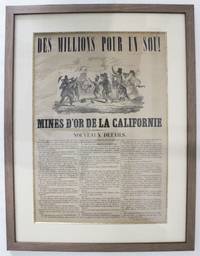
18495043Paris: Typ. Schneider Rue d'Erfurth 1 1849. Very good. Broadside approximately 18 x 13 inches. Matted and framed. A pair of short closed tears repaired at lower edge. Even toning and light creasing. Contemporary manuscript annotation under caption title. A wonderful illustrated faux news broadside published in Paris as gold fever coursed through Europe in 1849. The headline promises "nouveaux détails" of the gold mines in California but the text is in fact a humorous description and light-hearted admonishment of the multitudes thoughtlessly giving up their livelihoods for the hardscrabble life of a gold digger in the California wilderness. The first section runs through a litany of types who are abandoning their lives for adventure and advises them not to consider the difficulties of the journey:<br /> <br /> "En route pour les mines d'or de la Californie! Partez! Il n'est pas néccessaire que vous preniez de lourds baggages : une cassette et une bonne pioche vous suffriont. Ne vous laissez pas décourager par la peur d'une navigation de cinq mois. elle sera peut-être périlleuse. mais le résultat est si consolant : de l'or!. toujours de l'or!. Qu'importent la colique et les fièvres doublées d'un mal de mer brutal. de l'or!. toujours de l'or!. Qu'importe d'être noir ou jaune en mourant du moment qu'on se repose dans un linceul d'or pour l'éternité! Partez!"<br /> <br /> The remainder of the text somewhat sardonically describes life in California and warns prospective travelers not long for the comforts of home but rather to concentrate on their sought-after riches:<br /> <br /> "Par example ne vous attendez pas à jouir de toutes les douceurs de la vie. Vous n'y trouverez ni biftecks au beurre d'anchois ni dinde truffées; car les aliments y sont rares. Mais les racines y sont en grande abondance. Vous vivrez un peu à la manière des anachorètes pour un temps. seulement vous déterrerez de l'or. ce qu'ils ne faisaient pas que l'on sache."<br /> <br /> The illustration which occupies approximately the top third of the broadside depicts men and women from all walks of life carrying pickaxes on their shoulders and racing for a ship about to depart. The image carries the printed signature of "B. Netter;" a contemporary manuscript note under the caption identifies the publication date as February 17 1849. The Bibliothèque Nationale de France estimates that as many as 40000 French men and women made their way to California between 1848 and 1856. The present broadside is an excellent document of California gold fever in France and the pervasive interest in gold rush news in Europe during the mid-19th century. Rare we locate just four copies at Berkeley UCSD California Historical Society and the BNF. Typ. Schneider, Rue d'Erfurth, 1 unknown
189553540Chicago & New York: Rand McNally & Co. 1895. 8vo. 333 1 pp. Red linen decorated & lettered in gilt on front cover gilt lettering on spine t.e.g. minor rubbing minor soiling to spine slightly cocked still VG- copy. First American edition of this curious Henty title first published in book form in England by Chatto & Windus 1894 of this curious mystery of mystery and kidnapping of one of two twin girls used to inflict pain upon the father and the twin sister. The mystery is resolved by the young hero in the last half of the book in the gold camps above Sacramento CA. Rand, McNally & Co., unknown
199364153Los Angeles CA: Institute of Archaeology University of California Los Angeles 1993. 4to. xv 1 207 1 pp. Frontisp. with photographs maps diagrams charts throughout. White publisher’s cloth pictorial birds-eye map view of Los Angeles on endpapers minor bumping to corners w/ d.j. cover art photos by Greenwood minor bumping to couple corners still VG/VG copy from the library of David Kohl 1946-2025 former art teacher at the Hong Kong International School musician artist and historian. First edition of this surprisingly scarce work summarizing historical research fieldwork and laboratory analysis offering an incomparable view of Chinese-American society and community in Southern California prior to the dislocations caused by construction of the Santa Ana Freeway. Many of these discoveries were made during the early excavations prior to construction of the Los Angeles Metro Rail and provide essential information on food preparation recreation health and medical practices the roles of women and children in Chinese-American society and the extent of local social networks. Institute of Archaeology, University of California, Los Angeles, hardcover
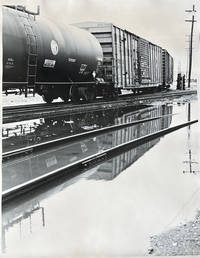
198863366Los Angeles & Westlake Village CA: Bill Bronstein 561 Hampshire Rd. ca. 1988-1989. Folio. 41 original silver gelatin photographs mostly on Ilford Multigrade IV RC Deluxe paper a few w/ photographer’s annotations on verso all sized 11 x 14 in. minor rippling to fore-edges of a couple images still a VG archive preserved in the original Ilford box w/ MS label on white tape affixed to box lid all retaining bright strong contrast from the collection of the photographer. This effective archive of 41 original photographs by Bronstein b. 1949 encompass a series of 34 images he began in the late 1980’s documenting the industrial arteries of Los Angeles Long Beach and San Pedro California transforming through black and white the visual contrast shadow and grit of areas seldom captured. Depicted are grain silos stark against the sun above the railyard; Southern Pacific oil cars with graffiti and rust; the vast Western Paper Mills Supplies Inc. recycling center established in 1983; refinery & cement factory tanks reflected in polluted pools of water; along with night and day shots of the vast railroad switching yards in Los Angeles. A few photos capture the Sunlaw Partners cogeneration power site in Los Angeles who were a pioneer in providing clean safe and efficient power from their plant; and mounds of oil tank floats piled alongside the tanks. Also included are photos of the Vincent Thomas Bridge crossing Los Angeles harbor in San Pedro CA; fishing boats in harbor and Long Beach CA railyards. This archive finishes with seven photos capturing Santa Clarita & Mojave desert along I-395 the Amargosa River and the surrounding landscape. Bill Bronstein, 561 Hampshire Rd., unknown
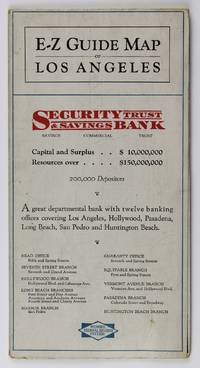
19222022San Francisco: Fred S. Bain Inc 1922. Very good. Folding map approximately 13 x 17 inches. Light wear along folds. Minor staining and dust soiling. A neat promotional map of early-1920s Los Angeles distributed by the Security Trust & Savings Bank. The reverse of the map carries a detailed street index as well as lists of hotels railroad offices and other significant municipal and commercial buildings. The map itself delineates Los Angeles from Hollywood and Highland Park in the north to Huntington Park in the south. Attached is a volvelle indicator which can be used to locate streets on the map in conjunction with the index. A second map oriented along the left edge of the sheet shows the major rails and roads of greater Los Angeles from Santa Monica and San Pedro to San Bernardino and Riverside. Fred S. Bain, Inc unknown