[California / Travel]. Coke, Henry JBiblio.com
8 987 résultats
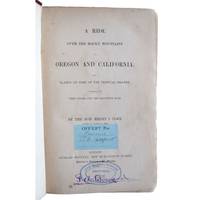
18521866London: Richard Bentley 1852. First edition. Good. 23 cm. x 388 2 2 blank 16 ads. Original burgundy marbled cloth frontispiece portrait of the author. Edgeworn with slight chipping to spine foot and joints; evidence of adhesive removal presumably library labels to spine; front joint cracked with corresponding gutter break following title leaf; one leaf detached but present; spine cocked; occasional minor foxing. Ex-library with moderate markings and bookplate signature and label of donor to title page. With the bookplate of the first French library in San Francisco. Richard Bentley hardcover
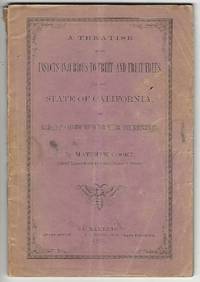
188120560Sacramento: State Office 1881. 72 pp illustrated with small wood engravings in original lavender printed wrappers. Some chipping to spine old tears and tape repairs to back wrapper else very good. Matthew Cooke was in the business of manufacturing fruit boxes in the 1870s when California's apple crop was devastated by Codlin moths. He began studying entomology to find defense against the moths and ensure the security of his business and quickly became an expert on a range of pests affecting California's fruit crops. He was appointed Chief Executive Horticultural Officer of California in 1881. This report prepared at the request of the State Board of Horticultural Commissioners describes the life cycles of the major insects damaging fruit crops moths scale insects mites caterpillars borers aphids etc. and recommends remedies for dealing with each. It also includes the text of new legislation intended to protect and promote the horticultural interests of the State of California. State Office unknown
1896225006Bosotn Raymond & Whitcomb 1896. 1896. Small oblong 8vo 5 1/2" x 4 1/4". 10 full page illustrations of hotels etc. 69 pages covers. A tight fresh copy. No signatures or bookplates. Printed by American Printing and Engraving Boston. Includes information on Mt. Lowe Pasadena Santa Barbara etc. Soft cover. Bosotn, Raymond & Whitcomb, 1896. paperback
194564014San Francisco CA: Carl Frederick Hobby 1211 Jackson Street ca. 1945. One large oil painting on canvas sized 11 x 14 in. preserved as original stretched canvas within the frame as presented to the artist’s niece and with the original green & gilt frame sized 14.5 x 17.5 in. now professionally cleaned and w/ artist’s pencil numbering on verso of frame and apparently executed about the same time as his “Produce Stand†painting. Signed in lower corner this painting was presented by the artist following the War to his niece and held in the family until 2025. This original oil painting depicts a young Chinese-American child drinking from a bottle of orange soda in traditional Chinese hat and high-collared cloak with rain falling around the subject as well as brick wall and cityscape faintly in the background. Chinese-American children were frequent subjects along with their families for the artist as he often featured them with parents marketing or in their everyday lives on the teeming streets of San Francisco. This close large portrait represents an unusual format for the artist as he tended to paint and draw group scenes.Hobby 1886-1964 was the son of an Iowa City IA ophthalmologist and moved with the family as a teenager to San Diego CA about 1900 where he began working at 14 as a sketch artist and later published a book in San Diego in 1919 with his artwork. He studied art at the Cumming School of Art in Des Moines the Art Students League in New York and became portrait and landscape painter in San Diego until 1923. After a divorce from Plooma Crowther he settled in San Francisco in Chinatown where he became an instructor at the Art Center while also painting and sketching the densely populated area publishing “The Street of Dragon Lanterns Chinatown of San Francisco†in 1936 while contracting with the Madison & Burke Agency through World War II. Exhibits of his paintings and pen & ink sketches were displayed at the Oakland Art Gallery in 1928 and the Society for Sanity in Art in 1945. See: Maud McB. Maywood Palm City The Chula Vista Star July 9 1937 p. 6; Sketches of San Diego 1919. Carl Frederick Hobby, 1211 Jackson Street, unknown
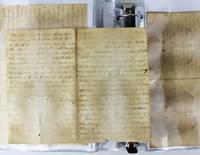
78065A binder containing historic land documents provided as legal support for the transfer of a Sacramento parcel in 1920. The property was originally part of a land grant made by the Mexican government in 1841 to John A. Sutter who established Sutter’s Fort in the area that would become Sacramento.<br /> <br /> The property at issue is described as “the south one-half of lot number one and the south thirty-five feet of the north one-half of the west three-quarters of lot number one in the block bounded by 2nd and 3rd and M and N streets†in the city of Sacramento. Today it appears the 5 Golden State Freeway and Capitol Mall Drive run through this property.<br /> <br /> In January 1920 H.A. Mitchell purchased for $1.2 million the land and other property and assets of the failing Oakland Antioch and Eastern Electric Railroad. Mitchell was a member of the reorganization company known as the San Francisco-Sacramento Railroad Company which the Railroad Commission approved to take over the former railway and issue new stock.<br /> <br /> The documents known as the abstract of title were made by Buckley-Gerber Abstract & Title Co. The materials are housed in a blue cloth binder covered with labels. unknown
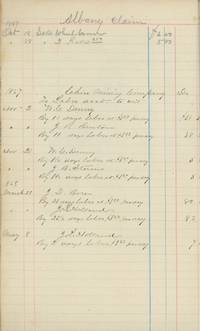
1868List2828Eureka South CA 1868. 7 ½ x 12 inch ledger book 33pp with many more blank. Front cover near detached and back cover detached missing spine some staining of inside pages. Many inside pages torn out. Overall good to very good. An accounting ledger with some annual meeting notes of the American Exchequer Gold Mining Company based in Eureka South California dating between 1866 and 1868. Eureka South was a small remote mining community with a population of about 400 people during the peak of its diggings’ productivity – now called Graniteville it had a population of twelve as of 2022. <br /> <br /> According to a copy of the company’s notice of location for its mine in Eureka South recorded in this ledger in November 1866 the company was founded on August 24th of that year following the discovery of a quartz ledge. A history of Nevada County describes 1866 as the year of the “revival of the quartz excitement of 1851†in Eureka South.1 Before this as the surface diggings began to dry up people had begun to abandon the town; with the quartz excitement the population swelled from twenty to 400 in a few months.<br /> <br /> However it does not seem as if the “American Exchequer Ledge†as they named the quartz vein in the location notice proved very productive. The minutes of the company’s 1866 annual meeting state:<br /> <br /> “matters of interest to the company were discussed ‘twas thought best to do but little more this winter than run the tunnel in some 50 to 100 feet further if we do not strike the ledge in the tunnel with this amount of labor added to it that we try and be prepared with money from assessments to put in a contemplated long tunnel down in the Hill in search of the Ledge.†November 27 1866<br /> <br /> Otherwise the ledger lists specific locations or other companies and associated expenses including “Albany claim†and the “Chico Mining Company†from whom American Exchequer bought the Chico mine; and wages and purchases such as hiring a horse for locating claims and “Whiskey for the boys†costing $4. Of interest to historians of mining and Northern California.<br /> <br /> 1 Harry Laurenz Wells History of Nevada County California Thompson & West: 1880 62–63. unknown
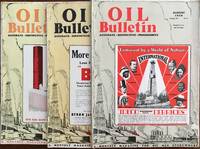
192958135Los Angeles CA: California Oil and Gas Association 1151 S. Broadway May Aug.-Sept. 1929. Three vols. 4to. 449-560; 785-896; 897-1024 pp. With 100’s of photo illustrations text illustrations diagrams illustrated ads many in colour. Colour-illustrated softcovers photo cover art of oil derricks and McDonald equipment Byron-Jackson Co. Oil Tool Division ads on back covers slight shelfwear very slight bumping minor tears to a couple spines still a VG bright set. First editions of these very scarce issues of this noted California oil industry trade magazine filled with articles and advertisements for oil derricks oil drilling equipment addressing oil drill and oil rigger safety issues oil fires and more. A number of articles focus on the development of the oil industry products for aviation fuels and the aircraft including one article on a trip in the “Rio Grande†Ford Tri-motor owned by the Rio Grande Oil Company. At the time Southern California was producing one-quarter of the World’s oil supply. Few examples of this lavish and expensive serial periodical survive either in institutional holdings or in the trade. California Oil and Gas Association, 1151 S. Broadway, paperback
77192An invitation "to witness my fine display of holiday meats" on December 22 and 24 1894 at the premises of Simon Maier at 149-151 North Spring Street in downtown Los Angeles. Printed on the recto only of a heavy card 4 3/8" x 3 3/8" with beveled edges.<br /> <br /> Born in Munich Simon Maier 1853-1931 migrated to the United States with his brother Joseph 1851-1905. Involved in the mining business in South Dakota for a time the brothers came to Los Angeles by way of San Francisco in 1877. Both established themselves as leaders in the business community: Simon as the owner of the Pacific Coast Beef and Provision Company the largest meatpacker west of Kansas City and Joseph as partner of the successful Maier & Zobelein Brewery. unknown
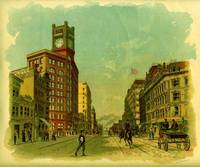
189417969San Francisco: H.J. Crocker Co 1894. First printing. Print. Very good condition. Chromolithograph of San Francisco and the Alameda County Building which boasted views of the 1894 California Midwinter Exposition which was held on 200 acres of what is now the Music Concourse of Golden Gate Park. The fair was the brain child of Michael de Young San Francisco Chronicle publisher who wanted a fair in his home city which would serve as an adjunct to the Chicago World's Fair. With descriptive text on the verso. 13 1/4 x 10 H.J. Crocker Co unknown
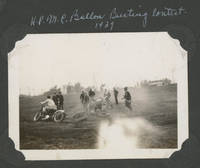
1939List1206Mostly Los Angeles 1939. Oblong quarto containing 117 photographs. Sixty-two of the photographs involve motorcycles directly either action shots or posed shots in attire with many others showing scenery from motorcycle tours. Some photographs missing those present are in excellent condition with fine contrast very good condition overall. Very Good. A charming album documenting the lives of a couple from California and their love of motorcycle touring and racing in the late 1930s uncommon for the many pictures of women in motorcycle clothing that are included. Some of the photographs document travels some in the west such as the Boulder Dam Arizona Big Bear Lake etc. and some at a motorcycle meet in Marion Indiana. Several photos show a crashed U.S. Army bomber at Miner Field in Inglewood. Several show San Gabriel Canyon on Thanksgiving 1937 with one showing a portrait of a woman captioned “Drunk Again.†Another shows a national time trial race in San Diego. The photos seem to follow a tight-knit group of friends with nicknames such as “Little Marvin†and “The Mad Russian.†Overall a charming document of late 1930s motorcycle culture in Los Angeles. unknown
188747663Columbus OH: Ward Brothers 1887. 12mo. 20 tinted lithograph plates tipped-in on accordion style leaves including birds-eye views. Elaborately decorated red boards w/ decoration & lettering in gilt and black backed in black cloth very minor rubbing light toning to rear pastedown still a VG copy. First edition of this wonderfully illustrated pocket-sized viewbook which featured the technique of lithographic images made from photo negatives and then finished with varnish to add depth. This piece includes birds-eye views of Riverside San Benardino County Riverside Orange Groves and vineyards early views of Magnolia Avenue local residences including P.K. Klinefelter O.T. Johnston O.T. Dyer as well as the Rowell Hotel First National Bank of Riverside the Calico Mining District an Indian Village and more. Worldcat locates 2 copies at UC Berkeley & Yale; See: Gottfried Landscape in American Guides and View Books: Visual History of Touring pp. 28-30. Ward Brothers, hardcover
193960410Stanford & San Francisco CA: James Ladd Delkin Bret Harte Associates of California WPA 1939. 8vo. 127 1 pp. Text illustrations throughout. Colour-illustrated softcovers map on back cover of the GGIE held on Treasure Island slight dustsoiling still NF copy. First edition of this excellent travel guide produced by the Federal Writers Project of the Works Progress Administration detailing events of the 1939 Golden Gate International Exposition held on Treasure Island in San Francisco and sights in the surrounding area. WPA & PWA New Deal program grants aided in funding the extravaganza. James Ladd Delkin, Bret Harte Associates of California, WPA, paperback
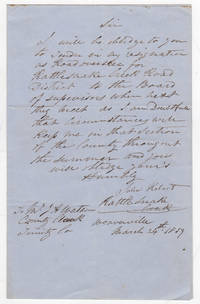
185944772Weaverville CA 1859. Very good minor creasing along edges and folds minor soiling contents clean. 1 pp. Bifolium. 5 x 8 inches. March 24th 1859. Gold Rush era letter from John Hobart to Trinity County Clerk J.A.Watson resigning from his post in Weaverville California . "I will be obliged to you to tender in my resignation as Road overseer for Rattlesnake Creek Road District to the Board of Supervisors when next they meet as I am doubtfull that circumstance will keep me in that section of the County throughout the summer." <br /> <br /> Weaverville California founded in 1850 was a Gold Rush town and once had a population of nearly 2500 Chinese goldminers. In 1855 the Weaverville Trinity Times called attention " the large and rapidly increasing number of Chinese among us.crowding themselves into every vacant spot they can find." unknown
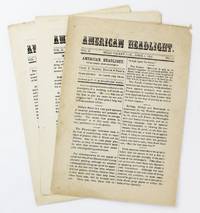
18876367Seiad Valley Ca 1887. About very good. Three issues 4pp. each. Light wear one issue splitting at center fold. A semi-monthly amateur periodical edited and issued by Charles T. Bailey. Present here are issues from Volume Two for 1887 numbers 17 21 and 23. The periodical seems to be full of the editor's witticisms and opinions and we note that very often the letter "E" is missing from a wide variety of words. As an exemplar "It has been discoverd that sea-watr may be made drinkabl by the addition to it of citric acid or citrate of silver." Of note is one opinion on the migration of the Chinese to the eastern half of the country which the author says makes the Californians quite pleased: "There is said to be a gradual xodus of the Chinese from San Francisco to easter cities where they will be right royally welcomd until their real natures become known. Then and not till then will our neighbors of the east become aware that the Asiatic is not such a desirabl companion as they would now hav us believ. Meanwhile the Californian is enjoying himself with the thought that by xperience shall they gain wisdom." We locate issues at four institutions -- the American Antiquarian Society the University of California at Davis the Newberry Library and the Huntington. unknown
1917914San Francisco 1917. Good plus. Sheet map 28 x 22.75 inches. Folded. Somewhat rumpled; a few small chips at edges not affecting text of map image. Several scattered patches of staining. A scarce real estate map of Berkeley California printed for and distributed by local agents Mason-McDuffie Company in 1917. Blocks are overprinted with lot numbers and letters as well as tract and neighborhood names and a street index is printed at the foot of the map. A large red arrow points to the location of the Mason-McDuffie office just west of the University of California campus and an area shaded in red labeled "Northbrae Properties" at the northern edge of the city limits indicates the principal real estate interests of the agents. We locate four copies at Berkeley Stanford the California State Library and the Oakland Public Library. unknown
192863890San Francisco CA: Carl Frederick Hobby 838 Grant Ave. ca. 1928-1930. One large oil painting on canvas sized 15.25 x 20 in. preserved as original stretched canvas within the frame as presented to the artist’s sister Ruth Annis Hobby Gibbs 1878-1940 and with the original green-stained frame now professionally cleaned faintly touched up in a couple indiscernible spots and backed w/ archival paper. Although unsigned this painting was presented with others by the artist over a 10 year period in the 1920’s-1930’s to his sister and held in the family until 2025. This original oil painting captures a street scene of young Chinese-American family strolling past Yee Sang Tong’s Chinese apothecary vividly displaying the historic building’s exterior a peek at the street around-the-corner and the advertising signage fronting the building in Chinese painted by Hobby. These signs include è£•ç”Ÿå ‚ Yee Sang Tong; åƒèŒ¸çŽ‹ç‰Œ Can song wangpai - premium ginseng and deer antler velvet products; and å„é …ä¸¸æ•£è—¥é…’ Ge xiang wan san yaojiu can ring wangpai - pills powders and medicinal tinctures of all kinds. Chinese-American apothecaries and pharmacies continued to be well-respected into the 20th-Century as Chinese-Americans were generally barred access from San Francisco’s hospitals and clinics and were often unfairly blamed for many of the diseases that occasionally swept the city. They often prescribed and distributed such traditional drugs as quinine digitalis and ephedrine. Hobby 1886-1964 was the son of an Iowa City IA ophthalmologist and moved with the family as a teenager to San Diego CA about 1900 about the time his sister Ruth Annis Hobby voyaged to marry her fiance during the Philippine Insurrection in 1899 in Manila. He studied art at the Cumming School of Art in Des Moines the Art Students League in New York and became portrait and landscape painter in San Diego until 1923. After a divorce from Plooma Crowther he settled in San Francisco in Chinatown where he became an instructor at the Art Center while also painting and sketching the densely populated area publishing “The Street of Dragon Lanterns Chinatown San Francisco†in 1936 while contracting with the Madison & Burke Agency through World War II. Exhibits of his paintings and pen & ink sketches were displayed at the Oakland Art Gallery in 1928 and the Society for Sanity in Art in 1945. See: Maud McB. Maywood Palm City The Chula Vista Star July 9 1937 p. 6; Elizabeth Fair Zijing Fan Hannibal Taubes Wendy Wan-ting Wang & Yifan Zheng Merchants and Revolutionaries: Chinese-Language Letters Held in the Chico History Museum Butte county Historical Society Diggin’s Vol. 67 No. 4 Winter 2023-2024. Carl Frederick Hobby, 838 Grant Ave., unknown
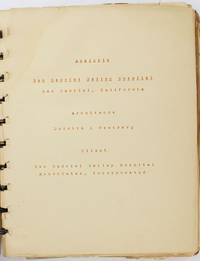
19535310San Gabriel Ca: Quintin & Westberg Architects 1953. Very good. 18pp. printed rectos only plus seventeen full-page mounted photographs. Quarto. Contemporary cardboard covers with clear outer wrappers spiral bound. Minor wear a couple of text leaves a few photographs and the rear cover detached but present. A seemingly-unique report on the proposed small-scale San Gabriel Valley Hospital prepared by Robert Quintin of the architectural firm of Quintin & Westberg in midcentury California. The text includes an introduction interviews with the architects and the hospital and a conclusion beginning with a historical background on the architectural needs of the group of medical doctors building the hospital and also including construction specifics "acoustical necessities" and more from the architects' perspective. The second section comes from an interview conducted with the hospital's representative David A. Lawrence who discusses management of the facility the quality and workability of the facility suggests numerous changes to the hospital based on his experience there and more. The text is illustrated with numerous photographs showing architectural plans exterior views and several interior views of various hospital locations such as the lobby major surgery minor surgery a typical patient room a corridor the delivery room nursery kitchen boiler room and so forth. There are also a few hand-drawn diagrams within the text. The architectural firm of Quintin & Westberg was based in Alhambra and lasted between 1941 and 1953 at which time the principals Scott Quintin and Edwin Westberg went their own ways. The present report is signed in type on the last page by Scott Quintin's son Robert who was in his twenties at the time and working as a draftsman for his father's firm. No copies in OCLC and likely prepared in very few copies for those involved with building the hospital. Quintin & Westberg, Architects unknown
1881303899Sacramento State Office J.D. Young 1881. 1881. Tall thin 8vo. Original black pebbled cloth stamped in gilt on the upper front cover. Very good. 43 pages. No dust jacket. No signatures or bookplates. Hardcover. Very Good/No Jacket. Sacramento, State Office, J.D. Young, 1881. hardcover
1921160171Los Angeles: California Theatre 1921. Archive of 41 vintage photographs of the elaborate stage sets and live performers which supported silent film screenings at the California Theatre in Los Angeles taken during the theatre's first three years in operation 1919-1921. 20 photographs with blindstamps crediting photographer Dick Stagg and 14 with blindstamps crediting photographer J.C. Milligan.<br /> <br /> Photographs housed in an album with typed labels on the versos of the adjacent pages identifying the film screening dates performers and musical numbers. <br /> <br /> The first two photographs in the archive feature a day shot and a striking night shot of the theatre's beautifully elaborate facade followed by a photograph of the "original installation" of the stage and grand staircase. The balance of the photographs however show theatre sets usually with performers present occasionally with the orchestra present and always without the audience present likely taken during rehearsals or after the completion of the set designs. <br /> <br /> The earliest dated photographs in the archive only two and a half weeks after the theatre's opening on December 24 1918 show two different sets for the screening of the 1918 film "Eye for an Eye." The last and latest photograph in the archive shows a parlor set with five costumed actors for the 1921 screening of the 1920 film "Billions." All in all 29 films are represented in the archive.<br /> <br /> Interestingly many of the screening dates of the films represented in the archive coincide with-or date earlier than-the currently believed premiere dates of the films some of which may have had their premiere at the California Theatre. <br /> <br /> Fred Miller opened the California Theatre at 810 S. Main Street in downtown Los Angeles on December 24 1918. The majestic Beaux-Arts cinema housed a capacity of 2000 and was designed by architect Alex B. Rosenthal who also designed the Granada Theatre in Santa Barbara. In 1919 the theatre was bought by Goldwyn Pictures and in 1935 operated as Teatro California often showing Spanish language films until 1983 after which it operated as a grindhouse and pornographic theater. The theater closed in 1987 and was demolished in 1990.<br /> <br /> Photographs: 8 x 10 inches. Very Good plus to Near Fine overall with some faint toning with one photograph with two vertical creases.<br /> <br /> Album: 13.75 x 10.25 inches. Very Good plus. California Theatre unknown
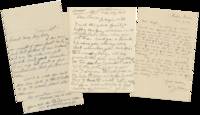
18744492Various locations in California 1874. Good. Ninety-four letters totaling 153pp. Mostly octavo. Leaves lightly dampstained and toned some faded. Old folds some separation and brittleness a few small areas of loss or tearing. An extensive archive documenting the activities of the Bridgeport Gold and Silver Mining Company in Sweetland California. Sweetland is in Nevada County about sixty miles north of Sacramento in the heart of the Sierra Nevada gold fields. At its peak it was home to a few hundred souls; today it is essentially defunct. In the present archive V.G. Bell secretary for the company writes to John Spencer in Nevada an agent for the company. John Spencer 1818-1891 emigrated to California in 1850 where he had some success at placer mining. After moving to Nevada in the early 1860s he became a successful rancher and public servant. We find Bell listed as a "ditching agent" in an 1867 directory for Bridgeport Township. Writing from by turns from Sweetland Birchville French Corral and North San Juan he apprises Spencer of the business activities of various mines including receipt of rent payments sent by Spencer reports of shareholders and trustees property upkeep and mine management. Specific mines mentioned include the Vineyard Mine the Bunker Hill Mine and the Baltimore Mine. Over half of the letters date to the period from 1864 to 1867. Though they have been exposed to water at some point they are mostly legible and are written in a neat hand.<br /> <br /> In the first letter here dated August 8 1864 Bell discusses the Trustees of the company as well as financing options available for the venture. He writes in part: "Dear Sir I have rec'd three reports from you the last of which was perfectly satisfactory; and had our supt. taken the same trouble during the latter part of last year to have made his reports as clean there would have been none of that bickering that took place between himself & the Co. In short the Trustees express themselves as well pleased with your mode of doing business. . It seems to be the desire of the Co. to husband our means in the territory as much as possible and make it a self sustaining institution as it is out of the question to raise means without resorting to borrowing; even at the rates of interest we could get money on this side for would soon eat the vitals out & have a dead concern on our hands."<br /> <br /> Much of the correspondence seems to include concern over the company's struggling finances. In a letter from February 1865 Bell asks Spencer to cut his salary writing "After a consultation of the trustees I was asked to write you in reference to a reduction in your salary to a less figure say seventy five dollars. The company is in debt here to a little over two thousand dollars borrowed money & they feel the necessity of reducing their expenses as much as possible and as there is so little doing with the company's business that it seems like a large salary to pay. . For one to look after this business without any thing else to occupy their time they are ready to admit is none too much and if your time is wholly taken up with their business do you not think it would be advisable to employ some competent person who could take time enough from other employment to see to our affairs." Bell assures Spencer that the Trustees are not unhappy with his work -- just his expense.<br /> <br /> A letter later that year in July discusses the hiring of a man as a second engineer also capable of blacksmith work. Other missives discuss the upkeep and refurbishment of a house as well as the means to rent it out. By October Bell has moved to discussion of the dispersal of some property as well as the difficulty of continually raising funds. "Your suggestion to levy an assessment in the Vineyard Co. to pay it out of debt meets with the approbation of our Co. which I presume was done at your last meeting. It is the wish of some of the members of our Co. to put our property in R into market & sell at some price & close the concern up. The Board is somewhat uncertain as to the course to pursue but the pressure is so great against the continuance of raising money by assessment that they will have to abandon that method for the time being."<br /> <br /> These excerpts are a mere sampling of the content. Some of the later letters are shorter asking for updates or indicating monies received though the bulk of the archive comprises letters that are two to four pages. An interesting and important snapshot of the activities of a large mining operation in the Sierra Nevada in the 1860s and 1870s and worthy of further research. unknown
19384491Primarily Los Angeles 1938. Overall about very good. Thirty-four printed items varying lengths; forty-eight postcards; eighty-four loose photographs mostly larger formats; string tied oblong folio album with sixty-six medium and large format images. Some wear with scattered chipping and closed tears to printed items. Occasional chipping and creasing to photo mounts. A few images beginning to fade but mostly crisp and clean. An extensive collection of photographs and ephemera related to the Mount Lowe Railway and various hotels and attractions that operated on Echo Mountain at the crest of the San Gabriel Mountains at the turn of the 20th century and the first part of the 1900s. The mountain was the site of a popular funicular that was originally engineered by Professor Thaddeus S.C. Lowe and opened as the Pasadena & Mt. Wilson Railroad Company in 1893. It was the only scenic mountain electric traction railroad ever built in the U.S. and it remained in operation until 1938 although its heyday was primarily the 1890s and the early-20th century. The railway consisted of nearly seven miles of track beginning in Altadena at a station called Mountain Junction and ending atop Echo Mountain at a magnificent seventy-room Victorian hotel called the Echo Mountain House. Only a few yards away stood the forty-room Echo Chalet which opened in conjunction with the railway. Other buildings on the peak over the years included an astronomical observatory car barns repair facilities dormitories a casino and a dance hall. Mount Lowe's operation was hit by a number of disasters which brought about a slow and ultimately terminal decline. The first was a kitchen fire that destroyed the Echo Mountain House in 1900. Further fires and floods eventually destroyed all remaining facilities and the railway was completely abandoned in 1938 after a storm cleared the mountainside and washed away nearly everything that remained.<br /> <br /> The collection includes thirty-four railway brochures pamphlets and other promotional items; two issues of the promotional Mount Lowe Daily News and a piece of sheet music in honor of the line; a collection of forty-eight postcards; eighty-seven loose photos mostly large format and mounted images; as well as a photograph album containing another sixty-six mid- to large format photos of this ingenious and precipitous tourist railway. The line was broken into three sections. The first was a fairly straightforward section that traversed the hillside residential sections of Altadena to the upper base of Echo Mountain. In order to reach the peak of Mount Lowe however passengers would have to transfer to a steeply graded and narrow funicular that travelled up 2200 feet on the "Great Incline" to the top of Echo before transferring again to wind up a further 3.5 miles on trolley cars over sharp switchbacks and curved viaducts with nicknames like "Cape of Good Hope." Because of the repeated setbacks caused by fire and storm the original owners sold the railroad and its mountain top attractions to Henry Huntington in 1905 after which the line operated as part of the Pacific Electric Railway for another thirty years. <br /> <br /> Amongst the printed matter here highlights include a program from the opening of the railway on August 23 1893 featuring a portrait of Thaddeus Lowe and an image of the Great Incline; a pair of extremely scarce copies of the illustrated promotional newspaper the "Mount Lowe Echo" from the early years of operation; three unrecorded broadsides advertising Mount Lowe excursions around the turn of the century; and a detailed and extensively illustrated pamphlet "Scenes on the Line of the Pasadena Mountain Railway." Also present are a clutch of nearly a dozen scarce color- and photo-illustrated brochures from the Pacific Electric era several illustrated leaflets including one with a bird's-eye view of Echo Mountain and Mount Lowe timetables and other promotional and review materials. The group of over fifty colorized photographic postcards were produced by a variety of publishers but a great number emanate from the shop of M. Rieder who produced numerous viewbooks of California towns in both English and Spanish-language editions during the early-20th century.<br /> <br /> The almost ninety larger format loose and individually mounted photographs show a variety of scenes depicting the railroad tourist facilities and environs across the span of its operation. Most are sized 8"x10" 5"x8" or in the vicinity of said measurements. The first group of photos shows early observation parties and other excursions including one mounted image by the Hill studio of Pasadena showing Professor Lowe guiding a party during the construction of the railway. The following considerate group comprises about twelve posed photos of children and families engaged in winter activities on Mt Lowe and clearly intended for an advertising campaign for year-round tourism to the peak and includes an idyllic image of children on a horse-drawn sleigh in the snow mounted on the card of LA studio Graham & Morill. Other studios represented here include C.B. Waite Putnam Studios and George Wharton James. There are also a number of images from the photo department of the Mt. Lowe Railway itself including numerous photos of the funicular and large souvenir images of tourists riding the open cars on the Great Incline. On the whole the images are often accompanied by manuscript or typed captions and in some cases by lengthy printed texts on the versos of card mounts.<br /> <br /> The terrific album of sixty-six photographs is focused for the most part on the early period of the railroad under the operation of Pacific Electric Railway following its purchase by Huntington in 1905. The professional photographer of these images is unidentified here but several conform to known photographs by C.C. Pierce who heavily documented the railway during this period and the group as a whole is heavily reminiscent of his work. The photos for the most part focus on the operation of the line and its dramatic setting and engineering with images of deep and narrow cuts along through the mountainside hairpin turns on precarious looking trestles the steep incline of the funicular and the astonishingly unfazed passengers. Mixed in with these are shots of the tourist facilities as they existed at that point and the mechanical and structural plant of the rail line. Similar to the loose photographs in the collection the album prints are mostly 8"x10" 5"x8" or thereabouts.<br /> <br /> In all a compelling and rich multi-format archive of one of the most interesting and spectacularly engineered tourist railroads of the late-19th and early-20th centuries. unknown
1935List2835California Texas Illinois and others 1935. 369 pieces: fourteen empty envelopes 108 pieces of unsorted ephemera and 247 letters. Of the letters twenty-one are undated; three date from 1851–1909; nineteen from 1910–11; thirty-five from 1912; thirteen from 1913–17; forty-two from 1921; thirteen from 1922–24; sixty-eight from 1934; and thirty-three from 1935. Overall very good to near fine. The Beaumans were a family from southern Texas who relocated to East St. Louis Illinois some time before 1908 and some of whom would later live in California. Captain Loui Beauman 1868–1921 was a military engineer Mason and member of the Society of American Military Engineers. He and his wife Kittie Woodruff 1867–1959 had three children survive to adulthood: Carrie Beauman 1893–1982 Second Lieutenant Loui Beauman 1894–1918—a Marine killed at 23 in a seaplane accident—and Julia Frances “Gally†Beauman 1908–1974. <br /> <br /> Offered here is a large correspondence archive belonging to the Beaumans; mainly addressed to Gally 119 letters the younger Loui seventy letters and Kitty fifty-two letters; and written by a wide variety of friends and family including Kitty fifty-one letters Carrie eighteen letters Katharyn Owen of San Antonio sixteen letters and Gally’s future husband Edwin J. Regan of Weaverville California twenty-three letters. Regan 1906–1996 was at the time running for District Attorney of Trinity County and would go on to hold that position before resigning in 1948 in favor of a State Senatorship followed by a judgeship on the Third Appellate Court of Appeal.<br /> <br /> Most of the early letters in the group are addressed to the younger Loui Beauman and their concerns include his friends’ jobs constructing railroads hiding their controversial “ragging†dancing from chaperones and which fraternity Beauman should join at the University of California. The fraternity issue is particularly contentious within the family; the elder Beauman tells his son that “I will not be pleased to hear that you have joined any of the fraternities†September 20 1912. The younger Beauman settled on Zeta Psi.<br /> <br /> After the passing of both father and son most of the letters are addressed to Kitty and Gally Beauman. Edwin Regan writes to Gally about his campaign for District Attorney which made him “worried and discouraged and down on the world†August 3 1934; Regan felt that “ability means nothing to the voters the sole issue is whether or not I am a ‘city guy’ or not†July 30 1934. Another common topic is the family’s concern for Carrie Beauman whose marriage to Arthur Levefre Jr. was becoming increasingly abusive. The couple lived in Houston far from the remaining family who were now in Berkeley and Weaverville.<br /> <br /> Though the family very rarely commented on politics—even including the Great Depression which was in full swing during the writing of nearly half of these letters—there is one event that enthused Carrie Beauman too much for her not to mention. This was the suppression by the KKK of alleged brewing race riots in Houston:<br /> <br /> “We came near a bad race riot last week. All the militia residents Light Guards ex-soldiers were called out. There were over 5000 armed white men on the main streets negro sections. Arthur slept with his clothes on 4 loaded guns. We all piled in one room. Believe me the Ku Klux Klan is doing efficient work. That’s twice in the last 10 days that they’ve ‘operated on’ the beasts. I’m tickled to death to know that there are a few fearless just honorable men left to meet sic out justice to these criminals. By the time this happens half a dozen times some of this crime wave will subside. If the paid officers of the law wont meet the emergency – then it’s time for the upright citizens to take a hand. I am tickled to death over this!†May 1 1921<br /> <br /> Overall an intimate look at the lives and affairs of an ordinary American family in the early twentieth century. unknown
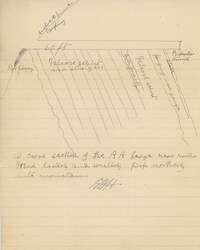
1921List3318California and Oregon 1921. 160 total items. Description of Pacific Coast Outlaws 32pp 8vo in cloth wraps; wraps excellent with some staining; contents very good to excellent with some water damage. Thirteen copies found on OCLC. Two business cards one with manuscript notes; 106 letters dating 1906 to 1911; twenty-two mailers circulars shareholder solicitations etc.; twenty-eight pieces of miscellaneous accounting records; and one Trinity Gold Dredging Company map measuring approximately 14 x 28 inches. Overall excellent. Harry N. Morse 1835–1912 was born in New York and came to San Francisco in 1849 seeking gold. After several odd jobs he became a deputy provost marshal in Oakland in 1862 was elected Sheriff of Alameda County in 1863 and held this office for fourteen years before establishing his private detective service in San Francisco. Morse is known for the arrests and killings of numerous California outlaws many of which Shinn’s booklet treats in great detail though with a focus on the Mexican-American contingent to the neglect of some of Morse’s more notable successes such as his role in the capture of Black Bart.<br /> <br /> The majority of the items in this archive concern Morse’s late-career foray back into gold mining first in Lewiston California and then in Applegate Oregon. John Marchand was Morse’s foreman in Lewiston and generally writes to him about the failures of their Lewiston enterprise. Many of the difficulties are attributed to troubles with a steam shovel though the claim itself turns out to be a dud. Marchand informs Morse near the end of their correspondence:<br /> <br /> “Things here I’m sorry to say have gone from bad to ‘very bad’. Y’day I got down to ‘bed-rock’ uncovered a piece 46 by 10 ft and increadible as it may read there was not 30¢ in there some pans in fact you could not get a color.†August 10 1906<br /> <br /> Morse then invests in a claim in Applegate Oregon with more success. The main setback in Applegate is that his mine is repeatedly sabotaged. His foreman E.B. Hawkins explains:<br /> <br /> “I realise things from this end must appear perhaps irregular or peculiar On or about the 17†of May the mine was dynamited I did not write you at that time because I thought I could catch up the ground in two or three days. It took nearer 20 and another thing you had sickness and later death in your family so I did not write about that first offence at all On June 17†we found the Star mine dynamited again good and plenty not less than 10 lbs of powder had been used for the job. They blew the h__l out of things blew the top off of the shaft and the gallows frame awry. I am almost certain I would have succeeded had I had only natures elements to contend with. I don’t know what in h__l will happen on the 17†of July This anarchy is beyond me. On the 17†of May I fired the distasteful element paying them off and I have fired the 17†of June element paying them off – I borrowed $50.00 from Jno. Pernoll to pay them there was 3 of them had not been working longâ€. June 19 1907<br /> <br /> Hawkins soon identifies the culprits:<br /> <br /> “On June 27†Jim Rock Sr. and Dick Rock came to me and offered to square the damages done at the star mine saying that if the mine was blasted their two boys were in on it On July 2†Dick Rock came to me and said his son Roy had confessed saying there were four in it namely Harry Gething Chas Brown Young Jimmy Rock and Roy Rock Dicks son They had all been working at the star. On July 4†Roy Rock confirmed to me same as above saying Harry Gething was leader and young Jimmy Rock was helper that they had a jig of whiskey on the ground that night Jimmy Rock furnished the whiskey Strange to say that every time I have gotten ready to take a certain good block of ore out of the star the mine has been blasted I propose to take that block of ore out if I live and can get grub while doing it†July 6 1907<br /> <br /> Hawkins has a few other confrontations with workers though none this severe and his letters are mainly providing Morse with in-depth updates on the status of the mine including many of Hawkins’ diagrams. The Star mine is never a roaring success and the pair consider trying cyanide mining—â€the salvation of southern Oregon†1908—and gravel mining in British Columbia.<br /> <br /> Of interest to historians of the post-Gold Rush west especially gold mining therein. unknown
193156801Los Angeles CA: Overland Monthly & Out West Magazine Arthur H. Chamberlain Publisher 1931. Five vols. 4to. 32; 32; 32; 32; 32 pp. Numerous photo illustrations text illustrations illustrated ads. Colour-illustrated softcovers photo cover art on two issues others w/ woodcut-engraved illust. ex-lib markings on front covers minor dustsoiling still G copies. First editions of this group of the Overland Monthly magazines with one double-issue specifically devoted to La Fiesta de Los Angeles and another the Souvenir Edition for the National Education Association convention held in 1931. Ambrose Bierce Mark Twain Willa Cather Jack London Joaquin Miller John Muir Clark Ashton Smith and many others all had their works published in the Overland Monthly. Overland Monthly & Out West Magazine, Arthur H. Chamberlain, Publisher, paperback
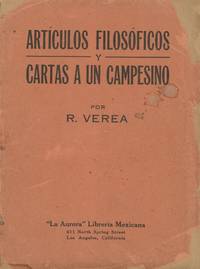
1909List2419Los Angeles: La Aurora Mexicana 1909. 8vo wraps 92 pp. Some chips to front wrap and first two pages slight brittleness very good minus overall. Very Good. Ramon Verea was a writer and inventor who was best known for his invention of a mechanical calculator capable of multiplying large numbers with great speed an invention he never marketed but that has remained legendary in history of computing circles with a prototype held at the IBM corporate headquarters. He was also an editor and writer founding the magazine El Progreso in 1884. Known for his anti-colonial ideas he moved to Guatemala in 1895 and then to Buenos Aires in 1897 dying two years later. This collection of Varea’s collected essays on various subjects was published by the “La Aurora†Libreria Mexicana located at 611 North Spring St. in Los Angeles a publishing house about which we find no information though it is notable as a Spanish-language publisher of radical works. OCLC locates six copies. La Aurora Mexicana unknown