8 987 résultats
1946305397Chicago Rock Island Lines 1946. 1946. 15" x 9". Brochure folds to form 24 pages. Printed in orange and black by Rand McNally. Illustrated with b/w halftone photographs; map and drawings. Fine. No signatures or bookplates. Includes information on: Palm Springs - La Quinta; San Diego; Santa Barbara; El Paso Texas; Tucson & Phoenix Arizona; Guaymas Mexico; Los Angeles. No Binding. Fine. Chicago, Rock Island Lines, 1946. unknown
194563368Tahoe City & Glendale CA: Lake Tahoe Sierra-Association ca. 1945. 4to. 8 x 9 in. 24 pp unpaginated. in double columns which folds out into folio 24 x 18 in. pictorial panoramic birds-eye view of Lake Tahoe by Gerald A. Eddy text & photos on rectos in columns 2 insert maps for location & mileages. Numerous colour photo illustrations self-printed double-page colour illustrated softcovers minor shelfwear NF copy. First edition of this nicely printed land promotion for Lake Tahoe with many photographs of skiing golfing fishing and boating in and around the Lake as well as the splendid birds-eye panoramic view map by Gerald A. Eddy. The Eddy map demarcates all the lodges and tourist spots around the lake the automobile travel route and amenities. The map is oriented with North to the left margin and the panoramic view extends from Donner Pass Summit at lower left corner to Blue Mountain at lower right with cartouche indicating “Painted by Gerald A. Eddy Glendale Calif.†Worldcat locates 1 copy Univ. of Illinois. Lake Tahoe Sierra-Association, paperback
193856963Fresno CA: City Planning Commission 1938. Oblong folio. 13.5 x 9.25 in. 17 blueprint maps variously numbered. w/ first map as the Key Map for the remainders. Stapled at gutter margin w/ protective green-tinted back softcover folded to provide reinforcement at spine from the library of George Reed Volker 1925-2018 former World War II pilot and urban planner in California New York and Washington State. First editions of these exceedingly scarce land use district zoning maps drawn up in 1938 after the passage of the 1937 Housing Act which unfortunately upended much of the spending not only by the WPA but also required any federal money to spent in “blighted†areas. These detailed maps show major streets demarcate singe family housing multi-family housing manufacturing and commercial bases for the community. Eventually the Public Housing which was built in Fresno during World War II began in West Fresno or “Chinatown first with the Sequoia Courts and later the Sierra Plaza followed by others. No copies located in Worldcat; See: Bibliography of Research Projects Reports W.P.A. Technical Series Research and Records Projects Bibliography No. 1 Feb. 2 1940 p. 53 Zoning Ordinance. City Planning Commission, paperback
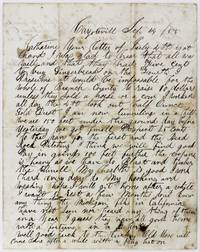
18553206Coyoteville: September 12 1855. Very good. 2pp. plus integral blank. Original mailing folds moderate toning staining and ink spotting but still easily readable. Bottom fourth of integral blank excised. An informative Gold Rush letter about mining in the long-vanished ghost town of Coyoteville which was an extraordinarily rich gold area for a couple of years in the early 1850s. A noted tunneling method nicknamed "coyoteing" was developed in the town and subsequently inspired the name of the town. In the present letter Moses Pine writes to "Catherine" in Branch County Michigan and signs his name simply as "Mose Esq" at the conclusion. The author informs Catherine presumably his wife or sister of his activities some of the economic realities and some of the practical details of prospecting for gold in California. Presuming that "it would be impossible for the whole of Branch County to raise $10 unless they sell a horse" Pine comments that he had ginger bread on the Fourth of July after working all day and yielding a "half Ounce Gold Dust." He then provides a detailed description of his mining: "I am now tunneling in a hill. We are 150 feet under the ground. Day before yesterday we got small respect 25 cents to the pan for the first and the bed rock pitching. I think we will find good pay in the going 100 feet further the expense is heavy as we have to blast and timber the tunnel." Pine also talks of his health and that "I work hard every day do my cooking and baking." He then expresses his hope to get back to Michigan to "rest a few months" but knows nothing of other Michigan folks in California: "Have not seen nor heard anything of them in a year. I guess they have all gone home with a fortune in a horn. Well good luck to the lucky. Old Mose will come home after a while with a pretty hat on." A nicely-detailed letter from an unusual and obscure Gold Rush location. September 12 unknown
1954List3210Greenville Illinois 1954. Two stapled packets of mimeographed typed pages eighty-seven and twenty-eight pages with one signed. Excellent to Near Fine. An autobiography and genealogy written by Ulysses S. DeMoulin 1871–1955 founder of DeMoulin Bros. a uniform manufacturing company which now mainly supplies marching band attire. The genealogy incorrectly traces the family’s history back to French Revolutionary figure Camille Desmoulins though it appears accurate otherwise. It includes a description of early Sebastopol Highland Illinois with a simple map. In the autobiography which is told in a large number of short anecdotes DeMoulin discusses his childhood and early life in Jamestown and Sebastopol and goes into detail about the early years of his company beginning with the formation of the Modern Woodmen of America fraternal organization for which the company supplied uniforms and items used in ‘rituals’. DeMoulin used the profits from this enterprise to invest in a number of others including a mine near Gold Hill Colorado and oil drilling land in Illinois. However the most interesting portions of the autobiography concern DeMoulin’s role in the development of agriculture in California’s Imperial Valley.<br /> <br /> DeMoulin first travels to southern California in 1903 happening to meet several engineers involved with the Imperial Irrigation System who take him to see the new town of Brawley:<br /> <br /> “Here by lantern light we sat around on the ground in the evening discussing many kinds of farm lands and if soft hard or sandy. We slept in ‘remadas’ made by setting posts to protrude about twelve feet above the ground which were then braced and divided into small box-like stalls. The remada was then covered with tree branches and a huge heavy taupalin sic curtain hung over the sides and front at night to keep out the dust of which you might find two or three inches at your door in the morning. A pitcher of water and a bowl were your only means of bathing. There were no streets in Brawley at this time only trails as the town had not yet been surveyed having only been founded in October 1902. People were living in tents while waiting for completion of hotel accommodations and other living quarters under construction.â€<br /> <br /> DeMoulin begins buying land in the Brawley area to rent to farmers and traveling to the area regularly. He describes the building of the Laguna Dam spending a week at the workers’ camp “at which time I slept in the workmen’s crudely-built bunks and ate with them at the long rough pine tablesâ€; and befriends author Harold Bell Wright. He also witnesses several conflicts with the IWW:<br /> <br /> “In 1908 there moved into Brawley about 200 International Workmen of the World or more familiarly known as ‘I.W.W.’s’ I won’t Work and in command was a Captain Stanley. However as most unwelcome guests they proceeded to join a strike in the cantaloupe sheds and inserting razor blades into apples the strikers threw them at workers. ‘Goons’ also tried to interfere with the trucking operations from the fields to the packing sheds. I recall of one driver telling a goon that if he even attempted to place a foot in his truck he would shoot him. And defying the driver the goon was instantly killed. Naturally this would cause a riot and they sent to El Centro for a tank such as it was in those days - a cannon and several machine guns. But soon after the Mayor had issued orders to shoot anyone getting out of hand an agreement was easily reached.â€<br /> <br /> University of Washington’s IWW History Project documents two IWW actions in Brawley between 1905 and 1920 neither of which match DeMoulin’s description; nor does the event appear in newspapers. However “Captain†William Stanley was in the area serving as the secretary of the I.W.W.’s chapter in the Imperial Valley. In 1911 Stanley was killed in an early battle of the Mexican Revolution assisting Mexican Liberal Party fighters in occupying Mexicali. DeMoulin claims to have traveled with several others to watch the fighting that would end the occupation:<br /> <br /> “It was suddenly discovered one morning that Captain Stanley and his I.W.W.’s had disappeared during the night and word had gotten around they had settled in Mexicalo sic a Mexican border town and were so strong in number they overpowered the police pillaged the shops and stores defying the Mexican Government by taking over complete possession of Mexicalo. However after putting up with this condition for several months the Mexican Government sent in about 500 Infantrymen with orders to get rid of them immediately under any condition. . Stanley’s men had made a large opening in the river bank to a depth of about five feet which led through to the bank facing south. From this vantage point his men could fire their muskets when the Mexicans advanced towards them and soon took to their heels when Stanley’s men began firing. . Several of us had driven down to sic Brawley to witness the fighting and bullets had been spattered everywhere. Many of the people never thinking of danger stood out in the open so as not to miss what was going on but I was glad to stay in the back of the adobes at least where one was protected from stray bullets. And having heard rumors of their retreating possibly the next day which was Sunday we drove down again but all was quiet and we met with no resistance. Many of the men were swimming and others were entertaining their wives and families in one way or another. We didn’t stay too long on that trip as one never knew what might happen. But it wasn’t long before they disappeared from Mexicalo entirely for which everyone was most grateful and happy.â€<br /> <br /> DeMoulin is none too fond of Mexican workers either describing how the 1928 construction of a primitive border wall “didn’t stop the wetbacks . from swimming across†and complaining that “regardless of having no sense nor education many were hired and the employers would hide them in groves because if they were arrested it would cost $160.00 including court and attorney fees to have each one returned to Mexico.†DeMoulin’s other targets for racial abuse include “a couple of crooked ‘Jewish Kikes’†who were “certainly professionals when it came to putting the money in their pockets†and several Black men who he claims steal from him.<br /> <br /> DeMoulin credits himself with bringing grapefruit production to the Imperial Valley and describes a scam by the area’s real estate agents to unload inferior farmland onto unsuspecting investors. He recounts his company making leather “‘Red Men’s’ costumes†for a “Chief Gray Eagle†in Oklahoma whose “squaws wouldn’t work for him any more.â€<br /> <br /> Of interest to historians of the Imperial Valley’s development and especially of labor relations in the agriculture industry. unknown
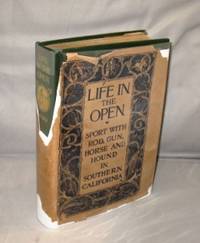
190626807New York:: G.P. Putnam's 1906. First Printing of the First US Edition. A Very Good plus copy in green cloth with brilliant gilt stamping to the front cover and spine in a poor dust jacket lacking several large from the corners and the spine. But copies of this title are rare with a dust jacket of any sort. Charles Frederick Holder 1851-1915 a founder of Pasadena's Tournament of Roses came from a wealthy Massachusetts Quaker family. After working as a curator at New York's American Museum of Natural History Holder moved to Pasadena in 1885. A passionate naturalist throughout his life he became known in Pasadena as a businessman philanthropist and conservationist/sportsman. Life in the open 1906 is Holder's account of hunting and fishing in the counties of Santa Barbara San Buenaventura Los Angeles San Bernardino Riverside Orange and San Diego. The topics include horseback hunts for lynx fox and wolves; fishing for trout in the Sierra Madres and for game fish off Catalina; pursuit of shore birds and water fowl; mountain lions and mountain goats; and photographic hunts for sea lions. Throughout Holder argues for the sportsman's role in conservation. G.P. Putnam's, hardcover
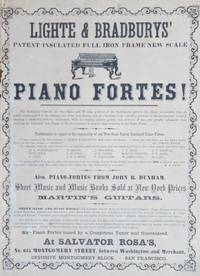
1864List2420San Francisco 1864. Broadside measuring 12 x 8.5. Some wear and archival tape repair to margin fine contrast excellent condition overall. Very Good. An interesting broadside advertising the Lighte and Bradbuiry piano as well as Martin Guitars printed for the Salvator Rosa music store at 615 Montgomery Street in San Francisco. Lighte and Bradbury was in its third iteration in the period from 1858-1864 when this broadside was printed having been started by the German immigrant Ferdinand C. Leuchte in 1847 who did business with a range of partners after anglicizing his name to Lighte. Among the testimonials listed on the broadside is praise from Lowell Mason the composer and music director. Salvator Rosa’s store was around from at least 1852 when a fire in the city destroyed the building on Clay St. making this location at 615 Montgomery Street at least the second for the firm. The firm published sheet music including “Fireman’s March†and “Garibaldi’s Hymn.†Martin Guitars had been based in Nazareth Pennsylvania since 1838 and were a relatively small company at this point before the growth of popularity of guitars and the shift to steel strings that happened in the early twentieth century. We find no other nineteenth century examples of broadside advertisements for Martin in trade records. unknown
194956995San Francisco CA: Southern Pacific Co. Dec. 1949. 4to. 1 71 4 leaves mimeograph tables throughout. Quarter-brown cloth over gold-coloured softcovers post-binder nickel-plated screwposts printed black lettering & S.P. logo on front cover minor foxing front cover minor edgewear still VG copy w/ former ownership marking on verso of front cover. First edition of this exceptionally scarce post-War Southern Pacific RR in-house document specifying all of the telephone lines maintenance offices headquarters what motor cars and equipment are attached to them as well as detailed specifications on Main Line or Branch Pole Miles Wire Miles and Offices Maintained. Also carefully details particular District responsibilities such as clearing the lines through the Sikiyous or in the Sierra Nevada mountains and more. No copies in Worldcat. Southern Pacific Co., paperback
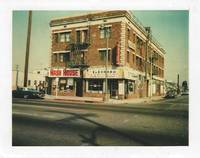
197576885Burbank California: American Broadcasting Company 1975. An archive of 55 color photographs of Los Angeles locations scouted for the pilot episode of Cooley High taken by location manager Cassius Weathersby. Most of the photographs are accompanied by captions noting the address or location. Also included are nine leaves with handwritten notes by Weathersby cast and crew lists shooting schedules call sheets location permits and other material relating to the production.<br /> <br /> One of Weathersby’s notes reads “no palm trees or stucco†a reminder that the locations were meant to stand in for the show’s Chicago setting. As such the photographs present images of Los Angeles not often seen in film of brick warehouses concrete apartment buildings vacant lots and old diners shot in South Central and outlying areas of the city.<br /> <br /> Cooley High was based on the 1975 film of the same name about a group of African American high school students in 1960s Chicago. The pilot episode wasn’t well received by ABC and the show was completely retooled into the sitcom What’s Happening!! 1976-79 which followed the lives of three working-class African American teens in the Los Angeles neighborhood of Watts. Weathersby would go on to work as the production manager for the show.<br /> <br /> Most of the photographs measure 4 ¼†x 3 ¼†11 x 8 cm. 30 are mounted on white paper with location information to the side. The remaining photographs are loose with location information handwritten on the verso. Housed in a generic manila file folder with the “Cooley High†handwritten on the tab. American Broadcasting Company unknown
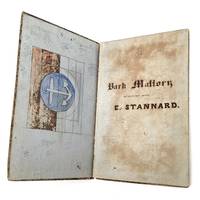
80034A logbook of accounts kept by Captain Elbert Stannard for two of the ships he commanded out of the port of San Francisco in the late 1850s and '60s the Bark Mallory and the Bark Daniel Webster. The latter was sold in 1861 to the government of Japan and became the first warship in the Japanese navy.<br /> <br /> The account book contains 22 pages related to the Bark Mallory and approximately 70 pages of accounts concerning the Daniel Webster. On the first page is written: "Bark Mallory in Account with E. Stannard".<br /> <br /> The blue-lined pages are written on in ink and pencil. Much of the spine has perished the marbled boards are detached and it appears a few pages have been removed from the logbook.<br /> <br /> The accounts concerning the Daniel Webster are dated between 1859 and 1861 and begin with the cost of repairs for its voyage from New York to San Francisco. It then traveled to Victoria and Perth from San Francisco and traveled from San Francisco to Shanghai and Kanagawa Japan and back.<br /> <br /> According to newspaper records Stannard 1828–1907 was in command of the first steamboat to enter Japanese and Chinese waters trading between these ports and San Francisco. He made his home in Westbrook Connecticut.<br /> <br /> Historical records indicate the Bark Mallory had been plying the coastal trade since the 1850s. The ship was hired by Snohomish Mills to transport lumber from Washington to San Francisco since there was not enough demand in the local lumber trade. On one of her voyages the Mallory took on water near Cape Flattery and was beached at Neah Bay. The windfall of lumber wound up in many local buildings.<br /> <br /> The log from 1857 for the Bark Mallory includes a line for payment of “Chinamen pumping†for $18.50. By 1848 when the first Chinese arrived in San Francisco they had already established a pattern of leaving China to work in other parts of the world.<br /> <br /> This logbook also contains an untitled handwritten 2 ½ page poem about mining with no attribution. unknown
192256784Long Beach CA: A.L. Smith 1219 Loma Vista Dr. ca. 1922-1930. Oblong 4to. 9.25 x 7.5 in. 102 pp unpaginated. on thick black paper stock. With 360 silver gelatin photos tipped-in sized from 1.5 x 1.5 in up to 7 x 9 in. with the majority sized 3 x 5.25 in. a few w/ text within the negative some w/ minor creasing a couple loose. Embossed red post-binder brass screw posts at gutter margin hand-lettered on front cover in neat draftsman’s hand draftsman hand annotations in pencil in blank margins of leaves when revealed on gutter spine blanks minor scuffing edgewear some occasional tears to internal leaves many leaves reinforced with archival black cloth tape still a VG exemplar. This intriguing photo album depicts the lives of Smith’s family primarily engineers inventors river pilots and miners originally on the Yukon River out of Whitehorse and Dawson City and then in southern California following World War I. The album opens with an image of of Archie his brother George and others seated in what appears to be an open 5-bench seat ca. 1915-1916 International Model F bus in front of ivy-covered building. This is followed by a section including approximately 30 photographs devoted to the store factory sales outlets advertising on the company car and sales promotions for the “Hydro Syphon†Iceless Refrigerator invented by Archie Smith. This short-lived Hydro-Syphon Iceless Refrigerator was touted throughout the West as a substitute for buying ice and featured a bowl of an inverted glass bowl of water supplying cooling to coils above the chamber holding items to kept “refrigerated.†These are followed by many photos depicting the Smith family’s “smart†Southern California Bungalows 1 Norman Revival Style apartment houses and homes in and around Long Beach and Los Angeles during the Roaring 20s. The rest of the album focuses on the adventures and outdoor living experienced by his children Evelyn Dorothy and later young Robert. With their home located next to the automobile garage at which he worked he created an extraordinary backyard for his children fitted with pergola slide swings wading pool toys and even a chalkboard and items for the daughter’s tea parties. Archie had previously worked as an engineer and draftsman for the White Pass & Yukon Route in the Yukon while developing Aerosleds with his brother George Smith which were small prop-driven single man sleds used on ice and also ran on the W. P. & Y. Route Ry tracks. Archie Smith 1887-1964 had married Pansie Grace Lawrence in 1916 in Tacoma and when registering for the World War I draft noted a physical disability. After his refrigerator business folds he worked as real estate agent and then draftsman in an automobile machine shop in Los Angeles. His brother George Camden Smith 1889-1972 also shown in the photos was a ship’s engineer and longtime river pilot on the Yukon River before immigrating back to the U.S. in 1941 to live near his brother. Their stepfather William Puckett b. 1869 Klondike gold miner living in Seattle WA in 1900 married Anna Smith a widow sometime before 1903 and then returns to Whitehorse with the stepchildren to establish his roadhouse hardware store and confectionary and retired to Long Beach in 1938. See: Nancy DeWitt Early Snow Vehicles in Alaska: Part 1 Fountainhead Antique Auto museum Fairbanks Alaska March 3 2014. A.L. Smith, 1219 Loma Vista Dr., hardcover
194859049Garden City NY: Doubleday & Co. 1948. 8vo. 219 1 pp. Double-page illustrated title numerous illustrations. Black-publisher’s cloth orange lettering illustrated map endpapers w/ d.j. wraparound cover art by Manning de V. Lee minor edgewear chipping head & foot of spine old tape repairs minor bumping to couple corners still VG/G copy w/ former ownership markings on verso of ffep. Early printing of this colourful story based on the fate of the barkentine “Niantic†a ship left deserted in San Francisco Bay in 1850 when the entire crew left for the gold fields above Sutter’s Fort. Doubleday & Co., hardcover
188376195Los Angeles: Atwood & Ferguson 1883. Hardcover. Good. A rare survivor not in Quebedeaux this early directory was published just two years after the Los Angeles Times began publication and a year prior to the arrival of cultural crusader Charles F. Lummis following his famous tramp across the continent. It also precedes the mid-1880s boom that initiated the transformation of the small town of just over 11000 people or about 33000 countywide into a thriving metropolis. Numerous notable residents are listed including Horace Bell author of Reminiscences of a Ranger 1881 and Elizabeth A. Follansbee Southern California's first female physican. Aspects of the city's cultural diversity are evident as well either overtly with individuals identified as "colored" or in the case of the Asian American population by omission. Notably the directory includes an advertisement for F.H. Rogers' Solar Art Gallery at 624 San Fernando Street which features an original albumen photograph.<br /> <br /> Octavo: 352 p. with numerous advertisements. Original printed paper-covered boards over a brown cloth spine with gilt titles. Some occasional smudging with a tiny stain to the fore-edge. The ink stamp of Leon F. Moss a Los Angeles attorney and former judge of the Los Angeles Superior Court appears on the front pastedown and both the front and rear panel. Some general shelfwear and toning to the boards with a bit of scuffing and soiling to the front panel and loss of the gilt stamping along the spine. Housed in custom clamshell box with marbled paper lining and a gilt-stamped green morocco spine label. Scarce OCLC locates only five holdings: Azusa Pacific University Fresno County Free Library San Joaquin Valley Library Santa Rosa Junior College and the University of California Los Angeles. Atwood & Ferguson hardcover
190863118Los Angeles CA: Hotel Lankershim 1908. 12mo. 20 pp unpaginated. printed in orange & black w/ sepia-tinted centerfold supplement. With photo illustrations & text decorations throughout centerfold double-page map map in orange & black at rear. Self-printed photo-illustrated softcovers photo cover art of Lankershim hotel & auto bus front cover advertisement on back cover slight bumping to lower left corner very minor shelfwear still VG bright copy. First edition of this well-illustrated guidebook to the newly opened Lankershim Hotel in Los Angeles CA during the Progressive Era completed and opened by 1906 designed by Los Angeles Architect Robert B. Young 1855-1914 for James Boon Lankershim 1850-1931. The Lankershim’s Automobile Bus service drove the traveler through the electric light displays and the broad streets in downtown Los Angeles and this brochure announces that 30 newly renovated “Sample Rooms†out of the hotel’s 350 rooms had been made available for salesmen to set up their sample wares and show clients on their 60-200 feet of table sapce and excellent lighting along with display items and even attached private baths to operate as pop-up commercial stores. The Lankershim Hotel operated until about 1971 when after suffering significant damage in 1971 it was forced to close the upper 7 floors and then in the mid-1980’s everything above the 8th floor was razed for a parking garage. Worldcat locates 1 copy of a similar 1909 edition WI Hist. Soc. Lib. Hotel Lankershim, paperback
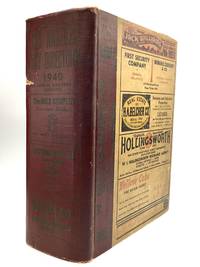
193978832Los Angeles: Los Angeles Directory Co 1939. Hardcover. Good. An important source of information on pre-war Los Angeles. Large quarto: 2350 92 2351-2558 4 pp. including the endpapers and boards with a plethora of advertisements a few photographic and coated endpapers printed in blue red and black. Typical toning to the contents with a small chip to the bottom edge of the title page. The top portion of the final leaf of the directory is fused to the rear flyleaf. It appears the binding has been reinforced between p.316 and 317. The advertisements along the edges are a little faded. The boards are shelfworn and moderately soiled with some general toning to the front panel a one-inch nick to the spine and a few small dents to the rear panel. Scarce OCLC locates no holdings. Los Angeles Directory Co hardcover
191463332Los Angeles CA: Los Angeles Chamber of Commerce Western Lithograph Co. 1914. 4to. 4 pp unpaginated. printed in sepia on yellow-tinted paper in double-columns photo illustrated throughout w/ woodcut borders. Self-printed photo-illustrated softcovers slight dustsoiling very minor shelfwear VG copy. First edition of this very scarce Los Angeles CA land promotion with back cover exclaiming over how the American Medical Association in their 1911 meeting determined that it was “the ideal climate for the aged and feeble and for those who are predisposed to tuberculosis and such diseases.†Of additional interest is the plug for automobile travel and the “Good Roads†movement exclaiming not only how Los Angeles and California had the second-highest rate of auto ownership behind New York during the Brass Era but also that there were hundreds of miles of newly completed well-paved roads with segue to promotion of the forthcoming Panama-Pacific International Exposition in San Francisco and the Panama-California International Exposition in San Diego. No copies in Worldcat. Los Angeles Chamber of Commerce, Western Lithograph Co., paperback
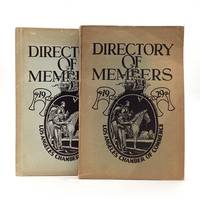
193080129Los Angeles: Los Angeles Chamber of Commerce 1930. First Edition. Wraps. This Directory particularly the classified section is developed for the convenience of mutual interchange of trade." The alphabetical section lists the name and address of each member along with the date the joined and reference numbers that correspond to the classified section. Octavo two volumes: 356 pp. 364 pp. Bound in the original printed paper wrappers which are unevenly toned with some mild edgewear. Scarce OCLC locates a single holding of the 1929 directory at the Workman and Temply Family Homestead Museum and no copies of the 1930 directory.<br /> <br /> The Los Angeles Chamber of Commerce established in 1888 has historically been the primary driver of regional growth engaging in aggressive boosterism to market Los Angeles' climate lifestyle and business opportunities to the nation. This pairing of directories was published immediately before and just after the "Black Tuesday" stock market crash that triggered the Great Depression. Los Angeles Chamber of Commerce unknown
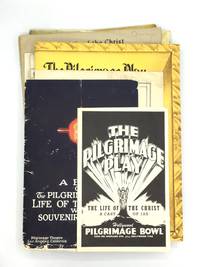
74665An archive of materials from performers who were involved in early productions of Los Angeles’ famed Pilgrimage Play. The production was the creation of Christine Wetherill Stevenson 1878–1922 an heiress of the Pittsburgh Paint Company. Her dream was to build her own open-air theater and stage her own plays. A member of the Theosophical Society she spent time studying in the society’s Krotona Institute in lower Beachwood Canyon. She claimed to have searched for years for the perfect venue to stage outdoor religious dramas of an inspirational nature and found it in the gentle Krotona foothills. In 1918 she produced 35 performances of Light of Asia a play by Sir Edward Arnold concerning the life of Buddha.<br /> <br /> In May 1916 a successful production of Shakespeare's Julius Caesar featuring a cast including Tyrone Power Sr. was presented in Beachwood Canyon's vast natural amphitheater. Impressed with such success Stevenson sought to build a permanent amphitheater to produce her "huge spectacles." Together with other Hollywood leaders she founded the Theater Arts Alliance to further these aims. Her initial attempt at securing 60 acres of land of what is now known as the Hollywood Bowl ended in conflict. She then quickly built the 1000-seat Pilgrimage Play Amphitheater now the John Anson Ford Amphitheatre across the street from the Bowl site. In June 1920 Stevenson's adaptation of the story of the life of Christ The Pilgrimage Play opened its first summer season to enthusiastic audiences. Until her early death in 1922 Stevenson was deeply involved with the annual production as producer writer director and costume designer working to make the play as authentic as possible. During a research trip to Palestine Egypt and India she bought over $3000 worth of costumes for the show; olives figs and grapes would be planted around the theatre to make it appear more like Palestine. The play continued annually until its final performance in 1964.<br /> <br /> This archive is from the estate of Ruth S. or Ruth Josephine Omey most likely sisters who both performed in the play as women of Judea. A brother or husband Lillburn T. Omey also performed as Apostle Bartholomew. The three performed in the 1944 and 1945 productions.<br /> <br /> Included in this archive are: 10 black and white original photographs of the three performers in various costume with pencil notations on the verso; Pilgrimage Play programs for the years 1925 1935 1944-47 1950 and 1961 the program for 1944 includes 75 signatures of performers and other persons involved with the production; and various brochures and newspaper clippings about the play. Apparently the Omey’s worked for Cathedral Films as indicated by a note wrapped around the clippings. unknown
193854069Los Angeles: Los Angeles County Chamber of Commerce 1938. 4to. 8 x 9 in. 8 pp unpaginated. printed in double-columns in one long folded sheet photo illustrations blue-coloured text illustrations self-printed colour-illustrated softcovers Art Deco cover art of palm trees and cityscape in blue black & white center fold as issued very minor shelfwear slight creasing 1 corner still NF copy. First edition thus of this scarce land promotion for Los Angeles County as the Great Depression drew to a close filled with illustrations of the cultural economic industrial and commercial possibilities in Los Angeles. Of particular note is the advisory note included at the end advising those who come seeking employment in Los Angeles that public assistance or relief aid is denied to anyone who has not been a resident of California for at least three years. Worldcat locates 2 copies Yale California Historical Society. Los Angeles County Chamber of Commerce, paperback
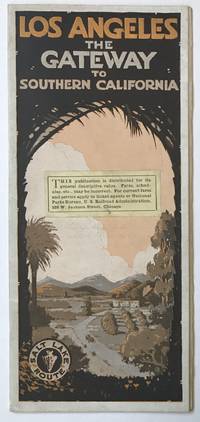
1916685Chicago 1916. Very good. 12pp. Original pictorial self-wrappers stapled. Small contemporary publisher's notice affixed to front wrap. Light wear and dust soiling. Rare promotional for the Salt Lake Route by rail to Los Angeles and for the attractions of the city itself published circa 1916. The text touts the population and commercial growth of Los Angeles from the turn of the 20th century its many attractions and year-round seasonability. The last leaf provides a summary of ways to arrive on the West Coast via the Salt Lake Route through Las Vegas from Chicago Minneapolis and Denver and prints a full-page map of the route and intermediate stops across Utah Southern Nevada and Southern California. The Salt Lake Route was operated by the Los Angeles & Salt Lake Railroad whose line between the two cities was completed in 1905 under the ownership and direction of Montana mining baron William A. Clark and as a result it was also known informally as the "Clark Road." With many photographic reproductions of Los Angeles and its attractions just after World War I including many of the grand Southern California resorts of the day. Not in OCLC. unknown
191248820Los Angeles: The Neuner Co. 1912. 12mo. 32 pp unpaginated. Photo-illustrated throughout. Colour-illustrated softcovers w/ California Mission on front cover oranges on back cover very minor tidemark to lower gutter margin & spine minor shelfwear still G copy. First edition of this rare brochure promoting the booming Los Angeles housing market with beautiful California Bungalows fine Los Angeles residences California gardens citrus groves agriculture oil production the beaches Catalina Island schools and more. The Neuner Co., paperback
4023S.l.:: s.n. Single sheet printed on one side only folded horizontally then vertically to business-letter size Contents—8 pp including self covers. Page. 1 Portrait of Mr.& Mrs. Nixon; pp. 2/3 blank; p. 4 “Give California a Decisive Leader!â€; p. 5 “Luncheonâ€â€”choice of three hot entrées; 3 Salads and 3 Sandwiches; pp. 6/7 blank; p. 8 “Win with Nixon!â€Nixon was running against Pat Brown the incumbent who won the election. Nixon famously blamed the press for being biased in Brown’s favor and commented that that it was his "last press conference" and "You won't have Nixon to kick around anymore." In 1968 Nixon was elected President! S.l.:: s.n.,. unknown
193957661San Francisco CA: Crocker Company 1939. Oblong 4to. 12 x 9 in. 16 pp unpaginated. With numerous colour photo plates. Colour-illustrated softcovers cover art night scene photos of the Exposition very slight shelfwear w/ original printed mailing envelope added label for Wobbers on cover minor toning shelfwear still F/NF copy. First edition of this beautifully printed photographic excursion through the Art Deco marvels of the 1939 Golden Gate International Exposition held on Treasure Island in San Francisco. Crocker Company, paperback
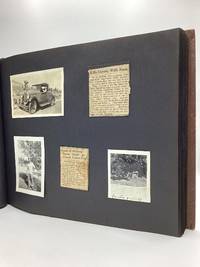
77792An album of 134 original photographs and 16 documents and newspaper clippings providing glimpses into the life of an intrepid jack of all trades who served in both World Wars.<br /> <br /> Born in Cripple Creek Colorado Griffith 1900-60 attended Pueblo City Schools and appears to have spent part of his adolescence in Johnstown Pennsylvania where he enlisted for service in the First World War in 1917. The first image in the album is a studio portrait of a youthful Griffith in full uniform and another shows him with seven fellow soldiers. According to the Commonwealth of Pennsylvania records he served with the 282nd Aero Squadron from December 13 1917 to December 14 1918.<br /> <br /> After the war Griffith was employed as a trucker in a Pennsylvania steel mill before moving to California and taking work as a riveter near Bakersfield. It was about this time he visited Yosemite and captured the 20 snapshots included in the album. Other images from this period show mining ranching and oil exploration presumably in Kern County.<br /> <br /> The newspaper clipping included herein depict Griffith as cool and resourceful. The brief story "Kills Coyote With Rock" reads: "W.P. Griffith who probably has had more experience with rattlers this summer than any one else in the community had a new one this week. While working in the hay fields for John Tarped he spied a coyote intently watching something hidden in the tall meadow. Walking around to the far side of the animal he was approaching it when suddenly it ran at top speed toward him. Quickly picking up a rock he hurled it at the coyote and killed it." Another piece published shortly after his move to Wenatchee Washington tells of the measures he took when a truck loaded with watermelons burst into flames: "Griffith wasted several minutes looking for water. Then he had an idea. He hurled watermelons at the blazing truck. They burst and water spouted out. The twenty-third melon put out the fire."<br /> <br /> Census records indicate Griffith worked as a self-employed tree surgeon in Los Angeles prior to his enlistment for service during the Second World War. The photographs and documents in the album suggest he joined the U.S. Navy and later served as an electrician in the U.S. Coast Guard. There is also some indication that he visited the The Universities' Mission to Central Africa in Zanzibar and also spent some time in Palm Springs California.<br /> <br /> The photographs which range in size from 1 3/4" x 1 3/4" to 6 1/2" x 8 1/2" most are 4 1/2" x 2 3/4" are mounted to black leaves which are bound in a decoratively embossed oblong brown buckram album. A few of the images are labeled in the margins. Some minor edgewear with a few faint spots to the front panel of the album; otherwise very good. unknown
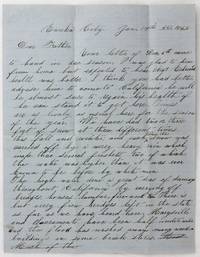
18624920Eureka City: January 14 1862. Very good. 2pp. on a folded sheet. Old folds minor wear. Manuscript letter to folks back home describing heavy rain and flooding around Eureka City. The author writes: "We have had two or three feet of snow at three different times this fall and winter and each time the snow was carried off by a verry heavy rain which made three several freshets two of which the water was higher than it was ever known to be before by white men." He goes on to discuss the difficulties caused by the flooding: "The high water done a great deal of damage throughout California by carrying off bridges houses lumber fire-wood &c. There is but verry few bridges left in the state as far as we have heard here. Marysville and Sacramento have been half under water and the flood has washed away many wooden buildings and some brick stores. A large portion of the farmers in the Sacramento Valley and also many other places were damaged considerable by having their land overflowed some crops washed off &c. The roads are almost impassable here we have had but three mails in as many weeks when we usually get one each day. January 14 unknown