Antiquariat.de

57 résultats
173018639Nürnberg, Homann, ca. 1730. Ca. 49 cm x 58 cm.
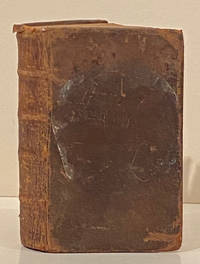
1759mon0000160234John Robertson 1759. Leather. Acceptable. in x in x in. Front board detached. Rear board almost fully detached. Staining. Ex library with markings. Gift inscription on ffep. Tape repair. Names on title page. John Robertson hardcover
178322278A Philadelphie (Paris), s.é., 1783. Un vol. au format in-12 (172 x 108 mm) de 192 pp. et 1 f. bl. Reliure de l'époque de plein veau glacé et moucheté fauve, double filet à froid porté sur les plats, dos lisse orné de doubles filets dorés, double caisson d'encadrement doré, pièces de titre de maroquin acajou, titre doré, jeu de petits filets obliques gras et maigres dorés sur les coupes, tranches mouchetées.
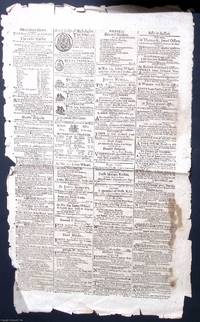
1798373718Boston 1798. Single Sheet. Fair Condition. A two-sided folio sheet measuring 31 x 52 cms printed in four columns no masthead or pagination. Aged paper with frayed edges and minor tears; no visible printer's imprint or page numbers. Quite likely a detached advertising supplement or standalone circular possibly distributed with the Columbian Centinel or Massachusetts Mercury. Both sides feature Commercial Notices & Auction Listings a dense array of classified-style advertisements including: Auction Announcements: Listings for upcoming sales of goods property and merchandise. Shipping Notices: References to arriving or departing vessels typical of Boston's maritime economy. Goods for Sale: Offers for imported items domestic wares and services. Of particular note is an advert for James Davenport's Spinning Machine Nov. 17 1798 promoting: Thread & Twine Production: Machine capable of spinning hemp flax and tow. Labour Efficiency: Claims of 2060 lbs/day output with minimal labour. Emphasizes American ingenuity and economic advantage over manual labour. Stylistic Notes: Long £s usage throughout with a serif-heavy typeface with tight column spacing. There is no editorial content or masthead present nor printer details given. Size: 31 x 52 cms. Category: Antiquarian & Rare; Special Features; Printed before 1800; Special Features. This item may require more postage than the rates shown for delivery outside the UK. If extra postage is required we will contact you before processing your order and you will be given the details and option to decline the extra cost. unknown
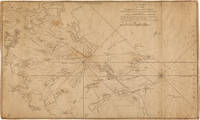
1800WRCAM52103London: R. Laurie and J. Whittle 1800. Engraved map sheet size approximately 21 x 34 3/4 inches. Backed with linen. Mid-19th-century ownership inscription near title. A few small chips and minor closed tears at edges light soiling and scattered faint foxing. Very good. Framed. An extremely scarce nautical chart of Boston Harbor from the second edition of the important 18th-century American atlas the NORTH AMERICAN PILOT. The chart depicts the state of the harbor just after the start of the Revolution having been reprinted from the first edition published in 1776 and 1777. The Boston peninsula and the "Ruins of Charlestown" are located in the west / far left of the chart area which follows the mainland coast as far south as Dorchester and Milton and out to Point Shirley and the Shirley Cut to the northeast in the upper center of the image; the Hull peninsula and Point Allerton are also visible in the lower right-hand quadrant of the map. In the center of the chart are the numerous islands that dot Boston Harbor as well as depth measurements and clearly marked shallow areas such as the shoals formerly known as the Dorchester Flats now a populated area of reclaimed land. Additionally there are a number of guidelines showing the best routes through the harbour to various points and markings for various points on land to aid in navigation. <br> <br> The second edition of the PILOT contained seven more maps than the first for a total of seventeen charts of which this plan of Boston Harbor was the seventh. The first edition was published by Robert Sayer and John Bennett who were succeeded by Laurie and Whittle before the publication of this atlas. The original chart engravings were executed by Thomas Jefferys. Rare in any form or edition OCLC traces only one copy of this individual map from the 1800 printing located at the State Library of Massachusetts. OCLC 843954569. PHILLIPS ATLASES 1220 ref. HOWES J84 ref. SABIN 55557 ref. R. Laurie and J. Whittle unknown books
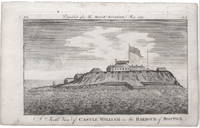
17893563Castle William's heritage as a military installation dates to 1634 when cannons first were deployed in an earthen fort to defend Boston Harbor. British officials used the fort as a refuge in the tumultuous times leading up to the American Revolution; on their way out of Boston in March 1776 the British destroyed the Fort. It was quickly rebuilt by Bostonians. <br /><br />The present view shows the rebuilt Fort with an oversized American flag waving above. The Fort served as an active military installation during the American Revolution the War of 1812 the Spanish-American War and World Wars I and II. Known as Fort Independence since 1797 the Fort today is a state park. <br /><br />Stauffer attributes the engraving to Samuel Hill who did many of the plates for the <i>Massachusetts Magazine</i>. Uncommon. <br /><br />References: Lewis: <i>A Guide to Engravings in American Magazines 1741-1810</i>: p. 10. Stauffer <i>American Engravers Upon Copper and Steel</i>: 1397. <i>John Carter Brown Archive of Early American Images</i>: Record no.5437-4. Cresswell T<i>he American Revolution in Drawings and Prints</i>: 491. From the May, 1789 issue of The Massachusetts Magazine.
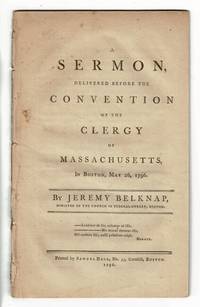
179657661Boston: printed by Samuel Hall no. 53 Cornhill 1796. 8vo pp. 29 1; removed from binding half-title wanting; very good. BAL 937; Evans 30052; Sabin 4438. printed by Samuel Hall, no. 53, Cornhill unknown
179657661Boston: printed by Samuel Hall no. 53 Cornhill 1796. 8vo pp. 29 1; removed from binding half-title wanting; very good. BAL 937; Evans 30052; Sabin 4438. <br/><br/> printed by Samuel Hall, no. 53, Cornhill unknown books
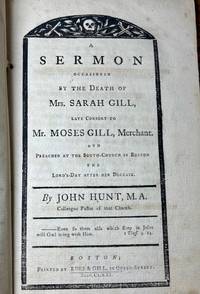
177135252Boston: Printed by Edes & Gill In Queen-Street 1771. First Edition. Wraps. Good. Stitched wraps. Approx. 8" x 5". 2 79 pages. Black thick paper covers. Two punch holes on the left edge. Spine is chipped with small tears. Light toning and damp staining to the text. Title page has a black border with skull and cross bones illustration at the top of the page. Scarce 12 copies located in OCLC as of 11/23. <br /> <br /> Evans 12080. Sarah Prince Gill was an Evangelical and organizer of Women prayer groups in Boston. She also was a Patriot. Gill married Moses Gill a merchant and politician from Massachusetts. The Colonial printer John Gill was the brother in law to Sarah Gill. <br /> <br /> AI generated: An Eighteenth Century imprint with a skull and bones illustrated title page is commonly referred to as a "memento mori" imprint. Memento mori is a Latin phrase meaning "remember that you will die" and it refers to artistic or literary works that serve as a reminder of the inevitability of death. The skull and bones illustrated title page was a popular motif during the 18th century often used in books and other printed materials to symbolize mortality and the transience of life. Printed by Edes & Gill, In Queen-Street unknown
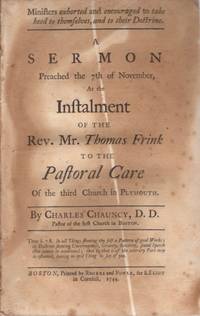
174432317Boston: Printed by Rogers and Fowle 1744. First Edition. Wraps. Good. Disbound wraps. 3-45 pages 1 page blank. Stitched wraps with title on page 3. Toning to the the title page. Very light occasional toning and foxing to the contents.<br /> <br /> Evans 5358. Printed by Rogers and Fowle unknown
175487817Boston: N.E.: Samuel Kneeland Printer to the Honourable House of Representatives 1754. First Edition. Stitched Pamphlet. Fair. Original stitched pamphlet 8 1/2 in. x 5 1/2 in. Bears the embossed blindstamp of the New England Historical Genealogical Society. Lacks half-title and final leaf 50 pp. out of 52 pp. present. Some dampstaining corner fraying and general toning throughout. Woman's name Caroline in period ink to bottom of page and a double line of inked dots pen trials to last page 50 of extant text. ".We have heard their threats and insolent menaces; we have seen their more insolent behaviour. .We are peaceably extending our settlements upon our own territories; they are extending theirs beyong their own by force of arms. We must meet at length; which cannot be without a violent conclusion: and the time seems not to be far off. Do I see the motley armies of French and painted Salvages taking our fortresses and erecting their own even in our capital towns and cities! Do I behold them spreading desolation thro' the land ! Do I see the slaves of Lewis with their Indian allies dispossessing the free born subjects of King George of the inheritance received from their forefathers.Do I see christianity banished for popery! the bible for the mass-book! the oracles of truth for fabulous legends!<br /> <br /> ".Instead of a train of Christ's faithful laborious ministers do I behold an herd of lazy Monks and Jesuits and Exorcists and Inquisitors and cowled and uncowled Imposters! Do I see a protestant there stealing a look at his bible and being taken in the fact punished like a felon!.And in fine do I hear the miserable sufferers those of them that survive bitterly accusing the negligence of the public Guardians.O dishonest! profane! excreble sight! O piercing sound! that entereth into the ears of the Lord of Sabbath." pp. 37-39. Samuel Kneeland, Printer to the Honourable House of Representatives unknown
177024240Glasgow: Robert and Thomas Duncan 1770. Hardcover. Very good. 6" x 4" 407 pp in original calf binding. Leather over joints partially cracked but hinges and binding sound. Ownership signatures one from 1777 one from 1972 on front endpapers otherwise unmarked. Thomas Boston 1676-1732 was a Scottish Presbyterian minister and theologian. The subject of this volume is described in the subtitle: "Wherein the parties in that Covenant the making of it and its carts conditionary and promissory and the Administration thereof are distinctly considered. Together with the trial of a saving person inbeing in in and the way of instating sinners therein unto their eternal salvation. Robert and Thomas Duncan hardcover
176120804Edinburgh: David Paterson 1761. First Edition. 12mo; 9100; 410pp. Full brown calf spine with 4 raised bands. Solidly bound and well worn with scuffing extremity wear especially to corners and crown of spine; Good. Inscribed on ffep 'Amos Grosvenor/His Book/January 10th/1764/Benjamin H. Grosvenot/Pomfret'. The Grosvenor family was one of the early settlers in New England coming to Pomfret from Massachusetts in the late 1600s. Amos Grosvenor 1724-1799 married Mary Hutchins and settled as a farmer in Pomfret. Among his children was a son Benjamin H. c. 1771-1847 who married Chloe Trowbridge to whom were born eight children the two eldest sons dying in early life. David Paterson unknown
177027373Glasgow: Robert and Thomas Duncan 1770. Attractive original calf with raised spine bands light wear. 407 1 blank pp. Rear free endpaper torn contemporary ownership signature of Thomas Manning. Scattered light foxing modern bookplate Very Good.<br /> ESTC T74880. Robert and Thomas Duncan unknown
177027373Glasgow: Robert and Thomas Duncan 1770. Attractive original calf with raised spine bands light wear. 407 1 blank pp. Rear free endpaper torn contemporary ownership signature of Thomas Manning. Scattered light foxing modern bookplate Very Good.<br/>ESTC T74880. Robert and Thomas Duncan unknown books
1793218222Boston: Belknap and Hall 1793. pamphlet. good. Folio 4 pages light foxing lower right corner of front page with seven inch expertly repaired tear with partial loss of some words center fold repaired in margin. Boston: Belknap and Hall 1793.<br/><br/> An entire issue of a Boston newspaper with mostly political content. The American Apollo was only published from January 6 1792 to December 25 1794. The entire front page is an article by William Fox the political reformer pamphleteer and bookseller from London entitled " Thoughts on the Death of the King of France". Most of the 2nd and 3rd pages consists of a reprinting of a letter from Thomas Jefferson as Secretary of State to Gouverneur Morris Minister Plenipotentiary to France. Jefferson writes against French provocations during the "Citizen Genet Affair" and other maritime actions that go against George Washington's policy of neutrality during the War between France and Great Britain. Jefferson writes extensively of the visit of French Minister Edmond Genet to the United States including Genet's attempts to enlist American ships in Charleston South Carolina as privateers against English ships. Jefferson mentions frequently how opposed he is to Genet's actions in America.<br/><br/> Belknap and Hall unknown books
179911026Boston: John Russell 1799. 13pp stitched contemporary plain blue wrappers verso of front wrap and front endpapers heavily foxed as usual. Text clean crisp and Very Good. <br /> <br /> "Surprisingly this is one of the most beautifully printed 18th century American pamphlets with a woodcut ship on the title page and a splendid variety of type fonts conservatively arranged." Jenkins. An early example of American incorporations. <br /> FIRST EDITION. Evans 35221. III Jenkins 887. NAIP w033188 4. 68 NUC 0676349 2. Not in Cohen. John Russell unknown
1799WRCAM16528Boston 1799. 13pp. Woodcut of ship on titlepage. Blue wrappers. Front endpapers foxed else a very good copy. An early and scarce example of an act of incorporation for an American insurance company. Only two copies are located by the NUC. EVANS 35221. unknown books
179911026Boston: John Russell 1799. 13pp stitched contemporary plain blue wrappers verso of front wrap and front endpapers heavily foxed as usual. Text clean crisp and Very Good. <br/><br/> "Surprisingly this is one of the most beautifully printed 18th century American pamphlets with a woodcut ship on the title page and a splendid variety of type fonts conservatively arranged." Jenkins. An early example of American incorporations. <br/>FIRST EDITION. Evans 35221. III Jenkins 887. NAIP w033188 4. 68 NUC 0676349 2. Not in Cohen. John Russell unknown books
1796LV1892Edinburgh:: Printed by Schaw and Pillans for the Reverend Joseph Johnston 1796. 1796. Second edition. Volume II of III. Small 4to. 495 pp. Lacks front ffep; leaves soiled stained and a bit worn with small gutter tear near p. 6. Original full calf; extremities heavily worn. As is. Printed by Schaw and Pillans, for the Reverend Joseph Johnston, 1796. unknown books
1773mon0001580982John Reid 1773. Hardcover. Good. . Leather binding showing wear and scuffing.Hinges and binding firm with no loose pages.Edges tannedText clear with some foxing/tanning John Reid hardcover
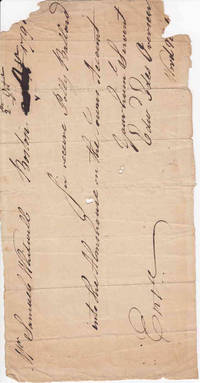
1791308540Boston 1791. 1p. pen and ink on paper. 8 x 4 inches. Old folds some chipping to right hand corners affecting date and text identifying ward number two small holes in center not affecting text else VG. 1p. pen and ink on paper. 8 x 4 inches. Between 1758 and 1800 the Boston Overseers of the Poor admitted around 7200 persons into the almshouse. Polly Ballard would have been sent to the almshouse at the corner of Beacon and Park streets in Boston established in 1696 to replace the city's original almshouse which had been destroyed in a fire. The site also included a prison added in 1723 and a separate workhouse built in 1739. The "Almshouse Keeper" was Samuel Whitwell who had served as an overseer of the poor for 21 years. Overseer of the Poor Edward Edes 1745-1803 was a Boston baker who baked among other items ships bread. He was also half-owner of the brigantine merchant ship "Olive Branch." He was the son of Thomas Edes 1719-1794 and Sarah Larabee 1719-1791. He married his half-cousin Elizabeth Edes in 1768 and had two sons. RECIEVED INTO THE ALSMHOUSE. <br/><br/> unknown
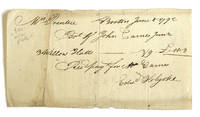
1792228522Boston 1792. 1 pp pen and ink on paper. 7 x 4 inches. Old folds minor tears VG. 1 pp pen and ink on paper. 7 x 4 inches. A quaint record of Federal era Boston which includes a handwrtiien list of 17 artisan and craftsman on the verso reading in part: "Receipt to Mrs. Prentice Bot of John Carnes Junr for 3 Willow Hatts 3/9 L11.3 rec'd pay't for. Edward Holyoke"<br /> <br /> Edward Holyoke 1770-1802 was the son of famed Sale physician Dr. Edwrad Augustus Holyoke. <br /> <br /> John Carnes Jr. was a failed minster turned shopkeeper and one of George Washington's earliest spies of the American Revolution. unknown
1792228522Boston 1792. 1 pp pen and ink on paper. 7 x 4 inches. Old folds minor tears VG. 1 pp pen and ink on paper. 7 x 4 inches. "BOT" OF A FORMER SPY. A quaint record of Federal era Boston which includes a handwrtiien list of 17 artisan and craftsman on the verso reading in part: "Receipt to Mrs. Prentice Bot of John Carnes Junr for 3 Willow Hatts 3/9 L11.3 rec'd pay't for. Edward Holyoke"<br/><br/>Edward Holyoke 1770-1802 was the son of famed Sale physician Dr. Edwrad Augustus Holyoke. <br/><br/>John Carnes Jr. was a failed minster turned shopkeeper and one of George Washington's earliest spies of the American Revolution. unknown books
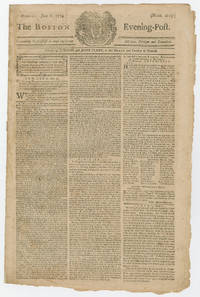
177424806<p>Early report in the local Boston newspaper on implementation of Parliament's Boston Port Act the first of the Intolerable Acts and the reaction to it in Massachusetts and beyond. Taking effect on June 1 1774 rather than punishing individuals the Act besieged the entire city until the colonists paid for the tea destroyed in the Tea Party December 16 1773.</p><p>"<i>the Act of Parliament for blocking up the Port of Boston is now in all its Parts carrying into Execution with the greatest Severity many Vessels being already prevented from coming in and Fishing boats and other small Craft strictly search'd; so that we have reason to expect that in a little time this Town will be in a truly distressed and melancholy Situation.</i>" p3/c1</p> <b>BOSTON PORT ACT.</b>Newspaper. <i>The Boston Evening-Post</i> June 6 1774 No. 2019. Boston: Thomas and John Fleet. 4 pp. 9¾ x 15⅜ in.<p><br /></p><p>The majority of this paper is devoted to patriotic content. The front page features a series of Questions and Answers from New York "<i>being conceived in some measure calculated to advance the cause of freedom in the present critical situation of affairs.</i>" It goes on to note that "<i>A Congress of Deputies from the several Colonies is thought to be absolutely necessary to devise means of restoring harmony between Great Britain and the Colonies and prevent matters from com</i>ing <i>to extremities</i>" p1/c1-2.</p><p>"<i>A Friend to Mankind</i>" wrote to the publishers "<i>When I first read the barbarous Act for shutting up the port of Boston; an act made with the pious design to starve the poor; make the industrious idle; the happy miserable; and as an entering wedge to the horrid purpose of enslaving America although I was transported beyond measure I could not help reflecting that bitter as it was for the present it would absolutely be of happy tendency to America in the result.</i>" p2/c1.</p><p>This issue prints a May 25 address from 33 Marblehead loyalists congratulating Massachusetts Gov. Thomas Hutchinson on his administration and wishing him a safe return trip to Great Britain p1/c3. On the other hand a public meeting in Marblehead denounced the address and declared Hutchinson "<i>an inveterate Enemy to the Liberties of the Province</i>" p2/c3.</p><p>This issue also announces from Boston "<i>the Corporation of <b>Harvard College</b>have voted that considering the present dark Aspect of our public Affairs—There be no public Commencement this Year—and that the Candidates for the first and second Degrees shall receive their Degrees in a general Diploma</i>" p3/c1. On May 1 1775 less than two weeks after the Battles of Lexington and Concord the faculty of Harvard dismissed the undergraduates early for the summer vacation again without a public commencement. Classes did not resume until October in Concord twenty miles away where students boarded with local residents and college courses were held in a deserted grammar school the courthouse and the First Parish meetinghouse. Meanwhile the five buildings of the college's campus in Cambridge housed 1600 American soldiers. After the British surrendered Boston in March 1776 and the American troops moved south to defend New York the college was permitted to reoccupy its buildings in June. Of 190 freshmen entering between 1775 and 1778 only 30 left prior to graduation.</p><p>An advertisement is included for a just-published pamphlet <i>Observations on the Act of Parliament commonly called the Boston Port Bill with Thoughts on Civil Society and Standing Armies</i>p2/c1. From September 1774 to March 1775 Josiah Quincy II 1744-1775 was in England arguing the American cause to sympathetic British politicians. He died of tuberculosis on the return voyage within sight of Massachusetts.</p><p><b>Historic Background</b></p><p>Relief for Boston was sent from as far away as South Carolina and the First Continental Congress convened in Philadelphia three months later to coordinate a colonial response to the Intolerable Acts.</p><p>Parliament finally repealed the Boston Port Act in 1783 after fighting ceased in the American Revolutionary War but before the Treaty of Paris officially ended the war and recognized American independence.</p><p><b>Condition</b></p><p>Near fine; several professional mends to gutter margin. A bright and attractive issue of an important colonial newspaper.</p> Thomas and John Fleet books