WITGEEST, Simon [= Willem GOEREE?].Biblio.com
160 résultats
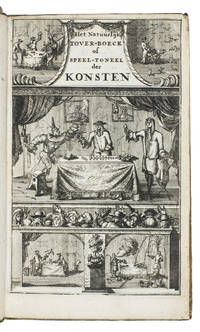
1684ABC_45272Amsterdam 1684. 8vo. Jan ten Hoorn Contemporary vellum with the manuscript title on the spine. With an engraved frontispiece in 5 compartments showing magic tricks and 40 small woodcuts illustrating the various magic tricks in the text. 8 512 24 pp. Rare second edition of a very popular Dutch conjuring book first published also by Jan ten Hoorn in Amsterdam in 1679. It went through many further editions sometimes augmented far into the 18th century. The edition of 1698 mentions 1600 magic tricks tover-konsten instead of the 500 in the present edition. It was also translated into German.Simon Witgeest from Middelburg is almost certainly a pseudonym. The family name does not appear in the www.wiewaswie.nl database until 1818. Witgeest literally means white spirit in Dutch and it probably served to suggest that the recipes were innocent white rather than black magic. Willem Goeree 1635-1711 a Dutch bookseller first in Middelburg and after 1677 in Amsterdam noted above as one of the books sources is often named as the possible author but his known publications books on art theory and practices and Jewish religion and history are aimed at more of a high-brow public.The author states in the preface that the book was meant to shorten wintery nights and gradually the sections on glass drawing and etching were omitted in favor of more magic tricks practical jokes riddles and entertainment with mathematical and astronomical brainteasers as well as small chemical and physics experiments for fun.Binding slightly worn otherwise in very good condition.l John Landwehr Simon Witgeests Natuurlyk tover-boek et alia in: Volkskunde 68 1967 pp. 67-82; Hoogendoorn p. 992 STCN 2 copies; for more about the text: www.dbnl.org/nieuws/nieuws.phpl=2020_01_09. hardcover
1694112349amsterdam, by Daniel van den Dalen, boekverkoope op't Rokkin, ter zyden de Beurs 1694 In-16 16,5 x 9,5 cm. Reliure de l’époque plein vélin ivoire, dos lisse avec titre manuscrit, [22]-606-[48] pp., page de faux-titre gravée, portrait gravé de Simon de Vries en frontispice. Exemplaire en bon état.
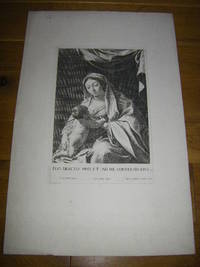
1638091309Paris 1638. Radierung von Pierre Daret nach Simon Vouet dargestellt ist die Muttergottes mit dem Christuskind; Blattgröße 495 x 323 cm Bildgröße ca. 275 x 185 cm; kräftiger Druck; Randbereich etwas unfrisch kl. Perforation im Vorhang kaum sichtbar ebenso im Randbereich. Befriedigend. 495 x 323 cm. unknown
1618L4OBDGT3RAY7Amsterdam: Claes Jansz. Visscher 1618. Large 1mo broadsheet 66.5 x 46.5 cm with engraved illustration 53 x 45.5 cm at the head with Visscher's name in the plate at lower right and a letterpress verse text below. Impressive large allegorical print of the defeat of the Arminians at the Synod of Dort in 1618 here in the rare first Visscher state. The publisher and engraver Claes Jansz. Visscher heavily reworked the plate of an earlier print by Simon Frisius commemorating the Dutch-Spanish truce of 1609 entitled: Pyramis pacifica. He revised the image so extensively that his revision is often treated as a separate work making the present version its first state. It is the most spectacular print to come out of the Arminian controversy. A more common much smaller and less impressive engraving was also published.A heated theological and political conflict had raged in the Low Countries between the Arminians from 1610 also called Remonstrants and Gomarists for more than a decade when it came to a head with the Synod of Dort 1618/19 which decided in favour of the Gomarists. The Synod led to the 1619 execution of the Republics greatest statesman Johan van Oldenbarnevelt who had supported the Arminian cause. In revenge his sons Reinier and Willem conspired to assassinate the Gomarist Dutch stadholder Maurits of Nassau Prince of Orange. Other prominent members of Dutch society who had political religious or personal grudges against the Prince lent their support. The plot was betrayed in February 1623 and the conspirators arrested and executed from March to May.A corner at the foot torn off and replaced with blank paper with the loss of most of the imprint and the ends of the last 8 lines of verse. Further with a few spots and tiny holes and small restored tears but generally in good condition and still attractive.l Atlas van Stolk 1347; Hollstein XXXVIII p. 21 no. 29 state III 4 copies; Muller Historieplaten 1329a zeldzaam. Claes Jansz. Visscher, unknown
1685041459's Gravenhage: Johan Veely Tongerloo Jasper Doll 1685. First Edition. Hardcover Full Leather. Very Good Condition. Full contemporary leather worn at edges heavily at corners hinges rubbed spine cracked but binding firm and intact. Bright internally wear to endpapers. Attractively engraved added title page. Printed in two columns 1520 numbered leaves. Size: Octavo 8vo. Text is clean and unmarked. Quantity Available: 1. Shipped Weight: Over 3 kilos. Category: History; Antiquarian & Rare. Inventory No: 041459. <br/><br/> Johan Veely, Tongerloo, Jasper Doll hardcover books
1672627911672. Leiden 1672. Leiden 1672. Two Great Jurists Analyze Excerpts from the Corpus Juris Civilis Van Leeuwen Simon 1626-1682. Vinnius Arnoldus 1588-1657. De Origine & Progressu Juris Civilis Romani Authores & Fragmenta Veterum Jurisconsultorum Cum Notis Arn. Vinnii & Variorum. Que Hisce Continentur Sequens Docebit Pagina. Leiden: Apud Arnoldum Doude 1672. xvi 850 10 pp. Main title page preceded by copperplate pictorial title page. Octavo 6-1/2" x 4-1/4". Contemporary vellum early hand-lettered title to spine large gilt arms of Arnhem to boards. Light soiling chip to head of spine upper corners bumped and somewhat worn front endleaves lacking. Light toning to text internally clean. Ex-library. Bookplate to front pastedown stamps to top edge bottom edge and rear endleaves. A nice copy. $500. Second edition. Two of the greatest Dutch jurists of their day Van Leeuwen and Vinnius were perhaps the most widely read Dutch jurists during the late-seventeenth and eighteenth century. De Origine is a collection of annotated excerpts from the Corpus Juris Civilis and essays. The first essay "De Origine Juris" is by Vinnius. Van Leeuwen compiled the excerpts and wrote two of the essay. Both authors provide annotations and cite additional annotations from other authors. It was first published in 1671 its third and final edition in 1762. Dekkers Bibliotheca Belgica Juridica 99 12. unknown books
1663015449Amsterdam: Joannem Blaeu Danielem Elzevirios Franciscum Hackium 1663. Book. Good- condition. Hardcover. First Edition. Folio. 10 p. leaves 796 12 388 12 300 92 39 p. Original full leather binding is heavily worn with the front board detached and heavy chipping and loss to the spine. Lacks the engraved title page. The printed title page is detached and has several scuffs tears creases and spots of staining with previous owner markings. The first page of text is also detached with creasing folding and soiling to the fore-edge. Minor staining to pages the gutter near Title continues ".repetitæ quintum prælectionis Dionysii Gothofredi JC. præter Justiniani Edicta Leonis & aliorum apostolorum græcè & latinè Feudorum libros Leges XII tabul. & alios ad jus pertinentes tractatus Fastos consulares indicesque titulorum ac legum : & quæcunque in ultimis parisiensi vel lugdunensi editionibus continentur huic editioni novè accesserunt Pauli receptæ Sententiæ cum selectis notis J. Cujacii et sparsim ad universum Corpus Antonii Anselmo . observationes singulares remissiones & notæ juris civilis canonici & novissimi ac in praxi recepti differentiam continentes ; denique lectiones variæ & notæ selectæ Augustini Belloni Goveani Cujacii Duareni Russardi Hotomanni Contii Roberti Rævardi Charondæ Grotii Salmasii & aliorum.". Joannem Blaeu, Danielem Elzevirios, Franciscum Hackium Hardcover books
1677c42cfHendrick en Dirck Boom 1677. Hardcover. Very Good/No Jacket. Dutch text. Vellum boards. Wavy pages and marks related to age. Pages remain tidy. Creases on the bottom of the first few pages. Small stamp from a previous owner on the front end page. Binding remains secure. it appears that a previous owner's bookplate was removed from under the front board. this has left some residue behind. Condition is given in terms of the books age. JHK. Our orders are shipped using tracked courier delivery services. Hendrick en Dirck Boom hardcover
1698J94816Amsteldam [Amsterdam], by Hendrik en de Wed. van Dirk Boom 1698 [46] + 688 + [32] pp. + gegraveerd portret (volblad, wellicht portret van auteur), 21cm., volperkmanenten band uit de tijd (contemporary vellum) met handgeschreven titel op rug en wat gebruiksvlekken maar intact en in goede staat, titelblad in rood en zwart, tekst helder, binding van aantal pagina's is wat gelost (fragiel maar intact), [vervolg van titel: "Met allerhande Ordonnantien, Placaten, Hand-vesten, Keuren, Gewoonten, en Gewijsden deser en omleggende Landen bevestigt"], goed exemplaar, J94816
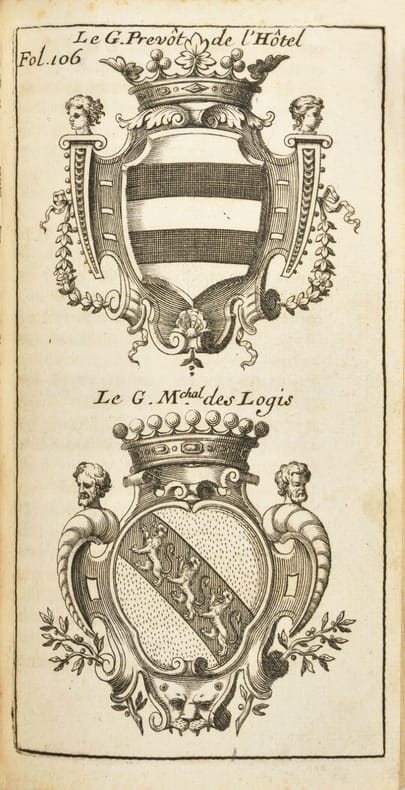
16897856chez Nicolas Le Gras, au troisième pilier de la grand'salle à l'L couronné - chez Martin Jouvenel, au bas de la ruë de la Harpe, à l'image S. Augustin - De l'imprimerie d'Estienne Chardon 9 x 15,5 Paris 1689 In-12 feuilleton dehors, dit à la hollandaise, i.e composé de cahiers de 8 ff. et de 4 ff. avec des signatures consécutives, reliure plein veau raciné de l'époque ou début XVIIIe, dos à cinq nerfs ornés de grenades et d'encadrements dorés, pièce de titre de maroquin rouge, titre doré, gardes papier à la cuve, tranches rouges, roulettes dorées sur les coupes, 12 ff. non ch., 318 p. [en fait 320, car l'imposition du premier cahier A comporte non pas 8 mais 9 ff., la page 2/3, cartonnée semble-t-il étant placée entre les feuillets A et Aii], 12 ff. non ch. Signatures: (a)8, (s)4, (A)9, (B)4, (C)8, (D)4 ...(Y)4, (Z)8, (Aa)4, (Bb)8, (Cc)4, (Dd)8, (Ee)4, (Ff)3 [manque Ff1. Absence du frontispice, bandeau gravé, précédant l'épitre dédicatoire, aux armes du chancelier Boucherat (1685-1699), bandeau, lettrines et culs-de-lampe.. Contient 51 planches gravées. Les pages liminaires contiennent une épître, une préface signée d'Hozier, l'approbation et une table des termes usités dans l'art du blason, armes du chancelier Boucherat gravées par Trudon à la fin de la table. - Les pages non ch. à la fin de l'ouvrage contiennent une table des familles et le privilège du Roi. Ouvrage peu fréquent, intéressant pour ses planches de blason (Saffroy, I-2266). Notre exemplaire présente les défauts suivants: reliure usagée avec manque en queue, mors fendu et coins et coupes émoussés, coiffe arasée, absence du frontispice, manque in fine du f. Ff1 dans la table des familles, taches d'encre sur la page de titre, salissure p. 3. Planches en bon état. Ex-libris gravé sur le contre plat "Thomé de Charaix" [couronne comtale, d'azur, à une tête de cerf coupée d'or, vieille famille originaire de Romans-sur Isère].(Bbis2) PHOTOS NUMERIQUES DISPONIBLES PAR EMAIL SUR SIMPLE DEMANDE-DIGITAL PHOTOGRAPS MAY BE AVAILABLE ON REQUEST.
16897856chez Nicolas Le Gras, au troisième pilier de la grand'salle à l'L couronné - chez Martin Jouvenel, au bas de la ruë de la Harpe, à l'image S. Augustin - De l'imprimerie d'Estienne Chardon 9 x 15,5 Paris 1689 In-12 feuilleton dehors, dit à la hollandaise, i.e composé de cahiers de 8 ff. et de 4 ff. avec des signatures consécutives, reliure plein veau raciné de l'époque ou début XVIIIe, dos à cinq nerfs ornés de grenades et d'encadrements dorés, pièce de titre de maroquin rouge, titre doré, gardes papier à la cuve, tranches rouges, roulettes dorées sur les coupes, 12 ff. non ch., 318 p. [en fait 320, car l'imposition du premier cahier A comporte non pas 8 mais 9 ff., la page 2/3, cartonnée semble-t-il étant placée entre les feuillets A et Aii], 12 ff. non ch. Signatures: (a)8, (s)4, (A)9, (B)4, (C)8, (D)4 ...(Y)4, (Z)8, (Aa)4, (Bb)8, (Cc)4, (Dd)8, (Ee)4, (Ff)3 [manque Ff1. Absence du frontispice, bandeau gravé, précédant l'épitre dédicatoire, aux armes du chancelier Boucherat (1685-1699), bandeau, lettrines et culs-de-lampe.. Contient 51 planches gravées. Les pages liminaires contiennent une épître, une préface signée d'Hozier, l'approbation et une table des termes usités dans l'art du blason, armes du chancelier Boucherat gravées par Trudon à la fin de la table. - Les pages non ch. à la fin de l'ouvrage contiennent une table des familles et le privilège du Roi. Ouvrage peu fréquent, intéressant pour ses planches de blason (Saffroy, I-2266). Notre exemplaire présente les défauts suivants: reliure usagée avec manque en queue, mors fendu et coins et coupes émoussés, coiffe arasée, absence du frontispice, manque in fine du f. Ff1 dans la table des familles, taches d'encre sur la page de titre, salissure p. 3. Planches en bon état. Ex-libris gravé sur le contre plat "Thomé de Charaix" [couronne comtale, d'azur, à une tête de cerf coupée d'or, vieille famille originaire de Romans-sur Isère].(Bbis2) PHOTOS NUMERIQUES DISPONIBLES PAR EMAIL SUR SIMPLE DEMANDE-DIGITAL PHOTOGRAPS MAY BE AVAILABLE ON REQUEST.
1689780Paris, Le Gras & Jouvenel, 1689 ; in-12 de [12] ff., 327 pp., [13] ff., reliure pastiche basane racinée, filets et roulette dorés encadrant les plats, dos à nerfs orné, pièce brune, coupes filetées, dentelle intérieure aux motifs d'oiseaux et de raisins, tranches dorées.
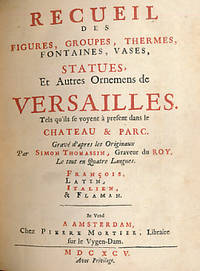
1695e6949Amsterdam: Chez Pierre Mortier. VG : in very good condition. Rebound with new eps. Fold out plan with some tears. 1695. Second Edition. Brown suede hardback cloth cover. 200mm x 150mm 8" x 6". 59pp 218 engraved plates. Engraved frontispiece and 218 copper engraved plates and fold out plan. Text in French. . Chez Pierre Mortier hardcover
162810791Leiden: B. & A. Elzevir 1628. Copper engraving by Simon Van der Passe. Very good condition apart from a few small tears in the margins a tinyhole in the lower left-hand corner of the image and a few light foxing marks in the margins. A fine print from the most sumptuous book on fencing ever produced which combines a strong design sense with beauty and historical importance executed by one of the greatest engravers of the day.<br/> <br/> Thibault's work was produced during a period when the Italian rapier or epee held sway. "The Italians discovered the effectiveness of the dexterous use of the point rather than the edge of the sword. By the end of the 16th century their lighter weapon.and simple nimble and controlled fencing style emphasizing skill and speed rather than force spread throughout Europe. Most of the wrestling tricks used in earlier disciplines were abandoned the lunge was discovered and fencing became established as an art" Encyclopaedia Britannica. The present image marks the zenith of the use of the epee in Europe. "In the latter half of the 17th century the sword and swordsmanship changed dramatically with a change in gentleman's dress. In France the court of Louis XIV set the fashion of silk stockings breeches and brocaded coats.As the long trailing rapier was unsuited to this form of dress fashion decreed the wearing of a light short court sword. The French style set in throughout Europe as the Italian had done earlier" op. cit.<br/> <br/> Cf. Vigeant p. 125; cf. Willems 302. B. & A. Elzevir unknown
162810794Leiden: B. & A. Elzevir 1628. Copper engraving by Simon Van der Passe. Very good condition apart from some overall light soiling and a small loss in the top margin. A fine print from the most sumptuous book on fencing ever produced which combines a strong design sense with beauty and historical importance executed by one of the greatest engravers of the day.<br/> <br/> Thibault's work was produced during a period when the Italian rapier or epee held sway. "The Italians discovered the effectiveness of the dexterous use of the point rather than the edge of the sword. By the end of the 16th century their lighter weapon.and simple nimble and controlled fencing style emphasizing skill and speed rather than force spread throughout Europe. Most of the wrestling tricks used in earlier disciplines were abandoned the lunge was discovered and fencing became established as an art" Encyclopaedia Britannica. The present image marks the zenith of the use of the epee in Europe. "In the latter half of the 17th century the sword and swordsmanship changed dramatically with a change in gentleman's dress. In France the court of Louis XIV set the fashion of silk stockings breeches and brocaded coats.As the long trailing rapier was unsuited to this form of dress fashion decreed the wearing of a light short court sword. The French style set in throughout Europe as the Italian had done earlier" op. cit.<br/> <br/> Cf. Vigeant p. 125; cf. Willems 302. unknown
162810791Leiden: B. & A. Elzevir 1628. Copper engraving by Simon Van der Passe. Very good condition apart from a few small tears in the margins a tinyhole in the lower left-hand corner of the image and a few light foxing marks in the margins. A fine print from the most sumptuous book on fencing ever produced which combines a strong design sense with beauty and historical importance executed by one of the greatest engravers of the day.<br/> <br/>Thibault's work was produced during a period when the Italian rapier or epee held sway. "The Italians discovered the effectiveness of the dexterous use of the point rather than the edge of the sword. By the end of the 16th century their lighter weapon.and simple nimble and controlled fencing style emphasizing skill and speed rather than force spread throughout Europe. Most of the wrestling tricks used in earlier disciplines were abandoned the lunge was discovered and fencing became established as an art" Encyclopaedia Britannica. The present image marks the zenith of the use of the epee in Europe. "In the latter half of the 17th century the sword and swordsmanship changed dramatically with a change in gentleman's dress. In France the court of Louis XIV set the fashion of silk stockings breeches and brocaded coats.As the long trailing rapier was unsuited to this form of dress fashion decreed the wearing of a light short court sword. The French style set in throughout Europe as the Italian had done earlier" op. cit.<br/> <br/>Cf. Vigeant p. 125; cf. Willems 302. B. & A. Elzevir unknown books
162810794Leiden: B. & A. Elzevir 1628. Copper engraving by Simon Van der Passe. Very good condition apart from some overall light soiling and a small loss in the top margin. A fine print from the most sumptuous book on fencing ever produced which combines a strong design sense with beauty and historical importance executed by one of the greatest engravers of the day.<br/> <br/>Thibault's work was produced during a period when the Italian rapier or epee held sway. "The Italians discovered the effectiveness of the dexterous use of the point rather than the edge of the sword. By the end of the 16th century their lighter weapon.and simple nimble and controlled fencing style emphasizing skill and speed rather than force spread throughout Europe. Most of the wrestling tricks used in earlier disciplines were abandoned the lunge was discovered and fencing became established as an art" Encyclopaedia Britannica. The present image marks the zenith of the use of the epee in Europe. "In the latter half of the 17th century the sword and swordsmanship changed dramatically with a change in gentleman's dress. In France the court of Louis XIV set the fashion of silk stockings breeches and brocaded coats.As the long trailing rapier was unsuited to this form of dress fashion decreed the wearing of a light short court sword. The French style set in throughout Europe as the Italian had done earlier" op. cit.<br/> <br/>Cf. Vigeant p. 125; cf. Willems 302. unknown books
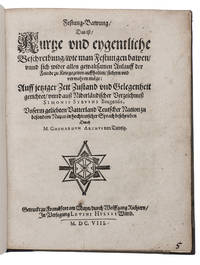
1608I48A877X5NJXFrankfurt am Main 1608. 4to. Wolfgang Richter for the widow of Levinius Hulsius 20th-century grey-brown half calf mottled-paper sides. With a woodcut fortification plan on the title-page and about 30 woodcut illustrations in the text mostly fortification plans and details a woodcut headpiece woodcut decorated gothic initials 3 series and typographic acorns. Lacking the 2 plates and 3 smaller slips with 7 additional woodcut illustrations. 8 132 pp. First German edition of the first Dutch fortification manual with woodcut illustrations by Simon Stevin 1548-1620 which inaugurated a new era in the history of siege warfare. It professionalized military engineering introducing many original ideas and presenting them in lucid vernacular language. The present first German translation made his work accessible to an international audience for the first time though translations had already circulated in manuscript and was followed by a French translation in Stevin's collected mathematical works in 1634. In part through the influence of the present manual the German-language classics of fortification such as Adam Freitag's continued to develop the Dutch school of fortification.The 1594 first edition was illustrated by woodcuts on the integral leaves but for the present edition seven of the woodcut figures were instead printed separately and inserted as 2 folding plates and 3 smaller slips. These are lacking in the present copy though it includes all integral leaves with the complete text and the other 30 illustrations. Quires C E and O are somewhat browned. Otherwise in very good condition and with generous margins occasionally preserving part of a deckle at the foot and fore-edge. The modern binding is in good condition.l Jähns p. 839; Jordan 3600 7 copies; noting only 2 plates; Sloos 8010 noting only 2 plates; VD17 23:252455D 4 copies. unknown
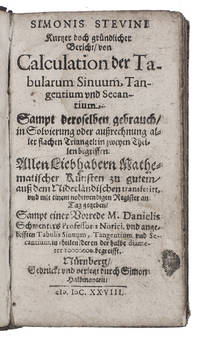
16286237Nuremberg 1628. 12mo. Simon Halbmayern Contemporary boards. With several woodcuts in text. 2 parts in 1 volume. 24 154 10; 182 pp. First German edition of Simon Stevin's 1548-1620 Van den Driehouck-Handel originally published in the Wisconstige Gedachtenissen 1605-1608 augmented by the translator Daniel Schwenter with axioms on spherical angles by the German mathematician Bartholomeus Pitiscus. The second part consists of tables for sine tangent and secants by Johann Praetorius. Stevin's writings are respected for their versatility their ability to combine theory and practice and the clarity of his argument. Name stamp on endpaper; slightly waterstained; a few wormholes. Good copy with armorial bookplate.l Bibl. Belg. V p. 232; Bierens de Haan 4590; and 4591; cf. Dijksterhuis pp. 104-105; Poggendorff 878. hardcover
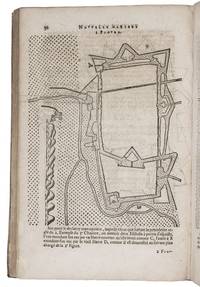
1618I44EE8UGV899Rotterdam: Jan van Waesberge 1618. Contemporary sheepskin parchment sewn on 4 vellum tapes laced through the joints with an old paper spine label. With: 2 STEVIN Simon. Nouvelle maniere de fortification par escluses. .Rotterdam Jan van Waesberge 1618. 2 works in 1 volume. Folio in 4s.With 2 title-pages each with Van Waesberges large woodcut publishers device angel with horn and ouroboros in an elaborately decorated frame with the nine muses one singing and each of the others with a different instrument signed Antonius van Leest more than 50 woodcut illustrations in the text many full-page or nearly full-page woodcut headpieces tailpieces and decorated initials 3 series. Set in roman types with incidental italic. The Castrametation lacks 2 preliminary leaves with the portrait and coat-of-arms of Maurits of Nassau Prince of Orange. First French editions of two complementary works in matching format and layout by Simon Stevin on the layout of army camps and on hydraulic engineering for fortifications in particular the use of pivoted sluices for deepening waterways draining land and operating locks. The Castrametation provides a window into daily life in the Dutch army during the Eighty Years' War of independence from Spain shedding light on both the physical arrangement of troops supplies armaments etc. and the rules that soldiers were expected to follow. The Fortification par escluses both reflects and helped to establish the Dutch mastery of the seas and waterways which was unique among nations at this date. While the numerous fortification plans are presented as general types to illustrate principles many are based on actual Dutch cities. The book therefore provides Stevin's analysis of the strtegic situation of many Dutch cities and the ways their security could be improved by hydraulic engineering. Both works were published during the Twelve Years' Truce 1609-1621 partly in anticipation of the renewal of hostilities in 1621 and therefore the need to improve the Dutch defences.With ink owner's additions to the fortification plan on F3 of the second work. Four of the fortification plans also have some additions drawn over them perhaps somewhat later in pencil. With bookplate. The Castrametation lacks 2 preliminary leaves with the portrait and coat-of-arms of Maurits of Nassau Prince of Orange. With a water stain at the head of the leaves in the first half and slightly browned throughout. The binding shows a few stains and scuffmarks with one tape broken at one joint and the paper label tattered but is otherwise good. First French editions of two important Dutch military works.l Bierens de Haan 4576 & 4577; Simoni S258; Sloos Warfare 8014 & 8015; STCN 5 & 4 copies; cf. Jähns I 127 . Jan van Waesberge, hardcover
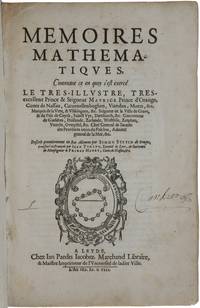
16084588Leyden: Jan Paedts Jacobsz 1608. First edition. Very rare first edition in French of this collection of works which was published almost simultaneously in Dutch French and Latin. They deal among other topics with geometry trigonometry perspective and double-entry book-keeping - Stevin was one of the first authors to compose a treatise on governmental accounting. The Appendice Algébraique which Sarton called 'one of Stevin's most important publications' is the first published general method of solving algebraic equations; it uses what is now called the 'intermediate value theorem' a remarkable anticipation as it was not rigorously formulated by mathematicians until the nineteenth century. All the works appearing in this volume were first published in this collection with one exception where the version here is the earliest extant. Hardcover. Double-entry bookkeeping. <p>Very rare first edition in French of this collection of works which was published almost simultaneously in Dutch French and Latin. They deal among other topics with geometry trigonometry perspective and double-entry book-keeping - Stevin was one of the first authors to compose a treatise on governmental accounting. The Appendice Algébraique which Sarton called 'one of Stevin's most important publications' is the first published general method of solving algebraic equations; it uses what is now called the 'intermediate value theorem' a remarkable anticipation as it was not rigorously formulated by mathematicians until the nineteenth century. All the works appearing in this volume were first published in this collection with one exception where the version here is the earliest extant - see below. Stevin 1548-1620 was perhaps the most original scientist of the second half of the 16th century the major works of Galileo did not appear until the 17th century. "He was involved in geometry algebra arithmetic pioneering a system of decimals dynamics and statics almost all branches of engineering and the theory of music" Kemp p. 113. "Stevin unconditionally supported the Copernican system several years before Galileo and at a time when few other scientists could bring themselves to do likewise" DSB XIII: 48. In 1593 Prince Maurice of Nassau 1567-1625 appointed Stevin quartermaster-general of the Dutch armies a post he held until his death. From 1600 Stevin organized the mathematical teaching at the engineering school attached to Leiden University. "The Prince used to carry manuscripts of Stevin's lectures with him in his campaigns. Fearing that he might lose them he finally decided to have them published not only in the original Dutch text Wisconstighe Gedachtenissen . but also in a Latin translation by Willebrord Snel Hypomnemata mathematica . and in a French translation by Jean Tuning offered here" Sarton p. 245. The Dutch and Latin editions were published in five parts of which the fourth consisted principally of reprints of his works on statics that had appeared separately in 1586. This fourth part was not translated into French because we are told at the beginning of the fifth part of the printer's impatience - he was tired of keeping the sheets already printed and suggested that additional materials could be published later when the author had prepared them. The printer's impatience also accounts for the fact that several works that are announced on the title pages of the individual volumes did not in fact appear in the Dutch French or Latin editions. The only other complete copy of this French edition listed by ABPC/RBH is the De Vitry copy in a nineteenth-century binding Sotheby's April 11 2002 lot 779 £15200 = $21935. OCLC lists Columbia Harvard and UCLA only in US.</p> <br /> <p>Provenance: L. Cundier early inscription on title-pages i.e. Louis Cundier c. 1615- 1681 French geometer surveyor and engraver. He was professor of mathematics at Aix and was responsible for a Carte géographique de Provence published about 1640. Contemporary marginal annotation on R6v of final part.</p> <br /> <p>The first part of the work entitled Cosmographie 1608 is a treatise on the trigonometrical techniques used in the observation of the heavens together with extensive tables of sines tangents and secants. "The first to use the term trigonometry seems to have been Pitiscus whose book Trigonometria made its first appearance in 1595 but in 1608 when Stevin's book appeared the term had not yet been generally accepted. The book consists of four parts the first dealing with the construction of goniometrical tables the second with plane triangles and the remaining two parts with spherical trigonometry . It is mainly of interest to those who wish to see what trigonometry was like in the sixteenth century long before Euler in 1748 introduced the present notation. It also has some distinction as the first complete text on trigonometry written in Dutch; and one of the first - if not the first - written in any vernacular" Works IIb p. 751.</p> <br /> <p>Part II De la Practique de Géométrie 1605 in Dutch De Meetdaet "is primarily a textbook for the instruction of those who like Prince Maurice wanted to learn some of the more practical aspects of geometry. The course was not one for beginners knowledge of Euclid's Elements being a prerequisite while the reader was also supposed to know something about the measurement of angles and Stevin's own calculus of decimal fractions . Parts of the contents were taken from the Problemata Geometrica the book which Stevin published in 1583 but to which he curiously enough never refers. Other parts show the influence of Archimedes and of contemporary writers such as Del Monte and Van Ceulen. Although in accordance with the title strong emphasis is laid on the practical applications of geometry many theoretical problems are discussed. For Stevin theory and application always went hand in hand.</p> <br /> <p>"The Meetdaet appeared in 1605 but it was drafted more than twenty years before. Already in the Problemata Geometrica Stevin refers to a text on geometry 'which we hope shortly to publish' and in which the subject was to be treated by a method parallel to that used in arithmetic. At that time Stevin's L'Arithmétique was either finished or well advanced. We get the impression that in this period 1583-85 Stevin decided to publish his full text on arithmetic but of his text on geometry only those parts which he considered novel. The general outline of the two texts was laid out at the same time and in close parallel. When at last the Meetdaet appeared it had undergone many changes resulting partly or wholly from lengthy discussions with the Prince of Orange. The underlying idea however remained the same.</p> <br /> <p>"In the introduction to the Meetdaet Stevin explains what he means by this parallelism of arithmetic and geometry. In arithmetic we begin by introducing the numerical symbols and follow this up by naming them and interpreting their value. Then come the four species the theory of proportions the theory of proportional division and finally the reduction of fractions to a common denominator. Similarly in geometry we begin by showing the student how to draw figures then we name them and explain how to measure them. Then follow the four species the theory of proportions of proportional intersections and the reduction of figures into others of given form and equal length area or volume. Since these topics are taken in six groups and each group with lines plane figures and solids the Meetdaet consists of six books each consisting of three parts.</p> <br /> <p>"The opinion of Stevin that geometry and arithmetic have to run parallel is not so artificial as it appears at first sight. Stevin expresses an opinion common to the mathematicians of his age who insisted on enlarging the field of numbers with irrationals to something like an arithmetic continuum who applied these numbers without discrimination to the measurement of figures and for whom numbers were not so much the object of abstract speculation as the tools for surveying navigation and astronomy. The subject matter of geometry is continuous quantity wrote such men as Tartaglia and Clavius. It seemed natural that there should exist relations and analogies between the professed geometrical and the intuitively felt arithmetical continuum. Stevin only gave an early sixteenth-century version of a point of view which was to lead within the next generations to analytic geometry. Consciousness of the analogy between arithmetical-algebraic and geometrical considerations continued to work as a leaven throughout the further development of mathematics. Later we find it in Leibniz' proposal for an algebra of directed quantities. In another form it appeared again more recently when Hilbert probed the consistency of geometrical axioms by means of a corresponding algebraic counterpart.</p> <br /> <p>"Book I of the Meetdaet in accordance with the author's program teaches methods for drawing lines and certain plane figures and for constructing certain solids. With his keen sense of the interdependence of theory and practice Stevin gives not only rules for the drawing board but also for the surveyor and instrument-maker. We thus meet here with a description of the surveyor's cross or diopter already described by Heron and used for setting out perpendiculars by lines of sight. With a graduated circle instead of a cross it becomes a so-called circumferentor or theodolite. The plane figures discussed are the circle the conic sections and the Archimedean spiral. No fewer than four methods are given for constructing points of an ellipse when the principal axes are given in position and magnitude . The fourth ellipse construction is equivalent to the one we often use at present and by which we find points of the ellipse by considering it the oblique parallel or orthographic projection of a circle with one of the axes as diameter. This construction may in this form be original with Stevin though it is closely related to another one also presented by Stevin in which he shows how the conic sections can be constructed as plane intersections of a right circular cone. His method amounts to what we now call orthographic projection . Book I also contains Stevin's description of the five regular and of eight Archimedean solids .</p> <br /> <p>"In Book II we find observations on the lengths of line segments and curves the areas of two-dimensional figures and the volumes of solids. Some surveyor's instruments appear among them the ancient 'traprondt' or graduated circle for measuring horizontal angles and the equally ancient triquetrum consisting of two arms of equal length hinged to a third; they are graduated and have sighting devices. The triquetrum also called PtoIemy's rods or parallactic instrument is used by Stevin to determine a triangle similar to a triangle in the fields though in his days it had also received attention as a favourite measuring instrument of Copernicus and Tycho Brahe. As an application of the triquetrum Stevin shows us how to measure the distance from a given point to a point beyond reach. A number of other exercises in surveying follow and also such problems as the computation of the altitudes of a triangle with given sides. In the section on the measuring of circumferences and areas we find a discussion of the value of π with due references to Archimedes Romanus and Van Ceulen .</p> <br /> <p>"Book III contains the application of four species to geometry with reference to the parallel treatment in L'Aritbmétique. Multiplication and division of segments areas and volumes is only performed by means of numerical factors; there is no reference to the multiplication of segments so as to form areas. Of interest is the addition and subtraction of solids but the only case discussed is that of similar figures .</p> <br /> <p>"In Book IV we find a theory of proportions. It is shown how areas and volumes proportional to given line segments can be found. The most interesting part is that in which the two mean proportionals between two line segments are discussed. As in the Problemata Geometrica reference is made to Hero's construction according to Eutocius. The Eratosthenes construction is mentioned but not further discussed.</p> <br /> <p>"Book V contains the division of plane polygons into parts of given ratio by a line satisfying certain conditions another of the topics of the Problemata Geometrica. Here Stevin goes a little beyond the text of 1583 . he not only modified some of the proofs of the theorems already discussed in the Problemata but added the cases where the line of division has to pass through a point outside or inside the polygon .</p> <br /> <p>"Finally Book VI deals with some transformations of figures into others of given form and given length area or volume such as the approximate construction of a straight line equal to the circumference of a given circle of a triangle equal in area to a given circle of a sphere equal in volume to a given cone of a cylinder equal in volume to a given sphere and of a segment of a sphere similar to one of two given segments and equal in area to the other" ibid. pp. 764-8.</p> <br /> <p>Part III Des Perspectives 1605 in Dutch Deursichtighe is a mathematical treatment of perspective. "Stevin's book gives an important discussion of the case in which the plane of the drawing is not perpendicular to the plane of the ground and for special cases solves the inverse problem of perspective" DSB XIII: 48. "Stevin's approach to perspective belongs in the Commandino - Benedetti - Guidobaldo tradition and his main demonstrations are uncompromisingly geometrical in nature. He also took up the essentially non-pictorial problem of the rotation of the picture plane into the ground plane formulating one of the basic theorems of homology. However he does show some of Marolois's sensitivity to the needs of practitioners. His treatise was occasioned by the desire of Prince Maurice to understand the principles of pictorial representation - 'wishing to design exactly the perspective of any given figure with knowledge of causes and mathematical proof'. Stevin accordingly provides 'abridgements' of his geometrical techniques for artists - albeit rather abstract abridgements - and illustrates a Dürer-like perspective machine" Kemp pp. 113-114. Stevin "was obliged to perform a considerable amount of original work since most of the books at his disposal had written by and for painters and architects and were rich in directives and deficient in mathematical demonstrations. The only textbook comparable to that of Stevin in mathematical clarity and antedating it was the Perspectiva of his contemporary and colleague Guido Ubaldo Del Monte 1545-1607 which was published in 1600 only five years before the Deursichtighe.</p> <br /> <p>"Stevin's work contains two books. The title of the first book Verschaeuwing is Stevin's translation of the Latin word scenographia. The term Deursichtighe is his translation of the word perspectiva. Since the second book of the Deursichtighe contains the principles of Spiegelschaeuwen theory of reflection in mirrors translation of catoptrica perspective in Stevin's terminology comprises both scenography and catoptrics. It also includes the principles of refraction called Wanschaeflwing but this subject is wanting in the book" Works IIb p. 785</p> <br /> <p>"There is much in Stevin's book which reminds us of Del Monte's notably the extensive use of rotations and the introduction of the inverse problem of perspective and the double solution of certain problems called here the 'mathematical' and the 'mechanical' way. The two men had much in common; both were experts on fortifications both were mathematicians deeply interested in problems of mechanics both combined a love of theoretical study with engineering practice. It is understandable that their approach to perspective was similar and it is not unlikely that Stevin thoroughly enjoyed Del Monte's work. Despite this influence which has to be inferred rather than proved by quotations Stevin's work is an achievement of remarkable originality. He probably had a good deal of the contents of his work ready before he studied Del Monte's Perspective if ever he did and maintained his particular way of exposition and selection throughout the book .</p> <br /> <p>"The Verschaeuwing itself opens with certain postulates showing how seriously the author tried to base his work on a correct mathematical foundation. One of these postulates is that a point and its perspective image lie in a straight line with the eye. Stevin's explanation of the necessity of this postulate is that the physical eye is not a mathematical point; by pressing the eye we can obtain a difference of as much as 33° in the image of a given point.</p> <br /> <p>"Among the first constructions are the classical ones of finding the perspective images of a point and a line. Here we meet the demonstration of Del Monte's theorem that all sets of parallel lines have images in lines passing through one point. This point 'saempunt' is Del Monte's 'punctum concursus'. Then comes Stevin's new approach: he takes the picture plane the 'glass' no longer perpendicular to the ground plane the 'floor' but at an arbitrary angle. This leads him to two new theorems Props. 7 and 8 by means of which the construction for this case is reduced to the case of the vertical picture plane . Stevin now undertakes the construction of the perspective images of several figures including that of a 'tower' a quadrangular pyramid on top of a cube with a face of the cube as its base; the cube is standing on the ground plane. He also constructs the ellipse as the image of a circle. Some methods of checking the correctness of constructions follow.</p> <br /> <p>"These propositions can be considered as forming the first part of the Verschaeuwing. The second part from Prop. 12 onwards deals with the inverse problem of perspective a subject already touched by Del Monte. Given a polygon as image and another polygon in the ground plane turned into the picture plane: to find if possible the eye; the angle between picture plane and ground plane is given and is not necessarily 90°. Stevin solves the problem in certain special cases; the solution of the solution of the general problem had to wait until the nineteenth century.</p> <br /> <p>"The text ends with an 'Appendix' which contains certain observations on terminology a correction of certain constructions by Serlio and a description of a model described by Dürer which caught the fancy of Prince Maurice to such an extent that he had it constructed. It was an instrument for drawing the perspective of a figure on a glass plate; it had helped Stevin himself to gain a better understanding of the theory.</p> <br /> <p>"Book II of the Deursichtighe the Catoptrics is short and does not contain much that is of interest . Stevin must have added the sixteen pages as a tribute to an ancient tradition but he did not develop the subject with his usual thoroughness. That part of the Catoptrics which deals with refraction and which was announced in the Summary Van de Wanschaeuwing was not even published" ibid. pp. 790-1</p> <br /> <p>Part V Meslanges 1608 contains a very important mathematical work Appendice algébrique contenant règle générale de toutes Equations as well as Stevin's treatise on double-entry bookkeeping. Sections on music architecture fortification and other topics announced on the title page were never published in the Dutch French or Latin editions.</p> <br /> <p>The Appendice had been published separately in 1594 but the unique copy kept at the University of Louvain was destroyed during World War I and its appearance here is now the earliest extant. "This is one of Stevin's most important publications: it includes a general rule to solve numerical equations of every degree. Expressed in modern language: if fa > 0 and fb < 0 there is between a and b at least one root of the equation fx = 0" Sarton p. 253. This is the first clear statement of what is now known as the 'intermediate value theorem' which was rigorously formulated and proved only two centuries later by Bolzano and Cauchy. Stevin tells us that his friend Ludolph van Ceulen had also found a general rule for the same purpose and it was probably also known to Adrianus Romanus but priority definitely belongs to Stevin as he was the only one to publish it.</p> <br /> <p>"In his Appendice Algébraique Stevin states that after the publication of L'Arithmétique he has found a general rule to solve all equations either perfectly or with any degree of approximation. His example is x3 = 300x 33915024. To find a first approximation for x try x = 1 then x = 10 100 1000 . The result is that for x = 1 x = 10 x = 100 the value of x3 is less than that of 300x 33915024 but for x = 1000 it is larger. Hence the first result is 100 < x < 1000. To find a second approximation for x he now substitutes x = 100 200 300 400 and finds 300 < x < 400. Now he tries x = 310 320 330 and finds 320 < x < 330 then x = 321 322 323 324. It appears that for x = 324 both sides of the equation are equal so x = 324 is the root.</p> <br /> <p>"The method can also be applied if the root is not an integral number. If x3 = 300x 33900000 we find 323 < x < 324. Then write x = 3230/10 and proceed as above first with 1/10 then 1/100 etc. This can go on indefinitely. If for instance the root were x = 5/6 the method gives first 8/10 then 83/100 then 833/1000 then 8333/10000 and so we can approach the root as closely as we like. The same holds if x were a radical incommensurable with common numbers" Works IIb p. 740.</p> <br /> <p>The treatise on double entry bookkeeping Livre de compte de prince à la manière d'Italie en domaine et finance extraordinaire . "was composed by Stevin at the request of Prince Maurice and aptly dedicated to Sully the great French economist and minister to Henry IV. It is divided into two parts: The merchant's account book and the prince's account book and the latter part is divided into three others: Livre de compte en domaine Livre de compte en dépenses Livre de compte en finances extraordinaires .</p> <br /> <p>"The origin of his treatise is clearly explained in the dedication to Sully and in two preliminary dialogues. He recalls his experience as a bookkeeper and cashier in an Antwerp firm and his work in the financial administration of his native city. While doing this work he was struck by the fact that the domanial and financial accounts were kept so badly that princes were always at the mercy of their intendents and receivers who could deceive them with impunity. It was very soon clear to him that the only way to put a stop to these abuses was to introduce into the public or princely administration the very methods used by merchants. But he had no chance to set forth his views to a competent person until the day came when Maurice of Nassau asked for his advice in that very matter. Stevin explained his ideas of reform to him and composed the first part of his work; Maurice then asked him to compose the second part i.e. the prince's account book. The Prince understood at once the advantage of Stevin's method and introduced it in his own domains" Sarton pp. 263-6. This treatise was issued separately in 1608 in French and perhaps also in Dutch.</p> <br /> <p>"The French translator Jean Tuning was secretary to Prince Frederik Hendrik of Nassau 1584-1647 Maurice's young brother; he was born in Leiden and matriculated at the University of Leiden in 1593" Sarton p. 256.</p> <br /> <p>Bibliotheca Belgica S.142 incomplete; Bierens de Haan 4571 describing only three of the four books; Crone et al eds. The Principal Works of Simon Stevin five vols. in six 1955-66; DSB XIII 47-51; Kemp The Science of Art 1990 Sarton 'Simon Stevin of Bruges 1548-1620' Isis 21 1934 pp. 241-303.</p> <br/> <br/> Four parts in one volume numbered I II III & V folio 310 x 197mm pp. 12 last leaf blank 1-234 231-360; 132; 91; 10 2 blank 21 3 6 58 2 8 108 including 'Annotation de l'autheur' on pp. 107-108 2 blank. Woodcut device of Stevin on title-page woodcut device of the printer on other titles woodcut initials and tailpieces woodcut diagrams those on B6r and C2r in part III with pasted-on folding flaps. Contemporary vellum over boards with yapped edges manuscript title along spine. A fine unrestored copy but for some intermittent browning which commonly affects this book. / Hardcover. Jan Paedts Jacobsz unknown
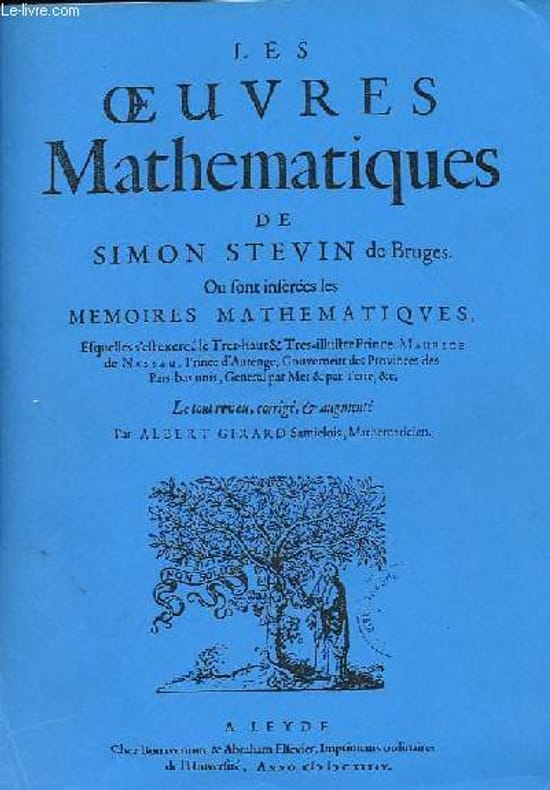
1634R200134218Bonaventure & Abraham Elfevier. 1634. In-4. Broché. A relier, 2ème plat abîmé, Dos satisfaisant, Intérieur frais. 222 pages photocopiées, texte en 2 colonnes, en supplément quelques photocopies de pages de l'ouvrage - pliures sur les plats, coins frottés, 2e plat désolidarisé du corps de l'ouvrage, 1er plat partiellement désolidarisé.. . . . Classification Dewey : 510-Mathématiques
1605180091605 Leyde, Jan Paedts Jacobsz, 1605-1608, in-folio de (8)-360-132-85-(1)-21-(1)-58-(2)-108 pp., papier assez bruni, quelques mouillures claires et taches n'affectant pas le texte, bords des 2 derniers feuillets consolidés, rel. d'époque de pleine peau de daim jaune clair, frottée, taches claires), dos à nerfs avec titre anciennement doré, bon ex. dans sa reliure d'origine.
1660222730085XRotterdam Arnout Leers 1660. REPRINT 24 444 p. Half Kunstleer 8° NIEUW uitgave Snoek Rotterdam, Arnout Leers unknown
168251316London: G. Wells 1682. First edition. Hardcover. Very good-. Two parts small octavo. Collation: A2 star8 B-O8 P2; second series K-2H8 2I4 = 296 leaves. 20 211 1 blank 129-487 1 blankpp. Index of letters bound between the reader's preface and the Life of Morin. Texts in Latin with occasional passages in Hebrew Arabic Syriac and Greek. Contemporary vellum lightly stained with old manuscript label faded and blurred at spine. Occasional light toning and a few oxidation spots else a very good copy with crisp text. <br /> <br /> First edition of this important collection of letters chiefly between the orientalist and member of the Oratorian order Jean Morin 1591-1659 and Cardinal Francesco Barberini 1597-1679. Occasioned by the attempt of Pope Urban VIII to unite the eastern churches with the Roman Catholic Church they document an important early attempt to address the relations between Rome and the Christian communities of the Levant and Near East. The first two letters from the Samaritan community in Egypt are addressed to Joseph Scaliger and discuss the differences between their luni-solar calendar and that employed by the mainstream Jewish community; originally written in Hebrew the present Latin versions were prepared by Morin. Fourteen letters contain the correspondence between Morin and Pietro Della Valle 1586-1652 on Samaritan matters and Islamic chronology. <br /> <br /> Purchased from the heirs of the French scholar Amelot de la Houssaye the 94 letters were edited by the pioneering biblical critic Richard Simon 1638-1712 who may be credited with the "first attempt to write a history of the Bible as a piece of literature" Schaff-Herzog. Focusing his analyses on the text versions and commentaries Simon critically discussed the Septuagint and the Vulgate and defended the translation of the Bible into the vernacular. He affirmed the critical value of the Masoretic text while acknowledging the late origin of the Hebrew vocalization system. In his Histoire Critique du Vieux Testament Paris 1678 he also dared to suggest "that Moses cannot be the author of all the books attributed to him." Too radical for its time the work was suppressed and nearly all copies of the first print run were destroyed. A transcription of one of the surviving copies served as the basis of the 1680 Rotterdam edition and an English version published at London in 1682. Simon was expelled from the Oratorians. It thus comes as no surprise to observe that his substantial biography of Morin which precedes the letters "amounts to a diatribe against not only Morin but the entire Oratorian Congregation" Wetzer & Welte. <br /> <br /> Provenance: Stamp of Collegii Albertini Bonnae at recto and verso of the title; from the library of Old Catholic theologian J. H. Reinkens 1821-96 with his manuscript entry at the front endleaf. References: ESTC R-5020; Ingold Essai de bibl. oratorienne 150; Orme Bibl. Biblica 301; Wetzer & Welte Kirchenlexikon VIII p.1919; Wing M-2764 & S-3795.<br /> <br /> Full title and imprint: Antiquitates Ecclesiae Orientalis clarissimorum virorum Barbarini Allatii Holstenii Morini Ecchellensis Peirescii à Valle Comberi Buxtorfii Hottingeri &c. Dissertationibus epistolicis enucleatae; nunc ex ipsis autographis editae. Quibus praefixa est Morini Congr. Orat. Paris. PP. Vita. Londini: Prostant apud Geo. Wells ad insigne Solis in Coemeterio D. Pauli. 1682. G. Wells hardcover