STEVIN, SimonBiblio.com
160 résultats
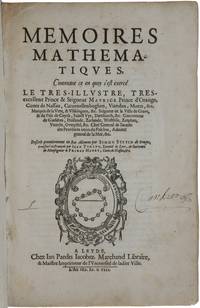
16084588Leyden: Jan Paedts Jacobsz 1608. First edition. Very rare first edition in French of this collection of works which was published almost simultaneously in Dutch French and Latin. They deal among other topics with geometry trigonometry perspective and double-entry book-keeping - Stevin was one of the first authors to compose a treatise on governmental accounting. The Appendice Algébraique which Sarton called 'one of Stevin's most important publications' is the first published general method of solving algebraic equations; it uses what is now called the 'intermediate value theorem' a remarkable anticipation as it was not rigorously formulated by mathematicians until the nineteenth century. All the works appearing in this volume were first published in this collection with one exception where the version here is the earliest extant. Hardcover. Double-entry bookkeeping. <p>Very rare first edition in French of this collection of works which was published almost simultaneously in Dutch French and Latin. They deal among other topics with geometry trigonometry perspective and double-entry book-keeping - Stevin was one of the first authors to compose a treatise on governmental accounting. The Appendice Algébraique which Sarton called 'one of Stevin's most important publications' is the first published general method of solving algebraic equations; it uses what is now called the 'intermediate value theorem' a remarkable anticipation as it was not rigorously formulated by mathematicians until the nineteenth century. All the works appearing in this volume were first published in this collection with one exception where the version here is the earliest extant - see below. Stevin 1548-1620 was perhaps the most original scientist of the second half of the 16th century the major works of Galileo did not appear until the 17th century. "He was involved in geometry algebra arithmetic pioneering a system of decimals dynamics and statics almost all branches of engineering and the theory of music" Kemp p. 113. "Stevin unconditionally supported the Copernican system several years before Galileo and at a time when few other scientists could bring themselves to do likewise" DSB XIII: 48. In 1593 Prince Maurice of Nassau 1567-1625 appointed Stevin quartermaster-general of the Dutch armies a post he held until his death. From 1600 Stevin organized the mathematical teaching at the engineering school attached to Leiden University. "The Prince used to carry manuscripts of Stevin's lectures with him in his campaigns. Fearing that he might lose them he finally decided to have them published not only in the original Dutch text Wisconstighe Gedachtenissen . but also in a Latin translation by Willebrord Snel Hypomnemata mathematica . and in a French translation by Jean Tuning offered here" Sarton p. 245. The Dutch and Latin editions were published in five parts of which the fourth consisted principally of reprints of his works on statics that had appeared separately in 1586. This fourth part was not translated into French because we are told at the beginning of the fifth part of the printer's impatience - he was tired of keeping the sheets already printed and suggested that additional materials could be published later when the author had prepared them. The printer's impatience also accounts for the fact that several works that are announced on the title pages of the individual volumes did not in fact appear in the Dutch French or Latin editions. The only other complete copy of this French edition listed by ABPC/RBH is the De Vitry copy in a nineteenth-century binding Sotheby's April 11 2002 lot 779 £15200 = $21935. OCLC lists Columbia Harvard and UCLA only in US.</p> <br /> <p>Provenance: L. Cundier early inscription on title-pages i.e. Louis Cundier c. 1615- 1681 French geometer surveyor and engraver. He was professor of mathematics at Aix and was responsible for a Carte géographique de Provence published about 1640. Contemporary marginal annotation on R6v of final part.</p> <br /> <p>The first part of the work entitled Cosmographie 1608 is a treatise on the trigonometrical techniques used in the observation of the heavens together with extensive tables of sines tangents and secants. "The first to use the term trigonometry seems to have been Pitiscus whose book Trigonometria made its first appearance in 1595 but in 1608 when Stevin's book appeared the term had not yet been generally accepted. The book consists of four parts the first dealing with the construction of goniometrical tables the second with plane triangles and the remaining two parts with spherical trigonometry . It is mainly of interest to those who wish to see what trigonometry was like in the sixteenth century long before Euler in 1748 introduced the present notation. It also has some distinction as the first complete text on trigonometry written in Dutch; and one of the first - if not the first - written in any vernacular" Works IIb p. 751.</p> <br /> <p>Part II De la Practique de Géométrie 1605 in Dutch De Meetdaet "is primarily a textbook for the instruction of those who like Prince Maurice wanted to learn some of the more practical aspects of geometry. The course was not one for beginners knowledge of Euclid's Elements being a prerequisite while the reader was also supposed to know something about the measurement of angles and Stevin's own calculus of decimal fractions . Parts of the contents were taken from the Problemata Geometrica the book which Stevin published in 1583 but to which he curiously enough never refers. Other parts show the influence of Archimedes and of contemporary writers such as Del Monte and Van Ceulen. Although in accordance with the title strong emphasis is laid on the practical applications of geometry many theoretical problems are discussed. For Stevin theory and application always went hand in hand.</p> <br /> <p>"The Meetdaet appeared in 1605 but it was drafted more than twenty years before. Already in the Problemata Geometrica Stevin refers to a text on geometry 'which we hope shortly to publish' and in which the subject was to be treated by a method parallel to that used in arithmetic. At that time Stevin's L'Arithmétique was either finished or well advanced. We get the impression that in this period 1583-85 Stevin decided to publish his full text on arithmetic but of his text on geometry only those parts which he considered novel. The general outline of the two texts was laid out at the same time and in close parallel. When at last the Meetdaet appeared it had undergone many changes resulting partly or wholly from lengthy discussions with the Prince of Orange. The underlying idea however remained the same.</p> <br /> <p>"In the introduction to the Meetdaet Stevin explains what he means by this parallelism of arithmetic and geometry. In arithmetic we begin by introducing the numerical symbols and follow this up by naming them and interpreting their value. Then come the four species the theory of proportions the theory of proportional division and finally the reduction of fractions to a common denominator. Similarly in geometry we begin by showing the student how to draw figures then we name them and explain how to measure them. Then follow the four species the theory of proportions of proportional intersections and the reduction of figures into others of given form and equal length area or volume. Since these topics are taken in six groups and each group with lines plane figures and solids the Meetdaet consists of six books each consisting of three parts.</p> <br /> <p>"The opinion of Stevin that geometry and arithmetic have to run parallel is not so artificial as it appears at first sight. Stevin expresses an opinion common to the mathematicians of his age who insisted on enlarging the field of numbers with irrationals to something like an arithmetic continuum who applied these numbers without discrimination to the measurement of figures and for whom numbers were not so much the object of abstract speculation as the tools for surveying navigation and astronomy. The subject matter of geometry is continuous quantity wrote such men as Tartaglia and Clavius. It seemed natural that there should exist relations and analogies between the professed geometrical and the intuitively felt arithmetical continuum. Stevin only gave an early sixteenth-century version of a point of view which was to lead within the next generations to analytic geometry. Consciousness of the analogy between arithmetical-algebraic and geometrical considerations continued to work as a leaven throughout the further development of mathematics. Later we find it in Leibniz' proposal for an algebra of directed quantities. In another form it appeared again more recently when Hilbert probed the consistency of geometrical axioms by means of a corresponding algebraic counterpart.</p> <br /> <p>"Book I of the Meetdaet in accordance with the author's program teaches methods for drawing lines and certain plane figures and for constructing certain solids. With his keen sense of the interdependence of theory and practice Stevin gives not only rules for the drawing board but also for the surveyor and instrument-maker. We thus meet here with a description of the surveyor's cross or diopter already described by Heron and used for setting out perpendiculars by lines of sight. With a graduated circle instead of a cross it becomes a so-called circumferentor or theodolite. The plane figures discussed are the circle the conic sections and the Archimedean spiral. No fewer than four methods are given for constructing points of an ellipse when the principal axes are given in position and magnitude . The fourth ellipse construction is equivalent to the one we often use at present and by which we find points of the ellipse by considering it the oblique parallel or orthographic projection of a circle with one of the axes as diameter. This construction may in this form be original with Stevin though it is closely related to another one also presented by Stevin in which he shows how the conic sections can be constructed as plane intersections of a right circular cone. His method amounts to what we now call orthographic projection . Book I also contains Stevin's description of the five regular and of eight Archimedean solids .</p> <br /> <p>"In Book II we find observations on the lengths of line segments and curves the areas of two-dimensional figures and the volumes of solids. Some surveyor's instruments appear among them the ancient 'traprondt' or graduated circle for measuring horizontal angles and the equally ancient triquetrum consisting of two arms of equal length hinged to a third; they are graduated and have sighting devices. The triquetrum also called PtoIemy's rods or parallactic instrument is used by Stevin to determine a triangle similar to a triangle in the fields though in his days it had also received attention as a favourite measuring instrument of Copernicus and Tycho Brahe. As an application of the triquetrum Stevin shows us how to measure the distance from a given point to a point beyond reach. A number of other exercises in surveying follow and also such problems as the computation of the altitudes of a triangle with given sides. In the section on the measuring of circumferences and areas we find a discussion of the value of π with due references to Archimedes Romanus and Van Ceulen .</p> <br /> <p>"Book III contains the application of four species to geometry with reference to the parallel treatment in L'Aritbmétique. Multiplication and division of segments areas and volumes is only performed by means of numerical factors; there is no reference to the multiplication of segments so as to form areas. Of interest is the addition and subtraction of solids but the only case discussed is that of similar figures .</p> <br /> <p>"In Book IV we find a theory of proportions. It is shown how areas and volumes proportional to given line segments can be found. The most interesting part is that in which the two mean proportionals between two line segments are discussed. As in the Problemata Geometrica reference is made to Hero's construction according to Eutocius. The Eratosthenes construction is mentioned but not further discussed.</p> <br /> <p>"Book V contains the division of plane polygons into parts of given ratio by a line satisfying certain conditions another of the topics of the Problemata Geometrica. Here Stevin goes a little beyond the text of 1583 . he not only modified some of the proofs of the theorems already discussed in the Problemata but added the cases where the line of division has to pass through a point outside or inside the polygon .</p> <br /> <p>"Finally Book VI deals with some transformations of figures into others of given form and given length area or volume such as the approximate construction of a straight line equal to the circumference of a given circle of a triangle equal in area to a given circle of a sphere equal in volume to a given cone of a cylinder equal in volume to a given sphere and of a segment of a sphere similar to one of two given segments and equal in area to the other" ibid. pp. 764-8.</p> <br /> <p>Part III Des Perspectives 1605 in Dutch Deursichtighe is a mathematical treatment of perspective. "Stevin's book gives an important discussion of the case in which the plane of the drawing is not perpendicular to the plane of the ground and for special cases solves the inverse problem of perspective" DSB XIII: 48. "Stevin's approach to perspective belongs in the Commandino - Benedetti - Guidobaldo tradition and his main demonstrations are uncompromisingly geometrical in nature. He also took up the essentially non-pictorial problem of the rotation of the picture plane into the ground plane formulating one of the basic theorems of homology. However he does show some of Marolois's sensitivity to the needs of practitioners. His treatise was occasioned by the desire of Prince Maurice to understand the principles of pictorial representation - 'wishing to design exactly the perspective of any given figure with knowledge of causes and mathematical proof'. Stevin accordingly provides 'abridgements' of his geometrical techniques for artists - albeit rather abstract abridgements - and illustrates a Dürer-like perspective machine" Kemp pp. 113-114. Stevin "was obliged to perform a considerable amount of original work since most of the books at his disposal had written by and for painters and architects and were rich in directives and deficient in mathematical demonstrations. The only textbook comparable to that of Stevin in mathematical clarity and antedating it was the Perspectiva of his contemporary and colleague Guido Ubaldo Del Monte 1545-1607 which was published in 1600 only five years before the Deursichtighe.</p> <br /> <p>"Stevin's work contains two books. The title of the first book Verschaeuwing is Stevin's translation of the Latin word scenographia. The term Deursichtighe is his translation of the word perspectiva. Since the second book of the Deursichtighe contains the principles of Spiegelschaeuwen theory of reflection in mirrors translation of catoptrica perspective in Stevin's terminology comprises both scenography and catoptrics. It also includes the principles of refraction called Wanschaeflwing but this subject is wanting in the book" Works IIb p. 785</p> <br /> <p>"There is much in Stevin's book which reminds us of Del Monte's notably the extensive use of rotations and the introduction of the inverse problem of perspective and the double solution of certain problems called here the 'mathematical' and the 'mechanical' way. The two men had much in common; both were experts on fortifications both were mathematicians deeply interested in problems of mechanics both combined a love of theoretical study with engineering practice. It is understandable that their approach to perspective was similar and it is not unlikely that Stevin thoroughly enjoyed Del Monte's work. Despite this influence which has to be inferred rather than proved by quotations Stevin's work is an achievement of remarkable originality. He probably had a good deal of the contents of his work ready before he studied Del Monte's Perspective if ever he did and maintained his particular way of exposition and selection throughout the book .</p> <br /> <p>"The Verschaeuwing itself opens with certain postulates showing how seriously the author tried to base his work on a correct mathematical foundation. One of these postulates is that a point and its perspective image lie in a straight line with the eye. Stevin's explanation of the necessity of this postulate is that the physical eye is not a mathematical point; by pressing the eye we can obtain a difference of as much as 33° in the image of a given point.</p> <br /> <p>"Among the first constructions are the classical ones of finding the perspective images of a point and a line. Here we meet the demonstration of Del Monte's theorem that all sets of parallel lines have images in lines passing through one point. This point 'saempunt' is Del Monte's 'punctum concursus'. Then comes Stevin's new approach: he takes the picture plane the 'glass' no longer perpendicular to the ground plane the 'floor' but at an arbitrary angle. This leads him to two new theorems Props. 7 and 8 by means of which the construction for this case is reduced to the case of the vertical picture plane . Stevin now undertakes the construction of the perspective images of several figures including that of a 'tower' a quadrangular pyramid on top of a cube with a face of the cube as its base; the cube is standing on the ground plane. He also constructs the ellipse as the image of a circle. Some methods of checking the correctness of constructions follow.</p> <br /> <p>"These propositions can be considered as forming the first part of the Verschaeuwing. The second part from Prop. 12 onwards deals with the inverse problem of perspective a subject already touched by Del Monte. Given a polygon as image and another polygon in the ground plane turned into the picture plane: to find if possible the eye; the angle between picture plane and ground plane is given and is not necessarily 90°. Stevin solves the problem in certain special cases; the solution of the solution of the general problem had to wait until the nineteenth century.</p> <br /> <p>"The text ends with an 'Appendix' which contains certain observations on terminology a correction of certain constructions by Serlio and a description of a model described by Dürer which caught the fancy of Prince Maurice to such an extent that he had it constructed. It was an instrument for drawing the perspective of a figure on a glass plate; it had helped Stevin himself to gain a better understanding of the theory.</p> <br /> <p>"Book II of the Deursichtighe the Catoptrics is short and does not contain much that is of interest . Stevin must have added the sixteen pages as a tribute to an ancient tradition but he did not develop the subject with his usual thoroughness. That part of the Catoptrics which deals with refraction and which was announced in the Summary Van de Wanschaeuwing was not even published" ibid. pp. 790-1</p> <br /> <p>Part V Meslanges 1608 contains a very important mathematical work Appendice algébrique contenant règle générale de toutes Equations as well as Stevin's treatise on double-entry bookkeeping. Sections on music architecture fortification and other topics announced on the title page were never published in the Dutch French or Latin editions.</p> <br /> <p>The Appendice had been published separately in 1594 but the unique copy kept at the University of Louvain was destroyed during World War I and its appearance here is now the earliest extant. "This is one of Stevin's most important publications: it includes a general rule to solve numerical equations of every degree. Expressed in modern language: if fa > 0 and fb < 0 there is between a and b at least one root of the equation fx = 0" Sarton p. 253. This is the first clear statement of what is now known as the 'intermediate value theorem' which was rigorously formulated and proved only two centuries later by Bolzano and Cauchy. Stevin tells us that his friend Ludolph van Ceulen had also found a general rule for the same purpose and it was probably also known to Adrianus Romanus but priority definitely belongs to Stevin as he was the only one to publish it.</p> <br /> <p>"In his Appendice Algébraique Stevin states that after the publication of L'Arithmétique he has found a general rule to solve all equations either perfectly or with any degree of approximation. His example is x3 = 300x 33915024. To find a first approximation for x try x = 1 then x = 10 100 1000 . The result is that for x = 1 x = 10 x = 100 the value of x3 is less than that of 300x 33915024 but for x = 1000 it is larger. Hence the first result is 100 < x < 1000. To find a second approximation for x he now substitutes x = 100 200 300 400 and finds 300 < x < 400. Now he tries x = 310 320 330 and finds 320 < x < 330 then x = 321 322 323 324. It appears that for x = 324 both sides of the equation are equal so x = 324 is the root.</p> <br /> <p>"The method can also be applied if the root is not an integral number. If x3 = 300x 33900000 we find 323 < x < 324. Then write x = 3230/10 and proceed as above first with 1/10 then 1/100 etc. This can go on indefinitely. If for instance the root were x = 5/6 the method gives first 8/10 then 83/100 then 833/1000 then 8333/10000 and so we can approach the root as closely as we like. The same holds if x were a radical incommensurable with common numbers" Works IIb p. 740.</p> <br /> <p>The treatise on double entry bookkeeping Livre de compte de prince à la manière d'Italie en domaine et finance extraordinaire . "was composed by Stevin at the request of Prince Maurice and aptly dedicated to Sully the great French economist and minister to Henry IV. It is divided into two parts: The merchant's account book and the prince's account book and the latter part is divided into three others: Livre de compte en domaine Livre de compte en dépenses Livre de compte en finances extraordinaires .</p> <br /> <p>"The origin of his treatise is clearly explained in the dedication to Sully and in two preliminary dialogues. He recalls his experience as a bookkeeper and cashier in an Antwerp firm and his work in the financial administration of his native city. While doing this work he was struck by the fact that the domanial and financial accounts were kept so badly that princes were always at the mercy of their intendents and receivers who could deceive them with impunity. It was very soon clear to him that the only way to put a stop to these abuses was to introduce into the public or princely administration the very methods used by merchants. But he had no chance to set forth his views to a competent person until the day came when Maurice of Nassau asked for his advice in that very matter. Stevin explained his ideas of reform to him and composed the first part of his work; Maurice then asked him to compose the second part i.e. the prince's account book. The Prince understood at once the advantage of Stevin's method and introduced it in his own domains" Sarton pp. 263-6. This treatise was issued separately in 1608 in French and perhaps also in Dutch.</p> <br /> <p>"The French translator Jean Tuning was secretary to Prince Frederik Hendrik of Nassau 1584-1647 Maurice's young brother; he was born in Leiden and matriculated at the University of Leiden in 1593" Sarton p. 256.</p> <br /> <p>Bibliotheca Belgica S.142 incomplete; Bierens de Haan 4571 describing only three of the four books; Crone et al eds. The Principal Works of Simon Stevin five vols. in six 1955-66; DSB XIII 47-51; Kemp The Science of Art 1990 Sarton 'Simon Stevin of Bruges 1548-1620' Isis 21 1934 pp. 241-303.</p> <br/> <br/> Four parts in one volume numbered I II III & V folio 310 x 197mm pp. 12 last leaf blank 1-234 231-360; 132; 91; 10 2 blank 21 3 6 58 2 8 108 including 'Annotation de l'autheur' on pp. 107-108 2 blank. Woodcut device of Stevin on title-page woodcut device of the printer on other titles woodcut initials and tailpieces woodcut diagrams those on B6r and C2r in part III with pasted-on folding flaps. Contemporary vellum over boards with yapped edges manuscript title along spine. A fine unrestored copy but for some intermittent browning which commonly affects this book. / Hardcover. Jan Paedts Jacobsz unknown
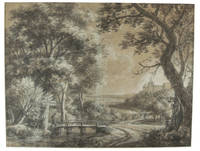
162023479The Netherlands 1620. 43 x 56 cm. Under glass in a black and gold wooden frame. Landscape drawing in black chalk and white chalk on paper. Stunningly beautiful wooded landscape with a castle on top of a hill at the right. Although the drawing is unsigned it has been authenticated by a leading expert on 17th-century Dutch art: Egbert Haverkamp Begemann John Langeloth Loeb professor emeritus at New York University's Institute of Fine Arts formerly of the department of prints and drawings at the Morgan Library and Museum in New York and professor of art history at Yale University. On the back is a sketch of a similar landscape apparently by the same artist.In very good condition with the paper slightly thin in places and reinforced along the edges. ABE CAT Art History unknown
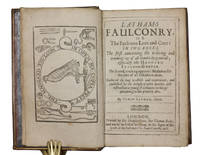
1658ABC_45288London 1658. Small 8vo. printed by Richard Hodgkinson for Thomas Rooks 19th century gold-tooled calf marbled endpapers. With woodcut frontispiece of "The Haggard Faulcon" second title with woodcut vignette of a gentleman riding his horse with his hawk on his arm. Second part with woodcuts in text woodcut headpieces and decorative initials. 2 parts in 1 volume. 34 176; 24 144 8 pp. The third first handy pocket-sized edition of two books on falconry by Simon Latham d. 1649 first published in 1614 and 1618 respectively. The first edition of part 1 was dedicated to Sir Thomas Monson Master Falconer to James I and the present edition retains that dedication though Monson died in 1641 and James in 1625. The second part is Lathams New and second book of faulconry first published in 1618 but usually bound up with the first Harting p. 16 and noted even on the 1614 and 1615 title-pages of the first part. Ordering and training of all hawks in general and especially the haggard falcon gentle. Approved medicines for the cure of all their difficulties. A very rare and valuable work USAF. The frontispiece depicts tools of the falconers trade. The 1615 edition of book 1 is a reissue of the first 1614 edition but second editions of both books appeared in 1633 and the present third editions in 1658. All editions before 1658 are in 4to format. The present small 8vo was more convenient for an ornithologist to use in the field.From the personal collection of the gentleman and Knightsbridge manuscript dealer Myles Colbeck Radford 1897-1963 with his armorial bookplate to front paste-down. Some spots and stains throughout; lacking the final blank. Lower corner of A2 in part 1 torn with slight loss of text professionally remargined.l ESTC R202683; Harting 20 note; WorldCat 228729034; USAF Academy Library Special bibliography series no. 38: Falconry p. 14; Wing L568 & L569; cf. Schwerdt I 302. ABE CAT Falconry & Hunting unknown
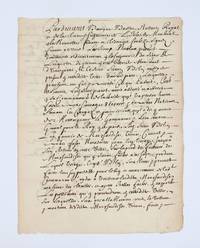
1688368775Montreal 1688. In French. 2pp. recto and verso on a single leaf. Signed by Perrot Bleinz and notary Benigne Basset. With an English transcription. Quarto. Old folds. Near fine. Provenance: Archibald de Léry MacDonald; Lawrence Lande. Exhibition: An Exhibition of Early Documents and Printed Material Relating to the Beginnings of Trade in North America from the Private Collection of Dr. Lawrence M. Lande McGill University May 30-July 15 1985 with an 8-page exhibition catalogue. In French. 2pp. recto and verso on a single leaf. Signed by Perrot Bleinz and notary Benigne Basset. With an English transcription. Quarto. Scarce seventeenth century voyageur fur trade contract for an expedition to the wilderness to trade with the Ottawa signed by one of the most important early traders and explorers of Canada and the upper midwest. "Partnership agreements such as this one of Nicholas Perrot are of great rarity" Lande.<br /> <br /> Perrot 1644-1717 was an explorer interpreter trader commandant diplomat and seigneur. He was one of the best-known figures in the early fur trade of New France particularly during the latter part of the 17th century and took possession of large tracts of land in the Great Lakes region in the name of King Louis XIV. His travels commonly took him deep into unexplored territory and he was the first Frenchman to explore the Upper Mississippi in what is now Wisconsin and Minnesota.<br /> <br /> Perrot arrived in New France about 1660 as a young donné or contracted assistant in the company of Jesuit Missionaries and travelled to the western Great Lakes region where he gained the friendship of the local First Nations people by trading guns for furs believing that they were entitled to defend themselves from their enemies. He also took the opportunity to learn several Native languages which served him well during his career. Perrot soon entered the fur trade full time and began forming business partnerships. He enlisted himself as a translator with government authorities and participated in peacekeeping missions to bring warriors of several First Nations together to sign peace treaties. By 1685 he was appointed Commandant-in-Chief at Bais des Puants present day Green Bay Wisconsin and surrounding regions and travelled to the upper reaches of the Mississippi River in the territory of the Sioux tribes where he built Fort St. Antoine in present-day Minnesota.<br /> <br /> During the spring of 1687 in preparation for taking part in raids on Indian villages in the Seneca country Perrot left his store of furs with the Jesuits at St. Francois-Xavier mission in present-day Wisconsin. While out with the raid party a fire at the mission destroyed his entire fur inventory valued at more than 40000 livres. Financially ruined Perrot returned to Montreal to deal with creditors and renew partnership agreements like the present.<br /> <br /> In the summer of 1688 Perrot partnered with Simon Bleinz to undertake an expedition to trade with the Ottawa Indians and other Nations. Perrot had always been a staunch ally of Governor Frontenac and had obtained a fur trade license from the governor for this venture to ensure that his activities were in keeping with the rules and regulations of the trade.<br /> <br /> The agreement states that Perrot would supply Bleinz with goods food provisions a canoe and other necessary supplies for the voyage and that Bleinz would convey the goods to the trading area and do all that he was able for the success of the partnership. Bleinz had the option of taking at his own expense six shirts two capots or hooded coats of blanket cloth moosehide or other material and one rifle to trade for his own personal profit. The pelts resulting from the venture were to be distributed evenly amongst Bleinz another unnamed associate of the partnership and Perrot. An "apichimon" or bonus of six beaver pelts was to be paid to Bleinz by the partnership upon the successful conclusion of the expedition. <br /> <br /> "Perrot who was often unappreciated even during his lifetime was France's best representative among the Indians of the west. His knowledge of the languages of the country his natural eloquence the happy blend of daring and coolness that were the essence of his character had made it possible for him to win the esteem confidence and even affection of the Indians. The Potawatomis the Menominees the Foxes the Miamis the Mascoutens and the Sioux granted him with the honours of the pipe of peace the rights and prerogatives enjoyed by their own chiefs. His credit was not less among the Ottawas and the Hurons. During the last four decades of the 17th century at a time when alliance with the nations of the west was indispensable in order to ward off the Iroquois peril and allow access to new territories Perrot thanks to the influence that he had acquired rendered valuable assistance to the colony" Dictionary of Canadian Biography.<br /> <br /> The present document is from the famed collection of Lawrence M. Lande 1906-1998 detailed as item 107 in his second bibliography of his collection The Founder of our Monetary System John Law Compagnie des Indes & the Early Economy of North America Montreal: 1984. Lande began collecting manuscript material relating John Law the Compagnie des Indes and the fur trade - North America's first economy - as early as the 1960s principally working with dealers Izzy Ehrlich and Alfred Van Peteghem purchasing material from the collections of Thomas Phillips Philip Sang and historian Archibald Lery MacDonald the assemblage of which Van Peteghem termed an "unparalleled feat." All of the printed material and many of the documents were donated by Lande in his lifetime; however a grouping of the manuscript items including the present document were sold by his heirs after his death. Lande Founder of our Monetary System 107 unknown
1605180091605 Leyde, Jan Paedts Jacobsz, 1605-1608, in-folio de (8)-360-132-85-(1)-21-(1)-58-(2)-108 pp., papier assez bruni, quelques mouillures claires et taches n'affectant pas le texte, bords des 2 derniers feuillets consolidés, rel. d'époque de pleine peau de daim jaune clair, frottée, taches claires), dos à nerfs avec titre anciennement doré, bon ex. dans sa reliure d'origine.
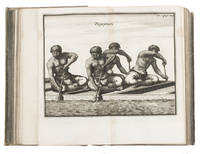
169189QBOS08WBVRAmsterdam 1691. 12mo. Abraham Wolfgang Contemporary slightly overlapping vellum manuscript title on spine blue edges. With the same woodcut printer's device on both title-pages 2 folding engraved maps 17 double-page engraved plates with printed music Siamese alphabets inhabitants etc. 21 full-page engraved plates engraved headpiece and several woodcut illustrations in text. 2 volumes bound as 1. 8 436 2; 4 324 1 1 blank pp. Second edition published in the same years as the first of a comprehensive work on the history of the kingdom of Siam "Universally regarded as the finest work on seventeenth-century Thailand" Wyatt. The French diplomat Simon de La Loubère 1642-1729 was appointed as Louis XIV's envoy extraordinary to the court of Siam and while he stayed in Siam for only three months he diligently and systemically asked questions "probably stimulated by the Jesuit scientists who accompanied the mission to take more than a passing interest in Siamese cosmology astronomy and mathematics" Lach & Van Kley. Loubère compensated his short stay with a thorough study of earlier writers referring to twenty-three European authors from Pinto to Gervaise in the first volume and collecting French translations of native works in the second. Besides presenting information on Siam itself Loubère also incorporates information on India and China and their influence on Siam's past.With the armorial bookplate of Anton Ernst Burckhard van Birckenstein active 1686-1744 on paste-down. Very good copy.l STCN 6 copies; Walravens 92; cf. Lach & Van Kley III pp. 1194-1196; Wyatt "Introduction" in: A new historical relation of the Kingdom of Siam 1966. ABE CAT Anthropology & Ethnography hardcover
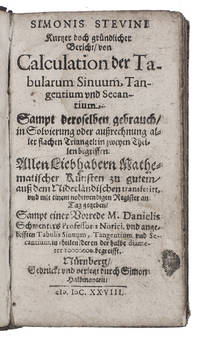
16286237Nuremberg 1628. 12mo. Simon Halbmayern Contemporary boards. With several woodcuts in text. 2 parts in 1 volume. 24 154 10; 182 pp. First German edition of Simon Stevin's 1548-1620 Van den Driehouck-Handel originally published in the Wisconstige Gedachtenissen 1605-1608 augmented by the translator Daniel Schwenter with axioms on spherical angles by the German mathematician Bartholomeus Pitiscus. The second part consists of tables for sine tangent and secants by Johann Praetorius. Stevin's writings are respected for their versatility their ability to combine theory and practice and the clarity of his argument. Name stamp on endpaper; slightly waterstained; a few wormholes. Good copy with armorial bookplate.l Bibl. Belg. V p. 232; Bierens de Haan 4590; and 4591; cf. Dijksterhuis pp. 104-105; Poggendorff 878. hardcover
165023027Amsterdam: Frederick de Wit 1650. Modern boards. Small oblong folio 18.5 x 26 cm. With 12 numbered engraved plates ca. 6.5 x 20.5 cm. Series of 12 numbered plates of birds 11 plates and butterflies 1 plate set in beautiful landscapes engraved by Simon Wynouts Frisius ca. 1580-1629 in mirror image after the plates of the series by Marcus Gheeraerts I not Marcus Gheeraerts II as catalogued by Hollstein originally published by Hendrik Hondius in 1610.The Frisius series is here in its third state with "F. de Widt excudit" on the first plate but with the monogram of Claes Jansz. Visscher who acquired the plates from Hondius still present on the other plates.Frederick De Wit was active in Amsterdam from 1654-1690 Gruys & De Wolf p. 199 and the paper is watermarked with a seven-pointed foolscap very similar to Laurentius II 476 dated 1686 so the series was probably issued around that time.Minor stain on the first leaf not affecting the plate and the last leaf browned with a torn-off corner restored. Very good copy.l Burch 10; Hollstein Dutch and Flemish VII p. 28 Frisius 92-103. Frederick de Wit, hardcover
163960630Rostock, Johann Hallervord, 1639. 4to. In contemporary full vellum. Title in contentemporary hand to spine. Gilt ornamentation to spine and gilt frames to boards. All edges gilt. Extremities with light soiling and a few dots and marks. Two previous owner's names in near contemporary hand to title-page. Three small worm-tracts affecting first few leaves, otherwise internally very nice and clean. (16), 80, 184, 19, (17), (32), (16) pp.
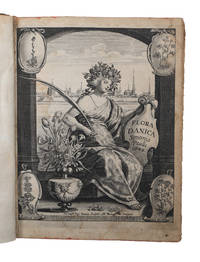
163960630Rostock Johann Hallervord 1639. 4to. In contemporary full vellum. Title in contentemporary hand to spine. Gilt ornamentation to spine and gilt frames to boards. All edges gilt. Extremities with light soiling and a few dots and marks. Two previous owner's names in near contemporary hand to title-page. Three small worm-tracts affecting first few leaves otherwise internally very nice and clean. 16 80 184 19 17 32 16 pp. <br/><br/><em>Exceedingly rare first edition of Paulli’s first substantial botanical work - and the first botanical university textbook in Denmark - which laid the foundation for his magnum opus the greatest illustrated work in Danish book-production and the largest Flora ever produced namely that of Flora Danica. The present work deals with the medicinal properties of various substances and is considered one of Paulli's most important contributions to the field of medicine. In the preface to Flora Danica Simon Paulli writes that the plant descriptions are drawn from Dodoens but organized into four groups based on the flowering time. One might think that this was meant as a simple and understandable system for laypeople but the system was not specifically created for this work. In Flora Danica Paulli employed a classification that he had already developed and presented in the present work the same year he arrived in Copenhagen. Since Simon Paulli originally wrote Flora Danica in Latin and had it translated with the help of a Danish student it is reasonable to assume that he drew much of the material directly from this book. See Bjerke “De Lærdeste Lægers Urtegaardeâ€. Simon Paulli 1603–1680 was a Danish physician and naturalist and made significant contributions to the fields of medicine and botany during the 17th century. Paulli was born in Rostock Germany and later moved to Denmark. He served as a professor of medicine at the University of Copenhagen and became the personal physician to King Christian IV of Denmark. In the botanical realm Paulli is particularly known for his work "Flora Danica". Published in the mid-17th century "Flora Danica" was one of the earliest works of its kind and contributed to the scientific understanding of plant life in Denmark. Apart from his botanical contributions Simon Paulli made important strides in the field of medicine and he is recognized for his studies on human anatomy. Simon Paulli's impact on botany and medicine particularly in Scandinavia has left a lasting legacy in the history of science. </em> hardcover
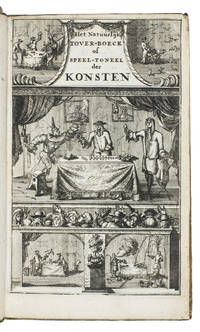
1684ABC_45272Amsterdam 1684. 8vo. Jan ten Hoorn Contemporary vellum with the manuscript title on the spine. With an engraved frontispiece in 5 compartments showing magic tricks and 40 small woodcuts illustrating the various magic tricks in the text. 8 512 24 pp. Rare second edition of a very popular Dutch conjuring book first published also by Jan ten Hoorn in Amsterdam in 1679. It went through many further editions sometimes augmented far into the 18th century. The edition of 1698 mentions 1600 magic tricks tover-konsten instead of the 500 in the present edition. It was also translated into German.Simon Witgeest from Middelburg is almost certainly a pseudonym. The family name does not appear in the www.wiewaswie.nl database until 1818. Witgeest literally means white spirit in Dutch and it probably served to suggest that the recipes were innocent white rather than black magic. Willem Goeree 1635-1711 a Dutch bookseller first in Middelburg and after 1677 in Amsterdam noted above as one of the books sources is often named as the possible author but his known publications books on art theory and practices and Jewish religion and history are aimed at more of a high-brow public.The author states in the preface that the book was meant to shorten wintery nights and gradually the sections on glass drawing and etching were omitted in favor of more magic tricks practical jokes riddles and entertainment with mathematical and astronomical brainteasers as well as small chemical and physics experiments for fun.Binding slightly worn otherwise in very good condition.l John Landwehr Simon Witgeests Natuurlyk tover-boek et alia in: Volkskunde 68 1967 pp. 67-82; Hoogendoorn p. 992 STCN 2 copies; for more about the text: www.dbnl.org/nieuws/nieuws.phpl=2020_01_09. hardcover
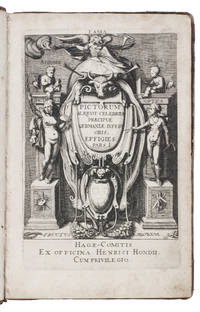
16108BNE272U2AXDThe Hague 1610. Folio. Henricus Hondius Contemporary half calf brown sprinkled paper sides. An engraved print series with an architectural title-page with allegorical figures an elaborate architectural cartouche with 3 allegorical female figures a terrestrial globe 2 putti a shield bearing only 3 smaller blank shields a bulls head a winged head and garlands of fruit; an engraved print with three putti tumbling through the air with 2 banderoles each bearing a 4-line verse; a letterpress dedicatory verse with a band of arabesque typographic ornaments above and below; 41 engraved portraits 20 x 12 cm by Hendrik Hondius 9 Robert de Baudous 4 Simon Frisius 23 and Andries Stock 5; and an allegorical closing print a skeleton holding an hour glass and an arrow not in the copy on Google Books. The three plates outside the portraits are all by Hendrick Hondius. With an extra added portrait of Hendrick Hondius engraved by Fredericus Boultats after a drawing by Hondius himself 16.5 x 11 cm; mounted on a blank leaf. 44 engraved ll. plus 1 letterpress leaf. A selection of 41 portraits plus the engraved allegorical title-page and the two other prints from the first edition of Hendrick Hondius's series of portraits of artists from the Low Countries. The complete set which contained 70 portraits appeared in or soon after 1610 the portrait of Jacobus de Geyn is dated 1610. Johannes Janssonius in Amsterdam published a second edition in 1618 with the title Theatrum honoris in quo nostri apelles . imagines. The prints were also sold separately and have no fixed order so the number of portraits and the additional prints included varies from copy to copy. Although there was no fixed order the STCN calls for three parts.The portraits in the complete series fall into three categories: 22 copy Domenicus Lampsonius's series of portraits of artists working before ca. 1500; 26 portray artists active in the sixteenth century and 20 portray contemporary artists.The present selection contains after 1 the engraved title-page H 80 2 the plate with the three putti with banderols 23 x 15 cm; H 81 3 a leaf with the mounted extra added portrait of Hendrik Hondius by Fredericus Boultats after the drawing by Hondius himself with a biographical note in French below 4 the leaf with the dedicatory poem by Hendrick Hondius "Picturae amatoribus admiratoribusque" 41 portraits and the allegorical print 21.5 x 13.5 cm with in the foot margin the motto "Post Funera Vita" Life after death by Hondius H 115 suggesting that the deceased subjects will live on.The present selection appears to deliberately cover artists after ca. 1500 including only one of the portraits after Lampsonius Cornelis Engelbrechtsz by Hondius a borderline case chronologically. It includes 23 of the 26 16th-century artists and 17 of the 20 contemporary artists. It therefore gives a good overview of artists in the Low Countries from ca. 1500 to ca. 1610.In total there are 10 portraits by the famous engraver etcher and publisher Hendrick Hondius 1573-1650 23 by Simon Wynouts Frisius ca. 1580-1629 5 by the pupil of Jacques de Geyn II Andries Stock ca. 1580-1648 and 4 by Robert de Baudous ca. 1574-ca. 1660 although many of the portraits are however signed by Hondius.Some marginal stains the top corner of several leaves damaged and the spine and boards somewhat rubbed but still in good condition.l New Hollstein Hendrick Hondius 80-115 pp. 90-105; Hollstein VII Frisius p. 32; Von Szwykowski 1856 p. 1; Kramm III p. 718; Van Someren 1 211a; Burchard 15. ABE CAT Art History hardcover
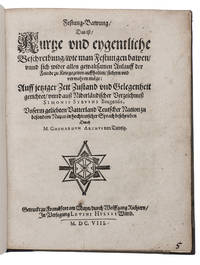
1608I48A877X5NJXFrankfurt am Main 1608. 4to. Wolfgang Richter for the widow of Levinius Hulsius 20th-century grey-brown half calf mottled-paper sides. With a woodcut fortification plan on the title-page and about 30 woodcut illustrations in the text mostly fortification plans and details a woodcut headpiece woodcut decorated gothic initials 3 series and typographic acorns. Lacking the 2 plates and 3 smaller slips with 7 additional woodcut illustrations. 8 132 pp. First German edition of the first Dutch fortification manual with woodcut illustrations by Simon Stevin 1548-1620 which inaugurated a new era in the history of siege warfare. It professionalized military engineering introducing many original ideas and presenting them in lucid vernacular language. The present first German translation made his work accessible to an international audience for the first time though translations had already circulated in manuscript and was followed by a French translation in Stevin's collected mathematical works in 1634. In part through the influence of the present manual the German-language classics of fortification such as Adam Freitag's continued to develop the Dutch school of fortification.The 1594 first edition was illustrated by woodcuts on the integral leaves but for the present edition seven of the woodcut figures were instead printed separately and inserted as 2 folding plates and 3 smaller slips. These are lacking in the present copy though it includes all integral leaves with the complete text and the other 30 illustrations. Quires C E and O are somewhat browned. Otherwise in very good condition and with generous margins occasionally preserving part of a deckle at the foot and fore-edge. The modern binding is in good condition.l Jähns p. 839; Jordan 3600 7 copies; noting only 2 plates; Sloos 8010 noting only 2 plates; VD17 23:252455D 4 copies. unknown
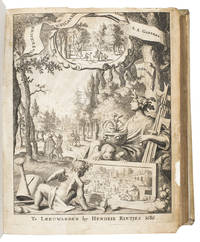
1687M1LEHD34NRM0Leeuwarden 1687. 4to. Hendrik Rintjes Contemporary vellum sprinkled edges new endpapers. With an engraved allegorical frontispiece ascribed to Jan Luyken. 1 1 blank 44 660 60 pp. Detailed botanical description of Frisian and Northwest European plants trees flowers and herbs by the Frisian historian Simon Abbes Gabbema 1628-1688. Although Gabbema was appointed history writer of Frisia in 1659 by the States of Frisia because of his learning and knowledge concerning Frisian history he also knew a lot about botany. The frontispiece is often ascribed to Jan Luyken Klaversma & Hannema 545. Altogether this work can be considered a compilation of Gabbema's own botanical knowledge enriched with ancient knowledge forming an extensive Frisian and Northwestern European flora.The present copy contains two leaves not normally present 45 and 55: the STCN notes them only in the copy at the Royal Library in The Hague: two laudatory poems by J. Vollenhove and H. Sweerts. Binding a bit dirty frontispiece a little browned and repaired some small stains throughout the book some paper corners a little frayed a small hole in leaf 2Y1 but otherwise in good condition.l Bibliotheca Hulthemiana 5970; Journal of the New York Botanical Garden 1902 p. 184; STCN 9 copies only 1 with the extra leaves; for the author: Van der Aa Biographisch woordenboek VII pp. 3-4; NNBW VI 1924; Posthuma Plantkunde uit de oude doos in: De levende natuur 21 1916 pp. 78-79; not in Hunt; Nissen; Pritzel; Stafleu & Cowan. hardcover
164861258Kiøbenhafn Melchiore Martzan 1647- 1648. 4to. In contemporary half calf with four raised bands. Wear to extremities. Previous owner's name to pasted down front end-paper. Ex-libris pasted on to pasted down front end-paper. Two-line annotation in Latin dated 1712 to front free end-paper. First leaves with marginal dampstaining. F. 379 missing lower outer corner but a leaf from another copy loosely inserted. Last 188 ff. depicting various flowers with annotations in contemporary hand and with occassional rudimentary handcoloring. With occassional marginal brownspotting throughout. 18 3-393 48 ff. 376 full page woodcuts of plants on 188 ff. frontispiece engraved half-title and 4 plates depicting the four seasons complete. <br/><br/><em>First edition of the first illustrated Danish Herbarium a seminal work in the history of Danish botanical literature. The work is widely regarded as being one the most beautiful and lavishly illustrated Danish 17th century prints. The first part of this work was published in Copenhagen in 1648. The second part containing the attractive four woodcut titles and plant woodcuts was published at Antwerp by Plantin in 1647 the Danish printers not having the facilities or expertise to do the job themselves. Most of the woodcuts are taken from Clusius and L’Obel.Nissen BBI 1497Birkelund 50. Biblioteca Danica II 188.Thesaurus 589. </em> hardcover
164861258Kiøbenhafn, Melchiore Martzan, (1647-) 1648. 4to. In contemporary half calf with four raised bands. Wear to extremities. Previous owner's name to pasted down front end-paper. Ex-libris pasted on to pasted down front end-paper. Two-line annotation in Latin dated 1712 to front free end-paper. First leaves with marginal dampstaining. F. 379 missing lower outer corner, but a leaf from another copy loosely inserted. Last 188 ff. depicting various flowers with annotations in contemporary hand and with occassional rudimentary handcoloring. With occassional marginal brownspotting throughout. (18), 3-393, (48) ff. + 376 full page woodcuts of plants on 188 ff., frontispiece, engraved half-title and 4 plates depicting the four seasons (complete).
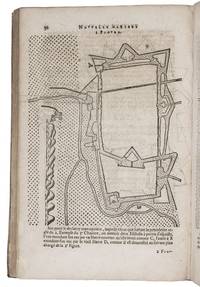
1618I44EE8UGV899Rotterdam: Jan van Waesberge 1618. Contemporary sheepskin parchment sewn on 4 vellum tapes laced through the joints with an old paper spine label. With: 2 STEVIN Simon. Nouvelle maniere de fortification par escluses. .Rotterdam Jan van Waesberge 1618. 2 works in 1 volume. Folio in 4s.With 2 title-pages each with Van Waesberges large woodcut publishers device angel with horn and ouroboros in an elaborately decorated frame with the nine muses one singing and each of the others with a different instrument signed Antonius van Leest more than 50 woodcut illustrations in the text many full-page or nearly full-page woodcut headpieces tailpieces and decorated initials 3 series. Set in roman types with incidental italic. The Castrametation lacks 2 preliminary leaves with the portrait and coat-of-arms of Maurits of Nassau Prince of Orange. First French editions of two complementary works in matching format and layout by Simon Stevin on the layout of army camps and on hydraulic engineering for fortifications in particular the use of pivoted sluices for deepening waterways draining land and operating locks. The Castrametation provides a window into daily life in the Dutch army during the Eighty Years' War of independence from Spain shedding light on both the physical arrangement of troops supplies armaments etc. and the rules that soldiers were expected to follow. The Fortification par escluses both reflects and helped to establish the Dutch mastery of the seas and waterways which was unique among nations at this date. While the numerous fortification plans are presented as general types to illustrate principles many are based on actual Dutch cities. The book therefore provides Stevin's analysis of the strtegic situation of many Dutch cities and the ways their security could be improved by hydraulic engineering. Both works were published during the Twelve Years' Truce 1609-1621 partly in anticipation of the renewal of hostilities in 1621 and therefore the need to improve the Dutch defences.With ink owner's additions to the fortification plan on F3 of the second work. Four of the fortification plans also have some additions drawn over them perhaps somewhat later in pencil. With bookplate. The Castrametation lacks 2 preliminary leaves with the portrait and coat-of-arms of Maurits of Nassau Prince of Orange. With a water stain at the head of the leaves in the first half and slightly browned throughout. The binding shows a few stains and scuffmarks with one tape broken at one joint and the paper label tattered but is otherwise good. First French editions of two important Dutch military works.l Bierens de Haan 4576 & 4577; Simoni S258; Sloos Warfare 8014 & 8015; STCN 5 & 4 copies; cf. Jähns I 127 . Jan van Waesberge, hardcover
1680CLL-614Amsterdam, Elzevier, 1680 In-4 de (15) ff., 612 pp., maroquin rouge, trois filets dorés sur plats, dos à nerfs orné de caissons de fleurons dorés, coupes et bordures décorées, tranches dorées (reliure de l'époque).
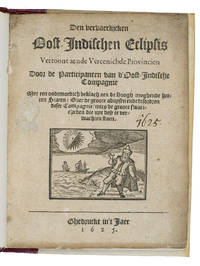
1625ABC_459231625. Modern half red faux snake-skin white paper sides manuscript title on front board new endpapers and paste-downs. Small 4to. With a small woodcut on the title-page. Set in textura types with incidental roman. Shortly abbreviated edition of an important and renowned pamphlet in the history in the VOC written by the lawyer Simon van Middelgeest about whom less is known. It is a complaint against the management the so-called "Heren XVII" of the Dutch East India Company VOC by the sharesholders who felt their concerns were being ignored. It is one of the many anonymous polemic pamphlets published by the so-called "doleanten" participants shareholders in which they express their grievances on the self-enrichment and abuses of the "Heren XVII" of the VOC. It is a shortened edition of a 1622 pamphlet titled Nootwendich discours oft vertooch aan de hooch-mogende heeren Staten Generaal van de participanten der Oost-Indische Compagnie tegens bewintshebbers Knuttel 3348; Landwehr VOC 884 which was reprinted several times under different titles including the present. The publishers frequently changed the title because the States of Holland published a proclaimation prohibited Van Middelgeest's Nootwendich discours in 1622 Knuttel 3349. With the bookplate of professor Dr. Willy L. Braekman on the front paste-down. Leaves very slightly browned otherwise in very good condition.l Knuttel 3585a; Landwehr VOC 911; Sabin 99316; STCN 4 copies; USTC 1034730 5 copies including the same 4. unknown
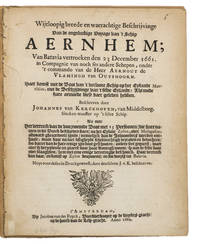
1664ABC_49305Amsterdam: Jacobus van der Fuyck 1664. Disbound loosely inserted in 20th-century plain brown paper wrappers. 4to. With a woodcut vignette on the title page and 2 decorated woodcut initials. Rare second edition under a different title of an eyewitness report of the dramatic shipwreck of the Arnhem a Dutch East Indiaman built in 1654 for the VOC. The report was written by Simon van den Kerkhoven a religious comforter to the sick Siecken-trooster on board and one of the shipwreck's survivors. The "ziekentrooster" was a religious office within the Dutch Protestant church in the 16th- to 20th centuries. Generally the person fulfilling its duty was not an official member of the clergy but when in service of the major trading companies VOC and WIC they received a special status which permitted them to perform clerical duties like administering the sacraments.The account of the shipwreck of the Arnhem was first published in Middelburg by Jacques Fierens in 1663 under the title: Historisch verhael der wonderlike ende seer zeldsame voor-vallen den gene bejegent die met het retour-schip Aernhem van Batavia na het vaderland verreist zyn den 23 decem. 1661. The present second edition claims on the title page that the name of the author is Johannes van Kerckhoven this appears to be a mistake as both the first edition the present preface and the signature at the end of the account in the present pamphlet mention Simon van den Kerkhoven. Another difference between the two editions can be found in the preliminaries: the dedication to the directors of the Zeeland chamber of the VOC is replaced by a rhymed preface in Dutch titled and signed Aen den leser door Simon van den Kerckhoven van Middelburgh; secken-trooster.On 23 December 1661 the Dutch East Indiaman Arnhem left Batavia in the Dutch East Indies now Jakarta Indonesia and set sail for the Low Countries together with 6 other ships under the command of the Dutch Admiral Arnold de Vlamingh van Oudtshoorn 1618-1662. In February 1662 on their way to Cape of Good Hope the fleet was caught in a storm and was scattered. Three ships disappeared without a trace while the Arnhem ran aground on the Cargados Carajos shoals in the Indian Ocean. Most of the crew managed to leave the ship in a small boat carrying 12 and a larger vessel carrying about 100 both headed for Mauritius many died on that journey and once back ashore the group further diminished and scattered in their attempt to survive. The surviving crew were able to leave Mauritius in small groups by boarding ships calling at the victualing station on the island. Curiously the surviving crew members of the Arnhem are now presumed to have been the last people to have seen live dodos.One of the survivors Dutch sailor Andries Stokram published the first report of this shipwreck in May 1663 in which the officers were blamed for the ship's sinking. They were also held responsible for putting men overboard from the lifeboat. Another survivor the Dutch bookkeeper Johan van Hal refuted these accusations in his report which was also published in 1663. In this same year Van den Kerkhovens report appeared in which he supported the charges of Stokram and held the officers responsible.The paper wrapper is damaged along the fold of the spine internally occasionally slightly browned. Otherwise in good condition.l Cat. NHSM p. 188; Knuttel 8912; Landwehr VOC 421; Petit 3299; Roeper & Wildeman Reizen op papier p. 66; STCN 853473501 6 copies; Tiele Land- en volkenkunde 1055 note; USTC 1801551 6 copies same as STCN; WorldCat 46304175 223757294 561184366 993578567 8 copies; cf. Knuttel 8760 1st ed different title. Jacobus van der Fuyck, unknown
1618L4OBDGT3RAY7Amsterdam: Claes Jansz. Visscher 1618. Large 1mo broadsheet 66.5 x 46.5 cm with engraved illustration 53 x 45.5 cm at the head with Visscher's name in the plate at lower right and a letterpress verse text below. Impressive large allegorical print of the defeat of the Arminians at the Synod of Dort in 1618 here in the rare first Visscher state. The publisher and engraver Claes Jansz. Visscher heavily reworked the plate of an earlier print by Simon Frisius commemorating the Dutch-Spanish truce of 1609 entitled: Pyramis pacifica. He revised the image so extensively that his revision is often treated as a separate work making the present version its first state. It is the most spectacular print to come out of the Arminian controversy. A more common much smaller and less impressive engraving was also published.A heated theological and political conflict had raged in the Low Countries between the Arminians from 1610 also called Remonstrants and Gomarists for more than a decade when it came to a head with the Synod of Dort 1618/19 which decided in favour of the Gomarists. The Synod led to the 1619 execution of the Republics greatest statesman Johan van Oldenbarnevelt who had supported the Arminian cause. In revenge his sons Reinier and Willem conspired to assassinate the Gomarist Dutch stadholder Maurits of Nassau Prince of Orange. Other prominent members of Dutch society who had political religious or personal grudges against the Prince lent their support. The plot was betrayed in February 1623 and the conspirators arrested and executed from March to May.A corner at the foot torn off and replaced with blank paper with the loss of most of the imprint and the ends of the last 8 lines of verse. Further with a few spots and tiny holes and small restored tears but generally in good condition and still attractive.l Atlas van Stolk 1347; Hollstein XXXVIII p. 21 no. 29 state III 4 copies; Muller Historieplaten 1329a zeldzaam. Claes Jansz. Visscher, unknown
162125590London: Printed for Iohn Grismand 1621. First Edition. Hardcover. 26 317 but actually 315 11 182 185-264 12pp. Recent chocolate brown half calf over marbled boards blind tooling on the sides spine with five raised bands gold lettering and decorations. Engraved title in compartments representing the history of creation by Simon van de Passe head-pieces initials and tail-pieces text enclosed in borders. Index and errata for the first and second week at end. The English translation of Simon Goulart's Commentaires et annotations sur la semaine de la création du monde de G. de Saluste sieur du Bartas. Title page edges and fore edges of eleven leaves skillfully repaired. Sporadic foxing an occasional spot and minor soiling previous owner's name in ink on title. A very good copy. ; Folio. Printed for Iohn Grismand hardcover
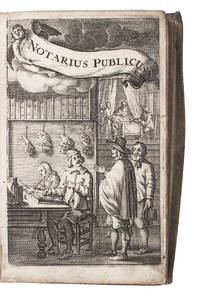
165821762Dordrecht 1658. Small 8vo 14.5 x 9.5 cm. Abraham Andriesz colophon: Dordrecht printed by Nicolaes de Vries Contemporary vellum sewn on 3 vellum tapes laced through the joints with a hollow back manuscript spine title. With 2 letterpress title-pages that for the dictionary with a woodcut device open book with Dutch quotation from Exodus 17:14 and the general title-page with compound leaf fleurons engraved frontispiece showing two gentlemen visiting a notary's office with books and papers against the wall and a small view in the background of a notary at a sickbed presumably drawing up a last will 3 woodcut decorated initials 2 series decorations built up from cast fleurons. Set in textura types with extensive use of roman and incidental italic. 10 108 2; 1 1 blank 154 pp. Third edition revised and enlarged of a rare practical handbook for practicing notaries written by Simon van Leeuwen 1626-1682 the most famous Dutch lawyer of the 17th century after Hugo de Groot Grotius. It incorporates a dictionary of more than 4000 technical terms many borrowed or adapted from Latin giving simple definitions in common Dutch. Unlike the second edition the present third edition explicitly notes that it has been newly revised improved and expanded. It teaches all theoretical and practical knowledge needed in a notary's office presented in the form of questions and answers like a catechism but sometimes also citing sources. Van Leeuwen's approach is refreshingly anti-bureaucratic.From the library of Eeltjo van Beresteyn 1876-1948. With a 1770 owner's inscription some underlining and an occasional pencilled note. With a small chip in the frontispiece a few pages with minor smudges or marginal defects but still in good condition. Binding somewhat soiled and back board wrinkled no endleaves. Rare practical handbook essential for historical research in any field.l Pitlo Notarisboeken p. 330 & pp. 62-71; STCN 1 incomplete copy; WorldCat 2 copies. hardcover
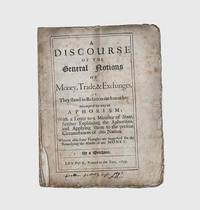
1695169334London: Printed in the year 1695. Addressing England's bullion drain First edition of this scarce mercantilist pamphlet uncut and folded as issued. Chi-Yuen Wu notes that "Although the honour of having given the first descriptions of the specie-point mechanism must be shared by Petty Locke and Simon Clement the description of Clement is the most elaborate of the three" p. 50. In the 1690s England experienced a severe shortage of its silver currency. Coins were melted down and sold abroad as bullion while many of those still circulating were mercilessly clipped. Here Simon Clement c.1654-c.1730 a London merchant argues that the bullion drain could be countered by restricting exports and that the widespread clipping could be resolved by a general recoinage. Clement identifies the mechanism as a self-correcting response to the silver shortage whereby the outflow of bullion would cause a reduction in money supply leading to a decline in the domestic price level a rise in competitiveness and so a correction in the balance of payments deficit. Quarto pp. 38 2. Uncut and folded as issued. Contemporary ink inscription to foot of title page: "written probably before 1693 S.B.". Stab-sewing renewed. Light bumping chipping and soiling faint foxing and damp staining to contents tears to fore- and lower margin of final leaf text unaffected; a good copy of a vulnerable pamphlet. ESTC R38746; Goldsmiths' 3101. Chi-Yuen Wu An Outline of International Price Theories 2007. unknown
164735404Kiøbenhafn, Melchiore Martzan, (1647-) 1648. 4to. (19,2x14,5 cm.). Senere helldrbd. med rig rygforgyldning (fra ca 1850). Med en krakelering i midten af ryggen der er repareret, ligesom kapitæler og false. Kobberstukket portræt af Paulli (efter Karel van Mander), kobberstukket titelblad afbildende gudinden Flora siddende i en portal hvorigennem der er udsigt til byens tårne (disse to kobbere tæt beskåret i ene margin og opklæbet). De 4 deltitelblade med de såkaldte årstidkobbere mangler. (36),(786 (= fol 1-393)),(94) pp. samt 376 helsides træsnit af planter på 188 blade. De 4 deltitelblade som hører til billeddelen er tilstede.Til slut kolofonbladet med Plantin's helsides træskårne bogtrykkermærke. Billeddelen har tilskrifter i gl. hånd med danske navne og undertiden anføres deres brug. Marginalnoterne er her tæt beskåret ved ombindingen. Trykt på svært papir, eksemplaret er i god stand med kun lette brugsspor. Registerbladene (94) omfatter 4 registre, 3 sprogregistre (latin, tysk, dansk) og et ""sygdomsregister"".