66 744 résultats
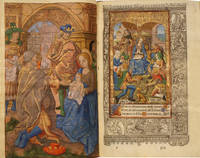
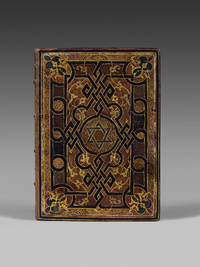
BOH 217FASCINATING MEDIEVAL BOOK OF HOURS WITH EXTENSIVE ILLUMINATIONS BY THREE DIFFERENT ARTISTS. In Latin and some French illuminated manuscript on parchment Southern Netherlands Mons c. 1460 original portion c. 1480-1490 updated. Dimensions 167 x 116 mm. 199 folios lacking one text leaf written by two different scribes in gothic textualis bookhand in single column on 17 lines; BINDING: seventeenth century brown calf over wooden boards spine with four raised bands gold-tooled gilt title "OFFICIU / BEATEM / VIRGIN" partly worn out gilt edges. ILLUSTRATION: 22 full-page miniatures within full rinceaux borders by the Mildmay Master 13 the Master of Philippe de Croÿ 7 and a third Mons illuminator follower of Simon Marmion 2 and 4 small miniatures by the Mildmay Master additional sixteen full rinceaux borders and 5-line initials in pink or blue on burnished gold grounds. The Mildmay Master was responsible for the core of the original manuscript; the artist paints elongated figures with small heads and slender bodies mostly situated on pale yellow tiled grounds. His outdoor landscapes are cursory. Unusual here are his delicate acanthus and floral borders sprinkled with fanciful grotesques. The artist responsible for updating the manuscript is the Philippe de Croÿ Master. He favors tiled floors in brown or gray and white with a generally somber almost grisaille palette with blue and white grey and a burnt brownish orange. A third painter a follower of Simon Marmion intervened during this second campaign. The most skilled of the three illuminators his delicate figures are well-modeled with tiny hands and individualized faces. PROVENANCE: The manuscript was made in Southern Netherlands probably in two different stages. The core of the Hours and the calendar were written in Mons for an unknown patron c. 1460. Then around 1480 the manuscript was updated also in Mons for a couple represented in prayer in the manuscript: Jean Antoine de Mahieu Lord of Bosqueau and his wife Jacqueline de Sivry Lady of Buath; belonged to Jean-Baptiste-Florentin Gabriel de Meyran marquis de Lagoy 1764-1829; inside front cover: "Jean Fransois de Lescluse demeurant a Frasne." CONDITION: ink stain in the margin of f. 1 water stains in lower margins of first 32 leaves colors slightly faded on marginal decoration f. 120v stain in the marginal decoration f. 77v other minor signs of use otherwise in very good condition. Binding condition: leather very rubbed gold tooling worn front cover almost detached hinges of the back cover fragile. Full description and images available. BOH 217 Southern Netherlands, Mons, c. 1460 (original portion), updated c. 1480-1490
5481Folding engraved plate in Vol. IV. Five vols. Large 4to 281 x 200 mm. cont. polished calf sides panelled in blind & gilt spines decorated in blind & gilt a.e.g. Paris: J.B.M. Duprat & others An VII 1798-1825-1827. First edition a magnificent set on large and fine paper complete set with all the supplements. This is the only large and fine paper set I have ever seen on the market. In this monumental and fundamental astronomical work Laplace - the "Newton of France" - codified and developed the theories and achievements of Newton Euler d'Alembert and Lagrange. "Laplace maintained that while all planets revolve round the sun their eccentricities and the inclinations of their orbits to each other will always remain small. He also showed that all these irregularities in movements and positions in the heavens were self-correcting so that the whole solar system appeared to be mechanically stable. He showed that the universe was really a great self-regulating machine and the whole solar system could continue on its existing plan for an immense period of time. This was a long step forward from the Newtonian uncertainties in this respect.Laplace also offered a brilliant explanation of the secular inequalities of the mean motion of the moon about the earth - a problem which Euler and Lagrange had failed to solve.He also investigated the theory of the tides and calculated from them the mass of the moon."-Printing & the Mind of Man 252. A magnificent set preserved in two boxes. Our set has the first state of the titles of Vols. I and II and all the supplements the supplement in Vol. V issued in 1827 is on regular paper. ❧ Dibner Heralds of Science 14. D.S.B. XV pp. 273-403. En Français dans le Texte 201. Horblit 63. Roberts & Trent Bibliotheca Mechanica pp. 197-98. Sparrow Milestones of Science 125. unknown books
182754811827. Folding engraved plate in Vol. IV. Five vols. Large 4to 281 x 200 mm. cont. polished calf sides panelled in blind & gilt spines decorated in blind & gilt a.e.g. Paris: J.B.M. Duprat & others An VII 1798-1825-1827.<br/> <br/> First edition a magnificent set on large and fine paper complete set with all the supplements. This is the only large and fine paper set I have ever seen on the market.<br/> <br/> In this monumental and fundamental astronomical work Laplace — the “Newton of France†— codified and developed the theories and achievements of Newton Euler d’Alembert and Lagrange. “Laplace maintained that while all planets revolve round the sun their eccentricities and the inclinations of their orbits to each other will always remain small. He also showed that all these irregularities in movements and positions in the heavens were self-correcting so that the whole solar system appeared to be mechanically stable. He showed that the universe was really a great self-regulating machine and the whole solar system could continue on its existing plan for an immense period of time. This was a long step forward from the Newtonian uncertainties in this respect…Laplace also offered a brilliant explanation of the secular inequalities of the mean motion of the moon about the earth — a problem which Euler and Lagrange had failed to solve…He also investigated the theory of the tides and calculated from them the mass of the moon.â€â€“Printing & the Mind of Man 252.<br/> <br/> A magnificent set preserved in two boxes. Our set has the first state of the titles of Vols. I and II and all the supplements the supplement in Vol. V issued in 1827 is on regular paper.<br/> <br/> ⧠Dibner Heralds of Science 14. D.S.B. XV pp. 273-403. En Français dans le Texte 201. Horblit 63. Roberts & Trent Bibliotheca Mechanica pp. 197-98. Sparrow Milestones of Science 125. unknown
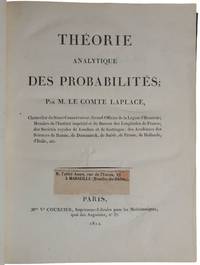
18256347Paris: Courcier; Huzard-Courcier 1825. First edition. <p>First edition very rare complete with all four supplements the fourth being especially scarce of what Anders Hald called "the most influential book on probability and statistics ever written." John Herschel praised it as "the ne plus ultra of mathematical skill and power." In this landmark work Laplace gave probability and statistics their first comprehensive theoretical foundation shaping the field for over a century. The supplements-composed between 1816 and 1825-extend its applications to natural philosophy and geodesy. No copy with all four supplements appears in RBH; even the Honeyman copy lacked the last three. This is the finest copy we have encountered. Provenance: Barthélémy Aoust 1814-1885 French mathematician and professor at Marseille.</p>. The Most Influential Book on Probability and Statistics Ever Written. <p>First edition very rare - especially when accompanied as here by all four supplements the fourth of which is of extreme rarity - of the most influential work on probability and mathematical statistics ever written. Pierre-Simon Laplace's Théorie analytique des probabilités published at Paris by Veuve Courcier in 1812 codified into a single mathematical framework the principal results of probability theory from Jakob Bernoulli's Ars Conjectandi of 1713 through Laplace's own four decades of research and established the analytical methods - generating functions characteristic functions asymptotic approximations the method of least squares the central limit theorem - that governed the subject for the next century and beyond. John Herschel called it 'the ne plus ultra of mathematical skill and power'. The DSB observes that it came to have the same relation to the later development of probability that Newton's Principia had to the later science of mechanics. This is the finest copy we have seen. RBH lists no copy with all four supplements and only two copies with the first three Gonnelli 2024 €35280; Sotheby's 2007 $25000; the Honeyman copy had only the first supplement.</p> <br /> <br /> <p>The work emerged from a long series of memoirs. Laplace had been publishing on probability since the early 1770s but the results were scattered across the publications of the Académie Royale des Sciences and the Institut de France and no single treatise had brought them together. The Théorie analytique is that treatise and Laplace's introduction to the first edition - eliminated in the second and third editions in favour of the Essai philosophique - sets out the programme in his own terms: he is concerned he writes to determine the probability of causes and results as exhibited in events that occur in large numbers and to investigate the laws according to which that probability approaches a limit in proportion to the repetition of events. The investigation he adds will benefit observers in identifying the mean to be chosen among the results of their observations and the probability of errors still to be apprehended and it will interest philosophers in showing how there is a regularity underlying the very things that seem to pertain entirely to chance. He closes by noting that the same analysis can in principle be applied to annuities tontines insurance inoculation with vaccine and the decisions of electoral assemblies. He never wrote the separate work on civil applications he here promises but the thought of it may have been what led him to expand his old École Normale lecture into the Essai philosophique sur les probabilités two years later - the non-mathematical companion that contains the celebrated passage on Laplace's demon and the philosophical argument that probability is the rational response to ignorance not a measure of it.</p> <br /> <br /> <p>Book I subtitled Calcul des fonctions génératrices develops the algebraic machinery of the treatise. Generating functions - power series whose coefficients encode the probabilities of interest - transform combinatorial and probabilistic problems into problems of analysis making them accessible to the methods of the calculus. The first part presents the theory of generating functions as a branch of the calculus of finite differences; the second develops the method of approximating by definite integrals the values of expressions containing very large numbers the technique that yields the asymptotic formulas on which all the practical results of the later chapters depend. Laplace traces the historical lineage of these methods through Lagrange Leibniz Newton and Wallis back to Descartes's invention of numerical exponents situating his own work as the natural continuation of two centuries of analytical development. The most important revision from his earlier memoirs of the 1780s is the omission of material on partial differential equations that was relevant to physics but not to games of chance and a correspondingly greater emphasis on the passage from finite to infinitesimal quantities and from real to imaginary complex numbers - two processes that Laplace found increasingly fertile as his command of the subject deepened.</p> <br /> <br /> <p>Book II Théorie générale des probabilités constitutes the subject. It is more than a republication of earlier memoirs: Laplace drew together the main types of problems from the theory of chance already treated by many mathematicians in a somewhat haphazard manner and re-handled them in tandem with problems from the new areas of application in the philosophy of science astronomy geodesy instrumentation error population and the procedures of judicial panels and electoral bodies. The first chapter lays down the general principles: the definition of probability the rule for multiplying the probabilities of independent events and a verbal statement of Laplace's theorem on the probability of causes inverse probability now called Bayesian inference - still without mentioning Bayes by name. Chapter 2 the most considerable occupying about a quarter of Book II treats the probability of compound events: lotteries Laplace adduces the French national lottery with its ninety numbers drawn five at a time the extraction of balls from urns order and sequence in the retrieval of numbered objects the division of stakes and the ruin or survival of a gambler - the classical problems of the subject now solved systematically by generating functions and arranged not for their own sake but to illustrate a typology of problems in probability at large.</p> <br /> <br /> <p>Chapter 3 concerns the laws that result from the indefinite multiplication of events. It contains Laplace's most general statement of the central limit theorem: that when the number of independent observations increases the distribution of their mean tends toward a Gaussian form regardless of the distribution of the individual observations and that the limits within which the mean will fall with a given probability grow closer together as the number of observations grows. The theorem is the mathematical foundation of modern statistics; it explains why the bell curve appears ubiquitously in nature and why averaging works. Laplace illustrates the theorem from birth records - the ratio of boys to girls taken from the registries of Paris London and Naples provides empirical figures for the prior probabilities that the theory then subjects to analysis.</p> <br /> <br /> <p>Chapter 4 on the probability of error represents the most significant development in the subject as a whole compared to Laplace's earlier memoirs. It derives the least-squares law for combining observations - the method that Legendre had published in 1805 and that Gauss had claimed priority for - first for the case of a single unknown element and then for two or more together with the probability that the resulting estimate will fall within given limits. The chapter includes instructions on the application of the analysis to the correction of astronomical tables and closes with a historical sketch in which Laplace renders Legendre and Gauss each his due in the development of the method.</p> <br /> <br /> <p>Chapter 5 applies probability to the investigation of phenomena themselves - to establishing the physical significance of data amid the complexities of the world. The principal example is the daily variation of the barometric pressure which long observation shows to be normally highest at nine in the morning and lowest at four in the afternoon. Laplace calculates the probability that this diurnal pattern is due to a regular cause the action of the sun rather than to chance and determines its mean extent. He raises the further question of atmospheric tides as a second contributing cause - a question he could not then resolve for lack of data but which became the subject of the last calculation he ever performed. The chapter closes with an application of probability to Buffon's needle problem - the probability that a needle tossed onto a grid of parallel lines will cross a line a problem Laplace adapts to a statistical method for approximating the value of π. Chapter 6 reworks Laplace's early memoir on the probability of causes applying inverse probability and the method of definite-integral approximation to population statistics; he now has figures from the partial census which at his request the French government had conducted in 1801.</p> <br /> <br /> <p>The brief seventh chapter returns to the effect of unequal prior probabilities mistakenly assumed to be equal - a finding Laplace always considered among his most important since it demonstrated the care required when mathematical calculations are applied to physical events. There are he insists no perfect symmetries in the real world and allowance must be made for slight deviations of parameters from assumed values. Chapters 8 through 10 treat life expectancy annuities tontines insurance the effect of vaccination on the death rate Laplace concludes that the eradication of smallpox would increase life expectancy by three years provided the resulting population growth did not outrun the food supply and moral expectation - Daniel Bernoulli's principle that the prospective benefit of a gain is not its absolute amount but its ratio to the total wealth of the beneficiary. Laplace adopts the principle as a guide to prudent conduct and concludes that in the most mathematically advantageous games of chance the odds are always unfavourable over time and that diversification is a prudent practice in the investment of wealth.</p> <br /> <br /> <p>The four supplements issued between 1816 and 1825 extend the theory into applied territory. The first 1816 applies inverse probability to the analysis of criminal proceedings - Laplace calculates the probability that a conviction is erroneous given assumptions about the truthfulness of jurors and concludes that the English jury system with its requirement for unanimity weights the odds too heavily against the security of society while the French criminal code with its plurality rule across two courts is unjust to the accused. The second 1818 turns to geodesy comparing Laplace's method of combining equations of condition with the method of Boskovic; Stigler considers this discussion the earliest instance of a rigorous comparison of two well-elaborated methods of estimation for a general population strikingly similar to the analysis that led R. A. Fisher to the concept of sufficiency in 1920. The third 1819 applies the method to the extension of the Delambre-Méchain survey of the meridian from Perpignan to Formentera; Laplace estimates the law of error on the basis of all 700 triangles in the original survey and calculates the probabilities of error in the resulting length of the meridian. The fourth 1825 the rarest generalises the Problem of Points using the method of generating functions and includes corrections to earlier results in the main text.</p> <br /> <br /> <p>The bibliographical context of the supplements compounds the difficulty of assembling a complete set. Each was issued separately by Veuve Courcier and her successor Huzard-Courcier in print runs of unknown but evidently small size and the four were never gathered together as a single bound publication during the early nineteenth century. Copies that left the publishing house with the supplements bound in were assembled by the binder copy by copy from sheets purchased separately; copies sold without binding rarely retain the supplements at all since these were slim pamphlets without the binding of their parent and easily separated from it. The fourth supplement of 1825 the rarest of the four was issued only two years before Laplace's death in 1827 and saw no further reprinting in the parent author's lifetime; it is the supplement most often missing from copies offered for sale. RBH records no copy of the work with all four supplements; the two copies recently in commerce with the first three lack the fourth and the Honeyman copy lacked the second third and fourth. The probability of all four reaching a single contemporary owner surviving together through two centuries of binding rebinding and dispersal and arriving intact in a single contemporary cloth was in any literal sense vanishingly small.</p> <br /> <br /> <p>Laplace's analytical apparatus passed quickly into general use after his death. Adolphe Quetelet the Belgian astronomer and statistician who had visited Laplace in Paris in the 1820s applied the central limit theorem to social phenomena in his Sur l'homme of 1835 founding what he called physique sociale - the systematic statistical study of human populations. Francis Galton in the 1880s adapted Laplace's framework to the study of inheritance defining regression to the mean and the correlation coefficient. Karl Pearson at University College London working from Galton formalised the chi-squared test in 1900 and established the moment-generating function Laplace's generating function under another name as the standard apparatus of the new mathematical statistics. R. A. Fisher's 1922 paper On the Mathematical Foundations of Theoretical Statistics introduced the concepts of likelihood and sufficiency that defined the modern subject; Stephen Stigler's 1986 study of the history of statistics observes that Fisher's argument on sufficiency closely parallels the comparison Laplace had drawn in the second supplement of 1818 between his own method of combining equations of condition and that of Boskovic. Through Quetelet Galton Pearson and Fisher the analytical framework of the Théorie analytique survived intact into the twentieth century and it continues to underlie every confidence interval hypothesis test and regression analysis performed in any field that depends on quantitative inference. The hidden continuity is part of what Laplace meant when he wrote in the introduction here suppressed that probability furnishes a regularity to the very things that seem to belong to chance.</p> <br /> <br /> <p>Pierre-Simon Laplace 1749-1827 the son of a cider-farmer in Normandy arrived in Paris in 1769 and within a decade had established himself as the foremost mathematical astronomer in Europe. His Mécanique céleste 1799-1825 is the most important work in mathematical astronomy since the Principia; the Théorie analytique des probabilités holds the same position in its own field. Between them the two works secured his reputation as - in the phrase that has clung to him since his own century - the Newton of France. He served Napoleon as Minister of the Interior for six weeks in 1799 Napoleon dismissing him observed that he had brought the spirit of the infinitely small into the work of government; he was elected to the Académie française in 1816 made a count of the Empire under Napoleon in 1806 and elevated to the rank of marquis at the Bourbon Restoration in 1817. He died at Paris on 5 March 1827 on the eve of the issue of the fifth volume of the Mécanique céleste which his son Charles-Émile saw through the press in his name. The 1812 Théorie analytique was the keystone of his late career and the work that consolidated mathematics as the apparatus of a quantitative science of human and natural events.</p> <br /> <br /> <p>Provenance: Barthélémy Aoust 1814-1885 French mathematician professor in the Faculty of Sciences at the University of Marseille from 1854 until his retirement. Aoust's research interests centred on differential geometry and on the analysis of curves and surfaces - questions distant enough from probability theory for the present volume to have functioned in his library as a reference work rather than a working text and the absence of marginalia in his hand suggests as much. His contemporary printed address label pasted to the title page in the early 1850s when he established himself at Marseille places this copy among the books he assembled for his teaching there and identifies it as part of his personal library.</p> <br /> <br /> <p>References: DSB XV 367-376 - Evans 12 - Grolier/Horblit 63a - Honeyman 1923 - Printing and the Mind of Man 252 - Stigler ch. 24 in Grattan-Guinness ed. Landmark Writings in Western Mathematics 1640-1940 2005 - Hald A History of Mathematical Statistics from 1750 to 1930 1998 - Stigler The History of Statistics: The Measurement of Uncertainty before 1900 Harvard 1986.</p> <br /> <br/> <br/> <br /> <p>Five parts bound in one vol. 4to 253 × 194 mm pp. vi 464 2: errata and blank; 34; 50; 36; 2 28. Contemporary green half-cloth over green marbled boards spine with raised bands compartments ruled in gilt and decorated in blind with a gilt lettering-piece top edges yellow-speckled spine very slightly rubbed small paper label at tail. A fresh well-margined copy internally clean.</p> . Courcier; Huzard-Courcier unknown
ABAA-75TH-VBF-6<p>In the title the mark and the name of Simon Vostre and in v° the calendar from 1508 to 1528.</p><p>Paris 1508.</p><p>Large gothic 8vo <strong>on vellum</strong> woodcut figures and borders 1 bl.l. 90 ll. signed a-b by 8 c by 4 d e f g h and i by 8 k by 6 Ä and Ä“ by 8 1 bl.l. Complete. Full light-brown calf covers decorated with frames of gilt and blind-stamped fillets central Renaissance design on gilt background flat decorated spine clasps. <em>16</em><em>th</em><em> century binding.</em></p><p>207 x 138 mm.</p><p><strong>Precious Book of Hours printed in Paris around the year 1508 described as follows in</strong> Brunet's Manual V 1591: "This edition contains 20 large plates not including the frontispiece the same with the exception of two as those found in the Hours 4to for the use of Rome printed for Sim. Vostre with an almanac for 16 years from 1515 to 1530. The subjects of the borders are <em>Joseph</em> <em>les Sibylles l'Apocalypse l'enfant prodigue le Jugement dernier la Danse des morts</em> le <em>Triomphe de César</em> les <em>Miracles de Nostre Dame</em> with pretty arabesques on several leaves. In the calendar there is a Latin and a French quatrain for each month. The last leaf gives the table of these present hours ending with the <em>Oraison du Saint Sepulchre</em>. In the copy printed on vellum which belongs to Mr. Ambroise-Firmin Didot the large plates and the initials are colored or better said miniaturized with care and enhanced with gold.</p><p>Although this edition has like the two previous ones an almanac for the years 1508-1528 it differs entirely from them."</p><p>"It is easy to recognize that the representations of scenes from real life at the end of the fifteenth century of which the French manuscripts of that period offer us so much variety inspired Simon Vostre and some of his skillful competitors and imitators in the compositions which adorn their books of Hours. The costumes of the various classes of society are faithfully reproduced as well as those of warriors artisans and shepherds and those of princesses and shepherdesses. While preserving the eminently religious character of the subjects one sees there appearing this French and mocking spirit which brightened the margins of the manuscripts by often burlesque scenes. It is especially the subject of Bathsheba in the bath that offers a clear link between the engravings of the Books of Hours and the miniatures of the manuscripts. Her modest pose although a little too low-cut the expression of her face in the calm of her interior in the midst of her followers the adjustment of her hair the costume of her women everything finally seems to be copied from some of the manuscripts that I possess.</p><p>It is these charming compositions which successively modified according to the taste of the skilful printers of Paris such as Pigouchet Thielman Kerver Gilles Hardouyn and under the inspiration of booksellers-publishers such as Simon Vostre Germain Hardouyn and so many others made our books of Hours so sought after in France and in foreign countries. Our fathers never tired of contemplating either the naive representation of rural scenes or the triumph of Caesar the story of Tobias or Susanna that of the Prodigal Son etc. which give appeal to each page while providing</p><p>matter to serious reflections by the dramatic representation of the Simulacres de la mort where the traces of the French spirit are found in the mocking expression given to this character. The variety of these compositions as wittily drawn as finely engraved attests that from that time Paris possessed skilled engravers; but their names have remained unknown just as the names of most of those skilled miniaturists who have left us so many masterpieces in our books of Hours whose merit is now better appreciated are unknown.</p><p>From the beginning of wood engraving in France the two currents of art that of Germany and that of Italy came to be concentrated in Paris one could say to clash there while softening each other by this immediate contact where the Gallic type so frank and so naive predominates. On the one hand Pigouchet Simon Vostre Gilles Hardouyn de Marnef Michel le Noir and others adopted the archaic style and were inspired by the German genius by preserving for their impressions the Gothic characters while Guyot Marchant Gourmont Simon de Colines Janot Anabat and especially Tory under the influence of the Italian taste decorated their impressions in Roman character of arabesques and compositions of a French style.</p><p>It is to Jollat that Papillon attributes the engraving of the frames and the subjects which decorate the large pages of the books of Hours which does not seem probable judging by the engravings which we know to be of him: the smoothness of the execution would seem rather to indicate Woeiriot.</p><p>The beauty of execution of these books of Hours joined to the modicity of their price compared to that of the manuscripts multiplied the flow in considerable proportions. People from all over the world went to Paris to obtain them and had editions printed in Flemish English and Italian. The Paris printing house then took on a greater extension than one might suppose and became the center of the great manufacture of liturgical books which supplied the Catholic world even in those countries which had however preceded France in the printing of books decorated with woodcuts.</p><p>The beautiful work that Mr. Brunet has undertaken on the Books of Hours and which he intends to complete will go into more detail on the eminently Parisian publications in which Jean Dupré Antoine Vérard Simon Vostre Philippe Pigouchet Thielman Kerver Gilles and Germain Hardouyn Guillaume Eustace Simon de Colines François Regnault Guillaume Godard Anabat and especially Geoffroy Tory distinguished themselves. It is by carefully following the modifications made to the style of the engravings which decorate these books intended for the immense majority of the people and which are consequently the true expression of the French taste that one can judge the progress of the art of wood engraving from 1486 to 1540 time when Geoffroy Tory published his last works. Although the style as a whole is still French one can see sometimes the influence of Germany sometimes that of Italy: in the Book of Hours whose calendar dates from 1519 the printer Guillaume Anabat declares it to be adorned with several figures and hystoires done in the Italian fashion. The Italian influence is also found in the books of Hours printed in Lyon expensis Bononi de Bononis Dalmatici 1499. This study is therefore interesting and it is with good reason that these books of Hours have become as sought after by connoisseurs and art-loving bibliophiles as they were less than half a century ago.</p><p><u>Of the Dance of Death.</u></p><p>In the frames of almost all the books of Hours <em>the Dance of the Dead</em> or Macabre is depicted in preference to any other subject. It is indeed this subject that we see represented in large in the oldest engravings of the Danses Macabres executed in Paris with a true feeling for art as can be judged by the edition of which here is the title: La Danse macabre nouvelle appellee Miroer salutaire pour toutes gens etc. and at the end of which we read: "<em>Ci finist la Danse macabre hystoriée et augmentée de plusieurs nouveaux personnages et beaux dis; et les trois mors été trois vifs ensembles: nouvellement ainsi composée et imprimée par Guyot Marchant demorant a Paris ou grant hostel du collège de navarre en champ gaillart. The year of grace 1486 on the 7th day of the month.</em>"</p><p>It contains 28 plates including two for the three dead and three alive and two at the beginning and end. The expression of the figures is well felt and very well rendered by the engraving. The drawing in its slightly gothic naivety already feels the influence of Martin Schoengauer which one notices in some Missals and Books of Hours."</p><p>A. F. Didot <em>Essai sur la gravure sur bois</em> col. 115-117.</p><p><strong>Precious and superb Book of Hours printed on vellum of which</strong> "the 22 large plates smaller ones and the initials are illuminated with the greatest care and enhanced with gold".</p><p>The copy <em>A. Firmin</em> Didot similar to this one was sold at the colossal price of 1 500 F Gold on May 31 1879 Ref : <em>Livres Précieux de M. A. Firmin</em> Didot May 1879 n° 98. Let us recall that a bibliophile book was then negotiated from 10 Gold F.</p><p>Pierre Berès catalogued 103 000 € 675 000 FF 23 years ago a book of Hours by Simon Vostre of the same date with a calendar illustrated with a single illuminated miniature Ref : <em>Des Valois à Henri IV</em> Paris 1994 n° 154.</p><p>From the libraries of <em>Fr. Amaury</em> with calligraphic bookplate; <em>Sauvages d'Alais Henri Vever; Georges Wendling.</em></p><p>FR</p><p>Au titre la marque et le nom de Simon Vostre et au v° le calendrier de 1508 à 1528.</p><p>Paris 1508.</p><p>Grand in-8 gothique <strong>sur peau de vélin</strong> figures sur bois et bordures 1 f.bl. 90 ff. signés a-b par 8 c par 4 d e f g h et i par 8 k par 6 Ä et Ä“ par 8 1 f.bl. Complet. Plein veau havane plats ornés de cadres de filets doré et à froid motif central Renaissance sur fond doré dos lisse orné filet à froid sur les coupes fermoirs. <em>Reliure du XVIe siècle</em>.</p><p>207 x 138 mm.</p><p><strong>Précieux livre d'Heures imprimé à Paris vers l'année 1508 ainsi décrit dans</strong> le Manuel Brunet V 1591 : " Cette édition contient 20 grandes pl. non compris le frontispice les mêmes à l'exception de deux que celles qui se trouvent dans les Heures in-4 à l'usage de Rome imprimées pour Sim. Vostre avec un almanach pour 16 ans de 1515 à 1530. Les sujets des bordures sont <em>Joseph</em> <em>les Sibylles l'Apocalypse l'enfant prodigue le Jugement dernier la Danse des morts</em> le <em>Triomphe de César</em> les <em>Miracles de Nostre Dame</em> avec de jolies arabesques à plusieurs feuillets. Dans le calendrier il y a un quatrain latin et un quatrain français pour chaque mois. Le dernier feuillet donne la table de ces présentes heures finissant par l'<em>Oraison du Saint Sepulchre</em>. Dans l'exemplaire impr. sur vélin qui appartient à M. Ambroise-Firmin Didot les grandes planches et les initiales sont coloriées ou pour mieux dire miniaturées avec soin et rehaussées d'or.</p><p>Quoique cette édition ait comme les deux précédentes un almanach pour les années 1508-1528 elle en diffère entièrement. "</p><p>" Il est facile de reconnaître que les représentations de scènes de la vie réelle à la fin du XVe siècle dont les manuscrits français de cette époque nous offrent tant de variété ont inspiré Simon Vostre et quelques-uns de ses habiles concurrents et imitateurs dans les compositions qui ornent leurs livres d'Heures. Les costumes dans les diverses classes de la société y sont fidèlement reproduits aussi bien ceux des guerriers des artisans et des pasteurs que ceux des princesses et des bergères. Tout en conservant le caractère éminemment religieux des sujets on y voit apparaître cet esprit français et narquois qui égayait les marges des manuscrits par des scènes souvent burlesques. C'est surtout le sujet de Bethsabée au bain qui offre un rapprochement manifeste entre les gravures des livres d'Heures et les miniatures des manuscrits. Sa pose pudique quoique un peu trop décolletée l'expression de sa figure dans le calme de son intérieur au milieu de ses suivantes l'ajustement de ses cheveux le costume de ses femmes le tout enfin semble calqué sur quelques-uns des manuscrits que je possède.</p><p>Ce sont ces charmantes compositions qui se modifiant successivement selon le goût des imprimeurs habiles de Paris tels que Pigouchet Thielman Kerver Gilles Hardouyn et sous l'inspiration de libraires-éditeurs tels que Simon Vostre Germain Hardouyn et tant d'autres ont rendu si recherchés en France et dans les pays étrangers nos livres d'Heures. Nos pères ne se lassaient pas d'y contempler soit la représentation naïve de scènes champêtres soit le triomphe de César l'histoire de Tobie ou de</p><p>Suzanne celle de l'Enfant prodigue etc. qui donnent de l'attrait à chaque page tout en fournissant</p><p>matière à de sérieuses réflexions par la représentation dramatique des Simulacres de la mort où se retrouvent les traces de l'esprit français dans l'expression goguenarde donnée à ce personnage. La variété de ces compositions aussi spirituellement dessinées que finement gravées atteste que dès cette époque Paris possédait d'habiles graveurs ; mais leurs noms sont restés inconnus de même qu'on ignore celui de la plupart de ces habiles miniaturistes qui nous ont laissé de si nombreux chefs-d'Å“uvre dans nos livres d'Heures dont maintenant on sait mieux apprécier le mérite.</p><p>Dès l'origine de la gravure sur bois en France les deux courants de l'art celui de l'Allemagne et celui de l'Italie vinrent se concentrer à Paris on pourrait dire s'y heurter tout en s'adoucissant réciproquement par ce contact immédiat où prédomine le type gaulois si franc et si naïf. D'un côté Pigouchet Simon Vostre Gilles Hardouyn de Marnef Michel le Noir et autres adoptèrent le style archaïque et s'inspirèrent du génie allemand en conservant pour leurs impressions les caractères gothiques tandis que Guyot Marchant Gourmont Simon de Colines Janot Anabat et surtout Tory sous l'influence du goût italien décoraient leurs impressions en caractère romain d'arabesques et de compositions d'un style françois.</p><p>C'est à Jollat que Papillon attribue la gravure des encadrements et des sujets qui ornent les grandes pages des livres d'Heures ce qui ne paraît pas probable à en juger par les gravures que nous savons être de lui : la finesse de l'exécution semblerait plutôt indiquer Woeiriot.</p><p>La beauté d'exécution de ces livres d'Heures jointe à la modicité de leur prix comparé à celui des manuscrits en multiplia le débit dans des proportions considérables. C'était de toutes parts qu'on s'adressait à Paris pour se les procurer et qu'on y faisait exécuter des éditions en flamand en anglais et en italien. L'imprimerie de Paris prit alors une extension plus grande qu'on ne le suppose et devint le centre de la grande fabrication de livres liturgiques qui approvisionna le monde catholique même dans les pays qui avaient cependant devancé la France pour l'impression des livres ornés de gravures sur bois.</p><p>Le beau travail que M. Brunet a entrepris sur les livres d'Heures et qu'il se propose de compléter entrera dans plus de détails sur les publications éminemment parisiennes où se sont distingués Jean Dupré Antoine Vérard Simon Vostre Philippe Pigouchet Thielman Kerver Gilles et Germain Hardouyn Guillaume Eustace Simon de Colines François Regnault Guillaume Godard Anabat et surtout Geoffroy Tory. C'est en suivant attentivement les modifications apportées au style des gravures qui ornent ces livres destinés à l'immense majorité du peuple et qui sont par conséquent la véritable expression du goût français que l'on peut juger des progrès de l'art de la gravure sur bois de 1486 à 1540 époque où Geoffroy Tory publia ses derniers ouvrages. Quoique l'ensemble du style soit toujours français on y constate tantôt l'influence de l'Allemagne tantôt celle de l'Italie : dans le livre d'Heures dont le calendrier date de 1519 l'imprimeur Guillaume Anabat le déclare orné de plusieurs figures et hystoires faictes à la mode d'Italie. On retrouve aussi l'influence italienne dans les livres d'Heures imprimés à Lyon expensis Bononi de Bononis Dalmatici 1499. Cette étude est donc intéressante et c'est avec raison que ces livres d'Heures sont devenus aussi recherchés par les connaisseurs et les bibliophiles amis des arts qu'ils l'étaient peu il y a moins d'un demi-siècle.</p><p><u>De la Danse macabre</u>.</p><p>Dans les encadrements de presque tous les livres d'Heures figure de préférence à tout autre sujet <em>la Danse des Morts</em> ou Macabre. C'est en effet ce sujet que nous voyons représenté en grand dans les plus anciennes gravures des Danses Macabres exécutées à Paris avec un véritable sentiment de l'art ainsi qu'on en peut juger par l'édition dont voici le titre : La Danse macabre nouvelle appelee Miroer salutaire pour toutes gens etc. et à la fin de laquelle on lit : " <em>Ci finist la Danse macabre hystoriée et augmentée de plusieurs nouveaux personnages et beaux dis ; et les trois mors été trois vifs ensembles : nouvellement ainsi composée et imprimée par Guyot Marchant demorant a Paris ou grant hostel du collège de navarre en champ gaillart. L'an de grace 1486 le 7è iour de iuing.</em> "</p><p>Elle contient 28 planches dont deux pour les trois morts et les trois vifs et deux au commencement et à la fin. L'expression des figures y est bien sentie et très bien rendue par la gravure. Le dessin dans sa naïveté un peu gothique se ressent déjà de l'influence de Martin Schoengauer que l'on remarque dans quelques Missels et livres d'Heures… "</p><p>A. F. Didot <em>Essai sur la gravure sur bois</em> col. 115-117.</p><p><strong>Précieux et superbe livre d'Heures imprimé sur vélin dont</strong> " les 22 grandes planches de plus petites et les initiales sont enluminées avec le plus grand soin et rehaussées d'or ".</p><p>L'exemplaire <em>A. Firmin Didot</em> semblable à celui-ci fut adjugé au prix colossal de 1 500 F Or le 31 mai 1879 Réf : <em>Livres Précieux de M. A. Firmin Didot</em> mai 1879 n° 98. Rappelons qu'un livre de bibliophilie se négociait alors à compter de 10 F Or.</p><p>Pierre Berès cataloguait 103 000 € 675 000 FF il y a 23 ans un livre d'Heures de Simon Vostre de même date au calendrier orné d'une seule miniature enluminée Réf : <em>Des Valois à Henri IV</em> Paris 1994 n° 154.</p><p>Des bibliothèques <em>Fr. Amaury </em>avec ex-libris calligraphié; <em>Sauvages d'Alais</em><em> Henri Vever </em>;<em> Georges Wendling. </em></p> hardcover
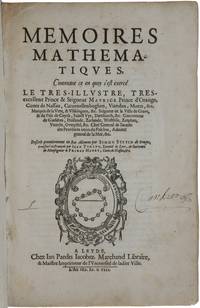
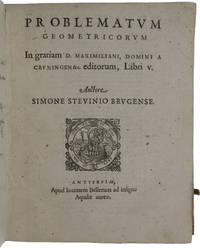
16084588Leyden: Jan Paedts Jacobsz 1608. First edition. Very rare first edition in French of this collection of works which was published almost simultaneously in Dutch French and Latin. They deal among other topics with geometry trigonometry perspective and double-entry book-keeping - Stevin was one of the first authors to compose a treatise on governmental accounting. The Appendice Algébraique which Sarton called 'one of Stevin's most important publications' is the first published general method of solving algebraic equations; it uses what is now called the 'intermediate value theorem' a remarkable anticipation as it was not rigorously formulated by mathematicians until the nineteenth century. All the works appearing in this volume were first published in this collection with one exception where the version here is the earliest extant. Hardcover. Double-entry bookkeeping. <p>Very rare first edition in French of this collection of works which was published almost simultaneously in Dutch French and Latin. They deal among other topics with geometry trigonometry perspective and double-entry book-keeping - Stevin was one of the first authors to compose a treatise on governmental accounting. The Appendice Algébraique which Sarton called 'one of Stevin's most important publications' is the first published general method of solving algebraic equations; it uses what is now called the 'intermediate value theorem' a remarkable anticipation as it was not rigorously formulated by mathematicians until the nineteenth century. All the works appearing in this volume were first published in this collection with one exception where the version here is the earliest extant - see below. Stevin 1548-1620 was perhaps the most original scientist of the second half of the 16th century the major works of Galileo did not appear until the 17th century. "He was involved in geometry algebra arithmetic pioneering a system of decimals dynamics and statics almost all branches of engineering and the theory of music" Kemp p. 113. "Stevin unconditionally supported the Copernican system several years before Galileo and at a time when few other scientists could bring themselves to do likewise" DSB XIII: 48. In 1593 Prince Maurice of Nassau 1567-1625 appointed Stevin quartermaster-general of the Dutch armies a post he held until his death. From 1600 Stevin organized the mathematical teaching at the engineering school attached to Leiden University. "The Prince used to carry manuscripts of Stevin's lectures with him in his campaigns. Fearing that he might lose them he finally decided to have them published not only in the original Dutch text Wisconstighe Gedachtenissen . but also in a Latin translation by Willebrord Snel Hypomnemata mathematica . and in a French translation by Jean Tuning offered here" Sarton p. 245. The Dutch and Latin editions were published in five parts of which the fourth consisted principally of reprints of his works on statics that had appeared separately in 1586. This fourth part was not translated into French because we are told at the beginning of the fifth part of the printer's impatience - he was tired of keeping the sheets already printed and suggested that additional materials could be published later when the author had prepared them. The printer's impatience also accounts for the fact that several works that are announced on the title pages of the individual volumes did not in fact appear in the Dutch French or Latin editions. The only other complete copy of this French edition listed by ABPC/RBH is the De Vitry copy in a nineteenth-century binding Sotheby's April 11 2002 lot 779 £15200 = $21935. OCLC lists Columbia Harvard and UCLA only in US.</p> <br /> <p>Provenance: L. Cundier early inscription on title-pages i.e. Louis Cundier c. 1615- 1681 French geometer surveyor and engraver. He was professor of mathematics at Aix and was responsible for a Carte géographique de Provence published about 1640. Contemporary marginal annotation on R6v of final part.</p> <br /> <p>The first part of the work entitled Cosmographie 1608 is a treatise on the trigonometrical techniques used in the observation of the heavens together with extensive tables of sines tangents and secants. "The first to use the term trigonometry seems to have been Pitiscus whose book Trigonometria made its first appearance in 1595 but in 1608 when Stevin's book appeared the term had not yet been generally accepted. The book consists of four parts the first dealing with the construction of goniometrical tables the second with plane triangles and the remaining two parts with spherical trigonometry . It is mainly of interest to those who wish to see what trigonometry was like in the sixteenth century long before Euler in 1748 introduced the present notation. It also has some distinction as the first complete text on trigonometry written in Dutch; and one of the first - if not the first - written in any vernacular" Works IIb p. 751.</p> <br /> <p>Part II De la Practique de Géométrie 1605 in Dutch De Meetdaet "is primarily a textbook for the instruction of those who like Prince Maurice wanted to learn some of the more practical aspects of geometry. The course was not one for beginners knowledge of Euclid's Elements being a prerequisite while the reader was also supposed to know something about the measurement of angles and Stevin's own calculus of decimal fractions . Parts of the contents were taken from the Problemata Geometrica the book which Stevin published in 1583 but to which he curiously enough never refers. Other parts show the influence of Archimedes and of contemporary writers such as Del Monte and Van Ceulen. Although in accordance with the title strong emphasis is laid on the practical applications of geometry many theoretical problems are discussed. For Stevin theory and application always went hand in hand.</p> <br /> <p>"The Meetdaet appeared in 1605 but it was drafted more than twenty years before. Already in the Problemata Geometrica Stevin refers to a text on geometry 'which we hope shortly to publish' and in which the subject was to be treated by a method parallel to that used in arithmetic. At that time Stevin's L'Arithmétique was either finished or well advanced. We get the impression that in this period 1583-85 Stevin decided to publish his full text on arithmetic but of his text on geometry only those parts which he considered novel. The general outline of the two texts was laid out at the same time and in close parallel. When at last the Meetdaet appeared it had undergone many changes resulting partly or wholly from lengthy discussions with the Prince of Orange. The underlying idea however remained the same.</p> <br /> <p>"In the introduction to the Meetdaet Stevin explains what he means by this parallelism of arithmetic and geometry. In arithmetic we begin by introducing the numerical symbols and follow this up by naming them and interpreting their value. Then come the four species the theory of proportions the theory of proportional division and finally the reduction of fractions to a common denominator. Similarly in geometry we begin by showing the student how to draw figures then we name them and explain how to measure them. Then follow the four species the theory of proportions of proportional intersections and the reduction of figures into others of given form and equal length area or volume. Since these topics are taken in six groups and each group with lines plane figures and solids the Meetdaet consists of six books each consisting of three parts.</p> <br /> <p>"The opinion of Stevin that geometry and arithmetic have to run parallel is not so artificial as it appears at first sight. Stevin expresses an opinion common to the mathematicians of his age who insisted on enlarging the field of numbers with irrationals to something like an arithmetic continuum who applied these numbers without discrimination to the measurement of figures and for whom numbers were not so much the object of abstract speculation as the tools for surveying navigation and astronomy. The subject matter of geometry is continuous quantity wrote such men as Tartaglia and Clavius. It seemed natural that there should exist relations and analogies between the professed geometrical and the intuitively felt arithmetical continuum. Stevin only gave an early sixteenth-century version of a point of view which was to lead within the next generations to analytic geometry. Consciousness of the analogy between arithmetical-algebraic and geometrical considerations continued to work as a leaven throughout the further development of mathematics. Later we find it in Leibniz' proposal for an algebra of directed quantities. In another form it appeared again more recently when Hilbert probed the consistency of geometrical axioms by means of a corresponding algebraic counterpart.</p> <br /> <p>"Book I of the Meetdaet in accordance with the author's program teaches methods for drawing lines and certain plane figures and for constructing certain solids. With his keen sense of the interdependence of theory and practice Stevin gives not only rules for the drawing board but also for the surveyor and instrument-maker. We thus meet here with a description of the surveyor's cross or diopter already described by Heron and used for setting out perpendiculars by lines of sight. With a graduated circle instead of a cross it becomes a so-called circumferentor or theodolite. The plane figures discussed are the circle the conic sections and the Archimedean spiral. No fewer than four methods are given for constructing points of an ellipse when the principal axes are given in position and magnitude . The fourth ellipse construction is equivalent to the one we often use at present and by which we find points of the ellipse by considering it the oblique parallel or orthographic projection of a circle with one of the axes as diameter. This construction may in this form be original with Stevin though it is closely related to another one also presented by Stevin in which he shows how the conic sections can be constructed as plane intersections of a right circular cone. His method amounts to what we now call orthographic projection . Book I also contains Stevin's description of the five regular and of eight Archimedean solids .</p> <br /> <p>"In Book II we find observations on the lengths of line segments and curves the areas of two-dimensional figures and the volumes of solids. Some surveyor's instruments appear among them the ancient 'traprondt' or graduated circle for measuring horizontal angles and the equally ancient triquetrum consisting of two arms of equal length hinged to a third; they are graduated and have sighting devices. The triquetrum also called PtoIemy's rods or parallactic instrument is used by Stevin to determine a triangle similar to a triangle in the fields though in his days it had also received attention as a favourite measuring instrument of Copernicus and Tycho Brahe. As an application of the triquetrum Stevin shows us how to measure the distance from a given point to a point beyond reach. A number of other exercises in surveying follow and also such problems as the computation of the altitudes of a triangle with given sides. In the section on the measuring of circumferences and areas we find a discussion of the value of π with due references to Archimedes Romanus and Van Ceulen .</p> <br /> <p>"Book III contains the application of four species to geometry with reference to the parallel treatment in L'Aritbmétique. Multiplication and division of segments areas and volumes is only performed by means of numerical factors; there is no reference to the multiplication of segments so as to form areas. Of interest is the addition and subtraction of solids but the only case discussed is that of similar figures .</p> <br /> <p>"In Book IV we find a theory of proportions. It is shown how areas and volumes proportional to given line segments can be found. The most interesting part is that in which the two mean proportionals between two line segments are discussed. As in the Problemata Geometrica reference is made to Hero's construction according to Eutocius. The Eratosthenes construction is mentioned but not further discussed.</p> <br /> <p>"Book V contains the division of plane polygons into parts of given ratio by a line satisfying certain conditions another of the topics of the Problemata Geometrica. Here Stevin goes a little beyond the text of 1583 . he not only modified some of the proofs of the theorems already discussed in the Problemata but added the cases where the line of division has to pass through a point outside or inside the polygon .</p> <br /> <p>"Finally Book VI deals with some transformations of figures into others of given form and given length area or volume such as the approximate construction of a straight line equal to the circumference of a given circle of a triangle equal in area to a given circle of a sphere equal in volume to a given cone of a cylinder equal in volume to a given sphere and of a segment of a sphere similar to one of two given segments and equal in area to the other" ibid. pp. 764-8.</p> <br /> <p>Part III Des Perspectives 1605 in Dutch Deursichtighe is a mathematical treatment of perspective. "Stevin's book gives an important discussion of the case in which the plane of the drawing is not perpendicular to the plane of the ground and for special cases solves the inverse problem of perspective" DSB XIII: 48. "Stevin's approach to perspective belongs in the Commandino - Benedetti - Guidobaldo tradition and his main demonstrations are uncompromisingly geometrical in nature. He also took up the essentially non-pictorial problem of the rotation of the picture plane into the ground plane formulating one of the basic theorems of homology. However he does show some of Marolois's sensitivity to the needs of practitioners. His treatise was occasioned by the desire of Prince Maurice to understand the principles of pictorial representation - 'wishing to design exactly the perspective of any given figure with knowledge of causes and mathematical proof'. Stevin accordingly provides 'abridgements' of his geometrical techniques for artists - albeit rather abstract abridgements - and illustrates a Dürer-like perspective machine" Kemp pp. 113-114. Stevin "was obliged to perform a considerable amount of original work since most of the books at his disposal had written by and for painters and architects and were rich in directives and deficient in mathematical demonstrations. The only textbook comparable to that of Stevin in mathematical clarity and antedating it was the Perspectiva of his contemporary and colleague Guido Ubaldo Del Monte 1545-1607 which was published in 1600 only five years before the Deursichtighe.</p> <br /> <p>"Stevin's work contains two books. The title of the first book Verschaeuwing is Stevin's translation of the Latin word scenographia. The term Deursichtighe is his translation of the word perspectiva. Since the second book of the Deursichtighe contains the principles of Spiegelschaeuwen theory of reflection in mirrors translation of catoptrica perspective in Stevin's terminology comprises both scenography and catoptrics. It also includes the principles of refraction called Wanschaeflwing but this subject is wanting in the book" Works IIb p. 785</p> <br /> <p>"There is much in Stevin's book which reminds us of Del Monte's notably the extensive use of rotations and the introduction of the inverse problem of perspective and the double solution of certain problems called here the 'mathematical' and the 'mechanical' way. The two men had much in common; both were experts on fortifications both were mathematicians deeply interested in problems of mechanics both combined a love of theoretical study with engineering practice. It is understandable that their approach to perspective was similar and it is not unlikely that Stevin thoroughly enjoyed Del Monte's work. Despite this influence which has to be inferred rather than proved by quotations Stevin's work is an achievement of remarkable originality. He probably had a good deal of the contents of his work ready before he studied Del Monte's Perspective if ever he did and maintained his particular way of exposition and selection throughout the book .</p> <br /> <p>"The Verschaeuwing itself opens with certain postulates showing how seriously the author tried to base his work on a correct mathematical foundation. One of these postulates is that a point and its perspective image lie in a straight line with the eye. Stevin's explanation of the necessity of this postulate is that the physical eye is not a mathematical point; by pressing the eye we can obtain a difference of as much as 33° in the image of a given point.</p> <br /> <p>"Among the first constructions are the classical ones of finding the perspective images of a point and a line. Here we meet the demonstration of Del Monte's theorem that all sets of parallel lines have images in lines passing through one point. This point 'saempunt' is Del Monte's 'punctum concursus'. Then comes Stevin's new approach: he takes the picture plane the 'glass' no longer perpendicular to the ground plane the 'floor' but at an arbitrary angle. This leads him to two new theorems Props. 7 and 8 by means of which the construction for this case is reduced to the case of the vertical picture plane . Stevin now undertakes the construction of the perspective images of several figures including that of a 'tower' a quadrangular pyramid on top of a cube with a face of the cube as its base; the cube is standing on the ground plane. He also constructs the ellipse as the image of a circle. Some methods of checking the correctness of constructions follow.</p> <br /> <p>"These propositions can be considered as forming the first part of the Verschaeuwing. The second part from Prop. 12 onwards deals with the inverse problem of perspective a subject already touched by Del Monte. Given a polygon as image and another polygon in the ground plane turned into the picture plane: to find if possible the eye; the angle between picture plane and ground plane is given and is not necessarily 90°. Stevin solves the problem in certain special cases; the solution of the solution of the general problem had to wait until the nineteenth century.</p> <br /> <p>"The text ends with an 'Appendix' which contains certain observations on terminology a correction of certain constructions by Serlio and a description of a model described by Dürer which caught the fancy of Prince Maurice to such an extent that he had it constructed. It was an instrument for drawing the perspective of a figure on a glass plate; it had helped Stevin himself to gain a better understanding of the theory.</p> <br /> <p>"Book II of the Deursichtighe the Catoptrics is short and does not contain much that is of interest . Stevin must have added the sixteen pages as a tribute to an ancient tradition but he did not develop the subject with his usual thoroughness. That part of the Catoptrics which deals with refraction and which was announced in the Summary Van de Wanschaeuwing was not even published" ibid. pp. 790-1</p> <br /> <p>Part V Meslanges 1608 contains a very important mathematical work Appendice algébrique contenant règle générale de toutes Equations as well as Stevin's treatise on double-entry bookkeeping. Sections on music architecture fortification and other topics announced on the title page were never published in the Dutch French or Latin editions.</p> <br /> <p>The Appendice had been published separately in 1594 but the unique copy kept at the University of Louvain was destroyed during World War I and its appearance here is now the earliest extant. "This is one of Stevin's most important publications: it includes a general rule to solve numerical equations of every degree. Expressed in modern language: if fa > 0 and fb < 0 there is between a and b at least one root of the equation fx = 0" Sarton p. 253. This is the first clear statement of what is now known as the 'intermediate value theorem' which was rigorously formulated and proved only two centuries later by Bolzano and Cauchy. Stevin tells us that his friend Ludolph van Ceulen had also found a general rule for the same purpose and it was probably also known to Adrianus Romanus but priority definitely belongs to Stevin as he was the only one to publish it.</p> <br /> <p>"In his Appendice Algébraique Stevin states that after the publication of L'Arithmétique he has found a general rule to solve all equations either perfectly or with any degree of approximation. His example is x3 = 300x 33915024. To find a first approximation for x try x = 1 then x = 10 100 1000 . The result is that for x = 1 x = 10 x = 100 the value of x3 is less than that of 300x 33915024 but for x = 1000 it is larger. Hence the first result is 100 < x < 1000. To find a second approximation for x he now substitutes x = 100 200 300 400 and finds 300 < x < 400. Now he tries x = 310 320 330 and finds 320 < x < 330 then x = 321 322 323 324. It appears that for x = 324 both sides of the equation are equal so x = 324 is the root.</p> <br /> <p>"The method can also be applied if the root is not an integral number. If x3 = 300x 33900000 we find 323 < x < 324. Then write x = 3230/10 and proceed as above first with 1/10 then 1/100 etc. This can go on indefinitely. If for instance the root were x = 5/6 the method gives first 8/10 then 83/100 then 833/1000 then 8333/10000 and so we can approach the root as closely as we like. The same holds if x were a radical incommensurable with common numbers" Works IIb p. 740.</p> <br /> <p>The treatise on double entry bookkeeping Livre de compte de prince à la manière d'Italie en domaine et finance extraordinaire . "was composed by Stevin at the request of Prince Maurice and aptly dedicated to Sully the great French economist and minister to Henry IV. It is divided into two parts: The merchant's account book and the prince's account book and the latter part is divided into three others: Livre de compte en domaine Livre de compte en dépenses Livre de compte en finances extraordinaires .</p> <br /> <p>"The origin of his treatise is clearly explained in the dedication to Sully and in two preliminary dialogues. He recalls his experience as a bookkeeper and cashier in an Antwerp firm and his work in the financial administration of his native city. While doing this work he was struck by the fact that the domanial and financial accounts were kept so badly that princes were always at the mercy of their intendents and receivers who could deceive them with impunity. It was very soon clear to him that the only way to put a stop to these abuses was to introduce into the public or princely administration the very methods used by merchants. But he had no chance to set forth his views to a competent person until the day came when Maurice of Nassau asked for his advice in that very matter. Stevin explained his ideas of reform to him and composed the first part of his work; Maurice then asked him to compose the second part i.e. the prince's account book. The Prince understood at once the advantage of Stevin's method and introduced it in his own domains" Sarton pp. 263-6. This treatise was issued separately in 1608 in French and perhaps also in Dutch.</p> <br /> <p>"The French translator Jean Tuning was secretary to Prince Frederik Hendrik of Nassau 1584-1647 Maurice's young brother; he was born in Leiden and matriculated at the University of Leiden in 1593" Sarton p. 256.</p> <br /> <p>Bibliotheca Belgica S.142 incomplete; Bierens de Haan 4571 describing only three of the four books; Crone et al eds. The Principal Works of Simon Stevin five vols. in six 1955-66; DSB XIII 47-51; Kemp The Science of Art 1990 Sarton 'Simon Stevin of Bruges 1548-1620' Isis 21 1934 pp. 241-303.</p> <br/> <br/> Four parts in one volume numbered I II III & V folio 310 x 197mm pp. 12 last leaf blank 1-234 231-360; 132; 91; 10 2 blank 21 3 6 58 2 8 108 including 'Annotation de l'autheur' on pp. 107-108 2 blank. Woodcut device of Stevin on title-page woodcut device of the printer on other titles woodcut initials and tailpieces woodcut diagrams those on B6r and C2r in part III with pasted-on folding flaps. Contemporary vellum over boards with yapped edges manuscript title along spine. A fine unrestored copy but for some intermittent browning which commonly affects this book. / Hardcover. Jan Paedts Jacobsz unknown
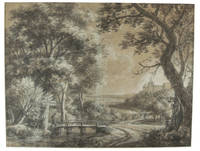
162023479The Netherlands 1620. 43 x 56 cm. Under glass in a black and gold wooden frame. Landscape drawing in black chalk and white chalk on paper. Stunningly beautiful wooded landscape with a castle on top of a hill at the right. Although the drawing is unsigned it has been authenticated by a leading expert on 17th-century Dutch art: Egbert Haverkamp Begemann John Langeloth Loeb professor emeritus at New York University's Institute of Fine Arts formerly of the department of prints and drawings at the Morgan Library and Museum in New York and professor of art history at Yale University. On the back is a sketch of a similar landscape apparently by the same artist.In very good condition with the paper slightly thin in places and reinforced along the edges. ABE CAT Art History unknown
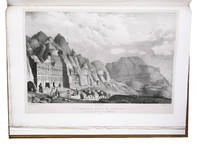
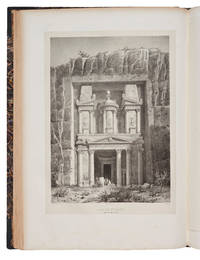
1830J3RDYNHESRKMParis: Giard colophon: printed by the Imprimerie Normale/Jules Didot l'ainé 1830. Period-style half calf with gilt title to spine. Royal 1mo 42 x 59.5 cm. With a lithographic title page with a large lithographed title vignette separately printed on "India" paper and mounted on the title page and lithographed coat of arms of the dedicatee Wilhelm II of Hesse printed directly on dedication leaf 69 lithographed plates 3 double-page and 1 larger folding showing views maps and plans after Laborde and Linant de Bellefonds most separately printed on "India" paper and mounted on the leaves. With 1 zoological plate of a marmot and young: "El Oueber" subtly coloured as published. First edition of "an important work" Blackmer of a stunning and beautifully illustrated account of some of the earliest explorations in the Sinai southern Jordan and northwest Arabia complete with all the magnificent views in extremely large format the double-page plates measuring about 58.5 x 83 cm and the folding map of the Sinai about 74 x 102 cm. All subsequent editions including the English one were published in octavo and contained only a few plates based on the present first edition all in drastically reduced format. The plates show maps plans of ancient sites views of ruins and other buildings coastal and other topographic views costume plates hieroglyphic and other inscriptions flora and fauna. Laborde journeyed to the ancient city of Petra in what is now Jordan with the engineer Linant de Bellefonds in 1828 travelling from Suez via St. Catherine's and through Wadi al-Araba to Akabah. The topographic term Arabie Pétrée derives from Ptolemy's division of Arabia into three regions. The maps in the present book show it as the Sinai peninsula the southern part of what is now Jordan and the northwestern part of the Arabian peninsula. The city of Petra itself is extensively documented in many of the present beautiful plates.Slight browning and foxing occasional waterstaining and tears to folds; a small tear in the map repaired but in all a good wide-margined copy in loose sheets apparently never bound. Rare: the last complete copy came up for auction in 2009 Christie's 3 June lot 120: £23750.l Blackmer 929; Brunet III col. 714; Gay Bibl. de l'Afrique et l'Arabe 929; Henze III 101; Vicaire IV cols. 758-759; cf. Macro Bibliography of the Arabian peninsula 1386 2nd ed.; not in Atabey. Giard (colophon: printed by the Imprimerie Normale/Jules Didot l'ainé), unknown
1830ABC_47846Paris 1830. Imperial folio 42 x 59.6 cm. Giard Simier binding in gold-tooled half green morocco and marbled paper over boards elaborately gold-tooled spine and stamped in gold: "Simier R. du Roi" marbled endpapers. With a large lithographed title vignette and the coat of arms of Wilhelm II on the dedication leaf. 69 lithographed plates maps and plans after Laborde and Linant de Bellefonds mostly mounted on India paper including 3 folding and 2 coloured. 8 87 1 pp. The first edition of this "important work" Blackmer: a monumental folio beautifully bound by René Simier 1772-1843 for King Louis-Philippe of France from whose library it came into the hands of the great art collector and founder of the French branch of Rothschilds Baron James de Rothschild.The volume is complete with all the magnificent views in large folio format; all subsequent editions including the English one were published in octavo and retained only a few plates of the original edition all considerably reduced in size. The work was published following the trip undertaken by the Marquis Léon de Laborde 1807-69 and remained famous in particular for its views of Petra and its Khazneh. Laborde made the journey to Petra with the engineer Linant de Bellefonds in 1828 travelling from Suez via St. Catherine's and through Wadi al-Araba to Akabah. Although Burckhardt Irby and Mangles had explored Petra before Laborde he was the first to make detailed drawings of the area.Born in Frankfurt under the Holy Roman Empire James de Rothschild initially moved to Paris to aid his brother Nathan Mayer Rothschild's business there; shortly he established himself and his family at the heart of France's industrial revolution and charted a steady course through the upheavals of 19th century French politics. Elevated to the status of Baron his interest in art was genuine and his collection well-respected.A beautiful text with an important provenance: bound for King Louis-Philippe of France. Latterly in the collection of the banker James Mayer Rothschild 1792-1868 founder of the French branch of the prominent Rothschild family.With the armorial bookplate of James de Rothschild and label of the Château de Ferrières on the front pastedown. Marbled paper subtly and professionally recovered at an early stage. Marginal dampstain apparent throughout.l Blackmer 929; Brunet III 714; Gay 929; Henze III 101; Nissen ZBI 2335; Vicaire IV 758f; not in Atabey; cf. Howgego 335 L2 1830-33 ed.; Macro 1386 2nd ed. only. ABE CAT Art History hardcover
NY47<p>22 août 1498.</p><p>Small gothic 4to 208 x 145 mm printed on vellum skin of 72 ll. a-i8 33 lines per page mark of the printer on the title historiated borders on each page 21 large full-page engravings not including the anatomical man numerous small initials illuminated with gold on red or blue background. </p><p>Full light brown morocco entirely decorated with blind-stamped motifs with a dark brown morocco mosaïc spine ribbed and decorated double inner gilt fillets framing gilt edges. Elegant binding signed by<i> Marius Michel</i>. </p><p><b>Incunabular partly first edition printed on vellum skin in Paris by Philippe Pigouchet for Simon Vostre considered by a large number of critics as the most beautiful French illustrated book of all times.</b></p><p>" <i>The back of the title contains the almanac from 1488 to 1508 the front of the 2nd l. the anatomical man and on the back the Holy Grail different from the edition of 1497. </i>There is in the text 21 figures 6 more than in the one from 1497<i> and we notice among them the Tree of Jesse the Combat where Uric was killed the Last Judgment and the Mass of S. Gregory. Several of these ancient subjects have been remade after new drawings better than the first ones. On the borderpieces that are also beautifuk we notice the theological and cardinal Virtues the life of J.-C. and the Virgin Mary Suzanne the Child Prodigy les 15 Signs 48 subjects of the Dance of Death and several repeated ornaments. There are copies that only contain 18 large plates. The subjects of the Danse of the dead occupy the eight ll. of the quire f. A copy on vellum is preserved in the cabinet of Mr. Didot; this is perhaps the same that has been sold 399 fr. The Prévost in 1857; another one is located at the imperial Library.</i> " Brunet V 1582-1583.</p><p>Soon after Udalric Gering and his two associates introduced in Paris the miraculous invention of Gutenberg perfected by Fust and Schoyffer and thus made the composter regularity and the economical speed of the press succeed to the ever so slow unprecised and above all expensive work of the scribes and rubricators the booksellers of the capital thought to exploit to their profit an art that by simplifying in a so sensitive way the fabrication of books was offering them an harvest as abundant as easy to collect. As they were first looking to apply the typography to fast flowing works it seems like they should have begin with these prayers books used by the devotees of all classes that they printed later under the title <i>Horæ</i>and <i>Officium</i> or even <i>Heures</i> and <i>Office</i> that were incarnating since a long time the main branch of their activity; but difficulty came and delayed for a while the printing of this type of works. Prayer books that were then used were all written on vellum decorated with initials painted in gold and in colours and almost all of them were also supplemented with more or less numerous and more or less well executed miniatures. For the calendar there were small subjects delightfully painted where were represented works occupations and games related to every month of the year; for the moveable feasts and the liturgy of deaths were larger miniatures representing subjects drawn from the Holy Scripture or related to the mystery celebrated or to the life of the invoked saint; we could almost always see represented there for examplethe <i>Martyr of St John the Evangelist</i> the <i>Angelus</i> the<i> Nativity of Jesus-Christ</i><i>the Sheperds Vision</i> <i>the Adoration of the Magi</i> the<i> Flight into Egypt</i> <i>the Massacre of the innocentsdes</i> <i>ordered by Herode</i> <i>David and Batsheba</i> etc. We also noticed in some of these precious manuscripts some more or less varied borderpieces more or less rich framing all of the pages and that were usually offering flowers birds insects and gracious arabesques where gold was skilfully married to brighter colours. Those rich volumes were considered rightfully as prized jewels and were transmitted by succession in families generation after generation. Being used then to read Hours in such illustrated books how could we have welcomed simple typographical productions entirely depraved of these ornaments necessary for all pious reading To succeed in this type of craftsmanship it was needed then to use the help of woodcut that was then being perfected and to reproduce as much as possible the drawings spreaded out in the manuscript Hours and to illustrate the prints with those. If until now the bibliographers couldn't agree on the real date of the most ancient illustrated Book of Hours produced on press<b> they usuallly recognize however that the printer Philippe Pigouchet and the bookseller Simon Vostre were the firsts in Paris who knew how to combine with success engraving with typography. </b>We can believe that those two booksellers already practiced woodcut themselves and that they knew how to join forces with skilled tailors in order to give to their small woodcuts the degree of perfection that they perfected. It is then to anonymous artists from the end of the 15th century and not as pretended Papillon to Mercure Jollat appeared thirty years later that we must give credit for the main part of the engraving of <b>those </b><i><b>Hours</b></i><b> so remarkable by the beauty of its vellum the quality of its inking and above all the variery of its borderpieces where pleasing arabesques singular grotesque subjects alternatively succeed with hunts games subjects drawn from Holy Scripture or even secular history and mythology and at last with those dances of dead imitated from the </b><i><b>men and women dance of death</b></i> which was then in vogue small compositions whose spicy expression can be admired. These borders which as can be judged from the specimens placed around these pages are more remarkable for the finish of the engraving than for the design consisted of small compartments which were divided changed and reunited at will according to the size and format of the volume in which they were to appear; so that while almost always using the same parts it was nevertheless so easy to give the different editions published an appearance of variety that one can hardly find two that reproduce themselves exactly page by page. The large plates intended to receive the embellishment of the painting are generally less finished than the small ones but one always recognises the same workmanship.</p><p>Let's hear now an English bibliographer who dedicated at least a hundred pages in one of his most interesting works to the description of ancient Hours printed in Paris and to the figuration with a conscientious exactitude of the most curious ornaments. This is then how T.-F. Dibdin expresses himself at the page 7 of the second day of his <i>Bibliographical Decameron</i>: "<i>Let us howerer… suppose that some spirited Collector or a select committee of the Roxburghe Club should unite their tastes and purses to put forth from the Shakespeare press an octavo volume of prayers from the liturgy decorated in a manner similar to what we observe in the devotional publications just alluded to – do you think the attempt would be successful In other words where are the ink and vellum which can match with what we see in the Missals of old The doubtful success of such an experiment would render it extremely hazardous; even were it not attended with what may be called an immensity of expense. Welcome therefore again I exclaim the rich and fanciful furniture which garnishes the texts of early printed books of devotion….</i>"</p><p>"Those parisian impressions of which foreigners are the first to recognize their superiority…"</p><p>Philippe Pigouchet not only printed almost all the Hours published by Simon Vostre from 1488 to 1502 as well as several other Hours for Pierre Regnault bookseller in Caen and for Guillaume Eustache bookseller in Paris of which we can find the article below; but before having put his press to the service of those three booksellers he had already published under his own name and on his own account several Books of Hours including the Almanac indicating the dates of Easter began in the year 1488.</p><p>The name of Simon Vostre who began to appear during the year 1488 at the latest cannot be found after 1520.</p><p>It is in this type of publication that Simon Vostre won over all of his concurrents. We can see thanks to his discerning taste the charming borderpieces in arabesques illustrating all these Hours and the pretty small figures appearing on the same borderpieces. First rarely varied but already remarkable in the editions given by him around 1488 those borderpieces were presenting since then a suite of small subjects who began to multiply enough to finally stop him from repeating several times in a row the same suite of plates as he was obliged to do in the beginning and even enough to make possible the fact of making them vary from an edition to another. </p><p>All of these suites are generally accompanied by a very short text in Latin or by a few particularly naive verses in French where we can read words we are surprized to see in a book of piet words we won't dare to print in letters now even in more mundane works. This is perhaps a crucial point in the research of those singular productions today and what will make their price increase as time progresses. The most curious copies in our opinion are the ones that contain a larger number of those pious quatrains and that gather the main part of the small suites that we just talked about. As for the choice of the proofs the editions around 1498 are superior to the subsequent ones for the variety of the arabesques the beauty of the printing. This is here an advantage that won't deny the artists neither the amateurs of ancient woodcuts who will find this mostly in copies in larger format and to whom we advise to choose non illuminated. </p><p><b>" There is something sure the Hours by Pigouchet exécutéd for Simon Vostre have always made the admiration of bibliophiles and connaisseurs</b><i><b>. </b>They bear the artistic mark of the old French School. The drawer</i> said J. Renouvier <i>stepped in the schema of the gothic iconography; He places on the first pages the representations that the sculptor used to put on the steps of the church on the sides of the portal and he adds as he pleases more familiar and more cheerful motifs small subjects of manners whose kindness touches us all the more because we see the tradition faithfully observed by country people and by children. We didn't make anything similar abroad : this is ultimate French art.</i> <b>As we flip through the leaves we would think being transported unders the naves of our ancient gothic cathedrals. </b></p><p><i>On sent vibrer dans ces images de la vie du Christ des Sacrements des Signes de la fin du Monde et de la Danse macabre la foi naïve et robuste de nos pères.</i></p><p><i>Outre les bordures dont nous avons présenté des échantillons la plupart des livres d'heures exécutés pour Simon Vostre dans la seconde manière de Pigouchet en contiennent d'autres figurant la Danse macabre des Hommes et des Femmes. Le cycle complet de la Danse des Morts se compose de soixante-six sujets ; trente scènes sont contenues dans dix bordures pour la Danse des Hommes et trente-six scènes en douze bordures pour la Danse des Femmes. Ce sont les mêmes personnages qui figurent dans la Danse macabre de Guy Marchant. Le dessinateur dispose adroitement ses couples dans un petit espace. Il drape la Mort d'un bout de linge lui donne pour instruments le pic et la pelle plutôt que la faux qui tiendrait trop de place et il la fait grimacer comme un singe en présence d'un partenaire merveilleusement signalé par son costume. C'est un vif dialogue une mimique piquante qu'ont avec la Mort le Bourgeois l'Usurier le Médecin l'Enfant la Reine la Chambrière la Mignote la Femme de village tous entraînés vers la danse finale</i>. " A. Claudin.</p><p><b>Claudin</b> <i>Histoire de l'imprimerie en France</i><b> dedicates 20 pages and numerous reproductions to this edition that we can consider as one of the most beautiful from the incunabular printing in the western world and that constitutes an important date in the evolution of ornamentation : " </b><i>des personnages fantastiques accompagnent dans leur chevauchée des chimères de toutes sortes le tout brochant sur une flore incomparable : telles sont ces bordures d'une exquise conception</i> " Claudin 44.</p><p><b>Superb copy printed on vellum skin of this incunabular Book of Hours so important in the history of printing in France entirely rubricated with gold on an alternated red and blue background. </b></p><p>The purity of its printing is such that it made its way into the collection of the greatest amateur <i>Georges Wendling </i>with ex-libris.</p><p>In 2004 14 years ago Pierre Berès described and catalogued ford 130 000 € the Hours of 1498 by Simon Vostre bound in the 19th century<i>. </i>Réf : Pierre Berès September 15-28 2004 n°2.</p><p><br /></p><p><u>Français</u><br /></p><p>Philippe Pigouchet sur le titre.</p><p>22 août 1498.</p><p>Petit in-4 gothique imprimé sur peau de vélin de 72 ff. a-i8 33 lignes par page marque de l'imprimeur sur le titre bordures historiées pour chaque page 21 grandes gravures à pleine page sans compter l'homme anatomique nombreuses petites initiales enluminées à l'or sur fond rouge ou bleu. </p><p>Plein maroquin havane entièrement décoré de motifs à froid avec mosaïque de maroquin brun foncé dos à nerfs orné coupes décorées à froid double encadrement de filets dorés intérieurs tranches dorées. Élégante reliure signée de<i>Marius Michel</i>. </p><p>208 x 145 mm.</p><p><b>Edition incunable en partie originale achevée d'imprimer sur peau de vélin à Paris par Philippe Pigouchet pour Simon Vostre considérée par nombre de critiques comme le plus beau livre français illustré du temps.</b></p><p>" <i>Le verso du titre contient l'almanach de 1488 à 1508 le recto du 2ème f. l'homme anatomique et le verso le saint Graal différent de celui de l'édition de 1497. </i>Il y a dans le texte 21 figures 6 de plus que dans celle de 1497<i> et parmi lesquelles on remarque l'Arbre de Jessé le Combat où Uric fut tué le Jugement dernier et la Messe de S. Grégoire. Plusieurs des anciens sujets ont été refaits sur de nouveaux dessins meilleurs que les premiers. Dans les bordures qui sont aussi fort belles on remarque les Vertus théologales et cardinales la Vie de J.-C. et de la Vierge Marie Suzanne l'Enfant prodigue les 15 Signes 48 sujets de la Danse des morts et divers ornements répétés. Il y a des exemplaires qui n'ont que 18 grandes planches. Les sujets de la Dans des morts occupent les huit ff. du cahier f. Un exemplaire sur vélin est conservé dans le cabinet de M. Didot ; c'est peut-être le même que celui qui a été vendu 399 fr. Le Prévost en 1857 ; un autre se trouve à la Bibliothèque impériale.</i> " Brunet V 1582-1583.</p><p>Peu de temps après qu'Udalric Gering et ses deux associés eurent introduit à Paris l'invention miraculeuse de Gutenberg perfectionnée par Fust et Schoyffer et y eurent ainsi fait succéder la régularité du composteur et l'économique célérité de la presse au travail si lent si peu exact et surtout si dispendieux des scribes et des rubriqueurs les libraires de cette capitale songèrent à exploiter à leur profit un art qui en simplifiant d'une manière si sensible la fabrication des livres leur offrait une moisson aussi abondante que facile à recueillir. Comme ils cherchèrent d'abord à appliquer la typographie à des ouvrages d'un débit rapide il semble qu'ils auraient dû commencer par ces livres de prières à l'usage des fidèles de toutes les classes que plus tard ils imprimèrent sous le titre d'<i>Horæ</i> et d'<i>Officium</i> ou sous celui d'<i>Heures</i> et d'<i>Office</i> et qui depuis longtemps formaient la principale branche de leur commerce ; mais voici la difficulté qui retarda quelque temps l'impression de ces sortes d'ouvrages. Les livres de prières dont on se servait alors étaient tous écrits sur vélin décorés d'initiales peintes en or et en couleurs et presque tous aussi enrichis de miniatures plus ou moins nombreuses et plus ou moins bien exécutées. Au calendrier c'était des petits sujets délicatement peints où figuraient les travaux les occupations et les jeux analogues à chaque mois de l'année ; aux fêtes mobiles au propre des saints et à l'office des morts se trouvaient de plus grandes miniatures représentant des sujets tirés de l'Écriture sainte ou relatifs au mystère que l'on célébrait ou à la vie du saint qu'on invoquait ; on y voyait presque toujours figurer par exemple le <i>Martyre de saint Jean l'évangéliste</i> la <i>Salutation angélique</i> <i>la Naissance de Jésus-Christ</i> <i>la Vision des bergers</i><i>l'Adoration des mages</i> <i>la Fuite en Égypte</i> <i>le Massacre des innocents</i> <i>ordonné par Hérode</i> <i>David et Betzabée</i> etc. On remarquait aussi dans une partie de ces manuscrits précieux des bordures plus ou moins variées plus ou moins riches qui en entouraient toutes les pages et qui offraient ordinairement des fleurs des oiseaux des insectes et des arabesques gracieuses où l'or se mariait habilement aux couleurs les plus vives. Ces riches volumes étaient avec raison considérés comme des bijoux de prix et se transmettaient par succession dans les familles de génération en génération. Accoutumé qu'on était alors à lire ses Heures dans des livres ainsi décorés comment aurait-on pu accueillir de simples productions typographiques entièrement dépourvues de ces ornements devenus un accompagnement nécessaire de toute lecture pieuse Pour réussir dans ce genre de fabrication il fallut donc emprunter le secours de la gravure sur bois qui commençait à se perfectionner et reproduire autant que possible les dessins répandus dans les Heures manuscrites et en décorer les imprimées. Si jusqu'ici les bibliographes n'ont pu tomber d'accord sur la véritable date du plus ancien livre d'Heures illustré qu'ait produit la presse<b> ils reconnaissent pourtant généralement que l'imprimeur Philippe Pigouchet et le libraire Simon Vostre furent les premiers à Paris qui surent allier avec succès la gravure à la typographie</b>. Il est à croire que ces deux libraires avaient déjà pratiqué par eux-mêmes la taille sur bois et qu'ils surent s'adjoindre des tailleurs assez habiles pour donner successivement à leurs petits bois le degré de perfection auquel ils les ont portés. C'est donc à des artistes anonymes de la fin du quinzième siècle et non pas comme l'a prétendu Papillon à Mercure Jollat venu trente ans plus tard qu'il faut attribuer la principale part dans<b>la gravure de ces </b><i><b>Heures</b></i><b> si remarquables par la beauté du vélin la qualité de l'encre et surtout par la variété des bordures où à des arabesques les plus agréables à des sujets grotesques les plus singuliers succèdent alternativement des chasses des jeux des sujets tirés de l'Écriture sainte ou même de l'histoire profane et de la mythologie et enfin ces Danses des morts imitées de la </b><i><b>Danse macabre des hommes et des femmes</b></i><b> </b>qui était alors dans toute sa vogue petites compositions dont on admire encore la piquante expression. Ces bordures qui ainsi qu'on peut en juger par les spécimens placés autour de ces pages sont d'ailleurs plus remarquables pour le fini de la gravure que pour le dessin se composaient de petits compartiments qui se divisaient se changeaient se réunissaient à volonté selon l'étendue et le format du volume où elles devaient figurer ; en sorte que tout en employant presque toujours les mêmes pièces il était cependant si facile de donner aux différentes éditions qu'on publiait une apparence de variété qu'à peine en trouve-t-on deux qui se reproduisent exactement page par page. Les grandes planches destinées à recevoir l'embellissement de la peinture sont en général moins terminées que les petites mais on y reconnaît toujours un même faire.</p><p>Laissons parler ici un bibliographe anglais qui a consacré cent pages au moins du plus intéressant de ses ouvrages à décrire les anciennes Heures imprimées à Paris et à en figurer avec une exactitude scrupuleuse les plus curieux ornements. Voici donc comme s'exprime T.-F. Dibdin à la page 7 de la seconde journée de son <i>Bibliographical Decameron</i>: " <i>Let us howerer… suppose that some spirited Collector or a select committee of the Roxburghe Club should unite their tastes and purses to put forth from the Shakespeare press an octavo volume of prayers from the liturgy decorated in a manner similar to what we observe in the devotional publications just alluded to – do you think the attempt would be successful In other words where are the ink and vellum which can match with what we see in the Missals of old The doubtful success of such an experiment would render it extremely hazardous; even were it not attended with what may be called an immensity of expense. Welcome therefore again I exclaim the rich and fanciful furniture which garnishes the texts of early printed books of devotion….</i> "</p><p>" <i>Ces impressions parisiennes dont les étrangers sont les premiers à reconnaître toute la supériorité…</i> ".</p><p>Philippe Pigouchet a non seulement imprimé presque toutes les Heures publiées par Simon Vostre de 1488 à 1502 ainsi que plusieurs autres Heures pour Pierre Regnault libraire de Caen et pour Guillaume Eustache libraire de Paris dont on trouvera plus bas l'article ; mais avant d'avoir mis sa presse au service de ces trois libraires il avait déjà publié sous son seul nom et pour son propre compte plusieurs livres d'Heures dont l'Almanach indiquant les dates de Pâques commence à l'année 1488.</p><p>Le nom de Simon Vostre qui commence à paraître l'année 1488 au plus tard ne se trouve plus après 1520.</p><p>C'est dans ce genre de publication que Simon Vostre l'a emporté sur tous ses concurrents. Nous devons à son goût éclairé les charmantes bordures en arabesques qui décorent toutes ses Heures et les jolies petites figures qu'offrent ces mêmes bordures. D'abord peu variées mais déjà fort remarquables dans les éditions données par lui vers 1488 ces bordures présentaient dès lors une suite de petits sujets qui peu à peu se multiplièrent assez pour qu'il pût enfin se dispenser de répéter plusieurs fois de suite les mêmes planches comme il avait été obligé de le faire dans l'origine et même pour qu'il fût possible de les varier d'une édition à l'autre. </p><p>Toutes ces suites sont ordinairement accompagnées d'un texte fort court en latin ou de quelques vers français d'une naïveté remarquable et où se lisent des mots qu'on est fort surpris de trouver dans un livre de piété des mots qu'on n'oserait plus imprimer en toutes lettres maintenant même dans les ouvrages les plus mondains. Voilà peut-être ce qui contribue le plus à faire rechercher aujourd'hui ces singulières productions et ce qui en augmentera le prix à mesure que nous nous éloignerons davantage de l'époque de leur publication. Les exemplaires les plus curieux à notre avis sont ceux qui renferment un plus grand nombre de ces pieux quatrains et qui réunissent la plus grande partie des petites suites que nous venons de signaler. Pour le choix des épreuves pour la variété des arabesques pour la beauté du tirage les éditions données vers 1498 l'emportent sur les dernières. C'est là un avantage que ne négligeront ni les artistes ni les amateurs d'anciennes gravures sur bois et qu'ils trouveront surtout dans les exemplaires en grand format que nous leur conseillons de choisir non enluminés. </p><p><b>" Il est un fait certain c'est que les Heures de Pigouchet exécutées pour Simon Vostre ont fait de tout temps l'admiration des bibliophiles et des connaisseurs</b><i><b>. </b>Elles portent le cachet artistique de la vieille École française. Le dessinateur</i> dit J. Renouvier <i>est entré d'emblée dans le plan de l'iconographie gothique ; il place aux premières pages les représentations que le sculpteur mettait aux marches de l'église sur les côtés du portail et il ajoute de son gré des motifs plus familiers et plus gais de petits sujets de mœurs dont la gentillesse nous touche d'autant plus que nous en voyons la tradition fidèlement observée par les campagnards et par les enfants. On n'a rien fait de semblable à l'étranger ; c'est de l'art français par excellence.</i> <b>En tournant ces feuillets on se croirait transporté sous les nefs de nos vieilles cathédrales gothiques.</b> <i>On sent vibrer dans ces images de la vie du Christ des Sacrements des Signes de la fin du Monde et de la Danse macabre la foi naïve et robuste de nos pères.</i></p><p><i>Outre les bordures dont nous avons présenté des échantillons la plupart des livres d'heures exécutés pour Simon Vostre dans la seconde manière de Pigouchet en contiennent d'autres figurant la Danse macabre des Hommes et des Femmes. Le cycle complet de la Danse des Morts se compose de soixante-six sujets ; trente scènes sont contenues dans dix bordures pour la Danse des Hommes et trente-six scènes en douze bordures pour la Danse des Femmes. Ce sont les mêmes personnages qui figurent dans la Danse macabre de Guy Marchant. Le dessinateur dispose adroitement ses couples dans un petit espace. Il drape la Mort d'un bout de linge lui donne pour instruments le pic et la pelle plutôt que la faux qui tiendrait trop de place et il la fait grimacer comme un singe en présence d'un partenaire merveilleusement signalé par son costume. C'est un vif dialogue une mimique piquante qu'ont avec la Mort le Bourgeois l'Usurier le Médecin l'Enfant la Reine la Chambrière la Mignote la Femme de village tous entraînés vers la danse finale</i>. " A. Claudin.</p><p><b>Claudin</b> <i>Histoire de l'imprimerie en France</i> <b>consacre 20 pages et de nombreuses reproductions à cette édition que l'on peut considérer comme l'une des plus belles de l'imprimerie incunable d'Occident</b> et qui constitue une date importante dans l'évolution de l'ornementation : " <i>des personnages fantastiques accompagnent dans leur chevauchée des chimères de toutes sortes le tout brochant sur une flore incomparable : telles sont ces bordures d'une exquise conception</i> " Claudin 44.</p><p><b>Superbe exemplaire imprimé sur peau de vélin de ce livre d'heures incunable si important dans l'histoire de l'imprimerie en France entièrement rubriqué à l'or sur fond rouge et bleu alterné.</b></p><p>La pureté de son tirage est telle qu'il entra dans la collection du grand amateur <i>Georges Wendling </i>avec ex-libris.</p><p>En 2004 il y a 14 ans Pierre Berès décrivait et cataloguait 130 000 € les Heures de 1498 de Simon Vostre reliées au XIXe siècle<i>. </i>Réf : Pierre Berès 15-28 septembre 2004 n°2.</p> hardcover
240126St. Petersburg J. J. Weitbrecht 1774-88. Folio 498 x 305 mm. Additional hand-coloured lithographed title-page with dedication to Catherine II. 101 beutifully hand-coloured engraved plates by Karl Friedrich Knappe numbered I-C with additional plate VIII B. The nomenclature of the plants in Latin and Russian. Original blue patterned paper boards. Red morocco lettering-pieces. Uncut. Joints and spines somewhat worn. First edition of the first great illustrated Russian flora. Complete with 101 engraved hand-coloured plates. Provenance: From the library of the Jussieu family and the library of Henry Rogers Broughton 2nd Baron Fairhaven. . hardcover
LCS-18039Exécutée par l’atelier au « Pecking Crow » travaillant pour Grolier. Paris, Simon de Colines, 1543. In-4 de 176 ff. (a-y8), 14 planches gravées à pleine page. Texte imprimé en rouge et noir. Almanach pour 1543-1568. Titre imprimé dans un encadrement architectural, toutes les pages bordées d'encadrements composites, 14 bois à pleine page avec bordures architecturales spécialement conçues pour chaque scène, et grandes lettres ornées à fond criblé. Plein veau brun foncé, plats recouverts d'un décor à la Grolier composé de filets dorés, entrelacs géométriques peints en noir et fleurons dorés, dos orné entre chaque nerf d'un petit fleuron doré, coupes décorées, tranches dorées et ciselées, ancienne restauration au bas du plat supérieur. Étui. 233 x 164 mm.
NYBF4<p>Paris Simon de Colines 1543.</p><p>4to 233 x 164 mm of 176 ll. a-y8 14 full-page engraved plates. Text printed in red and black. Almanac for 1543-1568. Printed title in an architectural frame all the pages bordered with composite frames 14 full-page woodcuts with architectural borders specially conceived for each scene and large decorated initials. Dark brown full calf covers with a Grolier decoration made of gilt fillets geometric tracery painted in black and gilt fleurons spine decorated with small gilt fleurons inside the panels gilt and chiseled edges former restoration in the lower part of the front cover. Bookcase.</p><p><b>Rich contemporary binding made by one of the Parisian workshops working for Jean Grolier the</b> "<i>Pecking Crow</i>" <b>workshop.</b></p><p>Harvard II 306; Brunet V 1661-1662; Renouard pp. 378-379; Rothschild vol. 3 n° 2537; Brun p. 233 8th ed.; Bernard pp. 209-212; Bohatta n° 1212; Lacombe 426 426 bis; Pichon cat 1897; Rahir 1931; Mortimer 306 "<i>First Colines quarto edition</i>"; Schreiber;<i>Simon de Colines</i> 206.</p><p><b>One of the most beautiful specimens of the art of historiated hours in the 16th century.</b> <i>Firmin Didot</i>.</p><p><b>First book of hours published by Simon de Colines in 4to format and first use of these very important woodcuts in the history of illustration</b><b>.</b> Decorated on each page the edition uses <b>16 fine wood-engraved frames around the text</b> repeated of great variety and <b>14 full-page woodcuts</b> scenes of the New Testament. Schreiber while comparing them with Tory's productions for his books of hours underlines their differences: of a delicacy and uncommon accuracy Simon de Colines's woodcuts show particularly meticulous shadow effects and too many details to be colored. The publication in 1543 was the achievement of a long-term project: some woodcuts are dated 1536 1537 and 1539; seven are signed with the cross of Lorraine.</p><p><b>Brunet insists on the beauty of these frames</b>"<i>among which the black is remarkable. They do not bear the mark of Tory but they are absolutely worthy of being attributed to him… The large decorated initials are of the utmost beauty.</i>"</p><p>Didot in the analysis he dedicated to this great book writes: "<i>All the pages are framed with rich arabesque borders sometimes in black sometimes light and always on a white background. This fine book seems to have been made in competition with the hours of Maillard of 1542 and we must I believe restitute it entirely to Simon de Colines</i>"<i>.</i></p><p>"<i>There are 14 figures the first one representing Saint Luke writing is the only one to be drawn with a simple line; the others are lightly shaded. They are generally attributed to Geoffroy Tory but even though they are in his style they offer a great difference of execution with the ones published before 1536 date of his death</i>". Brun <i>Le livre français illustré de la Renaissance</i>.</p><p>These 14 large figures including their frames measure approximately 210 x 130 mm. Three of them <i>the Visitation the adoration of the Magi King David</i> are marked with ‡; by the way they are the most beautiful.</p><p>The famous portrait in medallion of Francis I of France inserted in the border of the engraving of the resurrection of Lazarus f. mi is of a very pure issue.</p><p><b>A precious ruled wide-margined copy 233 x 164 mm printed in round characters decorated with red rubricated capital letters from the very first issue with many frames dated 1536 covered with a contemporary Parisian binding from one of the Parisian workshops working then for Jean Grolier the</b> "<i>Pecking Crow</i>" <b>workshop.</b></p><p>For the tools used by the "<i>Pecking Crow</i>" workshop see Needham <i>12 Centuries</i> n°54 Nixon PML n°17 and Foot Davis Gift I pages 129-138.</p><p>The Harvard catalogue II n° 306 presents on the same book a similar binding.</p><p><b>"This binding borrows to the</b> "<i>two centers of stimulation</i>"<b> of this art</b> analyzed by Jean Toulet in the <i>Histoire de l'édition française.</i> <b>Francis I of France and Jean Grolier are both the pioneers.</b></p><p><b>Francis I of France settles in Fontainebleau from 1530 and decides to constitute an important library. For the first time in France we observe the definition of a true program of bindings.</b> <i>The selection is made on very dark brown or black calf coverings. Jean Toulet perceives in this dark tonality an intention of dignity in accordance with the one of the royal library conceived as a container of antique and humanist texts and a place of studies.</i></p><p><b>The second center of stimulation is the one of Jean Grolier's library who discovers the binding as a social distinction</b><b>.</b> "<i>His bindings of great quality substitute to punctual ornamentation with tools and to fillet borders a decoration constituted with tracery structuring the rectangular surface of the covers.</i>"</p><p>The contribution of painted colors here the black highlights the game of tracery and the shape of tools. The impact of these colors softens the one of gilt. Thus the bindings with geometric tracery essentially works by Claude de Picques open the path for new formal research.</p><p>The <i>Librairie Patrick Sourget</i> has catalogued and sold two other copies of this book of Hours: in 1995 in a Claude de Picques binding for 600 000 FF 91 500 € Ref. <i>Deux cents Livres Précieux</i> n°24 and in 1999 22 years ago another binding from the Pecking Crow workshop for 250 000 FF 37 500 € Ref. <i>Manuscrits et livres précieux</i>. Catalogue XIX n°22.</p><p>Provenance: acquired in 1934 at Desombes'.</p><p><br /></p><p><b><u>Français</u></b><br /></p><p>Paris Simon de Colines 1543.</p><p>In-4 de 176 ff. a-y8 14 planches gravées à pleine page. Texte imprimé en rouge et noir. Almanach pour 1543-1568. Titre imprimé dans un encadrement architectural toutes les pages bordées d'encadrements composites 14 bois à pleine page avec bordures architecturales spécialement conçues pour chaque scène et grandes lettres ornées à fond criblé. </p><p>Plein veau brun foncé plats recouverts d'un décor à la Grolier composé de filets dorés entrelacs géométriques peints en noir et fleurons dorés dos orné entre chaque nerf d'un petit fleuron doré coupes décorées tranches dorées et ciselées ancienne restauration au bas du plat supérieur. Étui.</p><p>233 x 164 mm.</p><p><b>Riche reliure de l'époque exécutée par l'un des ateliers parisiens travaillant pour Jean Grolier le</b><b> " </b><i><b>Pecking Crow</b></i><b> " atelier.</b></p><p>Harvard II 306 ; Brunet V 1661-1662 ; Renouard pp. 378-379 ; Rothschild vol. 3 n° 2537 ; Brun p. 233 8è éd ; Bernard pp. 209-212 ; Bohatta n° 1212 ; Lacombe 426 426 bis ; Pichon cat 1897 ; Rahir 1931 ; Mortimer 306 "<i>First Colines quarto edition</i>" ; Schreiber ; <i>Simon de Colines</i> 206.</p><p><b>L'un des plus beaux spécimens de l'art des Heures historiées au XVIe siècle</b><b>. </b><i>Firmin Didot</i>.</p><p><b>Premier livre d'heures publié par Simon de Colines en format in-quarto et premier emploi de ces bois très importants dans l'histoire de l'illustration</b><b>.</b> Décorée sur chacune des pages l'édition fait usage de <b>16 beaux bois d'encadrement de texte</b> répétés d'une grande variété et de <b>14 bois à pleine page</b> scènes du Nouveau Testament. Schreiber tout en les rapprochant des productions de Tory pour ses livres d'Heures en souligne également les différences : d'une finesse et d'un détail peu communs les bois de Simon de Colines portent des effets d'ombre particulièrement minutieux et des détails trop nombreux pour être coloriés. La publication en 1543 était l'aboutissement d'un projet de longue durée : certains des bois sont datés de 1536 1537 et de 1539 ; sept sont signés de la croix de Lorraine.</p><p>Première occurrence d'un encadrement architectural à <b>décor de termes</b> sur la page de titre d'un livre parisien due au génial inventeur qu'est Simon de Colines.</p><p><b>Brunet insiste sur la beauté de ces encadrements</b><i>" parmi lesquels se font surtout remarquer les noirs. Ils ne portent pas la marque de Tory mais ils sont tout à fait dignes de lui être attribués. Les grandes initiales fleuronnées sont de la plus grande beauté ".</i></p><p>Didot dans l'analyse qu'il consacra à ce grand livre écrit : <i>" Toutes les pages sont entourées de riches bordures en arabesques tantôt en noir tantôt en clair et toujours sur fond blanc. Ce beau livre paraît avoir été fait en concurrence avec les heures de Maillard de 1542 et l'on doit je crois le restituer entièrement à Simon de Colines ".</i></p><p><i>" Les figures sont au nombre de 14 la première représentant Saint-Luc écrivant est la seule qui soit dessinée au simple trait ; les autres sont légèrement ombrées. Elles sont généralement attribuées à Geoffroy Tory mais bien qu'elles soient dans sa manière elles offrent cependant une très grande différence d'exécution avec celles parues avant 1536 date de sa mort ".</i> Brun <i>Le livre français illustré de la Renaissance</i>.</p><p>Ces 14 grandes figures y compris leur encadrement mesurent environ 210 x 130 mm. Trois d'entre elles <i>la Visitation l'adoration des Mages le roi David</i> sont marquées de la ‡ ; ce sont d'ailleurs les plus belles.</p><p>Le célèbre portrait en médaillon de François Ier inséré dans la bordure de la gravure de la résurrection de Lazare f. mi est d'un tirage très pur.</p><p><b>Précieux exemplaire réglé grand de marges 233 x 164 mm imprimé en caractères ronds orné de capitales rubriquées en rouge issu du tout premier tirage avec de nombreux encadrements à la date de 1536 revêtu d'une reliure parisienne de l'époque issue de l'un des ateliers parisiens travaillant alors pour Jean Grolier le </b><b>" </b><i><b>Pecking Crow</b></i><b> " atelier.</b></p><p>Pour les fers utilisés par le " <i>Pecking Crow</i> " atelier voir Needham <i>12 Centuries</i>n°54 Nixon PML n°17 et Foot Davis Gift I pages 129-138.</p><p>Le catalogue Harvard II n° 306 présente sur le même livre une reliure semblable.</p><p><b>" Cette reliure emprunte aux " </b><i><b>deux foyers de stimulation</b></i><b> " de cet art</b> analysé par Jean Toulet dans<i>l'Histoire de l'édition française.</i> François Ier et Jean Grolier en sont les initiateurs.</p><p><b>François Ier s'installe à Fontainebleau à partir de 1530 et décide d'y réunir une importante bibliothèque. Pour la première fois en France on y voit se définir un véritable programme de reliures.</b> <i>Le choix se porte alors sur des couvrures de veau brun très foncé ou noir. Jean Toulet décèle dans cette tonalité sombre une intention de dignité en accord avec celle de la bibliothèque royale conçue comme un réceptacle de textes antiques et humanistes et un lieu d'études.</i></p><p><b>Le second foyer de stimulation est celui de la bibliothèque de Jean Grolier qui découvre la reliure comme mode de distinction sociale</b><b>. " </b><i>Ses reliures d'une grande qualité de facture substituent à l'ornementation ponctuelle par fers et aux encadrements de filets un décor constitué par des entrelacs qui structurent la surface rectangulaire des plats </i>".</p><p>L'apport des couleurs peintes ici le noir met en évidence les jeux d'entrelacs et les formes de fers évidés. L'impact de ces couleurs atténue celui des dorures d'autant plus que se généralisent les fers azurés. Ainsi les reliures à entrelacs géométriques essentiellement œuvres de Claude de Picques ouvrent elles la voie à des recherches formelles nouvelles.</p><p>La <i>Librairie Patrick Sourget</i> a catalogué et vendu deux autres exemplaires de ce livre d'Heures : en 1995 en reliure de Claude de Picques 600 000 FF 91 500 € Ref. <i>Deux cents Livres Précieux</i> n°24 et en 1999 il y a 17 ans une autre reliure de l'atelier au Pecking Crow 250 000 FF 37 500 € Ref. <i>Manuscrits et livres précieux</i>. Catalogue XIX n°22.</p><p>Provenance : acquis en 1934 chez Desombes.</p><br /> hardcover
LCS-991L’édition originale d’un ouvrage fondamental dans l’histoire des mathématiques, l’un des textes fondateurs de la théorie des probabilités par « le Newton français ». Paris, Mme Ve Courcier, 1812 [-1820].In-4 de (3) ff., 464 pp., (1) f. d’errata, 34 pp., 50 pp., 36 pp. Des rousseurs. Relié en demi-maroquin aubergine à grain long, à coins, dos lisse orné de filets dorés. Coins et mors frottés. Reliure de l’époque fatiguée. 254 x 203 mm.
ABAACali20<p>Paris Mme Ve Courcier 1812 -1820.</p><p>4 to 254 x 203 mm 3 ff. 464 pp. 1 l. of errata 34 pp. 50 pp. 36 pp. Some foxing.</p><p>Bound in contemporary aubergine straight-grained half-morocco flat spine decorated with gilt fillets. Corners and joints rubbed. <em>Binding worn.</em></p><p><strong>First edition of one of the founding works of the theory of probability.</strong></p><p>DSB XV 367-376; UC Berkely <em>First Editions of Epochal Achievements</em> 1934 12; Stigler <em>History of Statistics</em> pp. 146-148.</p><p>"The '<em>Théorie analytique des Probabilités' </em>contains besides an introduction two books and four supplements: Book I. <em>Du calcul des Fonctions génératrices</em>; Book II. <em>Théorie générale des Probabilités ; </em>first supplement composed in 1816. <em>Sur l'Application du calcul des Probabilités à la philosophie naturelle ; second </em>supplement composed in 1817<em>. Sur l'Application du calcul des Probabilités aux opérations géodésiques et sur la Probabilité des résultats déduits d'un grand nombre d'observations ; </em>third supplement composed in 1819. <em>Application des formules géodésiques de Probabilité à la Méridienne de France. </em>It is in this publication that Laplace expounded his beautiful theory of the generative functions."</p><p>Hoefer <em>Nouvelle biographie générale</em> 547.</p><p><em>"Pierre Simon Laplace was born in Normandy on the 23rd of March 1749 and died in Arcueil on the 5th of March 1827. He was so talented for analysis that he was called "the French Newton"; he paid particular attention to the great problem of universal gravitation and motion of the celestial bodies.</em></p><p><em>Like Lagrange he attained remarkable results in this field proving the stability of the solar system and making notables discoveries which were recorded in the reports of the Académie des Sciences from 1784 …. In the 'Théorie analytique' 1812 Laplace gave a classical form to the calculation of probabilities."</em> Dictionnaire des auteurs III 40.</p><p>Laplace who had carried out his first works about probabilities between 1771 and 1774 published his '<em>Théorie analytique des probabilités' </em>in 1812.</p><p><strong>In this work Laplace gives decisive elements for the theory of probabilities for which he is considered as one of the founders.</strong></p><p>As a direct heir to Newton in the field of celestial mechanics Laplace may also be considered as the heir of Pascal in the field of calculation of probabilities as thanks to his works this subject has acquired a new power.</p><p><strong>"In the 'Théorie' Laplace gave a new level of mathematical foundation and development both to probability theory and to mathematical statistics.</strong></p><p><em>'Theorie Analytique des probabilités'. First publication: Paris Courcier 1812. </em><em>465 pages. Print-run : 1200 copies.</em></p><p><em>Pierre Simon Laplace published the first edition of 'Théorie analytique' in 1812 at the age of 63 years. It represented the culmination of a professional lifetime of concern for the topic and all of its text consisted of reworked versions of his earlier work. Laplace's prodigious abilities in the mathematical sciences were recognized early on by his teachers in Normandy and by Jean d'Alembert in Paris when he was only 20."</em></p><p><em>Landmark writings in Western Mathematics</em> 1640-1940 p.329.</p><p>" <em>Laplace has been called the 'Newton of France'… He was the son of a small farmer in Normandy. Some rich neighbours recognized his talents and helped with his education. Arriving in Paris at the age of eighteen he met d'Alembert who secured for him a position as professor of mathematics at the Ecole Militaire and he soon became a member of the Académie des Sciences …</em></p><p><em>Laplace's other mathematical work included the 'Théorie Analytique des Probabilités' 1812 and a treatise on the attraction of spheroids. Laplace's co-efficients are important in the theory of attraction hydrodynamics and electrical science</em>." PMM 252.</p><p><strong>Precious copy of this fundamental work in the history of mathematics.</strong></p><p><strong>The present book is extremely rare on the market.</strong></p><p><strong>Only one copy of this first edition appeared on the public market since over 30 years</strong> the <em>Honeyman </em>copywhich included only the first supplement and that was sold by <em>Sotheby's London</em> in May 1980.</p><p>Only two copies complete with the supplements are recorded in French public institutions: at the <em>Bibliothèque Sainte-Geneviève </em>of<em> Paris</em> and at the <em>Bibliothèque de Toulouse</em>.</p><p>The copy of this original edition preserved at the <em>B.n.F. </em>does not include any of the three supplements.</p><p><strong>FR</strong></p><p>Paris Mme Ve Courcier 1812 -1820.</p><p>In-4 de 3 ff. 464 pp. 1 f. d'errata 34 pp. 50 pp. 36 pp. Des rousseurs.</p><p>Relié en demi-maroquin aubergine à grain long à coins dos lisse orné de filets dorés. Coins et mors frottés. <em>Reliure de l'époque</em> <em>fatiguée</em>.</p><p>254 x 203 mm.</p><p><strong>Edition originale de l'un des ouvrages fondateurs de la théorie des probabilités.</strong></p><p>DSB XV 367-376; UC Berkeley <em>First Editions of Epochal Achievements</em> 1934 12; Stigler <em>History</em> <em>of Statistics</em> pp. 146-148.</p><p>" La '<em>Théorie</em><em> analytique des Probabilités'</em> outre une introduction qui se termine par une note historique sur le calcul des probabilités renferme deux livres et quatre suppléments : Livre I. <em>Du calcul des Fonctions génératrices</em> ; Livre II. <em>Théorie générale des Probabilités</em> ; 1er supplément composé en 1816. <em>Sur l'Application du calcul des Probabilités à la philosophie naturelle </em>; 2e supplément composé en 1817. <em>Sur l'Application du calcul des Probabilités aux opérations géodésiques et sur la Probabilité des résultats déduits d'un grand nombre d'observations </em>; 3e supplément composé en 1819. <em>Application des formules géodésiques de Probabilité à la Méridienne de France</em>. C'est dans cet ouvrage que Laplace exposa sa belle théorie des fonctions génératrices. " Hoefer <em>Nouvelle biographie générale</em> 547.</p><p>"<em>Pierre Simon Laplace est né en Normandie le 23 mars 1749 et mort à Arcueil le 5 mars 1827. Son père était un pauvre fermier et ne put faire faire des études à son fils que grâce à l'aide de mécènes. A dix-huit ans il se présentait à d'Alembert à Paris qui parvint à le faire nommer professeur de mathématiques à l'Ecole militaire de Paris. Très doué pour l'analyse à tel point qu'on a pu l'appeler 'le Newton de la France' il s'attachait au grand problème de la gravitation universelle dans les rapports des mouvements des corps célestes. A l'égal de Lagrange il atteignit à de remarquables résultats dans ce domaine prouvant la stabilité du système solaire et faisant de notables découvertes qui furent enregistrées dans les comptes rendus à l'Académie des Sciences à partir de 1784 …. Dans la 'Théorie analytique des probabilités' 1812 Laplace donna une forme classique au calcul des probabilités.</em> " Dictionnaire des auteurs III 40.</p><p>Laplace qui avait effectué ses premiers travaux sur les probabilités entre 1771 et 1774 en redécouvrant notamment après Thomas Bayes les probabilités inverses dites " >loi de Bayes-Laplace " ancêtre des statistiques inférentielles publie en 1812 sa <em>Théorie analytique des probabilités</em>.</p><p><strong>Dans cet ouvrage Laplace donne des éléments déterminants pour la théorie des probabilités dont il est considéré comme un des pères.</strong></p><p>Héritier direct de Newton dans le domaine de la mécanique céleste Laplace peut être aussi considéré comme celui de Pascal dans le domaine du calcul des probabilités puisque grâce à ses travaux cette discipline a acquis une puissance nouvelle. Posant les principes de base du calcul des probabilités Laplace a introduit les notions de corrélation de convergence stochastique rendu compte de la loi des grands nombres et développé avec Gauss la théorie des moindres carrés. Il a ainsi créé un outil universel non seulement pour les sciences physiques mais aussi pour d'autres disciplines comme la biologie l'économie et les sciences humaines et sociales.</p><p><strong>" In the 'Théorie' Laplace gave a new level of mathematical foundation and development both to probability theory and to mathematical statistics.</strong></p><p><em>'Theorie Analytique des probabilités'. First publication: Paris Courcier 1812. 465 pages. Print-run : 1200 copies.</em></p><p><em>Pierre Simon Laplace published the first edition of 'Théorie analytique' in 1812 at the age of 63 years. It represented the culmination of a professional lifetime of concern for the topic and all of its text consisted of reworked versions of his earlier work. Laplace's prodigious abilities in the mathematical sciences were recognized early on by his teachers in Normandy and by Jean d'Alembert in Paris when he was only 20."</em></p><p><em>Landmark writings in Western Mathematics</em> 1640-1940 p.329.</p><p>" Laplace fut l'un des plus grands savants de son époque le 'Newton français' qui fit faire d'immenses progrès non seulement à l'astronomie mais aux mathématiques à la théorie des probabilités et à la physique. " En Français dans le texte 201.</p><p>" <em>Laplace has been called the 'Newton of France'… He was the son of a small farmer in Normandy. Some rich neighbours recognized his talents and helped with his education. Arriving in Paris at the age of eighteen he met d'Alembert who secured for him a position as professor of mathematics at the Ecole Militaire and he soon became a member of the Académie des Sciences …</em></p><p><em>Laplace</em><em>'s other mathematical work included the 'Théorie Analytique des Probabilités' 1812 and a treatise on the attraction of spheroids. Laplace's co-efficients are important in the theory of attraction hydrodynamics and electrical science</em>." PMM 252.</p><p><strong>Précieux exemplaire de cet ouvrage fondamental dans l'histoire des mathematiques.</strong></p><p><strong>Le présent ouvrage est extrêmement rare sur le marché.</strong></p><p><strong>Un seul exemplaire de cette édition originale est passé sur le marché public depuis plus de trente ans </strong>il s'agit de l'exemplaire <em>Honeyman</em> qui comportait seulement le premier supplément.</p><p>Seuls deux exemplaires complets des suppléments sont répertoriés dans l'ensemble des institutions publiques françaises : à la <em>Bibliothèque Sainte-Geneviève</em> de Paris et à la <em>Bibliothèque de Toulouse</em>.</p><p>L'exemplaire de cette originale conservé à la <em>B.n.F</em>. ne comporte aucun des 3 suppléments.</p> hardcover
15995421Leiden: Ex officina Plantiniana apud Christophorum Raphelengium. Academiae Lugduno-Batavae Typographum 1599. First edition. <p>First Latin edition extremely rare of Stevin's highly important work on the determination of position at sea using magnetic variation; since latitude was simply measured this was tantamount to the determination of longitude. Originally published in Dutch as De Havenvinding "the Latin translation appeared almost simultaneously with the original Dutch version" Crone et al. The Principal Works of Simon Stevin Vol. III. No copy of the Dutch or Latin editions has sold at auction in the last 50 years.</p>. <p>DETERMINING LONGITUDE IN THE RENAISSANCE</p> . <p>First Latin edition extremely rare of Stevin's highly important work on the determination of position at sea using the magnetic variation or declination of the compass needle the angle between magnetic north and true north; since latitude was simply measured this was tantamount to the determination of longitude. Originally published in Dutch as De Havenvinding "the Latin translation appeared almost simultaneously with the original Dutch version" Crone et al. p. 375; English and French translations followed later in the same year. "In a seafaring nation like the Dutch republic matters of navigation were of course of great importance. In addition to his astronomical works Stevin . approached the subject of determining the longitude of a ship a problem that was not fully solved until the nineteenth century. Several previous authors had suggested that longitude might be determined by measuring the deviation of the magnetic needle from the astronomical meridian a suggestion based on the assumption that the earth-wide distribution of terrestrial magnetism was known. Since the determination of latitude was well known such a measurement would allow the sailor to chart longitudinal position against the latitudinal circle. Stevin in his booklet gave a clear explanation of this method; he differed from Petrus Plancius and Mercator in that he did not rely upon a priori conceptions of the way in which geomagnetic deviation depends upon geographical position. Although he was willing to offer a conjecture about this dependence Stevin insisted on the necessity of collecting actual measurements from all possible sources and urged the establishment of an empirical worldwide survey. His method was sound although as data began to accumulate it became clear that the magnetic elements were subject to secular variation. The problem of determining longitude was at last solved more simply by the invention of the ship's chronometer" DSB. The Latin translation of De Havenvinding is important as the first edition to be published in a language understood throughout Europe and hence is likely to have been much more widely read that the Dutch original. It also contains a fascinating dedication by Grotius not of course present in the Dutch edition or in the English and French editions. According to ABPC/RBH in the last 50 years no copy of the Dutch or Latin editions has sold at auction; they list just the Macclesfield copy of the French edition and the Streeter/Boies-Penrose copy of the English edition sold Christie's New York April 16 2007 $36000. OCLC lists no copies in US.</p> <br /> <p>"By the end of the sixteenth century the Dutch Republic had become a major sea power . It was thus understandable that the authorities in the Dutch Republic - Prince Maurice 1567-1625 and the States general - were greatly interested in a safe and speedy method of maritime travel. Maurice showed considerable enthusiasm for nautical affairs and it is likely that he asked Stevin to prepare a study of the subject .</p> <br /> <p>"Stevin explains what he intends right at the start of the book. 'It is known' he says 'that for a long time past principally since the great voyages to the Indies and America began a means has been sought by which the navigator might know at sea the longitude of the place where his ship is at the moment in order thus to get to the harbours to which he wishes to go but that hitherto it has not been possible to arrive at such accurate knowledge of the longitude. For some people hoping to find it through the variation of the compass ascribed a pole to the said variation calling it magnetic pole but it is found upon further experience that these variations do not obey a pole. Nevertheless the search for this has furnished a means for reaching a desired harbor even though the true longitudes of both the harbor and the ship are unknown.' In navigation the 'variation of the compass' is understood as the angle between the geographic and magnetic meridian. Gerardus Mercator 1512-94 and Pieter Plaetevoet 1552-1622 known as Plancius a Dranouter-born pastor of the Reformed Church in Amsterdam had written on the phenomenon of magnetic variation before Stevin and he had tried to make use of it in practical navigation and in attempts at determining longitude. Stevin's aim was clearly much more modest: he sought to enable the seafarer to reach a given harbor without having recourse to longitude.</p> <br /> <p>"Moreover Stevin was not convinced of the existence of a magnetic pole conceived as a rock located somewhere in the Arctic. In De Havenvinding he makes no attempt to explain the variation of the compass needle or terrestrial magnetism in general as his predecessors Plancius and Mercator had done. But he did make a thorough study of the observational data Plancius had collected and expanded on them.</p> <br /> <p>"Plancius assumed that there were four meridians on earth where the variation was zero: the prime meridian which at that time passed over the island of Corvo in the Azores and the meridians of 60° 160° and 260° east longitude. In each of the four lunes into which these meridians divide the earth's surface the needle is supposed to deviate from magnetic north in the same way. That is northeasterly in the lunes I 0-60° and III 160-260V and northwesterly in the lunes II 60-160° and IV 260-360°. The northeasterly variation would increase in lune I from 0° to 30° eastern longitude and decrease from 30° to 60° and so on. Stevin concurred with Plancius as regards lunes I and II for which there existed sufficient observational data but in place of four agonic lines meridians of zero variation he introduced six at 0° 60° 160° 180° 240° and 340° and cautiously presented his system as conjecture or supposition. Although Stevin criticized certain aspects of Plancius's work and used his method in a more restrained form he made no attempt to hide his admiration for his predecessor's data gathering 'listing in a table the variations that have already been observed which the learned geographer Mr Petrus Plancius has collected by protracted labour and not without great expense from different corners of the earth both far and near so that if navigators shall find land and harbours generally in this way as some in particular have already found them the said Plancius may be considered one of the principal causes of this.'</p> <br /> <p>"Stevin advocated the use of the tables of variation to find harbours or even to enable ships belonging to the same fleet to regroup at a specific point. He interpreted the proposition in an appendix to De Havenvinding thus: 'Since the given variation and latitude in combination indicate a definite point both at sea and on the land it follows from this that it is possible for ships to find each other at a given point at sea far from the land. This is useful among other things to help the ships of a fleet to reassemble after a storm. By this means it is also possible to fix a rendezvous where ships coming from different directions may meet at a predetermined time.'</p> <br /> <p>"If this technique was to be truly reliable the collection of compass variations at as many positions in the world as possible was essential. Prince Maurice ordered that navigators should henceforth 'find out actually and very carefully the variations of the needle from the north' and faithfully report the results of their observations to the Admiralty so practical tests could be made. Stevin studied the various methods of observing variations finally recommending a way of measuring them in De Havenvinding. In a section entitled 'How the True North and the Variation are Found' he explains how observations can best be taken. The navigator should use 'an azimuthal quadrant the horizontal plane of which notwithstanding the movement of the ship always remains level.' In the margin of the page Stevin provides a Latin translation for the description of this instrument Quadrantem Azimuthalium seu verticulu cuius planu horizontale - an azimuthal quadrant that turns about a vertical axis over a horizontal graduated circle. This instrument was built by Reynier Pietersz also known as Reynier Pieter van Twisch. An inhabitant of Hoorn in the province of North Holland Reynier Pietersz worked for the Hoorn ship owners. In 1598 he applied to the states of Holland and Westfresia for a subsidy for the building of two instruments. One of these was no doubt his azimuthal quadrant. On 13 March 1598 the States appointed a committee consisting of Scaliger Snellius Van Ceulen and Stevin together with the deputies of Amsterdam Rotterdam Hoorn and Enkhuizen to examine and test the instruments and report on them. The committee's conclusions are not known but the fact that Stevin recommended the instrument and explained how it should be used suggests that the committee deemed Reynier Pietersz's device to be useful and usable. Certain sources even describe it as the 'Golden Compass'" Devreese & Berghe pp. 96-99.</p> <br /> <p>The azimuthal quadrant is shown in the full-page illustration on p. 19. A vertical quadrant turns about a vertical axis over a graduated circle. At a certain instant before noon the alidade is directed towards the Sun and the angle between the plane of the quadrant and the needle is read say a°. After noon the measurement is repeated when the Sun has the same altitude again. If the angle is now b° the declination is a - b/2 easterly if a > b westerly if a < b. In this diagram H is a weight used for stabilization. Tables of the latitude longitude and declination at various locations on the globe are given on pp. 6 & 7.</p> <br /> <p>The 'Privilege' with which the work opens states that the States General of the United Netherlands by letters patent of 18 March 1599 granted to Christoffel van Raphelingen 1566-1600 printer at Leiden and a grandson of the famous Christoffel Plantijn Christophe Plantin at Antwerp for a period of six years the sole right of printing publishing and selling this book. We also read there that Van Raphelingen intended to publish the treatise not only in Dutch but in Latin French and other languages but Van Raphelingen actually brought out only a Latin and a French edition in addition to the Dutch; the English translation The Haven-finding Art or the way to find any Haven or place at sea by the Latitude and Variation by the great mathematician and nautical expert Edward Wright was printed and published in London also in 1599. The Latin edition has a dedicatory epistle dated 1 April 1599 and therefore probably appeared within days of the Dutch edition. The English translation had a dedicatory epistle by Wright dated 23 August 1599; it therefore probably appeared four or five months after the Dutch and Latin editions. The French translation Le Trouve-Port contains no dedicatory epistle no preface to the reader nor any other data from which the exact date of its publication might be inferred; even the identity of the translator is unknown. The Dutch edition was reprinted in the Wisconstighe gedachtenissen and the Latin edition in the Hypomnemata mathematica both published in 1605-8; the French edition was included in Les Oeuvres Mathématiques published by Albert Girard in 1634. The book's rapid translation into several languages indicates just how great was the interest it aroused in seafaring nations. De Havenvinding is the only work by Stevin not to include his name as author on the title page not even in the original Dutch publication. However his authorship is mentioned in Grotius's Latin translation and in the English version by Wright.</p> <br /> <p>"The jurist Hugo Grotius 1583-1645 a figure famed in world history at the age of 16 years had translated The Haven-Finding Art faithfully into elegant Latin . Grotius wrote for the booklet a dedicatory epistle addressed to the Doge the Senate and the people of Venice and dated Delft 1st April 1599. This date shows that the translation appeared almost simultaneously with the original Dutch version. It is not merely on account of the courtesy of the wording that this dedication is worth reading. It also contains some personal impressions of the author. It drives Stevin's meaning home to the reader more clearly than he himself had done and it throws full light on the importance attached to Stevin's work by the leader of the country Lieutenant-Admiral Prince Maurice.</p> <br /> <p>"Grotius relates that he had met the Venetian ambassador while accompanying the Dutch embassy sent to Paris. After making a polite comparison between Venice and the Republic he states he had resolved to dedicate a work to the Venetians. The favourable occasion which was worthy of them and which enabled him to add a contribution of his own - a reference to his dedicatory epistle - had now arisen. He was able to offer and recommend a booklet containing instructions given by the Prince to the commanders of the navy and to their boards to be followed by them. The Lieutenant-Admiral himself had previously studied the subject.</p> <br /> <p>"After a circumstantial discussion of the development of ancient navigation and the knowledge of the compass' Grotius recalls how on voyages from east to west the compass-needle had been found to deviate gradually and not inconsiderably from the true north which had caused great doubt and uncertainty among seamen. Thanks to prolonged observation of the magnetic declination at different times and places it had been found by the most learned mathematicians - as one of whom he considers Prince Maurice - that this was no mere accident but that in nature a certain regularity ratio et norma existed according to which the pointings of the needle varied. The Prince had now presented these instructions written about the matter by his mathematician Stevin to those in authority in maritime affairs in order that if there should be found to exist disagreement between theory and personal observation every effort might be made to deduce a rule from different experiments.</p> <br /> <p>"In order that as many data as possible might be collected the Prince had decided to present the booklet to the Doge so that the Venetian navigators might take similar observations which would make for greater certainty in the finding of any destination. Grotius concludes his dedicatory epistle with a general recommendation of the method and with the wish that "this small present" might be sympathetically received "which will be of benefit to both parties and to the whole of the human race". The high expectations that were entertained - by the Prince in particular - of the fruits of Stevin's work could hardly be expressed more eloquently" Crone et al pp. 375-6.</p> <br /> <p>One of the most original scientists of the sixteenth century Simon Stevin 1548-1620 "was a merchant's clerk in Antwerp for a time and eventually rose to become commissioner of public works and quartermaster general of the army under Prince Maurice of Nassau. He engineered a system of sluices to flood certain areas and drive off any enemy an important defense of Holland. He also invented a 26-passenger carriage with sails for use along the seashore. In De Beghinselen der Weeghconst 1586; "Statics and Hydrostatics" Stevin published the theorem of the triangle of forces. The knowledge of this triangle of forces equivalent to the parallelogram diagram of forces gave a new impetus to the study of statics which had previously been founded on the theory of the lever. He also discovered that the downward pressure of a liquid is independent of the shape of its vessel and depends only on its height and base. In 1585 Stevin published a small pamphlet La Thiende "The Tenth" in which he presented an elementary and thorough account of decimal fractions and their daily use. Although he did not invent decimal fractions and his notation was rather unwieldy he established their use in day-to-day mathematics. He declared that the universal introduction of decimal coinage measures and weights would be only a question of time. Stevin published a report in 1586 on his experiment in which two lead spheres one 10 times as heavy as the other fell a distance of 30 feet in the same time. His report received little attention though it preceded by three years Galileo's first treatise concerning gravity and by 18 years Galileo's theoretical work on falling bodies" Britannica.</p> <br /> <p>Bierens de Haan 4565; Dijksterhuis X and pp 87-92; Taylor Mathematical Practitioners of Tudor and Stuart England 99/100b; Waters The Art of Navigation pp. 229-230. Crone et al eds. The Principal Works of Simon Stevin Vol. III 1961. Devreese & Berghe 'Magic is no Magic': The Wonderful World of Simon Stevin 2008.</p> <br/> <br/> Small 4to 229 x 160mm pp. xii 21 1 with woodcut printer's compass device on title and three woodcut illustrations in text two full-page a few minor spots and stains. Eighteenth-century gilt Buntpapier. A very good copy of an extremely rare book. Ex officina Plantiniana apud Christophorum Raphelengium. Academiae Lugduno-Batavae Typographum unknown
H908Straflburg G. Ulricher 1534. Folio. 32 : 21 cm. 6 Bll. Vorwort von M. Herr 242 recte 248 num. Bll. Mit 2 Holzschnitt-Druckermarken auf Titel und letztem Bl. verso grofler Wappen-Holzschnitt-Initiale und zahlr. Holzschnitt-Schmuckinitialen. Schweinslederband der Zeit ¸ber Holzdeckeln mit reicher Blind- und Rollenpr‰gung und 2 Metallschlieflen mit Monogramm "IWS". - Foliierung springt von 145 auf 150 letztes Bl. ebenfalls falsch numeriert. Leicht gebr‰unt und fleckig Titel und die 5 Bll. Vorwort mit Restaurierungen und im Rand erg‰nzt erste Textbll. in der oberen rechten Ecke moulliert ca. 10 Bll. im Rand mit kl. teils hinterlegter L‰sur durch entfernte Blattweiser Innengelenke ausgebessert. Einband fleckig Ecken bestoflen Leder der Schlieflen erneuert. Gutes Exemplar. Erste deutsche Ausgabe der Sammlung von Reiseberichten ¸ber die fr¸hen Entdeckungsreisen des 15. und 16. Jahrhunderts. Die ‹bersetzung der lateinischen Ausgabe Novus orbis regionum Basel 1532 besorgte der Straflburger Arzt und Gelehrte Michael Herr. "It is less known and much rarer than the original. The version is somewhat broad and is distinguished by a certain originality in expression. Although it has no map it has on the other hand the merit of being augmented in the text. It contains a full translation of Peter Martyr's Decades folios 174-229 and also his three books De Legatione Babylonica folios 235-248 both wanting in all the different Latin editions. Besides it contains all the pieces of the first Latin edition of 1532 except M¸nster's Introductio in tabulam geograph. to which the map belongs and would therefore have been superfluous in this edition. The preface by Grynaeus is omitted." Sabin. Enth‰lt ferner Paese Novamente retrovati von Montalboddo die vier Reisen des Vespucci Varthemas Lobwertige Rays deren erste deutsche ‹bersetzung 1515 ebenso von Michael Herr stammt Marco Polos Reisen u. a. - Zweispaltiger Druck eine der letzten Erzeugnisse der nur sechs Jahre bis 1536 bestehenden Straflburger Offizin von Georg Ulricher. PROVENIENZ: Hs. Besitzvermerk "Conradus Bolhuis me possidet" auf Titel Stempel der Hamburger Commerzbibliothek Dubl. Stempel der Vollbehr-Sammlung Americana Dubl verkauft in Metuchen NY 1932 Bibl.-Schild der Collection Robert Williams 1933; mont. Katalogbeschreibung von Swann Auction Galleries Auktion 1955. Zuletzt niederl‰ndische Privatsammlung. LITERATUR: VD 16 G 3830. - Muller II 330 22. - Ritter 2205. - Alden/L. 543/20. - Sabin 34106. - Harissee 188. First German translation of "Novus orbis regionum" Latin ed. Basel 1532 an important collection of travel accounts about the early discoveries of the 15th and 16th century. With 2 woodcut printer's devices and numerous woodcut initials. Contemp. pigskin over wooden boards with 2 brass clasps with monogr. "IWS". - Foliation jumping from 145 to 150 last leaf also with wrong number. Slightly tanned and stained title and first leaves foreword by M. Herr with restaurations and partly remargined the first text leaves with small defects by mould in upper corner ca. 10 leaves with small marginal defects inner hinges repaired. Binding stained corners bumped calf of clasps renewed. Good copy. - Provenance: Ms. ownership entry "Conradus Bolhuis me possidet" on title. - Commerzbibliothek Hamburg stamp doubl. - Vollbehr Americana collection stamp doub. sold in Metuchen NY 1932. - Collection Robert Williams 1933. - Mounted catalogue description of Swann Auction Galleries sale in 1955. Dutch private collection. hardcover
1658ABC_45288London 1658. Small 8vo. printed by Richard Hodgkinson for Thomas Rooks 19th century gold-tooled calf marbled endpapers. With woodcut frontispiece of "The Haggard Faulcon" second title with woodcut vignette of a gentleman riding his horse with his hawk on his arm. Second part with woodcuts in text woodcut headpieces and decorative initials. 2 parts in 1 volume. 34 176; 24 144 8 pp. The third first handy pocket-sized edition of two books on falconry by Simon Latham d. 1649 first published in 1614 and 1618 respectively. The first edition of part 1 was dedicated to Sir Thomas Monson Master Falconer to James I and the present edition retains that dedication though Monson died in 1641 and James in 1625. The second part is Lathams New and second book of faulconry first published in 1618 but usually bound up with the first Harting p. 16 and noted even on the 1614 and 1615 title-pages of the first part. Ordering and training of all hawks in general and especially the haggard falcon gentle. Approved medicines for the cure of all their difficulties. A very rare and valuable work USAF. The frontispiece depicts tools of the falconers trade. The 1615 edition of book 1 is a reissue of the first 1614 edition but second editions of both books appeared in 1633 and the present third editions in 1658. All editions before 1658 are in 4to format. The present small 8vo was more convenient for an ornithologist to use in the field.From the personal collection of the gentleman and Knightsbridge manuscript dealer Myles Colbeck Radford 1897-1963 with his armorial bookplate to front paste-down. Some spots and stains throughout; lacking the final blank. Lower corner of A2 in part 1 torn with slight loss of text professionally remargined.l ESTC R202683; Harting 20 note; WorldCat 228729034; USAF Academy Library Special bibliography series no. 38: Falconry p. 14; Wing L568 & L569; cf. Schwerdt I 302. ABE CAT Falconry & Hunting unknown
LCS-18448Il renferme des poèmes de Ronsard, Baïf, Jamyn, Dorat et Pasquier en édition originale. Paris, Denis du Pré pour Olivier Codoré, 1572. 54 ff. dont 8 planches à pleine page, 1 planche hors texte à pleine page et 1 planche dépliante hors texte. C’est l’ordre et forme qui a este tenu au sacre & couronnement de tres-haute, tres-excellente, & très-puissante princesse Madame Elizabet d’Autriche Roine de France: faict en l’Eglise de l’Abbaie sainct Denis en France le vingt cinquiesme iour de Mars, 1571. A Paris, de l’imprimerie de Denis du Pré, pour Olivier Codoré, 1571. Avec privilège du roy. 10 ff. Entrée de la Reine. 26 ff., (1) f., (1) f.bl., 6 planches. Soit 3 parties en 1 volume in-4. Veau fauve, double filet or encadrant les plats avec armes au centre, dos à nerfs orné. Reliure début XVIIe siècle.
1162One folding engraved plate. iv 245 1 pp. 8vo cont. half-cloth & marbled boards ends of spine almost invisibly repaired spine gilt. Berlin: T.H. Riemann 1827. First edition of this pioneering work which contains one of the most important discoveries in electrical science - "Ohm's law" - the basis of the present system of electrical measurement. Ohm discovered the unit of resistance in an electrical current. "In the field of electrical measurement Ohm was the great pioneer.Ohm's great contribution - 'The Galvanic Chain Mathematically Calculated' - was to measure the rate of current flow and the effects of resistance on the current. 'Ohm's law' - that the resistance of a given conductor is a constant independent of the voltage applied or the current flowing - was arrived at theoretically by analogy with Fourier's heat measurements 1800-14."-Printing & the Mind of Man 289. It is known that the publisher was forced to pulp most of the copies of this book due to lack of sales. A very fine and fresh copy with the bookplate of Alfred Schmid. ❧ Dibner Heralds of Science 63. Horblit 81. Sparrow Milestones of Science 154. Wheeler Gift Cat. 835. hardcover books
3373One folding engraved plate. iv 245 pp. lacking the errata leaf & leaf of ads. 8vo cont. grey paste-paper boards lower joint with short split at head & foot. Berlin: T.H. Riemann 1827. First edition and a splendid association copy of this pioneering work which contains one of the most important discoveries in electrical science - "Ohm's law" - the basis of the present system of electrical measurement. Ohm discovered the unit of resistance in an electrical current. This copy belonged to the "Prince of Mathematicians" - Carl Friedrich Gauss - and has the "Gauss-Bibliothek" stamp on the title. It is quite exciting to be able to link two of the greatest 19th-century scientists through an important book like this. "In the field of electrical measurement Ohm was the great pioneer.Ohm's great contribution - 'The Galvanic Chain Mathematically Calculated' - was to measure the rate of current flow and the effects of resistance on the current. 'Ohm's law' - that the resistance of a given conductor is a constant independent of the voltage applied or the current flowing - was arrived at theoretically by analogy with Fourier's heat measurements 1800-14."-Printing & the Mind of Man 289. It is known that the publisher was forced to pulp most of the copies of this book due to lack of sales. A very fine and fresh copy. Lacking the errata leaf it clearly was never bound-in and as usual the leaf of ads. With the stamp of the Royal Observatory at Göttingen on free front endpaper with release stamp facing on the front paste-down endpaper and title. ❧ Dibner Heralds of Science 63. Horblit 81. Sparrow Milestones of Science 154. Wheeler Gift Cat. 835. hardcover books
182733731827. One folding engraved plate. iv 245 pp. lacking the errata leaf & leaf of ads. 8vo cont. grey paste-paper boards lower joint with short split at head & foot. Berlin: T.H. Riemann 1827.<br/> <br/> First edition and a splendid association copy of this pioneering work which contains one of the most important discoveries in electrical science — “Ohm’s law†— the basis of the present system of electrical measurement. Ohm discovered the unit of resistance in an electrical current. This copy belonged to the “Prince of Mathematicians†— Carl Friedrich Gauss — and has the “Gauss-Bibliothek†stamp on the title. It is quite exciting to be able to link two of the greatest 19th-century scientists through an important book like this. <br/> <br/> “In the field of electrical measurement Ohm was the great pioneer…Ohm’s great contribution — ‘The Galvanic Chain Mathematically Calculated’ — was to measure the rate of current flow and the effects of resistance on the current. ‘Ohm’s law’ — that the resistance of a given conductor is a constant independent of the voltage applied or the current flowing — was arrived at theoretically by analogy with Fourier’s heat measurements 1800-14.â€â€“Printing & the Mind of Man 289. <br/> <br/> It is known that the publisher was forced to pulp most of the copies of this book due to lack of sales. <br/> <br/> A very fine and fresh copy. Lacking the errata leaf it clearly was never bound-in and as usual the leaf of ads. With the stamp of the Royal Observatory at Göttingen on free front endpaper with release stamp facing on the front paste-down endpaper and title. <br/> <br/> ⧠Dibner Heralds of Science 63. Horblit 81. Sparrow Milestones of Science 154. Wheeler Gift Cat. 835. unknown
3535Folding engraved plate in Vol. IV. Five vols. Large 4to cont. polished mottled calf joints & a few corners carefully repaired spines nicely gilt red morocco lettering pieces on spines. Paris: J.B.M. Duprat & others An VII 1798-1825. First edition and a complete set with all the supplements. In this monumental and fundamental astronomical work Laplace - the "Newton of France" - codified and developed the theories and achievements of Newton Euler d'Alembert and Lagrange. "Laplace maintained that while all planets revolve round the sun their eccentricities and the inclinations of their orbits to each other will always remain small. He also showed that all these irregularities in movements and positions in the heavens were self-correcting so that the whole solar system appeared to be mechanically stable. He showed that the universe was really a great self-regulating machine and the whole solar system could continue on its existing plan for an immense period of time. This was a long step forward from the Newtonian uncertainties in this respect.Laplace also offered a brilliant explanation of the secular inequalities of the mean motion of the moon about the earth - a problem which Euler and Lagrange had failed to solve.He also investigated the theory of the tides and calculated from them the mass of the moon."-Printing & the Mind of Man 252. A very nice set. Our set has the first state with the earlier dates of the titles of Vols. I and II all the half-titles and all the supplements. ❧ Dibner Heralds of Science 14. D.S.B. XV pp. 273-403. En Français dans le Texte 201. Horblit 63. Roberts & Trent Bibliotheca Mechanica pp. 197-98. unknown books
15834928Antwerp: Jean Bellère 1583. First edition. <p>First edition very rare of the principal geometrical work by Stevin "perhaps the most original man of science of the second half of the sixteenth century" Sarton; this highly original work is his only publication in Latin and his second-published work after the Tables of Interest. "He was involved in geometry algebra arithmetic pioneering a system of decimals dynamics and statics almost all branches of engineering and the theory of music" Kemp.</p>. HIS PRINCIPAL WORK IN GEOMETRY. <p>First edition very rare of the principal geometrical work by Stevin "perhaps the most original man of science of the second half of the sixteenth century" Sarton p. 242; this highly original work is his only publication in Latin and his second-published work after the Tables of Interest. "He was involved in geometry algebra arithmetic pioneering a system of decimals dynamics and statics almost all branches of engineering and the theory of music" Kemp p. 113. "Stevin unconditionally supported the Copernican system several years before Galileo and at a time when few other scientists could bring themselves to do likewise" DSB XIII: 48. "Not the least important part of Stevin's geometrical work is formed by his study of the convex semi-regular polyhedral of the first species i.e. convex polyhedra whose faces are regular polygons not all equal and similar to each other while the solid angles at the vertices are equal and similar to each other without being regular . Besides the regular polyhedra and the semi-regular polyhedra of the first species in the Problemata geometrica Stevin deals with the five so-called augmented polyhedra which are produced if on each of the faces of a regular polyhedron as base is erected a regular pyramid whose slant edges are equal to the edges of the base" Dijksterhuis pp. 43-45. "Stevin was among the first Renaissance men to study Archimedes with a certain amount of independence. In the Problemata he took some problems he had found in Archimedes' On the Sphere and Cylinder and generalized them somewhat; this gave him an opportunity to apply the methods given by Eutocius for the construction of the two mean proportionals between two lines: a : x = x : y = y : b a problem which cannot be solved by means of compass and straightedge alone" Works IIa pp. 6-7. The work is divided into five books: "Book I. Division of polygons a by a line passing through a point of the perimeter or b by a parallel to one of the sides. Book II. Application of the regula falsi to mensurations. Book III. Regular polyhedra and semi-regular polyhedra which can be inscribed in a sphere. Book IV. Construction of a solid similar to another and equal in volume to a third. Book V. Construction of a solid similar to two others and equal in volume to their sum or difference" Sarton pp. 248-249. ABPC/RBH list only two copies since Honeyman both in modern bindings.</p> <br /> <p>"Stevin's contributions to geometry illustrate the fundamental position of Euclid's Elements in the work of sixteenth-century mathematicians. The Elements were their main source of reference to which they constantly returned for knowledge method and inspiration. The typically 'Greek' reasoning of Euclid which was also basic to the demonstrations of Apollonius and Archimedes geometrical to the core was an essential element in the mathematical thinking of sixteenth-century Europe.</p> <br /> <p>"This Greek influence was gradually undermined by the adaptation of the arithmetical-algebraic methods traditional in the Orient which reached Europe almost entirely through authors originally writing in the Arabic language. Stevin's Tables of Interest present a good example of how the practice of life itself compelled mathematicians to become proficient in these methods. On a higher theoretical level we see the same influence at work in Stevin's Arithmétique. Even the Problemata Geometrica though fundamentally a series of papers based on the 'Greek' approach shows the influence of the Arabic tradition in several places.</p> <br /> <p>"Several printed editions of the Elements existed in Stevin's days. One of Stevin's favourites was the Latin edition by Clavius the Jesuit astronomer at the Vatican. It was a thorough piece of work first published in 1574 consisting of two volumes in a rather handy quarto size. It had the advantage of introducing the reader to related work by other mathematicians explained in Scholia to the text. Other books used by Stevin in preparing his Problemata were Dürer's Underweysung of 1525 and Commandinus' Latin edition of the principal works of Archimedes of 1558.</p> <br /> <p>"The Problemata consists of five books each with a topic of its own. The first book after an introduction on proportions of lines solves problems concerning the division of polygons into parts of a given ratio. The second book contains the application of the so-called regula falsi to certain constructions or in other words shows how certain constructions can be performed with the aid of similarity of figures. In the third book we find Stevin's studies on regular and semi-regular polyhedra. The fourth book deals with the construction of a polyhedron of a given volume similar to a given polyhedron the fifth book with the construction of a polyhedron similar to two similar polyhedra and equal to either their sum or their difference. While the first and second books are based on Euclid the third is based on Dürer; the last two are the result of Stevin's study of Archimedes.</p> <br /> <p>"The first book opens with a classification of ratios and proportions based on the fifth book of Euclid's Elements. This classification in its attempt to give special names to particular proportions strikes us as clumsy and pedantic but Stevin merely followed an ancient tradition. All this labelling was fundamentally due to a serious desire to understand Euclid though it was encumbered with relics from the works of medieval Latinists .</p> <br /> <p>"The next part consists of the application of this theory of proportions to the problem of the division of figures into parts of a given ratio. Stevin found an example of this problem in an appendix by Clavius to the 6th book of the Elements where it is shown how to divide a triangle into two parts in a given ratio by a line passing through a point on a side. This was not however an original idea of Clavius. As he sets forth himself in the Prolegomena to his translation he found the problem in a book published by Commandinus and John Dee in 1570 which he says though ascribed to a certain Mahomed of Bagdad may have been Euclid's book on Divisions. Stevin who did not know this book took Clavius' problem and discussed aspects of it in his first set of three problems. Then he himself added five more problems which he thought to be novel. All eight problems deal with the division of polygons in a given ratio either by a line through a vertex or by a line through a point on a side or by a line parallel to a side . Stevin's work was excellent enough to be preferred by Clavius who in 1604 praised his treatment of the division of figures above the others .</p> <br /> <p>"The second book of the Problemata contains problems involving the so-called 'regula falsi' the rule of the false supposition. It is a device to solve problems leading to the linear equation ax = b by first substituting for x an arbitrary number x = x0; if ax0 = b0 then x : x0 = b : b0and x is found by means of proportion . The device also functions for problems which lead to an equation of the form ax b = c . In the Problemata Stevin introduces this 'regula falsi' in accordance with his desire to bring about as close a relation as possible between arithmetical and geometrical proportions. Applying the 'regula falsi' to problems in geometry he has to consider proportions and this amounts to the solution of certain geometrical problems by means of similarity. If for instance Ex. 11 we have to construct a square when the difference between diagonal and side is given we start with any square this is the false supposition determine for this square the difference between diagonal and side and then find the side of the required square by means of a proportion. All that Stevin now requires is Euclid's theory of proportions which he finds in Books V and VI of the Elements. </p> <br /> <p>"The third book is by far the most interesting part of the Problemata. It contains a theory not only of the regular solids but also of certain semi-regular solids and of polyhedra Stevin calls 'augmented regular solids'. All Stevin had to go by was Euclid's Elements Book XIII the so-called XIVth XVth and XVIth books which Clavius also had translated and Dürer's Underweysung der Rechnung mit dem Zirckel und Richtscheyt of 1525. From Euclid-Clavius Stevin obtained his information on the five regular solids from Dürer the method of obtaining semi-regular solids as well as the regular ones by paper-folding. To understand these different achievements we shall denote a polyhedron with m faces which are regular polygons of a sides n faces which are regular polygons of b sides etc. by ma nb . Then the five regular solids are the tetrahedron 43 the cube 64 octahedron 83 the dodecahedron 125 and the icosahedron 203. A semi-regular solid or as Stevin calls it a 'truncated regular solid' is defined Def. 11 as a solid inscribed in a sphere of which all the solid angles are equal of which the faces are regular polygons which are not all congruent and of which all the edges are equal. Dürer had the models of seven such solids: 43 46 83 68 64 83 86 64 184 83 64 326 68 86 124. Dürer had two more models but one of these 64 123 has some isosceles i.e. not regular triangles while the other 612 323 as Stevin showed is impossible as a closed polyhedron.</p> <br /> <p>"Stevin reconstructed these solids not only from plane diagrams by folding but also by finding the method by which these solids are generated by cutting off truncating parts of the regular solids. He found three types not described by Dürer . the additional solids 203 125 1210 203 and 206 125. He was one of the first if not the first in Renaissance days to find all these ten .</p> <br /> <p>"The third book of the Problemata also contains a description of what Stevin called 'augmented regular solids'. These are polyhedra obtained by placing on top of each face of a regular polyhedron as base a pyramid with equal edges. Stevin lists all five of them. He was led to the consideration of these solids by a discovery of Frans Cophart leader of the Collegium Musicum at Leiden. Cophart had taken a cube and cut out twelve tetrahedra each having the end points of an edge and the midpoints of the faces through this edge as vertices. The solid thus obtained by 'faceting' the cube is what is now called the stella octangula; it is bounded by twenty-four congruent equilateral triangles. Cophart had claimed it as a sixth regular solid.</p> <br /> <p>"Stevin while admiring the discovery had to deny this claim. He pointed out that the vertices of Cophart's solid do not all lie on one sphere but are distributed on two spheres six on one sphere and eight on a concentric one. At the same time he discovered another construction of the solid by starting not from a cube and then faceting it but from an octahedron and then 'augmenting' it by placing a regular tetrahedron on each face with this face as base. He now saw that this procedure could be applied to all regular bodies and in this way he obtained four new polyhedra.</p> <br /> <p>"Of all these five solids of Stevin we only call the stella octangula a regular star-polyhedron. The reason is that regular star-polyhedra are obtained from the regular polyhedra by the process of 'stellating' i.e. by producing the planes of the faces and allowing non-adjacent faces to intersect in such a way that the faces of the new solid are regular star-polygons polygons obtained by allowing non-adjacent sides of regular polygons to intersect. This procedure does not yield a new body in the case of the regular tetrahedron and the cube but gives us the stella octangula in the case of the regular octahedron. We also obtain regular star-polyhedra by stellating the regular dodecahedron and icosahedron; for each of these solids we obtain two possible star-polyhedra. But whereas these four bodies are single the stella octangula is found to be the intersection of two regular tetrahedra. We may thus speak of nine regular solids: five ordinary Platonic and four stellated ones .</p> <br /> <p>"The fourth and fifth books of the Problemata Geometrica present Stevin to us as a student of Archimedes. The editio princeps of Archimedes' works had appeared at Basle in 1544; it contained not only the original Greek text and a Latin translation but also the precious commentaries of Eutocius again both in Greek and in Latin. Another useful though limited edition was the Latin translation of five of Archimedes' treatises with Eutocius' commentary on one of them prepared by Commandinus and published in 1558. Stevin quotes Commandinus' edition but he must also have known the editio princeps since he shows himself to be acquainted with material which is to be found in the publication of 1544 but not in that of 1558.</p> <br /> <p>"Archimedes in the book On the Sphere and Cylinder the book in which he determines the area and the volume of the sphere solves some problems which involve the finding of the two mean proportionals between two given lines. An example is formed by the problem: 'given two spherical segments to find a third segment similar to the one and having its volume equal to that of the other'; another example consists in the problem of finding a sphere equal in volume to a given cone or cylinder . Moreover in Commandinus' edition though it does not contain the book On the Sphere and Cylinder with its commentaries there are several problems which belong to the same group. The first is the problem: 'Given any two cones or cylinders to find a third cone or cylinder equal in volume to the first and similar to the second' .</p> <br /> <p>"Stevin in his fourth book casts the problem into its general form: 'Given two solids S1 S2 to find a third solid equal to S1 and similar to S2 . Stevin uses the general term 'solid' then makes use of the theorem that any solid can be changed into a cone of equal volume; he actually applies the theorem to . polyhedra circular cones cylinders and to segments of cones. Stevin shows for instance how a spherical segment can be changed into a cone with equal base .</p> <br /> <p>"Stevin's procedure is as follows: a he changes S1 into a circular cone C1 and S2 into a circular cone C2; b he then changes C1 into a cone C1' of the same altitude as C2; c he then constructs a cone C3 similar to C2 and equal to C1'; d he then changes C3 into an equal solid S reversing the process by which S was changed into C2. The steps a b d only involve ordinary proportions step c involves the construction of two mean proportionals; for this purpose Stevin mentions Hero's construction on which Eutocius reports.</p> <br /> <p>". in the last book of the Problemata Stevin solved another problem leading to two mean proportionals between two lines which appears to be a new one. Given two similar solids S1 and S2S1 > S2 Stevin asked to find a solid similar to S1 and S2 and equal to a the sum of b the difference between S1 and S2. The problem was again solved by reducing the solids to circular cones" Works IIa pp. 121-130.</p> <br /> <p>The Problematum geometricorum was not included in Stevin's collected works Hypomnemata mathematica 1605 of which the second volume was devoted to geometry. "This work is different from the Problemata geometrica and inferior to it; it is also a collection of geometrical problems but it is not arranged as logically as the former; it was chiefly made to complete the Prince's geometrical training" Sarton p. 261.</p> <br /> <p>Adams S1858. Crone et al. eds. The Principal Works of Simon Stevin five vols. in six 1955-66; Dijksterhuis Simon Stevin Science in the Netherlands around 1600 1970; Kemp The Science of Art 1990; Sarton 'Simon Stevin of Bruges 1548-1620' Isis 21 1934 pp. 241-303.</p> <br/> <br/> 4to 200 x 157 mm pp. 4 5-118 1 with woodcut printer's device on title numerous woodcut diagrams in text and errata on recto of last leaf. Contemporary limp vellum with remains of ties hole in upper part of spine probably due to insect damage f. I2 with several tiny tears in gutter without loss. A very good unrestored copy. Jean Bellère unknown
19245204<p>Quarto 29x21.5 cm wrappers 48 leaves 96pp. Edition of 1000 copies. Imraklii Gamrekeli 1894-1943 and Beno Gordeziani 1894-1975 were the art editors and designers of this masterpiece of the Georgian avant-garde. Cover with letterpress typographic design by Gamrekeli photomechanical reproductions of Gamrekeli and Gordeziani throughout with texts of typographic designs. This audacious and wonderful statement is the most famous of visual productions to come out of avant-garde Georgia under Soviet rule and is the apex of Gamrekeli's graphic production. This work continues the Futurist-into-Dada movement that began with the Zdanevich brothers before WWI and the 41 Degrees group. Carrying on the tradition of the transrational it drew some of the most creative artists and writers of the time employing experimental typography as artistic composition and zaum transrational language as the poetic vehicle. The H2SO4 group would continue for the next two years to publish experimental work in Tbilisi before submission to the esthetics of the state. This is the first and only number of the symposium-journal to be released. OCLC finds this in Yale and NYPL for North American institutions but also MOMA 534 illus. pp. 128-129. A very copy of this treasure from the Georgian avant-garde. Chepyzhov No. 3.</p> H2SO4 paperback