45 résultats
1533748286 126 leaves engraved title page and frontispiece full page plate title in red and black gothic text further 56 woodcuts throughout including diagrams decorated capitals. First published in Paris 1504 under title: Le Cuer de philozophie this is a new translation of an anonymous compilation of a treatise attributed to Jean Bonnet an abstract of "De sphera" by Johannes de Sacro Bosco and a translation of Anianus by S. de Compiègne. It follows the edition of 1530 Printed by Philippe le Noir, University Bookbinder hardcover
159598421595 basane, dos à n. in-8, (8ff.), 324ff., (7ff.), s.n., s.l., 1595,
150251411502 broché, 150 x 210, bon état, 488 pages, collection "Santé Naturelle", dédicace en page de garde, ISBN : 9782703305729
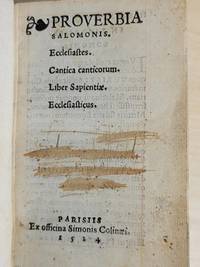
1524Biblio187<p><b><i>Colinis Simon de c. 1480– c. 1546. Proverbia Salomonis. Ecclesiastes Cantica canticorum Liber Sapientiat Ecclesiasticus.</i></b> Parisiis Ex Officina Simonis Colinaeis. 8vo; New Blank a8-i8; k8-t8; v8-x8; New Blank. 168 numbered leaves ; 12 cm. Monsieur Nocolaus Dieu with filigree emblem and OVOD DEI DEO God on back board plus gilt spine and cover. 1524. First edition. OCLC Number: 82770805; "Hieronymi praefatio in libros Salomonis."--Verso of the title page and following leaf. CribleÌ and outline initials. Reprinted by Colines in 1526 1527 1535 1539 and 1542. Red lined with type perfectly placed. Some cropping on rebind close to words but no loss of words. Fresh clean interior. Excellent condition. Early use of page numbers and chapter headings.</p><p>Simon de Colines c. 1480 – c. 1546 a Parisian printer one of the first printer type of the French Renaissance. He was active in Paris between 1520 and 1546. Colines used elegant roman and italic types and a Greek type with accents that was superior to its predecessors. His books usually were small in format and superbly crafted.</p><p>Colines was associated with the elder Henri Estienne and continued his work after his death in 1520. Colines married widow of Estienne and was in charge of the press until Estienne's son Robert I entered the business in 1526 by which time Colines had set up his own shop nearby. In 1528 he began to use italic type. Colines published many Greek and Latin classics. Although he was not a scholar himself he extended the range of the Estienne firm's learned and scientific works to include the natural sciences cosmology and astrology. He is credited with the design of italic and Greek fonts and of a roman face for St. Augustine's Sylvius 1531 from which the Garamond types were derived. In 1525 he published the notable Grandes Heures de Simon de Colines with decorations by Geoffroy Tory. Jerome Solomon aforementioned books. IVNGAR letter which joins facea gifts; Indeed the charter does not divide Christ's love ties. coa metarios the first by Hosea Amos & Zaharias Malachi also wrote that if allowed to ask for good health. Put comforts costs; notarÃa librarians sustain our mouth it is preferable that you nostru oozes character. And behold the people are different the answers to the frequent at the side of; just as if what is just to you in answer to the hungry but the residue of the given and the nature of labor or in the ACCP cuiq in addition to you to be exposed to. So long illness not completely silent about this year and I was speechless with you for your cosecraui three op intepretatione the three misle Solomon's book that the Jews Parables if the common statement that Greek proverb called Coletha Eclesiasten Latin preacher can say Sir that they are in the forbidden tongue of our Hasirim Song of Songs. panaeretos reported silij Jesus Sirach and other pseudeepigraphus who inferibitur Wisdom of Solomon. The Book of Proverbs which the Hebrews misle appeliatur.</p><p>Colines focused his publishing efforts on Greek and Latin classics – works by Aristotle Cicero Sophocles Hesiod Horace Ovid Virgil Terence Euclid Hippocrates and others – works then considered the literary backbone of the civilized world. He added to the classics publications of anti-Lutheran theological writings and works by the faculty of the University of Paris. In all Colines' press produced at least seven hundred and fifty publications. Although not a scholar himself he used his considerable familiarity with the Estienne publications and extended his own press to include writings on the natural sciences cosmology and astrology. </p><p>Colines was an important part of the development of book and reading structure in Renaissance printing. It was during this time that chapter headings subheadings running heads page numbers tables of content indices and source notes became elemental fixtures in the publication of texts.</p> Simon de Colinis hardcover
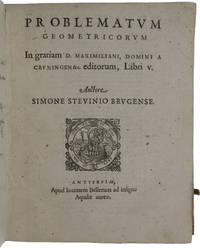
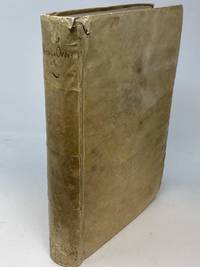
15834928Antwerp: Jean Bellère 1583. First edition. <p>First edition very rare of the principal geometrical work by Stevin "perhaps the most original man of science of the second half of the sixteenth century" Sarton; this highly original work is his only publication in Latin and his second-published work after the Tables of Interest. "He was involved in geometry algebra arithmetic pioneering a system of decimals dynamics and statics almost all branches of engineering and the theory of music" Kemp.</p>. HIS PRINCIPAL WORK IN GEOMETRY. <p>First edition very rare of the principal geometrical work by Stevin "perhaps the most original man of science of the second half of the sixteenth century" Sarton p. 242; this highly original work is his only publication in Latin and his second-published work after the Tables of Interest. "He was involved in geometry algebra arithmetic pioneering a system of decimals dynamics and statics almost all branches of engineering and the theory of music" Kemp p. 113. "Stevin unconditionally supported the Copernican system several years before Galileo and at a time when few other scientists could bring themselves to do likewise" DSB XIII: 48. "Not the least important part of Stevin's geometrical work is formed by his study of the convex semi-regular polyhedral of the first species i.e. convex polyhedra whose faces are regular polygons not all equal and similar to each other while the solid angles at the vertices are equal and similar to each other without being regular . Besides the regular polyhedra and the semi-regular polyhedra of the first species in the Problemata geometrica Stevin deals with the five so-called augmented polyhedra which are produced if on each of the faces of a regular polyhedron as base is erected a regular pyramid whose slant edges are equal to the edges of the base" Dijksterhuis pp. 43-45. "Stevin was among the first Renaissance men to study Archimedes with a certain amount of independence. In the Problemata he took some problems he had found in Archimedes' On the Sphere and Cylinder and generalized them somewhat; this gave him an opportunity to apply the methods given by Eutocius for the construction of the two mean proportionals between two lines: a : x = x : y = y : b a problem which cannot be solved by means of compass and straightedge alone" Works IIa pp. 6-7. The work is divided into five books: "Book I. Division of polygons a by a line passing through a point of the perimeter or b by a parallel to one of the sides. Book II. Application of the regula falsi to mensurations. Book III. Regular polyhedra and semi-regular polyhedra which can be inscribed in a sphere. Book IV. Construction of a solid similar to another and equal in volume to a third. Book V. Construction of a solid similar to two others and equal in volume to their sum or difference" Sarton pp. 248-249. ABPC/RBH list only two copies since Honeyman both in modern bindings.</p> <br /> <p>"Stevin's contributions to geometry illustrate the fundamental position of Euclid's Elements in the work of sixteenth-century mathematicians. The Elements were their main source of reference to which they constantly returned for knowledge method and inspiration. The typically 'Greek' reasoning of Euclid which was also basic to the demonstrations of Apollonius and Archimedes geometrical to the core was an essential element in the mathematical thinking of sixteenth-century Europe.</p> <br /> <p>"This Greek influence was gradually undermined by the adaptation of the arithmetical-algebraic methods traditional in the Orient which reached Europe almost entirely through authors originally writing in the Arabic language. Stevin's Tables of Interest present a good example of how the practice of life itself compelled mathematicians to become proficient in these methods. On a higher theoretical level we see the same influence at work in Stevin's Arithmétique. Even the Problemata Geometrica though fundamentally a series of papers based on the 'Greek' approach shows the influence of the Arabic tradition in several places.</p> <br /> <p>"Several printed editions of the Elements existed in Stevin's days. One of Stevin's favourites was the Latin edition by Clavius the Jesuit astronomer at the Vatican. It was a thorough piece of work first published in 1574 consisting of two volumes in a rather handy quarto size. It had the advantage of introducing the reader to related work by other mathematicians explained in Scholia to the text. Other books used by Stevin in preparing his Problemata were Dürer's Underweysung of 1525 and Commandinus' Latin edition of the principal works of Archimedes of 1558.</p> <br /> <p>"The Problemata consists of five books each with a topic of its own. The first book after an introduction on proportions of lines solves problems concerning the division of polygons into parts of a given ratio. The second book contains the application of the so-called regula falsi to certain constructions or in other words shows how certain constructions can be performed with the aid of similarity of figures. In the third book we find Stevin's studies on regular and semi-regular polyhedra. The fourth book deals with the construction of a polyhedron of a given volume similar to a given polyhedron the fifth book with the construction of a polyhedron similar to two similar polyhedra and equal to either their sum or their difference. While the first and second books are based on Euclid the third is based on Dürer; the last two are the result of Stevin's study of Archimedes.</p> <br /> <p>"The first book opens with a classification of ratios and proportions based on the fifth book of Euclid's Elements. This classification in its attempt to give special names to particular proportions strikes us as clumsy and pedantic but Stevin merely followed an ancient tradition. All this labelling was fundamentally due to a serious desire to understand Euclid though it was encumbered with relics from the works of medieval Latinists .</p> <br /> <p>"The next part consists of the application of this theory of proportions to the problem of the division of figures into parts of a given ratio. Stevin found an example of this problem in an appendix by Clavius to the 6th book of the Elements where it is shown how to divide a triangle into two parts in a given ratio by a line passing through a point on a side. This was not however an original idea of Clavius. As he sets forth himself in the Prolegomena to his translation he found the problem in a book published by Commandinus and John Dee in 1570 which he says though ascribed to a certain Mahomed of Bagdad may have been Euclid's book on Divisions. Stevin who did not know this book took Clavius' problem and discussed aspects of it in his first set of three problems. Then he himself added five more problems which he thought to be novel. All eight problems deal with the division of polygons in a given ratio either by a line through a vertex or by a line through a point on a side or by a line parallel to a side . Stevin's work was excellent enough to be preferred by Clavius who in 1604 praised his treatment of the division of figures above the others .</p> <br /> <p>"The second book of the Problemata contains problems involving the so-called 'regula falsi' the rule of the false supposition. It is a device to solve problems leading to the linear equation ax = b by first substituting for x an arbitrary number x = x0; if ax0 = b0 then x : x0 = b : b0and x is found by means of proportion . The device also functions for problems which lead to an equation of the form ax b = c . In the Problemata Stevin introduces this 'regula falsi' in accordance with his desire to bring about as close a relation as possible between arithmetical and geometrical proportions. Applying the 'regula falsi' to problems in geometry he has to consider proportions and this amounts to the solution of certain geometrical problems by means of similarity. If for instance Ex. 11 we have to construct a square when the difference between diagonal and side is given we start with any square this is the false supposition determine for this square the difference between diagonal and side and then find the side of the required square by means of a proportion. All that Stevin now requires is Euclid's theory of proportions which he finds in Books V and VI of the Elements. </p> <br /> <p>"The third book is by far the most interesting part of the Problemata. It contains a theory not only of the regular solids but also of certain semi-regular solids and of polyhedra Stevin calls 'augmented regular solids'. All Stevin had to go by was Euclid's Elements Book XIII the so-called XIVth XVth and XVIth books which Clavius also had translated and Dürer's Underweysung der Rechnung mit dem Zirckel und Richtscheyt of 1525. From Euclid-Clavius Stevin obtained his information on the five regular solids from Dürer the method of obtaining semi-regular solids as well as the regular ones by paper-folding. To understand these different achievements we shall denote a polyhedron with m faces which are regular polygons of a sides n faces which are regular polygons of b sides etc. by ma nb . Then the five regular solids are the tetrahedron 43 the cube 64 octahedron 83 the dodecahedron 125 and the icosahedron 203. A semi-regular solid or as Stevin calls it a 'truncated regular solid' is defined Def. 11 as a solid inscribed in a sphere of which all the solid angles are equal of which the faces are regular polygons which are not all congruent and of which all the edges are equal. Dürer had the models of seven such solids: 43 46 83 68 64 83 86 64 184 83 64 326 68 86 124. Dürer had two more models but one of these 64 123 has some isosceles i.e. not regular triangles while the other 612 323 as Stevin showed is impossible as a closed polyhedron.</p> <br /> <p>"Stevin reconstructed these solids not only from plane diagrams by folding but also by finding the method by which these solids are generated by cutting off truncating parts of the regular solids. He found three types not described by Dürer . the additional solids 203 125 1210 203 and 206 125. He was one of the first if not the first in Renaissance days to find all these ten .</p> <br /> <p>"The third book of the Problemata also contains a description of what Stevin called 'augmented regular solids'. These are polyhedra obtained by placing on top of each face of a regular polyhedron as base a pyramid with equal edges. Stevin lists all five of them. He was led to the consideration of these solids by a discovery of Frans Cophart leader of the Collegium Musicum at Leiden. Cophart had taken a cube and cut out twelve tetrahedra each having the end points of an edge and the midpoints of the faces through this edge as vertices. The solid thus obtained by 'faceting' the cube is what is now called the stella octangula; it is bounded by twenty-four congruent equilateral triangles. Cophart had claimed it as a sixth regular solid.</p> <br /> <p>"Stevin while admiring the discovery had to deny this claim. He pointed out that the vertices of Cophart's solid do not all lie on one sphere but are distributed on two spheres six on one sphere and eight on a concentric one. At the same time he discovered another construction of the solid by starting not from a cube and then faceting it but from an octahedron and then 'augmenting' it by placing a regular tetrahedron on each face with this face as base. He now saw that this procedure could be applied to all regular bodies and in this way he obtained four new polyhedra.</p> <br /> <p>"Of all these five solids of Stevin we only call the stella octangula a regular star-polyhedron. The reason is that regular star-polyhedra are obtained from the regular polyhedra by the process of 'stellating' i.e. by producing the planes of the faces and allowing non-adjacent faces to intersect in such a way that the faces of the new solid are regular star-polygons polygons obtained by allowing non-adjacent sides of regular polygons to intersect. This procedure does not yield a new body in the case of the regular tetrahedron and the cube but gives us the stella octangula in the case of the regular octahedron. We also obtain regular star-polyhedra by stellating the regular dodecahedron and icosahedron; for each of these solids we obtain two possible star-polyhedra. But whereas these four bodies are single the stella octangula is found to be the intersection of two regular tetrahedra. We may thus speak of nine regular solids: five ordinary Platonic and four stellated ones .</p> <br /> <p>"The fourth and fifth books of the Problemata Geometrica present Stevin to us as a student of Archimedes. The editio princeps of Archimedes' works had appeared at Basle in 1544; it contained not only the original Greek text and a Latin translation but also the precious commentaries of Eutocius again both in Greek and in Latin. Another useful though limited edition was the Latin translation of five of Archimedes' treatises with Eutocius' commentary on one of them prepared by Commandinus and published in 1558. Stevin quotes Commandinus' edition but he must also have known the editio princeps since he shows himself to be acquainted with material which is to be found in the publication of 1544 but not in that of 1558.</p> <br /> <p>"Archimedes in the book On the Sphere and Cylinder the book in which he determines the area and the volume of the sphere solves some problems which involve the finding of the two mean proportionals between two given lines. An example is formed by the problem: 'given two spherical segments to find a third segment similar to the one and having its volume equal to that of the other'; another example consists in the problem of finding a sphere equal in volume to a given cone or cylinder . Moreover in Commandinus' edition though it does not contain the book On the Sphere and Cylinder with its commentaries there are several problems which belong to the same group. The first is the problem: 'Given any two cones or cylinders to find a third cone or cylinder equal in volume to the first and similar to the second' .</p> <br /> <p>"Stevin in his fourth book casts the problem into its general form: 'Given two solids S1 S2 to find a third solid equal to S1 and similar to S2 . Stevin uses the general term 'solid' then makes use of the theorem that any solid can be changed into a cone of equal volume; he actually applies the theorem to . polyhedra circular cones cylinders and to segments of cones. Stevin shows for instance how a spherical segment can be changed into a cone with equal base .</p> <br /> <p>"Stevin's procedure is as follows: a he changes S1 into a circular cone C1 and S2 into a circular cone C2; b he then changes C1 into a cone C1' of the same altitude as C2; c he then constructs a cone C3 similar to C2 and equal to C1'; d he then changes C3 into an equal solid S reversing the process by which S was changed into C2. The steps a b d only involve ordinary proportions step c involves the construction of two mean proportionals; for this purpose Stevin mentions Hero's construction on which Eutocius reports.</p> <br /> <p>". in the last book of the Problemata Stevin solved another problem leading to two mean proportionals between two lines which appears to be a new one. Given two similar solids S1 and S2S1 > S2 Stevin asked to find a solid similar to S1 and S2 and equal to a the sum of b the difference between S1 and S2. The problem was again solved by reducing the solids to circular cones" Works IIa pp. 121-130.</p> <br /> <p>The Problematum geometricorum was not included in Stevin's collected works Hypomnemata mathematica 1605 of which the second volume was devoted to geometry. "This work is different from the Problemata geometrica and inferior to it; it is also a collection of geometrical problems but it is not arranged as logically as the former; it was chiefly made to complete the Prince's geometrical training" Sarton p. 261.</p> <br /> <p>Adams S1858. Crone et al. eds. The Principal Works of Simon Stevin five vols. in six 1955-66; Dijksterhuis Simon Stevin Science in the Netherlands around 1600 1970; Kemp The Science of Art 1990; Sarton 'Simon Stevin of Bruges 1548-1620' Isis 21 1934 pp. 241-303.</p> <br/> <br/> 4to 200 x 157 mm pp. 4 5-118 1 with woodcut printer's device on title numerous woodcut diagrams in text and errata on recto of last leaf. Contemporary limp vellum with remains of ties hole in upper part of spine probably due to insect damage f. I2 with several tiny tears in gutter without loss. A very good unrestored copy. Jean Bellère unknown
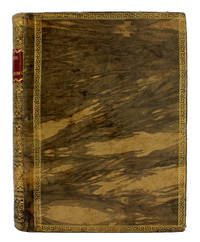
15876397Alcalá de Henares: Juan Gracián 1587. First Edition — Primera edición. Alcalá de Henares Juan Gracián 1587. En 4º. 10 105 i.e.103 hojas incluyendo 2 hojas de errata licencia y tasa impresas aparte. Portada con grabado en madera. Encuadernación de principios del siglo XIX en pasta lomera cuajada de dorados y tejuelo en marroquén. Contiene las 2 hojas de errata licencia y tasa no descritas por Palau Catalina GarcÃa MartÃn Abad ni ninguna otra bibliografÃa consultada. Tampoco aparecen registradas estas dos hojas en el Catálogo Colectivo del Patromonio Bibliográfico Español. Primera edición de una de las obras más importantes dedicadas a la lógica que tenemos en español; obra pionera no en vano dice de ella Palau: "Este libro es un caudal de doctrina profunda y un modelo de claridad". A pesar de que en el tÃtulo se indica "Primera parte" es todo lo publicado. Su segunda parte que trataba sobre la fisiologÃa o filosofÃa natural asà como una tercera parte dedicada a la filosofÃa moral que ya se anunciaban en esta primera quedó sin imprimir. En la Biblioteca Real se conserva un manuscrito Ms. II/1158 que Mathiela Morreale supone autógrafo y contiene de hecho algunas correcciones y sugerencias sobre diagramas y tablas propias del autor. A partir de la segunda mitad del siglo XVI surge un interés por el estudio y discusión de temas de filosofÃa y lógica en lengua vernácula. Fue quizá Alessandro Piccolomini uno de los primeros autores en escribir un tratado de lógica publicado en italiano en 1551 con el tÃtulo "L'instrumento della filosofia". Este comienzo de discutir y transmitir la filosofÃa en lengua vulgar no fue fácil. Al igual que Piccolomini Simón Abril se tuvo que enfrentar a quienes despreciaban y tenÃan en poco las ciencias si se hacÃan en lenguas comunes. No dudó en exigir nuestro autor a las autoridades competentes que llevasen a cabo las reformas necesarias para la difusión de la filosofÃa en España propuesta que incluÃa la difusión del conocimiento filosófico más allá de las aulas universitarias. Donde mejor se recogen sus teorÃas educativas es en "Apuntamentos de cómo se deben reformar las doctrinas y la manera de enseñarlas" 1589 que dirigió a Felipe II. "Lo que procuramos es la propiedad y claridad del lenguaje. especialmente siendo esto lo primero que acerca de esta materia 'la lógica' nace en esta lengua" Simón Abril p.251 Pedro Simón Abril manchego nacido en Alcaraz de La Sierra Albacete 1530-1595 fue procesado por la Universidad de Huesca por enseñar allà las disciplinas de Artes y FilosofÃa lo que era entonces privilegio único de esa institución académica. Como el maestro se negó a suspender sus enseñanzas fue excomulgado desde los púlpitos y tuvo que ceder finalmente y reducir el estudio a la disciplina de Gramática. Este ejemplo muestra la oposición a su labor que desgraciadamente no tuvo continuidad inmediata ya que sus textos no consiguieron modificar el modo en que se enseñaba y difundÃa la filosofÃa cientÃfica. Para muchos se trata de un personaje imprescindible del Renacimiento y del humanismo español considerado como el primer divulgador y traductor de diversas obras clásicas además de un gran renovador del teatro de su época. Juan Antonio Pellicer a finales del siglo XVIII lo tenÃa como el mejor traductor español antiguo. Entre sus traducciones más importantes nos encontramos con textos de Platón Terencio Esopo Cicerón y Aristóteles entre otros. Fue también profesor de griego y latÃn en la Universidad de Zaragoza donde alcanzó la cátedra y posteriormente de poesÃa en Tudela. La tercera y última parte del libro acaso la más interesante versa sobre la lógica dedicada a la analÃtica donde se dan ciertas pautas tocantes a los negocios. El autor escribió además alguna obra de economÃa: Manuel Colmeiro en su célebre <em>Biblioteca de los Economistas Españoles</em> recoge la cita de Nicolás Antonio en su <em>Biblioteca Hispana</em> de un manuscrito con el tÃtulo <em>Libro de la tasa del pan y del modo que se debe tener en hacella</em>. Sus estudios e investigaciones relativos a la lógica quedan muy bien expuestos al ver como se plantea su actitud hacia dos visiones enfrentadas del mundo los sistemas ptolemaico y copernicano: "Ponen todos los astrólogos la tierra en el centro del mundo y el sol en el cuarto cielo y los demás cielos por su orden y hacen sus juicios de conjunciones oposiciones eclipses y otras cosas semejantes y salvan las apariencias y salen los juicios verdaderos. Viene Nicolao Copérnico y trueca la suerte y hace el sol centro del mundo y la tierra súbela al cuarto cielo y hácela movible y salva las apariencias y conforme a este presupuesto hace los mismos juicios y sálenle bien". Como vemos Pedro Simón no rechaza la teorÃa heliocéntrica de Copérnico por motivos religiosos ni filosóficos le parece tan válida como la teorÃa ptolemaica porque ambas comparten "condiciones esenciales de estar en conformidad con los sentidos y observar las exigencias del razonamiento legÃtimo". Autor prolijo este enorme humanista español merecerÃa un plan de publicación de su obras completas especialmente aquellos tÃtulos que aun no han sido publicados. Simón Abril nos ha dejado según he podido recopilar 12 obras impresas y más de 30 manuscritos repartidos por las bibliotecas públicas españolas. Posiblemente haya sido Luis de Cañigral Cortés quien más y mejor ha estudiado la obra del autor junto a su predecesora Margherita Morreale de Castro. En el siglo XIX se publicó una "muy correcta segunda edición" de esta obra en la colección "La verdadera ciencia Española. Biblioteca Económica" Vol. LXVIII Barcelona 1886. Muy buen ejemplar en perfecta condición. Nuestro ejemplar contiene 2 hojas de erratas licencia y tasa no descritas en ninguna bibliografÃa. Curiosamente el Catálogo Colectivo del Patrimonio Bibliográfico Español tampoco menciona la existencia de estas dos hojas. Hace unos años revisé un ejemplar defectuoso de varias hojas ofrecido en Christie's el 20 de marzo de 2013 lote 37 que sin embargo también contenÃa estas dos hojas. El ejemplar digitalizado por la Biblioteca Virtual del Patrimonio Bibliográfico no las contiene ni los ejemplares minuciosamente descritos por Catalina GarcÃa y MartÃn Abad. Por tanto estas hojas sin signatura debieron imprimirse aparte algo más tarde y fueron añadidas sólo en unos pocos ejemplares. En nuestro ejemplar que está intonso se encuentran encuadrenadas entre los dos pliegos de preliminares. Juan Gracián unknown
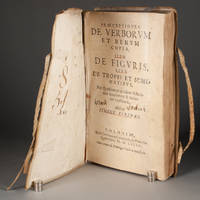
158200370<p>BOOK FOR PEOPLE WHO CAN'T WRITE GOOD --- 16 319 1 p. 8vo a8 A-V8 164 x 103 mm --- First edition of the Dutch Catholic teacher's last work a students' guide to Latin composition. By <em>copia</em> Verepaeus here means not <em>abundance</em> but <em>ability</em> what he calls the <em>facultas</em> to properly use words and figures of speech p. 17-18. In subsequent years <em>Praeceptiones de verborum et rerum copia</em> and <em>Praeceptiones de figuris</em> would often appear separately. Editions stretch into the 18th century demonstrating an enduring utility. Includes a verse encomium by Aegidius Vlieger. ¶ Written in a catechetical question-and-answer format the author covers all the elements of good composition. He does address some grammar and the parts of speech but generally ventures beyond these in pursuit of more advanced rhetorical topics. "What is the use of metaphor" p. 166-168 for example and "What is synecdoche" p. 173-174. He discusses irony too providing classical examples and addressing its uses p. 192: "vituperation is always more agreeable"; <em>vituperatio semper venustior est</em>. He briefly touches on sarcasm not that we care p. 193. Allegory onomatopoeia hyperbole—all your favorite rhetorical devices find treatment here. Like many such manuals of the day Verepaeus underscores the value of good composition in the critical endless task of correspondence p. 3 but also in verse composition p. 4 and speaking p. 5. It's difficult to overstate the importance of rhetoric in humanistic early modern Europe—"the art of arts and science of sciences" according to Anthony Grafton. And there seems to have been no shortage of teachers willing to sell their secrets to unleashing rhetorical power. ¶ Scarce in the trade this the only copy we find in auction records. --- PROVENANCE: Early ownership signature of one Carmelus Lentinus on title page. ¶ A little underlining and a handful of early <em>nota bene</em> marginalia both confined to the first thirty pages. --- CONDITION: Early limp parchment preserving the original upper pair of tawed ties but only remnants of the lower. Title and date in early ink on the front cover. ¶ Scattered light foxing; final leaf twice torn nearly across the width through the text and a couple square inches of loss at its foot no textual loss. Parchment soiled and torn at the head of the spine. ¶ A nice solid copy. --- REFERENCES: VD16 V 613 ¶ Peter Mack <em>A History of Renaissance Rhetoric 1380-1620</em> Oxford University 2011 p. 224 "Verepaeus is extremely thorough in his treatment of the tropes making many subdivisions particularly in metaphor metonymy and synecdoche"; Anthony Grafton <em>Bring Out Your Dead </em>Harvard University 2001 p. 168</p> Gerwin Calenius and the Heirs of Johann Quentel
152566040Paris:: Simon de Colines 1525. old full calf; gilt spine. A few old ink notes to the title page; rubbed at corners and extremities. 16mo. Trad. S. Hieronymus. Renouard ICP III 770. Simon de Colines, unknown
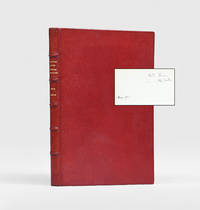
1519187464London: The Zionist 1915-1916. Presented by the drafter of the Balfour Declaration Ten Zionist pamphlets finely bound for presentation by the leading British Zionist Leon Simon inscribed by him to a family member "Nellie Simon from one of the Editors 1 Aug. 1916" - the recipient was probably his wife Ellen. Simon has also handwritten a contents page. Simon 1881-1965 was one of the most prominent voices in the Zionist movement in the early decades of the 20th century and edited the publications of The Zionist which published these pamphlets three of which are authored by him. He is best remembered for his role in drafting the Balfour Declaration - his original draft sold for $884000 in 2005. Comprising all first editions: i SIMON Leon. Zionism and the Jewish Problem. 1916; ii BRENTWICH Norman. Zionism and Jewish Culture. 1915; iii LANDMAN Samuel. History of Zionism. 1915; iv SACHER Harry. A Hebrew University for Jerusalem. 1915; v SACHER Harry. Zionism and the State. 1915; vi SPIERS Frederick Solomon. Zionism and the Jewish Religion. 1915; vii MILLER E. Palestine and the Hebrew Revival. 1915; viii SIMON Leon. Hebrew Education in Palestine. 1916; ix SIMON Leon. Jewish Colonisation and Enterprise in Palestine. 1916; x LANDMAN Samuel. Zionism: Its Organisation and Institutions. 1916. 10 works bound in 1 vol. octavo 202 x 132 mm. Contemporary red morocco by Sangorski & Sutcliffe spine lettered in gilt pink endpapers gilt edges. In fine condition. unknown
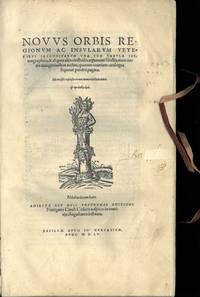
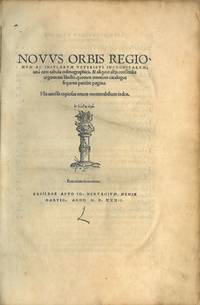
1532WRCAM41962Basel 1532. 48584 i.e. 5862pp. Lacks the map. Folio. Antique-style gilt calf gilt spine gilt with raised bands. Slight worming to first hundred leaves mostly affecting margins. Contemporary annotations throughout volume. Very good. One of the most important collections of New World material issued up to the time. Grynaeus is often given credit for this volume somewhat unfairly since the majority of the work was compiled by John Huttich. Describes the voyages of Columbus and Vespucci and prints various accounts of Portuguese discoveries in Brazil and the East accounts of Marco Polo and much of the material gathered by Peter Martyr. There are extensive accounts of almost all of the European voyages to the larger world. EUROPEAN AMERICANA 532/17. SABIN 34100. HARRISSE 171. JCB 3I:104. STREIT I:28. MEDINA BHA 46n. hardcover books
155574799Basel 1555. Folio. 1500-talls mykt helpergamentbind med nyere snorer i brunt skinn. 38 2 blanke 12 677 egentlig 577 2 blanke 1 2 blanke s. Med to treskårne illustrasjoner og tallrike detaljerte treskårne initialer. Io. Hervagium Latin. <br/><br/><em>Klipp i tittelbladet. Notater i eldre hånd. Flere feilpagineringer men teksten er komplettt. Fuktskjolder på enkelte sider. Viktig bok om reiser til Amerika. SJEKK BRUNET OG SABIN. </em> unknown
153272482Basel 1532. Folio. Eldre marmorert bind med “falsk†pergamentrygg. 48 584 2 s. Med to treskÃ¥rne illustrasjoner og tallrike treskÃ¥rne initialer. Folio. Older marbled binding with “false†vellum spine. 48 584 2 pp. Two woodcut illustrations numerous woodcut initials. Io. Hervagium Latin. <br/><br/><em>“This is the first edition of a work usually known as the collection of Grynæus a learned professor at Basle who wrote the preface. It was compiled by John Huttich and contains among other important matter relating to America the first three voyages of Columbus Pinzon’s voyage fourth voyages of Vespucius and an extract of the fourth decade of Peter Martyrâ€. Kartet mangler slik det som oftest gjør. Map is lacking- as usual. </em> hardcover
153739475Basel: Johannes Hervagen 1537. Folio. 12 1/2 x 8 inches. Augmented edition. a-d4 a-z6 A-Z6 Aa-Dd6 Ee2. 24 1-599 1. 624 pp. Lacking the woodcut world map attributed to Hans Holbein the Younger and Sebastian Münster. Woodcut printer's devices on title and verso of last leaf historiated initials head and tail pieces woodcut illustrations on pp. 127-29. Title Contents Dedication Grynaeus's Text Index Texts. Contemporary ink manuscript annotations in margins. Contemporary full limp vellum with brown ink manuscript title on spine and remanants of two pairs of leather ties with pill-shaped watermark on laid paper a blue cloth clamshell box with gilt-lettered leather titling-piece on spine<br/> <br/> A fine example of the most influential collection of early sixteenth-century travel literature.<br/> <br/> Besides the three voyages of Columbus the present work includes descriptions of those of Petrus Alonzo and Pinzo three of Vespucci's four voyages and Peter Martyr's De Insulis Nuper Inventis. According to Borba the present edition is the first to contain the letter of Maximilian of Transylvania reporting the news of Magellan's voyage p. 585. This augmented edition holds the second and third letters of Cortes and selected letters of Juan Zumarraga the first Archbishop of Mexico. Though the account of Magellan's voyage was originally published in 1522 in a 16-leaf ephemeral edition of a letter addressed to Charles V its appearance in Grynaeus's collection of voyages marks the first time his landmark discoveries appear in an historical context side-by-side with those of Columbus Vespucci and the Portuguese navigators.<br/> <br/> Adams G1337. Alden 537/14. Borba I. Burmeister 62. Church 123. Harrisse 223. Sabin 34103. European Americana 537/14. Johannes Hervagen unknown
153281628Basel: Basileae Apud Io. Hervagium Mense Martio 1532. First Edition. Leather-bound Vellum. Good Plus. Folio.IN LATIN. No Map. Vellum.Text 30.5 x 20 cm. Manuscript title to spine. Vellum stained as per usual and apart from a very small tear near top of spine is in lovely and solid condition. Lacks the rarely seen woodcut map of the world "Typus Cosmographicus Universalis" and lacks Jehan Petit's printer's device to title page but this device bust on a pedestal is present on verso of last leaf. Very light toning throughout and darkening and tidelines to first 170 or so pages but restricted to very wide margins not text. Additional tidelines at bottom to final 30 pages and again with no effect upon the clarity of the text. Pages are supple with a nice easy-to-read typeface.<br /> <br /> Simon Grynaeus wrote the preface "Declaratio" but John Huttich alone compiled this massive and invaluable historical work. Later editions dropped this preface because it contained text critical of The Inquisition.<br /> <br /> One title page variant noted in WorldCat. Index complete. Collates complete but as usual skips 578- 581 and 584 585 584. Final leaf "Index Ternionum" and on the verso Jehan Petit's printer's device of a bust on a pedestal. In-text woodcuts DropCaps.<br /> <br /> FIRST EDITION of one of the earliest accounts of exploration in the Americas -- a very early compendium of travels and explorations. The most complete edition of this important and rare collection of 15th and 16th century voyages. The work contains accounts of the voyages of Cadamosto the three voyages of Columbus Nino Pinzon Vespucius Cabral Marco Polo and part of the Fourth Decade i.s. Chapter of Peter Martyr d'Anghiera an Italian historian in the employ of Spain who wrote the first accounts of explorations in Central and South America. <br /> <br /> Sabin 34100. As for the absence of the map in this copy Harrisse in his Bibliotheca Americana Vetustissima wrote: ".Notwithstanding the statement in Mr. Grenville's Catalogue respecting the frequent absence of the map "there is no doubt but that a map does belong to the work.Mr. Muller has reproduced ten copies in exact facsimile" Harrisse remarks: "Whether they were the maps really belonging to the work and described by Munster we are unable to say as no two copies of this edition had the same. Basileae Apud Io. Hervagium, Mense Martio unknown
15946251Geneva: Jacobus Stoer 1594. First edition. 8vo. 1249125pp. Double column text. Indices. Title within an elaborate woodcut border and with a woodcut publisher's device. Early 17th c. vellum hand lettered spine. In recent times a second work as indicated on spine and which was of similar length was removed from this binding but to maintain its integrity blank leaves now fill in the space at back. Goulart's 1543-1628 collection of excerpts from classical and contemporary writers which he uses to elucidate alphabetically arranged Latin terms. Adams G909. Jacobus Stoer hardcover books
1524V1078Frankfurt/Leipzig (Insel) 1993 (= it 1524). 8°, illustrierte Originalbroschur, 205 S., Abbildungen
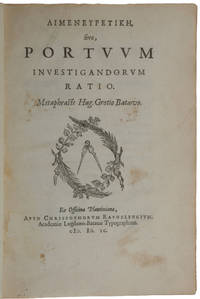
15995421Leiden: Ex officina Plantiniana apud Christophorum Raphelengium. Academiae Lugduno-Batavae Typographum 1599. First edition. <p>First Latin edition extremely rare of Stevin's highly important work on the determination of position at sea using magnetic variation; since latitude was simply measured this was tantamount to the determination of longitude. Originally published in Dutch as De Havenvinding "the Latin translation appeared almost simultaneously with the original Dutch version" Crone et al. The Principal Works of Simon Stevin Vol. III. No copy of the Dutch or Latin editions has sold at auction in the last 50 years.</p>. <p>DETERMINING LONGITUDE IN THE RENAISSANCE</p> . <p>First Latin edition extremely rare of Stevin's highly important work on the determination of position at sea using the magnetic variation or declination of the compass needle the angle between magnetic north and true north; since latitude was simply measured this was tantamount to the determination of longitude. Originally published in Dutch as De Havenvinding "the Latin translation appeared almost simultaneously with the original Dutch version" Crone et al. p. 375; English and French translations followed later in the same year. "In a seafaring nation like the Dutch republic matters of navigation were of course of great importance. In addition to his astronomical works Stevin . approached the subject of determining the longitude of a ship a problem that was not fully solved until the nineteenth century. Several previous authors had suggested that longitude might be determined by measuring the deviation of the magnetic needle from the astronomical meridian a suggestion based on the assumption that the earth-wide distribution of terrestrial magnetism was known. Since the determination of latitude was well known such a measurement would allow the sailor to chart longitudinal position against the latitudinal circle. Stevin in his booklet gave a clear explanation of this method; he differed from Petrus Plancius and Mercator in that he did not rely upon a priori conceptions of the way in which geomagnetic deviation depends upon geographical position. Although he was willing to offer a conjecture about this dependence Stevin insisted on the necessity of collecting actual measurements from all possible sources and urged the establishment of an empirical worldwide survey. His method was sound although as data began to accumulate it became clear that the magnetic elements were subject to secular variation. The problem of determining longitude was at last solved more simply by the invention of the ship's chronometer" DSB. The Latin translation of De Havenvinding is important as the first edition to be published in a language understood throughout Europe and hence is likely to have been much more widely read that the Dutch original. It also contains a fascinating dedication by Grotius not of course present in the Dutch edition or in the English and French editions. According to ABPC/RBH in the last 50 years no copy of the Dutch or Latin editions has sold at auction; they list just the Macclesfield copy of the French edition and the Streeter/Boies-Penrose copy of the English edition sold Christie's New York April 16 2007 $36000. OCLC lists no copies in US.</p> <br /> <p>"By the end of the sixteenth century the Dutch Republic had become a major sea power . It was thus understandable that the authorities in the Dutch Republic - Prince Maurice 1567-1625 and the States general - were greatly interested in a safe and speedy method of maritime travel. Maurice showed considerable enthusiasm for nautical affairs and it is likely that he asked Stevin to prepare a study of the subject .</p> <br /> <p>"Stevin explains what he intends right at the start of the book. 'It is known' he says 'that for a long time past principally since the great voyages to the Indies and America began a means has been sought by which the navigator might know at sea the longitude of the place where his ship is at the moment in order thus to get to the harbours to which he wishes to go but that hitherto it has not been possible to arrive at such accurate knowledge of the longitude. For some people hoping to find it through the variation of the compass ascribed a pole to the said variation calling it magnetic pole but it is found upon further experience that these variations do not obey a pole. Nevertheless the search for this has furnished a means for reaching a desired harbor even though the true longitudes of both the harbor and the ship are unknown.' In navigation the 'variation of the compass' is understood as the angle between the geographic and magnetic meridian. Gerardus Mercator 1512-94 and Pieter Plaetevoet 1552-1622 known as Plancius a Dranouter-born pastor of the Reformed Church in Amsterdam had written on the phenomenon of magnetic variation before Stevin and he had tried to make use of it in practical navigation and in attempts at determining longitude. Stevin's aim was clearly much more modest: he sought to enable the seafarer to reach a given harbor without having recourse to longitude.</p> <br /> <p>"Moreover Stevin was not convinced of the existence of a magnetic pole conceived as a rock located somewhere in the Arctic. In De Havenvinding he makes no attempt to explain the variation of the compass needle or terrestrial magnetism in general as his predecessors Plancius and Mercator had done. But he did make a thorough study of the observational data Plancius had collected and expanded on them.</p> <br /> <p>"Plancius assumed that there were four meridians on earth where the variation was zero: the prime meridian which at that time passed over the island of Corvo in the Azores and the meridians of 60° 160° and 260° east longitude. In each of the four lunes into which these meridians divide the earth's surface the needle is supposed to deviate from magnetic north in the same way. That is northeasterly in the lunes I 0-60° and III 160-260V and northwesterly in the lunes II 60-160° and IV 260-360°. The northeasterly variation would increase in lune I from 0° to 30° eastern longitude and decrease from 30° to 60° and so on. Stevin concurred with Plancius as regards lunes I and II for which there existed sufficient observational data but in place of four agonic lines meridians of zero variation he introduced six at 0° 60° 160° 180° 240° and 340° and cautiously presented his system as conjecture or supposition. Although Stevin criticized certain aspects of Plancius's work and used his method in a more restrained form he made no attempt to hide his admiration for his predecessor's data gathering 'listing in a table the variations that have already been observed which the learned geographer Mr Petrus Plancius has collected by protracted labour and not without great expense from different corners of the earth both far and near so that if navigators shall find land and harbours generally in this way as some in particular have already found them the said Plancius may be considered one of the principal causes of this.'</p> <br /> <p>"Stevin advocated the use of the tables of variation to find harbours or even to enable ships belonging to the same fleet to regroup at a specific point. He interpreted the proposition in an appendix to De Havenvinding thus: 'Since the given variation and latitude in combination indicate a definite point both at sea and on the land it follows from this that it is possible for ships to find each other at a given point at sea far from the land. This is useful among other things to help the ships of a fleet to reassemble after a storm. By this means it is also possible to fix a rendezvous where ships coming from different directions may meet at a predetermined time.'</p> <br /> <p>"If this technique was to be truly reliable the collection of compass variations at as many positions in the world as possible was essential. Prince Maurice ordered that navigators should henceforth 'find out actually and very carefully the variations of the needle from the north' and faithfully report the results of their observations to the Admiralty so practical tests could be made. Stevin studied the various methods of observing variations finally recommending a way of measuring them in De Havenvinding. In a section entitled 'How the True North and the Variation are Found' he explains how observations can best be taken. The navigator should use 'an azimuthal quadrant the horizontal plane of which notwithstanding the movement of the ship always remains level.' In the margin of the page Stevin provides a Latin translation for the description of this instrument Quadrantem Azimuthalium seu verticulu cuius planu horizontale - an azimuthal quadrant that turns about a vertical axis over a horizontal graduated circle. This instrument was built by Reynier Pietersz also known as Reynier Pieter van Twisch. An inhabitant of Hoorn in the province of North Holland Reynier Pietersz worked for the Hoorn ship owners. In 1598 he applied to the states of Holland and Westfresia for a subsidy for the building of two instruments. One of these was no doubt his azimuthal quadrant. On 13 March 1598 the States appointed a committee consisting of Scaliger Snellius Van Ceulen and Stevin together with the deputies of Amsterdam Rotterdam Hoorn and Enkhuizen to examine and test the instruments and report on them. The committee's conclusions are not known but the fact that Stevin recommended the instrument and explained how it should be used suggests that the committee deemed Reynier Pietersz's device to be useful and usable. Certain sources even describe it as the 'Golden Compass'" Devreese & Berghe pp. 96-99.</p> <br /> <p>The azimuthal quadrant is shown in the full-page illustration on p. 19. A vertical quadrant turns about a vertical axis over a graduated circle. At a certain instant before noon the alidade is directed towards the Sun and the angle between the plane of the quadrant and the needle is read say a°. After noon the measurement is repeated when the Sun has the same altitude again. If the angle is now b° the declination is a - b/2 easterly if a > b westerly if a < b. In this diagram H is a weight used for stabilization. Tables of the latitude longitude and declination at various locations on the globe are given on pp. 6 & 7.</p> <br /> <p>The 'Privilege' with which the work opens states that the States General of the United Netherlands by letters patent of 18 March 1599 granted to Christoffel van Raphelingen 1566-1600 printer at Leiden and a grandson of the famous Christoffel Plantijn Christophe Plantin at Antwerp for a period of six years the sole right of printing publishing and selling this book. We also read there that Van Raphelingen intended to publish the treatise not only in Dutch but in Latin French and other languages but Van Raphelingen actually brought out only a Latin and a French edition in addition to the Dutch; the English translation The Haven-finding Art or the way to find any Haven or place at sea by the Latitude and Variation by the great mathematician and nautical expert Edward Wright was printed and published in London also in 1599. The Latin edition has a dedicatory epistle dated 1 April 1599 and therefore probably appeared within days of the Dutch edition. The English translation had a dedicatory epistle by Wright dated 23 August 1599; it therefore probably appeared four or five months after the Dutch and Latin editions. The French translation Le Trouve-Port contains no dedicatory epistle no preface to the reader nor any other data from which the exact date of its publication might be inferred; even the identity of the translator is unknown. The Dutch edition was reprinted in the Wisconstighe gedachtenissen and the Latin edition in the Hypomnemata mathematica both published in 1605-8; the French edition was included in Les Oeuvres Mathématiques published by Albert Girard in 1634. The book's rapid translation into several languages indicates just how great was the interest it aroused in seafaring nations. De Havenvinding is the only work by Stevin not to include his name as author on the title page not even in the original Dutch publication. However his authorship is mentioned in Grotius's Latin translation and in the English version by Wright.</p> <br /> <p>"The jurist Hugo Grotius 1583-1645 a figure famed in world history at the age of 16 years had translated The Haven-Finding Art faithfully into elegant Latin . Grotius wrote for the booklet a dedicatory epistle addressed to the Doge the Senate and the people of Venice and dated Delft 1st April 1599. This date shows that the translation appeared almost simultaneously with the original Dutch version. It is not merely on account of the courtesy of the wording that this dedication is worth reading. It also contains some personal impressions of the author. It drives Stevin's meaning home to the reader more clearly than he himself had done and it throws full light on the importance attached to Stevin's work by the leader of the country Lieutenant-Admiral Prince Maurice.</p> <br /> <p>"Grotius relates that he had met the Venetian ambassador while accompanying the Dutch embassy sent to Paris. After making a polite comparison between Venice and the Republic he states he had resolved to dedicate a work to the Venetians. The favourable occasion which was worthy of them and which enabled him to add a contribution of his own - a reference to his dedicatory epistle - had now arisen. He was able to offer and recommend a booklet containing instructions given by the Prince to the commanders of the navy and to their boards to be followed by them. The Lieutenant-Admiral himself had previously studied the subject.</p> <br /> <p>"After a circumstantial discussion of the development of ancient navigation and the knowledge of the compass' Grotius recalls how on voyages from east to west the compass-needle had been found to deviate gradually and not inconsiderably from the true north which had caused great doubt and uncertainty among seamen. Thanks to prolonged observation of the magnetic declination at different times and places it had been found by the most learned mathematicians - as one of whom he considers Prince Maurice - that this was no mere accident but that in nature a certain regularity ratio et norma existed according to which the pointings of the needle varied. The Prince had now presented these instructions written about the matter by his mathematician Stevin to those in authority in maritime affairs in order that if there should be found to exist disagreement between theory and personal observation every effort might be made to deduce a rule from different experiments.</p> <br /> <p>"In order that as many data as possible might be collected the Prince had decided to present the booklet to the Doge so that the Venetian navigators might take similar observations which would make for greater certainty in the finding of any destination. Grotius concludes his dedicatory epistle with a general recommendation of the method and with the wish that "this small present" might be sympathetically received "which will be of benefit to both parties and to the whole of the human race". The high expectations that were entertained - by the Prince in particular - of the fruits of Stevin's work could hardly be expressed more eloquently" Crone et al pp. 375-6.</p> <br /> <p>One of the most original scientists of the sixteenth century Simon Stevin 1548-1620 "was a merchant's clerk in Antwerp for a time and eventually rose to become commissioner of public works and quartermaster general of the army under Prince Maurice of Nassau. He engineered a system of sluices to flood certain areas and drive off any enemy an important defense of Holland. He also invented a 26-passenger carriage with sails for use along the seashore. In De Beghinselen der Weeghconst 1586; "Statics and Hydrostatics" Stevin published the theorem of the triangle of forces. The knowledge of this triangle of forces equivalent to the parallelogram diagram of forces gave a new impetus to the study of statics which had previously been founded on the theory of the lever. He also discovered that the downward pressure of a liquid is independent of the shape of its vessel and depends only on its height and base. In 1585 Stevin published a small pamphlet La Thiende "The Tenth" in which he presented an elementary and thorough account of decimal fractions and their daily use. Although he did not invent decimal fractions and his notation was rather unwieldy he established their use in day-to-day mathematics. He declared that the universal introduction of decimal coinage measures and weights would be only a question of time. Stevin published a report in 1586 on his experiment in which two lead spheres one 10 times as heavy as the other fell a distance of 30 feet in the same time. His report received little attention though it preceded by three years Galileo's first treatise concerning gravity and by 18 years Galileo's theoretical work on falling bodies" Britannica.</p> <br /> <p>Bierens de Haan 4565; Dijksterhuis X and pp 87-92; Taylor Mathematical Practitioners of Tudor and Stuart England 99/100b; Waters The Art of Navigation pp. 229-230. Crone et al eds. The Principal Works of Simon Stevin Vol. III 1961. Devreese & Berghe 'Magic is no Magic': The Wonderful World of Simon Stevin 2008.</p> <br/> <br/> Small 4to 229 x 160mm pp. xii 21 1 with woodcut printer's compass device on title and three woodcut illustrations in text two full-page a few minor spots and stains. Eighteenth-century gilt Buntpapier. A very good copy of an extremely rare book. Ex officina Plantiniana apud Christophorum Raphelengium. Academiae Lugduno-Batavae Typographum unknown
1539B668Basle: J. Walder c. 1539. A few stains and some light thumbstaining at the beginning otherwise a very good copy. Binding: 18th-century brown ¼ calf with marbled boards spine in four compartments of raised bands and gilt tooling gilt text on two. Notes: This is a rare edition of the Greek dictionary by Simon Grynaeus 1493-1541 distinguished Protestant theologian and friend of Melanchthon and Erasmus. He was professor of Greek at Heidelberg and later in 1536 moved to Basle where the dictionary was published. Size: 4to Illustration: Fine woodcut title-border with central woodcut printer’s device. References: Cordell STC 77. Pages: P. 1148 pp. Category: Book Classics; Book Early Printed 1500; J. Walder hardcover
1583109213[à Genève], De l'Imprimerie de Jeremie des Planches. M. D. LXXXIII. Avec Privilege du Roy 1583 In-folio 39 x 24,5 cm. Reliure postérieure XVIIe siècle veau havane marbré, dos à nerfs encadrés de fers dorés, manque pièce de titre, [623-776]-[28] pp., petits portraits placés en tête des biographies des Illustres, de bandeaux, lettrines et culs-de-lampe gravés. État d'usage de la reliure avec frottements et épidermures, mors fendillés, coins frottés, mouillures marginales en continu.
158453385En Anvers:: Par Heudrik Connix 1584. 19th century quarter calf over boards. Old ink annotations and light dampstaining to title page; marginal light dampstains to a few other leaves; spine and boards lightly scuffed but tight and sound. 8vo. Nouvellement tourne en Francois par S. G. S. Par Heudrik Connix, hardcover
159511435[Genève], [Jacob Stoer], 1595. In-12 de 776 pages (mal chiffrées A8, A8, B4, C-Z8, AA-ZZ8, AAA-BBB8.), pleine basane maron mouchetée, dos à 5 nerfs orné de fleurons, roulettes, titre et tomaison dorés, tranches mouchetées. Coins frottés, manque à la coiffe supérieur, un mors fendu, manque la moitié de l'étiquette de titre.
1579712651579. London 1579. A thoroughly annotated copy. London 1579. A thoroughly annotated copy. Important Early Work on Writs Thoroughly Annotated by an Early Owner Theloall Simon. Le Digest des Briefes Originals Et des Choses Concernants Eux. London: In Aedibus Richardi Tottelli 1579. viii 424 ff. Octavo 5-3/4" x 3-3/4". Seventeenth-century calf blind rules to boards raised bands to spine boards reattached. Moderate rubbing to boards heavier rubbing to extremities with wear to spine ends and corners small section lacking from center of spine a few partial cracks to text block Signature G ff. 49-56 trimmed a little shorter than other signatures. Massively annotated by a contemporary owner in law-French in a neat small chancery hand notes affected in places by trimming. Contemporary owner inscription to title page Robbart along with a few brief contemporary annotations purchase date to verso of final leaf: "25 May 1580." Preserved in a custom cloth clamshell box with printed paper title label. $7500. First edition. Theloall's Digest was the accepted register of correctly drafted writs. It owes its origin to the suggestion of Staunford that it would be a good idea if lawyers would write treatises on the other titles of the abridgments similar to his study of the Title "Prerogative." Staunford illustrated his meaning by showing how the Title "Brief" might be treated. Theloall chose this title and wrote a treatise on it for his own use. The manuscript having been lent eventually found its way to a printer. "It deserved to be printed as it is the most orderly treatise on procedure founded on the Year Books that had yet appeared. Historically it comes between the older commentaries upon writs and the modern books on procedure" Holdsworth. A second edition was published in 1678. The work of a seasoned practitioner the annotations in our copy are a collection of case references cross references and glosses. Holdsworth A History of English Law V:381. English Short-Title Catalogue S118369. Beale A Bibliography of Early English Law Books T499. unknown books
159813112<p><b>1598 Wars Religion French Holy League Catholic Church Duke of Parma Henry IV</b></p><p>Simon Goulart was a 16th-century French reformed theologian who wrote a number of books on history and theology. His most important work was a description of the most memorable and important events that occurred during the French Catholic League or Holy League of the French Wars of Religion.</p><p>This book covers the French holy wars in 1592-1593 focusing on the Dukes of Parma Alessandro and Ranuccio.</p><p>Item number: #13112</p><p>Price: $750</p><p>GOULART Simon</p><p><b><i>Le cinquiesme recueil contenant les choses plus memorables avenues sous la Ligue depuis le deuxiesme et dernier voyage du duc de Parme en France au commencement de l'an M.D. XCII. jusques aÌ€ la fin de l'an M.D. XCIII.</i></b></p><p>Geneva: ImprimeÌ l'an de nostre Salut M.D.XCIX. 1598.</p><p><br /></p><p><u>Details</u>: </p><p>· Collation: Complete with all pages</p><p>o 16 835 1</p><p>· References: not in Adams</p><p>· Language: French</p><p>· Binding: Vellum; tight & secure</p><p>· Size: ~7in X 4.5in 18cm x 12cm</p><p>Our Guarantee:</p><p>Very Fast. Very Safe. Free Shipping Worldwide.</p><p>Customer satisfaction is our priority! Notify us with 7 days of receiving and we will offer a full refund without reservation!</p><p>13112</p><p>Photos available upon request. </p> ImprimeÌ l'an de nostre Salut hardcover
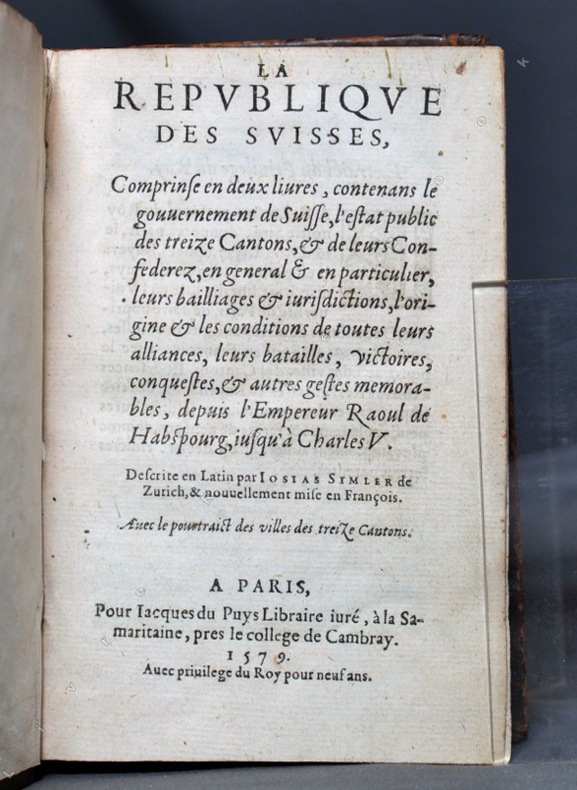
15797477Paris, Jacques du Puys, 1579. In-12 de [24]-467-[13] pages, pleine basane marron, dos à nerfs, caissons ornés de filets et fleurons dorés, tranches mouchetées, reliure un poil de Saint Bernard frotté, un mors partiellement fendu avec un petit manque de peau au dos. (reliure XVIIe siècle). Hormis les ff. de table rognés un peu court, intérieur très frais.
1580979Z7Anvers Antwerp: De L'Imprimerie de Jean Remy 1580. First edition. Leather. Very Good. 6.5" by 4.5". None. The first edition of an important and very scarce sixteenth century ecclesiastical history being the second volume in Theodore Beze's history of the reformed churches bound in full contemporary calf. The first edition.Volume two only complete in three. Illustrated with an engraving to the title page. Theodore Beza's Theodore Beze important ecclesiastical history being one of the most prominent works on the history of the Protestant Church from this era and a valuable resource on the reformed church in the sixteenth century. The work while attributed to Beza is believed by many to actually be the work of Simon Goulart who worked alongside Beza and took over his role after his death. Written in the original French. The register runs as; A- Aviii A-Zviii AA-HHviiiblanks IIii-ZZviii AAA- FFFviii GGG-GGGii HHHi-HHHviii III. Collated lacking IIi. Bound in full contemporary calf. Endpapers and blanks renewed. Externally staining to the spine and extremities with marks to the boards and light wear to the extremities with a small label to the rear of the spine and a small hole to the head. Front hinge weak bookplate to rear pastedown. Front free endpaper and blanks disbound but present. Internally pp 81-96 tender but generally firm with generally bright and clean pages with age toning and marks to the title and the odd page and tidemarks. closely cropped to the head of the pages. Very Good De L'Imprimerie de Jean Remy hardcover