468 résultats
1851406078New York: Wm. C. Locke & Co 1851. Wrappers chipped at edges professionally rebacked some unobtrusive offsetting on map. 8vo. 50 pages. Large folding map on three joined sheets 21 x 1788 cm; 8.25 x 61.75 inches. 11 woodblock illustrations in text and with 2 more not recorded in the index but always present. Original printed wrappers with woodblock vignette. SCARCE Hudson River Railroad travel guide published the first year in which the full line was completed. It covers points of interest along the route with woodblocks illustrating the text. Topics include: the history of the Hudson River the history of the construction of the Hudson River Railroad and the cities towns and villages along the Hudson from New York City all the way to Troy. Concerning the West Point Foundry at Cold Spring the guide states: "the iron foundry was established here by Gouverneur Kemble. The works are situated about a mile west of the village upon a small stream which tumbles rapidly down the mountains affording considerable water power. It is the largest establishment of its kind in the country employing nearly five hundred hands constantly." The building of the Hudson River Railroad is another topic in the guide. The project was considered highly impractical since much of the route had to be cut through extremely difficult rock and terrain. This section includes a description of the tunnels which had to be constructed. The railroad was opened in three stages. In September 1849 it allowed passengers to travel from New York to Peekskill. By that December 6 twenty-three additional miles were opened extending to New Hamburg. By the 31st of the month it was open the remaining distance of nine miles to Poughkeepsie. The Hudson River Railroad was an extension of the Troy and Greenbush Railroad which was chartered in 1845 connecting Troy South to Greenbush now Rensselaer on the east side of the Hudson. The Hudson River Railroad was chartered on May 12 1846 to extend this line south to New York City. The full line opened on October 3 1851 the same year in which this travel guide was published. WorldCat/OCLC records 25 copies but it is scarcely found complete with the map and the map is also excluded from the digitized versions available online. <br/><br/> Wm. C. Locke & Co unknown books
196740431Chicago IL: Illinois Central Railroad 1967. 1st printings. Buff paper printed with black ink stapled. Light age-toning and wear to paper faint creasing. A VG set. 46 pp. each. Charts housed within. 9-3/4" x 8-3/4" <br/><br/>Includes: 2 time tables Nos. 5 & 61 detailing the scheduling of the Chicago Division lines in the 1960s. Illinois Central Railroad unknown books
1857040173Chicago: Illinois Central Rail Road Office 1857. First Edition. Softcover. Very Good. 80pp. Bound in at front: Outline Map of Illinois; Railway Guide to the Illinois Central Rail Road Lands double-page map; woodcut frontispiece "Prairie Scene in Illinois." Six woodcuts in the text. Bound in at back: four pages of broadside-style ads printed in diaplay type on lavender stock. 1 "Passengers for St. Louis Jacksonville Naples Kansas and Nebraska should procure their tickets via Illinois Central R. Road." 2 "Great Western and Michigan Central Railway Line only direct route via Niagara Falls and Suspension Bridge." 3 Great Reduction of Fare! For St. Paul! Great Western Mail Route. Galena and Chicago Union Rail Road." 4 "Passengers for St. Paul should be particular and call for tickets via Dunleith . Having Twelve Splendid Steamers." Bound in printed wrappers with prairie scene on cover. 9" x 5.5" Byrd Illinois Imprints 2683. Buck Travel and Description 559. <br/><br/> Illinois Central Rail Road Office paperback books
185874242Wash D. C.: GPO. Very Good. 1858. Pamphlet. GPO unknown books
185833688Chicago: Illinois Central Rail Road Office 1858. 8vo 5 p.l. pp. 5-80; full-page map of Illinois double-page map of the guide to the Illinois Central Railroad Lands wood-engraved frontispiece 6 wood-engraved illustrations in the text; slight nibble out of the fore-margin of the first 3 leaves else a near fine copy in original yellow pictorial wrappers. Another edition with same text has imprint: Boston G.C. Rand & Avery printers 1857. Byrd 2683; Ante-Fire Imprints 263. <br/><br/> Illinois Central Rail Road Office unknown books
194836032Chicago: Railroad Workers Industrial Union 1948. Four panel brochure not folded 8.5x11 inches full paper size paper evenly browned else very good condition. Miles 4346. Railroad Workers Industrial Union unknown books
194862853Chicago: Railroad Workers Industrial Union no. 520 1948. Leaflet printed on both sides creased horizontally with closed tears along the fold paper browned chipping on edges else good condition 9x12 inches. Miles 4455. Railroad Workers Industrial Union no. 520 unknown books
1898013055Washington: International Railway Commission 1898. MAPS AND PROFILES ONLY. The seven maps from the report; America Central America Colombia Ecuador and Peru Part of Mexico Part of Mexico Bolivia Chile and Argentina. Back flap of Map 1 is browned. . All maps are colored and in nearly fine condition without tears or soiling. Along with the five profiles in equally nice condition. . First Edition. Nearly Fine. International Railway Commission unknown books
194140360n. p.: Interurban Electric Railway Co 1941. White paper printed in blue orange and black. Moderate wear to timetables and notice age-toning creasing. Small 1cm tear to left edge of poster no losses. A VG set. 6 items each of varying pages. Charts and spreadsheets located throughout. Various sizes: 10-3/4" x 15-3/8" Timetables oblong format. 14" x 11" Public notice. <br/><br/>Includes: 4 timetables numbers 2 2x 3 2x & 2 puublic notices small posters regarding the Key System transbay service. Notice to the Public: "The Key System transbay service between Oakland San Leandro and San Francisco will be commenced Saturday March 22 1941 at which time under authority of California Railroad Commission Decision No. 33891 dated February 11 1941 Interurban Electric Railway Company will discontinue service between San Francisco and Oakland and San Leandro." The East Bay Electric Lines were a unit of the Southern Pacific Railroad that operated electric interurban-type trains in the East Bay region of the San Francisco Bay Area. The East Bay Electric Lines became the Interurban Electric Railway in December 1938 in anticipation of the completion the following month of the tracks on the lower deck of the San Francisco - Oakland Bay Bridge to the San Francisco Transbay Terminal. SP Interurban Electric Railway transbay commuter train service ended in July 1941." Wikipedia. Interurban Electric Railway Co unknown books
1962SGG313B-45Los Angeles CA: Interurbans Electric Railway Publications 1962. Paperback. Very Good. Series: Interurbans Vol. 20 No. 1; Interurbans Special No. 16 pt. 4A. Pamphlet. 11 x 8 1/2 inches. 40 pp. Many halftone photographic illustrations maps; text clean unmarked. Printed wrappers in red and black vignette advertisements on back stapled three-hole punched; binding square and tight minor soiling head and foot of spine bumped light shelf wear. Very good. Vol. 20 No. 1 of Interurbans Magazine edited by Ira L. Ewett Raymond E. Younghans Frank Barnes Librarian. This Special Edition focuses on the history of the Pasadena Long Beach and San Pedro streetcars and railways. Includes chronologies histories and statistics for each line as well as extensive historic photographic images of the cars from the early teens through the 1940s; also with historic maps of each line. The Pacific Electric Railway founded by Henry Huntington was the largest railway network in the world in the 1920s. It connected Los Angeles with many surrounding cities the first of which was Long Beach. Interurbans Electric Railway Publications paperback books
18491743930th Cong. 2d Sess.: HR26. 1849. 46 3 blank pp stitched untrimmed partially uncut. Light scattered foxing light dustsoiling. Good. HR26. unknown books
1868WRCAM33573AWashington: Government Printing Office 1868. 39pp. plus large color folding map 23 1/4 x 44 3/4 inches. Original printed wrappers. Presentation inscription on front wrapper see below. Wrapper edges chipped minor soiling and tanning to wrappers spine partially chipped old vertical fold to pamphlet. Light foxing and tanning and occasional soiling throughout Map with a few small closed tears at cross-folds with no loss. About very good. This copy is inscribed on the front wrapper: "With Regards of James Tilton C.E." Tilton 1819-78 was then chief engineer of the Washington Division of the Northern Pacific Railroad. Thanks in part to his support for Franklin Pierce's presidential campaign Tilton was appointed the first Surveyor General of Washington Territory and served from 1853-61. Both the Tilton River and Fort Tilton near Fall City Washington are named for him. <br> <br> An important report to Congress by the Northern Pacific Railroad headed by Minnesota railroad magnate James J. Hill for federal aid to support the Railroad's expansion to the West Coast. The petition reviews the railroad's original charter printing with it a memorial from the NPRR's Board of Directors and supporting communications from military figures including Montgomery Meigs and Ulysses S. Grant. Since the early 1850s Edwin Johnson described by Wheat as a "visionary" engineer had been associated with the plan to build a railroad across the northern part of the United States from the Great Lakes to the Pacific Coast. In 1867 he was named chief engineer of the Northern Pacific and this memorial is a work of major importance for the history of the railroad. It includes Johnson's topographical survey of the route to the Pacific a discussion of potential problems that may be encountered and a detailed economic and military survey of the area in justification of construction. <br> <br> The exceptional large folding "Map of the Country from Lake Superior to the Pacific Ocean from the Latest Explorations and Surveys" was produced by the Colton firm in New York. One of the finest maps of the region to date it shows the area from Detroit to the Pacific well into Canada and south to about the 39th parallel. Johnson has drawn the route of the Northern Pacific from Lake Superior to Washington Territory where the line splits with one branch heading toward Fort Vancouver and the other to Puget Sound. Among the details shown on the map are the Pony Express route wagon routes and overland mail routes exploration routes and other proposed railroad routes the locations of Indian tribes mineral deposits military forts and much more. Wheat gives a long description of the map and remarks that "the detail of such a map defies cataloging." Construction on the Northern Pacific Railroad began in 1870 and was completed in 1883. Edwin Johnson did not see its completion dying in 1872. An edition of this report with the supporting documents and map was also privately published in Hartford. <br> <br> A significant early account of railroad expansion in the Northwest. We could find only ten copies listed in OCLC and this is the first copy we have seen in wrappers and with a presentation from an important engineer on the project. RAILWAY ECONOMICS pp.242-43. SABIN 55819 Hartford edition. WHEAT TRANSMISSISSIPPI WEST V item 1169 pp.205-09. PHILLIPS MAPS p.916. DECKER 37:266 Hartford ed. MIDLAND NOTES 68:164. OCLC 60578657. Government Printing Office unknown books
18808710Cleveland: Short & Forman 1880. Original printed wrappers stitched 54pp. Text illus. Light wear Very Good. Much data on the Road's growth in freight business particularly between Chicago and New York; financial data engineers' report on road mileage freight forwarded and received performance of locomotive engines passenger traffic by station and historical financial data. FIRST EDITION. Short & Forman unknown books
2804Manchester Lancs.: C. W. Bayley Chief Traffic Manager; printer's slug of The Manchester Guardian at the foot of the front cover 1899. . 12mo pictorial pale-green printed wrappers. No other copies located; OCLC & COPAC both checked. Pages 3Ð19 number the tours from number 1Ð36 but only the first 20 are in this volume; the remainder mustappear in a separate Yorkshire volume. The starting point is given and then the cost of both a first and a third classicket plus a bicycle charge. Pages 20Ð45 contain detailed highlights of each tour. SOLD WITH: Another edition 1905 with title-page and 6 halftones detailing 22 tours out of 39. The printer's slug on this edition also on the front cover reads "Henry Blacklock & Co. Ltd. Colour Printers Manchester."``````` [Manchester, Lancs.: C. W. Bayley, Chief Traffic Manager; printer's slug of The Manchester Guardian at the foot of the front unknown books
185822429Cincinnati: Gazette Company Steam Printing House 1858. Original printed wrappers stitched. 37 1 blank pp. Folding table. Light wear Very Good plus. <br/><br/> The Directors blame "the continued and unusual navigable condition of the Ohio river during nearly all of the year" for the parlous condition of the Railroads. Despite the attractiveness of transportation by water the Directors express high hopes for the future joint operations of the Companies. Tables and much data on the companies' rolling stock and financial condition are included. <br/>FIRST EDITION. Not in BRE Sabin Eberstadt Thomson OH. Gazette Company Steam Printing House unknown books
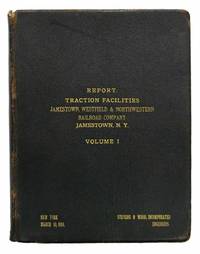
192644099New York: Stevens & Wood Incorporated 1926. 1st Edition. Leather binding with title gilt stamped to front cover. Brown marbled paper eps. Edgewear. Minor chipping at spine ends. Very Good. 83 numbered leaves. Typed text recto only on onionskin paper with red rule border. Leaves 71 through 83 with 26 b/w captioned photographs 2 per leaf on recto. Of the 26 photographs 3 show rolling stock e.g. 'Class "B" Passenger Car No. 310' with the remainder showing divers buildings etc e.g. 'Passenger Station - Village of Westfield' & 'Signal Tower at Pennsylvania R.R. Crossing in Mayville'. 11" x 8-3/8" <br/><br/>This report 1 volume of 3 submitted on March 10 1926 in New York by Stevens & Wood to George L. Maltby General Manager of the Jamestown Westfield & Northwestern Railroad Company is an inventory and appraisal of the property of the railroad including: 1 the electric railway line located in the County of Chautauqua NY owned and operated by the railroad including roadways tracts paving bridges culverts fences signs signals telephone lines poles and fixtures distribution and transmission system; 2 railroad lines located in Chautauqua County NY known as the Chautauqua and Falconer Branches of the railroad which have not been electrified and have been abandoned including roadways tracks bridges and culverts; 3 cars and their electrical equipment; 4 substation buildings and equipment in Westfield and Mayfield; 5 feeder lines interconnecting the distribution system along the right of way of the railroad with the Chautauqua Traction Company’s substation at Stow and in Mayville; 6 all stations waiting rooms and miscellaneous buildings and structures identified as the property of the railroad; 7 Midway Park owned by the railway company. Not present are Volumes II & III with "inventory summaries showing quantities prices and extensions grouped according to Tax Districts and by accounts and the Cost References." An excellent source of New York local history for the mid-1920s. Stevens & Wood, Incorporated hardcover books
1930292777London: Locomotive Pub. Co. 1930. Soft Cover. Good binding. The booklet opens to the color frontispiece of the "Standard 4-6-0 Locomotive 'Royal Scot' Class" followed immediately to the Foreward. If there was a title page with publisher information it is not present.~~There are a number of black and white illustration of L.M.S. locomotives and eight color plates including the frontispiece. There wrappers have some wear with minor loss to the top of the spine. 51 pages. Good binding. [Locomotive Pub. Co.] unknown books
190627672Newton-le-Willows Eng. McCorquodale & Co. 1906. 12mo pp. 142; 3 plates 2 in color folding map and numerous sepia-colored half-tones in the text; a very good copy in original color pictorial wrappers. NYPL only in OCLC. <br/><br/> unknown books
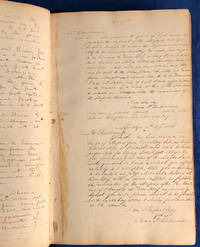
183524879<p>This volume is a fascinating primary source for the nation's oldest railroad still operating under its original name including correspondence setting the course for routes now traveled by millions of riders every month. Later use of this book by a New Jersey hatmaker and Civil War veteran gives insights into the daily life and expenses of a craftsman and farmer in the 1870s.</p> <b>LONG ISLAND RAILROAD.</b>Memorandum and Letter Book 1835-1872. 344 pp. of which 212 pp. have writing 8¼ x 13 x 1¼ in.<p><br /></p><p>This volume likely originally belonging to chief engineer James P. Kirkwood contains a wide variety of memoranda relating to the railroad. It begins with two pages of diary-like entries from February 8 to May 16 1836 including mention of Matthias W. Baldwin 1795-1866 the founder of Baldwin Locomotive Works February 8 and discussion of the route for the new Williamsburg Branch April 1 and reports on the contractors at Jamaica May 4 and 11.</p><p>It is followed by copies of two letters from the chief engineer regarding the delivery of railroad ties from Maine May 27 and August 4 1836 then six pages of estimates for grade work on new lines between Jericho and Ronkonkoma Pond between Jamaica and Jericho and between Flushing and Jericho.</p><p>Next are three draft letters totaling 40 pages to the president and directors of the railroad reporting engineering details on three different routes which had been surveyed from Jamaica to Greenport. The letters are dated November 4 1835 January 1836 and September 19 1836 and include tables estimating the costs for grading each route.</p><p>The following 37 pages include copies of letters to and from Long Island Rail Road engineer James P. Kirkwood between August 11 1835 and March 28 1837 mostly about surveying and construction issues. Among the interesting letters is one from Postmaster General Amos Kendall to the President of the Long Island Rail Road April 26 1836 asking for a map or plan of the route so the post office could update its maps. These pages also include an August 9 1836 letter from Lieutenant George Gordon Meade 1815-1872 acknowledging payment of $45.44 for "services rendered" to the railroad likely surveying shortly before he resigned from the army to pursue work as a civil engineer. Meade went on to lead the Army of the Potomac to victory at the Battle of Gettysburg in July 1863 and continued in command until the end of the Civil War.</p><p><b>James Pugh Kirkwood</b> 1807-1877 was born in Edinburgh Scotland. After his education and an apprenticeship to a land surveyor he began his own business in Glasgow in 1832. Later that same year he immigrated to the United States where he worked as an engineer on the Norwich & Worcester the Boston & Providence and the Stonington & Providence Railroads. In 1837 he became the resident engineer for the Long Island Rail Road. From 1840 to 1843 he was resident engineer for the Western Railroad of Massachusetts. Over the course of his career Kirkwood became one of the foremost civil engineers of the mid-nineteenth century. He was involved in many improvement projects to enhance the harbor of New York City. As general superintendent of the New York & Erie Railroad he pioneered the use of telegraph signals to manage trains. From 1850 to 1855 he was the chief engineer of the Missouri Pacific Railroad and managed its construction. He was a co-founder of the American Society of Civil Engineers in 1852 and served as its president from 1867 to 1868. He also became involved in a variety of water supply projects for various cities in the United States and Europe.</p><p><b>Long Island Rail Road</b> 1835-1928 1949-present is the oldest U.S. railroad still operating under its original name and charter. The New York General Assembly passed an act to incorporate the Brooklyn and Jamaica Railroad in 1831 which incorporated in 1832 to build a ten-mile line between those cities. Engineer Major D. B. Douglass planned for a continuation through the center of Long Island to near its eastern end to connect New York and Boston via rail and steamship. The legislature chartered the Long Island Rail Road Company in 1834. The railroad organized in June 1835 with Knowles Taylor as the first president and it soon acquired the Brooklyn and Jamaica line. The main line from Brooklyn to Greenport was completed in 1844 but rail and steamship service to Boston lasted only until 1847 when competing rail lines through southern Connecticut and steamships directly from New York took away business. The railroad then turned its attention to local service and added more branches to the northern and southern shores while small rival rail lines opened on the island. In 1875 New York rubber baron Conrad Poppenhusen acquired all of the railroads and consolidated them under the Long Island Railroad Company. By 1900 the Pennsylvania Railroad purchased a controlling interest in the Long Island Railroad and the railroad served more and more commuters into Manhattan. From 1928 to 1949 the railroad was largely owned by the Pennsylvania Railroad but it declared bankruptcy in 1949 and the Pennsylvania Railroad stopped supporting its debts. The Long Island Railroad came out of bankruptcy in 1954 and the State of New York purchased it in 1965. Today the railroad carries more than 300000 passengers each weekday over more than seven hundred miles of track.</p><p><b>Further items in the book:</b></p><p>Next comes eight pages of descriptions of land purchases dated between 1798 and 1842 which may be related to the Long Island Rail Road.</p><p>A three-page undated anti-Whig political letter regarding civic responsibility follows: "<i>There is no higher duty we owe to ourselves to each other and to our country in whatever situation we may be placed in whatever sphere of action we may fill than to understand the nature of our government and the civil institutions by which our rights are maintained as citizens and by which our civil duties & obligations towards each other are to be regulated</i>."</p><p>The latter half of the book was apparently used by at least two different owners who recorded property acquisitions reports on canals and railroads in different states and various memoranda.</p><p>Peter J. Butler used fifty-eight pages in the latter half of the volume for a diary with income and expenditures from January 1870 to March 1872. Later pages record Butler's individual accounts with John Allen Johnson Abner Reeves Charles Bessing the School District Nathan Squire and M. P. Hart. Four additional pages give school receipts and expenditures for school years ending August 31 1873 and July 31 1875; Butler served as clerk for the school. The diary provides an interesting view of the household finances of a craftsman and Civil War veteran in the years after the war.</p><p><b>Peter J. Butler</b> 1842-1889 was born in New Jersey as the son of Peter Butler 1806-1874 and Catherine Butler 1802-1893 both Irish immigrants. Peter J. Butler was a farmer and hatmaker in Livingston New Jersey twenty miles west of New York City. During the Civil War Butler served as a landsman for the navy steamers USS <i>North Carolina</i> and USS <i>Monticello</i> from August 1864 to June 1865. In February 1867 he married Hettie C. Denman with whom he had two children.</p><p>Among the interesting items is the following letter to a soldier perhaps Peter J. Butler from the Civil War:</p><p><i>Dear Friend</i></p><p> <i>I arrived at home on Saturday as I left on Thursday after a verry pleasant ride. I intended to write before but I have been on the go day and night since I have been home so that I have had no time yet I am anxious to hear from you as ever. The 4 of July was selebrated in great stile all over the country and all had a good time in general I am in hopes that you will not have to serve the whole of your time out in fact I think you ought to be entitled to your discharge oferd the verry reason that you have served in the army and navy ever since the commencement of the war and before and never had a bounty I think the Captain will interseed for you and he will if he has any manly principle in him whatever</i></p><p>Another owner of the book appears to have been John S. Cunningham who is likely responsible for the copy of the "<i>Speech of Adherbal to the Roman Senate imploring their Protection against Jugurtha</i>" in parallel Latin and English columns and a map of a battle from the Jugurthine War in 108 B.C. with Latin labels and narrative. Both have the initials "<i>J.S.C.</i>" at the bottom. Among other items in the book is a brief "List of John S. Cunningham's private library" including books on Greek Latin and French and an 1847 account of J. S. Cunningham with Andrew A. Smalley 1814-1893 covering two pages. Early in Butler's diary is an entry for January 9 1870: "<i>Wrote to John S Cunningham</i>" so perhaps Cunningham had given the ledger to Butler.</p><p><b>John S. Cunningham</b> 1827-1893 was born in New Jersey and educated at Orange Academy. He particularly studied surveying and civil engineering. He was involved in the manufacture of wrought bar iron for several years. In 1848 he became an assistant engineer with the Morris & Essex Railroad and then the Patterson & Ramapo Railroad. From 1849 to 1851 he worked as an engineer on the Chesapeake and Ohio Canal. He then returned to railroad work through the 1850s. He settled in Coalsmouth Virginia St. Albans West Virginia thirty-five miles east of Huntington. During the Civil War he served as an officer in a loyal Virginia regiment then returned to St. Albans where he held a variety of local offices including from 1889 judge of the Kanawha County Court.</p><p><b>Condition</b></p><p>Overall good. Cover wear and some missing spine cap; marbled endpapers; one torn page; interior clean.</p> hardcover books
1928TB30959Pennsylvania Station New York City: Long Island Railroad 1928. First Edition. Very good in printed multi-color wraps over a stapled binding. An octavo of 9 by 6 inches with light rubbing and wear around the perimeter of the covers and with modest soiling to the title page and verso of the front cover and to the recto of the rear cover. Without a dust jacket as issued. Issued by the General Passenger Department of the Long Island Railroad. 96 pages followed by a fold-out map five color map of Long Island which has a one inch closed tear in one fold and a two inch closed tear starting at the end of the above tear both of which have been repaired with archival tape. Illustrated throughout from black and white photographs and replete with ads for hotels resorts and inns. Long Island Railroad paperback books
503718ca. 1920 by Aerograph Co. Los Angeles with blindstamp in lower left corner. Framed in a black wooden frame with white mat. Framed size: 13 1/2" x 26". F. Soft cover. paperback books
1981197204Los Angeles California n.p. 1981. 1981. Folding 6 panel brochure 8" x 22". 11 tinted color photographs; map by D.W. Pontius; blue background on front panel. Very good. Scarce. Includes advertisements for Mt. Lowe Orange Empire Trolley trip to Redlands Balloon trip Old Mission Trip. No Binding. Very Good. Los Angeles, California [n.p.] 1981. unknown books
192551163fdChicago: Pool E. Bros. 1925. Slim octavo color-illustrated self-wrappers stapled 48 pp. Photos. map in color. New Orleans to Mobile and Pensacola. Fine. Pool E. Bros., (1925). unknown books
19281134Louisville 1928. Very good. 59 leaves. Oblong narrow octavo. Blueprint self-wrappers with blue paper spine enclosing blueprint contents. Light wear to spine and corners some wear to wrappers. Contemporary ownership inscription on front cover. Internally clean. Profile guide map for the Birmingham Mineral Railroad operating at this time under the name of its parent company the Louisville and Nashville Railroad. Printed in blueprint the volume opens with a map of the entire line from Montgomery north to Birmingham and looping to the north and east through Talladega and Gadsden. There follow detailed maps of the line indicating culverts depots and other features on the route. These maps are provided for the Columbiana Branch the Marbleton Branch the Lumberton Spur the Rock Springs Spur the Self Creek Branch the Long Branch Coal Railroad the Graystone Branch and the Huntsville No. 2. The Birmingham Mineral Railroad was chartered as a division of the Louisville & Nashville Railroad in 1884 designed to freight coal and other minerals from mines in the region. The Huntsville No. 2 Branch opened in 1889 from Birmingham to the Champion Mines. Many of the Red Mountain mines were abandoned by the Great Depression and the railroad was slowly dismantled throughout the 1930s and 1940s. We find no record of this title in OCLC and suspect it was produced in a limited number for internal use. unknown books
2338Portland Me.: Chisholm Bros. Circa 1880s-1890s. . Small 4to6 x 5 1/4 inches maroon diced cloth front highly gilt; some minor wear to corners and edges. [Portland, Me.: Chisholm Bros.], Circa 1880s-1890s. hardcover books