Vaizey, MarinaBiblio.com
11 815 résultats
0847812391.Ghardcover. Good. Access codes and supplements are not guaranteed with used items. May be an ex-library book. hardcover
1990Q-0847812391Rizzoli 1990-07-15. Hardcover. New. In shrink wrap. Looks like an interesting title! Rizzoli hardcover
185490101X.Gpaperback. Good. Access codes and supplements are not guaranteed with used items. May be an ex-library book. paperback
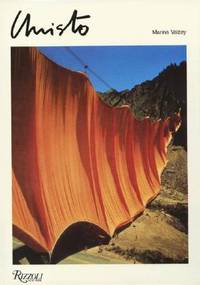
199085664New York: Rizzoli International Publications Inc 1990. First U. S. Edition Presumed First printing. Hardcover. Very good/Good. Cristo. Format is approximately 8.5 inches by 12 inches. 128 pages. Profusely illustrated some in color. DJ has some wear and soiling. Text by Marina Vaizey. Includes Biography Bibliography Museum Collections Illustrations and List of Illustrations. Inscribed by Christo on the title page to Tom. Inscription reads For Tom Christo N. Y. 1991. This was inscribed to Dr. Thomas E. Lovejoy renowned as "The Godfather of Biodiversity". Acquired at auction of part of the Lovejoy family collection. Thomas Eugene Lovejoy III August 22 1941 - December 25 2021 was an American ecologist who was President of the Amazon Biodiversity Center a Senior Fellow at the United Nations Foundation and a university professor in the Environmental Science and Policy department at George Mason University. Lovejoy was the World Bank's chief biodiversity advisor and the lead specialist for environment for Latin America and the Caribbean as well as senior advisor to the president of the United Nations Foundation. In 2008 he also was the first Biodiversity Chair of the H. John Heinz III Center for Science Economics and the Environment to 2013. Previously he served as president of the Heinz Center since May 2002. Lovejoy introduced the term biological diversity to the scientific community in 1980. He was a past chair of the Scientific Technical Advisory Panel STAP for the Global Environment Facility GEF the multibillion-dollar funding mechanism for developing countries in support of their obligations under international environmental conventions. Marina Alandra Vaizey Baroness Vaizey CBE née Stansky; born 16 January 1938 is an art critic and author based in the UK. Vaizey is an Anglo-American broadcaster exhibition curator and journalist. She was educated at Radcliffe College and Girton College Cambridge. She was formerly Art Critic for the Financial Times and Sunday Times and editor of the Art Quarterly and Review. She has written several books on art. She now lectures including at the National Gallery and British Museum. She was a founding Trustee of the Geffrye Museum and has also been a trustee of the Imperial War Museum and the South Bank. She has also been a judge for the Turner Prize. Christo Vladimirov Javacheff was born on June 13 1935 in Gabrovo Bulgaria. Christo received private art instruction at a young age and the support of his parents who invited visiting artists to their house. While Bulgaria was under repressive totalitarian rule and Western art was suppressed Christo pursued realistic painting through the mid-1950s. He was admitted into the Sofia Academy of Fine Arts in 1953 but found the school dull and stifling. Instead he found inspiration in Skira art books and visiting Russian professors who were older than him and once active in Russian modernism and the Soviet avant-garde. In 1956 he used an academy connection to receive permission to visit family in Prague Amid fears of further Russian suppression in Hungary Christo decided to flee to Vienna as a railcar stowaway. In Vienna he stayed with a family friend who had not expected him studied at the Vienna Fine Arts Academy and surrendered his passport to seek political asylum as a stateless person. There he supported himself with commissions. At the behest of a friend relocated from Sofia he saved up to visit Geneva in late 1957. In violation of his visa he continued to pursue commissions whose works he would sign with his family name reserving his given name for more serious work and was transformed after visiting the Kunstmuseum Basel and Kunsthaus Zürich. In January 1958 he first began to wrap things as would become his trademark starting with a paint can. His collection of wrapped household items would be known as his Inventory. In February 1958 Christo left for Paris having received a visa with the assistance of a Sofia academy connection. In 1973 after 17 stateless years Christo became a United States citizen. L'Arc de Triomphe Wrapped a planned work by Christo and Jeanne-Claude went ahead posthumously in Paris in September 2021. Rizzoli International Publications, Inc hardcover
1990209308New York: Rizzoli 1990. First. hardcover. fine/fine. Christo. 161 illustrations 133 in color. Slim 4to cream cloth d.w. New York: Rizzoli 1990. First Edition. Fine.<br/> <br/> Boldly signed in red crayon on the title page.<br/> <br/> Rizzoli unknown
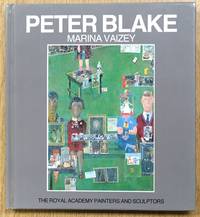
1986620408London: George Weidenfeld & Nicolson Ltd 1986. Hardcover with printed boards no dust jacket in very good condition. Signed both by Marina Vaizey and Peter Blake. Boards are slightly scuffed and sunned. Upper board edges are a little bumped. Page block and page edges are lightly tanned with spots of foxing on the page block head. Binding is sound pages are clear and colours vivid. LW. Hardcover. Very Good/No Dust Jacket. Used. George Weidenfeld & Nicolson Ltd Hardcover
1908419407.Gpaperback. Good. Access codes and supplements are not guaranteed with used items. May be an ex-library book. paperback
1902721020.Ghardcover. Good. Access codes and supplements are not guaranteed with used items. May be an ex-library book. hardcover
2013015918Oxford: Artist's Choice Editions 2013. Limited to 500 copies. Book measures 12 1/2 x 8 1/2 inches. 201 pages extensively illustrated throughout. Bound in original publishers orange cloth. Binding in near fine condition. Dust jacket lightly marked minor abrasion wear. Jacket in very good clean conditrion. Internally pages clean fine. A very nice near fine copy in a very good dust jacket. . Very Good Plus Near Fine/Very Good. Quarto. Artist's Choice Editions hardcover
3659410527.Gpaperback. Good. Access codes and supplements are not guaranteed with used items. May be an ex-library book. paperback
36497033like new. unknown
1644265737.Ghardcover. Good. Access codes and supplements are not guaranteed with used items. May be an ex-library book. hardcover
5386027417.Gpaperback. Good. Access codes and supplements are not guaranteed with used items. May be an ex-library book. paperback
JI-08BM-56JXFine. unknown
19594638aUSA: Department of the Navy. Good. Hardcover. 1959. 3 heavy ring binders volume one has the front cover repaired spine split<br><p></p> . Department of the Navy. hardcover
194385830Washington DC: U.S. Navy Department 1943. Revised Edition issued June 1943. Wraps. Fair. Three-hole punched laced. Taped edges near spine. Approx. 150 wraps profusely illustrated. Tabbed sections on U.S. Army aircraft U.S. Navy aircraft United Kingdom British Aircraft German Aircraft Japanese Aircraft Italian Aircraft Russian Aircraft no pages in this section and Miscellaneous Aircraft no pages in this section. Covers creased soiled & stained pages somewhat darkened soiled and stained. Ink notation on front cover. Name of Stanley R. Simon in ink on the front cover. This is possibly the same Stanley Simon who was with the First Ordnance Squadron stationed at Tinian Island Los Alamos NM and Wendover UT and was a member of the 509th Composite Group and a Manhattan Project Veteran. This manual supersedes FM 30-30 February 21 1942; FM 30-31 August 1 1941; FM 30-34 July 18 1941; FM 30-35 March 11 1942; FM 30-38 March 16 1942 and FM 30-39 October 24 1941. It was also issues by the Training Division Bureau of Aeronautics Navy Department June 1943. "This document contains information affecting the national defense of the United States with the meaning of the Espionage Act 50 U.S.C. 31 and 32 as Amended. Its transmission or the revelation of its contents in any manner to an unauthorized person is prohibited by law." The present manual was primarily designed for self-instruction and general use but also served as a text in recognition course. It includes four types of material: black and shite silhouettes wash drawings protographs and editorial matter. Silhouettes are the foundation on which all recognition training is based. The first requirement in warfare is the ability to distinguish friend from foe. Nowhere is this more difficult than in the air. Owing to the great speeds and heights attained by modern aircraft recognition is frequently dependent on a momentary glimpse. In the same way instant and accurate recognition of surface craft mechanized ground equipment etc. is fraught with great difficulties owning to varying conditions of visibility distance and variety of types. Before the outbreak of this war few realized the grave problems of recognition that the increasing dominance of air power would present. The existence of these problems was soon apparent when after two months the casualties of the British Advance Air Striking Force in France amount to:--Shot down by the Germans eight; shot down by the French nine. In those days the only questions asked was "Is it in range' Since them mistakes in recognition on the sea on land and in the air have been too numerous to mentions. Usually these mistakes are attended by the most serious consequences. It is now fully realized that the only way to prevent these occurrences is by demanding the highest general level of proficiency in recognition throughout the services. This can only be attained by concentrated study. It is not suggested that practice will main one absolutely perfect with it will certainly go most of the way toward reducing the changes of a man being a danger not only to himself but to his comrades-in-arms. The Navy's problem at sea whether on warship or merchant ship is to know as soon as possible where any aircraft or ship within sight is friendly or hostile what type it is and how it is likely to attack and from that to estimate the best method of defense. The Army's problems are also varied. Antiaircraft gunners should be able to recognize any airplane within range or likely to come within range whether flying directly toward the battery or not. Instant recognition save lives and leads to the destruction of the enemy. The first thin to be appreciated is that recognition does not begin and end with appearance. It is also essential to recognize the exact type. U.S. Navy Department paperback
19436048Washington DC: U.S. Navy Department 1943. Revised Edition. fair to good. Approx. 250 wraps profusely illus. covers creased & soiled ink name on front cover pages somewhat darkened. Includes Aircraft Supplement No. 1. U.S. Navy Department paperback
19436049Washington DC: U.S. Navy Department 1943. Revised Edition. fair. Approx. 150 wraps profusely illus. covers creased soiled & stained pages somewhat darkened soiled and stained. U.S. Navy Department paperback
195176953Washington DC: GPO 1951. Presumed First Edition First printing thus. Hardcover. good. Quarto Approximately 8 inches by 10.5 inches Volume II ONLY. xiv 242 pages. Illustrations some with color. Figures. Tables. Bibliography. Appendix I II and III. Index. This publication was Restricted and remarked by stamp as Unclassified. Ex-library with usual library markings. Cover has some wear and soiling. Small tear in frontis illustration. Foreword by Brigadier General Herbert B. Loper Armed Forces Special Weapons Project. The purpose of this volume was to provide in its true perspective the essential background information which would make possible intelligent planning in advance and appropriate action in an emergency. The first half of the book deals with the characteristics of atomic weapons and their effects on structures equipment and personnel. The second half considered the steps that could be taken to minimize those effects and to control their consequences. The Armed Forces Special Weapons Project AFSWP was a U. S. military agency responsible for those aspects of nuclear weapons remaining under military control after the Manhattan Project was succeeded by the Atomic Energy Commission. These responsibilities included the maintenance storage surveillance security and handling of nuclear weapons as well as supporting nuclear testing. The AFSWP was a joint organization staffed by the U. S. Army U. S. Navy and U. S. Air Force. Major General Leslie R. Groves was its first chief. The early nuclear weapons were stored as components rather than complete devices and required expert knowledge to assemble. The short life of their lead-acid batteries and modulated neutron initiators and the heat generated by the fissile cores precluded storing them assembled. The large quantity of explosives in each weapon demanded special care be taken in handling. A team of regular Army officers were trained in the assembly and handling of the weapons. GPO hardcover
195076954Washington DC: GPO 1950. Presumed First Edition First printing thus. Hardcover. good. Quarto Approximately 8 inches by 10.5 inches Volume III ONLY. v 1137 1 pages. Illustrations . Figures. Tables. Bibliography. No restrictive markings but a statement that the contents were not to be reproduced without permission. Ex-library with usual library markings. Cover has some wear and soiling. Small tear in frontis illustration. Foreword by Major General K. D. Nichols Armed Forces Special Weapons Project. This volume is a compilation of lectures presented in Washington D. C. during 1947 1948 and 1949 in a joint course on "Medical Aspects of Nuclear Energy" presented by the Armed Forces Special Weapons Project. This joint course was conducted for indoctrination of Medical Officers of the Armed Services with participation open to representatives of all interested government agencies. This volume should assist defense personnel preparing for complex casualty problems and others in the civil defense structure. The Armed Forces Special Weapons Project AFSWP was a U. S. military agency responsible for those aspects of nuclear weapons remaining under military control after the Manhattan Project was succeeded by the Atomic Energy Commission. These responsibilities included the maintenance storage surveillance security and handling of nuclear weapons as well as supporting nuclear testing. The AFSWP was a joint organization staffed by the U. S. Army U. S. Navy and U. S. Air Force. Major General Leslie R. Groves was its first chief. The early nuclear weapons were stored as components rather than complete devices and required expert knowledge to assemble. The short life of their lead-acid batteries and modulated neutron initiators and the heat generated by the fissile cores precluded storing them assembled. The large quantity of explosives in each weapon demanded special care be taken in handling. A team of regular Army officers were trained in the assembly and handling of the weapons. GPO hardcover
194856732Washington DC: GPO 1948. Presumed First Edition First printing thus. Hardcover. good. Quarto Approximately 8 inches by 10.5 inches Volume I ONLY. xi 3 163 3 pages. Frontis. Illustrations. Figures. Tables. Bibliography. Appendix on Fission Products. Subject Index. This publication was Official Use Only and remarked Unclassified in pencil. Ex-library with usual library markings. Cover has some wear and soiling. Name in ink inside front cover. Small tear in frontis illustration. Foreword by Major General L. R. Groves Armed Forces Special Weapons Project. This text is a reprint of a document formerly issued under the title of Radiological Safety. The previous document had been classified as Restricted. Upon review this document was found to have contained no restricted data under Public Law 585 79th Congress the Atomic Energy Act of 1946. Additional volumes were anticipated. The Armed Forces Special Weapons Project AFSWP was a U. S. military agency responsible for those aspects of nuclear weapons remaining under military control after the Manhattan Project was succeeded by the Atomic Energy Commission. These responsibilities included the maintenance storage surveillance security and handling of nuclear weapons as well as supporting nuclear testing. The AFSWP was a joint organization staffed by the U. S. Army U. S. Navy and U. S. Air Force. Major General Leslie R. Groves was its first chief. The early nuclear weapons were stored as components rather than complete devices and required expert knowledge to assemble. The short life of their lead-acid batteries and modulated neutron initiators and the heat generated by the fissile cores precluded storing them assembled. The large quantity of explosives in each weapon demanded special care be taken in handling. A team of regular Army officers were trained in the assembly and handling of the weapons. GPO hardcover
1396439021.Ghardcover. Good. Access codes and supplements are not guaranteed with used items. May be an ex-library book. hardcover
194290081942. Lot of 42 War & Navy V-Mail from WW II from one officer to his family. All dated between 1943 and 1945 each about 4 x 5" This archive of 54 letters are from Capt. W.H. Minnich in original transmittal envelope with post marked date. Mostly personal correspondence to family. During WW II V-mail system was adopted by the US Post Office in 1942 to save space. The weight of 150000 letters was reduced from 2575 pounds to a mere 45. V-mail consisted of miniaturized messages reproduced by microphotography. Individual facsimiles were reproduced in the States and then delivered to the addressee. December 18 1944 ".This war is a terrible thing and I for one shall be glad when its all over." ".It won't be long until it gets cold again and I hope by then the Germans will have enough." some interesting comments: dated May 21 1945 ".All I want now is for the war to end and then an early return home. I hope to do that in another year after all these Germans and Japs can't fight forever." Very good condition. unknown
1991110911004US Navy 1991. Hardcover. Very Good. 0x0x0. VG Pictoral cover - Military year book commemorating the USS Phillipp Sea CG 58 Ship and crew and missions RARE US Navy hardcover
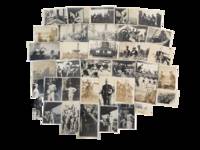
1917233411917. U.S. Navy photo archive documenting the Mexican Patrol mission of USS Rainier a Pacific Fleet auxiliary schoonerduring World War I. This archive documents U.S. naval personnel moved between shipboard duty shore stations and regional exploration in Mexican and California waters. Taken by Lieutenant junior grade Dr. Louis Henry Clerf the ship's medical officer these photographs place a named naval physician inside the working life of a little-documented auxiliary vessel assigned to Division 2 Pacific Fleet and the Mexican Patrol after the Navy acquired and commissioned the former civilian schooner in 1917. Rather than isolating military routine from observational practice the archive shows how officers aboard a small auxiliary ship simultaneously functioned as servicemen medical staff coastal travelers and recorders of local environments and natural science during a period of expanding American naval movement along the Pacific and Baja coastline.<br /> <br /> <br /> Photo archive of 41 silver gelatin photographs with many captions most measure 3.5" x 4.5" aboard USS Rainier and in Pacific coastal locations including San Diego and the Guaymas region circa 1917 to 1919. Several photographs focus on animals aboard ship including dogs kept by the crew birds fish catches and larger game animals associated with hunting and provisioning activities carried out during the patrol. Other images depict sailors handling fish and displaying catches beside the vessel revealing the practical realities of subsistence and food sourcing aboard a small auxiliary ship operating in relatively isolated Pacific waters. Together the photographs document the intersection of military hierarchy environmental encounter maritime labor and animal life aboard a World War I patrol. The images include repeated shipboard views of sailors and officers in white tropical uniforms and darker service dress posed singly and in groups on deck among rigging spars deck fittings railings and a mounted gun firmly establishing the operational setting aboard a naval auxiliary rather than a private voyage. Several photographs show relaxed mess scenes beneath awnings men seated at tables or gathered informally at sea while others picture uniformed personnel beside an automobile ashore and in front of a large urban hotel or institutional building. A large formal group portrait taken before an ornate Spanish colonial church further extends the coastal location. One verso identifies "Duck shooting at Ensenada de Francisco Bay about 20 miles north of Guaymas" while another reads "Hospital. Navy Training camp San Diego" linking the group to both field excursion and medical infrastructure. The captions combined with views of harbor craft shore architecture and regional movement show the same photographic hand operating across military environmental and natural science subjects. There are also many photos of the fishes and animals of the Baha region with captions.<br /> <br /> <br /> USS Rainier built in Portland in 1917 as the civilian schooner Patrol and later renamed Angel entered Navy service as a Pacific auxiliary during World War I. Commissioned at Mare Island on July 30 1917 and assigned to Division 2 Pacific Fleet she served on the Mexican Patrol off Southern California and Baja California placing this archive within the history of continued U.S. naval surveillance and mobility in Mexican waters during World War I rather than in a purely European war frame. The archive is attributable to a trained Navy physician who later went on to a long and prominent civilian medical career Dr. Louis Henry Clerf of Washington state. this archive preserve the operational world of a Navy auxiliary schooner where smaller patrol and support vessels were essential to maritime presence but far less frequently documented than battleships or major transports. Clerf's position as medical officer gives the archive unusual coherence since the photographs join shipboard hierarchy working naval space coastal circulation and natural-history attention within one attributable officer's record of service during the final years of World War I and the Mexican Patrol. Dr. Cliff also seem to have a deep interest in natural sciences and has included many photographs of the fish and animals that could be found at the time in the Baha region. Light surface wear scattered fading and minor edge or corner wear; captions present on some versos with images generally clean and legible. The archive offers an identified record of Mexican Patrol service aboard USS Rainier and of the broader naval presence that connected California Baja California and the Gulf of California during the final years of World War I. unknown