National Aeronautics & Space AdminBiblio.com
Handbook for Industrial Noise Control
A9780894990656Paperback / softback. New. paperback

The Saint Bookstore · Royaume-Uni43,40 £GB≈ 49,55 €
857 résultats
197065899Washington D.C.: National Aeronautics and Space Administration 1970. Hardcover. Near Fine. 35.5 x 27 cm. Folio. Red cloth. 125 pages. National Aeronautics and Space Administration hardcover
A9780894990656Paperback / softback. New. paperback
ria9780894990656_inpPaperback. New. New Book; Fast Shipping from UK; Not signed; Not First Edition; N/A paperback
B9780894990656Paperback / softback. New. paperback
0894990659.Gpaperback. Good. Access codes and supplements are not guaranteed with used items. May be an ex-library book. paperback
2001DADAX0894990659Books for Business 2001-07-01. paperback. New. 8.16x0.38x11.00. Buy with confidence. Excellent Customer Service & Return policy. Books for Business paperback
1974748700PN. New. 1974. Soft Cover. Date is original print. This is a reprint edition. . PN paperback
1969738753PN. New. 1969. Soft Cover. Date is original print. This is a reprint edition. . PN paperback
1974748699PN. New. 1974. Soft Cover. Date is original print. This is a reprint edition. . PN paperback
1990233483PN. New. 1990. Soft Cover. Date is original print. This is a reprint edition . PN paperback
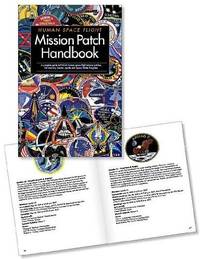
201287989Bradenton Fla: AeroGraphics Inc 2012. First printing stated. Paperback. Extremely subtle wear to spine head and foot faint soiling to top fore-edge very bright pages in tight binding else Near fine. Small blue octavo 173 pages color illustrations; 21 cm. Space Missions. A comprehensive guide to NASA's human space flight mission patches for Mercury Gemini Apollo and the Space Shuttle programs. The book features a collection of 168 mission patches printed in full-color. Details are included about each mission patch design as well as about the mission itself - including launch and landing dates and times crew members and payload. This handbook provides a complete reference for the colorful emblems of NASA's manned missions. Scarce. AeroGraphics, Inc paperback
20011333064PN. New. 2001. Soft Cover. Date is original print. This is a reprint edition . PN paperback
1993261664PN. New. 1993. Soft Cover. Date is original print. This is a reprint edition . PN paperback
1950709004PN. New. 1950. Soft Cover. Date is original print. This is a reprint edition. . PN paperback
1993263974PN. New. 1993. Soft Cover. Date is original print. This is a reprint edition . PN paperback
A9781503248915Paperback / softback. New. paperback
B9781503248915Paperback / softback. New. paperback
1984773265PN. New. 1984. Soft Cover. Date is original print. This is a reprint edition. . PN paperback
20001326582PN. New. 2000. Soft Cover. Date is original print. This is a reprint edition . PN paperback
19401340178PN. New. 1940. Soft Cover. md . PN paperback
198281051Pasadena CA: California Institute of Technology Jet Propulsion Laboratory 1982. Tailored compilation unknown number of these specific sets assembled. Folder with multiple inserts. Good. Scarce compilation of publications and 14 photographs. Folder is worn/torn and approximately 9 inches by 12 inches with impressive color space photographs on front and back. Inside there are two/pockets with text and inserts in each side. On the left side there is a pamphlet JPL Closeup approximately 8.5 inches by 8.5 inches. 16 pages plus covers. Illustrated. Dated 5/80. The second item is entitles Voyager at Saturn: 1981. It is approximately 8.5 inches by 11 inches. It has an illustration on the front cover. It is dated on the back as produced in 1981. It is 16 pages plus covers with illustrations some in color. On the right side is Voyager 1 Encounters Saturn JPL 400-100 dated 12/80. It is approximately 8.5 inches by 11 inches. It has 40 pages plus covers and is illustrated some in color. There are 6 8.5 inches by 11 inch color photographs with substantial text on the back of each. The Voyager Jupiter photographs are designated Voyager 1-47 P-21182 March 3 1979 Voyager 1-143 P-21457 March 3 1979 Voyager 1-149 P-21631 undated; Voyager 1-S-13 P-23058 November 6 1980 Voyager 1-S-54 P-23178 November 15 1980 and Voyager 1-S-82 P=23400 undated. There are 8 approximately 8 inch by 10 inch photographs 2 in black and white and six color. The Voyager Jupiter images are P-23876C August 13 1981 P-23912C/BW August 21 1981 P-23913C August 21 1981 P-23887C/BW August 24 1981 P-23922C August 24 1981 P-23927C August 25 1981 P-23932BW August 25 1981 and P-23933BW August 25 1981. Each image back has text taped to it. Folder with multiple inserts The Jet Propulsion Laboratory is a research development and flight center owned by the National Aeronautics and Space Administration and operated by the California Institute of Technology. JPL's primary responsibility is the investigation of the solar system with automated scientific spacecraft. The Laboratory's activities however are not limited to space exploration. The basic research and development in support of space exploration involves a broad spectrum of scientific and engineering disciplines; the resulting technological and managerial capabilities are finding increasing application to medical and environmental problems on earth especially in the area of solar energy research. To provide spacecraft tracking and communications for deep-space missions JPL designed developed and manages the Deep Space Network DSN with stations in California Spain and Australia. The twin Voyager 1 and 2 spacecraft are exploring where nothing from Earth has flown before. Continuing on their more-than-40-year journey since their 1977 launches they each are much farther away from Earth and the sun than Pluto. In August 2012 Voyager 1 made the historic entry into interstellar space the region between stars filled with material ejected by the death of nearby stars millions of years ago. Voyager 2 entered interstellar space on November 5 2018 and scientists hope to learn more about this region. Both spacecraft are still sending scientific information about their surroundings through the Deep Space Network or DSN. The primary mission was the exploration of Jupiter and Saturn. After making a string of discoveries there — such as active volcanoes on Jupiter's moon Io and intricacies of Saturn's rings — the mission was extended. California Institute of Technology, Jet Propulsion Laboratory unknown
20182-1730998895Independently published 2018. Paperback. New. 418 pages. 11.00x8.50x0.95 inches. Independently published paperback
20182-1730970745Independently published 2018. Paperback. New. 301 pages. 11.00x8.50x0.68 inches. Independently published paperback
201186129Washington DC: National Aeronautics and Space Administration 2011. Xerox-style reproduction. Presumed to be one of only a few copies made for media representatives. Stapled at upper left corner. Very good. 25 1 pages. Illustrations. Contents include Media Services Information; Quick Facts; Jupiter at a Glance; Why Juno; Mission Overview; Mission Phases; Spacecraft; Science Overview; Missions to Jupiter; and Program/Project Management. Juno is a NASA space probe orbiting the planet Jupiter. It was built by Lockheed Martin and is operated by NASA's Jet Propulsion Laboratory. The spacecraft was launched from Cape Canaveral Air Force Station on August 5 2011 UTC as part of the New Frontiers program. Juno entered a polar orbit of Jupiter on July 5 2016 UTC to begin a scientific investigation of the planet. After completing its mission Juno will be intentionally deorbited into Jupiter's atmosphere. Juno's mission is to measure Jupiter's composition gravitational field magnetic field and polar magnetosphere. It will also search for clues about how the planet formed including whether it has a rocky core the amount of water present within the deep atmosphere mass distribution and its deep winds which can reach speeds up to 390 mph. Juno is the second spacecraft to orbit Jupiter after the nuclear powered Galileo orbiter which orbited from 1995 to 2003. Juno is powered by solar panels commonly used by satellites orbiting Earth and working in the inner Solar System whereas radioisotope thermoelectric generators are commonly used for missions to the outer Solar System and beyond. For Juno however the three largest solar panel wings ever deployed on a planetary probe play an integral role in stabilizing the spacecraft as well as generating power. During the science mission infrared and microwave instruments will measure the thermal radiation emanating from deep within Jupiter's atmosphere. These observations will complement previous studies of its composition by assessing the abundance and distribution of water and therefore oxygen. This data will provide insight into Jupiter's origins. Juno will also investigate the convection that drives natural circulation patterns in Jupiter's atmosphere. Other instruments aboard Juno will gather data about its gravitational field and polar magnetosphere. The Juno mission was planned to conclude in February 2018 after completing 37 orbits of Jupiter but now has been commissioned through 2025 to do a further 42 additional orbits of Jupiter as well as close flybys of Ganymede Europa and Io. The probe was then intended to be deorbited and burnt up in Jupiter's outer atmosphere to avoid any possibility of impact and biological contamination of one of its moons. The Juno spacecraft's suite of science instruments will: Determine the ratio of oxygen to hydrogen effectively measuring the abundance of water in Jupiter which will help distinguish among prevailing theories linking Jupiter's formation to the Solar System; Obtain a better estimate of Jupiter's core mass which will also help distinguish among prevailing theories linking Jupiter's formation to the Solar System; Precisely map Jupiter's gravitational field to assess the distribution of mass in Jupiter's interior including properties of its structure and dynamics; Precisely map Jupiter's magnetic field to assess the origin and structure of the field and the depth at which the planet's magnetic field is created. This experiment will also help scientists understand the fundamental physics of dynamo theory; Map the variation in atmospheric composition temperature structure cloud opacity and dynamics to pressures far greater than 100 bar 10 MPa; 1500 psi at all latitudes; Characterize and explore the three-dimensional structure of Jupiter's polar magnetosphere and auroras; and Measure the orbital frame-dragging known also as Lense-Thirring precession caused by the angular momentum of Jupiter and possibly a new test of general relativity effects connected with the Jovian rotation. National Aeronautics and Space Administration unknown