414 résultats
186166<p>Original rubbing for the Stele of Second Opium War Arrow War in China during 1856-1860. Stele erected in 1861 in Canton Guangzhou City in GuangTong Province in China.</p><p>Very big size on a whole thick rice paper 152cm X 98cm The original stone had been demolished long long ago. This rubbing is the only one found in the world. Folded a few wears at edges. Both text and pictures were fine copied and undamaged but had some folds.</p><p>Rubbing is an ancient Chinese method to copy text and pictures on stone or on bronze wares by hand.</p>
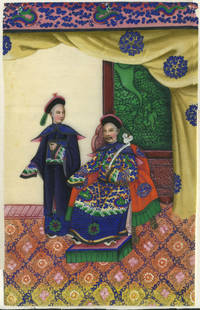
187027200China 1870. Fine. A splendid series of pith paintings from the Doheny collection. The watercolor and gouache paintings are splendidly preserved displayed and housed. The bookplates of Carrie Estelle Doheny and Edward Laurence Doheny are mounted on acid free board which sits atop the images and the totality fits snugly into the box. <br /> <br /> The images are in the traditional format in this case illustrating nine subjects - <br /> Royal Procession 6 images; Birds 11 images; Ships & Barges 5 ; Tea Cultivation 7; Punishments 11; Butterflies & Flowers 2 ; Butterflies & Insects 8; Court life 5; Flowers Camellias etc. 9. Each is protected in an archival paper sleeve 13 x 8.25 inches and numbered in pencil on the wrapper. Images 33 x 21 cm. <br /> <br /> The stability of these images is greatly enhanced by their conservation. Each pith image has been backed on acid free tissue supporting the pith which is quite fragile. The vast majority of the images are complete and undamaged. A minority have small marginal cracks or small corners missing. A couple have slight browning. Each image is preserved in a numbered acid-free folder and the whole is housed in a custom brown and black leather solander box numbered XI on the front board. <br /> <br /> Pith paintings are notoriously fragile. Crossman states "The other paper commonly used for watercolors and gouaches after 1800 was pith. The pith paper is a very fragile medium to work on and many of those watercolors which have survived are cracked and broken. Crossman "The China Trade" pp 95-97.<br /> <br /> A splendid collection. unknown
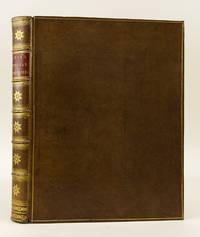
1803ST15927London: Cadell and Davies 1803. ONE OF 60 LARGE PAPER COPIES of the "considerably enlarged" Fourth Edition ours a variant retaining the date of 1803 on the title-page rather than 1804. 330 x 252 mm. 13 x 9 7/8". xviii 4 xix 1 380 pp. Two leaves usually bound at the end and containing the "List of Principle Books Referred to in this Work" and "Works by the same Author" bound between pp. xvii and xix here. <br/> VERY FINE CONTEMPORARY SPRINKLED CALF raised bands flanked by plain and decorative gilt rules and chain roll spine panels with star centerpiece red morocco label marbled endpapers. With six engravings: five maps two folding and one view. A Large Paper Copy. Front pastedown with engraved armorial bookplate of Marcus Gage; title page with ink inscription at head: "M. Gage's Book got from Mr. Asperne London April 15th 1805." Lada-Mocarski 29 note; Howes C-834; Sabin 17309; Streeter VI 3501; Cordier Bibliotheca Sinica pp. 2447-48. ◆Small chip to tail of spine corners a bit rubbed flyleaves somewhat foxed the usual minor foxing to plates and a bit of offsetting to adjacent pages otherwise A VERY FINE COPY OF AN ESPECIALLY DESIRABLE EDITION clean and fresh internally with vast margins and the binding firm lustrous and with only very minor wear to the joints.<br/> <br/> This is an extremely well-preserved copy in an elegant contemporary binding of the most sought-after edition of a key source on Russian exploration and that country's efforts to expand trade with China and Alaska. Eminent historian William Coxe 1747-1828 studied the voyages and exploration by Bering and others to the regions of Kamchatka the Aleutian Islands and Siberia to prepare this overview of the geography and cultures of the lands between Russia and North America and to analyze the economic potential of trade--particularly in furs--with the region. According to Sabin "Mr. Coxe's book contains many curious and important facts with respect to the various attempts of the Russians to open a communication to the New World." The 1780 first edition of this work covered Russian voyages of discovery between 1740 and 1769; the 1787 third edition added a supplement comparing these explorations to those of Captains Cook and Clerke. Our much-expanded fourth edition gives in the words of the Preface "a complete series of voyages from 1711 to 1792 comprising all that is known on the subject." Some of this supplementary information was gleaned from earlier accounts by German historians G. F. Muller and P. S. Pallas and some from Coxe's own travels in Russia. According to Lada-Mocarski Coxe "also succeeded in securing additional material: for instance the narrative and maps of Krenitzin and Levashev's 'secret' expedition the first official Russian government expedition since Bering's 2nd expedition of 1741. He was able to secure this particular information not widely known at the time even in Russia from Dr. Wm. Robertson who in turn obtained it through his friend Dr. Rogerson first physician to the Empress Catherine II. . . . In view of the above additions one should consider the fourth edition of 1803 as the most desirable." He concludes: "Coxe's work particularly the fourth edition is a result of contemporary and authoritative sources translated into English not to be overlooked by scholars and collectors alike." There are also distinct aesthetic advantages to the present Large Paper version over the octavo printing. Not only is the type beautifully re-set and laid out as well as surrounded by vast margins but as Streeter notes there are two charts here that are not included in the octavo issue of 1803. The original owner of this volume Marcus Gage is known to have assembled a substantial library of beautifully cared-for books on travel and discovery see for example "Exploration & Discovery 1576-1939 Books from the Library of Franklin Brooke-Hitching" passim. Gage notes that he got the book from "Mr. Asperne"—no doubt the London publisher and bookseller James Asperne 1757-1820. ABPC and RBH find just four other Large Paper copies at auction in the past 45 years two of which had condition issues. One could wait a considerable time to find a copy as attractive and desirable as the present one. Cadell and Davies unknown
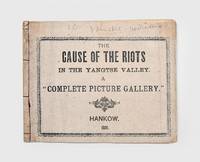
1891175500Hankow: no stated publisher 1891. Anything more horribly beastly and disgusting than these painted representations it would be impossible to imagine Sole edition of this collection of 32 images used by anti-Christian agitators in central China to whip up anti-foreign sentiment. They "appeal directly to the folk and elite traditions of China's classical past. In vivid colours they depict graphic violence. and show graphically the growing conflict between western missionary views of China and Chinese views of the Western presence" Perdue. The treaties signed at the end of the Opium War authorized western missionaries to proselytise in the Chinese hinterland. During the late 19th century when Chinese agriculture and rural life faced steep decline missionaries became popular scapegoats. "The original causes might be a dispute over land or water rights or an inappropriate marriage or an illicit love affair but the conflict could easily metastasize into large scale violence" Perdue. During the 1891 riots hundreds of Chinese Christians and two western missionaries were killed. The editor the missionary John Griffith based this publication on a pamphlet attributed to the Hunanese official Zhou Han 1842-1911 who used a publishing outfit in Changsha to disseminate a large quantity of anti-foreign literature. Zhou's images employ colour allegory and popular folk custom to "attack religious heterodoxy and sexual deviance with violent rhetoric. They portray the Christians as animals who know nothing of the moral codes that define humanity. The pictures portray the Western missionaries as goats and their Chinese followers as pigs. The play on words linking 'Jesus' as 'master' zhu with 'hog' zhu or 'Westerner' yang with 'goat' yang reduced the Christian believers to a bestial level. The use of the color green indicating 'cuckold' in the characters referring to Christians signified the undermining of the family by the alien believers. In a number of these images the animalistic Christians are brought before a god or magistrate who sits in judgement and offers them as sacrifices by having their throats slit" Purdue. Landscape quarto. With 32 full-page colour woodblocks colour Chinese title page. Original printed wrappers recent purple thread xianzhuang stitching front cover lettered in black rear cover with decoration and Chinese text in red black and green. Housed in custom burgundy quarter morocco box. Contemporary manuscript notation on front cover. Wrappers and edges of leaves creased and bumped rear cover rather worn recent adhesive tape repair to Chinese title page verso of final folded leaf sometime laid down onto rear wrapper illustrations bright stab-holes from original binding visible in gutter: a very good copy of a fragile work. Peter Perdue "The Cause of the Riots in the Yantgse Valley 1891 - Introduction" available online. unknown
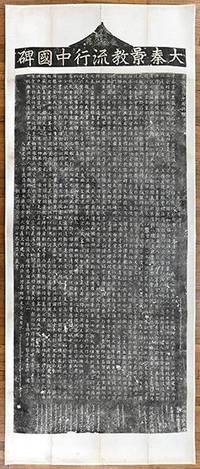
1900174874Xi'an China: c.1900. China's "Christian Rosetta Stone" A rubbing of the most famous document of Chinese Christianity. When rediscovered the Nestorian Stele transformed understanding of the cross-cultural history of Tang dynasty China. "The discovery of this monument is what made Westerners aware of the presence of Christianity in China prior to the mission of the Franciscans in the thirteenth and fourteenth centuries and those of the Jesuits" Nicolini-Zani p. 117. The Nestorian stele was carved in 781 and stands at almost three metres tall. The Chinese inscription in the calligraphy of a local official Lu Xiuyan describes how Christians arrived at the Tang capital of Xi'an in 635 and with official permission founded churches. The stele also introduces in Chinese and Syriac some of the community's senior clergy and the present state of the Nestorian church. "Erecting a stone monument to describe commend and propagate its teachings was no small undertaking for the Tang Christian community. Putting up stone monuments was an expensive exercise because of the price of the stone and the fee of the expert artisan who engraved the text. The monument itself makes an important statement about the place of Christianity within Tang society" Nicolini-Zani pp. 120-1. In 845 Christianity was banned by Emperor Wuzong and the stele was buried. Rediscovered by Chinese antiquarians around 1625 it brought to light a lost dimension to China's history and translations soon appeared in Jesuit sinological writings including Kircher's China Monumentis 1667 which includes the first printed reproduction of the text. The stone now stands at the Beilin Museum in Xi'an and is listed among the small number of protected antiquities that will never be exhibited abroad. Rubbings from the original are no longer permitted. Provenance: the theologian and sociologist Y. Y. Tsu 1886-1986 also known as Chu Yu-Yu. Born in Shanghai Tsu studied at St John's College Shanghai and at Columbia where he was one of the first Chinese students of sociology to study abroad. In 1912 he became Professor of Sociology at St John's and later served as religious director of the Peking Union Medical College. "In 1940 he was consecrated an Episcopal bishop in Shanghai and was named Assistant Bishop of Hong Kong and Bishop of Kunming where he began his Burma Road work. Bishop Tsu was known. as the 'Bishop of the Burma Road' because of his efforts to befriend Allied troops traveling the international highway that ran through his district" obituary in New York Times. In 1931 Tsu held a visiting lectureship at the Pacific School of Religion in Berkeley California. This rubbing was gifted to the institution by Tsu and displayed there during the 1930s. It is regularly mentioned as a point of interest in contemporary tourist guides to the state. Rubbing from stone on multiple paper sheets arranged soon after execution to form 120 x 320 mm curved headpiece 100 x 588 mm title and 1825 x 870 text body mounted on four long pieces of paper joined to form area of 2338 x 958 mm edges of mount reinforced with old decorative white paper. Rubbing generally sharp and legible a few surface blemishes sectional joins expertly reinforced in places on verso: a very good example of an imposing piece. Matteo Nicolini-Zani The Luminous Way to the East: Texts and History of the First Encounter of Christianity with China 2022. unknown
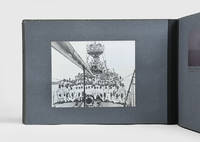
1898178920China Japan and at sea: 1898-99; 1911-13. The "scramble for China" An important visual record of Germany's empire-building in China and naval life in East Asia before the First World War including early views of Qingdao. It was assembled by Hermann Mörsberger a future rear-admiral who served at Kiautschou Bay during the 1897-8 crisis and commanded the East Asia Squadron's SMS Nürnberg between 1911 and 1913. The murder of two missionaries in Shandong in 1897 offered Germany an excuse to deploy troops to Kiautschou Bay and press its case for a concessionary area - and strategically positioned port - on Chinese soil. Attached to the Matrosenartillerie-Detachement Kiautschou as a leutnant zur see Mörsberger 1872-1940 shipped out to China in late 1897 on the screw steamer Darmstadt. The ship's arrival off Qingdao in January 1898 and the rapid deployment of its marines confirmed Germany's de facto control of the territory and left the Qing government with little option but to grant a concession. The first album opens with a photograph of Darmstadt and superb photographs of the cruiser SMS Kaiserin Augusta - ordered to China to brandish its dozen guns - and other powerhouses of the squadron including Cormoran Irene and Prinzess Wilhelm. Images show the parade on 27 January 1898 to welcome the future governor Rear-Admiral Ernst Otto von Diederichs 1843-1918 and Qingdao's artillery dump and yamen. Missionaries were hot on the navy's heels the album containing a group portrait of Joseph Freinademetz and other visiting Catholic missionaries in February 1898 as well as several pieces of red paper with their Chinese and Western signatures. After the legal takeover of the concession Mörsberger transferred to Kaiserin Augusta visiting Shanghai Hong Kong and Tokyo. More standard tourist views of Shanghai including a nicely composed image of a junk moored in the river are arranged alongside photographs of the unveiling of the city's ltis Monument on 21 November 1898. In a more relaxed moment Mörsberger poses playfully with other junior officers. German power did not take long to bed in. Within a decade and a half Mörsberger - now a fregattenkapitän - returned to Qingdao with Nürnberg a Königsberg-class light cruiser and the squadron's newest member. A panorama shows the armoured cruiser SMS Scharnhorst the flagship of squadron commander Count Maximilian von Spee docked in newly built facilities the recently christened Prince Heinrich Hill in the background. Nürnberg moves between ports as part of its Yangtze patrol duties Mörsberger obtaining panoramas taken from the river of Shanghai Zhenjiang Jiujiang Nanjing and Hankou as well as shots of other squadron vessels. Alongside official events including the welcoming of official dignitaries and the parade to celebrate the 25th anniversary of the Kaiser's coronation there is time for tourism parties and an international rowing contest. Four unusual photographs capture the illuminated buildings of Shanghai at night. A small proportion of material concerns Japan Thailand Honolulu and Mexico. Many of the professionally executed photographs concerning China were clearly circulated only within the German military and in small numbers. 2 albums landscape folio. With 195 mounted albumen platinum and gelatin silver photographs including 31 large portraits and views c. 145 x 205 to 205 x 280 mm 26 panoramas c. 90 x 290 to 110 x 340 mm and 138 small photographs c. 55 x 80 to 145 x 210 mm. Together with other laid-down material: 17 items of printed ephemera documents menus etc. 14 ms. items some in Chinese ms. map watercolour 110 x 140 mm. With 4 ms. maps printed map photographic panorama and printed passport loosely inserted. Neat German captions. First album: original black half sheep green cloth sides decorative linings card leaves hinged with black cloth. Second album: original green cloth lettered "S.M.S. Nürnberg" in gilt on front cover decorative linings black cloth rear pocket card leaves hinged with black cloth. Material well preserved occasional offsetting fading and yellowing to some photographs but detail still readily discernible one photograph splitting along old horizontal fold binding of first album worn second sunned and with a few abrasions: very good. hardcover
187464884Berlin, R. Wagner, (1871-1874). Imp.-Fol. (62 x 53 cm). Mit 34 chromolithogr. Farbtafeln v. R. Steinbock (27) u. W. Loeillot (7) nach Eduard Hildebrandt, vom Verlag auf Untersatzkartons montiert. Zus. m. dem letzten Orig.-Lieferungsumschlag lose in schwarz- u. goldgepr. illustr. OLwd.-Mappe.
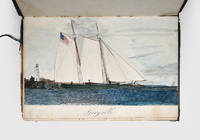
1842170558At sea & China: 1842-48. This ground is under English control though their authority is might makes right An American second mate's illustrated eyewitness account of China in the immediate aftermath of the First Opium War. Sailing east on a Jardine Matheson specie and opium runner he becomes an old China hand and a sharp observer of early colonial Hong Kong and Shanghai coastal trade and maritime life. The opening section consists of diary entries kept during the outward voyage from the United States describing a life of adventure entered almost by accident. "On the 1st of Sept. 1842 being in Boston and out of employ I shipped in the Schr Gazell" p. 1. The Gazelle - an Aberdeen-built schooner illustrated in watercolour at the front of the manuscript - sailed on 19 September 1842 with guns muskets and nine boxes of specie. Some 30 pages trace the passage with detailed daily entries including latitudes and longitudes weather hazards marine life shipboard routines and the rituals of crossing the Equator. After rounding the Cape the vessel encounters American traders off China and reaches Macao on 22 February 1843. The remainder of the manuscript comprises reflective recollections written later in the 1840s. Macao is judged healthy and pleasant but eclipsed after the war by Hong Kong now the hub of British trade. The Gazelle is reassigned to opium running along the coast bringing higher pay and extended travel. The author recalls Hong Kong in 1844: the nightly curfew gunshot the opium fleet at Whampoa and the crowded Pearl River illustrated with pencil sketches of local craft. His view of the Chinese population is unsympathetic though he offers a vivid portrait of "Boston Jack" a wealthy comprador and indispensable intermediary to American ships. Further chapters describe Canton the forts of the Bogue Amoy and its junks and Chusan praised for its industry and abundance. Shanghai emerges as a newly important centre of opium exchange its foreign settlement firmly under British control. The author sketches the harbour notes the thousands of junks and contrasts the city's "civil and obliging" inhabitants with those of Canton. The manuscript breaks off mid-sentence on page 50 leaving the writer's later life unknown but preserving a detailed first-hand record of a China on the threshold of colonial modernity. Octavo notebook 252 x 165 mm. Opening full-page watercolour 12 illustrations and plan in pencil. Original blue linen pink patterned endpapers edges sprinkled blue 49 pages neatly written in black ink 38 unused blanks. Notebook worn and shaken with sewing loose a few closed tears internally touching a few letters only. A very good example. unknown
1873312749Shanghai: Printed at The "North China Herald" Office 1873. First edition. Presentation copy inscribed from the author to Douglas Jones on first blank. Title-page printed preface and text with holograph manuscript by Jones on the Index and Game Register. Pp. vii 116 Diary & Game Register accomplished in ink 4 pages unused; 1-50. 1 vols. 4to 10-1/8 x 8 inches; 257 x 203 mm. Contemporary full brown roan upper cover titled in gilt. Spine neatly rebacked notes on front endsheets. Quarter black morocco slipcase and cloth chemises. First edition. Presentation copy inscribed from the author to Douglas Jones on first blank. Title-page printed preface and text with holograph manuscript by Jones on the Index and Game Register. Pp. vii 116 Diary & Game Register accomplished in ink 4 pages unused; 1-50. 1 vols. 4to 10-1/8 x 8 inches; 257 x 203 mm. "The immense tracts of country available for purposes of sport and well stocked with game the entire absence of game laws and the friendly disposition of the natives combine to render Keang-soo and the adjoining provinces a very Paradise for sportsmen ." Groom from the Preface. <br /> <br /> Early work on hunting in China with a partly printed dairy and "Register of Game Bagged" here accomplished with an extensive and detailed manuscript of expeditions from 1878 to 1892 recounting trips on the Merlin and other boats after deer waterfowl and other game listing participants names of dogs and game bags. The manuscript is followed by the printed text with notes on boats guns and kit "The Medicine Chest" cookery and chapters on various types of game pheasant snipe wild pig and a printed Vocabulary with Chinese/English translations and phonetic transcriptions.<br /> <br /> Among the hunting companions of Jones in the 1885 season was Bell-Irving author of Diary of the Ewo Party 1890. Both Jones and Bell-Irving are quoted frequently in Wade's With Boat and Gun in the Yangtze Valley 2nd ed. 1910.<br /> <br /> Some interesting ephemera has been preserved including printed Chinese broadside shooting permits for Jones for the years 1884 and 1885 a shooting permit for Hong Kong and the New Territories 1894; fivee sketch maps of Kiang Su Le Yang and Kashing; four small photographs of Hong Kong mounted on the verso of a Victorian photographic portrait of Douglas Jones; a manuscript translations of Chinese verse by one of Jones' companions and four autograph letters on sporting topics or introductions and requests to assist Jones in his up country trips; and a stray sheet of printed letterhead of the Union Insurance Society of Canton Shanghai where Jones was Secretary.<br /> <br /> A UNIQUE AND SUBSTANTIAL RECORD OF SPORT IN CHINA. Czech Asia p. 93. Not in OCLC Printed at The "North China Herald" Office unknown
1890312761London: Printed at the Army-Navy Cooperative Society Limited 1890. 3 mounted albumen photographs of the shooting party with their trophies head- and tailpieces. xii 170 pp. 1 vols. 8vo 7-3/4 x 5 -3/8 inches; 196 x 137 mm. Contemporary full black morocco over stiff card covers ruled in silver upper cover with text in blindstamp edges silvered decorative endpapers. Finely rebacked to style; edges rubbed. Black morocco backed slipcase and chemise. 3 mounted albumen photographs of the shooting party with their trophies head- and tailpieces. xii 170 pp. 1 vols. 8vo 7-3/4 x 5 -3/8 inches; 196 x 137 mm. A signed presentation copy from the author John Bell-Irving to Douglas Jones. <br /> Bell-Irving was a Scottish businessman and partner in the Hong Kong trading firm Jardine Matheson and a director of the Hong Kong Electric Company. Jones was Secretary of the Union Insurance Society of Canton of Shanghai. <br /> "The greatest pleasure in up-country shooting trips" Bell-Irving claims "is the idea of perfect freedom far removed from business cares and beyond the reach of letters and telegrams." Succinct account of many hunting trips after pheasant waterfowl deer and other game with observations on weather and conditions and game bag. Bell-Irving and Jones are quoted frequently in Wade's With Boat and Gun in the Yangtze Valley 2nd ed. 1910.<br /> <br /> A SUSTANTIAL ACCOUNT OF SPORT ALONG THE YANGTZE OVER THREE DECADES.<br /> <br /> EXCEEDINGLY RARE. OCLC 42241800 Princeton Printed at the Army-Navy Cooperative Society Limited unknown
189532714Ca. 1895 / 96. Format fast 4°. (Original) Halbleder. [5 Warenabbildungen]
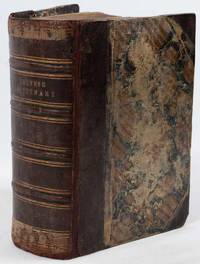
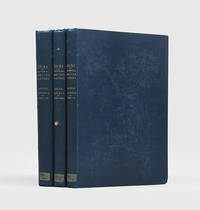
1865219705Shanghae sic & London.: London Mission Press and Trubner & Co. 1865. Two volumes in one: <br>Volume I. ii Title i-x Advertisement Preface 762 pp including Index of Chinese characters pp 1-99 pagination duplicated for pp 224 & 239. <br>Volume II. ii Title 724pp iv List of the Radicals of the Chinese Language. <br> <br>22 x 15 cms contemporary half calf spine gilt between raised bands expertly rebacked mounting the original spine numerous annotations and underlinings in pencil a handful in ink at the head the final blanks with notes and translation age-toned and worn boards rubbed but a good complete copy of the scarce reprint. <br> <br>Provenance: <br>With the early inked signature of "Hugh Wadell Newchwang 1869" the pioneering missionary whose work laid the foundation for the Irish Presbyterian Church's long-term presence in East Asia. In 1869 Waddell 1839–1901 landed at Newchwang now Yingkou where he established a mission station that included a church school and dispensary. His daughter was Helen Waddell poet scholar and theological novelist. <br> <br>Recent signature of A. Allan Shearer Wellington. Scarce reprint of the second part of Morrison's Dictionary first published between 1815 and 1823 with a notable provenance. The 1865 reprint was issued as a single volume combining the second part of the dictionary with an index of characters arranged according to the Kangxi radicals. <br> <br>"The Second Part of Morrison's Dictionary has been generally commended by experienced Sinologues as the most perfect and useful of the whole. The present is merely a reprint of it with such slight modifications as are mentioned at the close of the original preface." Preface <br>Löwendahl 1334 . London Mission Press [and] Trubner & Co. hardcover
181038599Canton Guangzhou workshop 1810. Watercolour and opaque body-colour with ink on thick chinese paper depicitng 1. A Temple Compound and 2. An Imperial Pleasure Garden. Sheet size: 16 1/8 x 22 inches. An exceptional pair of Chinese export watercolours rich in architectural detail exemplifying the pictorial conventions developed to frame China for European eyes.<br/> <br/> A fine pair of large-scale architectural fantasy views produced in a Canton workshop for the export trade at the height of the China Trade period. The compositions exemplify the hybrid artistic language developed for Western patrons by Chinese painters trained in native techniques yet attuned to foreign tastes for picturesque and monumental subjects. The first painting depicts a two-courtyard Buddhist or Taoist temple approached through a three-bay shan-men ceremonial gateway flanked symmetrically by drum and bell towers. A painted screen wall in the inner court displays guardian deities in brilliant red while the gilded Buddha presides from an elevated rear hall. The temples architecture is stylized but evocative of southern Chinese religious compounds. Above the gateway a plaque bears brush-written characters reading "Beautiful Hall of Profound Reverence" a fictive name likely invented by the workshop for decorative effect rather than to identify a specific site. The second painting shows a walled palace complex centered around a multi-tiered pavilion rising from a lotus pond filled with sculptural rocks and pleasure boats. Dragon grottoes stone causeways and ornamental bridges evoke the fantastical terrain of imperial parks such as the Yuanmingyuan rendered here in a compressed stage-set perspective. White elephants bearing crimson banners guard the main gate signaling a courtly or ceremonial setting. While reminiscent of northern gardens the details are compositional inventions rather than topographical records. The palette vermilion malachite green gamboge and carbon black and the use of crisp ink outlines are typical of late 18th-century Canton export workshops. Unlike smaller pith-paper images destined for albums these works were painted on thick laid paper of generous dimensions. Loose drawings such as these were often compiled into custom albums in British India where Chinese watercolours were often combined with Indian and Persian material to appeal to the tastes of British collectors. The Persian-Urdu foliation on the verso indicates their inclusion in such a collection likely assembled in Calcutta or Lucknow in the early 19th century. While drawing upon recognizable architectural forms and cultural symbols the views are best understood as imaginary or composite constructions designed to satisfy European curiosity about China. The temple compound reflects generic southern typologies while the palace garden borrows selectively from northern models such as the Yuanmingyuan. unknown
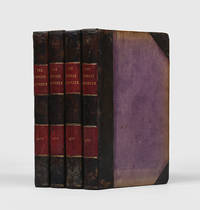
1875160133Shanghai: American Presbyterian Mission Press 1875-78. The most important interdenominational missionary journal of the time A collection of four scarce early volumes of this Shanghai-based periodical which served as the expatriate missionary community's premier forum for sinological exchange including contributions on philosophy social history linguistics literature and religion. Early volumes are now seldom encountered in commerce. The Chinese Recorder and Missionary Journal was first published in 1868 in Fuzhou under the editorship of Stephen Livingstone Baldwin and then Justus Doolittle. In 1874 editorial responsibilities were passed to Alexander Wylie 1815-1887 the agent of the British and Foreign Bible Society in Shanghai with the city's American Presbyterian Mission Press taking over printing and distribution. Issued every two months the journal featured articles by leading missionary-sinologists including Emil Bretschneider Henry Yule Timothy Richard and Samuel Wells Williams. 24 parts in 4 vols octavo 235 x 153. With 4 folding plans and maps 3 woodblock and printed on delicate rice paper illustrations in text. Vol. VIII bound without the index. Contemporary black half sheep A. H. Chen Shantou recently rebacked with original spines laid down red spine labels purple wavy-grain cloth sides. Bindings somewhat worn and faded small piece of leather reglued at head contents generally fresh folding plans with occasional creasing and stub tears. A very good set. Francesca Torocco The Cultural Practices of Modern Chinese Buddhism 2007. hardcover
1895182165Shanghai: Published at the Statistical Department of the Inspectorate General of Customs 1895-1905. I believe the Inspectorate aided by its Medical Officers can do good work A lengthy run of this valuable specialist compendium. Each issue had a circulation of around 500 copies only the majority sent to customs stations and libraries as well as diplomats and naval officers and copies are therefore rare in commerce. The Chinese Maritime Customs Service was founded in 1854 by Britain and other foreign powers to collect taxes on maritime trade for the Chinese government but its remit quickly expanded to include domestic customs administration the postal service waterway and harbour management and scientific research. In 1870 Inspector-General Sir Robert Hart instituted this series information to be provided by the medical officers assigned to customs stations. Issues were issued on a yearly or half-yearly basis sometimes in double numbers. "This network of epidemic monitoring and ecological investigation which was gradually built up by the medical officers and medical missionaries extended throughout East Asia and created a huge medical database" Gao p. 54. 17 works bound in 3 quarto 271 x 220 mm. With plates charts maps and diagrams throughout some folding and a few in colour; occasional text in French. Contemporary blue library cloth spines lettered in gilt top edges sprinkled brown other edges untrimmed original yellow wrappers bound in. Ex-Bodleian Library with its shelf labels on spines pencilled pressmarks and accession and cancellation ink stamps. Bindings lightly worn and rubbed one spine with abrasions to cloth occasional short closed tears internally the odd repair and loss but a very good usable collection. Gao Xi "Discovering Diseases: Research on the Globalization of Medical Knowledge in Nineteenth-Century China" in David Luesink William H. Schneider and Zhang Daqing eds China and the Globalization of Biomedicine 2019. hardcover
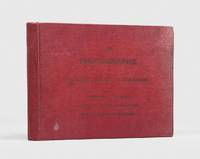
1900176895Shanghai: Brewer & Co. c.1900. From the Chefoo Bluff to Lamtong Head Sole edition untraced institutionally the copy of Vice-Admiral Seymour's chief of staff in Tianjin during the Boxer Uprising. This photographic guide is designed for "the navigator of this changeable and frequently foggy locality" preface. We have traced only one other copy which appeared in commerce in 2017. Navigators in the late Qing period could rely on only a small network of lighthouses and fixed navigational aids when sailing the Chinese coast. "In thick weather even a person familiar with the coast is at a loss to identify a well-known Islands with its summit" preface. The thirty views include the Chefoo Bluff in the Pechili Gulf the waters near the Hieshans Light House Zhejiang and Hong Kong's Lamtong Head. A concerted period of lighthouse-building in the 1910s and 1920s obviated the need for further publications of this kind. Provenance: though unmarked as such this copy was owned by Captain Edward Henry Bayly C.B. 1849-1904 Commander of the International Forces at Tianjin in June 1900. Bayly had a lifelong career in the Royal Navy. He was promoted to the rank of lieutenant in September 1873 commander in June 1887 and captain in January 1894 having served overseas in numerous ships. Bayly captained HMS Pelorus during the fleet review for Queen Victoria's diamond jubilee in 1897 and in 1899 became captain of the armoured cruiser HMS Aurora on the China station. During the Boxer Uprising he replaced the wounded John Jellicoe as chief of staff to Seymour was mentioned by Seymour in dispatches and remained at Tianjin until the withdrawal of naval forces. He retired at his own request in February 1904. Landscape octavo. With 30 mounted collotypes within red frames. Original red cloth front cover lettered in gilt white coated endpapers leaves hinged with white linen as issued. A little shaken binding sunned and stained contents well preserved a little toning at fore edges: a very good copy. hardcover
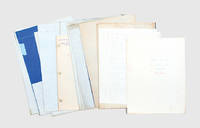
1822188322Various cities and architects: c.1918-22. Building Republican China An appealing collection highlighting the role of foreign finance and architectural expertise in the modernization of Republican China's major commercial centres. The blueprints show business premises Western-style houses and apartments and a theatre. Seven were issued by the architectural firm of Henry Charrey and Marcel Conversy. Based in Jinan the firm was employed from 1918 by the Belgian-French company Crédit Foncier d'Extrême-Orient which financed and oversaw construction in Beijing Shanghai Tianjin and other cities with a foreign presence. In Jinan Charrey & Conversy were involved in the laying out of a new post office compound and designing Western-style houses. Also present are blueprints for offices for the Danish outfit Andersen Meyer & Co. which arrived in the city in 1916 and a hong for the Asiatic Petroleum Company. A second group relates to the Tianjin civil engineers Brossard Mopin & Co. Founded in 1910 it specialized in buildings made with reinforced concrete. A large plan shows the imposing front face of a proposed building for the Gongxian Arsenal one of China's main manufacturers of weaponry and ammunition. In Tianjin Brossard Mopin also contracted for apartments and a new theatre and clubhouse for the China Theatre Company the floorplans here accompanied by textual overviews of the projects. Accompanying these two groups are a 1919 plan of Tsinghua University Beijing and seven blueprints for houses in a "Peking model residential centre" which was proposed by the city authorities in the early 1920s. This collection belonged to the engineer G. Gregoire who worked for the Crédit Foncier d'Extrême-Orient in partnership with both Charrey & Conversy and Brossard-Mopin & Co. His signature as the lead architect appears in the seven Charrey & Conversy blueprints and his ink stamp is on nearly all of the material suggesting his involvement in the wide range of projects. 21 blueprints 217 x 255 mm to 625 x 1130 mm; 2 project booklets in French each 6 pp. duplicate typescript and typescript cover sheet fixed with 3 butterfly clips. Various ink stamps numbers and annotations on booklets and verso of blueprints. General browning and light creasing couple of short splits plan of Tsinghua University slightly faded and lacking contrast but generally a well-preserved collection. unknown
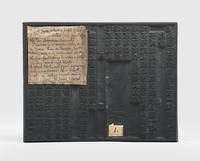
1880183225China: c.1880. China on Thomas Hardy's doorstep Labels on both faces indicate that this artefact of missionary printing was owned by Henry Joseph Moule 1825-1904 a close friend of Thomas Hardy and the brother of two prominent China missionaries. Moule was the first curator of the Dorset County Museum where this woodblock was perhaps displayed to a curious public. Moule's seven brothers included George Evans Moule 1828-1912 consecrated the first Bishop of Mid-China in 1880 and Arthur Evans Moule 1838-1916 who was active in Ningbo and Shanghai and who also wrote prolifically on Chinese history and current affairs. The primary face has the text of the fourth to tenth commandments as given in Deuteronomy and the carving employs a songti character style with serifs. The largest of the labels reads "Block from which a page of a book has been printed; viz. part of the Ten Commandments. Printing is a much older art in China than in Europe but always was and is performed as by the pre-Gutenberg European printers viz. from wood-cut blocks. A rough block with wood-engraving tools accompanies this block; and also an inking brush and a printing pad. The press is used China." Moule is named on a small label on the reverse. Single wooden block 165 x 210 mm engraved in 8-columns on primary face one column of characters and page subdivisions on secondary face 3 manuscript labels the largest covering upper-left quadrant of primary face. Contemporary blue pencil note on secondary face. General signs of handling carved character distinct: very good. unknown
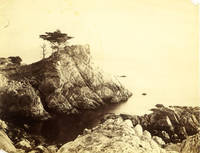
1880J6SGPBJ1IXLV1880. With 12 albumen prints ranging in size from ca. 16.5 x 23 cm to 21 x 28 cm. Collection of 12 vintage photographs from the late 19th century showing China Indonesia the Hawaiian Islands California and Egypt. Of the 4 photographs of China 2 show Hong Kong including one possibly by the famous Chinese photographer Lai Fong ca. 1839-1890 showing Queen's Road Central. The two rarest photographs show several of the 7500 imperial examination cubicles in Canton Guangzhou while a photograph by A Chan Ya Zhen shows the famous five-story pagoda on Kun Yam Hill in 1870. The Indonesian island Java can be seen on 3 photographs including one of lake Telaga Warna by the British firm Woodbury & Page based in Batavia Jakarta. Taken further to the west were 3 photographs of Hawaii probably all taken in or near Honolulu. A rare undated photograph of the statue of King Kamehameha was taken probably right after the unveiling ceremony in 1883 as it shows a small wooden fence around the statue which can be seen in an illustration in The Graphic 28 April 1883 but is absent from all later images. Of the 2 final images one by Isaiah West Taber 1830-1912 shows Midway Point in Monterey California and the other by Hippolyte Arnoux fl. 1860-1890 a group of Arabs and camels waiting for the ferry near El Qantara in Egypt. Most of the photographs are worn at the edges with small tears and folds and a few have small holes; one of the images of Hawaii with a waterstain at the lower margin. unknown
1864223685Shanghai.: Presbyterian Mission Press. 1864. viii 279 pp. contemporary half roan rubbed 23.3 x 16.5cm marbled boards spine gilt lettered a little light rubbing to the boards last two leaves archivally strengthened at the hinge small tidemark to the inner corner of the title-page age-toning and some offsetting to the text inked signature of an early owner Dec. 1870 Fred. P. Napier lettering on spine a little worn a good complete copy. The second work published by the remarkable sinologue missionary and linguist Joseph Edkins 1823-1905. This second edition is noted for its deeper inquiry into the Peking dialect specifically its "laws of tones and accent" <br>The book is divided into three primary parts designed to move a student from basic sounds to complex communication: <br>Part I: On Sound: Detailed exploration of pronunciation the tonal system and phonetics. <br>Part II: Parts of Speech: A categorical breakdown of Mandarin vocabulary and functional grammar. <br>Part III: Syntax: Guidance on sentence structure and verbal interaction. <br>Appendices: Includes discussions on southern Mandarin dialects Mandarin literature and contemporary Chinese philology <br> <br>Lowendahl 1811 Supplement. . Presbyterian Mission Press. hardcover
18041100731804. First Edition. CHINA MASON Major George Henry MILLER William publisher. The Punishments of China Illustrated by Twenty-two Engravings. London: William Miller 1804 i.e. circa 1819. Folio 10-1/2 by 14-1/2 inches contemporary full straight-grain burgundy morocco elaborately gilt-decorated spine all edges gilt. $3200.Later edition of this survey of the punishments of China illustrated with 22 folio engravings each finely hand-colored. A handsome copy in contemporary morocco-gilt.This collection depicts a variety of Chinese punishments for assorted crimes as well as appearing before a magistrate being conveyed to prison and being conducted to trial. This volume originally formed part of publisher William Miller's six-volume series on costume each volume separately issued: The Punishments of China 1801 The Costume of Turkey 1802 The Costume of Russia 1803 The Costume of China 1804 The Costume of Austria 1804 and The Costume of Great Britain 1804. This is a later reprint as is shown by the watermarks text leaves watermarked 1818; plates 1819 of the 1804 edition text printed by Wilson rather than Bulmer. ""The first edition was apparently in 1801"" Abbeyhe had this circa-1819 reprint in his collection. Another edition appeared in 1808. Text in English and French. Abbey Travel 532. Colas 2010-12. Prideaux 317. Lipperheide 1522 1808 edition. Plates clean and fine hand-coloring vivid. Attractive contemporary morocco-gilt binding with expert repairs to joints and corners. An excellent copy. Scarce. unknown
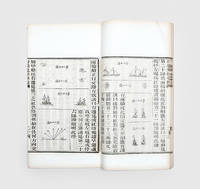
1895188172Shanghai: Jiangnan zhizao ju "Jiangnan Arsenal" 1895. Turning China into an economic powerhouse First edition issued by Shanghai's Jiangnan Arsenal as part of the late-Qing "self-strengthening movement" during which a wave of radical commercial scientific and legal changes aimed to rapidly modernize China's economy. The text was overseen by John Fryer 1839-1928 who translated more Western scientific works into Chinese than any other 19th-century sinologist. In 1868 Fryer was recruited by the Jiangnan Arsenal a hotbed of political and military reform to join its dedicated Translation Office. Over the next three decades he produced dozens perhaps even hundreds of publications for the use of trainee officers and scientists. For the present work Fryer co-operated with the Westernized engineer Zhong Tianwei 1840-1900 and drew inspiration from provisions introduced in successive British parliamentary Acts regulating merchant shipping. Sections discuss systems of signal lights how ships can safely pass alongside each other and best practices for pilots and navigators. Quarto 295 x 175 mm ff. 1 38 25. Illustrations in text; text in Chinese. Near-contemporary brown wrappers renewed xianzhuang stitching Recent bookseller's manuscript ticket on rear binder's blank. Wrappers dust-soiled front cover sometime repaired at foot with repurposed piece of printed paper rear cover with a little worming at head extending into margin of last 2 printed leaves: very good. unknown