Rackham, BernardBiblio.com

3 141 résultats
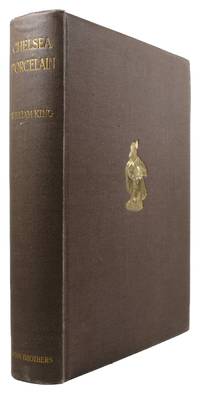
192216496London: His Majesty's Stationery Office 1922. 2nd. Hardcover. Fine. 9.8x7.7x1.1in. 3/4 red morocco linen covered boards top edge gilt; bookplates on pastedown and front endpaper. <br>650 objects are described. Illustrated with 99 black and white plates. <br>172pp 2.85lb 9.8x7.7x1.1in His Majesty's Stationery Office hardcover
197912868Washington: Smithsonian Institution Press 1979. 1st. Hardcover. New/New. 11.6x9.6x1.7in. in shrinkwrap. <br>The first volume of a proposed four volume set on the Hans Syz collection. 400 objects are described and illustrated several in color. <br>697pp 8.11lb 11.6x9.6x1.7in <br>EXTRA SHIPPING CHARGES NECESSARY Smithsonian Institution Press hardcover
1967037883Los Angeles: Marvin H. Newman 1967. 1st Edition . Soft cover. Near Fine. 30 Pp. Complete Catalog; The Second Session Containing The Balzer Orientalia From Robert Balzer's Library. Shows Prices Realized In Balzer's Hand. Covers Browning At Edges Otherwise Fine. Robert Balzer Was One Of The Most Prominent Food And Wine Critics In California And Was Considered Instrumental In The Rise Of The Finer California Wines. <br/> <br/> Marvin H. Newman paperback
1966w220931819Ch'eng-Wen Publishing Company 1966. 367pp. Green cloth hardback 359pp. Green cloth hardback no DJ's volume one has slight faded area on front cover fold out maps in each volume index footnotes volume one has books one and two volume two has books three and four Cathay and the Way Thither : Being a Collection of Medieval Notices of China . Hard Covers. Very Good. Ch'eng-Wen Publishing Company
198828756China: CCTV 1988. First Edition ~1st Printing. Hardcover. near fine in very good dust jacket in fresh mylar cover; minor scuffing to jacket gentle softening to jacket edges small address label on free front endpaper else a tight square unmarked copy in unclipped dust jacket; text in Chinese CCTV hardcover
14634Celluloid collar advertising card with illustration of men emerging from the water wearing the waterproof collars and cuffs as a Chinese laundry worker tearfully watches and in the background pig tail wearing Chinese laundry men depart on boats "Off for China". With advertising text at verso "For Sale at Auer's North Pearl St Albany. Not dated. <br /> <br /> 5 1/4 x 3 1/4" slt marked at verso o/w very good. unknown
14626Corset clasp advertising card with illustration of three Chinese pig tail wearing laundry workers comparing a corset without the new corset clasps and one with the new product. With text at the top: "Side & dress steels guaranteed not to rust". With additional advertising text on the verso. Not dated. 5 1/2 x 3 1/2 in. Upper right corner of front of card slt creased slt toning to lower edge of verso of card o/w very good. unknown
200722653Milwaukee WI: Chipstone Foundation 2007. 1st. Hardcover. New/New. 11.3x8.9x1.2in. in shrinkwrap. <br>314pp 4.24lb 11.3x8.9x1.2in Chipstone Foundation hardcover
200218585Milwaukee WI: Chipstone Foundation 2002. 1st. Soft cover. New. 11.0x8.5x0.9in. in shrinkwrap. <br>300pp 3.24lb 11.0x8.5x0.9in Chipstone Foundation paperback
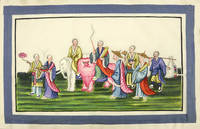
91713Canton 2nd half of 19th century. . A set of 10 watercolour and gouache studies on pith paper; one with a long horizontal closed tear. Contemporary red patterned silk binding; upper hinge broken and upper cover detached.<br /> <br />Pith seems not to have been adopted for painting until about 1820. Some European museums claim that their paintings on pith often erroneously called "rice paper" or "mulberry pith" come from the end of the eighteenth century but there do not seem to be any dateable examples that are so early. There is a record of the Kaiser Franz of Austria buying some albums from an English Consul-General Watts in 1826. We know of an Italian Count who visited Canton in 1828 and had over 350 paintings on pith in his baggage when he died in Ambon two years later. In the British Library there is a scrap-book containing six pith paintings and a journal entry by a serving British officer who sent them home from India in 1829. These examples and contemporary accounts by visitors to Canton suggest that there was a flourishing trade in pith paintings by the early 1830s.<br /><br />Pith presumably came into use for painting to satisfy the increasing demand for small inexpensive and easily transported souvenirs following the massive growth in the China Trade in the first quarter of the nineteenth century. Paintings in oils on board and canvas were costly and difficult to carry home. Earlier and more prestigious export water-colours had often been on a larger scale and painted on fine Chinese paper or on paper imported from Europe. The albums of pith paintings and later the little glass-fronted boxes were inexpensive light easy to pack and gave the pictures some protection on the long voyage home. Because many were sold in albums and hence protected from the light they retain their bright colours to this day.<br /><br />Pith comes from the central column of spongy cellular tissue in the stem of a small tree called Tetrapanax Papyrifera native to south-west China. It has had a variety of uses some going back many centuries. At the imperial court both men and women wore coloured flowers made from pith in their hair. For use in painting it is cut by hand with a knife into thin sheets from short lengths of the spongy tissue. Cutting is highly skilled and the constraints of the process mean that the finished sheets for painting seldom if ever measure more than about 30cms by 20cms. The sheets are dried trimmed and used for painting without any further processing.<br /><br />Because of the nature of pith and its cellular structure the gouache used by the Chinese sat on the surface and produced a bright and even sparkling effect. Very fine detail could be achieved but pith did not lend itself to the flat wash of colour favoured for European watercolours. <br /><br />Carl Crossman in his book The Decorative Arts of the China Trade originally published under the title The China Trade gives an excellent list of export painters with a note of those known to have painted on pith. These include Tingqua Sunqua and Youqua. From 1757 until 1842 Canton was the only Chinese port open to trade with the west and it is no surprise that of the eight studios identified by Crossman as producing works on pith six were in Canton. <br /><br />It seems that the 1830s and 1840s may have been the heyday of pith painting. The international trading bases the waterfront 'factories' on the 'Hongs' in Canton where they were produced were partially burnt during the First Opium War 1839-41 and totally destroyed in a fire of 1856. The foreign trading companies then moved to Honan and subsequently put up splendid new offices on reclaimed land at Shamian Island a little up river. As the result of the Treaty of Nanking in 1842 additional Chinese ports were opened up for foreign trade and Hong Kong was established as a major trading centre. <br /><br />By 1860 references to China in the Illustrated London News plentiful three years earlier were few and far between. That is not to say that painting on pith ceased. Nicholas the second was given paintings on pith when he visited Canton in 1891 and the last Emperor is said to have sent him a gift which included pith paintings in 1907 though these could have been examples of much earlier work. <br /><br />Painters on pith did not in general sign their work the sole exception is Sunqua whose name can be found on the face of three paintings on pith. <br /><br />There are collections of paintings on pith in the Ashmolean the British Museum the Fitzwilliam the Hermitage the Peabody/Essex Museum in Massachusetts and the Hong Kong Museum of Art. However because paintings on pith are not in general regarded as fine art they are usually to be found in ethnographic or specialised collections.<br /> Canton, 2nd half of 19th century]. unknown
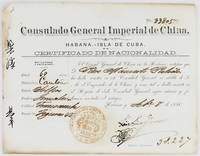
18802592Havana: September 8 1880. Very good. Partially-printed broadside 6.5 x 8.25 inches completed in manuscript in Spanish and Chinese. Small marginal wormhole mild edge wear light toning. Ink stamp of the Consulado General at bottom-center. A scarce certificate issued in 1880 by the Chinese Consulate in Havana authenticating the registration and details of a Chinese laborer in Cuba. The printed form is completed in manuscript with the name of the recipient his age place of origin occupation and place of residence. The present examples were completed for a sixty-year-old laborer from Canton being called Pedro Pulido who was going to work and/or live at 48 Calle Figueroa in Havana. The printed text states that "El Cónsul General de China en la Habana certifica que blank ha hecho constar en este Consulado General ser súbdito de S.M. el Emperador de la China y como tal se halla inscrito en el Registro de dicho Consulado General segun número y filiacion anotados al márgen." The certificate is dated September 8 1880 and is stamped with the seal of the consulate in red and with the rubberstamped signature of the Consul General Lin Liang Yuan. The form are also bears two ink signatures in Chinese in the left margin a rare occurrence. An excellent document of the bureaucracy surrounding imported Chinese labor to Cuba in the last quarter of the 19th century. September 8 unknown
19-7810Brussels: Imperial Government of China 1905. Folio. Single page. Very Good. Printed both sides. Coupons present. Dated April 12 1905. Text in French. Brussels: Imperial Government of China, 1905. unknown
19-7814Paris: Republic of China 1914. Folio. Single page. Good with creasing from folds slight edge wear and marginal tearing on sides. Printed both sides. Coupons present on right fold some missing. Signed by Chinese Minister of Finances the Chinese Minister of Paris and the Industrial Bank of China. Dated April 7 1914. En Francais. Paris: Republic of China, 1914. unknown
ria9783527352944_inpHardback. New. New Book; Fast Shipping from UK; Not signed; Not First Edition; N/A hardcover
197315955-AR<p>Hardcover w/ clear plastic dj in slipcase last entered info in text appears 1973 publication. Color still good on softcover slipcase but has a little wear to flap end corners some pressured places along spine. Hardback virtually fine one small spot on title page not sure whether came after or part of printing some tiny light spots on page edges in places.</p> hardcover
194216725Webster Publishing Company 1942. Paperback. Very good overall. A cooperative project between American Council Institute of Pacific Relations and Webster Publishing. Contents include: China and the Chinese; Old China; A Century of Imperialism; and The New China. Sml 8vo 94pp b&w ills maps. Webster Publishing Company paperback
19862092902140300891Japan Broadcasting Publishing Association 1986. Soft Cover. Fine. Number of books: 1 Japan Broadcasting Publishing Association paperback
2026x-1032544813Taylor & Francis Ltd 2026. Paperback. New. 182 pages. 7.00x0.40x10.00 inches. Taylor & Francis Ltd paperback
2M3401Kitech China um 2000. Im Original-Karton. - neuwertig ungeöffnet / original verlagsfrisch verschweißt - unknown
192211352London: Benn Brothers Limited 1922. 1st. Hardcover. Near Fine. 11.4x9.3x1.8in. rubbing to tips and bottom of boards. <br>With 171 illustrations of which 7 are in color. <br>135pp 5.20lb 11.4x9.3x1.8in Benn Brothers Limited hardcover
ria9783110573145_inpHardcover. New. New Book; Fast Shipping from UK; Not signed; Not First Edition; The book discusses the present strategies towards antioxidant capacity evaluation including optical chromatography electrochemical methods as well as photoelectrochemical technique where the advantages limitations and different appl hardcover
1919931198.Gpaperback. Good. Access codes and supplements are not guaranteed with used items. May be an ex-library book. paperback
Q-0285636901Souvenir Pr Ltd. Hardcover. New. New. In shrink wrap. Looks like an interesting title! Souvenir Pr Ltd hardcover
1990Q-0020335202Collier Books 1990-06-01. Paperback. New. New. In shrink wrap. Looks like an interesting title! Collier Books paperback
19131410150038New York : Domestic and Foreign Missionary Society 1/1/1913. Paperback. Very Good. 0x0x0. Softcover. 98 p. : ill. ; 20 cm. Chipping and loss to head and tail of spine. Rear wrap detached. Clean unmarked pages. <br><br> Written within a year after conclusion of the Xinhai Revolution Revolution of 1911 this pamphlet was written for teens and young about the then-modern China's youth in light of their new democracy. New York : Domestic and Foreign Missionary Society paperback