25 868 résultats
First Edition. 12mo. Contains 234 pages + 12 pages of plates, bound in orange wraps, showing the culprits displayed appropriately in black, with severely deformed bodies. Very clean and Near Fine. processo alla vedova mao e alla banda dei quattro.
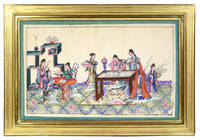
109513Canton ca. 1860. . Watercolour and gouache studies on pith paper overall dimensions 33 x 23.5cm. framed and glazed.<br /> Pith seems not to have been adopted for painting until about 1820. Some European museums claim that their paintings on pith often erroneously called "rice paper" or "mulberry pith" come from the end of the eighteenth century but there do not seem to be any dateable examples that are so early. There is a record of the Kaiser Franz of Austria buying some albums from an English Consul-General Watts in 1826. We know of an Italian Count who visited Canton in 1828 and had over 350 paintings on pith in his baggage when he died in Ambon two years later. In the British Library there is a scrap-book containing six pith paintings and a journal entry by a serving British officer who sent them home from India in 1829. These examples and contemporary accounts by visitors to Canton suggest that there was a flourishing trade in pith paintings by the early 1830s.<br /><br />Pith presumably came into use for painting to satisfy the increasing demand for small inexpensive and easily transported souvenirs following the massive growth in the China Trade in the first quarter of the nineteenth century. Paintings in oils on board and canvas were costly and difficult to carry home. Earlier and more prestigious export water-colours had often been on a larger scale and painted on fine Chinese paper or on paper imported from Europe. The albums of pith paintings and later the little glass-fronted boxes were inexpensive light easy to pack and gave the pictures some protection on the long voyage home. Because many were sold in albums and hence protected from the light they retain their bright colours to this day.<br /><br />Pith comes from the central column of spongy cellular tissue in the stem of a small tree called Tetrapanax Papyrifera native to south-west China. It has had a variety of uses some going back many centuries. At the imperial court both men and women wore coloured flowers made from pith in their hair. For use in painting it is cut by hand with a knife into thin sheets from short lengths of the spongy tissue. Cutting is highly skilled and the constraints of the process mean that the finished sheets for painting seldom if ever measure more than about 30cms by 20cms. The sheets are dried trimmed and used for painting without any further processing.<br /><br />Because of the nature of pith and its cellular structure the gouache used by the Chinese sat on the surface and produced a bright and even sparkling effect. Very fine detail could be achieved but pith did not lend itself to the flat wash of colour favoured for European watercolours. <br /><br />Carl Crossman in his book The Decorative Arts of the China Trade originally published under the title The China Trade gives an excellent list of export painters with a note of those known to have painted on pith. These include Tingqua Sunqua and Youqua. From 1757 until 1842 Canton was the only Chinese port open to trade with the west and it is no surprise that of the eight studios identified by Crossman as producing works on pith six were in Canton. <br /><br />It seems that the 1830s and 1840s may have been the heyday of pith painting. The international trading bases the waterfront 'factories' on the 'Hongs' in Canton where they were produced were partially burnt during the First Opium War 1839-41 and totally destroyed in a fire of 1856. The foreign trading companies then moved to Honan and subsequently put up splendid new offices on reclaimed land at Shamian Island a little up river. As the result of the Treaty of Nanking in 1842 additional Chinese ports were opened up for foreign trade and Hong Kong was established as a major trading centre. <br /><br />By 1860 references to China in the Illustrated London News plentiful three years earlier were few and far between. That is not to say that painting on pith ceased. Nicholas the second was given paintings on pith when he visited Canton in 1891 and the last Emperor is said to have sent him a gift which included pith paintings in 1907 though these could have been examples of much earlier work. <br /><br />Painters on pith did not in general sign their work the sole exception is Sunqua whose name can be found on the face of three paintings on pith. <br /><br />There are collections of paintings on pith in the Ashmolean the British Museum the Fitzwilliam the Hermitage the Peabody/Essex Museum in Massachusetts and the Hong Kong Museum of Art. However because paintings on pith are not in general regarded as fine art they are usually to be found in ethnographic or specialised collections.<br /> Canton, ca. 1860. unknown
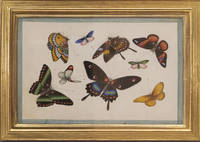
94512Canton 2nd half of 19th century. . Six watercolour and gouache studies on pith paper edged in turquoise silk ribbon and laid on paper; framed glazed and overall size: 27 x 39.4 x 2 cm.<br /> An exquisite group of interior scenes exclusively of noblewomen and ladies in waiting engaging in various genteel activities such as flower arranging painting poetry reading and writing surrounded by elegant Qing dynasty furniture and ornaments including unusual asymmetrical display cabinets exotic bird swings and porcelain vases all standing or sitting on elaborately patterned silk carpets.<br /><br />Pith seems not to have been adopted for painting until about 1820. Some European museums claim that their paintings on pith often erroneously called 'rice paper' or 'mulberry pith' come from the end of the eighteenth century but there do not seem to be any dateable examples that are so early. There is a record of the Kaiser Franz of Austria buying some albums from an English Consul-General Watts in 1826. We know of an Italian Count who visited Canton in 1828 and had over 350 paintings on pith in his baggage when he died in Ambon two years later. In the British Library there is a scrap-book containing six pith paintings and a journal entry by a serving British officer who sent them home from India in 1829. These examples and contemporary accounts by visitors to Canton suggest that there was a flourishing trade in pith paintings by the early 1830s.<br /><br />Pith presumably came into use for painting to satisfy the increasing demand for small inexpensive and easily transported souvenirs following the massive growth in the China Trade in the first quarter of the nineteenth century. Paintings in oils on board and canvas were costly and difficult to carry home. Earlier and more prestigious export water-colours had often been on a larger scale and painted on fine Chinese paper or on paper imported from Europe. The albums of pith paintings and later the little glass-fronted boxes were inexpensive light easy to pack and gave the pictures some protection on the long voyage home. Because many were sold in albums and hence protected from the light they retain their bright colours to this day.<br /><br />Pith comes from the central column of spongy cellular tissue in the stem of a small tree called Tetrapanax Papyrifera native to south-west China. It has had a variety of uses some going back many centuries. At the imperial court both men and women wore coloured flowers made from pith in their hair. For use in painting it is cut by hand with a knife into thin sheets from short lengths of the spongy tissue. Cutting is highly skilled and the constraints of the process mean that the finished sheets for painting seldom if ever measure more than about 30 by 20 cm. The sheets are dried trimmed and used for painting without any further processing.<br /><br />Because of the nature of pith and its cellular structure the gouache used by the Chinese sat on the surface and produced a bright and even sparkling effect. Very fine detail could be achieved but pith did not lend itself to the flat wash of colour favoured for European watercolours. <br /><br />Carl Crossman in his book The Decorative Arts of the China Trade originally published under the title The China Trade gives an excellent list of export painters with a note of those known to have painted on pith. These include Tingqua Sunqua and Youqua. From 1757 until 1842 Canton was the only Chinese port open to trade with the west and it is no surprise that of the eight studios identified by Crossman as producing works on pith six were in Canton. <br /><br />It seems that the 1830s and 1840s may have been the heyday of pith painting. The international trading bases the waterfront 'factories' on the 'Hongs' in Canton where they were produced were partially burnt during the First Opium War 1839-41 and totally destroyed in a fire of 1856. The foreign trading companies then moved to Honan and subsequently put up splendid new offices on reclaimed land at Shamian Island a little up river. As the result of the Treaty of Nanking in 1842 additional Chinese ports were opened up for foreign trade and Hong Kong was established as a major trading centre. <br /><br />By 1860 references to China in the Illustrated London News plentiful three years earlier were few and far between. That is not to say that painting on pith ceased. Nicholas the second was given paintings on pith when he visited Canton in 1891 and the last Emperor is said to have sent him a gift which included pith paintings in 1907 though these could have been examples of much earlier work. <br /><br />Painters on pith did not in general sign their work the sole exception is Sunqua whose name can be found on the face of three paintings on pith. <br /><br />There are collections of paintings on pith in the Ashmolean the British Museum the Fitzwilliam the Hermitage the Peabody/Essex Museum in Massachusetts and the Hong Kong Museum of Art. However because paintings on pith are not in general regarded as fine art they are usually to be found in ethnographic or specialised collections.<br /> [Canton, 2nd half of 19th century]. unknown
190574181905 Worcester, Baylis, Lewis & Co. Printers, sans date (c. 1905) ; in-8° étroit broché, couverture blanche ,titre argent et or au 1er plat d'une encadrement de filets de même couleur sur fond beige ; 44, ( 1)pp. Frontispice en 2 tons , texte imprimé en gris et illustrations tirées en sépia.
1879168207Shanghai.: American Presbyterian Mission Press. 1879. xx 259pp the original wrappers have at some stage been resewn and bound into a quarter leather binding with linen spine the inner edge has been re-enforced and is discoloured. Additions & Corrections have been bound in. New endpapers one page has an archival tape repair to the inner hinge. Paper slightly browned and a little dusty in places rough cut edges corners rubbed but a very good firm copy. 25 x 16.5cm. Thomas Watters 1840 - 1901 was a noted scholar-consul of his day. He spent over 32 years in China serving in Taiwan Fuchow Swatow Ichang Canton and elsewhere and was acting Consul-General in Korea 1887-1888. . American Presbyterian Mission Press. hardcover
143 pages, illustrated. eng
in-16, 58 pages; HB/No DW. VG+++ [P-15]
1986RO80064338CHINA GUIDES SERIES. 1986. In-12. Broché. Bon état, Couv. fraîche, Dos satisfaisant, Intérieur frais. 96 pages illustrées en couleurs. Ouvrage en anglais.. . . . Classification Dewey : 951-Chine
2071Perth, University of Western Australia Press, 1966 (first edition). 1 volume in-8, XI-134 pp., hardcover, illustrated dust jacket, a very good copy.
Soft Cover. . 32 pages with photographs and folded map of the Palace Museum (Pekin Forbitdden City)
196656119Taipei Taiwan ROC: China Evangelical Luthern Church 1966. 4to. 2 ii 4 128 pp. With 128 photo plates illustrations. Red & black softcovers black lettering front cover & spine very slight sunning to spine edgewear still VG copy w/ Chinese Chop stamped on ffep. Second edition of this informative and well-illustrated work on annual Chinese festivals marriage ceremonies and customs as well as funeral customs and rules to guide Christian missionaries working in Taiwan avoid unnecessary misunderstandings and offenses. Albrecht worked on the translation with Go Sin-gi and drew from the Chinese original which was much abbreviated and first published in 1955 by the Taiwan Presbyterian Church. [China Evangelical Luthern Church], paperback
49731144like new. unknown
49731144-nnew. unknown
198820269Peking, Foreign Languages Press, (1988). Mit zwei farbigen Karten und sehr zahlreichen, oft farbigen Abbildungen. 4°. 6,156,6 S. OKlappkarton. Minimal gebraucht.
First Edition (so stated on copyright-page)Hardcover Dust jacket present, price intact 294 pages: IndexKeywords: Autobiography -- Memoir -- Chinese author -- English language Binding height: 9-1/2" as new cloth and boards, in as new Dust jacket . ISBN:03945. 74710
13037Boston: Houghton Mifflin Company 1965. 8vo 955 pages. Illustrated with black & white plates maps and charts. This book has been beautifully bound in blue and tan leather. The boards are blue and the cross banded spine and corners are tan. Blue label with gilt lettering to spine. Book binders label to front pastedown. No inscriptions. A most attractive copy . Boston: Houghton Mifflin Company, 1965 hardcover
London and Henley, Routledge & Kegan Paul, 1977, in-8, br. editoriale, pp. 388. Con illustrazioni.
1967100285London, Routledge & Kegan Paul, 1967. In-8, 359 pp., illustr., cartonnage éditeur. (reliure défraichie et délavée). (B4)
2 vols., 8vo., First Edition thus, with over 1200 coloured and monochrome illustrations; maroon cloth, gilt backs, a near fine set in unclipped dustwrapper.
1997009888Cambridge etc., Cambridge University Press, 1997. xxiii, 801 S. Orig.-Broschur. "Written with an elegant and flowing narrative, the essential virtue of Jacques Gernet's classic book is to see the history of Chinese civilization as a whole. Yet within the synthesis of the trends - social, political, religious, scientific, artistic that make up China's past and present, the author never loses sight of the telling detail which brings history to life. A History of Chinese Civilization is illustrated with a wide range of photographs, many maps, line drawings and tables. A detailed chronological table and full bibliography complement the text" (Publisher's description). Mit kleinem chinesischem Stempel, sonst schönes, gut erhaltenes Exemplar mit nur leichten Gebrauchsspuren.
Tall 8vo x, 448 pages. Maps. Illustrated. Footnotes. Bibliography. Index. red cloth gilt lettering, scarce.
12802London, William Heinemann, MCMI (1901). First edition. 1 volume in-8, green cloth-bound, vi-448 pp., with 2 chinese stamps, somme marginal inscriptions in chinese, copy of french General Consul in Hankow, M. Lecomte, a good copy.
Imp.8vo. r xx,455pp. Notes Bibliography and Index folding map, biblio., index. First original chinese edition (only volume 1 was ever published in this edition). A very nice copy in later hardback. w. gilt titles in chinese and english. scarce in this orginal Henri Vetch edition.
1959009721Princeton, N.J., Princeton University Press 1959-1960, 1959. xxxiv, 455; xxv, 783 S. Orig.-Leinenbände. Jeweils mit kleinem Namenszug und geringen Anstreichungen mit Kugelschreiber auf ca 30 Seiten in Band 1 und 8 Seiten in Band 2, sonst handelt es sich um ein gut erhaltenes Exemplar des Standardwerks mit nur leichten Gebrauchsspuren.
8vo, br. xxi + 778 pages. Index. This volume launches the translation of a work that describes the development of Chinese political thought from the time of Confucius in the late Chou era into the twentieth century. The author systematically treats leading thinkers, schools, and movements, displaying a consummate mastery of traditional Chinese learning, and of Western analytical and comparative methods. This first complete translation includes prefatory remarks by Kung-chuan Hsiao and notes prepared by the translator to assist the Western reader. Originally published in 1979. The Princeton Legacy Library uses the latest print-on-demand technology to again make available previously out-of-print books from the distinguished backlist of Princeton University Press.