JAPAN PHOTOABAA

235 résultats
13932Original 19th Century Hand colored photograph of the Festival of Lanterns at Yokohama Japan. The photograph measures 8"x10" and is matted to 10-1/2"x13". Lower right hand corner label reads "A 264 Festival Lanterns at Bentendori Yokohama." Festival lanterns cheer up the business district of Bentendori 2-chome and 3-chome in Yokohama. During the Meiji Period this was Yokohama's premier shopping street. Foreign visitors came here to buy porcelain curios ivory silk and photographs. The photographer of this very image Kimbei Kusakabe actually had a studio on this street between 1881 and 1889. Unfortunately the exotic amalgamation of Japan and the Western world that existed on Bentendori was forever destroyed by the Great Kanto Earthquake of 1923. Photographs such as this are all that is left of a bygone era. In very good condition. unknown books
188358137Boston: Lee and Shepard Publishers 1883. First edition. 169 illustrations. xiii 301 pp. 1 vols. Small 4to. Green cloth stamped in black and gilt designed by the author. Spine ends chipped extremities rubbed. Very Good. First edition. 169 illustrations. xiii 301 pp. 1 vols. Small 4to. Lee and Shepard Publishers unknown books
192850317Tokyo: The Japan Advertiser 1928. First edition. Very good/Very good. Tokyo: The Japan Advertiser 1928. First edition. Many sepia photos also an original woodblock print of Himeji Castle by Hiroshi Yosida tipped in. 179 pp. . Folio. Eggplant silk Japanese style binding with silk ties and a large very colorful phoenix-like bird on the front cover. Very slight fading at top and bottom board edges where unprotected by dust wrapper or folding cover else in wonderful condition - vibrant; dust wrapper is mildly edge-frayed along top; folding protective case is splitting at folds and generally quite worn. Very good/Very good. Insurance required to ship this item. The Japan Advertiser unknown books
1939866111939. ADVERTISING ART - JAPAN. KÔKOKKAI. ADVERTISING AND COMMERCIAL ART. Volume 16 number 9. Tokyo Seibundo Showa 14 1939. Decorated wrappers. 26.3 x 19 cm. 96 pp. Kôkokkai was the premier professional journal on the art and science of advertising in Japan at the time of its publication. Ken Domon was in charge of photography. The issues were full of scientific and perceptive articles and illustrated with color and bw plates and reproductions of posters ads signboards etc. etc. Despite a bi-lingual title on the title page inside the text is entirely in Japanese. Ephemeral issues from early Showa have largely disappeared. unknown books
188926938Osaka Japan: Aoki Szandow 1889. C. 120 pages; most of which have an illustration and sometimes two. Text in Japanese; titles given in English. Colin Franklin in 'Exploring Japanese Books and Scrolls' calls these publications an "appealing series of guides As travel within Japan had been restricted for three centuries and travel abroad forbidden these represented the new freedom. They combine charm with taste and a fine vagueness about that obsession of modern publishers "the market." As book-production they jump into more popular format with color-printed pictures over boards to bind themwith English captions erratic and fearless the many hundred illustrations which adorn the Japanese text.were they for the tour-guide to show his visitor - or in the world for Japanese travelers to show their guides Neither of these perhaps just a venture over the border into Western habit. They are excellent little books to leaf throughTechnically too they joined West with East. A new method was used for illustration: relief metal-cut like white-line wood engraving - Bewick's technique - difficult and delicate to manage practical in Japan for just a few years in the last quarter of the century. Paper suitable for such fine-line reproduction smooth machine-made was folded at the fore-edges in the traditional Japanese way. End-leaves and all edges were marbled an innovation for which as has been mentioned these books are now admired by collectors in JapanThey providetempting glimpses of all manner of scene and aspect of life on the eve of change" This is one volume of the 7-volume series. Approx. 4" x 6" size; bound in illustrated paper covered boards; cloth spine marbled endpapers all edges marbled. Some edge tips wear to the binding; contents in very good condition. . First Edition. Hard Cover. Very Good. Aoki Szandow hardcover books
1939866041939. ADVERTISING ART - JAPAN. KÔKOKKAI. ADVERTISING AND COMMERCIAL ART. Volume 16 number 6. Tokyo Seibundo Showa 14 1939. Decorated wrappers. 26.3 x 19 cm. 96 pp. Kôkokkai was the premier professional journal on the art and science of advertising in Japan at the time of its publication. Ken Domon was in charge opf photography. The issues were full of scientific and perceptive articles and illustrated with color and bw plates and reproductions of posters ads signboards etc. etc. Despite a bi-lingual title on the title page inside the text is entirely in Japanese. Ephemeral issues from early Showa have largely disappeared. The fragile paper is in nice condition overall. unknown books
1939866071939. ADVERTISING ART - JAPAN. KÔKOKKAI. ADVERTISING AND COMMERCIAL ART. Volume 16 number 1. Tokyo Seibundo Showa 14 1939. Decorated wrappers. 26.3 x 19 cm. 96 pp. Kôkokkai was the premier professional journal on the art and science of advertising in Japan at the time of its publication. Ken Dômon was in charge of photography. The issues were full of scientific and perceptive articles and illustrated with color and bw plates and reproductions of posters ads signboards etc. etc. Despite a bi-lingual title on the title page inside the text is entirely in Japanese. Ephemeral issues from early Shôwa have largely disappeared. The fragile paper is in nice condition overall. unknown books
16646Photo Album Education Co-educational Primary School in Tokyo. Three-Wood Common Elementary School1941 during World War 2. Album of Gelatin silver print photos. Original textured paper wrapper. Album opens right to left. 6.9 x 9.75 in. Album cover is dated "March of the 15th year of the Showa Dynasty" in Japanese. 7 photographs measuring 4.5 x 6 in. Each class photo includes names of sitters printed on rice paper in Japanese. <br/><br/>Of note in the 6 class photographs of school children and faculty are the mix of men and women as teachers and the mix of girls and boys as students. In the first image of the entire school boys and girls are lined up next to each other although they stand in rows of their own single-gender classes. Two class photos have additional small portraits of students who were absent for picture day. In Japan at this time education was not compulsory beyond primary school but childhood was regarded as an important time to foster learning growth and intellectual curiosity for both boys and girls. Very good condition. unknown books
1876318091New York: Harper & Brothers Publishers Franklin Square 1876. First edition. Illustrated. 625 1 12 ads pp. 1 vols. 8vo. Bound in three quarter modern green morocco and marbled boards red leather title label. Fine. First edition. Illustrated. 625 1 12 ads pp. 1 vols. 8vo. Harper & Brothers, Publishers, Franklin Square unknown books
1907309219London: Strker 1907. With 33 tipped in photographs with tipped "Farewell to the "Gneisenau" broadside small broadside of "Coronation of H.M.King George V printed in Yokohama 22nd June 1911.". 8vo. Black and blue cloth with button on cover from Captain of Gneisenau. With 33 tipped in photographs with tipped "Farewell to the "Gneisenau" broadside small broadside of "Coronation of H.M.King George V printed in Yokohama 22nd June 1911.". 8vo. Filled in with an English family's trip to Japan. Started in London on December 11 and boarded the Ship Gneisenau on the morning of the 12th reached Singapore Jan. 11 arrived Nagasaki Jan. 23. Strker unknown books
188726924Chicago Illinois: Rand McNally & Co. 1887. Pocket map of Japan printed in colors detailing the Japanese island system in two separate maps: Northern Japan with an inset at top of Chishima; with the previous owner noting the location of the volcano Bandai-San. Approx. 13 3/4" x 21" overall size; and Southern Japan with inset of Yayeyama and Riukiu Island chain approx. 14" x 20 3/4". With a folding Index and Population of Towns in Japan having a pronunciation list and giving the districts islands lakes mountains provinces rivers and towns; this is printed two sides approx. 13 3/4" x 19 3/4" size. Bookseller's ticket on front inner panel of the cover of Kelly & Walsh Ltd. Printers Publishers Booksellers Stationers &c. &c. &c. No. 28. Yokohama. Small faint previous ownership stamps on the blank panels on the back of the maps as well as on the front endpaper of the cover of collector Dr. George R. Brush U.S. Navy; served as a surgeon and medical inspector from 1861-1894 & often on-station in various locales in Japan. Maps & index contained in the publisher's dark brown cloth binding approx. 3 1/2" x 6 1/4" size gilt titled. Some color mottling to the case light wear; map papers darkened a little; Northern Japan & the Index loose; Southern Japan still attached to the inner cover; in very good condition. Pocket Map. Hard Cover. Very Good. Rand, McNally & Co. hardcover books
195021606Japan: Artist Published 1950. Group includes two country landscape scenes in color both signed lower left in black ink both approx. 9" x 13"; with 2 ink and wash heightened and accented with white paint winter scenes approx. 10" x 14 1/2" one signed lower right; and 2 ink washes waterside scenes 10" x 14 1/4" one signed lower left. Not dated and circa 1950s; all are laid-down on to paper backers. Light wear; one of the wash pieces with a thin line-scrape; the paper backers with wear and wrinkling in margins creasing couple short tears. The artworks are in very good condition. First Edition. Not Bound. Very Good. Artist Published Paperback books
4696JAPAN. Diary. January 14 1950 to late 1954. Various places Philadelphia Japan Fort Meade. A lengthy diary of an American officer Lieutenant Louis T. Holtz who was stationed in Japan during the Korean War. It was written on dozens of sheets of loose-leaf notebook pages and it contains many black and white photographs with captions as well as newspaper and magazine cutouts and brochures from places he visited. The diary begins on January 14 1950 in Philadelphia and he discuses seeing shows and such but notes that “All in all this constituted a very enjoyable ten days of leave prior to going overseas. Sometimes I wish I could stay at home and live a normal routine life like everyone else. Other times I find myself eager to go…Almost two years ago who could forecast a war in Korea and the manner in which it would rip everyone’s life to shreds†He writes on January 2 1951 from Kurume Japan: “…perhaps 10 years from now it the diary will be of interest – if any of our civilization remains in 1961…I collapsed 28 June and spent 3 weeks in the hospital with excessive fatigue…I am the Officer-in-charge of the Kurume Office with an area of jurisdiction of approximately 1000 square miles…â€. In April 1951 he mentions “I am very busy in my position as OIC Officer In Charge. It’s a full 7-day-a-week job…The Korean mess has everyone guessing as to eh future of the Far East…being the senior official in an area of jurisdiction of nearly 10000 square miles with dozens of mayors and police chiefs constantly catching my every word as official.â€. The next couple dozen pages contain black and white photographs of protests in Japan and Holtz’s commentary about the images including “When people get hurt propaganda fills the air. The winner: the Kremlin – always!†“Demonstrations take planning and people. You can always be sure the plans were framed in red and the spectators sprinkled liberally with dye-hard communist stooges†“Demonstrations & rallies are usually fantastically well organized. And as often as not they can be unbelievably orderly†and “But orderly or violent you can always be sure there is a professional communist keeping the ‘sheep’ in line or arousing them to maximum fury.†In September 1951 Holtz writes from Sapporro “…life in the Armed Services has been a miserable one because of one bad experience after another…Kurume was one of the most pleasant and enjoyable assignments I ever held. The 45th was without doubt the most bitter and least enjoyable. I gave up so much for so little…â€. Holtz was in California’s Camp Stoneman in November 1951: “…with all the hundreds of officers here not particularly anxious to go overseas and with several actually fighting the assignment I was amazed to find that someone eager to return is sidetracked so abruptly…â€. He was back in Japan by December and then wrote a lengthy entry entitled “The Korean Story†starting with “Combat precautions make it mandatory that no diaries or personal papers be kept where they may fall into enemy hands†and he spends the next seven pages describing his experiences in the Korean War. Holtz wrote in part: “…Things had not gone well at all with Trubota’s unit prior to August 1951. After my arrival working results proved very satisfactory…Three other officers has also joined up in the interim between leaving Sapporo and going to Korea…When oriented in Tokyo they were told that the 45th Detachment would remain in Sapporo and they had already alerted their families to start to prepare to join them overseas…I had to fight Trubota in order to be able to fight the enemy. In one occasion I was reprimanded for going to a forward observation post and not being personally available to answer the telephone at my CP…†and the section finishes with a photograph of the USS Marine Lynx the ship that brought him home. The diary continues with his being stationed at Maryland’s Fort Meade. There are photographs of the mansion he occupied in Kyushu Japanese women at the beach his fellow soldiers after a bowling tournament etc. There are “Samples of United Nations propaganda leaflets dropped on North Korean positions early in the Korean conflict†that show Truman and MacArthur a December 7 1950 letter signed by the mayor of Kurume City Japan. The condition is fine to very fine. unknown books
8575718. PHOTO ALBUM - JAPAN. 50 ALBUMEN OUTDOOR SCENES AND WOMEN. Small late 19th early 20th century oblong 13.4 x 18.3 cm album of albumen photos Half of the album is made up of shots of Japanese women in kimono in the studio and out. The other half is a catalogue of tourist scenes each about 9 x 13 cm image size. Decorated lacquer covers with insets. The images are handcolored with quite a bit of differential fading the reds stand out. The covers have a bit of edgewear and gouges but the condition overall is good. Interesting for its emphasis on women. unknown books
14062An original 19th century albumen photograph of two Japanese sumo wrestlers in starting position. 10.5" x 8.5" Mounted on split card. Minor loss of tone and contrast. Tastefully handpainted only on the cloths the wrestlers are wearing as was typical of 19th century Japanese images. This image has an artful minimalistic quality. Overall condition good. unknown books
192928505Paris: Musee du Jeu de Paume Jardin des Tuileries 1929. First Edition. Illustrated with 180 plates with 352 figures. 2 vols. 4to. Cloth wrappers printed in gold wrappers in chemise one joint split else fine. 2. First Edition. Illustrated with 180 plates with 352 figures. 2 vols. 4to. Musee du Jeu de Paume (Jardin des Tuileries) unknown books
8482718. PHOTO ALBUM - JAPAN. 30 Albumen Scenes around Nikko. Small late 19th early 20th century oblong 11.5 x 17.8 cm album of albumen photos of Nikkô each about 9.5 x 14 cm. Simple lacquer covers. The images are bw with a bit of fading as usual. The condition overall is very good. $485.00. unknown books
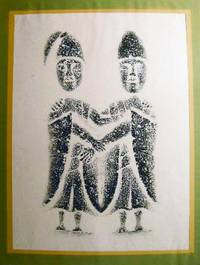
197223967Japan: Otosaburo Moriizumi 1972. 10 rubbings made by Otosaburo Moriizumi; these are printed in black and white on fine thin Japanese paper; each rubbing tipped-on by its corners to a thin cardstock backer and with a dark blue gray or green stiff paper "window" surround; with a 4-sided folding explanatory sheet text in Japanese & English including a brief introduction by Shoji Hamada; with an illustration of Mr. Moriizumi biographical details and information on the rubbings; the author-collector "chose ten lovely carvings found in the Matsumoto district" for this selection; images and titles in Japanese of the images with the dates of creation if known these from 1695 - 1870 - the undated images from earlier times; and with the sizes of the original carvings in cm.; from the author's text: ".We often find a group of three or four naive stone-carved images at the village borders and crossings when we travel along olden ways of Shinano Province. It became popular among farmers to make this sort of stone images from the middle Edo period based on their belief. They prayed for fertility and prosperity by erecting such images representing Buddhist Shinto and folkloric deities. Among them the most prevalent is Dosojin a pair of male and female folkloric gods. They were considered to be patron gods for children and young couples and gods who brought the peace of the village and abundance of crops.Besides these independent images there are stone carvings known as koshin tower. .the relief of Blue-headed Kongo a Buddhist deity as the main image and that of the sun and moon above."; all items loosely contained in a blue paper-covered hardcover folding portfolio with paper title label printed in two colors; the overall size is approx. 15" x 19 3/4"; the art of varying sizes some taking the entire sheet some smaller; the portfolio contained in the original protective cardboard slipcase also with paper title label; some edgewear age-darkening and closed tears to cardstock slipcase; blue portfolio with light wear a few cover scratches; text portion with a little edge-creasing; one of the rubbing plates with a ¾" paper flaw or rub in the background paper; two of the green paper surrounding 'window' mounts with sunning to gold on the inner ½" of the border; the artwork in very good condition; an interesting Japanese folk-art collection iconic imagery. First Edition. Portfolio. Very Good. Otosaburo Moriizumi Hardcover books
1940862071940. CHILDREN'S - JAPAN TAKEI Takeo editor. Yôji Hyôjun Ehon OHISAMA TO OTSUKISAMA. Tokyo Showa 15 1940. Stiff wrappers about 10" x 7" illustrated in color throughout. The covers and the twelve double-page spreads within are printed after work by several important artists and illustrators including Takei himself. This is volume 7 of the "Standard Picture Books for Children" series its title could be translated as MADAM SUN AND MISTRESS MOON. It has a series of fifteen charming depictions of the influence and necessity of the sun and moon on our daily lives. No sign of the Imperial sun worship of the time save an explicit pictorial juxtaposition of the ancient Egyptians and modern Japanese worshipping the sun. The moon comes in to the picture at the very end as a guide for children on dark streets at night. The text is by Takei. The covers are a bit rubbed and slightly stained and soiled but overall a good copy of this extremely ephemeral publication. unknown books
19250379901925. Original photograph album. Very Good. Oblong string-tied album of black cardstock leaves 11" x 13" photographs mounted on 35pp blanks at the rear. Bound in black flexible boards with an embossed sailing ship and gilt lettering Photo-Album on the cover. Pasted in are 116 albumen and silver gelatin prints ranging from small candids to 8 ½" x 10 ½" group portraits a few fading overall sharp and clean. Laid into the album are a Japanese news article a small head-shot of an older gentleman and a watercolor portrait 10" x 8 ¼" of a man's face. Most of the photographs in this album. circa 1895-1925 were taken in Mie-Ken or "Mie prefecture" part of the Kansai region on the main island of Honshu. The group and individual portraits reflect new social and economic developments and cultural norms that emerged during this period. Subjects are shown in either traditional Japanese garments or in Western dress. Group shots often depict people wearing both styles within the same picture. There are many group shots of schoolchildren of both sexes young people in uniforms posed before buildings with Japanese signs on them as well as many formal group shots of families some "nuclear"-husband wife children- others extended by relatives. Individual shots of young children show them almost invariably in western dress one posed with his tricycle young boys in uniform a young girl in kimono showing a dance move while holding a fan infants in traditional robes and young men in business suits. Several birdseye views feature very large groups of rural people in traditional dress posed outdoors. Among the most striking photographs are: one 8 ½" x 10 ½" showing 11 doctors/ medical students posed around two corpses one smiling happily being dissected on two tables; four women and one man posed around a table doing handwork weaving tatting; men in western dress "strap-holding" inside a streetcar; and 5 actors 2 male 3 female on stage in costume. ~~ The Meiji period 1868-1912 saw the restoration of the Emperor this time with a centralized bureaucracy behind him after years of shogun rule. Japan was under heavy influence from Western political economic and educational models and the country became more capitalist industrial and progressively democratic offering free education to youngsters of both genders. Transportation and communications systems were modernized the feudal lords and samurai lost their power and a powerful national army and navy were created. By the early 1870s the government declared all classes of people to be equal. The Taishu period 1912-26 saw the continued influence of Western culture and values such as efficiency and individualism continued to replace more traditional ones. Japanese participation on the world stage continued to grow as the nation co-founded the League of Nations and emerged on the winning side in WWI. By 1925 there was universal male suffrage in Japan. Corruption in government increased however and the West began to form negative views of this newly-powerful non-white nation exacerbated by Japan's poor treatment of China. <br/><br/> hardcover books
0000544Albums rubbed one flaking with joints beginning to split certainly Good or better. The images show occasional creasing silver mirroring & fading but are generally Very Good. Approximately 430 presumably amateur silver gelatin photographs 6.5†x 5†and smaller and a couple of real photo postcards housed in three commercial albums oblong or vertical quartos measuring about 11 inches by 8 inches. The compiler is unknown but quite possibly “Takamasa†first name or his descendants. His photograph is the first image in the album we have identified as album A. The photos are dated as early as 1909 and as late as 1954 with most from the mid twenties to late thirties. Many of the images include manuscript and occasionally rubber-stamped or printed annotations in Japanese on the versos. An eight page English translation accompanies the archive. <br/><br/>An impressive archive documenting life in Japan between the wars. Particularly interesting are several images depicting a banquet with Geisha and other events at a convention of the Japan Brewing Equipment Merchant’s Association in November 1926. Other images depict the building of the Sankyo Corporation on the day of the Great Kanto Earthquake scenes along the Tama River in Western Tokyo and various views of Temples Shrines Hot Springs etc. The accompanying translation is categorized by album A B & C with photos identified by numbers which correspond to added post-it slips. In addition to providing versions in English of the annotations the photos are described as to place etc. when known unknown books
1884859271884. PHOTO ALBUM - JAPAN. 25 OUTDOOR SCENES AND STUDIO POSED PHOTOS. Small late 19th century oblong 12 x 18.3 cm album of albumen photos of landscape and city scenes genre shots of trades and customs in the studio each about 9.5 x 13.5 cm image size. Brocade covered boards. The images are skillfully handcolored with very little fading. The covers have a bit of rubbing and the condition overall is very good. With the inscription of Capt. John C. Cooper from 1884 and hence a bit earlier than most albums one sees and certainly more interesting. unknown books
189827983London: Edward Stanford 1898. Colored map. 1 vols. 22 x 26 1/2 inches. Bound in green cloth paper label folding paper over linen backing. Fine. Colored map. 1 vols. 22 x 26 1/2 inches. Edward Stanford unknown books
194143024Japan 1941. Loose in a black clamshell box. Very good copies with slight curl; some with small edge or corner tears; 23 have the name of the film or featured actors/actresses rubber-stamped on the back in Japanese. 47 b/w photos. Approximately 6 x 4 inches. One duplicate. Most are group scenes from dramas a few portraits a few without characters; subject matter ranges from early historical dramas to contemporary scenes to the war and its effects. The dates have been verified on a few and all fall during the years of the Pacific War including Tadashi Imai's Tanjiko-mura 1940 "Hanagoyomi hasshojin" 1940 based on the 19th century novel "Josei hongan" 1940 made in the same year as the novel by Kan Kikuchi Yasuki Chiba's "Kuso buraku" 1939. The balance of the stills appear to date within approximately the same period. unknown books
19695ca. 1920-1931 Kyushu Japan. Very good . Oblong 4to. String-tied commecial album; black boards. Contains 57 gelatin-silver prints of various sizes including 8" by 10" 7.5" by 5" and smaller most of which are adhesive-mounted with several loose plus 11 postcards depicting Kyushu Lutheran churches and one bookmark. One photograph apparently perished; several others loosening from pages. Else apparently complete.Album edges moderately worn; one photo missing a chunk at edge. Most are lightly toned but overall clean. Very good or better. <br/><br/>Well-assembled photo album compiled by an American Lutheran missionary to Japan whose face appears consistently in the majority of the photographs. The island of Kyushu is home to several Lutheran schools and churches including the Kyushu Gakuin Kyushu Lutheran College and the Janice James School both of which are pictured here having recently been built in the early 1900's. The Kyushu Lutheran mission was founded in 1893 by American missionaries; within several years they began building churches under the supervision of one Charles Lafayette Brown 1874-1921 and presumably the subjects pictured here with members of that particualr mission. The album features posed group photographs of large congregations — as large as roughly 150 — captioned with date and location in cities including Kurume Kamamoto and Saga; additionally included are many images of church services in progress plus several family portraits of church members. While Christianity began to spread when Japan phased out its isolationist policies in the 1850s Protestant evangilization in particular slowed under the military government of the Showa period the early years of which are covered by this album.These anti-Western trends were closely tied to the patriotic fervor that culminated in WWII. An absorbing visual archive of a prospering Protestant community and of American missionary activity in Imperial Japan. hardcover books