235 résultats
738736 folding leaves of which four are blank. 8vo 240 x 170 mm. orig. blue semi-stiff wrappers wrappers somewhat worn orig. label heightened in gold with manuscript title new stitching. Japan: n.d.<br /> During the Edo period there were 12 Korean delegations to Japan whose purposes were mostly to congratulate a new Tokugawa shogun. The missions which normally included 300-500 Koreans accompanied by roughly 1500 Japanese escorts symbolized the amicable relationship between the two nations and in the early years served to legitimize the Tokugawa shogunate.<br /> These delegations which usually took nine or ten months round-trip were enormously expensive undertakings for both countries. The Koreans brought many luxurious presents both public and private gifts and the Japanese in turn furnished equally lavish gifts including large quantities of silver. Also the receiving Japanese were obligated to fund a number of elaborate and costly banquets during the delegation's travels on the mainland and in the capital city as well as provide accommodations throughout.<br /> Our manuscript is concerned with one of the three final missions which took place in 1748 1764 and 1811 this last mission was held on the island of Tsushima located roughly halfway between Kyushu and the Korean mainland. All three of these missions experienced considerable cost-cutting. We suspect our manuscript is a record of the banquets for the final 1811 mission as there is a reference to a Russian translator at this time there was considerable tension between Japan and Russia because of the Russian desire to open trade with the island nation.<br /> Our manuscript describes a series of banquets served during one of these three final missions. In spite of the newly instituted austerity it is clear that the participants ate very well. For each of the 13 banquets we are given the number of guests and their official positions the number of dishes per tray what foods were served etc. Some of the banquets were limited to just a dozen or so guests and others included more than 300 people. <br /> The cuisine is very much in the tradition of the ritualistic preparation and serving of the food on a series of trays known as honzen ryori "main tray cuisine" which was the dominant banqueting style for the elite from the Muromachi period through the Edo period. Various seafoods including luxury items like lobster smoked fish roe octopus and preserved fish are listed along with preparations of chickens eggs many kinds of vegetables burdock daikon radish ginger eggplant wild wasabi and many vegetables that are today quite obscure cooked in various ways pickles mushrooms fruits persimmons pears yuzu nuts rice and other grains and elaborate confections including sweets of Portuguese origin like pound cake or kasutera.<br /> Fine copy preserved in a chitsu. unknown books
1919875901919. PHOTOGRAPHY- JAPAN. HOSHITA Eishô photographer. SCENES ON THE TRANS-SIBERIAN RAILWAYS ZEN SHIBERI TESTUDÔ SHASHIN-CHÔ. Urajio Vladivostok Taishô 8 1919 Contemporary oblong folio rebacked. Album of 250 photo illustrations of the Japanese Imperial Army in the Allied Siberian Expedition 1918-1922 ranging in size from 3 5/8" x 5 1/8" to 8 3/4 x 11 1/2". Includes a panoramic bird's eye view of Vladovostok measuring 7 3/8' x 41 7/8/" and a fold out map of the route of the expedition measuring 14" x 29 3/4". Three-quarter leather stamped in gilt rebacked. The cloth and leather corner pieces are worn and rubbed. Captions in Japanese English and Russian with text in Japanese. title is taken from cover. Includes a number of pictures of partisan sabotage of railway between Chita and Krasnoyarsk. Hoshita Eishô produced at least two such albums of the warfare in the Russian Far East. Very unusual and important record of a "lost war unknown books
15852438<p>Venice: Appreso I Gioliti 1585. </p><p>Price: $8500.00 </p><p>Octavo: 16 x 10.5 cm. 188 11 pp. Collation: A-M8 N4</p><p>One of several 1585 editions first ed. 1584</p><p>Bound in modern cartoncino. A very good copy with some minor repairs lightly washed. With a fine woodcut headpiece and Jesuit emblem on the title page and numerous decorative head- and tailpieces and initials including one of a dragon throughout.</p><p>This collection contains the following letters from the Jesuit missions in Japan and Goa: Francesco Carreón writing from Kuchinotsu 1 Dec. 1579; Gregorio de Céspedes 1579; Lorenço Mexia at Bungo 20 Oct. 1580; three letters by LuÃs Fróis Miyako 14 April 1581; 19 May 1581; and 29 May 1581; Francesco Cabral 15 Sept. 1581; and Alessandro Valignano Goa 28 Dec. 1583.<br /><br />The Salsette Martyrs:<br /><br />This collection concludes with Valignano's important letter from Goa –one of only five Jesuit letters from India published between 1570 and 1585- detailing the deaths of the Jesuit Martyrs of Cuncolim who were killed on Monday 25 July 1583 in the village of Cuncolim in the district of Salsette territory of Goa India. The "martyrs" were the Italian Rudolph Acquaviva the Spaniard Alphonso Pacheco the Swiss Peter Berno the Portuguese Anthony Francis and Brother Francis Aranha also a Portuguese. In addition the Portuguese layman Gonçalo Rodrigues and some Indian youths Dominic Alphonso Francis Rodrigues Paul da Costa and ten others were also killed.<br /><br />While prosecuting their mission of Conversion in Cuncolim the Jesuits and their companions desecrated a Hindu temple by urinating in it a relatively mild if repugnant form of desecration; on an earlier excursion Father Berno had set fire to another temple and destroyed a sacred anthill. In addition they killed a cow that was also an object of worship and hurled its entrails into a sacred well thereby defiling it. The understandably outraged citizenry set upon the Jesuits and their companions killing them with scimitars lances and arrows. They then threw their bodies into a well. The five Jesuits quickly achieved great fame as martyrs and at last in the 19th century were elevated to sainthood while the lay Indians who were slaughtered with them were ignored. <br /><br />It should be remembered that three of the five Jesuit martyrs were in Cuncolim as chaplains to a force of Portuguese soldiers sent to exact harsh reprisals for indigenous resistance to Portuguese rule and the Jesuit campaign of forced conversion. In this context the killing of the Jesuits is remembered by the people of modern day Cuncolim as one of the first acts of revolutionary resistance to European rule in India.<br /><br />Of course the letter written in December of 1583 by the Jesuit Provincial of India Alessandro Valignano glorifies the "martyrs" and in true martyrological style vividly describes the deaths of Acquaviva and his companions.<br /><br />"The Pagans then fell upon them; Father Rudolph received five cuts from a scimitar and a spear and died praying God to forgive them and pronouncing the Holy Name. Father Berno was next horribly mutilated and Father Pacheco wounded with a spear fell on his knees extending his<br />arms in the form of a cross and praying God to forgive his murderers and send other missionaries to them.</p><p>Streit Bibliotheca Missionum IV. 1639; Sommervogel II col 492; Cordier Sinica 75; Laures 170</p> Appreso I Gioliti, books
1859WRCAM55020Japan 1859. 354pp. including twelve full-page or double- page ink and watercolor wash illustrations. Contemporary Japanese wrappers string-tied paper label completed in manuscript on front cover. Noticeable wear and rubbing to the binding newer string. Uneven worming throughout mostly unobtrusive. About very good. In a half morocco and cloth clamshell box spine gilt with raised bands. Large bound collection of contemporary manuscript papers documents and drawings relating to Commodore Perry and the Black Ships entering Edo Bay in July 1853. The text is comprised of accounts of the event and transcriptions of official letters from President Millard Fillmore Secretary of State Edward Everett and Commodore Perry to the Japanese Emperor. Illustrations include two double-hemispheric world maps a map showing the course of the Black Ship squadron Edo Bay and the landing of the ships Perry's marines marching sketches of large cannons aboard Perry's ships and diagrams and fortifications protecting the Japanese people from foreign invasion. <br> <br> In 1852 Perry was appointed head of a naval expedition charged with inducing the Japanese government to establish diplomatic relations with the United States. The expedition involved two visits to Japan. On his first Perry arrived at Edo Bay on July 8 1853. After a brief standoff and show of force he was able to land the following week and deliver a letter from President Fillmore with the U.S. demands with the promise he would return the following year for a reply. On February 13 1854 Perry returned with a total of ten vessels and 1600 men. After another standoff and three weeks of negotiation Perry signed the Convention of Kanagawa at the end of March 1854 which opened the ports of Shimoda and Hakodate to American ships provided for care of shipwrecked sailors and the establishment of an American consulate in Shimoda. "The most important result however was that the visit contributed to the collapse of the feudal regime and to the modernization of Japan" - Hill. <br> <br> Altogether a very comprehensive manuscript archive of this important occasion that helped open Japan to world commerce and culture. HILL 1332 ref. hardcover books
1853WRCAM53554Edo 1853. 31; 31; 61pp. plus a loose sheet. Original paper wrappers stitched. Contemporary manuscript annotations in red ink in one volume. Scattered worming heavy in places. Some dampstaining and dust soiling. About very good. Three fascinating Japanese manuscript accounts of the arrival of Commodore Perry to Japan in 1853. Then first URAGA KUROTONE NI KANSARU or "The Black Ship Arriving in Uraga" comprises the official government report of events when Perry steamed into Uraga Bay. This volume contains contemporary edits to the text in red ink. The second account of Perry's arrival EDO URAGA BIKOKU FUNE TORAI IKKEN or "Arrival of the Ships at Uraga" contains a double-page manuscript sketch of the coastline of Uraga Bay together with the disposition of Perry's ships. The final volume consists of a third manuscript entitled GASSHUKKO SHOKAN WAGE UTSUSHI a copy of the report on the Perry arrival prepared by Abe Masahiro Chief Senior Councillor in the Toguwara Shogunate which includes translations of the letters from Fillmore and Perry delivered by Perry on July 8 1853. Also with a single manuscript sheet that provides a description of Perry's ship. <br> <br> Vital contemporary manuscript accounts of this monumental transformation in Japanese foreign relations from significant Japanese participants in events. unknown books
15854676Venice: I Gioliti 1585. Hardcover. Very Good. 8vo - over 7¾ - 9¾" tall. 8vo. 103 pp. Bound in old vellum. Discrete former ownership stamp on title. Gutter margin of title reinforced; inconsequential toning otherwise excellent. Rare early edition of this Jesuit letter containing news of missions and activity in Japan from the year 1582 the only edition of 5 printed that year to contain a title-page advertising the famous Japanese embassy of 1584-86. Significantly the work also discusses the embassy the participants and their noble lineage and expresses the hope that the embassy will prove a convincing sign of the Jesuit's spectacular success in Japan p. 7. The present imprint of this edition comprises the first entry in Boscaro's bibliography of printed works related to the embassy. It thus stands at the head of nearly 50 works printed in 1585 alone to record and commemmorate an event that-in addition to providing a public relations coup for the Jesuits-became a watershed moment in cross-cultural exchange between the Orient and the West: "no Japanese emissaries to Europe either before or since aroused comparable interest or enthusiasm" Lach. In the annals of international relations between Europe and Japan in the 16th C it is particularly noteworthy "how the physical presence of the Japanese in Europe stimulated an unexpected number of typographical presentations" Boscaro of which this particular Gioliti edition with the titlepage advertising the embassy-Portata de Novo Dal Giapone Dai Signori Ambasciatori-is the very first. Boscaro notes that there were four other editions of Coehho's letter published in Italy in 1585 around the time the embassy arrived in Venice on June 25 including another by Gioliti but none of these uses the embassy as a way to market itself.The report itself is also a significant document of the embassy's genesis: Coelho composed it in February 1582 the month that the embassy of four Japanese Christian converts departed from Nagasaki. In it he describes the ongoing missionary activity across the country: e.g. in Hirado Amasuka Bungo and especially Funai Oita City the home of a thriving Jesuit college. Presumably the contents of this letter as the title suggests were "brought from Japan by the eminent ambassadors" as the latest news on the Jesuits current success in that faraway land.Though the embassy did not reach Lisbon until August 1584 it eventually was as Coelho had hoped a resounding success: from 1584-86 the four young Japanese nobles were the object of intense curiosity wherever they traveled and they were treated to lavish receptions in Lisbon Madrid Florence Rome Venice and other cities throughout Catholic Europe.OCLC: Cornell NYPL HU and Newberry. Boscaro 1; Alt-Japan 812; Sommervogel II.1267; Cordier 78; Laures 169; Pagès 22; Lach I.2.690. I Gioliti hardcover books
12689Used; Like New/Used; Like New. An extraordinary collection of five Japanese pressed LPs each signed by the primary artist while on tour in Japan 1973-78 and including an especially rare signed copy of Miles Davis' "Kind of Blue." <br style="">The support for jazz in Japan has long been immense and also remarkably consistent. Even during a slump in the United States in the 70's that threatened to put many American jazz labels and musicians out of business American jazz artists flocked to Japan to perform with many releasing "Live in Japan" albums including Miles Davis Bill Evans and Sarah Vaughan. ''Japan almost singlehandedly kept the jazz record business going during the late 1970's'' said a producer with Blue Note Records Michael Cuscuna. ''Without the Japanese market a lot of independent jazz labels probably would have folded or at least stopped releasing new material.'' NY Times "In Japan Jazz Resurges As a National Passion" 1/7/88  <br>Each album includes the original obi strip spine card the piece of paper wrapped around the spine of Japanese LPs the term obi designating the sash around a kimono Kimono no obi. Japanese pressings generally feature very high quality vinyl and the present examples are all in fine condition rated individually below. Four of them are dated by the obtainer of the signature or by the artist Simone. <br style="">BILL EVANS - NEW CONVERSATIONS.  Label: WARNER P-10516<br style="">Cover : EW/ Record : E<br style="">Obi stripe: E<br style="">Obtained 13 September 1978 signed dated and inscribed in black ink on the front cover. <br style=""><br style="">SARAH VAUGHAN WITH CLIFFORD BROWN<br style="">Label: MERCURY BT-1324<br style="">Cover : EW/ Record : EDJ<br style="">Obi stripe: E<br style="">Obtained 26 April 1975 signed in black ink on the front cover.  <br style="">NINA SIMONE - SPELL ON YOU<br style="">Label: PHILIPS SFX-7167<br style="">Cover : EW/ Record : E-W<br style="">Obi stripe: E<br style="">Obtained 1973 signed and dated in black ink on the record label and to an interior page of the album booklet<br style=""><br style="">DEXTER GORDON - APARTMENT<br style="">Label: STEEPLECHASE RJ-7101<br style="">Cover : EW/ Record : E<br style="">Obi stripe: E<br style="">Obtained 25 September 1975 signed in black ink on the front cover by Dexter Gordon Kenny Drew Niels-Henning Orsted Pedersen and Albert "Tootsie" Heath<br style=""><br style="">MILES DAVIS - KIND OF BLUE<br style="">Label: CBS/SONY SOPL-155Cover : EW/ Record : EObi stripe: EObtained 1975 signed in silver ink "Miles Davis" on the front cover. <br style=""><br style=""><br style="">The present collection includes several remarkable rarities but the highlight is surely the exceedingly rare signed copy of what is widely regarded to be the greatest jazz album of all time Miles Davis' "Kind of Blue." Davis was notoriously prickly and a generally reluctant autograph signer. Though authentic autograph signatures are certainly obtainable we are aware of only one other extant authentically signed copy also sold by Schubertiade of Davis's greatest masterpiece. Of the previous example sold by Schubertiade noted jazz collector and dealer Larry Rafferty noted that in his 40 years of collecting jazz autographs this is "absolutely the only copy I have ever seen -- or heard of" and our research further confirms that no signed copies have appeared at auction or in trade catalogues.  <br style="">The best-selling jazz record of all time is universally acknowledged as a masterpiece revered as much by rock and classical music fans as by jazz lovers. Kind of Blue brought together seven now-legendary musicians in the prime of their careers: tenor saxophonist John Coltrane alto saxophonist Julian "Cannonball" Adderley pianists Bill Evans and Wynton Kelly bassist Paul Chambers drummer Jimmy Cobb and of course trumpeter Miles Davis. To the musicians who recorded it Kind of Blue was just another session when it was released in August 1959. But the disc was quickly recognized by the jazz community as a classic. Jazz musicians were startled by the truly different sound on an album that laid out a clear roadmap for further modal explorations. "So What" became the tune the one that every musician -- not just the practitioners of jazz -- simply had to know. The other tracks also quickly became standards and the individual solos throughout the record continue to inspire musicians to this day. Drummer Jimmy Cobb puts it all down to simplicity -- the reason Kind of Blue has remained so successful for so long. And because of its inherent balance historian Dan Morgenstern adds the album never wears out its welcome.<br style=""> unknown books
1853WRCAM52129Uraga Bay Japan 1853. Pen and ink manuscript scroll on thick mulberry paper in Japanese 10 1/2 x 125 inches. Mounted on a wooden roller and with a small contemporary cloth extension panel to the scroll cotton tie. Manuscript backed on thick paper a few worm holes at upper margin of the final panel occasional brown stain at upper margins of first few panels a few tiny holes some old creases. Very good. A Japanese manuscript depiction showing the parade of Commodore Matthew Perry and his forces on the shore at Uraga Bay to visit the Japanese Princes on July 14 1853. An important piece of American naval and diplomatic history and a rare survival of a Japanese "Black Ship" Scroll for the 1853 arrival of Perry this is one of only a handful to have survived. <br> <br> Perry's sudden arrival near the entrance to Tokyo Bay at Uraga on July 8 1853 with two sloops and two paddle-steamer battleships carrying letters and gifts to deliver to the Emperor threw the Japanese authorities into a tailspin. The reports went back to the Emperor who immediately took ill presumably fearing an invasion. For several days there was a stand-off the smaller Japanese vessels amassing around the American vessels one of which had ninety-two cannons. Local warlord families took up arms all around the Bay and made promises of men for the defense of Edo. For five days the stand-off continued and Perry stayed in his cabin and let it be known he had a letter from President Fillmore to deliver to the Emperor and only the Emperor or his emissary could receive it. The Japanese first threatened him then tried to bribe him to leave and go to Nagasaki to complete his mission. Perry stood firm and ignored the Japanese demands. <br> <br> Perry sent out smaller boats to start surveying the area and the Japanese stood aside wondering if the cannon would strike them. On July 14 a hastily erected tent was put up on the shore of the bay and two sons of the Emperor Princes Ido and Toda came down by Imperial barge from Edo and sat in the tent to receive the letters. Perry arrived with his troops his marching band playing the Stars and Stripes flags flying. He formally delivered the letters and said he would be back in a year for an answer to the President's call for a trade treaty with Japan protection for shipwrecked sailors and the establishment of refueling stations for American ships in the Western Pacific. The Japanese asked him to leave quickly but he stayed anchored for a further three days then spent some time doing surveys of other parts of Edo Bay returning via Okinawa to winter at the American station in Hong Kong. He returned the following February with a larger flotilla strengthened by newly- completed battleship steamers sent out from the States. The second meeting took place at Yokohama from February to June 1854 where Perry insisted that negotiations begin and at that time there was an exchange of diplomatic gifts. A provisional treaty was signed in 1854 but the full trading treaty was not completed until 1858 after Townsend Harris came to Japan as U.S. Consul and set about finalizing the negotiations. <br> <br> The artist of this piece certainly documented the action well. It begins with a panel showing an American officer and three soldiers from the ship continues with eight sketches of hats seven instruments of the band and a naval sword two small barges that brought the crew and troops to the shore a detailed annotated sketch of the flagship Susquehanna followed by the procession of the 300 Americans from the shore to the receiving tents the Stars and Stripes waving and including the band and a similar sketch of the Japanese procession with clan banners a sketch of the receiving area with a parade ground and two tents and a final view of Uraga Bay with the four American ships at anchor and the landing place on the shoreline. <br> <br> While the census for the scrolls and scroll fragments depicting Perry's second arrival in 1854 number at least twenty in institutional hands for the 1853 arrival of Perry we locate only one - a ten-foot watercolor scroll in the British Museum for which this is either a precursor or a contemporary near- copy. A close comparison with the British Museum scroll has yet to be accomplished but there are textual differences in some of the captions and it appears from the sketchy monochrome nature and uncolored state of this scroll that it is more likely a provisional sketch done from observation by a Japanese artist who attended the event rather than a contemporary finished scroll. It is likely that after the meeting with Perry the warlord attendees would have been presented with a finished watercolor scroll. This scroll may well be the original provisional version of that finished sketch. <br> <br> An extraordinarily rare and important "Black Ship" Japanese scroll. hardcover books
1856WRCAM55468N.p. but probably Tokyo 1856. Ink and watercolor on twenty-five linen- mounted rice paper panels joined into a scroll measuring approximately 10 1/2 inches x 29 1/2 feet. Mounted on a wooden roller with silk tie housed in a custom balsa wood box. Intermittent creasing fairly regular small chips to bottom edge sometimes costing a bit of the image area. Very good. An incredible informative and beautifully rendered "Black Ship Scroll" giving a thirty- foot long visual account of the visit of Commodore Perry's U.S. naval squadron to Shimoda in the wake of the signing of the Treaty of Kanagawa. It is an awe-inspiring artifact of a momentous event in American and Japanese history and a brilliant work of art. <br> <br> Perry's 1854 arrival in the remote port of Shimoda aroused great curiosity and was recorded both by anonymous artisans as well as real artists the latter being the case for the present scroll. One of Perry's interpreters S. Wells Williams reported seeing similar scrolls depicting the naval visit just a few weeks after they anchored. He wrote in his account of the visit: "A pictorial representation of our squadron and description annexed and an account of the war between England and China were seen today by officers." Williams goes on the remark that it was forbidden to sell these scrolls to Americans and in fact being a non- trading closed society Japanese officials discouraged personal purchases of any kind by U.S. personnel. <br> <br> Evident in the present scroll is the Japanese fascination with American military technology. Perry's official account made note of the Japanese being insatiably inquisitive when invited on board: "When visiting the ship the mandarins and their attendants were never at rest: but went about peering into every nook and corner peeping into the muzzles of the guns.They were not contented to merely observing with their eyes but were constantly taking out their writing materials their mulberry bark paper." <br> <br> The present scroll depicts the deck and equipment details of one of Perry's frigate steamers as well as handsome harbor scenes of the numerous ships at anchor including a moonlight view brilliantly-colored American flags flying from the masts of the ships undulating coastlines maps of the locations of Perry's ships the narrative of their travel from Edo Bay a portrait of Commodore Perry and two of his interpreters and an account of naval gun salutes and the burial of a sailor with a rendering of his tombstone. Also shown is a small American military band large portraits of several of Perry's ships a detail of an American landing party departing one of the imposing Black Ships and much more. On the whole the expert illustrations give not only the details of Perry his men ships and their armaments but a sense of the level to which the American squadron impressed the Japanese. Accomplished by an artist that would almost certainly have had firsthand knowledge of the visit of the American squadron it is a far more artistically-polished memorial of Perry's extraordinary visit than many of the more folk-art type scrolls that make up the majority of surviving examples. <br> <br> Perry's sudden arrival near the entrance to Tokyo Bay at Uraga on July 8 1853 with two sloops and two paddle-steamer battleships carrying letters and gifts to deliver to the Emperor threw the Japanese authorities into a tailspin. The reports went back to the Emperor who immediately took ill presumably fearing an invasion. For several days there was a stand-off the smaller Japanese vessels amassing around the American vessels one of which had ninety-two cannons. Local warlord families took up arms all around the Bay and made promises of men for the defense of Edo. For five days the stand-off continued and Perry stayed in his cabin and let it be known he had a letter from President Fillmore to deliver to the Emperor and only the Emperor or his emissary could receive it. The Japanese first threatened him then tried to bribe him to leave and go to Nagasaki to complete his mission. Perry stood firm and ignored the Japanese demands. <br> <br> Perry sent out smaller boats to start surveying the area and the Japanese stood aside wondering if the cannon would strike them. On July 14 a hastily erected tent was put up on the shore of the bay and two sons of the Emperor Princes Ido and Toda came down by Imperial barge from Edo and sat in the tent to receive the letters. Perry arrived with his troops his marching band playing flags flying. He formally delivered the letters and said he would be back in a year for an answer to the President's call for a trade treaty with Japan protection for shipwrecked sailors and the establishment of refueling stations for American ships in the Western Pacific. The Japanese asked Perry to leave quickly but he stayed anchored for a further three days then spent some time doing surveys of other parts of Edo Bay returning via Okinawa to winter at the American station in Hong Kong. <br> <br> Perry returned the following February with a larger flotilla strengthened by newly- completed battleship steamers sent out from the United States. The second meeting took place at Yokohama from February to June 1854 where Perry insisted that negotiations begin and at that time there was an exchange of diplomatic gifts. A provisional treaty was signed in 1854 but the full trading treaty was not completed until 1858 after Townsend Harris came to Japan as U.S. Consul and set about finalizing the negotiations. <br> <br> Perry's return in 1854 with a much more substantial force provoked the same curiosity and trepidation among the Japanese populace as his first visit if not more so and it is this second visit that is captured in the present scroll. The Americans arrived by steam frigates the "black ships of evil men" as well as under sail with their canons and howitzers conspicuous. This second visit to Edo Bay was a purposeful display of the United States' superior military force to impress an essentially feudal society - all the better for Perry to encourage the signing of a treaty allowing American whalers to use the islands as a resupply outpost of America's burgeoning economic empire and Pacific expansion. <br> <br> Following the signing of the Treaty of Kanagawa on March 31 1854 Perry visited the two ports named as open to American ships Shimoda and Hakodate. Americans were also allowed to travel inland from these ports to a proscribed distance of seven ri approximately seventeen miles. Officers were allowed onshore and the manners appearance and customs of the Americans were of nearly insatiable interest to the inhabitants of these remote fishing villages. This was the first interaction common Japanese citizens had with Westerners. <br> <br> The present scroll descends from the Perry family specifically Calbraith Perry Rodgers famed aviator and Commodore Matthew Calbraith Perry's great-grandnephew. The scroll is accompanied by a later typed transcription of an 1858 account of Commodore Perry's life by R.S. Rodgers. <br> <br> One of the more impressive examples of a Black Ship Scroll documenting Perry's second interaction with the Japanese rulers and people executed by an accomplished Japanese artist and descended through the Perry family. unknown books
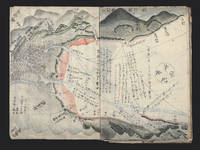
5611"Hishu" today Saga Prefecture: 1841-45. A very rare Japanese manuscript sea chart of the sea routes from Saga Prefecture a major trading area in the west to Osaka through the Inland Sea which is more than 400 km. long and includes in excess of 3000 islands. The Inland Sea one of the main trade routes for the Japanese in the Edo period has numerous areas of turbulence and navigating through the numerous islands and rocky outcroppings presented enormous problems in the era before modern navigation systems. In the early 1840s the central government in Edo ordered each fiefdom to prepare maps of coastal routes to facilitate trade and shipping. Our manuscript was prepared by Tsugihei Miyachi a high level sea pilot "mite kako" in the Saga Prefecture shipping office as an employee of the Nabeshima Clan. The map were it to be unbound is about 11340 mm. long about 37 feet depicting Saga in the west to Osaka in the east. It is finely drawn in black ink heightened with wash in green purple blue grey and red. Five of the openings have folding extension sections pasted onto the lower margins of the leaves. Blue lines depict safe sailing routes for smaller ships. The map depicts in very great detail areas of turbulence there are famous whirlpools in the Inland Sea numerous islands rock formations and landscapes for orientation anchorages harbors and fishing areas. Each section of the map has been annotated by the compiler with notes on distances characteristics of rivers landmarks for navigation tidal activities the route to Nagasaki etc. The first map opening depicts Saga and the final opening Osaka. The sea chart is prepared with considerable local knowledge of castles and temples. A series of notable castles each is labeled with name of the lord assets etc. are depicted along the shores and Miyachi describes harbors for anchoring and to get fresh water. The routes are drawn from a "bird's-eye view" perspective with lovely vistas of mountains and islands and villages and towns. The two leaves of manuscript text at the beginning in the style of a dedicatory letter to the fiefdom lord describes the compiler's efforts over a five-year period to prepare the map. He writes that it is based on his own personal experiences as a sea pilot. He states that purple denotes routes he has taken red denotes shallows blue lines denote the routes for large ships grey for land and green for mountains and forests. The eleven pages of text at the end provide details on prevailing weather patterns and how to prepare for inclement weather how to navigate by landmarks and the stars wind and tidal patterns and the history of the preparation of this map "it took me five years of daily observation to prepare this work". He provides a list of his voyages to different cities on this route. On the final page the author states that three copies were made: the first for the fiefdom lord the second for a cabinet member and the third for Miyachi's divisional chief. A modern scholar has laid-in a note describing this sea chart as one of those three. Japanese sea charts are rare survivals and we know of no other similar example outside of Japan. ❧ The sea pilot Miyachi's log books are preserved in the Nabeshima clan's archives see the Saga kenritsu toshokan database. unknown books