[JAPAN] NINAGAWA, NoritaneBiblio.com
11 476 résultats
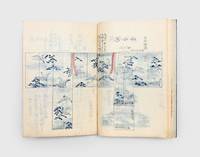
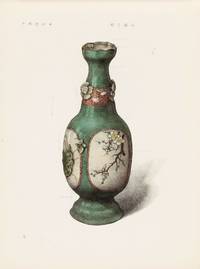
1876018471Tokyo 1876-1877 and 1879-1880. First Edition. Wraps. Wrappers of Part I quite worn with one title label mostly lost; front wrapper of Part III creased. Some offsetting and color bleedthrough; occasional edge browning; a few leaves very slightly moisture warped from coloring. Tape or glue residue in places on the versos of the plates in Part I. Near Fine with stunning hand-colored plates. First edition of Ninagawa's study of Japanese pottery arranged in chronological order from ancient times onward. Apparently one of only 300 copies published. Seven oblong folio parts 15-1/4" x 10-3/8" stitched as issued in the original blue paper wrappers with lithographed title labels on the front wrappers in French and Japanese Parts I-V and in English and Japanese Parts VI and VII. Each part with lithographed text in Japanese 5; 10; 11; 9 11; 10; and 14 leaves respectively. Printed on rectos only. Ninagawa's red stamp appears on the last leaf of text in each part. Illustrated with 125 numbered hand-colored lithographed plates several heightened with gum arabic 17 plates in Part I and 18 plates each in Parts II-VII. Some plates and items numbered with small printed labels. An excellent copy of this fragile set with the extremely scarce Parts VI and VII. This copy without the five octavo booklets containing the French translation of Parts I-V Tokyo: H. Ahrens & Co. 1876-1878 or the publisher's silk chitsu or portfolio issued with the first five parts. <br/><br/> paperback
44211<p>Japan and Western Medicine. Oranda jin Geka ryoji no zu Dutch Surgery in Nagasaki. Original pen ink and watercolor drawing on light brown-toned silk with 4 vertical lines of Japanese characters in the upper left corner. Japan: late 18th or early 19th century. 483 x 363 mm. mounted as a scroll at a modern date on light grey silk backed with paper with a half-round hanging rail with braided ribbon attached at the top and a suspension bar at the foot measuring 914 x 443 mm. overall; preserved in a custom-made wooden box. A few tiny pinholes in upper corners of image but fine with the coloring fresh and bright.</p> <p> This striking image showing an amputation carried out by a Dutch surgeon in Japan was most likely painted in the late eighteenth or early nineteenth century during Japan's self-imposed period of national isolation. The hand-painted image is related but by no means identical to a Nagasaki woodblock print titled "Surgery by a Dutch Physician" one of many popular souvenir prints depicting scenes unique to Nagasaki which at the time was the sole point of contact between Japan and the outside world. See our reproduction of the print. It may be that our scroll is the original of the image; however it is also possible that both hand-painted and woodcut versions of the image were produced simultaneously.</p> <p> Western surgery came to Japan in the sixteenth and seventeenth centuries via the Portuguese who in 1543 became the first Europeans to make direct contact with Japan and the Dutch who became the only European nation allowed to trade with Japan after Japan's expulsion of the Portuguese in 1639. Surgeons attached to the Dutch East India Company established practices at the island of Dejima in Nagasaki Bay which led to the formation of several Japanese schools of surgery based on European methods. "This aspect of Western medicine known as K m -ry geka or 'Surgery of the Red-Haired' has had a profound effect on the development of surgical practice in Japan" Van Gulik p. 37. Van Gulik "Dutch surgery in Japan" in Red-Hair Medicine: Dutch-Japanese Medical Relations ed. Beukers et al. pp. 37-50. </p> <p>. unknown
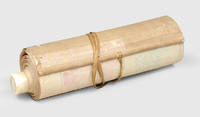
1870127747Japan: c.1870. The feudal lordships of Meiji Japan Highly attractive and distinctly uncommon early Meiji-period scroll showing the flags of 29 daimy s feudal lordships and giving details of annual revenue recorded in kokus of rice approximately 280 litres originally defined as enough to feed one person for one year provinces capitals of their respective territories or han and the cadet branch of each clan illustrated with flags for each both the -uma-jirushi "great standard" and ko-uma-jirushi "lesser standard". The scroll opens with the Hinomaru "circle of the sun" and imperial chrysanthemum mon or crest above the standards of the Tokugawa shogunate three hollyhock leaves within a circle. The sixteen-petalled Imperial Chrysanthemum Crest was first recognized as the exclusive emblem of the imperial household in 1868; the Hinomaru was adopted officially in 1854: "Japan had no national flag until 1854 when upon a petition by the lord of Satsuma han Shimazu Nariakira the bakufu military government determined that Japanese ships should fly a white flag bearing the Rising Sun emblem in order to identify themselves as Japanese. In 1870 the Meiji government following the late Tokugawa precedent decreed that Japanese ships ought to use the Rising Sun flag as the national flag" Takashi Fujitani Splendid Monarchy: Power and Pageantry in Modern Japan 1998 p. 49. The British Museum notes that the flags are presented here "on western-style horizontal flags mounted on flag poles" and not in the Japanese manner. This is a fascinating record dating to the advent of the Meiji Restoration 1868 which curtailed the power of the daimy s: "On paper the abolition of the old domains and with them the daimy as well and the creation of the new administrative units called prefectures seemed to be in 1868 the most politically dangerous of the Meiji reforms. Great care and planning went into this reform announced in 1871 lest the daimy s fight it" Louis G. Perez The History of Japan 1998 p.98. Among British and Irish institutional libraries Library Hub cites only the copy at the Society of Antiquaries of London WorldCat adds Harvard both this and the SoA copy bound in book form; we have traced a copy at the British Museum catalogued as "Flags of the different Daimyos of Japan" which survives as a scroll; only one entry on auction records 2013 apparently the present copy. A superb survival from the period of the opening of Japan perhaps intended for the tourist market when foreign trade was being established in effect acting as a guide to the leading families of Japan. Scroll 180 x 400 mm. 88 hand-coloured woodblock flags on paper text in English and Japanese. Original polished bone jikugi central cylindrical rod pale brown silk tie. Exterior a little darkened otherwise in remarkably good condition. unknown
19822091502135700896Fukuoka Prefecture Western Japan Cultural Association 1982. Soft Cover. Fine. The book is in fine condition. Fukuoka Prefecture Western Japan Cultural Association paperback
19002111902160201143Shinshu Ueda Town Japan Linguistics Joint Stock Company 1900. Soft Cover. Fine. Number of books: 1 Shinshu Ueda Town Japan Linguistics Joint Stock Company paperback
19972080502106907340Not Available 1997. Soft Cover. Fine. The book is in fine condition. Not Available paperback
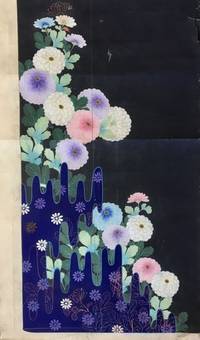
181956897Kyoto Japan: Marubeni Shoten Design Dept. Keimeikai Textile & Dyeing Studio Tanioka Shoten Design Dept. ca. 1918-1945. Folio. 61 original hand-painted inked and pencil designs with a few on a lightly toned but quality semi-translucent paper the majority on thick paper stock and still others with two pieces carefully pasted together with contiguous designs sized from 9 x 15 in. up to 19.25 x 38.5 in. with 13 of the pieces larger the larger size a number of them sized 18 x 32 in. and many in the 14.25 x 15.5 in. size colour painted; the majority feature the design studio chop or crest at lower corners throughout many w/ annotations in margins several w/ change orders neatly annotated or even the title of the design and still many others w/ Roman numeric inventory codes in margins as well two still retaining original small silk samples many with creasing or minor tears & edgewear or creasing to fore-edges a few w/ small & large closed tears while others show some creasing and thumbing from continued use still an exceptional group of manuscripts. This superb archive of 61 original hand-painted kimono designs furnishes an exceptional visual array of Taisho- and early Showa-era Japanese motifs and styles. A number of the designs evoke traditional Japanese Ukiyo-e woodblock prints with deep vivid colours and well rendered illustrations. Many of these designs incorporate floral patterns including Kiku Chrysanthemum Botan Mon Peony Pattern Manju Kiku Marigolds Japanese Irises Morning Glory Cockscomb Ivy Dahlias and many other botanical motifs. In addition there are many illustrating ornately embroidered designs austere bamboo mushrooms and intriguing landscapes some with a small portion fully painted in with brilliant colouring while the outline of the kimono fills out the drawing. Two of the designs still features their original small attached silk kimono sample more reminiscent of Western Design houses which often attached their chosen fabric samples to their clothing designs. A few of the designs are executed on translucent thin paper for the kimono draper to transfer the design to white silk or other fabrics via some type of carbon paper process. Another of the designs has been executed on a stunning silver metallic paper with palm or bamboo leaf fronds executed in vivid blues & browns. Some feature a nearly surrealist quality while several others include illustrations of doves or chickens. Two of the designs incorporate Art Deco representations of Chinese Junks and Japanese sailing vessels typical of the 1930’s prior to World War II. In the Taisho Era a new era opened for textile designers working with Kyoto drapers and department stores with many having trained at new art colleges and then working in the design studios of Marubeni Keimeikai Textile & Dyeing Studio and others. The Tachiki Artist design studio designs on thin translucent paper include one with designer stamp of character embedded within a skull. Some appear to have two different date stamps for the Marubeni Shoten Design and some are unsigned or stamped. The Taisho- and Showa-era kimonos featured brighter colours more groundbreaking designs as Japan’s designers embraced traditional dress and transformed it into a new garment equally appealing to the “Moga†or brazen “Modern Girl.†The designer notes include instructions to “leave a little more space between the fans;†“Drop the little fan crest;†“too much white bush clover†on the pine cones and even that Matsuo Taishichi had ordered a design for “clothes for paying a visit for a young person.†The Marubeni Shoten originated with Chubei Itho who began in 1858 as a salesman for linen cloth and by 1872 had opened his drapery store Benchu in Senba Osaka. By 1918 Chubei Itoh had expanded the business into Osaka and deciced to merge with Itochu Shoten Ltd. becoming Marubeni Shoten with their own drapers shops and many contracts with department stores. Later by the mid-1950s Marubeni merged with the company that operated the Takashimaya Dept. Store Chain all the while preserving their design studio and artists. See: Yuko Fukatsu-Fukuoka The Evolution of Yuzen-dyeing Techniques and Designs After the Meiji Restoration 2004; Arisa Shinko Tomikawa Hand Painted Kyo Yuzen Atelier “Arisa†A Brief Introduction 2020; Annie Van Asche Japanese Kimono Fashion of the Early Twentieth Century Textile Society of America Symposium Proceedings 2000; Our History Our Roots Marubeni Corporation 2020. Marubeni Shoten Design Dept., Keimeikai Textile & Dyeing Studio, Tanioka Shoten Design Dept., hardcover
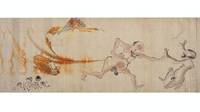
10939Ten vividly rendered scenes. Scroll 265 x 6150 mm. gold-flecked inner front endpaper outside covered with a fine silk floral-patterned brocade fabric. Japan: mid-Edo.<br /> <BR> <BR> Flatulence humor has a long history in Japan: he-gassen å±åˆæˆ¦ “fart competitions†or hÅhi-gassen 放å±åˆæˆ¦ “fart fights†have been depicted in the country’s art since the Heian era 794-1185. Our scroll contains ten explicit scenes:<br /> <BR> <BR> 1. Before the competition naked men drink cold water to induce flatulence.<br /> <BR> <BR> 2. The competition begins with naked rather well-endowed men frolicking farting with such force that a heavy game table is knocked over.<br /> <BR> <BR> 3. One man is farting on another who is defending himself with a fan.<br /> <BR> <BR> 4. Three men are farting with serious intent.<br /> <BR> <BR> 5. Seven men are farting at each other one of whom is defending himself with a makeshift shield. Another is retching. One competitor has gathered his gas in a bag and is carrying it to the action. Another man is enjoying the power of a competitor’s wind as he is being blown into the air.<br /> <BR> <BR> 6. One man is farting and his opponent is ducking away from the wind.<br /> <BR> <BR> 7. A man is farting and has knocked down his opponent by the wind’s force.<br /> <BR> <BR> 8. Six men are competing with uncertain results.<br /> <BR> <BR> 9. One man is defending himself with a fan and an onlooker is entertained by the activities.<br /> <BR> <BR> 10. The final scene depicts five men at the conclusion of the competition sitting peacefully sipping a liquid porridge and eating raw chestnuts.<br /> <BR> <BR> At the end we find text stating this was created in the mid-Edo period and was the property of the Fukuda family of Awa province today’s Tokushima Prefecture. Beforehand it had been owned by Inokuma Nobuo shrine master of Shirotori jinja in Shashu province today’s Kagawa Prefecture. With one seal of the Fukuda family and another that we cannot identify.<br /> <BR> <BR> In fine condition carefully rebacked with some mending. unknown
19952110502151001996Gakuseisha 1995. Soft Cover. Fine. Number of books: 73 boxes 76 books Gakuseisha paperback
19902091202133206396Kuresushuppan 1990. Soft Cover. Fine. Number of books: 9 books in total Kuresushuppan paperback
1897186729Tokyo: 1897. The dress of the classical Japanese nobility An attractive manuscript copy of this rare treatise on Heian-period ceremonial attire. Only one other copy is known held by the National Archives of Japan. The copyist Ishimoto Shuen was an artist-historian whose research focused on ancient clothing. She was named as one of the most accomplished artists in Tokyo by a 1916 broadside. Shozoku shokushikimoku otherwise known as Shozoku imon or in the case of the other known copy Kinpi shozoku imon introduces over 40 examples of different types of clothing worn throughout Japanese history and manuscript captions explain their features. The clothing ranges from kanmuri headwear to ceremonial leather belts sekitai swords fans and ritual omigoromo robes. Different examples of each are given depending on the season and the rank of the person who was permitted to wear certain colours and designs. According to the colophon the text was first found in the collection of Ise Sadatake 1718-1784 a samurai and notable historian of court etiquette. A copy was made in 1772 then another in 1856 and finally this example in 1897. Ishimoto Shuen was the protégé of the famous academic and Shinto scholar Kosugi Sugimura. The pair produced a number of books and hanging scrolls depicting Heian-period and earlier court dress especially in the late 1890s. Ishimoto's ownership signatures and seal are on the first and final pages. The illustrations in this copy are in a slightly different layout to the other surviving example although the colours are more vivid. Quarto 264 x 190 mm with 26 leaves of mica-infused paper. Manuscript text and watercolour illustrations throughout. Original blue paper wrappers renewed white thread fukuro-toji binding. A little rubbed and creased wrappers with scattered patches of discolouration contents bright with very minor wormholing: a very good example. hardcover
2081402109400016West Japan Cultural Association N.A. Soft Cover. Fine. Number of pages: 66 books Size: 22-38cm Number of books: 66 books West Japan Cultural Association paperback
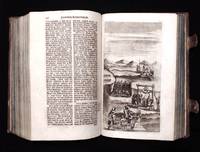
1738018990Augsburg: Franz Antoni Alger 1738. First Edition. Hardcover. Nineteenth century signature to front fly leaf and early signature to title some very light staining in various places throughout mostly only visible in margins; expected soiling to binding. A clean and attractive Near Fine example. Quarto 8-1/2" x 12-1/2" with two parts bound together in contemporary blind-stamped pigskin over wooden boards clasps lacking but catches present title on spine label stamped in blind; 24 534 2 559 1 pages. Title in red and black engraved head- and tail-pieces and initials. Illustrated with 9 engraved plates. The First German Edition of this history of the Jesuit Mission in Japan. While Christianity in Japan flourished for a brief period in the mid 1500s the religion was banned in 1620 and existed only underground. The Catholic church took some exception to Crasset's work saying that he "attributed the origin of the persecution of 1597 to the imprudence of the friars in making their religious ceremonies too public" Catholic Encyclopedia IV 468. <br/><br/> Franz Antoni Alger hardcover
19572110502150901164Not Available 1957. Soft Cover. Fine. Number of books: 102 Not Available paperback
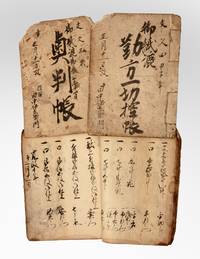
1094998 folding leaves. Small 4to 283 x 205 mm. orig. wrappers orig. stitching with two other documents described below. N.p.: 1852-67.<br /> <BR> <BR> In the 19th century papermaking mills in villages were common throughout Japan. This manuscript a copy kept by the mill owner Tanaka Izaemon records the business activities in 1864 of his papermaking activities. We have been unable to determine where he operated but we find in the two accompanying documents the village names Shiraki ç™½æœ¨æ‘ Yamanaka å±±ä¸æ‘ and Tateyama ç«‹å±±æ‘ all rather common place names. This manuscript provides the names of the employees their lengths of employment monetary and tax matters etc.<br /> <BR> <BR> The second manuscript 22 folding leaves 284 x 206 mm. is entitled on upper wrapper “1863. On kami suki on hÅkÅ baibai. Okuhan chÅ. ShÅgatsu JÅ«ichi nichi aratame. Tanaka Izaemon†文久三年. 御紙漉御奉公売買. 奥判帳. æ£æœˆå一日改. ç”°ä¸ä¼Šå·¦è¡›é–€ “1863. Papermaking. Wages for Employees. Review. Tanaka Izaemonâ€.<br /> <BR> <BR> The third manuscript 45 folding leaves 281 x 22o mm. has no title but is concerned with the sale of papermaking permits from one owner to another details of ownership official forms and contracts hÅkÅnin ukejÅ with employees wages living provisions etc.<br /> <BR> <BR> In very good condition. Each manuscript has suffered from hungry mice “horse bites†in Japanese but the texts are very largely untouched. unknown
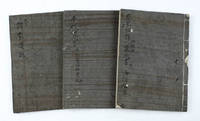
1573393 manuscript volumes neatly written in black and red ink. Original wrappers with later string ties. Wrappers damaged with a little loss in places. Some worming. Still overall very good. 19 x 13.5cm. These three volumes are a collection of manuscripts written in the late Edo period probably the 1860s. Most of the original documents on which the manuscripts were based were written shortly after the arrival of the American delegation led by Commodore Matthew Perry in July 8 1853 June 3 in Japanese calendar. These documents written in the face of this national crisis were mostly driven by the patriotic fervour of the authors. They show a variety of thoughts about the threat from the foreign powers. None of these were published at the time and only Watanabe Kazan’s Shinki-ron was published in modern times. <br> <br>Kazan wrote his treatise inspired not by the arrival of Perry but by the Edo government’s hostile treatment of the American merchant ship Morrison in 1837. <br> <br>Titles and short synopses of these works follow: <br> <br>Volume 1: Chiyoda mondō Questions and Answers in Chiyoda 千代田問答 1853; Momijiyama shinrei-ki紅葉山神靈記 Message from the Holy Spirit in Momijiyama <br> <br>The author of Chiyoda mondō is unknown. The word "Chiyoda" in Chiyoda mondō is the name of the area where the Edo Castle sat and refers to the god in the Tōshōgū Shrine in Momijiyama next to the western part of the Edo Castle. This document is difficult to read but it appears to explain how a group of mysterious people or possibly divine spirits tell stories related to Japan's national affairs in 1853 discussing the country's national defence against foreigners and the situation regarding Christianity. <br> <br>In Momijiyama shinrei-ki the anonymous author who was an attendant to the group of the high government officials visiting the Tōshōgū Shrine in Momijiyama fell asleep and in his dream a Holy Spirit appeared and told him the necessity of enhancing the coastal defence in the face of the American expansion. <br> <br>Volume 2: Daimyō shoka kengi 大名諸家建議 Proposals from War Lords and Various People <br> <br>This manuscript is a collection of proposals and opinions expressed by Daimyō war lords and the retainers of the Edo government on the subject of Japan's foreign policy after the arrival of the American delegation led by Commodore Perry which requested trade with Japan. The Daimyō discuss how to deal with the crisis in terms of such issues as trade and coastal defence. Some even proposed possible war with the American fleet. The daimyo some of whom were high-rank officials of the Edo government included Shimadu Nariakira島津斉彬 1809-58 Maeda Nariyasu 前田斉泰 1811-84 Matsudaira Shungaku 松平春嶽 1928-90 Tokugawa Yoshinobu 徳川慶喜 1837-1913 Ii Naosuke 井伊直弼 1815-60 Nabeshima Naomasa 鍋島直正 1815-71 and the retainers included Inoue Saburōemon 井上三郎右衛門 - and Katsu Rinsuke 勝麟助 1823-99. Katsu became a capable mediator when the Edo castle was surrendered peacefully to the new Meiji government in 1868. <br> <br>Volume 3: 海防備言 Kaibō bigen Words on Coastal Defence. Habu Kumagorō 土生熊五郎- Rifujutsui 嫠不恤緯 Widow Does Not Worry the Shortage of Weft the latter a Chinese expression referring to strong patriotism; Watanabe Kazan 渡辺崋山 1793-1841 Shinki-ron愼機論 Essay on Attention to an Opportunity 1838; Hakura Morochika羽倉用九 1790-1862 Gakaisho 畫灰書 Drawing in Ash and Gasuisho畫水書 Drawing in Water 1854; Fujimori Kōan 藤森弘庵 1799-1862 Kaibō biron 海防 備論Treatise on Coastal Defence 1853 <br> <br>Habu Kumagorō was a Confucian scholar in Wakayama. He proposed the developing the land of Ezo 蝦夷 Hokkaido. Rifujutsui discusses such topics as the advance of the Russians to Siberia and the necessity of developing Hokkaido as well as the art of war. <br> <br>Watanabe Kazan was a chief retainer of the Tahara Domain eastern part of present Aichi Prefecture Confucian scholar and also famous as a painter. Shinki-ron criticises the xenophobic foreign policy of the Edo government. <br> <br>Hakura Morochika was a Confucian scholar in Osaka. After the arrival of Perry he discussed the measures against foreign enemies. In Gakaisho a collection of historical essays Hakura objected to trade with America in the form of an answer to the sovereign message from America seeking trade with Japan. He also wrote an answer to the sovereign message from Russia but he was more sympathetic to the Russians because they sought trade through the official channel in Nagasaki while the American delegate in the military fleet came to Uraga in a threatening manner. In Gasuisho also Hakura mentions the harmful effects of Christianity. <br> <br>Fujimori Kōan was a Confucian scholar of the Ono Domain in present Ono City Hyogo Prefecture. In his later life he opened a private school in Edo and wrote the comprehensive treatise on Japanese coastal defence Kaibō biron after the arrival of Perry. . unknown
20042092902141400200Yoshikawakobunkan 2004. Soft Cover. Fine. Number of books: 54 Yoshikawakobunkan paperback
20132080502106917736Not Available 2013. Soft Cover. Fine. The book is in fine condition. Not Available paperback
2080402107100283Not Available N.A. Soft Cover. Fine. Number of books: 20 Not Available paperback
1904353246Tokyo: K. Ogawa 1904. Illustrated with photos by Ogawa. 177 ff. 1 vols. Oblong folio. Publisher's decorated green silk-covered boards with titles and decorations in gold embroidery fine silk-backed endpapers decorated with gold inner hinges strengthened bound at the spine with cream ribbon in Japanese style. Green calf backed folding box. Illustrated with photos by Ogawa. 177 ff. 1 vols. Oblong folio. K. Ogawa unknown
53661Osaka: Darumaya Shoten Taisho 11 1922. Two vols. 30; 32 pp. With 48 hand-coloured woodblock plates each showing 5 or more coloured masks most w/ identifying numbers and occasional text. Uniformly bound leporello accordion-style in bright orange covers w/ printed title labels in red & black on front covers illustrated endpapers slight shelfwear very slight rubbing to fore-edges w/ original green silk folding case woodblock printed label on front cover preserving 1 of 2 original bone clasps at side some soiling edgewear rubbing to fore-edges NF/VG- set. First edition of this remarkably scarce and stunning catalogue of Japanese Noh theatre masks many offering the titles and origins of the masks. Noh performers carefully choose their masks because traditionally it has been believed that they are more spiritual than merely a prop to change the actor’s appearance. The types of masks represented in these beautifully printed colour woodblock plates -- many highlighted in hand colouring -- encompass the Okina Old man masks the oldest of these types of masks; Jo Elders masks used when the actor is portraying a spirit; Onna-men woman masks which tend to be the most popular and varied with beautiful young woman masks mature and middle-aged women masks and those representing the very old; Otoko-men Men masks; along with the fantastical Kishin Demons and Onryo Ghosts & Spirits masks. The Kishin masks represented here are distinguishable as the long-nosed Tengu goblins as well as the Tobide portraying demons and savages. Noh masks are often considered to be very valuable heirlooms and many have been handed down from generation to generation within the same family or school of performers. Worldcat locates 4 copies 3 complete copies at Cornell National Library of Australia & Waseda Univ. Library; National Diet copy has only vol. I. Darumaya Shoten, unknown
1855030323London / Madrid / New York: Germer Bailliere 1855. 1st Edition . Hardcover. Very Good. 574 Pp 1 Pp Errata At End. Blue Morocco Gilt Over Blue Marbled Paper Covered Boards Marbled Endpapers Somewhat Similar Color Speckles On Edges Of Page Block. Binding Clean And Complete Original With Small Repairs To Corners No Chipping Hinges Tight No Names Or Marks Or Bookplates. Contents Fine Slight Even Aging To Pages No Wear To Pages. <br/> <br/> Germer Bailliere hardcover
19392090502113701642Not Available 1939. Soft Cover. Fine. The book is in fine condition. Not Available paperback
19952091502135302477Kokusho Publishing Association 1995. Soft Cover. Fine. Number of books: 19 Kokusho Publishing Association paperback
20132091502135416667Quaternary Society of Japan 2013. Soft Cover. Fine. Volume: 201 Quaternary Society of Japan paperback