[ISHIKAWA, TOMONOBU]. 石川流宣.Biblio.com
74 résultats
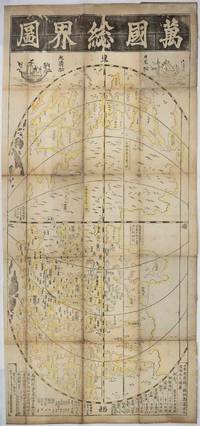
1708219243東京. Tokyo.: 須原屋茂兵衛. Suwaraya Mohei. Hoei 5 1708. Black and white woodblock map with yellow outlining in original hand colour 55.8 x 127cm map; 59.5 x 131cm sheet folding into the original Japanese wrappers chipped and rather worn 26.4 x 17.4cm the map with old repairs laid down on washi rather browned and wormed at the folds but with no serious loss the sheet age-toned and a little dusty but overall in remarkably good condition. Preserved in a modern blue linen Japanese case with toggle-closures. A famous woodblock-printed Japanese map of the world by renowned Edo Period map-maker Ishikawa Tomonobu who is also known as Ishikawa Ryūsen. This is a revised version of an earlier map produced by Ishikawa in 1688. <br> <br>The map appears to draw on Chinese and Portuguese geographical knowledge. The Chinese production of world maps had been transformed by the influence of the Italian Jesuit Matteo Ricci who collaborated with Chinese cartographers to produce a 1584 map of the world. In Japan the production of maps of "the myriad countries" or "the international countries" bankoku had been inspired by contact with Portuguese missionaries and with the Dutch in the 16th century. <br> <br>Ishikawa's map broadly resembles the Ricci map in being placed in an oval frame with the Pacific and thus also China and Japan at the centre. The content though is different. While Ricci's map is oriented to the north Ishikawa's is oriented to the east with America at the top of the page and the sketchy outlines of Europe including 'Ikiresu' England and a large and clearly marked Holland and Africa 'Kafuri' at the bottom. This orientation apparently influenced by the first world map in Japan "Bankoku Sōzu" 万国総図 which was published in 1645. Interestingly although Ishikawa had earlier produced a quite detailed and fairly accurate map of Japan the Japan shown on this world map is a rather loosely outlined collection of islands in which for example Ryūkyū the Ryukyu Kingdom now Okinawa and Hachijōjima appear much larger than they are in reality. Japan is also unusually oriented making it appear as though Ezo now Hokkaido is in the middle of the Pacific. It seems that the cartographer's interest here was less in outlining Japan in detail than in broadly setting out the country's place in relation to the land masses to the east and west. <br> <br>Like other Japanese world maps of the Edo period and like Ricci's map Ishikawa's image of the world includes imagined countries such as 'The Land of Giants". The continuing centrality of China in Japanese thought is indicated by the fact that Ishikawa's map contains a very clearly marked depiction of the Great Wall and that the map is decorated at the top with depictions of a Japanese and a Chinese sailing ship. The text at the bottom gives estimated distances between Hizen Province where the port of Nagasaki provided Japan's main official outlet to the world in this age of seclusion and various places in China and between Hizen and the Ryūkyū Kingdom. It also gives the estimated distance from Korea to Tsushima Island which served as Japan's gateway for diplomatic and trade relations with Korea. <br> <br>Engelbert Kaempfer a German physician and explorer brought back the 1688 edition of this map printing to Europe after his stay in Japan between 1690 and 1692. The map was introduced to European audiences in the 17th century and impacted on later European cartographic endeavours. <br> <br>Copies of this rare and historically significant map are held only in a handful of major collections: the British Library National Diet Library NDL of Japan the Staatsbibliothek of Berlin University of California Berkeley's Japanese Historic Maps Collection and the University of British Columbia. . 須原屋茂兵衛. [Suwaraya Mohei]. unknown
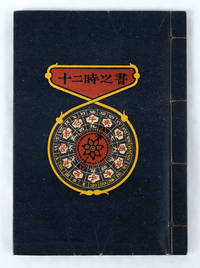
1719160736Tokyo.: 私刊豆本. Limited edition of 300 signed copies. Showa 17 1942. 15 folded leaves delightfully illustrated with colour lithographs showing Japanese clocks and other time pieces by well-known artist and author Takeo Takei. Japanese four hole stab string binding pictorial covers. A little very light wear. Very good. Influential Japanese artist Takeo Takei 1894 -1983 is probably best known for his children's book illustrations but his work was far from limited to this genre. His work is regarded as having three distinct areas: Douga or illustrations for children Hanga or woodblock prints and Kanpon books of various materials. This stunning petite book was his eighth book. . 私刊豆本. unknown
1760015796Paris Circa 1760: Jacques Chereau 1760. First Edition . No Binding. Good. 15 1/2" x 10 1/4. Hand Colored Engraving. A Very Large 15 1/2" X 10 1/4" Engraved View Of The Ruins Of A Monastery In Rome. Many Figures In Foreground Walking And Exploring The Ruins. Title In Mirror Image Above " Les Ruines De Ste. Marie Des Anges A Rome" All In Capital Letters At Bottom Is The Full Title With The Publisher's Legend Beneath "A Paris Chez Jacques Chereau Rue St. Jacques Au Defous De La Fontaine St. Severin Aux A Colonnes No. 257". 3/4" Chip In Margin At Left Not Affecting The Engraving; 1/2" Tear At Right Margin Including 1/4" Barely Visible Tear Into Engraved Area. Colored As Usual In Red Blue Pink Green Yellow. <br/> <br/> Jacques Chereau unknown
1796016852Benoit Dandré/Garnery, Paris, 1796 /An IV. 1ere Edition Hartkarton/Leder Gut
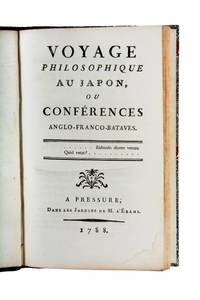
17883005361Pressure" Paris: Dans les Jardins de M. l'Ebahi 1788. A good copy. Octavo half-title woodcut vignette of a ship setting sail at start of text; neat modern quarter calf. <p><p>First edition scarce: a witty and urbane discussion of everything from the rules of Japanese society to the French Compagnie des Indes. The unknown author's reflections on religion and satirical comments on Europe meant that the work must have been skirting very close to being censored.</p> <p>Presumably published in Paris the imprint is meant to refer to l'Ebahi's stately home the Chateau de Pressure in a salon of which the three main characters the much-travelled Monsieur l'Ebahi "Mister Flabbergasted" the Englishman "Thincker" and the Dutchman "Wurtzheim" are comfortably seated as they swap tales of their marvellous adventures not only in Japan but throughout Asia. The whole story is told with such brio that it could almost pass for actual reportage if it were not for the knowing interjections of the author who says at the outset that the only philosophical lesson worth learning is to admire the teachings of Democritus and be amused by the foibles of mankind.</p> <p>The work does appear quite rare with copies recorded in the British Library and the Bibliothèque Nationale de France but with apparently few others.</p> </p> . Dans les Jardins de M. l'Ebahi unknown
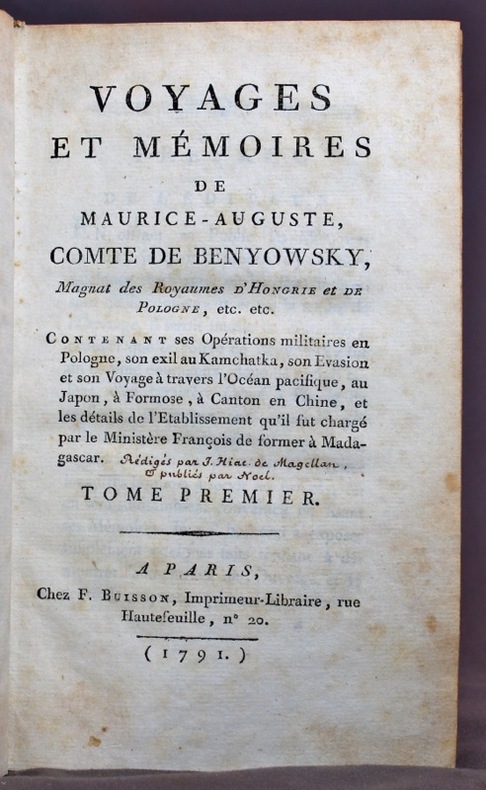
17916424A Paris, Chez F. Buisson, Imprimeur-Libraire, rue Hautefeuille, n°20. (1791). 1791 2 vol. in-8° (200 x 125 mm.) de : I. [2] ff. (titre, f. t.), viii, 466 pp.; II. [2] ff. (titre, f. t.), 486 pp. Initiales manuscrites à l'encre "L R" surles faux titres. Demi-basane dépoque, dos lisses ornés et titrés à l'or, coins de parchemin, plats recouverts de papier à la colle bleu.
179115636Paris, Buisson, 1791. 2 volumes in-8 de 4-VIII-466; [4]-486 pages, demi-basane brune à coins, dos lisses ornés de filets dorés, pièces de titre beige et de tomaison, ronde et verte, en forme de médaillon. Ex-libris Monvert et signature de Ch. L. Monvert, avocat. Une note à l'encre sur la page de titre précise Rédigés par J. Hiac. de Magellan, & publiés par Noel.
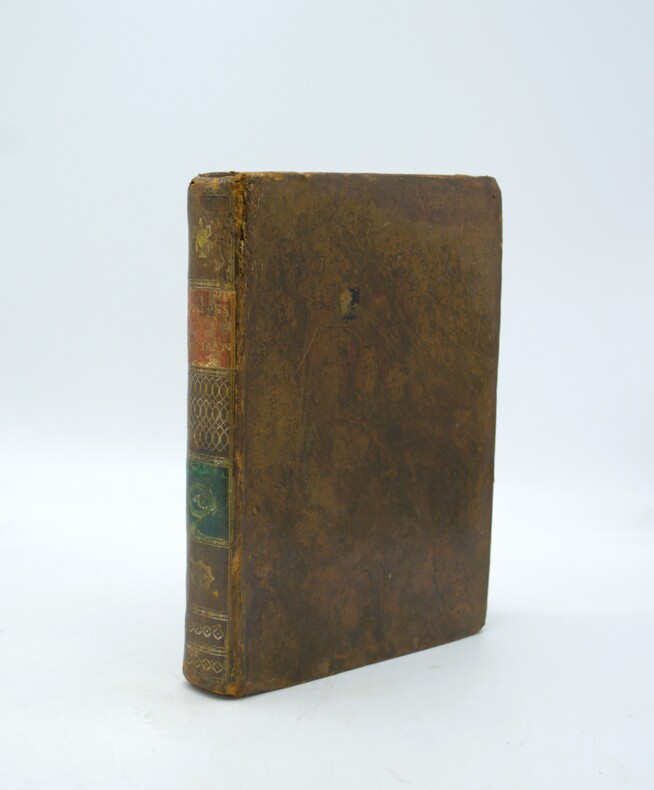
1796P2-1A-4Paris : Benoît Dandré, Garnery, Obré, An IV (1796). 4 volumes i n-8 (191x123mm) : portait, 2ff., LXIV, 417pp., 1 planche ; VIIIpp., 1f., 430pp., 4 planches ; VIII, 445pp., 4 planches ; XII, 462pp., 19 planches. Basane racinée, dos lisse orné, tranches jaunes, reliure de l’époque. L’une des plus importantes relations de voyage au Japon, composée par le botaniste et médecin suédois Carl Peter Thunberg (1743-1828), surnommé le « Linné japonais ». Cette ouvrage est le fruit des voyages qu’il commença en 1770, tout d’abord au Cap de Bonne-Espérance jusqu’en 1774, puis à Java, Batavia et au Japon en 1775 et 1776 avant son retour dans sa patrie en 1779 en passant par Ceylan et Amsterdam. L’édition fut traduite, rédigées augmentée par l’orientaliste Louis Langlès (1763-1824) et revue, pour ce qui concerne l’histoire naturelle, par le naturaliste Jean-Baptiste de Monet de Lamarck (1744-1829). C’est la première édition de cette traduction. L’illustration se compose d’un portrait de Thunberg gravé par Denis Née (1732-1817) d’après Claude Jacques Notté, d’une vignette gravée par Née d’après Ozanne, et de 28 planches dont 7 dépliantes. Dos légèrement éclaircis, frottements d’usage au dos et sur les coupes, quelques épidermures. Partie inférieure de la reliure du dernier volume légèrement gondolée par l’humidité. Feuillets brunis, rousseurs. Tâche d’encre page 128 du premier volume. Mouillures. THUNBERG CARL PETER. Paris, Benoît Dandré, 1796. 4 vols in-8° (191x123mm), full contemporary leathers gilt back, red labels. Illustrated with a portrait ant 28 plates. Thunberg was the student of LINNAEUS. He set out to Japan to explore the island and its manners and costume.
1796PHO-1991Paris, Benoît Dandré, Garnery, Obré, An IV [1796]. — 4 volumes in-8, (130x200), portrait, lxiv, 417 pp., 1 planche, viij pp., (1 f.), 430 pp., 4 planches ; viij, 445 pp., 4 planches ; xij, 462 pp., 19 planches, basane marbrée, pièces fauve et verte au dos, tranches rouges (Reliure de l’époque), reliure usée, manque un feuillet T4 (p33-34), mouillures, quelques brunissures Cordier, Japonica, p. 447. - Chadenat, 1763.
1796PHO-2059Paris, Dandré ; Garnerey ; Obré, an IV (1796). 1 volumes in-4 (2) (265x200mm); XLIV-510pp., , relié basane raciné de l'époque, dos lisses ornés, pièces de titre rouge et de tomaison verte, frottements, accroc au plat, début de fente, coins usés, mouillure claire, déchirure en marge sur les 4 derniers feuillets et les planches sans atteinte, petit trou de ver.
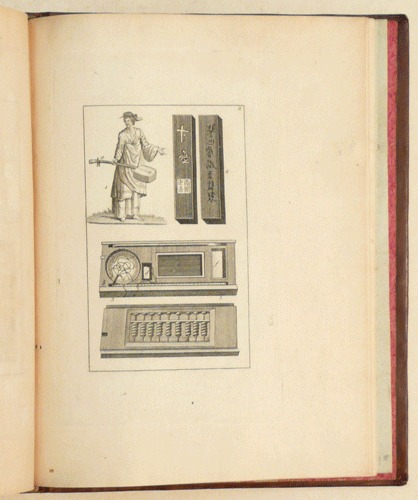
179619842Paris B. Dandré 1796 in-8 demi-veau 2 volumes, reliure demi-veau havane in-octavo (binding half calfskin in-octavo) (13 x 21 cm), reliure d'époque, dos à nerfs (spine with raised band), décoration or et à froid (gilt and blind stamping decoration), à filets or (gilt lines) , pièce de titre sur fond rouge avec double filets or en encadrement (label of title with double gilt line) et pièce de tomaison sur fond vert foncé avec double filets or en encadrement (label of volume numbering with double gilt line), dos frotté, les coiffes manquent, papier fantaisie jaune d'époque aux plats (cover with imagination paper), coins émoussés, marque-page en tissu (bookmark in tissue), toutes tranches lisses (all smooth edges) jaunes, orné au tome III : de 4 planches hors-texte Numérotée de 1 à 4 gravées sur bois en noir in-fine et Orné au tome IV : de 4 planches hors-texte numérotées de 5 à 8 gravées sur bois en noir + 8 planches d'Histoire Naturelle numérotées de 1 à 8 gravées sur bois en noir + 7 hors-texte de monnaies Japonaises contenant les planches de 1 à 8 gravées sur bois en noir, (VIII-445 + 4 planches hors-texte) + (XII-462-VIII + 19 planches) pages, an IV (1796) Paris : B. Dandré Editeur,
1796102985Paris Benoît Dandré, Garnery, Obré 1796 2 vol. relié Tomes I et II seuls (sur 4). 2 vol. in-8, demi-basane tabac, dos lisses ornés en long d'arabesques dorées, tranches marbrées, (4) + LXIV + 417 pp. et VIII + (2) + 430 pp., vignette et 1 planche dans le 1er tome, 4 planches dans le 2e tome. Traduits, rédigés et augmentés de notes sur la religion, le gouvernement, le commerce, l'industrie et les langues de ces différentes contrées, particulièrement sur le Javan et le Malai par L. Langlès, et revus quant à la partie d'histoire naturelle par J. B. Lamarck. Manque le frontispice du tome 1. Dos uniformément passés, sinon très bon exemplaire.
1796102985Paris Benoît Dandré, Garnery, Obré 1796 2 vol. relié Tomes I et II seuls (sur 4). 2 vol. in-8, demi-basane tabac, dos lisses ornés en long d'arabesques dorées, tranches marbrées, (4) + LXIV + 417 pp. et VIII + (2) + 430 pp., vignette et 1 planche dans le 1er tome, 4 planches dans le 2e tome. Traduits, rédigés et augmentés de notes sur la religion, le gouvernement, le commerce, l'industrie et les langues de ces différentes contrées, particulièrement sur le Javan et le Malai par L. Langlès, et revus quant à la partie d'histoire naturelle par J. B. Lamarck. Manque le frontispice du tome 1. Dos uniformément passés, sinon très bon exemplaire.
17960038431796 A Paris, chez Benoît Dandré, Garnery & Obré, An IV [1796]. Un volume (sur 2) in-quarto (208 X 260) basane fauve granitée, encadrement de roulette dorée sur les plats, dos lisse orné de roulettes dorées en place des nerfs, chainettes et fleurons dorés, pièces de titre et de tomaison maroquin havane foncé, coupes et coiffes filetées (reliure d'époque) ; (2) ff. de faux-titre et titre, portrait-frontispice, XLIV pages de préface du rédacteur, préface de l'auteur, table des chapitres et explication des planches, 510 pages, 16 planches hors-texte. Petites galeries de ver aux 20 premiers feuillets, sans atteinte au texte ; puis deux trous de vers, en fond de cahier et de la grosseur d'une tête d'épingle, jusqu'à la page 104 pour le premier trou, et jusqu'à la fin du volume pour le second.
1728019215London: for the Publisher and Thomas Woodward and Charles Davis 1728. First Edition. Hardcover. Light dampstaining in second volume. Generally clean and bright Near Fine. Two folio 8-1/2" x 13-3/4 volumes in contemporary calf leather neatly rebacked preserving the original gilt spine labels. First edition in English second issue with the additional appendix in volume 2 translated from the German by J. G. Scheuchzer. Titles printed in red and black with additional engraved titles and 45 mostly double-page or folding plates and maps. Kaempfer's HISTORY OF JAPAN "was for more than a century the chief source of Western knowledge of the country. It contains the first biography of Kaempfer; an account of his journey; a history and description of Japan and its fauna; a description of Nagasaki and Deshima; a report on two embassies to Edo with a description of the cities which were visited on the way; and six appendices on tea Japanese paper acupuncture moxa ambergris and Japan's seclusion policy" DICTIONARY OF SCIENTIFIC BIOGRAPHY. Kaempfer was a physician for the Dutch East India Company's trading settlement at Nagasaki in the late 17th century. Sir Hans Sloane acquired the manuscript after Kaempfer's death and arranged for it to be translated into English for this edition. Of significance is the fine folding map of Japan "Imperium Japonicum in Sexaginta et Octo Provincias Divisum." <br/><br/>Cordier JAPONICA pages 414-15; Cox I: 332; Garrison-Morton 6374.11; See Nissen BBI 1019 note; Wellcome III: 376. for the Publisher, and Thomas Woodward and Charles Davis hardcover
179914737AB1799. 10,5 : 10,8 cm. Drawing and Aquatint. Framed.
17822091202133203456Kihei Kashiwaya and others 1782. Soft Cover. Fine. Number of books: 3 books in total Kihei Kashiwaya and others paperback
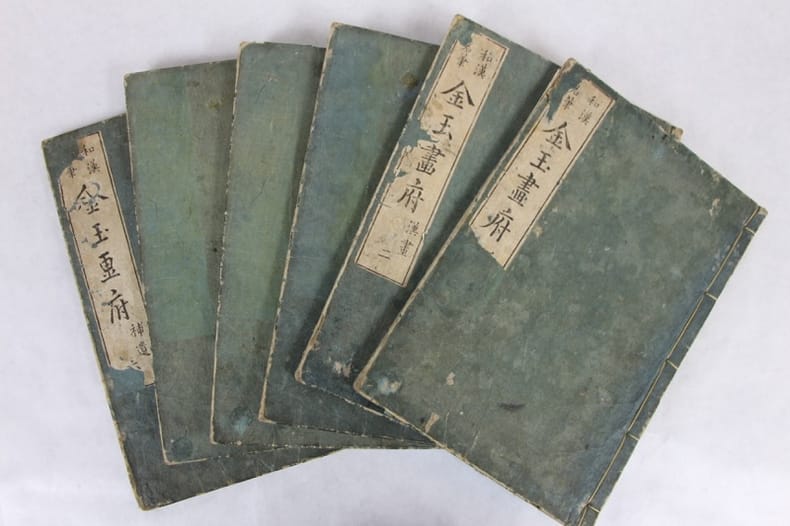
1770135640Hosaki Jogwanken 1770 6 volumes 26,5 x 18,5, Reliure japonaise d’origine, étiquettes d’origine petits manques pour 3 volumes, 236 pp. de gravures en noir. Légère humidité éparse, plus marquée pour un volume. Quelques attaques de vers.. Manque le 21ème feuillet du premier volume. Au 6ème volume, un frontispice avec le titre Jimbutsu no Bu. Gwafu Hoï, supplément de Gafu, puis quelques pages d’introduction non signée.
1770038298Rome 1770. 1st Edition . No Binding. Near Fine. Large Engraving Image Size 11 5/8" X7 3/4". Strong Impression Thick Heavy Ink Easily Felt By Hand On Laid Paper One Of A Large Collection Of Original Antique Engravings Formed By A Southern California Artist In The Early To Middle Twentieth Century. Giovanni Battista Also Giambattista Piranesi 1720 - 1778 Was An Italian Artist Famous For His Etchings Of Rome And Of Fictitious And Atmospheric "Prisons" Le Carceri D'invenzione. It Is Important To Look At His Contribution As An Archaeologist Which Was Acknowledged At The Time As He Had Been Elected To The London Society Of Antiquaries. His Influence Of Technical Drawings In Antiquarian Publications Is Often Overshadowed. He Left Explanatory Notes In The Lower Margin About The Structure And Ornament. Most Ancient Monuments In Rome Were Abandoned In Fields And Gardens. Piranesi Tried To Preserve Them With His Engravings. To Do This Piranesi Pushed Himself To Achieve Realism In His Work. A Third Of The Monuments In Piranesi's Engravings Have Disappeared And The Stucco And Surfacings Were Often Stolen Restored And Modified Clumsily. Piranesi's Precise Observational Skills Allow People To Experience The Atmosphere In Rome In The Eighteenth Century. Piranesi May Have Recognised His Role To Disseminate Remarkable Information Through Meaningful Images. He Became The Director Of The Portici Museum In 1751. Wikipedia. <br/> <br/> unknown
1748826931748. MAP - JAPAN. SETTSU NO KUNI MEISHO. Kyoto Kimura Juyodo Kan'en Gannen 1748. A handcolored woodblock printed map of Settsu provice containing the area of Osaka castle etc. 117.3 X 129.1 cm folds into heavy paper covers of approximately 27.7 x 18.9 cm. The original title slip is gone replaced by a handbrushed label: "Osaka no Kuni" "Carte Baie d'Osacca". Lovely and interesting map found at Beans main volume p.22 1748.1. Condition is very good printed on very strong and supple paper. For a detaiuled illustration see the record at UBC's website for the Beans copy: http://angel.library.ubc.ca/cdm4/item_viewer.phpCISOROOT=%2 Ftokugawa&CISOPTR=286&DMSCALE=50&DMWIDTH=600&DMHEIGHT=600&DM MODE=viewer&DMFULL=0&DMX=75&DMY=44&DMTEXT=&DMTHUMB=1&REC=2&D MROTATE=0&x=266&y=296 Our copy has different hand-coloring. The Beans copy hand-colors the harbor ours hand-colors the land primarily. From the collection of Roger Keyes. unknown books
1748826931748. MAP - JAPAN. SETTSU NO KUNI MEISHO. Kyoto Kimura Juyodo Kan'en Gannen 1748. A handcolored woodblock printed map of Settsu provice containing the area of Osaka castle etc. 117.3 X 129.1 cm folds into heavy paper covers of approximately 27.7 x 18.9 cm. The original title slip is gone replaced by a handbrushed label: "Osaka no Kuni" "Carte Baie d'Osacca". Lovely and interesting map found at Beans main volume p.22 1748.1. Condition is very good printed on very strong and supple paper. For a detaiuled illustration see the record at UBC's website for the Beans copy: http://angel.library.ubc.ca/cdm4/item_viewer.phpCISOROOT=%2Ftokugawa& CISOPTR=286&DMSCALE=50&DMWIDTH=600&DMHEIGHT=600&DMMODE=viewer&DMFULL=0 &DMX=75&DMY=44&DMTEXT=&DMTHUMB=1&REC=2&DMROTATE=0&x=266&y=296 Our copy has different hand-coloring. The Beans copy hand-colors the harbor ours hand-colors the land primarily. From the collection of Roger Keyes. unknown
17872091202133206213Seigankaku Suharaya Ihachi 1787. Soft Cover. Fine. Number of books: 6 books in total Seigankaku Suharaya Ihachi paperback
172212240… où l'on voit ce qui s'est passé de plus important dans cet empire pendant trente-huit ans qu'elles ont duré. Pleine basane brune, dos à nerfs orné, pièce de titre rouge. Très bon Amsterdam Jordan 1722 1 volume in-12
179223183Wien, Schrämbl, 1792. Kl. 8°, XIV, 384 Seiten. Marmorierter Halbleder mit goldgeprägtem Rückenschild.
176015718Carl Hermann Hemmerde, Halle und Helmstädt (Helmstedt), 1760. Titel, 38 nn., 955 Seiten. 8vo. Pappe.