11 476 résultats
19692080202105201194Yamada shoin 1969. Soft Cover. Fine. The book is in fine condition. Yamada shoin paperback
19272092902137401260Tokoshoin 1927. Soft Cover. Fine. Number of books: 1 book Tokoshoin paperback
19692080202102702885Yamada shoin 1969. Soft Cover. Fine. Size: A4 size Yamada shoin paperback
19762090202118100105Not Available 1976. Soft Cover. Fine. The book is in fine condition. Not Available paperback
19762080502106504823Not Available 1976. Soft Cover. Fine. Volume: 1 Not Available paperback
19742090202120414505Rare Book Publishing Association 1974. Soft Cover. Fine. Number of books: 1 Rare Book Publishing Association paperback
19682090502113705514Not Available 1968. Soft Cover. Fine. The book is in fine condition. Not Available paperback
19792091202132802994Not Available 1979. Soft Cover. Fine. Number of books: 1 Not Available paperback
19532092902137702638University of Tokyo Press 1953. Soft Cover. Fine. The book is in fine condition. University of Tokyo Press paperback
19542082402113508615Bijutsu shubbansha 1954. Soft Cover. Fine. Number of books: 13 Bijutsu shubbansha paperback
19792082402113505091Japan Institute of International Affairs 1979. Soft Cover. Fine. Volume: 1 Japan Institute of International Affairs paperback
19512110502150400436The Textile Machinery Society of Japan 1951. Soft Cover. Fine. Volume: 1 The Textile Machinery Society of Japan paperback
19602080502106908725Japan Productivity Center 1960. Soft Cover. Fine. The book is in fine condition. Japan Productivity Center paperback
19622080502106914052Japan Productivity Center 1962. Soft Cover. Fine. The book is in fine condition. Japan Productivity Center paperback
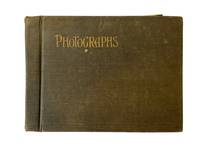
1920216411920. Japan OccupationWWII Primary-source photo album of United States military governance during the occupation of Japan with particular emphasis on the enforcement of legal authority and the administration of war crimes proceedings under Allied control. Centered on the career of General Charles Sabin Ferrin in his capacity as Provost Marshal of Tokyo the album captures the institutional frameworks through which U.S. forces maintained order supervised political transition and participated in the International Military Tribunal for the Far East IMTFE. The collection includes images of high-ranking military and political figures official proceedings connected to the war crimes trials and formal and informal interactions with Japanese leadership situating Ferrin's role within broader systems of occupation-era administration legal oversight and diplomatic engagement.<br /> <br /> The album contains 85 black-and-white silver gelatin photographs varying in size from 2.5" x 2.5" to 6" x 4.25" mounted in a clothbound album measuring approximately 7" x 5". The images begin in the United States depicting early domestic life before shifting focus to Ferrin's stationing in China from 1919 into the 1920s and later to his critical role in postwar Japan where he engaged with Japanese political and military officials at the highest levels. The China-era photographs include striking scenes of the U.S. Army's presence in Tientsin Tianjin as indicated by labeled photographs of "U.S. Army Buildings Tientsin" designed by architect Albert Benz. Other images capture American cavalrymen of the 15th Infantry Regiment on horseback lined up in disciplined formation labeled "1921 Tientsin China 15th Infantry U.S.A." The album also contains personal family moments such as a uniformed soldier cradling a small child on horseback annotated "1918 Russell" and an image of two children dressed formally on a walkway inscribed "Aug 26 1919 leaving for China." Additionally candid moments in Tientsin show a young child riding in a rickshaw pulled by a Chinese laborer and another with a Chinese woman identified as an "Ama" caring for the family's child at a beach in Chinwangtao Qinhuangdao in July 1921. <br /> By the late 1940s the album shifts focus to Ferrin's tenure as Provost Marshal of Tokyo a role that placed him at the center of postwar military governance and legal oversight. Several photographs depict U.S. military officials dining and meeting with Japanese political figures. One particularly notable photograph shows Ferrin standing beside a dignitary identified as "Prince Takamatsu Hirohito's younger brother." Other images depict high-ranking officers including Admiral James O. Richardson testifying at the International Military Tribunal for the Far East IMTFE with a caption stating: "Admiral James O. Richardson Commander-in-Chief United States Fleet testifies on the witness stand at the International Military Tribunal for the Far East during the Pearl Harbor phase of the trials of the 27 accused Japanese war criminals." A separate image shows troops of the 720 MP Battalion executing a right-dress formation in front of the War Ministry Building in Tokyo on October 13 1947. The presence of these high-ranking officials alongside candid social and formal meetings with Japanese elites underscores Ferrin's prominent role in enforcing law and order during the American occupation and his involvement in overseeing war crimes proceedings. The album is in very good condition overall. A rare and historically significant visual chronicle of General Charles Sabin Ferrin's career across pivotal moments in 20th-century history with firsthand images of U.S. military presence in China the occupation of Japan and high-level engagements with political and military leadership. unknown
196612929Tokyo: Chikyu Shuppan Co. Ltd. Very Good in Very Good dust jacket. 1966. First Edition. Hardcover. Usual xlib marks. ; Ex-Library; 4to 11" - 13" tall; 193 pages . Chikyu Shuppan Co. , Ltd. hardcover
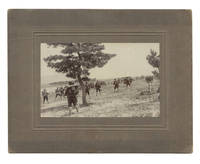
105302Very Good. The gelatin silver images each approximately 90 × 140 mm are on the original blind-embossed card mounts each approximately 170 × 220 mm; the surfaces of both images are lightly scuffed; one has a few visible fingerprint marks in the negative; overall both items are in excellent condition. One photograph features columns of soldiers marching with packs and rifles with fixed bayonets over a suspension bridge and along a riverside path in a rural area watched over by a local family standing at the top of a nearby cutting. The second photograph depicts presumably the same troops in two ragged lines facing each other with fixed bayonets in a sparsely wooded field. 2 items. unknown
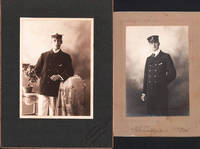
1901215445Kobe. Circa 1901. Two photographic prints 14.3 x 10.3 and 13.1 x 9.4 cms images mounted on stamped studio card: 22.5 x 15.8 and 18.5 x 13.3 cms the smaller a little bumped and stained to a lower corner faint spotting to one image and some silvering in the other the larger signed in the image "Arthur 1901" and the other "Yours sincerely Francis Ayres" in very good condition.<P> Handsome portraits of young British naval officers from the famed studio of Kozaburo Tamamura c.1856 - 1923 a pioneer of Japanese photography during the Meiji Period.<P> <b>When referring to this item please quote stockid 215445</b> . unknown
19652081002108500152Not Available 1965. Soft Cover. Fine. The book is in fine condition. Not Available paperback
19942080202102706755National Printing Bureau 1994. Soft Cover. Fine. Page size: 220 pages Size: B5 size National Printing Bureau paperback
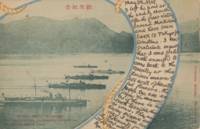
1905List3150Tokyo Japan 1905. Two postcards measuring 3 ½ x 5 ½ inches. Near Fine. Two postcards from Kyoske Uyeda in Japan to his friend Bessie Mulkey in San Francisco dated May and July 1905. At the time the Russo-Japanese War fought over the Russian and Japanese Empires’ imperial ambitions for Manchuria and Korea was nearing its end. Uyeda had been on the front; in his earlier postcard he writes:<br /> <br /> “May 5th 1905 I left the front at the end of March after the great victory around Mukden and have been back to Tokyo for sometime. I congratulate myself that I was fortunate enough to come back to the country at this glorious season of all sorts of beautiful flowers. The people too are enjoying the seasons as if there is no such terrible thing as war. They are having picnics every day. I will leave the country for the front within a short time. Kyo.â€<br /> <br /> Mukden—present-day Shenyang Liaoning province—was the site of the war’s final land battle fought from February to March 1905 and resulting in a decisive victory for Imperial Japan. In his second postcard Uyeda is set to depart for another significant location in the war:<br /> <br /> “I will leave here for Port Arthur to-morrow and having stayed there a day or two and coming back here am probably to go to our Headquarters at Mukhden to attend to the annual celebration of the day in which our Manchurian Expedition Army organised that is on the 6th of July 04. I expect a grand time there Marshal Oyama Gen. Baron Kodama Gen. Kuroki and many other grand chieftains will assemble at the Capital of Manchuria.â€<br /> <br /> Port Arthur now Lüshunkou District in Liaoning province China was seized by the Japanese in 1894 during the First Sino-Japanese War; returned to China in 1895; and then leased in an unequal treaty by the Russian Empire in 1898. Japan’s surprise attack against the Russian fleet at Port Arthur launched the war in February 1904 and resulted in Japan retaking the port.<br /> <br /> Uyeda’s notes are written on interesting themed postcards depicting the Imperial Japanese Navy; one reads “Our Combined Squadron steaming towards the enemy†and the other “Our torpedoboat squadron returning to a naval base after fighting with the enemy.†How Uyeda and Mulkey would have met and begun a correspondence is unclear. unknown
20062090502126802506Keibun-do 2006. Soft Cover. Fine. Number of pages: 198 pages Size: 46 size Keibun-do paperback
186034745Edo 1860. Two woodblock-printed Kawaraban broadsides on Japanese paper each 9 x 11 5/8 inches. Two late Edo Kawaraban broadsides recording foreign people objects coinage dress and material culture at the moment of Japan's accelerated contact with Europe and America.<br/> <br/> These two Kawaraban belong to the popular printed culture that developed around Japan's encounter with foreign powers in the 1850s and early 1860s. Produced for circulation beyond official channels such broadsides translated diplomatic and commercial contact into a form legible to a broad Japanese readership combining image caption anecdote and report. Their interest lies in the way they classify the foreign world through visible particulars: clothing physiognomy tools coins flags animals weapons and curiosities. The first broadside is arranged in four compartments under a title describing Western products and curiosities. It includes figures identified as foreign visitors or crewmen among them an English captain and a Black sailor together with a Dutch-style optical instrument and a draped clay or stone figure possibly a classical statue. The second broadside combines a portrait of a captain's wife with her dog a depiction of a foreign flag and examples of foreign coins shown obverse and reverse including Russian coinage and coins dated 1843 and 1854. Here the focus is less on a single event than on the material signs by which foreign nations could be distinguished. The woman's dress the dog the flag and the coins are presented as objects of information and curiosity evidence of a public appetite for visual knowledge about the peoples then appearing in Japanese ports. Together the broadsides show how Kawaraban helped mediate the experience of opening Japan to foreign trade and diplomacy. Their compact format and direct visual language made them effective vehicles for reporting and interpreting the unfamiliar preserving a popular Japanese response to the presence of Westerners at a moment of rapid political and cultural change. unknown
1922381719Kobe: Office of the Japan Chronicle 1922. First Edition. Softcover. Good pamphlet copy only. Spine bands and cover edges worn and nicked. Pages tanned as with age but text remains in fine condition; clear without blemish. Physical description: 32 pages. Subjects: kuma Shigenobu 1838-1922. Yamagata Aritomo 1838-1922. Japanese statesmen. Kobe: Office of the Japan Chronicle paperback
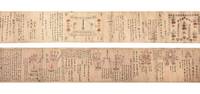
9137Numerous fine paintings & diagrams throughout using blue green red gray yellow much gold silver & flesh-colored pigments. Siddham script in several places. Two scrolls 185 x 17660 mm.; 175 x 9210 mm. each with gold-speckled inner endpapers at front dark blue paper on outsides. At the end of the first scroll a note states these texts were first written in 1192 KenkyÅ« 建久 3 & copied on an auspicious day in the 12th month of Genna 元和 5 this part of Genna 5 corresponds to 1620; the second scroll is also dated at end “the 12th month of Genna 5.â€<br /> <BR> <BR> These two scrolls are related to a kind of Daoist-influenced star worship that was associated with esoteric Buddhism. This practice became popular within the Japanese aristocracy in the medieval period. It drew on several strands of thought imported from China that were synthesized in Japanese religious practice. Buddhism as it appeared when imported to China from India and Central Asia in the first millennium CE carried with it astronomical and astrological knowledge including an identification of the planets and their association with the calendar e.g. the association between the planets and the days of the week still apparent in the modern Japanese names for them. In China this knowledge became influenced by Daoism exemplified for example by the worship of the stars of the Big Dipper Ch.: beidou J.: hokuto 北斗. In medieval Japan star worship under the auspices of esoteric Shingon and Tendai Buddhism became popular and highly ritualized. One star-related ritual expressed the worship of an individual’s birth and year stars. During these rituals offerings were made to a star or a constellation to obtain fortune or longevity. Such rituals are described in these two scrolls.<br /> <BR> <BR> Mandala dhÄraṇī and mudrÄ were important features of ritualized star worship and the three of them are present in the first scroll. There is a fine series of 158 flesh-toned paintings of mudrÄ gestures of the hand depicted and labeled. MudrÄ were hand and arm gestures made during the course of ritual practice or depicted in images of buddhas bodhisttvas tantric deities and other Buddhist images. With the development of Mahayana and Vajrayana iconography the number of mudrÄ proliferated and reaching the hundreds. DhÄraṇī were incantations and are presented as lists of syllables written in the Indic Siddham script. There is also a diagram a mandala depicting the Big Dipper the legends reference the earthly branches each listed as either yin or yang.<br /> <BR> <BR> The second scroll includes among other things a list of the Seven Planets sun moon and the planets of the solar system minus Neptune and Pluto and associated Buddhist deities stars in the constellation of the Big Dipper and years in the sexagenary calendrical cycle. Through this list an individual’s personal star can be determined. Further into the scroll the layout of the altar featuring e.g. silver coins food offerings and candles and the conduct of the rituals for various kinds of worship are described and illustrated in a series of scenes. Ritual objects like mandalas with Siddham characters are depicted as well. The instructions for the conduct of these rituals include the performance of combinations of mudrÄ and dhÄraṇī associated with the mystery of the body and the mystery of speech respectively.<br /> <BR> <BR> In addition to the importance of the Big Dipper the Daoist influence on these scrolls is evident in its mention of deities such as the Dongyue emperor and Huang Shigong.<br /> <BR> <BR> Very good preserved in a modern box. Some worming carefully repaired. unknown