235 résultats
1853WRCAM55689Japan 1853. 14pp. including three double-page woodblock illustrations. Gathered signatures stitched as issued. Mild wear. Near fine. Rare kawaraban newsbook announcing the arrival of Commodore Perry and the Black Ships to Japan in 1853. The work includes three double-page illustrations: a dominating portrait of Perry's flagship; Perry and a contingent of marines marching in procession to a meeting with local dignitaries at Kurihama with two cabin boys carrying boxes presumably official gifts or President Fillmore's letter requesting harmonious commerce; and a map of Edo Bay where the Black Ships entered. Listings of the Samurai and Daimyo Feudal Lords entrusted with the protection of Japan from foreign invasion are found on the final leaves. Such kawaraban - news sheets broadsides or small periodicals - provided the most immediate contemporary news of events in Japan including Commodore Perry's momentous first visit. unknown books
2002323842002. Hardcover. VG- light wear to edges and corners. Color-illustrated boards with yellow and white spine lettering green textured end papers. 317 pp. Mainly color illustrations. Catalogue of an exhibition from August 10 to October 27 2002 at the Museum of Contemporary Art Toyko and from November 3 2002 to January 26 2003 at the Hiroshima City Museum of Contemporary Art. Text in Japanese and English. hardcover books
1859WRCAM55020Japan 1859. 354pp. including twelve full-page or double- page ink and watercolor wash illustrations. Contemporary Japanese wrappers string-tied paper label completed in manuscript on front cover. Noticeable wear and rubbing to the binding newer string. Uneven worming throughout mostly unobtrusive. About very good. In a half morocco and cloth clamshell box spine gilt with raised bands. Large bound collection of contemporary manuscript papers documents and drawings relating to Commodore Perry and the Black Ships entering Edo Bay in July 1853. The text is comprised of accounts of the event and transcriptions of official letters from President Millard Fillmore Secretary of State Edward Everett and Commodore Perry to the Japanese Emperor. Illustrations include two double-hemispheric world maps a map showing the course of the Black Ship squadron Edo Bay and the landing of the ships Perry's marines marching sketches of large cannons aboard Perry's ships and diagrams and fortifications protecting the Japanese people from foreign invasion. <br> <br> In 1852 Perry was appointed head of a naval expedition charged with inducing the Japanese government to establish diplomatic relations with the United States. The expedition involved two visits to Japan. On his first Perry arrived at Edo Bay on July 8 1853. After a brief standoff and show of force he was able to land the following week and deliver a letter from President Fillmore with the U.S. demands with the promise he would return the following year for a reply. On February 13 1854 Perry returned with a total of ten vessels and 1600 men. After another standoff and three weeks of negotiation Perry signed the Convention of Kanagawa at the end of March 1854 which opened the ports of Shimoda and Hakodate to American ships provided for care of shipwrecked sailors and the establishment of an American consulate in Shimoda. "The most important result however was that the visit contributed to the collapse of the feudal regime and to the modernization of Japan" - Hill. <br> <br> Altogether a very comprehensive manuscript archive of this important occasion that helped open Japan to world commerce and culture. HILL 1332 ref. hardcover books
1986206804New York: Japan Society 1986. First. hardcover. fine/near fine. Numerous photographic illustrations in color & in black & white. 4to red cloth d.w. crease on front cover. New York: Japan Society 1986. First Edition. Near Fine.<br/><br/> Japan Society unknown books
193588894Tokyo: Board of Tourist Industry. Japanese Government Railways 1935. Revised Edition. Paperback. Good. illustrations folding map 50p. Softcover in original wrapper. 19 cm. Cover chips and tears reglued here and there leaving some small gaps on narrow backstrip and in upper right corner of front cover. Internally sound with some creasing and dog-earing. An uncommon tourist guide. <br/><br/> Board of Tourist Industry. Japanese Government Railways paperback books
194143024Japan 1941. Loose in a black clamshell box. Very good copies with slight curl; some with small edge or corner tears; 23 have the name of the film or featured actors/actresses rubber-stamped on the back in Japanese. 47 b/w photos. Approximately 6 x 4 inches. One duplicate. Most are group scenes from dramas a few portraits a few without characters; subject matter ranges from early historical dramas to contemporary scenes to the war and its effects. The dates have been verified on a few and all fall during the years of the Pacific War including Tadashi Imai's Tanjiko-mura 1940 "Hanagoyomi hasshojin" 1940 based on the 19th century novel "Josei hongan" 1940 made in the same year as the novel by Kan Kikuchi Yasuki Chiba's "Kuso buraku" 1939. The balance of the stills appear to date within approximately the same period. unknown books
1870811701870. BASEBALL - JAPAN Shihon Gakkou-hen. SHÔGAKU TOKUHON Maki no Ichi. Aichi-ken Nagoya Shihongakkô Teacher's College n.d. 1870's An interesting little elementary school reader from the first series of textbooks designed and created by the Teachers College Normal School system in Japan after the Meiji restoration to introduce "Western Learning" to the country. What follows is a series of excerpts from an informative article found online at http://wwwwp.mext.go.jp/hakusyo/book/hpbz198103/hpbz198103_2 _035.html "The Normal School which was under the direct jurisdiction of the Department of Education was also requested to compile elementary school textbooks on the basis of its practical experience. Also an office for editing elementary school textbooks was set up in the Normal School in December 1872. The Department of Education encouraged independent prefectures to reprint the textbooks and other educational material which it and the Normal School had compiled and it was not long before most of the prefectures adopted this practice and the reprinted textbooks were in nationwide use. Especially following the establishment of regulations for the course of study for elementary schools by the Normal School the textbooks prepared by this institute gained wide acceptance. These textbooks included elementary school readers introductory geography outlines of Japanese topography outlines of world topography outlines of Japanese history outlines of world history elementary school arithmetic etc. .The elementary school textbooks proved to be an interesting introduction of the new knowledge based on the Civilization and Enlightenment Bunmeikaika thought and they were accepted not only as textbooks but also as popular reading material for the public at large. Thus their influence was of considerable importance in the dissemination of the new culture." It is pretty clear that the introduction of Western culture also entailed the introduction of a least a variety of baseball in the 1870's as well a fact confirmed by other sources on the origins of baseball in Japan. The American educational consultants and their Japanese colleagues in Aichi saw fit to include a cut and a story with a group of boys playing with bats and balls pitching and hitting - interesting proof that baseball is nearly as old in Japan as it is in the States. The text of the story crude. unknown books
19520000173Tokyo: Shinbun Gekkansha Showa 27 1952. First edition. Good . 4to variously paginated numerous illustrations from photographs facsimiles. Publisher's tan cloth backed in gilt-lettered brown pigskin. Text mostly in Japanese. Small loss at the top of the spine binding lightly soiled & rubbed corners bumped previous owner's name & chop at rear blank page. <br/><br/>A massive volume of over a thousand pages compiled by the Japanese Ministry of Foreign Affairs which is a compendium of mostly Japanese documents relating to the Pacific War. Special attention is focused on the final months focusing on peace feelers in May 1945 through Moscow the Battle of Okinawa the demand for "unconditional surrender" the atomic bombing of Hiroshima and Nagasaki the final fateful War Council in the Imperial Presence in which the Emperor spoke for peace and the decision to have the Emperor announce the surrender on radio to his subjects. The work is organized into 60 sections beginning with war plans and the attack on Pearl Harbor on December 7 1941 to the arrival of General MacArthur as Supreme Commander of the Allied Powers in Tokyo Bay on the U.S.S. Missouri to officiate at the surrender ceromony on September 2 1945. Changes in war leadership and cabinets as well as in war policy political diplomatic social and economic conditions are covered in intervening sections. Shinbun Gekkansha hardcover books
19391652281939. PHOTOMONTAGE. Showa Juninendo Renshu Kantai Junko Kinego. Illustrated throughout with photomontages. With an illustrated map laid in. Oblong folio. 295 x 220 mm bound in publisher's green cloth. Tokyo: Teikoku Kaigunsha 1940. An elaborate and beautifully produced book commemorating the Japanese fleet's 1939 training exercises. As with many of this type of Japanese photobook there is a certain disconnect between great care lavished on the design from the decorative endpapers to the layout and the subject matter. Remains of staples in the gutter a very nice copy. OCLC records only 2 copies of which the one in the US is at Penn. hardcover books
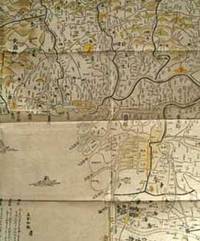
1748826931748. MAP - JAPAN. SETTSU NO KUNI MEISHO. Kyoto Kimura Juyodo Kan'en Gannen 1748. A handcolored woodblock printed map of Settsu provice containing the area of Osaka castle etc. 117.3 X 129.1 cm folds into heavy paper covers of approximately 27.7 x 18.9 cm. The original title slip is gone replaced by a handbrushed label: "Osaka no Kuni" "Carte Baie d'Osacca". Lovely and interesting map found at Beans main volume p.22 1748.1. Condition is very good printed on very strong and supple paper. For a detaiuled illustration see the record at UBC's website for the Beans copy: http://angel.library.ubc.ca/cdm4/item_viewer.phpCISOROOT=%2 Ftokugawa&CISOPTR=286&DMSCALE=50&DMWIDTH=600&DMHEIGHT=600&DM MODE=viewer&DMFULL=0&DMX=75&DMY=44&DMTEXT=&DMTHUMB=1&REC=2&D MROTATE=0&x=266&y=296 Our copy has different hand-coloring. The Beans copy hand-colors the harbor ours hand-colors the land primarily. From the collection of Roger Keyes. unknown books
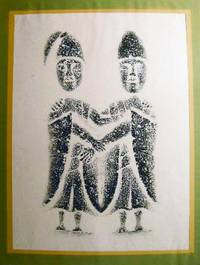
197223967Japan: Otosaburo Moriizumi 1972. 10 rubbings made by Otosaburo Moriizumi; these are printed in black and white on fine thin Japanese paper; each rubbing tipped-on by its corners to a thin cardstock backer and with a dark blue gray or green stiff paper "window" surround; with a 4-sided folding explanatory sheet text in Japanese & English including a brief introduction by Shoji Hamada; with an illustration of Mr. Moriizumi biographical details and information on the rubbings; the author-collector "chose ten lovely carvings found in the Matsumoto district" for this selection; images and titles in Japanese of the images with the dates of creation if known these from 1695 - 1870 - the undated images from earlier times; and with the sizes of the original carvings in cm.; from the author's text: ".We often find a group of three or four naive stone-carved images at the village borders and crossings when we travel along olden ways of Shinano Province. It became popular among farmers to make this sort of stone images from the middle Edo period based on their belief. They prayed for fertility and prosperity by erecting such images representing Buddhist Shinto and folkloric deities. Among them the most prevalent is Dosojin a pair of male and female folkloric gods. They were considered to be patron gods for children and young couples and gods who brought the peace of the village and abundance of crops.Besides these independent images there are stone carvings known as koshin tower. .the relief of Blue-headed Kongo a Buddhist deity as the main image and that of the sun and moon above."; all items loosely contained in a blue paper-covered hardcover folding portfolio with paper title label printed in two colors; the overall size is approx. 15" x 19 3/4"; the art of varying sizes some taking the entire sheet some smaller; the portfolio contained in the original protective cardboard slipcase also with paper title label; some edgewear age-darkening and closed tears to cardstock slipcase; blue portfolio with light wear a few cover scratches; text portion with a little edge-creasing; one of the rubbing plates with a ¾" paper flaw or rub in the background paper; two of the green paper surrounding 'window' mounts with sunning to gold on the inner ½" of the border; the artwork in very good condition; an interesting Japanese folk-art collection iconic imagery. First Edition. Portfolio. Very Good. Otosaburo Moriizumi Hardcover books
1919875901919. PHOTOGRAPHY- JAPAN. HOSHITA Eishô photographer. SCENES ON THE TRANS-SIBERIAN RAILWAYS ZEN SHIBERI TESTUDÔ SHASHIN-CHÔ. Urajio Vladivostok Taishô 8 1919 Contemporary oblong folio rebacked. Album of 250 photo illustrations of the Japanese Imperial Army in the Allied Siberian Expedition 1918-1922 ranging in size from 3 5/8" x 5 1/8" to 8 3/4 x 11 1/2". Includes a panoramic bird's eye view of Vladovostok measuring 7 3/8' x 41 7/8/" and a fold out map of the route of the expedition measuring 14" x 29 3/4". Three-quarter leather stamped in gilt rebacked. The cloth and leather corner pieces are worn and rubbed. Captions in Japanese English and Russian with text in Japanese. title is taken from cover. Includes a number of pictures of partisan sabotage of railway between Chita and Krasnoyarsk. Hoshita Eishô produced at least two such albums of the warfare in the Russian Far East. Very unusual and important record of a "lost war unknown books
191020624Nakatsucho Japan 1910. 7.5 x 10.5 in. oblong in string-tied faux-leather boards. Some edgewear one tie replaced and one lacking. Very good. Souvenir view book with two pages of text in Japanese folding map and 34 half-tone photographic plates captioned in Japanese and English. Located in the upper and middle reaches of the Yamaguni River in Nakatsu City Oita Prefecture the Yabakei Valley is considered one of Japan's most beautiful scenic areas. Among the views included here are Sugi Village from Blue Grotto Peak of Kyoshu Hachioji Rock Rakanji Temple Goryu Falls Nembutsu Bridge and other bridges waterfalls and geologic formations. unknown books
197288919NY: Japan Society Inc 1972. Paperback. Very Good. Exhibition catalog Illustrated. 98p. Softcover in original wrapper. Slightly oblong 21 cm. Uneven browning and some foxing and staining on cover. Contents sound and clean. Issued in connection with the exhibition held in the winter of 1972. Text by Sidney B. Cardozo. <br/><br/> Japan Society Inc paperback books
19450088251945. Very good. Envelope only no letter. <br /><br />The envelope was addressed to Private First Class Walter Mikucki at the Osaka Yodogawa Bunsho POW Camp in Japan. It has a typed "Prisoner of War Postage Free" free frank in the upper right corner and has received a Chicago "War Savings machine postmark dated Jan 13 1944. The envelope was opened by a U.S. censor and resealed using censor tape annotated "Examined by 6587." The address was subsequently obliterated with a red cross and black bands using grease pencil or crayon. It has a circular handstamp in the lower right corner dated Nov 20 1945 with text that appears to read "LIBERATED HQ. USMC. WASH. D.C." There is a USMC "pointing finger" return-to-sender hand stamp that point to the return address. <br /><br />Pfc. Mikucki was a member of the 4th Marine Regiment when as war clouds rumbled in the Pacific it was sent from China to Corregidor to defend Manila Bay in the Philippines. Shortly after its arrival Japan launched its infamous sneak attack on Pearl Harbor and allied bases throughout the Pacific. Corregidor was bombed continuously from late December 1941 until May 5 1942 when an overwhelming force of Japanese soldiers landed on the island. After tanks were brought ashore the following day Lt. Gen. Jonathan Wainwright realized defeat was imminent and surrendered fearing the thousand or so wounded men and bedraggled defenders would be annihilated. <br /><br />Although most of the 4th Marine Regiment had been killed the remaining men were transported to prison camps in Japan. The Yodogawa Bunsho Camp near Osaka was one of the smallest Japanese prisoner of war camps and records in the National Archives identify only 12 prisoners that were known to have been held there. Pfc. Mikucki's name is not on that list. <br /><br />Other records show that Mikucki may also have been imprisoned at various times at the Itchioke Chikko and Umeda Bunsho camps. He died from unknown causes on March 11 1943. <br /><br />Clearly this information was not provided by the Japanese to the Red Cross as Mikucki's parents sent this letter ten months later. <br /><br />Examples of mail sent to American prisoners held in Japan are very scarce and this example may be unique for at the time of this listing I find no mention in philatelic or ephemera auction records in sale listings or institutional holdings of other returned mail for Corregidor Marines who died in Japanese prisoner of war camps . Also there is no mention of anything similar in Gruenzner's <i>Postal History of pf American POWs</i>. <br /><br /> books
1998179421998. Hardcover. VG. Color boards. 180 pp. Numerous bw and color plates. Text in Japanese and French. hardcover books
193832594Tokyo: Asiatic Society of Japan 1938. First edition. Self wrappers. A very good clean copy with edgewear. 4 pp. 8vo. [Asiatic Society of Japan] unknown books
1900WRCAM45650Various locations in Japan 1900. Ten leaves containing eighty photographs each 2 1/4 x 3 1/4 inches. Oblong octavo. Contemporary black three- quarter morocco and cloth. Hinges and corners lightly worn. Bookplate on front pastedown. Light foxing primarily to mounts and not images. Prints sharp and clear. Very good. Eighty attractive images of turn-of-the- century Japan as seen through a Western lens. Evidently narrating a trip in Japan each photograph is captioned in English usually stating location which include Kagoshima the Kuma River Kumamoto Nakatshu Fukuoka Nagasaki and Isahaya. While most of the images show landscapes and the scenery of the area many of them include local people - at temple and shrines in city streets going about every day life. Of particular interest are a photograph of a woodcutter's hut with the family in the foreground a fortuneteller plying his trade a group of young men washing vegetables a view of Suizenji Park a Buddhist Temple threshing rice the sulphur springs at Nagasaki and various scenes in native villages. A nice collection of images with the bookplate of New Zealand photo-historian Frederic Hardwicke Knight. hardcover books
188726924Chicago Illinois: Rand McNally & Co. 1887. Pocket map of Japan printed in colors detailing the Japanese island system in two separate maps: Northern Japan with an inset at top of Chishima; with the previous owner noting the location of the volcano Bandai-San. Approx. 13 3/4" x 21" overall size; and Southern Japan with inset of Yayeyama and Riukiu Island chain approx. 14" x 20 3/4". With a folding Index and Population of Towns in Japan having a pronunciation list and giving the districts islands lakes mountains provinces rivers and towns; this is printed two sides approx. 13 3/4" x 19 3/4" size. Bookseller's ticket on front inner panel of the cover of Kelly & Walsh Ltd. Printers Publishers Booksellers Stationers &c. &c. &c. No. 28. Yokohama. Small faint previous ownership stamps on the blank panels on the back of the maps as well as on the front endpaper of the cover of collector Dr. George R. Brush U.S. Navy; served as a surgeon and medical inspector from 1861-1894 & often on-station in various locales in Japan. Maps & index contained in the publisher's dark brown cloth binding approx. 3 1/2" x 6 1/4" size gilt titled. Some color mottling to the case light wear; map papers darkened a little; Northern Japan & the Index loose; Southern Japan still attached to the inner cover; in very good condition. Pocket Map. Hard Cover. Very Good. Rand, McNally & Co. hardcover books
1904316723London: Anthony Treherne & Co. Ltd 1904. Second Impression. Color frontispiece 6 color plates and 30 iillustrations after Hokusai. 443pp. 1 vols. 8vo. Bound in three quarters modern mottled brown calf and marble boards red title label. Fine. Second Impression. Color frontispiece 6 color plates and 30 iillustrations after Hokusai. 443pp. 1 vols. 8vo. Anthony Treherne & Co., Ltd unknown books
2002014057Japan: Institute of Developing Economies Japan External Trade Organization 2002. Cloth. Fine/Fine. 8vo - over 7¾" - 9¾" tall. ix 118p. maps Bibliography index. Naga City case study as a clue to Philippine politics with many insights found nowhere else. Already a scarce item most copies are found in university libraries. Institute of Developing Economies, Japan External Trade Organization unknown books
193951359Tokyo: Board of Tourist Industry Japanese Government Railways 1939. Paperback. Very Good. photos folding map vii 138p. Original wrapper. 19cm. Backstrip chipped at top. <br/><br/> Board of Tourist Industry, Japanese Government Railways paperback books
193513899np Japan nd ca. 1935. Hardcover. Near fine. Oblong 4to. double string-tied commercial album silk brocade bound 9" x 12". Containing 60 4.5" x 6" silver gelatin prints mounted to heavy gilt-edges card-stock one to a page both recto and verso. Printed captions in English additionally mounted below each photo. Near fine or better with only touches of wear to extremities. Quite well-preserved. <br/><br/>A handsome and rather lavish production by an unknown but likely professional photographer possibly as presentation for special occasion or visit from foreign dignitary/delegation. Undated but clearly pre-war and based on internal evidence ca. 1935-1940. A broad range of scenes from Japanese domestic and cultural life are included: cormorant fishing the tea ceremony flower arrangement Kabuki and Noh theater Sumo and other sports kendo archery battledore shuttlecock festivals musicians rice and tea harvesting as well as scenes of shrines temples cherry blossoms and gardens. More modern scenes include Tokyo street scenes a Nikko cable car and silk mill workers. An attractive and informative look at Japan in the years immediately preceding WWII. hardcover books
19250379901925. Original photograph album. Very Good. Oblong string-tied album of black cardstock leaves 11" x 13" photographs mounted on 35pp blanks at the rear. Bound in black flexible boards with an embossed sailing ship and gilt lettering Photo-Album on the cover. Pasted in are 116 albumen and silver gelatin prints ranging from small candids to 8 ½" x 10 ½" group portraits a few fading overall sharp and clean. Laid into the album are a Japanese news article a small head-shot of an older gentleman and a watercolor portrait 10" x 8 ¼" of a man's face. Most of the photographs in this album. circa 1895-1925 were taken in Mie-Ken or "Mie prefecture" part of the Kansai region on the main island of Honshu. The group and individual portraits reflect new social and economic developments and cultural norms that emerged during this period. Subjects are shown in either traditional Japanese garments or in Western dress. Group shots often depict people wearing both styles within the same picture. There are many group shots of schoolchildren of both sexes young people in uniforms posed before buildings with Japanese signs on them as well as many formal group shots of families some "nuclear"-husband wife children- others extended by relatives. Individual shots of young children show them almost invariably in western dress one posed with his tricycle young boys in uniform a young girl in kimono showing a dance move while holding a fan infants in traditional robes and young men in business suits. Several birdseye views feature very large groups of rural people in traditional dress posed outdoors. Among the most striking photographs are: one 8 ½" x 10 ½" showing 11 doctors/ medical students posed around two corpses one smiling happily being dissected on two tables; four women and one man posed around a table doing handwork weaving tatting; men in western dress "strap-holding" inside a streetcar; and 5 actors 2 male 3 female on stage in costume. ~~ The Meiji period 1868-1912 saw the restoration of the Emperor this time with a centralized bureaucracy behind him after years of shogun rule. Japan was under heavy influence from Western political economic and educational models and the country became more capitalist industrial and progressively democratic offering free education to youngsters of both genders. Transportation and communications systems were modernized the feudal lords and samurai lost their power and a powerful national army and navy were created. By the early 1870s the government declared all classes of people to be equal. The Taishu period 1912-26 saw the continued influence of Western culture and values such as efficiency and individualism continued to replace more traditional ones. Japanese participation on the world stage continued to grow as the nation co-founded the League of Nations and emerged on the winning side in WWI. By 1925 there was universal male suffrage in Japan. Corruption in government increased however and the West began to form negative views of this newly-powerful non-white nation exacerbated by Japan's poor treatment of China. <br/><br/> hardcover books
17162Girls Education Japan Photograph album from a girl student in Japan c. 1926. Filled with 78 original silver gelatin print photographs of classmates school activities and social outings. Original cloth and red boards. 10 x 7.5 in. "Photo Album" printed on front cover. Pasted label on the final page with some information on the original owner dated 1926. Photographs of various small sizes from 1.75 x 2.5 inches to 3 x 5". Many images are school portraits of teenage girls in their matching uniforms posing either individually in pairs or small groups. Occasional photographs of teenage boys as well including one with the sitter dressed in a samurai outfit. Photos of a field day with outdoor footraces marches and performances. A few later photographs of older young women in civilian clothes posing by a river and strolling in a park together. These may be images of some of the younger students years later as adults. Most of the images show figures in Western styles clothes although 2 photographs show women dressed up in kimonos. Images lack captions but there is an autograph on one photograph. Some soiling to cover and 8 sheets of album are detached from spine. Unique images are in very good condition. unknown books