2 060 résultats
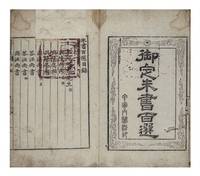
11191. 1 p.l. 4 25 34 29; 37 30 28 folding leaves. Six kwÅn in two volumes. Small folio 360 x 223 mm. orig. wrappers some wear & rubbing handwritten title on covers orig. stitching. HansÅng: Kyujanggak ca. 1799.<br /> <BR> <BR> A royal gift presented by the king of Korea. In 1794 King ChÅngjo 1752-1800 of the ChÅson dynasty compiled and had printed a collection of the letters of the great Neo-Confucian philosopher Zhu Xi 朱熹 1130-1200 to be disseminated throughout his kingdom. As King ChÅngjo wrote on this occasion “the learning of Master Zhu in its expansive and oceanic plentitude is best represented by his collected writings; the writings of Master Zhu in their utmost subtlety and precision are best represented by his personal correspondences†“ChusÅ paeksÅn yukkwÅn†朱書百é¸å…å· in Hongjae chÅnsŠ弘齋全書 Collected Writings of King ChÅngjo kwÅn 180. Drawing from a number of established collections he selected 100 letters and carefully arranged them “beginning with the letter to Yanping 延平 i.e. Li Tong æŽä¾— 1093-1163 Zhu Xi’s teacher to pronounce his lineage of instruction and ending with the letter to Zhiqing ç›´å¿ i.e. Huang Gan 黃干 1152-1221 Zhu Xi’s disciple to demonstrate the bestowment of teachings.â€<br /> <BR> <BR> That 1794 edition with moderate marginal annotations on “personal and place names as well as philological glosses and references†was sent to be printed with the chÅngyuja ä¸é…‰å— metal type cast in the year 1777. Printed copies were sent to various official printing houses throughout the kingdom and used as models to carve woodblocks for a xylographic edition ibid. Sometime around 1799 realizing that in the capital only metal type copies of the book remained the king ordered woodblocks to be made locally as well for the work so that more copies could be printed and distributed ChÅngjo “Sinin ogyÅng…†新å°äº”經… in Hongjae chÅnsÅ kwÅn 36.<br /> <BR> <BR> Most woodblock re-editions of this work retain the original title-page which contains not only the title Royal Edition of a Hundred Selected Letters of Zhu K. ÅŽjÅng chusÅ paeksÅn å¾¡å®šæœ±æ›¸ç™¾é¸ but also the inscription in seal script that reads ç”²å¯…å…§é–£æ´»å° â€” “palace edition printed with movable type in the kabin year 1794.†This title-page compounded with the absence of any additional paratextual information likely resulted in the description of these woodblock re-editions as the original metal type 1794 edition in spite of lacking the features of metal typography.<br /> <BR> <BR> We have carefully examined our copy and found that it was likely printed with the woodblocks carved around 1799 undoubtedly through the cannibalization of a typographic copy and kept within the royal library. Certain qualities of our copy make it distinctive: not only are the cursive characters rendered with impressive clarity the marginal annotations mentioned in King ChÅngjo’s edict are also preserved in faux-manuscript style — a feature absent in some other copies we have consulted erroneously described as the 1794 edition.<br /> <BR> <BR> The best evidence that our copy was printed by the royal library K. kyujanggak å¥Žç« é–£ of course is the fact that it was a royal gift K. naesabon 內賜本 presented by the king himself to notable officials or individuals in this case an examinee from SuwÅnbu 水原府. The “Record of Presentation†K. naesagi 內賜記 is handwritten on the front endpaper of the first volume as usual and is dated to the second month of Xianfeng 5 1855. However both the name of the recipient and the official responsible for the Record have been obscured. A name Im HÅi-ji 林熙之 is written next to the name of the recipient but in a clearly different hand and ink. Records of the Royal Secretariat K. SÅngjÅngwÅn ilgi 承政院日記 states that on the 29th day of this month copies of the Hundred Selected Letters were indeed bestowed to six examinees but all their names are not given.<br /> <BR> <BR> On the first leaf of the table of contents and facing the title-page is the Seal of Presentation K. naesa’in å…§è³œå° which reads å¥Žç« ä¹‹å® Treasure of the Kyujanggak. This seal was used for presentation copies roughly between 1782 and 1894 as shown by Lee & Song in “A Study on Naesabon Preserved in Kyujanggak†in Journal of Korean Library and Information Science Society 43 no. 2.<br /> <BR> <BR> This book is rare outside of East Asia. We find three copies under WorldCat 35891835 with a misspelled title and described as the 1794 edition on account of the aforementioned title-page which our copy also possesses. None of them is described as a presentation copy.<br /> <BR> <BR> Very good set. Some occasional soiling and dampstaining. Unimportant worming mostly marginal.<br /> <BR> <BR> ⧠King ChÅngjo Hongjae chÅnsŠ弘齋全書 in Han’guk munjip ch’onggan 韓國文集å¢åˆŠ digital access via krpia.co.kr. unknown
233 pages. Footnotes. Bibliography. Index. Reproduction of black and white photo in text. "This compelling first-person account deepens our appreciation of the conflicts, failures, and triumphs of those who find themselves in the hands of their nation's enemies." - from dust jacket. Unmarked but for one high-lighted word in bibliography. Binding tight. Moderate overall wear. Dust jacket now preserved in glossy new archival-grade Brodart. A sound copy. EDWARDS 1582. Book
Orignal Wraps. 4to. 4 pages. 28 cm. Volume 2, Number 6, Sivan 5711, June, 1951. Shevuoth Issue. Front Page 'Dear Moish' letter; signed Chiel (Rabbi Samuel Chiel? ; army chaplain in these years) ; discusses the rights of religious Jewry in Eretz Israel, the oppressive measures taken againt religious Jewry in Medinath Israel; relates the discipline needed on the battlefield as akin to the discipline needed for certain Mitzvot. Articles include 'The Meaning of Shevuoth', 'Those who Fight...Write' (letters from servicemen, thanking the Bureau for Kosher Pesach food, being able to stay an an orthodox home near the army base, a special seder service in Japan) , and 'Dinim about Yom Tov', concerning work not permitted on Yom Tov and exceptions specifically of use to servicemen. Subjects: Jewish soldiers - United States - Religious life - Periodicals. Jewish soldiers - Religious life. Periodicals. United States. OCLC lists 2 copies (Harvard, Natl Libr Israel) . Pages aged, very brittle at edges. Fair condition. (HOLO2-121-18)
Original Wraps. 4to. 5 pages. 28 cm. Volume 2, Number 7, Rosh Hashono 5712, October, 1951. Single sided mimeographed typed newsletter for Orthodox Jewish soldiers in the American Armed Forces. Front page 'Dear Moish' letter. Contains brief discussion of major aspects of the high holidays; portions titled: Praying to Pray, Selichoth, Rosh Hashanah, Ten Days of Penitence, Yom Kippur; further sections detail what is necessary for a proper observance (Minyan, fasting, if one has to eat what the restrictions are) . Last page includes letters from two soliders, on being relocated, being able to obtain kosher food without difficulty, about Jewish boys fighting in Kora. Includes a form to buy a Kosher food package for ten dollars, address of Jewish Servicemen's Religious Bureau, 5 Beekman Street, New York. Subjects: Jewish soldiers - United States - Religious life - Periodicals. Jewish soldiers - Religious life. Periodicals. United States. OCLC lists 2 copies (Harvard, Natl Libr Israel) . Pages aged, edges worn, bumped and slight tears; otherwise fresh. Good condition. (HOLO2-121-17)
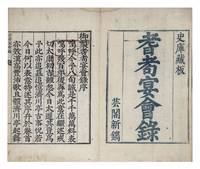
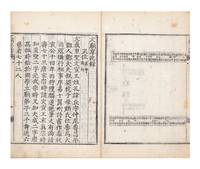
11384. 1 46 folding leaves. Small folio 346 x 227 mm. orig. yellow semi-stiff wrappers lightly rubbed title in manuscript on upper cover old stitching. HansÅng: Un'gak 1773.<br /> <BR> <BR> First and apparently only printing of the official record of "linked songs" composed at the royal banquet of elders on the occasion of King YÅngjo's r. 1724-76 80th birthday in 1773 printed the day after the banquet and presented to its guests. The title is not in WorldCat or KORCIS; we locate only two other copies both in Korea.<br /> <BR> <BR> In the intercalary third month of the 50th year of his reign King YÅngjo - the longest reigning monarch in ChosÅn history - held two birthday banquets within the KyÅnghÅigung 慶熙宮 palace complex. According to the colophon the first was a banquet of high-ranking officials held at the SungjÅng Hall 崇政殿 on the first day of the month. The second which took place a day later was a gathering of elders at the Kimsang Gate 金商門 "to reminisce about the events of the kingdom's past." The suggestion for these banquets came from the Grand Heir wangseson çŽ‹ä¸–å« enthroned as King ChÅngjo in 1776 and was accepted by King YÅngjo only reluctantly. The high-ranking official SÅ MyÅng-Ång å¾å‘½è†º 1716-87 who composed the colophon describes the festive banquet of elders as follows:<br /> <BR> <BR> "On this day the rain ceased and the sky cleared. A gentle breeze blew softly. Looking up at the throne one saw the King standing tall beneath the colorful canopies the table to his left and staff to his right. Looking down at the banquet hall one saw white-haired elders and toothless seniors their faces glowing amidst the delicacies. When the bells and drums were about to sound and the cups were not yet raised the elderly commoners delighting in this joyous gathering cast aside their staffs and rose to dance. Stooping and stumbling they advanced forward while shouting: 'May the King live a thousand years!'"<br /> <BR> <BR> King YÅngjo smiling at this sight composed a short verse that invoked the famous Song of Great Wind Ch. dafeng ge å¤§é¢¨æŒ of Liu Bang 劉邦 256-195 B.C.E. the first king of the Han dynasty likewise written during an auspicious gathering of elders. He then asked the Grand Heir and other officials at the banquet to each compose a song echoing his own in three enneasyllabic lines ending with the sinographs sul è¿° baek 百 and Åk å„„ respectively. The sequence of "linked songs" thus composed - together with the names and positions of their authors - were collected and printed to ensure the longevity of their transmission. The colophon continues<br /> <BR> <BR> "King Gao of the Han in the prime of his life happily celebrated with the elders of his village. This was of course a common occurrence. Yet he did not know that throughout the four quarters of the realm ritual and music take precedence; instead he was preoccupied with recruiting fierce warriors.Now our sovereign achieving the seniority of Yao and Shun observes the flourishing rites of Yu and Xia. The sagely ruler honors the longevity of his subjects and his subjects likewise revere the longevity of the sage ruler. This is truly something unheard of among the rulers of the Han and Tang dynasties."<br /> <BR> <BR> SÅ MyÅng-Ång believes that the format of linked songs which brought together King YÅngjo and his subjects through reciprocal "winds of transformation" K. p'unghwa 風化 elevated this Korean banquet above its various Chinese precedents and into closer proximity to the sagely rites of old. Writing on the transregional tradition of linked songs in East Asia Amy Y. Zhang observes the "ubiquitousness of linked verse as a potential means of constructing defining and negotiating community" and when adapted by the Korean monarchy it became "a way to cultivate harmonious relations with his subjects and to ensure continued prosperous rule"-Zhang "Writing Communities into Being: The Art of Linked Verse" PhD diss. Harvard 2025 pp. 243-44.<br /> <BR> <BR> Based on the presentation inscription on the front endpaper in our and another copy see below the woodblocks for the Record were likely carved overnight so that imprints could be distributed to guests of the banquet the next day "the third day of the intercalary third month of the 38th year of the Qianlong reign." The title-page states that the woodblocks were carved at Un'gak 芸閣 i.e. the kyosÅgwan æ ¡æ›¸é¤¨ the royal printing house and kept within the royal archives K. sago å²åº«. Our copy was presented to Sin U-sang 申禹相 1730-99 the Assistant Director of the Ministry of War K. pyÅngjo chwarang 兵曹ä½éƒŽ whose name together with the song he had composed at the banquet appears on f. 36r of the Record. Facing the title-page and on the first leaf of the royal Preface is the Seal of Presentation K. naesa'in å…§è³œå° which reads sÅnsajigi 宣賜之記. The oldest of five seals of presentation used throughout ChosÅn history the sÅnsajigi seal appears in royal presentation copies from 1534 to 1778 as Lee & Song demonstrate in "A Study on Naesabon Preserved in Kyujanggak" in Journal of Korean Library and Information Science Society 43 no. 2.<br /> <BR> <BR> The title though recorded in traditional Korean bibliography is not in WorldCat or KORCIS. We locate only two other copies one held at the Academy of Korean Studies in SÅngnam call no. MF35-2211 and the other at the Sudang kot'aek ä¿®å ‚å¤å®… residence of the Yi clan in Yesan. The front endpaper of the Academy of Korean Studies copy is not digitized while the Sudang kot'aek copy bears a similar royal presentation inscription dated to the same day as our copy. It was presented to Yi Su-il æŽç§€é€¸ 1705-79 whose composition is recorded on f. 30r-v.<br /> <BR> <BR> Excellent copy a few leaves lightly stained on upper corner. unknown
9430Four leaves of illus. 30 folding leaves. Large 8vo 305 x 208 mm. orig. yellow semi-stiff wrappers upper wrappers somewhat soiled both wrappers with some worming new stitching. Korea: 1765.<br /> <br> <br> <br /> First edition of this book published on royal command by King YÅngjo of ChosÅn. The book was compiled by Kim Kwi-ju 金龜柱 1740-86 the older brother of Queen Consort ChÅngsun 1745-1805. The royal Preface is furthermore written in Kim’s standard script calligraphy. Years after the compilation of this book factional intrigue under YÅngjo’s successor ChÅngjo led to Kim being exiled after which he soon died.<br /> <br> <br> Our book outlines sacrifices at the Confucian temple in Seoul including the KyesÅng å•“è–ç¥ and SongjÅl å´‡ç¯€ç¥ shrines. The KyesÅng shrine built in 1669 was the site of sacrifices to the fathers of several Confucian sages including Confucius and Mencius. At the temple as a whole a number of Chinese and Korean Confucian sages and worthies were worshipped. The book contains illustrations outlining the layout of the shrines with the placement of the tablets for the various Confucian scholars marked with their names.<br /> <br> <br> The royal Preface is dated 1765. Ordering the compilation of a record of past exemplars apparently made the king reflect on his own character and actions. He wrote “when I with my shallow learning recite the writings of the sages and worthies but remain unable to learn the Way of the sages and worthies and when I admire the deeds of the sages and worthies but cannot act in their manner it is like knowing what something tastes like but not get to eat it or like knowing the road but being unable to follow it. Even though I might laugh at people of the past why would people of the future not laugh at me tooâ€<br /> <br> <br> Minor worming mostly marginal towards end. See WorldCat 855527023 for a digital copy. unknown
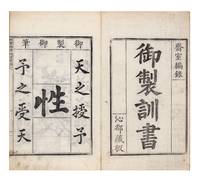
942941 folding leaves. Large 8vo 337 x 206 mm. orig. semi-stiff wrappers new stitching. Korea: Simdo æ²éƒ½ 1756.<br /> <br> <br> <br /> First edition and rare; WorldCat lists only one printed copy at Berkeley. This book of exhortations on good government with striking royal calligraphy was written by King YÅngjo or Yeongjo of ChosÅn 1694-1776 in 1756. At this time YÅngjo was commemorating the death of his father the previous king. According to Fang Chaoying 1908-85 YÅngjo then in his 65th year “could not foresee that he was to live twenty more years and so it appears that he was trying to justify himself in his own mind with regard to posterity as well as to the ancestors whom he expected to face any day†The Asami Library 115. YÅngjo offered three main principles for a king to follow: “to venerate Heaven to love the people and to treat the officials with respect†ibid.<br /> <br> <br> Large standard script characters written by the king himself are reproduced in the beginning of the book. The king’s brush records Confucian assertions such as “the following of human nature is called the Way / the cultivation of the Way is called instruction.†Accepting the Mencian dictum that human nature is inherently good the king continues: “I possess the good human nature / to realize the bright mandate of Heaven.â€<br /> <br> <br> The main text of the book is reproduced in the handwriting of the important scholar-official SÅ MyÅng-Ång or Seo Myeong-eung å¾å‘½è†º 1716-87. SÅ wrote in many genres and had a cosmopolitan outlook. For example he wrote a Preface to one of the major multilingual lexicographical works produced in ChosÅn in the 18th century see Söderblom Saarela “Mandarin over Manchu†379-80.<br /> <br> <br> Very fine and fresh copy beautifully printed.<br /> <br /> <br> <br> References<br /> <br> <br> Fang Chaoying. The Asami Library: A Descriptive Catalog. Edited by Elizabeth Huff. Berkeley: University of California Press 1969.<br /> <br> <br> Söderblom Saarela MÃ¥rten. “Mandarin over Manchu: Court-Sponsored Qing Lexicography and Its Subversion in Korea and Japan.†Harvard Journal of Asiatic Studies 77.2 2017. unknown
196011914NBerlin - Wiesbaden, Bote & Bock, 1960. (VNr. B & B 21578 (756)), Groß-Oktav (23 x 15 cm), 35, (1) Seiten Hellgrauer Original-Karton (lichtschattig)
196311915NBerlin - Wiesbaden, Bote & Bock, 1963. (VNr. B & B 21804 (845)), Groß-Oktav (23 x 15 cm), 96 Seiten Hellgrauer Original-Karton (lichtschattig) Erstes und letztes Blatt gebräunt
200741616BBWiebelsheim, Aula Verlag, 2007. 1. Auflage. Gebundene Ausgabe. Sehr guter Zustand mit nur minimalen Gebrauchsspuren am Einband. Kein Besitzervermerk! Keine Anstreichungen! Kein Mängelexemplar!
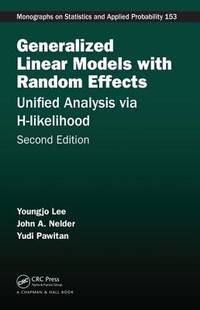
2017BN174511Taylor & Francis Inc 2017. 2017. Hardcover. Generalized Linear Models with Random Effects <br/><br/>Generalized Linear Models with Random Effects Youngjo Seoul National University South Korea Lee John A. Nelder Yudi Karolinska Institute Stockholm Sweden Pawitan Taylor & Francis Inc hardcover
1581Librairie Plon, (colection: Feux croisés, âmes et terres étrangères)Paris, dépôt légal 1936, nouveau tirage 1949.
1978004494Seoul, Research Center for Peace and Unification, 1978. Pappeinband Gr. 8° 0
8°, br. edit., pp. X - 198. La religione primitiva della Corea, il confucianesimo, il buddismo, il taoismo, ecc. Interessante e rara monografia.
2925EBBerlin., Distanz Verlag., 2017. 31,5 x 25,5 cm. 134 S. OLeinen mit illustriertem OUmschlag., 2925E 1. Auflage. Sehr gutes Exemplar.
200141915AB[Berlin]., DAAD., 2001. 8°. 39 S., 2 Blatt. OPappband. 1. Auflage. Sehr gutes Exemplar.
201565496BBHeidelberg/Berlin., Kehrer Verlag., 2015. 27 x 22 cm. 62 unpaginierte S., 3 Blatt. OLeinen mit illustriertem OUmschlag., 65496BB 1. Auflage. Einbandkanten mit minimalen Bereibungen, sonst sehr gutes Exemplar.
19806047120Bonn 1980. 8°. 280 pp., mit 75 Textabb. und über 90 Abb. im Anhang. Halbleinwand. Schlicht. Kleineres Signaturschild auf Buchrücken. Stempel verso Titel. Von sehr ordentlicher Erhaltung.
19886050070Bonn 1988. 4°. (4), XV, 253 pp., Abbildungen und Tabellen im Anhang. Broschur. Signaturschildchen auf Rücken. Stempel verso Titel. Sonst ordentlich.
19631179476Hakwon-Sa Ltd. Seoul, Korea, 1963. 739 S.; zahlr. Illustr.; Karten; 26 cm. Originalleinen mit farb. illustr. Schutzumschlag.
2006131250Seoul Korea: National Museum of Korea 2006. Softcover. VG boards slightly rubbed. Black printed boards with bw illus. 231 p. : illustrates in color and BW. Includes some maps. In Korean and English. "The new world class building of the National Museum of Korea was designed and built by the Koreans' own hands and opened in 2005. The museum is an embodiment of the Korean architectural spirit reinterpreted for modernity." National Museum of Korea paperback
196180595-11Köln, 1961. 181 Seiten, 8°, kartoniert.
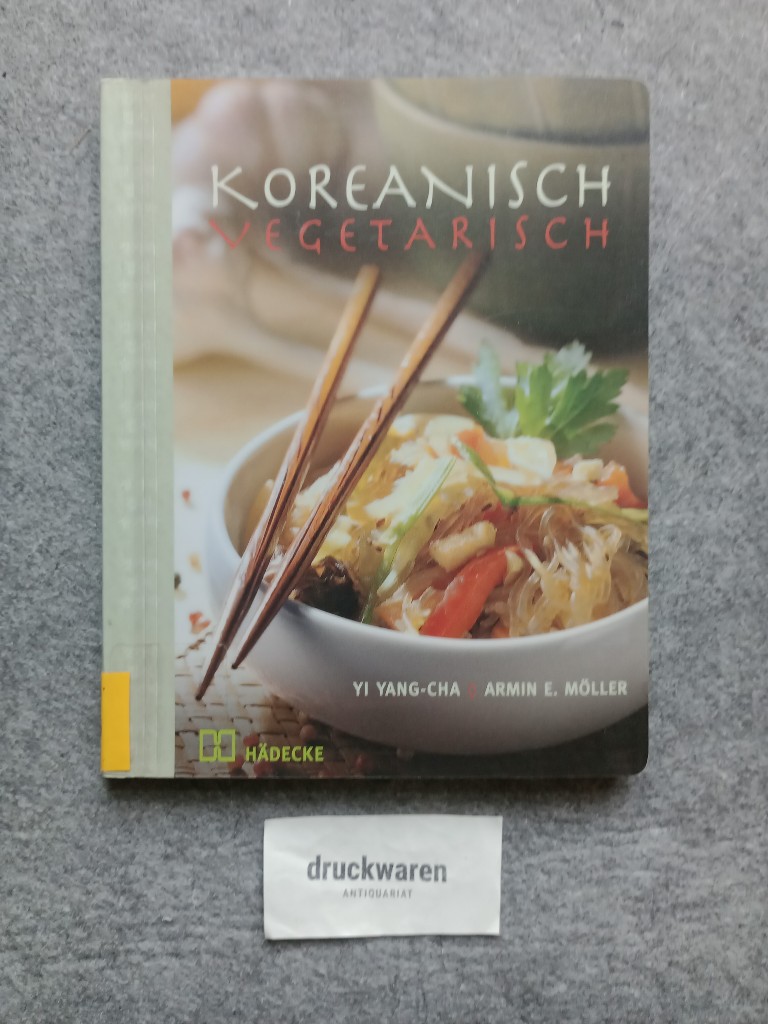
2005228120Weil der Stadt : Hädecke, 2005. 127 S. : zahlr. Ill. 21 cm. Bibliothekseinband, Broschiert.
Visiting North Korea is a surreal experience. Harried-looking traffic police clear up imaginary bottlenecks on the deserted streets of Pyongyang, while long lines of forlorn citizens wait patiently to be admitted to amusements parks that have long since been abandoned. Everywhere, pretense and illusion are the order of the day. Closed to the West for more than forty years, North Korea is an isolated and alien land. When Yi Sun-Kyung traveled there in the summer of 1994-the first Western journalist ever allowed in for an extended visit-she found a nation ruled by fear and a people yearning for unification with the South. This extraordinary memoir grew out of that unforgettable trip. But Inside the Hermit Kingdom is more than just a travelogue of a strange and foreign country. It is in fact the story of two journeys-the first a journey to a place seldom seen and only vaguely understood, the second a journey of self-discovery for the author. Born in South Korea in 1967, Sun-Kyung moved with her family to Canada when she was still a girl. 237p. plates Book
51408975like new. unknown