[RARE NORTH KOREA FABRIC PENNANT].Biblio.com
2 084 résultats
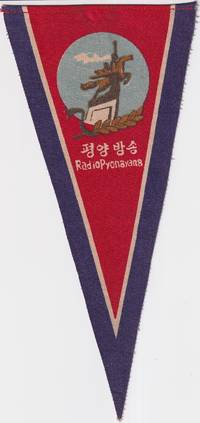
1960219665No publication details. circa1960s –70s based on design and material. Printed fabric pennant promoting Radio Pyongyang North Korea’s official broadcasting service. The image shows a stylised monument of two figures possibly symbolising industry and broadcasting with a laurel motif and radio waves under a red sky. Text in both Korean and English. Radio Pyongyang. “평양 방송” translates directly as Pyongyang Broadcasting. Text in Korean and English. 23.5 height x 11cm at top edge. <br> <br>A scarce example of early North Korean visual propaganda. Radio Pyongyang was founded in October 1945 and inaugurated programming with a live broadcast of Kim Il Sung's victory speech when he returned to Pyongyang at the end of WWII. The image on this pennant features a statue of two figures a worker and a peasant woman carrying a sheaf of rice riding the mythical horse Chollima symbolising speed strength and the spirit of the North Korean people. The Chollima movement which began in 1956 encouraged citizens to achieve extraordinary production and labour targets indicated by the sheaf of wheat symbolic of agricultural abundance. Radio Pyongyang helped to disseminaate the ideals of the Chollima movement and this pennant probably dates from after the Chollima Monument was unveiled in 1961. <br> <br>Provenance: Bought in China by a western collector in the late 20th century. . No publication details. unknown
200664115KyÅnggi-do P'aju-si: An GÅrap'iksÅ 2006. Large 8vo pp. 260; illustrated throughout mostly in color; fine copy in original red cloth and publisher's slipcase. Parallel text in English and Korean. Korean treasures from the Paleolithic Age to the 19th century including furniture ceramics textiles paintings manuscripts etc. An Gŭrap'iksŭ unknown
1981117243Tokyo Kyuryudo 1981 1 vol. relié in-folio, demi-toile de l'éditeur, étui, 237 pp., nombreux plans en noir et photographies en noir et en couleurs par Osamu Murai. Textes japonais avec leur traduction anglaise. Dessin au feutre sur la page de garde. Sinon très bon exemplaire.
1981117243Tokyo Kyuryudo 1981 1 vol. relié in-folio, demi-toile de l'éditeur, étui, 237 pp., nombreux plans en noir et photographies en noir et en couleurs par Osamu Murai. Textes japonais avec leur traduction anglaise. Dessin au feutre sur la page de garde. Sinon très bon exemplaire.
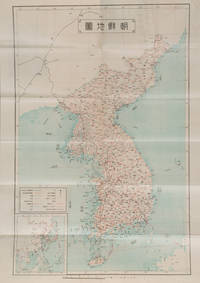
1927159846Korea: Chōsen Sōtokufu 朝鮮総督府 Office of Governor eGeneral of Korea. Reprint. Shōwa 2. 1927. Japanese language travel brochure for Korea single folded sheet with colour map of Korea Scale 1:2500000 on one side attractive colour cover and descriptive text with black and white photographic illustrations in 12 panels on the reverse. Map includes a small inset map of East Asia. Measures 53.8 x 38.4cm folded 9.6 x 19.5cm. This travel brochure was published in Korea by the Office of Governor-General of Korea in 1927 with the aim of attracting Japanese visitors to Korea. The text describes Korea's geography weather and transportation; major cities such as Busan and Seoul; and industry including agriculture commerce and manufacturing. Accompanying photos are those of Seoul Kunsan Port a ginseng field Moran Fortress in Pyongyang and Mt. Kumgang. . Chōsen Sōtokufu 朝鮮総督府 [Office of Governor eGeneral of Korea] unknown
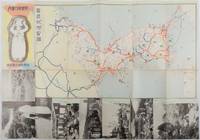
1937178598Korea.: 朝鮮総督府鉄道局. Chosen Sotokufu Tetsudokyoku. Showa 12 1937. Folded travel brochure featuring a large colour map of Korea black and white photographic illustrations 53 x 38 cm folded. Small holes and a little worn along folds a good copy. 18.2 x 9 cm. Attractive folding map and travel guide to Korea produced by the colonial government's Railway Bureau. The cover illustration shows a Korean woman carrying a water jug on her head. The map shows the Korean Peninsula with main towns. The map is surrounded by a set of black-and-white photos of landmarks including a cityscape of Seoul and a flock of sheep in northern Korea. The photos are set in a design showing Korean figures in traditional costume. The text on the reverse of the map provides information including various railway lines in the country and possible itineraries to cover major sites. There is also a more detailed explanation of the sights to be seen along five major rail routes: from Busan to Seoul Keijo; from Seoul to Andong; from Daejeon to Mokpo from Seoul to Wonsan and from Wonsan to Hoeryong. . 朝鮮総督府鉄道局. [Chosen Sotokufu Tetsudokyoku]. unknown
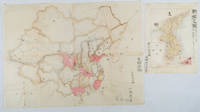
1902220266Japan. No date. Circa1902. Two very attractive colour folded manuscript maps one showing China and the other Korea. <br> <br>Map of China: Watercolour map 48 x 63.5cm. Closed tear now professionally repaired. <br> <br>Map of Korea: Finely detailed watercolour map a few tiny holes very neatly repaired on the verso with archival washi. 33 x 24.5cm Two delicate hand-painted maps one of China and one of Korea produced by a Japanese student cartographer named Koike Tokushige 小池徳重. <br> <br>The undated map of China appears to have been produced in the first five years of the twentieth century: a time when Japan had recently colonized Taiwan and when Japanese economic and political interest in the region was rapidly expanding. The inscription on the map suggests that it was a third year college project. But the high level of detail suggests that the artist had considerable experience of map making. The map of China shows the main provinces rivers major transport routes the Great Wall and the location of key cities although the names of the cities are not included. It also shows outlines of the Korean Peninsula Taiwan and the Japanese island of Kyushu but not the rest of Japan. <br> <br>The map of Korea is more detailed. It provides an accurate outline of the Korean Peninsula with careful hatching indicating changes in elevation. Rivers and major road routes are shown on the map and the locations of major towns are marked though only Busan and Incheon are named. Dotted lines show coastal sea routes and routes between Kyushu and Busan and between Incheon and China. The map shows the Gyeongin railway line between Seoul and Incheon which was completed in 1899 and route of the Gyeongbu railway line between Busan and Seoul whose construction started from both ends in 1901. But the map depicts only small sections of this line close to Seoul and Busan as being completed with the rest more lightly outlined to show the projected route implying that the map was drawn around 1901-1902 and certainly before the Gyongbu line was opened in 1904. <br> <br>Inserted text gives the land area and population of Korea. Rather strangely though the figure given for the Korean population is vastly underestimated. Ikeda gives this as 5.7 million when in fact at that time is was around 18 million. . unknown
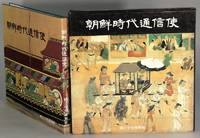
198665283Seoul: Sanhe Publishing 1986. Square 4to pp. 155 1; text in Korean; color text illustrations throughout; full green cloth gilt title on spine; fine in fine dust jacket and slipcase. During the Joseon Choson period the government sent a number of envoys to Japan for diplomatic missions. Those missions were met with intense curiosity by the local Japanese and became the subjects of many works from paintings to popular prints. Sanhe Publishing unknown
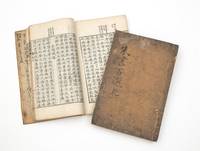
7461Two parts in one vol. Small folio orig. wrappers somewhat tired & a little soiled some light staining & soiling here & there manuscript title on upper cover later stitching. Hansong Seoul: Kyujanggak the Royal Library Preface dated 1793 & 1796.<br/> <br/> First edition of this handsome and large-format 323 x 217 mm. royal publication. King Chongjo 1752-1800 was one of the most intellectual and enlightened of the Korean monarchs. Perhaps Korea’s greatest bibliophile as royal patron he supported all aspects of the book: typographers printers authors librarians and lexicographers. A number of “royal†editions were published under his auspices. He founded the Kyujanggak Library in 1776 now part of the library of the Seoul National University.<br/> <br/> “The official rhyming dictionary of Chinese characters compiled under the supervision of King Chongjo and engraved in 1796. The arrangement is different from the usual Korean system in that instead of three rows of characters in the same rhyme there are four rows with the ipsÅng characters distributed in the bottom row†Fang The Asami Library 12.3.<br/> <br/> The main compiler of this work was the reformer Tong-mu Yi 1741-93 who had travelled to China and was an important member of the Northern Learning School. This group of intellectuals recognized the practical benefits of commerce and technology and urged the modernization of Korean society. Yi was appointed by King ChÅngjo as one of the famed four editors of the Royal Library overseeing the publication of books.<br/> <br/> A very nice copy.<br /> <br> <br> References<br /> <br> <br> Fang Chaoying. The Asami Library: A Descriptive Catalog. Edited by Elizabeth Huff. Berkeley: University of California Press 1969. unknown
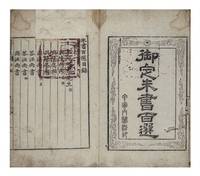
889392.5; 95 folding leaves. Two vols. Small folio orig. yellow-brown patterned wrappers some soiling to wrappers old stitching. ChÅnju today’s Jeonju: 1795 or possibly later.<br /> <BR> <BR> A selection of 100 letters written by Zhu Xi 1130-1200 the great synthesizer of the philosophical school known as Neo-Confucianism. Zhu Xi who lived in southeastern coastal China far from the center of power became extremely influential in East Asia for centuries following his death. His interpretation of Neo-Confucianism a metaphysically argued philosophy of the self the family and the state became official orthodoxy in late imperial China and ChosÅn Korea promulgated largely through the civil service examination system. However there were challenges to its primacy from intellectuals especially from the 18th century onward.<br /> <BR> <BR> “In the opinion of many historians the Song’s preeminent philosopher Zhu Xi outshined Confucius himself. He was the only person in Chinese history apart from Confucius and Mencius whom the official hagiography addressed as Master†Kuhn The Age of Confucian Rule 103.<br /> <BR> <BR> Given Zhu Xi’s standing in Korea several collections of excerpts from his works were published beginning in the 16th century. On account of its authorship Royally Authorized Selection of One Hundred Letters by Zhu Xi became one of the most widely circulated such collections for the last century of the ChosÅn period. According to the court chronicle the culturally ambitious King ChÅngjo 1752-1800 himself made the selection on the basis of Zhu Xi’s collected works a voluminous oeuvre that numbered 2354 pieces of writing in one scholar’s recent count. Text-critical notes e.g. on place names personal names official titles and expressions that might be unfamiliar to Korean readers were then added by four high civil officials which were printed in the upper margin of the text.<br /> <BR> <BR> The book was finished on the 25th day of the 12th month of the 18th year of ChÅngjo’s reign Qianlong 59 which corresponds to 15 January 1795. While most of the 18th year corresponds to 1794 it is incorrect to date the book to that year. The book was first printed in Seoul with metal movable type — the so-called chÅng’yu cha ä¸é…‰å— set of type cast in 1777 the chÅng’yu year when ChÅngjo ascended the throne. Further editions were subsequently published at several provincial offices using woodblocks intended for wide dissemination among the educated elite.<br /> <BR> <BR> Our copy belongs to one of these provincial woodblock editions. The title-page says Ålmyo wanyÅng kan’in ä¹™å¯å®Œç‡ŸåˆŠå° meaning that it was printed in 1795 the Ålmyo year in the provincial government offices at ChÅnju Jeonju in what is now southern South Korea. However it is possible that the actual copy was struck later than that date as the blocks remained on the site. They were moved to the local official Confucian school in 1899 where they remain today.<br /> <BR> <BR> Fine set of a very rare book. Minor staining and soiling at beginning and end of each volume.<br /> <BR> <BR> ⧠WorldCat accession number 874756267.<br /> <br> <br> <br /> References<br /> <br> <br> Kuhn Dieter. The Age of Confucian Rule: The Song Transformation of China. Cambridge: Mass.: Harvard University Press 2011. unknown
11191. 1 p.l. 4 25 34 29; 37 30 28 folding leaves. Six kwÅn in two volumes. Small folio 360 x 223 mm. orig. wrappers some wear & rubbing handwritten title on covers orig. stitching. HansÅng: Kyujanggak ca. 1799.<br /> <BR> <BR> A royal gift presented by the king of Korea. In 1794 King ChÅngjo 1752-1800 of the ChÅson dynasty compiled and had printed a collection of the letters of the great Neo-Confucian philosopher Zhu Xi 朱熹 1130-1200 to be disseminated throughout his kingdom. As King ChÅngjo wrote on this occasion “the learning of Master Zhu in its expansive and oceanic plentitude is best represented by his collected writings; the writings of Master Zhu in their utmost subtlety and precision are best represented by his personal correspondences†“ChusÅ paeksÅn yukkwÅn†朱書百é¸å…å· in Hongjae chÅnsŠ弘齋全書 Collected Writings of King ChÅngjo kwÅn 180. Drawing from a number of established collections he selected 100 letters and carefully arranged them “beginning with the letter to Yanping 延平 i.e. Li Tong æŽä¾— 1093-1163 Zhu Xi’s teacher to pronounce his lineage of instruction and ending with the letter to Zhiqing ç›´å¿ i.e. Huang Gan 黃干 1152-1221 Zhu Xi’s disciple to demonstrate the bestowment of teachings.â€<br /> <BR> <BR> That 1794 edition with moderate marginal annotations on “personal and place names as well as philological glosses and references†was sent to be printed with the chÅngyuja ä¸é…‰å— metal type cast in the year 1777. Printed copies were sent to various official printing houses throughout the kingdom and used as models to carve woodblocks for a xylographic edition ibid. Sometime around 1799 realizing that in the capital only metal type copies of the book remained the king ordered woodblocks to be made locally as well for the work so that more copies could be printed and distributed ChÅngjo “Sinin ogyÅng…†新å°äº”經… in Hongjae chÅnsÅ kwÅn 36.<br /> <BR> <BR> Most woodblock re-editions of this work retain the original title-page which contains not only the title Royal Edition of a Hundred Selected Letters of Zhu K. ÅŽjÅng chusÅ paeksÅn å¾¡å®šæœ±æ›¸ç™¾é¸ but also the inscription in seal script that reads ç”²å¯…å…§é–£æ´»å° â€” “palace edition printed with movable type in the kabin year 1794.†This title-page compounded with the absence of any additional paratextual information likely resulted in the description of these woodblock re-editions as the original metal type 1794 edition in spite of lacking the features of metal typography.<br /> <BR> <BR> We have carefully examined our copy and found that it was likely printed with the woodblocks carved around 1799 undoubtedly through the cannibalization of a typographic copy and kept within the royal library. Certain qualities of our copy make it distinctive: not only are the cursive characters rendered with impressive clarity the marginal annotations mentioned in King ChÅngjo’s edict are also preserved in faux-manuscript style — a feature absent in some other copies we have consulted erroneously described as the 1794 edition.<br /> <BR> <BR> The best evidence that our copy was printed by the royal library K. kyujanggak å¥Žç« é–£ of course is the fact that it was a royal gift K. naesabon 內賜本 presented by the king himself to notable officials or individuals in this case an examinee from SuwÅnbu 水原府. The “Record of Presentation†K. naesagi 內賜記 is handwritten on the front endpaper of the first volume as usual and is dated to the second month of Xianfeng 5 1855. However both the name of the recipient and the official responsible for the Record have been obscured. A name Im HÅi-ji 林熙之 is written next to the name of the recipient but in a clearly different hand and ink. Records of the Royal Secretariat K. SÅngjÅngwÅn ilgi 承政院日記 states that on the 29th day of this month copies of the Hundred Selected Letters were indeed bestowed to six examinees but all their names are not given.<br /> <BR> <BR> On the first leaf of the table of contents and facing the title-page is the Seal of Presentation K. naesa’in å…§è³œå° which reads å¥Žç« ä¹‹å® Treasure of the Kyujanggak. This seal was used for presentation copies roughly between 1782 and 1894 as shown by Lee & Song in “A Study on Naesabon Preserved in Kyujanggak†in Journal of Korean Library and Information Science Society 43 no. 2.<br /> <BR> <BR> This book is rare outside of East Asia. We find three copies under WorldCat 35891835 with a misspelled title and described as the 1794 edition on account of the aforementioned title-page which our copy also possesses. None of them is described as a presentation copy.<br /> <BR> <BR> Very good set. Some occasional soiling and dampstaining. Unimportant worming mostly marginal.<br /> <BR> <BR> ⧠King ChÅngjo Hongjae chÅnsŠ弘齋全書 in Han’guk munjip ch’onggan 韓國文集å¢åˆŠ digital access via krpia.co.kr. unknown
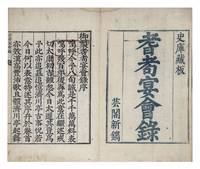
11384. 1 46 folding leaves. Small folio 346 x 227 mm. orig. yellow semi-stiff wrappers lightly rubbed title in manuscript on upper cover old stitching. HansÅng: Un'gak 1773.<br /> <BR> <BR> First and apparently only printing of the official record of "linked songs" composed at the royal banquet of elders on the occasion of King YÅngjo's r. 1724-76 80th birthday in 1773 printed the day after the banquet and presented to its guests. The title is not in WorldCat or KORCIS; we locate only two other copies both in Korea.<br /> <BR> <BR> In the intercalary third month of the 50th year of his reign King YÅngjo - the longest reigning monarch in ChosÅn history - held two birthday banquets within the KyÅnghÅigung 慶熙宮 palace complex. According to the colophon the first was a banquet of high-ranking officials held at the SungjÅng Hall 崇政殿 on the first day of the month. The second which took place a day later was a gathering of elders at the Kimsang Gate 金商門 "to reminisce about the events of the kingdom's past." The suggestion for these banquets came from the Grand Heir wangseson çŽ‹ä¸–å« enthroned as King ChÅngjo in 1776 and was accepted by King YÅngjo only reluctantly. The high-ranking official SÅ MyÅng-Ång å¾å‘½è†º 1716-87 who composed the colophon describes the festive banquet of elders as follows:<br /> <BR> <BR> "On this day the rain ceased and the sky cleared. A gentle breeze blew softly. Looking up at the throne one saw the King standing tall beneath the colorful canopies the table to his left and staff to his right. Looking down at the banquet hall one saw white-haired elders and toothless seniors their faces glowing amidst the delicacies. When the bells and drums were about to sound and the cups were not yet raised the elderly commoners delighting in this joyous gathering cast aside their staffs and rose to dance. Stooping and stumbling they advanced forward while shouting: 'May the King live a thousand years!'"<br /> <BR> <BR> King YÅngjo smiling at this sight composed a short verse that invoked the famous Song of Great Wind Ch. dafeng ge å¤§é¢¨æŒ of Liu Bang 劉邦 256-195 B.C.E. the first king of the Han dynasty likewise written during an auspicious gathering of elders. He then asked the Grand Heir and other officials at the banquet to each compose a song echoing his own in three enneasyllabic lines ending with the sinographs sul è¿° baek 百 and Åk å„„ respectively. The sequence of "linked songs" thus composed - together with the names and positions of their authors - were collected and printed to ensure the longevity of their transmission. The colophon continues<br /> <BR> <BR> "King Gao of the Han in the prime of his life happily celebrated with the elders of his village. This was of course a common occurrence. Yet he did not know that throughout the four quarters of the realm ritual and music take precedence; instead he was preoccupied with recruiting fierce warriors.Now our sovereign achieving the seniority of Yao and Shun observes the flourishing rites of Yu and Xia. The sagely ruler honors the longevity of his subjects and his subjects likewise revere the longevity of the sage ruler. This is truly something unheard of among the rulers of the Han and Tang dynasties."<br /> <BR> <BR> SÅ MyÅng-Ång believes that the format of linked songs which brought together King YÅngjo and his subjects through reciprocal "winds of transformation" K. p'unghwa 風化 elevated this Korean banquet above its various Chinese precedents and into closer proximity to the sagely rites of old. Writing on the transregional tradition of linked songs in East Asia Amy Y. Zhang observes the "ubiquitousness of linked verse as a potential means of constructing defining and negotiating community" and when adapted by the Korean monarchy it became "a way to cultivate harmonious relations with his subjects and to ensure continued prosperous rule"-Zhang "Writing Communities into Being: The Art of Linked Verse" PhD diss. Harvard 2025 pp. 243-44.<br /> <BR> <BR> Based on the presentation inscription on the front endpaper in our and another copy see below the woodblocks for the Record were likely carved overnight so that imprints could be distributed to guests of the banquet the next day "the third day of the intercalary third month of the 38th year of the Qianlong reign." The title-page states that the woodblocks were carved at Un'gak 芸閣 i.e. the kyosÅgwan æ ¡æ›¸é¤¨ the royal printing house and kept within the royal archives K. sago å²åº«. Our copy was presented to Sin U-sang 申禹相 1730-99 the Assistant Director of the Ministry of War K. pyÅngjo chwarang 兵曹ä½éƒŽ whose name together with the song he had composed at the banquet appears on f. 36r of the Record. Facing the title-page and on the first leaf of the royal Preface is the Seal of Presentation K. naesa'in å…§è³œå° which reads sÅnsajigi 宣賜之記. The oldest of five seals of presentation used throughout ChosÅn history the sÅnsajigi seal appears in royal presentation copies from 1534 to 1778 as Lee & Song demonstrate in "A Study on Naesabon Preserved in Kyujanggak" in Journal of Korean Library and Information Science Society 43 no. 2.<br /> <BR> <BR> The title though recorded in traditional Korean bibliography is not in WorldCat or KORCIS. We locate only two other copies one held at the Academy of Korean Studies in SÅngnam call no. MF35-2211 and the other at the Sudang kot'aek ä¿®å ‚å¤å®… residence of the Yi clan in Yesan. The front endpaper of the Academy of Korean Studies copy is not digitized while the Sudang kot'aek copy bears a similar royal presentation inscription dated to the same day as our copy. It was presented to Yi Su-il æŽç§€é€¸ 1705-79 whose composition is recorded on f. 30r-v.<br /> <BR> <BR> Excellent copy a few leaves lightly stained on upper corner. unknown
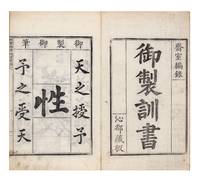
942941 folding leaves. Large 8vo 337 x 206 mm. orig. semi-stiff wrappers new stitching. Korea: Simdo æ²éƒ½ 1756.<br /> <br> <br> <br /> First edition and rare; WorldCat lists only one printed copy at Berkeley. This book of exhortations on good government with striking royal calligraphy was written by King YÅngjo or Yeongjo of ChosÅn 1694-1776 in 1756. At this time YÅngjo was commemorating the death of his father the previous king. According to Fang Chaoying 1908-85 YÅngjo then in his 65th year “could not foresee that he was to live twenty more years and so it appears that he was trying to justify himself in his own mind with regard to posterity as well as to the ancestors whom he expected to face any day†The Asami Library 115. YÅngjo offered three main principles for a king to follow: “to venerate Heaven to love the people and to treat the officials with respect†ibid.<br /> <br> <br> Large standard script characters written by the king himself are reproduced in the beginning of the book. The king’s brush records Confucian assertions such as “the following of human nature is called the Way / the cultivation of the Way is called instruction.†Accepting the Mencian dictum that human nature is inherently good the king continues: “I possess the good human nature / to realize the bright mandate of Heaven.â€<br /> <br> <br> The main text of the book is reproduced in the handwriting of the important scholar-official SÅ MyÅng-Ång or Seo Myeong-eung å¾å‘½è†º 1716-87. SÅ wrote in many genres and had a cosmopolitan outlook. For example he wrote a Preface to one of the major multilingual lexicographical works produced in ChosÅn in the 18th century see Söderblom Saarela “Mandarin over Manchu†379-80.<br /> <br> <br> Very fine and fresh copy beautifully printed.<br /> <br /> <br> <br> References<br /> <br> <br> Fang Chaoying. The Asami Library: A Descriptive Catalog. Edited by Elizabeth Huff. Berkeley: University of California Press 1969.<br /> <br> <br> Söderblom Saarela MÃ¥rten. “Mandarin over Manchu: Court-Sponsored Qing Lexicography and Its Subversion in Korea and Japan.†Harvard Journal of Asiatic Studies 77.2 2017. unknown
9398Paris, François Maspero, 1968. 1 volume in-12, 188 pp., broché, couverture illustrée, deux tampons chinois sur la page de titre, une petite déchirure sur le dos, très bon état.
19926049102München 1992. 8°. VI, 163 pp. Broschur. Signaturschildchen auf Rücken. Stempel verso Titel. Sonst ordentlich.
8769Espace ARCH.I.DE, Paris, 1991. In-8, en feuilles sous chemise rempliée bleue et sous serpente, 12 pp. Biographie - Planches - Zong Dé Han : être avec le temps, par Farid Abdelouahab - Planches.
7378Galerie Patricia Dorfmann, Paris, 1994. In-4, broché, 32 pp. Zong De Han : La pause du temps, par Stéphane Huchet - Planches - Biographie.
8773Gana Art Gallery, Seoul, 1995. In-4, broché sous couverture illustrée en couleur, 64 pp. Beauté, splendeur du vrai, par Michel Nuridsany - Planches - Things that disappear, remain and revive - To the 9th solo exhibition of Zong De Han, by Shin-Eu Park, art critic - Biographie.
195280571952 broché in-octavo, dos crème, couverture recto ornée d'une illustration photographique, long papier, très légères piqûres, 248 pages, 1952 à Paris Editions Corréa,
24391P., Corrêa (Collection "L'Esprit Vivant"), 1952, in 8° broché, 248pp. ; couverture illustrée (fanée).
19522401030006xbvkBudapest, Ungarischer Friedensrat (Hrsg.), 1952. 100 (1) Seiten Text, 9 ganzseitige und 30 halbseitige fotografische Abbildungen in Kupfertiefdruck auf 24 zwischengebundenen Kunstdrucktafeln. - Fotografisch illustrierter Original-Halbleineneinband mit Deckeltitel; 8vo.(ca. 20 x 16 cm).
19882111902152905110Hirakawashuppansha 1988. Soft Cover. Fine. Size: B6 size Hirakawashuppansha paperback
2013dz1306Kum Kang Sa Sélection Neiges d'Antan Album souple 2013 In-4 (21,5 x 29,5 cm.), album souple, reproduction des calligraphies en couleurs, texte en coréen, catalogue d'exposition au Nomura Art Museum à Kyoto au Japon, légende des calligraphies en chinois - coréen - japonais - anglais ; coiffes et coins un peu frottées, quelques taches à la couverture, intérieur frais, bon état. Livraison a domicile (La Poste) ou en Mondial Relay sur simple demande.
198426635S. l. : DKKV, Dt.-Korean. Künstlervereinigung, 1984. 65, [10] S. : überw. Ill. Gr. 8°. Ill. OBroschur.
200069440ABBasel., Öffentliche Kunstsammlung., 2000. 22,5 x 20.5 cm. XIV, 17 S. Illustrierter OKarton., 69440A Erste Auflage. Innen papierbedingt minimalst lichtspurig, sonst gutes bis sehr gutes Exemplar.