[TERRA NOVA EXPEDITION]; LEVICK, G MBiblio.com
1 955 résultats
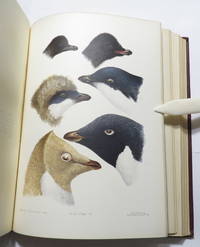
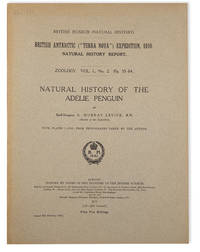
115685London British Museum 1915. . First edition; 4to; 21 photographic plates; publisher's original paper wrapper; a fine copy; pp. 55-84 xxi.<br /> The first monograph on the Adelie penguin by zoologist G. Murray Levick a member of Robert Falcon Scott's 'Terra Nova' expedition.<br /> Rosove 292-14. London, British Museum, 1915. unknown
1330534999.Gpaperback. Good. Access codes and supplements are not guaranteed with used items. May be an ex-library book. paperback
0332334740.Ghardcover. Good. Access codes and supplements are not guaranteed with used items. May be an ex-library book. hardcover
1908IG197201908 iv, 279 p., 59 (21 col./tinted) pls, roy. 4to, hcloth.Includes the following papers: Nierstrasz, H.F. Mollusca. Solenogastres. 13 p, 2 plts / Carpenter, G.H. Arthropoda. Aptera. 5 p, 1 plt / Tattersall, W.M. Crustacea. Schizopoda. 42 p 8 plts / Wolfenden, R. Norris. Crustacea. Copepoda. 44 p, 7 plts / Bell, F. Jeffrey . Echinoderma. 16 p, 5 plts / MacBride, E.W. and J.C. Simpson. Echinoderm Larvae. 9 p, 1 plt / Ritter, v. Stummer- Traunfels, Dr. Rudolf. Myzostomidae, 26 p, 1 plt / Lanchester, W.F. Sipunculoidea. 6 p / Clubb, J.A. Coelentera, Actiniae. 12 p, 3 plts / Kirkpatrick, R. Porifera, Tetraxonida. 56 p, 19 plts / Jenkin, C.F. Porifera, Calcarea. 50 p, 12 plts.
1910HM052711910 ix, 212 p., several figs, 28 pls, roy. 4to, publisher's hcloth (spine with outer ends somewhat worn and with tiny hole). The plates of the Tunicata part with a waterstain in upper margin. This volume includes the following contributions: Marett Tims, Seal Embryos (21 p., 2 pls), Herdman, Tunicata (26 p., 7 pls), Hodgson, Crustacea Isopoda (77 p., 10 pls), Joubin, Nemertinea (15 p., 1 pl.), Browne, Coelenterata Medusae (62 p., 7 pls), Vernon Darbishire, Lichenes (11 p., 1 pl.).
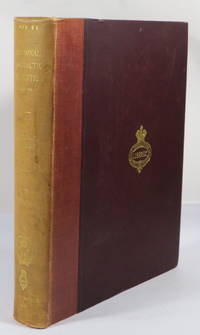
190727497London: Printed by Order of the Trustees of the British Museum. Very Good with no dust jacket. 1907. First Edition. Hardcover. Ex-library General Assembly Library New Zealand. Gilt library stamps on spine and front board. Fading to spine. Small 8mm tear to cloth at lower end of front joint. A little bruising with 18mm crease lines to lower outer corners of boards. Label on front endpaper "Presented by The Trustees of The British Museum". Overall a very good copy that although ex-library shows little sign of use and does not appear to have been a circulating copy. ; Volume Two only. xiv 362 each section individually paginated 1 1 blank pages 74 plate leaves 19 colour of which one of the Cephalodiscus plates only has small areas of red colouring 1 folding colour map in pocket at rear. In-text figures. Original red buckram cloth spine and burgundy cloth boards. Gilt lettering on spine. Page dimensions: 306 x 231mm. A volume of zoological reports from the Discovery Expedition 1901-1904 which was led by Captain Robert Falcon Scott 1868-1912. Various contributors. "The chief part of the present volume is Dr. Wilson's beautifully illustrated report on the Birds and Mammals giving his personal experiences during the Expedition as well as the results of subsequent study of the collections. This expedition was the first to discover a nesting colony of the Emperor Penguin. All the other collections of vertebrates made during the Expedition are here reported on with the exception of the embros of seals and the pelagic fishes which will be dealt with later. The investigation into the development of the feathers of the penguin raises several points of great morphological significance. The collection of fishes is small but interesting." - from the Preface to Volume II by F. Jeffrey Bell. The section on Mammals by Edward A. Wilson includes 3 colour and 2 black-and-white plates by Wilson. The section on Birds by Wilson and Pycraft includes 13 colour plates by Wilson. References: Rosove 288-2.A1 has "73 plate leaves" but the number of plate leaves given for each section add to 74 plate leaves which is correct; Renard 1129 - "The coloured plates by Wilson are particularly fine." . Printed by Order of the Trustees of the British Museum hardcover
190827532London: Printed by Order of the Trustees of the British Museum. Very Good with no dust jacket. 1908. First Edition. Hardcover. Ex-library General Assembly Library New Zealand. Gilt library stamps on spine and front board. Fading to spine. Label on front endpaper "Presented by The Trustees of The British Museum". Overall a very good copy that although ex-library shows little sign of use and does not appear to have been a circulating copy. ; Volume Four only. 2 blank iv 2 preliminary pages 13 1 blank; 5 1 blank; 41 1; 46; 16; 9 1 blank; 26; 6; 12; 56; 50 pages each section paginated individually 59 plate leaves 21 colour and another 9 with a single beige colour background tint. The fourth section is listed in the Contents as having 44 pages but it actually has 46 pages. Original red buckram cloth spine and burgundy cloth boards. Gilt lettering on spine. Page dimensions: 303 x 230mm. A volume of zoological reports from the Discovery Expedition 1901-1904 which was led by Captain Robert Falcon Scott 1868-1912. Various contributors. 20 of the colour plates are of sponges Porifera of which 9 of Tetraxonida and 11 are of Calcarea calcareous sponges. 1 colour plate of Myzostomidae marine worm. References: Rosove 288-4.A1 Rosove states 58 instead of 59 plates and 18 plate leaves for the section on Tetraxonida but this should be 19 as there are 19 plates numbered VIII through XXVI in this section. The Contents in the book also list 19 plates in this section.; Renard 1129 . Printed by Order of the Trustees of the British Museum hardcover
1334304491.Gpaperback. Good. Access codes and supplements are not guaranteed with used items. May be an ex-library book. paperback
0331604205.Ghardcover. Good. Access codes and supplements are not guaranteed with used items. May be an ex-library book. hardcover
1908ZB657436London: The Royal Society 1908. first edition; folio leaves slightly shorter than 30.5 cm. v 1 192 pp. 21 plates with one folding and including six plates of aurora observations in muted grey blue and brown also a double page color map of Laurie Island; hardcover ex library spine worn hinges reinforced with tape else text clean & binding tight; five articles viz. Tidal Observations in the Antarctic Regions 1902-1903 Pendulum observations Earthquakes and other Earth Movements recorded in the Antarctic Regions 1902-1903 Antarctic Observations of Aurora 1902-1903 and Antarctic Magnetic Observations 1902-1904. - If you are reading this this item is actually physically in our stock and ready for shipment once ordered. We are not bookjackers. Buyer is responsible for any additional duties taxes or fees required by recipient's country. Photos available upon request. London: The Royal Society, hardcover
0483698962.Ghardcover. Good. Access codes and supplements are not guaranteed with used items. May be an ex-library book. hardcover
0332894649.Ghardcover. Good. Access codes and supplements are not guaranteed with used items. May be an ex-library book. hardcover
19105597London: British Museum 1910. Hardcover. Very good condition. Volume 5 of the account of the Discovery Expedition of 1901-04 led by Capt. Robert F Scott known officially as the British National Antarctic Expedition. Numerous lithographic plates including seals tunicata isopoda nemertinea coelentera and lichen. <br /> <br /> Large 4to xxii 21pp article 2 plts on seal embryos; 26 pp 7 plts on tunicata; 77pp & 10 plts on isopoda; 15pp & 1 plt on nemertinea; 62pp & 7 plts on coelentera; 12 pp & 1 plt on lichens. <br /> <br /> Original red gilt buckram ex-lib copy w/ sml. cancelled stamp on verso of plates very good condition. Vol 1. of the 6 natural history volumes is listed as Spence 837. British Museum hardcover
The Lakeside Classics Series. Edited with an introduction by Harold Augenbraum. Álvar Núñez Cabeza de Vaca was a Spanish explorer of the New World, and one of four survivors of the 1527 Narváez expedition. During eight years of traveling across the US Southwest, he became a trader and faith healer to various Native American tribes before reconnecting with Spanish civilization in Mexico in 1536. After returning to Spain in 1537, he wrote of his adventures in " La relación of Álvar Núñez Cabeza de Vaca" published in 1542. 88p. maps, illus. index. The Lakeside Press Classics series was started in 1903 by Thomas E. Donnelley, [who] believed that a simple book, dignified and well designed, would be an appropriate holiday gift. Beautifully printed on fine paper in a handsome green cloth covered boards, with gilt title and decorations. Small format nice gift volume. Book
66939New York, D. Appleton & Company 1846, 230x145mm, IV - 186pages, paperback. Lower cover missing. Spine used. Name of the owner on the superior cover.
1856E05603 volumes: xvii1537 pages with 90 lithographs plates including the usual expunged bathing plate many in color including 3 "facsimiles" of Japanese woodblock prints 2 folding; 6 maps and charts 2 folding; 79 woodcuts in the text; 2414414-1xi pages with 4 color lithographs of Chinese scenes; 2 uncolored natural history engraved plates; 6 hand-colored lithographs of birds; 10 hand-colored steel-engravings of fish; 5 lithographs of shells 2 hand-colored; 16 diagram plates of winds and currents; 14-page facsimile of Japanese language version of the U.S.-Japan treaty; 17 folding charts on 16 sheets; numerous woodcuts in the text; xliii17051 pages woodcut star charts throughout. Volume III titled "United States Japan Expedition. Observations on the zodiacal light from April 2 1853 to April 22 1855 . by Rev. George Jones A.M. chaplain United States Navy". Quarto 11½ x8 ¾" bound in the original blind stamped cloth. Volume 1 rebacked with the original cloth spine laid down. Hill 1332; Sabin 30968 First edition of the House Issue.<br /><br />Detailed and profusely illustrated account of Perry's expedition to open Japan to the West; Upon his return to the U.S. his chief duty for the following year was to compile his reports of the expedition aided by Francis Hawks. The first volume has the account of the voyage and lithographs of the travel; the second volume has the natural history reports by D.S. Green and others and includes hand-colored plates of Japanese fishes and shells. In addition to the artist W. Heine from whose drawings a great number of the lithographs were made the daguerreotypist E. Brown Jr. went on the expedition taking what were undoubtedly the earliest photographic images of Japan many of them reproduced lithographically in this work. This copy with the nude bathing plate which was not included on the list of plates and not issued in all copies. <br /><br />In advance of his voyage to the Far East Commodore Perry read widely amongst available books about Tokugawa Japan. His research even included consultation with the increasingly well-known Japanologist Philipp Franz von Siebold who had lived on the Dutch island of Dejima for eight years before retiring to Leiden in the Netherlands. In 1852 Perry embarked from Norfolk Virginia for Japan in command of a squadron in search of a Japanese trade treaty. Aboard a black-hulled steam frigate he ported Mississippi Plymouth Saratoga and Susquehanna at Uraga Harbor near Edo modern Tokyo on July 8 1853. His actions at this crucial juncture were informed by a careful study of Japan's previous contacts with Western ships and what could be known about the Japanese hierarchical culture. He was met by representatives of the Tokugawa Shogunate who told him to proceed to Nagasaki where there was limited trade with the Netherlands and which was the only Japanese port open to foreigners at that time. Perry refused to leave and demanded permission to present a letter from President Millard Fillmore threatening force if he was denied. Perry ordered his ships to attack several buildings around the harbor to demonstrate US naval power. The Commodore was fully prepared for more hostilities if his negotiations with the Japanese failed and threatened to use unrestrained fire if the Japanese refused to negotiate. He sent two white flags to them telling them to hoist the flags when they wished a bombardment from his fleet to cease and to surrender. Perry's ships were equipped with new Paixhans shell guns capable of wreaking great destruction with every shell. The Japanese military forces could not resist Perry's modern weaponry; the term "Black Ships" in Japan would later come to symbolize a threat imposed by Western technology. Perry returned in February 1854 with twice as many ships finding that the delegates had prepared a treaty embodying virtually all the demands in Fillmore's letter. Perry signed the Convention of Kanagawa on March 31 1854 and departed mistakenly believing the agreement had been made with imperial representatives. The agreement was made with the Shogun the de facto ruler of Japan. On his way to Japan Perry anchored off Keelung in Formosa modern day Taiwan for ten days. Perry and crew members landed on Formosa and investigated the potential of mining the coal deposits in that area. He emphasized in his reports that Formosa provided a convenient mid-way trade location. Formosa was also very defensible. It could serve as a base for exploration as Cuba had done for the Spanish in the Americas. Occupying Formosa could help the US to counter European monopolization of the major trade routes. President Franklin Pierce declined the suggestion remarking such a remote possession would be an unnecessary drain of resources and that he would be unlikely to receive the consent of Congress. When Perry returned to the United States in 1855 Congress voted to grant him a reward of $20000 in appreciation of his work in Japan. Perry used part of this money to prepare and publish a report on the expedition in three volumes titled Narrative of the Expedition of an American Squadron to the China Seas and Japan. He was also advanced to the grade of rear-admiral on the retired list when his health began to fail as a reward for his services in the Far East.<br /><br />Condition:<br /><br />Wear and fading to cloth first volume rebacked; large map detached several others with stub tears and splitting to folds; light foxing else good to very good. A O P Nicholson hardcover books
99086Edmonton, M. H. Hurtig Ltd. 1970, 195x135mm, XXVII - 663pages, editor's binding with jacket. Book in good condition.
1831E01322 volumes. xxi472 pages with three maps two folding and one double page figures and 13 plates; iv452 pages with 10 plates some folding tables and appendices. Octavo 9 1/2" x 5 1/2" Bound in contemporary half leather with marbled boards and gilt lettering to spine. Ferguson 1418; Hill I p. 19; Howes B309; Lada-Mocarski 95; Sabin 4347. Second edition published after quarto edition of the same year.<br /><br />Frederick William Beechey 17 February 1796 – 29 November 1856 was an English naval officer and geographer. He was the son of Sir William Beechey RA and was born in London. 1806 he entered the Royal Navy and saw active service during the wars with France and America. In 1818 he served under Lieutenant afterwards Sir John Franklin in David Buchan's Arctic expedition of which at a later period he published a narrative. In the following year he accompanied Lieutenant W. E. Parry in HMS Hecla. In 1821 he took part in the survey of the Mediterranean coast of Africa under the direction of Captain afterwards Admiral William Henry Smyth. He and his brother Henry William Beechey made an overland survey of this coast and published a full account of their work in 1828 under the title of Proceedings of the Expedition to Explore the Northern Coast of Africa from Tripoly Eastward in 1821-1822. In 1825 Beechey was appointed to command the HMS Blossom. His task was to explore the Bering Strait in concert with Franklin and Parry operating from the east. In the summer of 1826 he passed the strait and a barge from his ship reached 71°23'31" N. and 156°21'30" W. near Point Barrow which he named a point only 146 miles west of that reached by Franklin's expedition from the Mackenzie river. The whole voyage lasted more than three years and in the course of it Beechey discovered several islands in the Pacific and an excellent harbor near Cape Prince of Wales. In July 1826 he named the three islands in the Bering Strait. Two were the Diomede Islands that Vitus Bering had named in 1728: "Ratmanoff Island" Big Diomede and "Krusenstern Island" Little Diomede. Beechey called the uninhabited third islet "Fairway Rock" which is still its contemporary name. One of his crew Petty Officer John Bechervaise gave a detailed account of the voyage in his Thirty Six Years if a Seafaring Life by an Old Quartermaster published privately in 1839. In 1831 there appeared his Narrative of a Voyage to the Pacific and Beering's Strait to Co-operate with the Polar Expeditions 1825-1828. In 1835 and the following year Captain Beechey was employed on the coast survey of South America and from 1837 to 1847 carried on the same work along the Irish coasts. He was appointed in 1850 to preside over the Marine Department of the Board of Trade. In 1854 he was made rear-admiral and in the following year was elected president of the Royal Geographical Society. Beechey Island where Sir John Franklin wintered is named after him.<br /><br />Condition:<br /><br />Name neatly excised from head corner of titles small inconspicuous stamp to last pages. Inner hinges beginning marble to boards rubbed some stains to map. some toning to some plates some plates not bound in order to the printer but are all accounted for corners gently bumped else about a very good set. Henry Colburn and Richard Bentley hardcover books
1843E01482 volumes. xxxvii23878 ad pages with frontispiece woodcuts in text and 7 steel-engraved plates; vi2474 pages with frontispiece woodcuts in texts and 10 steel-engraved plates. Royal octavo 9¼x5½" in publisher's original green cloth spine lettered in gilt covers decorative blind stamped. First Edition.<br /><br />In 1825 Edward Belcher accompanied Frederick William Beechey's expedition to the Pacific and Bering Strait as a surveyor. In 1836. he commanded a surveying ship on the north and west coasts of Africa and in the British seas. Belcher took up the work which Beechey had left unfinished on the Pacific coast of South America. He was on board the bomb vessel HMS Sulphur which was ordered to return to England in 1839 by the Trans-Pacific route. Belcher made various observations at a number of islands which he visited having been delayed by being dispatched to take part in the war in China in 1840. On 26 January 1841 the then Commander Belcher landed on Possession Point at the north shore Hong Kong Island and made the first British survey of Hong Kong harbor. After the war's end in 1842 he reached home and for his services was made a Knight Bachelor in the following year. He was then engaged in HMS Samarang in surveying work in the East Indies the Philippines Geomun-do Port Hamilton and other places until 1847. In 1852 Belcher led the last and largest Admiralty expedition to rescue Sir John Franklin. He was also to look for his former surveying officer in Hong Kong Richard Collinson and Robert McClure whose ships had not been seen after entering the Bering Strait. He did a great deal of sledge exploration rescued McClure and abandoned four of his five ships in the ice. He had five ships: Assistance Belcher Resolute Henry Kellett second mate George Nares the steam tenders PioneerSherard Osborn and Intrepid Leopold McClintock and the depot ship North Star William Pullen. Belcher and one tender were to enter Wellington Channel where Franklin was thought to be while Kellett was to go west to Melville Island and look for Collinson and McClure. North Star was to stay at Beechey Island as a supply base. He left the Nore in April 1850. By early winter Assistanceand Pioneer were frozen in at Northumberland Sound to the north of Wellington Channel while Resolute and Intrepid were frozen in off Melville Island Arctic—the first ships this far west since William Edward Parry in 1819. A great deal of exploration was done by man-hauled sledges. In April 1853 Leopold McClintock and others left the Resolute on sledges and returned 105 days later having covered 1400 miles and discovered Prince Patrick Island. Another party went west and discovered Robert McClure whose ship was frozen in at Mercy Bay. Belcher went north by sledge and found a channel at the northern tip of Devon Island hinting that Franklin might have used it to escape to Baffin Bay. When the ice broke up that summer he pushed his ships up Wellington Channel and became trapped again. By February 1854 Belcher was becoming increasingly worried about the safety of his ships and men. In April he ordered Kellett to abandon his ships and return by sledge to North Star. Belcher abandoned his two ships in late July. Aided by two ships that showed up at Beechey Island Phoenix and Breadalbane the whole party returned to England. Belcher went through a court martial which was automatic for any captain who had lost a ship. He was exonerated but his sword was returned to him 'without observation'. He never again received an active command. Curiously Resolute broke free of the ice and drifted all the way to Davis Strait where it was picked up by an American whaler.<br /><br />Condition:<br /><br />Some staining and wear to covers spines a bit faded ends chipped and worn rear joint of Vol. I with chipping and loss; hinges repaired at endpapers some light foxing and occasional mostly marginal damp staining within the three folding maps which should be loose in a pocket not present; overall good uncommon in the original cloth. Henry Colburn hardcover books
183512587Paris, Baudry, Amyot, Barrois, 1835. In-8 de [4]-VI-[2]-XVI-475 pages, demi-chagrin rouge à coins, dos lisse orné de filets et fleurons dorés, tranches mouchetées. Rousseurs.
1843E01482 volumes. xxxvii23878 ad pages with frontispiece woodcuts in text and 7 steel-engraved plates; vi2474 pages with frontispiece woodcuts in texts and 10 steel-engraved plates. Royal octavo 9¼x5½" in publisher's original green cloth spine lettered in gilt covers decorative blind stamped. First Edition.<br /><br />In 1825 Edward Belcher accompanied Frederick William Beechey's expedition to the Pacific and Bering Strait as a surveyor. In 1836. he commanded a surveying ship on the north and west coasts of Africa and in the British seas. Belcher took up the work which Beechey had left unfinished on the Pacific coast of South America. He was on board the bomb vessel HMS Sulphur which was ordered to return to England in 1839 by the Trans-Pacific route. Belcher made various observations at a number of islands which he visited having been delayed by being dispatched to take part in the war in China in 1840. On 26 January 1841 the then Commander Belcher landed on Possession Point at the north shore Hong Kong Island and made the first British survey of Hong Kong harbor. After the war's end in 1842 he reached home and for his services was made a Knight Bachelor in the following year. He was then engaged in HMS Samarang in surveying work in the East Indies the Philippines Geomun-do Port Hamilton and other places until 1847. In 1852 Belcher led the last and largest Admiralty expedition to rescue Sir John Franklin. He was also to look for his former surveying officer in Hong Kong Richard Collinson and Robert McClure whose ships had not been seen after entering the Bering Strait. He did a great deal of sledge exploration rescued McClure and abandoned four of his five ships in the ice. He had five ships: Assistance Belcher Resolute Henry Kellett second mate George Nares the steam tenders PioneerSherard Osborn and Intrepid Leopold McClintock and the depot ship North Star William Pullen. Belcher and one tender were to enter Wellington Channel where Franklin was thought to be while Kellett was to go west to Melville Island and look for Collinson and McClure. North Star was to stay at Beechey Island as a supply base. He left the Nore in April 1850. By early winter Assistanceand Pioneer were frozen in at Northumberland Sound to the north of Wellington Channel while Resolute and Intrepid were frozen in off Melville Island Arctic—the first ships this far west since William Edward Parry in 1819. A great deal of exploration was done by man-hauled sledges. In April 1853 Leopold McClintock and others left the Resolute on sledges and returned 105 days later having covered 1400 miles and discovered Prince Patrick Island. Another party went west and discovered Robert McClure whose ship was frozen in at Mercy Bay. Belcher went north by sledge and found a channel at the northern tip of Devon Island hinting that Franklin might have used it to escape to Baffin Bay. When the ice broke up that summer he pushed his ships up Wellington Channel and became trapped again. By February 1854 Belcher was becoming increasingly worried about the safety of his ships and men. In April he ordered Kellett to abandon his ships and return by sledge to North Star. Belcher abandoned his two ships in late July. Aided by two ships that showed up at Beechey Island Phoenix and Breadalbane the whole party returned to England. Belcher went through a court martial which was automatic for any captain who had lost a ship. He was exonerated but his sword was returned to him 'without observation'. He never again received an active command. Curiously Resolute broke free of the ice and drifted all the way to Davis Strait where it was picked up by an American whaler.<br /><br />Condition:<br /><br />Some staining and wear to covers spines a bit faded ends chipped and worn rear joint of Vol. I with chipping and loss; hinges repaired at endpapers some light foxing and occasional mostly marginal damp staining within the three folding maps which should be loose in a pocket not present; overall good uncommon in the original cloth. Henry Colburn hardcover
182447632Vol. I has a large partial coloured map as frontis and Vol. II has 3 large folding maps in the rear The record of Franklin's first Arctic expedition fraught with hardship and tragedy constitutes one of the classics in the annals of travel literature. In all the party travelled 5500 miles overland and with the aid of canoes exploring the territory from York Factory to the mouth of the Coppermine River on Coronation Gulf east along the Arctic coast as far as Point Turnagain and back across the Barren Lands. Provisions were poor and scant and on the return journey many crew members died of cold and starvation; the young naval artist Robert Hood was murdered and another executed for the crime. The work also includes accounts by Richardson and Back of the last leg of the desperate journey across the Barren Lands. This edition omits the appendix on the natural history of the region and scientific observations on the aurora borealis and the magnetic needle. Arctic Bib. 5195. Sabin 25625. TPL 1249. Lande 1181-82. Peel 151n. John Murray hardcover
1823040517John Murray. Good with no dust jacket. 1823. First Edition. Hardcover. Hardcover; Hardcover. Brown leather boards with gold design at board edges. Title in gold over black leather label on gold decorated spine. Boards are noticeably scuffed and worn. Frayed edges some sunning. Marbleized edges match marbleized endpapers. Occasional foxing throughout. 4 maps 30 plates of which 11 are hand colored. All are in nice condition some light foxing/soil. Always carefully wrapped and shipped in cardboard boxes to protect your purchase.; B/w Illus; 4TO . John Murray hardcover
1831E0132<p>2 volumes. xxi472 pages with three maps two folding and one double page figures and 13 plates; iv452 pages with 10 plates some folding tables and appendices. Octavo 9 1/2" x 5 1/2" Bound in contemporary half leather with marbled boards and gilt lettering to spine. Ferguson 1418; Hill I p. 19; Howes B309; Lada-Mocarski 95; Sabin 4347. Second edition published after quarto edition of the same year.<br /><br />Frederick William Beechey 17 February 1796 – 29 November 1856 was an English naval officer and geographer. He was the son of Sir William Beechey RA and was born in London. 1806 he entered the Royal Navy and saw active service during the wars with France and America. In 1818 he served under Lieutenant afterwards Sir John Franklin in David Buchan's Arctic expedition of which at a later period he published a narrative. In the following year he accompanied Lieutenant W. E. Parry in HMS Hecla. In 1821 he took part in the survey of the Mediterranean coast of Africa under the direction of Captain afterwards Admiral William Henry Smyth. He and his brother Henry William Beechey made an overland survey of this coast and published a full account of their work in 1828 under the title of Proceedings of the Expedition to Explore the Northern Coast of Africa from Tripoly Eastward in 1821-1822. In 1825 Beechey was appointed to command the HMS Blossom. His task was to explore the Bering Strait in concert with Franklin and Parry operating from the east. In the summer of 1826 he passed the strait and a barge from his ship reached 71°23'31" N. and 156°21'30" W. near Point Barrow which he named a point only 146 miles west of that reached by Franklin's expedition from the Mackenzie river. The whole voyage lasted more than three years and in the course of it Beechey discovered several islands in the Pacific and an excellent harbor near Cape Prince of Wales. In July 1826 he named the three islands in the Bering Strait. Two were the Diomede Islands that Vitus Bering had named in 1728: "Ratmanoff Island" Big Diomede and "Krusenstern Island" Little Diomede. Beechey called the uninhabited third islet "Fairway Rock" which is still its contemporary name. One of his crew Petty Officer John Bechervaise gave a detailed account of the voyage in his Thirty Six Years if a Seafaring Life by an Old Quartermaster published privately in 1839. In 1831 there appeared his Narrative of a Voyage to the Pacific and Beering's Strait to Co-operate with the Polar Expeditions 1825-1828. In 1835 and the following year Captain Beechey was employed on the coast survey of South America and from 1837 to 1847 carried on the same work along the Irish coasts. He was appointed in 1850 to preside over the Marine Department of the Board of Trade. In 1854 he was made rear-admiral and in the following year was elected president of the Royal Geographical Society. Beechey Island where Sir John Franklin wintered is named after him.<br /><br /><strong>Condition:</strong><br /><br />Name neatly excised from head corner of titles small inconspicuous stamp to last pages. Inner hinges beginning marble to boards rubbed some stains to map. some toning to some plates some plates not bound in order to the printer but are all accounted for corners gently bumped else about a very good set.</p> Henry Colburn and Richard Bentley hardcover
H909Washington Beverley Tucker 1856. Three volumes quarto Volume 1 with 88 lithographed plates most tinted three colour facsimiles of Japanese woodblock prints two folding six maps two folding numerous wood-engraved illustrations in text the suppressed nude bathers plate is present !; Volume 2 with 27 illustration plates 18 hand-coloured 16 plates of wind & current diagrams 16 folding maps 14 linen-backed; Volume 3 with 352 wood-engraved star charts. Original cloth rubbed joints with small tears minor wear Text and plates in good condition. First edition the Senate Issue of Perry's account of his historic voyage to Japan in command of a naval expedition which was to lobby the Japanese government to establish diplomatic relations with the United States. The resulting treaty in 1853 ensured better treatment by the Japanese authorities of shipwrecked seamen and permitted American ships to dock at two Japanese ports to refuel and to seek supplies. "The most important result. was that the visit contributed to the collapse of the feudal regime and to the modernization of Japan" Hill. "As one of the chief diplomatic achievements of the 19th century the opening of Japan by the treaty negotiated by Perry will long make the name of Perry memorable. His expedition marked a departure in Occidental policy restricting Japan in American policy respecting the Orient and in Japanese policy respecting the Western world. In June 1855 Perry was ordered to Washington where his chief duty for more than a year was the preparation of a report of his expedition which was published by the government in 1856" DAB. hardcover