[Breviary in Arabic].MareMagnum

4 752 résultats
8vo. (10), 736 pp. Printed in red and black throughout. Contemporary blindstamped black calf binding. The Arabic Horologion (following the Byzantine rite), containing the breviary, canonical prayers and hymns for the feast days of the Saints throughout the year. From the printing office of the Melkite monastery of St. John the Baptist at al-Shuwayr in the Lebanese Kisrawan mountains, operative between 1734 and 1899, during which time it produced in all 69 Arabic books, including re-editions (cf. Silvestre de Sacy I, pp. 412-414; Middle Eastern Languages and the Print Revolution. A Cross-Cultural Encounter, Westhofen 2002, pp. 179-181). Occasional insignificant brownstaining; slight chipping to extremeties of the appealing original binding. Rare: OCLC lists two copies only (at the University of Leiden and the Veech Library, Catholic Institute of Sydney, Australia). OCLC 68525490, 224329156.
4to. 36 pp. With 5 black and white photographic plates in the text. Original printed wrappers. Rare issue of the periodical of the British Falconers' Club, the first issue of which appeared in 1937, including tributes to the late Vice-Presidents George Edward Lodge (1860-1954) and Guy Aylmer (1887-1954), as well as several book reviews. The contributors make observations on the Ovampo sparrowhawk, the African goshawk, and the red-headed merlin, as well as on partridge hawking, hacking, and the Dutch Falconers' Hut in "De Hoge Veluwe" National Park. The editorial discusses the 1954 Protection of Birds Act, which established the necessity of a licence when taking, selling, or importing live birds of prey for the purposes of falconry, stating that "it is most satisfactory that falconry has been recognised in this way, which gives it, potentially, a very much more favourable status than it has enjoyed for many years" (p. 10). The illustrations show the two former vice-presidents, G. E. Lodge painting, G. Aylmer with his hawk, hawks and merlins, and the Dutch Falconers' Hut surrounded by several hooded birds on perches. - Upper right corner of front cover slightly creased. A good copy. U.S. Air Force Academy Library, Special Bibliography Series 81, p. 91, 2. OCLC 52319876.
Oblong folio (335 x 245 mm). 188 silver gelatin photographs, one hand-tinted, mostly 105 x 80 mm, mounted in photo corners with handwritten captions. Original green cloth binding with hand-drawn map of Africa, Europe, and Asia on the front pastedown labelled "England to Aden 4643 miles" and four small maps of Kuwait, Ceylon, Iraq, and India mounted on rear pastedown with hand-coloured borders in blue and orange. A previously unknown collection of unique photographs by an anonymous British serviceman, documenting an interwar deployment to Aden and featuring one of earliest known photographs of Sheikh Juma bin Maktoum bin Hasher Al Maktoum (b. 1891) and Sheikh Saeed bin Maktoum bin Hasher Al Maktoum (1878-1958) of Dubai. Early photographs of Dubai or its rulers are quite uncommon, making this an exceptionally important piece. Here, the brothers are shown touring a British Royal Navy cruiser. Sheikh Juma (on the left) was the founder of the Al Maktoum branch of the Dubai royal family; his brother, Sheikh Saeed (on the right), was the longest-tenured ruler of Dubai, and presided over many of the huge economic changes of the first half of the 20th century. Both were deeply important to the formation of Dubai as it is today, but relics of their lives are extremely scarce. - Another rare photograph captures the Sultan of Oman Said bin Taimur (1910-72) as a young man touring a British light cruiser no more than a few months after the start of his reign in 1932. At only twenty-one, Said inherited both the sultanate and the difficulties faced by his predecessor. Though his reign was not easy, he was famously successful in uniting the warring factions within the sultanate. - The photographer behind this collection was likely a serviceman based on the H.M.S. Emerald, an Emerald-class light cruiser of the Royal Navy which would go on to provide support service during the D-Day landings at Gold Beach in WWII, but spent much of her career in the Indian Ocean and the Gulf. The serviceman has snapped a shot of a Fairey Flycatcher pontoon plane with the registration number N9670 - the Flycatcher known to have been assigned to the Emerald - photographed from the deck, and the Emerald appears repeatedly throughout the collection. Though the Emerald had a long tenure in the Gulf, photographs of the crash of the same ill-fated Fairey Flycatcher N9670 date the collection to circa December 1931, and the appearance of the young Sultan of Oman can only have been taken after the start of his reign on the 10th of February, 1932, covering a reasonable span of six months or more. Additionally, the Hawkins-class heavy cruiser H.M.S. Effingham appears in tow at the East Indies Station Trincomalee, Sri Lanka, which could only have occurred in early 1932, as later that same year she was sent back to Britain as part of the Reserve Fleet. - The photographs of ship life are full of action: men bathing over the side in the warm waters off Gibraltar, views of the Suez Canal, the use of a "smoke box" on the ship to generate a smokescreen, and torpedo drills, one capturing a launched torpedo in motion. However, no small part of the collection is dedicated to rare early views of Bahrein, Oman, and Iran. Bahrain is introduced by the Flycatcher plane crash; the British desired to impress their allies among the local dignitaries in Bahrain with a demonstration of military power, and sent Flight Lt. Peter Dabney Heinemann out in the Flycatcher to machine-gun targets which had been floated in the sea just off Bahrain. Heinemann reportedly lost control and spun out, and was killed when the plane crashed into the sea. Seven photographs show the British retrieving the wreckage, and the following photographs show a funeral procession in Manama, the bed of a military truck laid out in carpets acts as a hearse, and the burial in the Old Christian Cemetery. Two more photographs show a cityscape view of Manama and the clock tower of the Church of Christ in Bahrein. - Photographs of Old Muscat show the al-Jalali and al-Mirani forts, the former then still in use as a prison, and a view of the city "from hill top". Rounding out the tour of the Gulf, two photographs show the Abadan oil refinery in Iran. - The photographer spent some time in the Indian Ocean, and made port at Columbo, Trincomalee, Anuradhapura, Kandy, and Diyatalawa in Sri Lanka, as well as Karachi, Negapatam, Visakhapatnam, Kolkata (Calcutta), Sittwe (Akyab), and Port Blair. In Karachi, several photographs show the city's newly constructed airship mast and the cavernous airship shed, built as one of the main "terminals" of Britain's Imperial Airship Communications Scheme. The mast and shed were never used: a decade before the more famous Hindenburg disaster, the inaugural flight of the Scheme saw the R101 Airship leave London bound for Karachi, only to crash over France, killing all but six of the fifty-four crew and passengers and effectively ending the Scheme. Also of interest are several photographs of the large prison at Fort Blair, and include a photograph of an inmate strapped onto a "flogging board". - A touch of light wear; a few photographs are apparently missing as shown by their empty mounts; however, in excellent condition. Altogether a tour de force, featuring incredibly rare portraits of dignitaries and numerous photographs of cities of the Arabian Gulf.
Folio (271 x 493 mm). Broadsheet with 5 engravings and two columns of letterpress. Extremely rare, uncommon print describing the legendary Biblical city of Enoch, the "first city of the world", founded by Cain and named after his first son (cf. Gen. 4:17). The centre of the sheet shows a large (264 x 152 mm) view of the city (workmen erecting the walls in the background; Cain's family farming in the foreground), with numerous animals including elephants and lions. The smaller engravings to the left and right (130 x 85 mm each) show pumpkins ("Pepones"), a white falcon, a crane, and several marine animals (including a seal, dolphin, and sand flea). To the left and right of these are columns of letterpress text describing the city in eight twelve-line verses. - The style of the view is obviously closely related to the illustrations familiar from the Prague engraver Jan Hiller (active 1716-46, cf. Dlabacz, Allgemeines Künstlerlexikon für Böhmen I, 628-631), who also provided the plates for Myller's "Peregrinus in Jerusalem", a work that not only contains several topographical views, but also botanical and zoological illustrations. The Myller plate "La Ragna, die Meer-Spinne" shows several of the marine creatures depicted here in exactly the same fashion: clearly, Hiller re-used his work for the present broadsheet. This conclusion is further supported by the fact that the five plates evidence varying degrees of wear: while the large, central illustration shows good, strong contrast, the other four are markedly fainter. - Mounted on sturdy paper, probably by a near-contemporary collector; trimmed close to the plate edges. Slight brownstaining.
French bronze reliefs gilt, both preserved in their original frame. Each 43 x 39 x 4.5 cm. Showing two horses facing each other. Both bronze reliefs are very intricately detailed and mounted on a base of red velvet in two strictly contemporary frames of the French Empire period.
Photograph panorama, taken from the Austrian corvette "Fasana". Two conjoined albumen prints on backing cardboard, with Bublay's autogr. caption. 490 x 180 mm. Impressive view, photographed near the beginning of the two-year expedition of the Austrian "Fasana", in which the later Rear Admiral Bublay participated as ensign. This Austrian circumnavigation of the world, begun in Pola on Sept. 1, 1893, was completed in March 1895. - Includes a group photograph of the "Fasana" officers during a "Picknik im Middle-Harbour (Sydney) 9./5. 1894" (Bublay's caption).
8vo. (2), 210, (2), 211-422, (2), 423-664 pp. With a wood-engraved title vignette. Contemporary half calf over marbled boards. Brown marbled endpapers. A volume from James Buckingham's important journal which he founded in January 1824 under the significant title, "The Oriental Herald and Colonial Review", though the subtitle was renamed "Journal of General Literature" the following year. Several pieces are of direct relevance to the Arab world and the Gulf region: the transcript of a Debate at the East India House on the Bombay Marine (pp. 146ff.) variously discusses the "pirates in the Persian Gulph", the climate and various mishaps befalling ships there, while a review of the 1826 book "Sketches of Persia" (pp. 77ff.) gives an account of the "burning sandy plain which skirts the gulf". Johann Gottfried Eichhorn's "Historical Sketch of the Trade with India Before the Age of Mohamed" (pp. 437ff.) includes a discussion of Arabian and Gulf-region trade in the third century, and literature is represented in reviews of the Arabian tales "Abassah" (pp. 239ff.) and "Karmath" (pp. 557ff.). - "Except for 'The Asiatic Journal', the official publication of the East India Company, England had no paper devoted to colonial affairs. 'The duty of nations to enlighten and improve the condition of the people they subjugate,' he said in an introductory essay, 'can scarcely be required to be enforced by argument.' From this point of view he proposed to treat colonial problems in terms of colonial interests and at the same time to show the English people that conditions in the colonies were related to their own welfare" (R. E. Turner, James Silk Buckingham, 1786-1855: A Social Biography [1934], p. 226). - Binding rubbed; extremeties bumped; occasional wrinkles to pages. Armorial bookplate of Richard Archdall on pastedown. Stamps of the Caesarean Dramatic Literary Society of the Royal Hall, Jersey.
4to. (4), 68, 60 pp. (without 16 pages of preliminaries). - (Bound with) II: Manuale equestre, oder Compendium der Reichs-Ritterschafftlichen alt-hergebrachten Rechten [...]. Ulm, Johann Gassenmeyer, 1720. (8), 120, 144, 48, (18) pp. - (Bound with) III: Harpprecht zu Harpprechtstein, Stephan Christoph. Speculi Suevici et praesertim iuris feudalis Amamannici [...]. Kiel, Johann Christoph Reuther, 1723. (10), 240, (2), 154, (6) pp. Contemporary full vellum with handwritten spine label. All edges coloured. Collection of three 1720s manuals on the Holy Roman Empire's legal foundations of the Imperial Knightage and Swabian feudal law. The second part of the first work contains a condensement of Georg Rüxner's famous tournament book, first published in 1530. Burgermeister (1663-1722), who compiled the first two works, was the legal counsel of the Swabian free knights in the Neckar-Schwarzwald district and later served as Imperial councillor in Ulm. "He was the most fervent apologist for the privileges of the free baronetage, and this is the subject of almost all his writings, composed in German. While conceived without plan or discrimination, they do contain valuable source material for the history of the lower nobility of the Empire" (cf. ADB). - The German jurist Harpprecht (1676-1735), a native of Sindelfingen near Stuttgart, taught at the University of Tübingen, later serving in Vienna and then as professor in Kiel in Northern Germany, where he published the present study of his native Swabia's feudal law. - Occasional light browning, but altogether a good, tight copy. VD 18, 1050284X. Pütter (Staatsrecht) I, 320. ADB III, 601. VD 18, 12892033.
Large 12mo. V, (3), 20 pp. Modern half calf over marbled boards with black morocco label to spine, gilt. Padded at the end with 22 sturdy blank leaves with binder's ticket of "Period Binders, Bath". First edition of this rare introduction to Arabic. As the author writes in his dedication to the Rev. John Frederick Usko, "The object of the following pages is to put the Hebrew student in possession of just so much Arabick as may enable him to profit by the illustrations of Hebrew words in the Lexicons of Simonis and others." He proceeds to explain and justify his methods in the face of the many difficulties encountered by students. The text looks at the construction of the alphabet itself, compares Hebrew and Arabic letters, and similarly verbs and their tenses. - Attributed to Thomas Burgess (1756-1837), who served successively as Bishop of Salisbury and St. David's. He was educated at Winchester college and gained a scholarship to Corpus Christi College, Oxford, where he spent most of his time studying Greek. He was ordained in 1784 and at this time he became interested in Hebrew and theology. A prolific author, he published over a hundred works - the first while at Oxford. Early in his career, he came under the patronage of the Bishop of Salisbury. In his spare time, he helped increase the number of Sunday schools and contributed in writing primers for the students. The present work is an obvious fruit of these interests. - No copies listed in auction records of this unusual Newcastle imprint, which also names the London bookseller and dealer in continental books, W. H. Lunn. Some contemporary handwritten annotations in ink & ownership inscription to title-page "A Bertiz / August 5, 1829". - Rare. OCLC 55524381.
4to. (4), 33, (1) pp., final blank leaf. Bound with the original yellow printed wrappers. Contemporary giltstamped half calf over green cloth boards with giltstamped spine-title. Marbled endpapers. First edition. Rare English-language poem by Burton, purporting to be a translation of an original Persian Sufi text. In an attempt to bring Sufist ideas to the West, Burton claims to be the translator of a Persian poem, to which he gives the English title "Lay of the Higher Law". It is thus a pseudo-translation, pretending to be based on an original Persian text which never existed. - The Kasidah is essentially a distillation of Sufi thought in the poetic idiom of that mystical tradition. Both first and second issues were published by Bernard Quaritch in 1880 for the use of the author and his friends. The present first issue omits the Quaritch name and the date from the title. Few copies of the first issue were sold (possibly fewer than 100), and the remainders were returned to Burton or members of his circle. - Cloth slightly soiled; original wrappers a little duststained. A good copy. Penzer 97. Casada 84. OCLC 57537856.
Diameter: 31 cms. A beautiful copper gilt tray in a rounded flat form, engraved with geometric designs in the Mamluk revival style, the Star of David and Hebrew and Arabic lettering. - Exceedingly well preserved.
Oblong folio (455 x 365 mm). 28 matte photographs (195 x 280 mm or the reverse), individually mounted on cards, recto only. Contemporary sewn red half morocco gilt, flat spine, upper cover titled in gilt and with the photographer's name in gilt. Marbled endpapers. Fine album of 28 black/white mounted photographs showing officials and dignitaries, horse and camel trainers, riders, and races at an unknown celebration or festival during the last days of the Khedivate and Ottoman rule in Egypt. A similar album, comprising merely 24 photographs, is kept at the UC Santa Barbara, Special Research Collections (Bernath Mss 185). - Several mounts loosened or detached. Binding worn at extremeties, some waterstaining to covers.
54 x 90 mm. Black-and-white photographic print on cardboard backing (62 x 104 mm). Captioned in French. Rare photograph of two mounted camel couriers in a desert landscape, by the celebrated French photographer Claude-Joseph Portier (d. 1910), active in Algeria in the 1860s. The picture shows one camel resting on the ground, the other standing. Featuring a bedouin tent in the background, as well as 2 bedouins sitting on the ground near the left side of the image. - Small scratch mark near the centre.
Large 8vo. (16) pp. (including original illustrated wrappers; 6 leaves printed on one side only). With 8 hand-coloured woodcut illustrations and a woodcut tailpiece. Sewn. Children's book about the various types of camels, their habits and uses, issued within the series of "Grandmamma Easy's new pictorial colored toy books". Includes pictures of a Bedouin camp, a desert caravan, the Holy Camel bearing the Qur'an on the pilgrimage to Mecca, a camel fight, and a two-humped camel exhibited on the streets of London. - Sewn with large stitches; tear to front cover mended by stiching; slight edge defects. Rare. OCLC 16800959.
Large 8vo. 8 ff. (including original illustrated wrappers; 6 leaves printed on one side only). With 8 hand-coloured woodcut illustrations and a woodcut cover illustration. Sewn with cloth spine. Scarce children's book about the various types of camels, their habits and uses, issued within the series of "Uncle Joseph's Pretty Stories". Includes pictures of a Bedouin camp, a desert caravan, the Holy Camel bearing the Qur'an on the pilgrimage to Mecca, a camel fight, and a two-humped camel exhibited on the streets of London. - Numerous repaired tears, some chipping to wrappers with slight loss to title. Rare; OCLC lists a single holding library (University of Chicago). OCLC 41203190.
Folio. 28 (misnumbered: 29) pp., 1 blank f., (2) pp. 19th century marbled wrappers. Amsterdam legal injunction against the mother, father, and brother-in-law (formerly defendants and now counterclaimants) of Frans Canter, manager of the VOC factory at Basrah from 1746 till 1750, who had infamously fled his post when he was to be replaced by Tido Baron Kniphausen. Fearing exposure for having embezzled Company funds, Canter had escaped to nearby Grain (Kuwait): "Sig van Bassoura door de vlugt heeft geretireert naar Green" (p. 4, no. 46). He continued his flight by caravan to Aleppo, then to Iskenderun, and finally by ship to Amsterdam, "where the East India Company was unable to get him prosecuted by the autonomous government of this town. - Canter's flight to Grain is a typical manifestation of a basic characteristic of Kuwait. Its essential function in the life of the Gulf at that time was that it was an area outside the sphere of influence of the Ottoman Government of Basra. In this way, it could serve as a refuge for both persons and trade when, for one reason or another, there was risk of trouble in Basra. This little desert trading town was born and continued to grow because of the simple fact of its being outside the troubled area of Ottoman Iraq" (Slot, The Origins of Kuwait, p. 117). Canter is also memorable for having composed, in the course of his escape, the first known letter written in Kuwait. While the original is lost, a contemporary copy made by an Amsterdam notary during these legal proceedings now rests in the General State Archives of the Netherlands (cf. Slot, p. 117-121). - Slight duststaining to the wide margins. A rare survival. Landwehr, VOC, 1020. OCLC 71711399. Not in Knuttel.
2 vols. Oblong small folio (23.5 x 36.8 cm and 25.4 x 39.4 cm). 66 pen-and-ink, watercolour and gouache drawings of horses, mostly highlighted with silver and gold (one folding), all signed, each within a black ruled border, most trimmed and mounted onto larger sheets at a period date. Early marbled paper spines. Housed in an early calf-backed marbled paper covered faux-book box, metal clasps. Unique illustrated manuscript trade catalogue, with each image depicting a horse in elaborate carriage tack. The drawings were executed by Michael Fölsch himself, one of the foremost Viennese makers and sellers of luxury tack in the early 19th century, to show prospective clients possible designs for their carriage horses. Every single drawing is signed by the artist: Fölsch's talent for draughtsmanship and colouring was hitherto unknown and is remarkable for a leather craftsman who probably never received training as a painter. The breadth and complexity of the designs, and the use of gold and silver, is impressive, underlining the fact that such bespoke equipment was intended for the wealthy elite. - Provenance: first in the equestrian library of the Imperial stablemaster Franz Wenzel Schleichart von Wiesenthal (engraved bookplate on verso of box), who came from a great dynasty of stablemasters and horsebreakers that included his father as well as his two younger brothers Anton Philipp and Johann Joseph; latterly in the collection of Franz Josef II, Fürst von und zu Liechtenstein (1906-89, armorial bookplate).
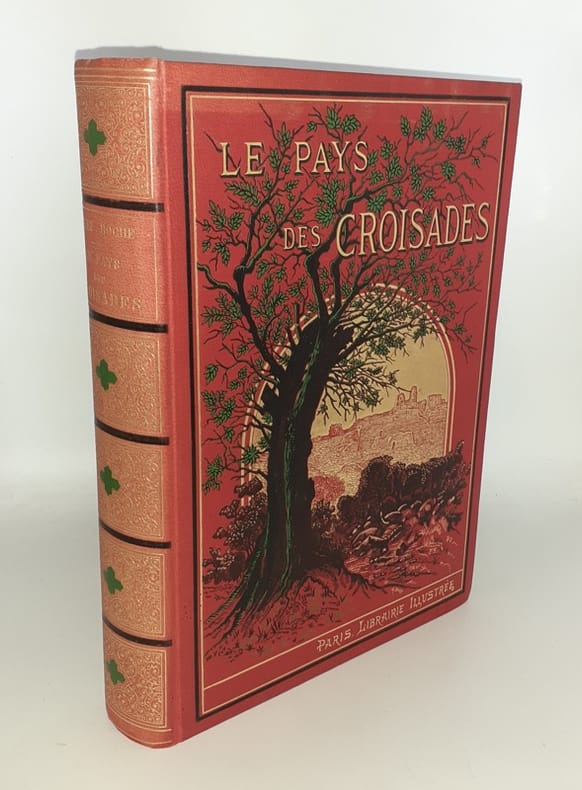
603920Paris, Librairie Illustrée, s.d. [1885]. Grd in-8, cartonnage illustré pleine-toile rouge d'éditeur, dos et plats ornés de plaques polychromes (A.Souze), tranches dorées ; 646 pp., très nb. gravures en n/b. in et h.-t., 1 carte en coul. de la Palestine.
12mo (96 x 138 mm). Engraved title-page, 1 letterpress leaf, 15 engraved plates (of which 3 are double-page-sized). In a pretty red leather wallet binding with fore-edge flap and tab. Marbled endpapers. Edges gilt. Pretty German issue of engravings showing views from Levantine journeys. The set was published by Degen between 1803 and 1809 in the "Wiener Taschenbuch". The plates were engraved after the monumental, never-completed "Voyage pittoresque de la Syrie, de la Phénicie, de la Palestine et de la Basse Égypte" by L. F. Cassas (Paris 1799, 180 plates in-folio: cf. Cohen/Ricci 204; Tobler 134). The travels during which the illustrations were made largely took place in the years 1778-87; Cassas was one of the engravers whom Choiseul-Gouffier had hired for his "Voyage Pittoresque". The plates show cities, landscapes, ancient and modern buildings in the Near East. - Binding rubbed, interior somewhat brownstained, but an attractive volume.
8vo. 2 volumes. (40), "976" [= 980] pp. (8), "855" [= 847], (1) pp. Pages progress from right to left like a normal Arabic book. With an Arabic title-page on the second page of each volume, each with the Propaganda Fide's woodcut Jesus and apostles device and each preceded (on the back of the same leaf) by a Latin half-title. Further with woodcut tail-pieces, 1 woodcut decorated initial, and tailpieces and factotums built up from cast fleurons. Set in 2 sizes of nashk Arabic type, with the 13-page dedication to Pope Pius VI and a few other preliminary pages also in Latin on the facing pages, set in roman and italic type. Early 19th-century half sheepskin parchment, sewn on recessed cords with a hollow back, hand-lettered spine titles, shell-marbled sides, brown sprinkled edges. First unabridged Arabic edition of the catechism translated from the Latin version authorized by the Council of Trent and the most extensive Arabic catechism ever published, comprising 1827 pages plus preliminaries. It follows the Roman Catholic rite and was printed and published by the Propaganda Fide in Rome. It is based on the Latin text authorized by the Council of Trent under Pope Pius V, first published in Latin in 1566. While some small Arabic catechisms of a few dozen pages had been printed as early as 1580, only a few more extensive ones had appeared, with Bellarmino's growing from 86 pages (not including the parallel Latin text) in 1613 to 411 pages in 1770 and De Beauvais and Richelieu's 1640 Paris edition comprising 415 pages. The present edition is probably the most extensive Arabic work that the Propaganda Fide ever published. Volume 1 is dated 1786 on the Latin half-title and it may have been issued without the dedication (quires *-2*) in that year, but the dedication is dated 22 December 1787 and volume 2 is dated 1787 on the half-title. The Vatican established the Propaganda Fide in 1622 to promote Catholic missionary work, especially in the Middle and Near East, and it set up its own printing office in Rome in 1626. The printing office acquired many types for exotic languages from various earlier Roman printing offices that had operated under the authority of or in close cooperation with the Vatican and also had many new types cut for them, mostly by their own in-house punchcutters. In this way they assembled what was probably the largest collection of exotic printing types in the world, most of them exclusive to their press. The press had declined in the 18th-century, but began to flourish again when the future cardinal Sefano Borgia took chage of the Propaganda Fide and Giovanni Cristoforo Amaduzzi of the press in 1770. The type used for the main text of the present catechism was cut for the Propaganda Fide, probably in-house, and first used for Tommaso Obizzino, Thesaurus Arabico-Syro-Latina, 1636. With a nineteenth-century library stamp, apparently from the Propaganda Fide's own college, in the unprinted areas on both Arabic title-pages (only partly legible, but apparently reading "Pont. Univ. de Propaganda Fide"). With occasional minor and mostly marginal foxing and an occasional quire slightly browned, but otherwise in very good condition, with only an occasional tiny hole or small marginal chip. Only slightly trimmed, preserving an occasional deckle. The most ambitious Arabic catechism produced to this date. Schnurrer 308. WorldCat (2 copies); not in Smitskamp, Philologia orientalis.
Small 8vo. 51, (1) pp. Contemporary yellow wrappers. Catholic catechism (Talim) published by the Fransciscans of Jerusalem, printed in Arabic throughout except for colophon "Reimprimatur + J. Patriarcha Hierosolymitanus". Rare; a single copy (with variant ending) recorded in library catalogues (Bayerische Staatsbibliothek, shelfmark A. or. 1771 - "gift from Jerusalem"). OCLC 163278889.
Tables only: 11 genealogical tables on 15 folding sheets. Contemporary red half morocco; marbled covers and endpapers. Slightly foxed throughout. From the library of Richard C. Hodges (his etched bookplate on front flyleaf); later in the library of Sidney Edward Bouverie-Pusey (1839-1911), only son of the agriculturist Philip Pusey (cf. DNB XLVII, 64), with his bookplate on front pastedown.
A group of 71 photographs of A Century of Progress, held in Chicago in 1933-34. They are by Kaufmann-Fabry, Official Photographers of the fair, and are so marked. The "Century of Progress International Exposition", also known as the Chicago World's Fair, was held from 1933 to 1934. The fair buildings were multi-coloured and generally had a "Moderne" design to them in contrast to the neoclassical themes used at the 1893 fair. One of the more famous aspects of the fair were the performances of fan dancer Sally Rand. Other popular exhibits were the various auto manufacturers, the Midway (filled with nightclubs such as the Old Morocco, where future stars Judy Garland, The Cook Family Singers, and The Andrews Sisters performed), and a recreation of important scenes from Chicago's history. The fair also contained exhibits that would seem shocking to modern audiences, including now-offensive portrayals of African Americans, a "Midget City" complete with "sixty Liliputians", and an exhibition of incubators containing real babies.
12mo. (10), 180 pp. With engraved additional pictorial title and small woodcut ornament to printed title; woodcut head- and tail-pieces and decorative initials. Contemporary full vellum. Extremely rare first edition of this history of gemstones, corals and pearls, with plentiful references to the Arabian Gulf ("ou Mer d'Elcatif"), and specifically to Bahrain, Al-Qatif, Muscat, and Ormus, including separate chapters on pearls, their valuation, and the process of pearl-fishing. Carter lists Chappuzeau's work, which draws strongly on Tavernier, under the "key European accounts", quoting his mention of the Gulf as a major source of pearls: "The most significant pearl fishing ground is on the coast of Arabia Felix, between the towns of Julfar and Catif" (p. 94). - Chappuzeau's "text is in two parts, the first, of six chapters, describes gemstones beginning with diamond, then those of color, pearls, coral, amber yellow stones, the metals, ambergris, bezoar, indigo and other 'rich productions' of the East and West Indies, and including salts. The second part describes the places referred to in the first part, from Abyssinia to Visapur [...] Chappuzeau provides information on places in India where diamonds are found, how they are mined, and prices demanded for diamonds and other gemstones. The method of pricing pearls is also given along with a table of values [... This chapter] is famous for its perpetuation of the story that pearls generate from dew drops falling into the gaping shells of the pearl oysters" (Sinkankas). Also includes references to mining in Peru and trade from the West Indies and Americas. - Spine somewhat dust-soiled; interior shows some browning throughout. Provenance: Contemporary ink ownership "F. Baker" (?) to title-page. Latterly removed from the Library of the Birmingham Assay Office, one of the four assay offices in the United Kingdom, with their inconspicuous library stamp to the flyleaf. Vastly rarer than the 1671 English edition: no other copy seen in the trade. Sinkankas 1251. Sabin 12010. Cioranescu (17th c.) 18639. OCLC 78250964. Carter, Sea of Pearls, pp. 94 & 106. Cf. Hoover 217; Roller/Goodman I, 222; Macclesfield 512 (for the 1671 English translation).
Latin ms. on vellum. 378 x 210 mm. Papered seal. Signed by Charles Soillot (1434-93?), secretary to Charles the Bold. Letter of "sauf conduit" (safe conduct) for the merchant and diplomat Anselm Adornes (1424-83) for a Burgundian embassy to Persia: "[...] Universis principibus baronibus militibus et plebeis quibus hec nostre littere fuerint ostense, benivolenciam nostram et salutem universitatem vestram et vestrum quemlibet. Rogamus quatenus dilectum et fidelem consiliarium, oratorem et cambellanum nostrum dominum Anselmum Adornes militem, dominum de Corthuy, harum latorem, quem ad nonnullas orientales partes impresentiarum mittimus cum penes vos venerit seu per terras et dominia vestra iter fecerit benevole recipere, amoreque nostri et contemplatione favorabiliter tractare et tractari mandare velitis eumdem unacum viginti personis et totidem equis seu aliis equitaturis aut inferius, permittendo transire sine pedagio, gabella, fundonavis, datia aut alia exactione quacunque [...]". - From March to June 1474, Adornes, Lord of Cortachy, led an embassy in the name of Charles the Bold to the Shah of Persia Uzun Hassan (1423-78), whom the Duke of Burgundy sought to persuade to engage in a new military expedition against the Ottomans, following a campaign in the previous year which had ended in Uzun Hassan's defeat by Mehmed II. Adornes was chosen for this mission due to his knowledge of Muslim territories; he had made a pilgrimage to the Holy Sepulchre in Jerusalem in 1470/71 (the account of his journey written by his son Jan is still preserved). - One of the most illustrious members of the Adornes-Adorno family, of Genoese origin, and a wealthy patron, Anselm was closely involved in international trade (mainly in alum and cloth from Tournai and England). He maintained commercial relations with Genoa as well as Spain and played an important role in Burgundian diplomacy. - Some wrinkling as common; traces of folds. Well preserved. Messager des sciences historiques ou Archives des arts et de la bibliographie de Belgique (1881), pp. 41-42. Cf. Nationaal biografisch woordenboek XII, 2/25. C. van Hoorebeeck, Livres et lectures des fonctionnaires bourguignons (Turnhout, 2014), passim.