4 751 résultats
8vo. 44 pp. Ottoman Turkish in Arabic type. Original red printed wrappers. First and only edition. - A rare copy of what likely is the only extant written record of the situation of Muslims in Brazil in the 19th century, a minority formed mostly by former African slaves and their descendants. Abdurrahman was a crew member of one of two Ottoman warships thrown off their course to Basra by a storm on the Atlantic near Cape Verde, which dragged them in the opposite direction, to Rio de Janeiro. While his companions continued their voyage to the Arabian Gulf, Abdurrahman remained in Brazil, and his account focuses entirely on his religious work there. He describes the lessons he gave and a Portuguese booklet he prepared to outline the basics of Islam, which was memorized by most of his students, and he criticizes their way of life, including their former religions, their practice of fasting in the month of Saban instead of Ramadan, and the frequent baptism of Muslim children. The book includes geographical descriptions of Brazil and Rio de Janeiro and mentions tropical fruits unfamiliar to the author, who finishes with the route he took home to Istanbul a few years later, including stops at Lisbon, Cordoba, Tangier, Mecca, and Damascus. - While it discusses the voyage to the New World only briefly, this is in fact the second of two known accounts of the first voyage ever made to the American continent by the Ottoman navy, published only three years after the other travelogue (by Faik Bey). Abdurrahman wrote his account in Arabic and had it translated into Ottoman Turkish by Antepli Mehmed Serif. - A small waqf stamp to the final page. Covers slightly faded, else very good. Several copies in libraries worldwide, mostly in the United States, but none in auction records. Özege 20671. Baysal, Osmanli türklerinin bastiklari kitaplar, 2641. OCLC 68231927. Cf. Snowden, Accidental Turks in Brazil and Beyond. Kabacali, Gezi edebiyati seçkisi (2004).
pp. 323 - 487. Illustrated with numerous folding plates, maps and photographs. Quarto. Original printed wraps, chipped. Lacks spine. Front wrap detached. HOLY LAND BOX 1
Broch?. 189 pages. Couverture tach?e.
In 8°, br. edit. ill., pp. 211,(13), con alcune ill. b.n. in fondo al vol.; prima ed., es. molto buono, solo lievemente brunito.
92 x 126 cm. Scale: 1:1,000. Whiteprint on thick paper. Title, scale and compass executed in manuscript in blue pen. Impressive plan of the excavation site of Tell Halaf (now on the Syrian-Turkish border), the location of the great ancient Aramaean town of Guzana, and one of the most important archaeological revelations of the modern era. Then in the Ottoman Empire, it was discovered in 1899 by the German diplomat Max von Oppenheim (1860-1946) while travelling through northern Mesopotamia on behalf of Deutsche Bank, working on establishing a route for the Bagdad Railway. - This is a working copy of the official, authoritative plan of the site produced during the 1911-13 excavation led by Oppenheim, printed at Tell Halaf for the use of the senior archaeological team. Signed in the upper right-hand corner by Theodor Dombart (1884-1969), a professional architect and one of Oppenheim’s principal associates, later an esteemed professor of ancient Middle Eastern architecture and an authority on Munich history. - A little worn, slight toning along old folds, else very good.
200023448Birzeit: Birzeit University. Fine. 2000. Paperback. 0897570502 . Illustrated. First edition paperback. Fine in oversized pictorial wraps. . Birzeit University paperback books
8vo. XIV, 673, (1) pp. With wood-engraved title vignette, folding map of the Middle East, 3 maps, 4 wood-engraved plates, 1 steel-engraved portrait, and numerous wood-engraved text illustrations. Contemporary half calf with giltstamped spine title. Marbled edges and endpapers. Fascinating account of the work on the submarine telegraph lines from British India to Turkish Arabia, the so-called "Persian Gulf Cable" laid in the 1860s. An extensive section is devoted to the laying of cables in the Arabian Gulf south of Persia, with a separate diagram of the diversion of the "Persian Gulf Cable" from Elphinstone Island off the northern tip of Arabia to Henjam and Jask. The telegraph lines ultimately reached from London via Munich, Vienna, Constantinople, Diarbekr, and Baghdad to Basrah, then continued by the Indian Government to Bushehr, Henjam, Gwdar and Karachi as well as to Tehran. Other cables connected Cairo with Aden and thence with Bombay. - Some brownstaining and edge flaws, otherwise an excellent copy. Inscribed "Thomas Kirk Johnson Dec. 1876 From R. B. Hull". Howgego III, G31. OCLC 1283945.
New English Paperback. Demy 8vo. (22 x 15 cm). In English. 284 p. The present book is based on a workshop held in Istanbul in November 2005 under the title "Learning about the other and teaching for tolerance in Muslim majority societies". It conveys critical analyses and innovative visions for tolerance education in school, focusing particularly on the role that religious and ethical education, social studies and history teaching can play in fostering tolerance and promoting inclusive notions of citizenship. In the book, one will find examples of how scholars and educators from Muslim majority countries (joined by two Western European scholars) see the special challenges that these societies face when trying to rethink the way in which religion, history and civics are taught in school. The chapters focus particularly on challenges and recent developments in Bosnia and Herzegovina, Egypt, Indonesia, Iran, Lebanon, Nigeria, Palestine and Turkey. Recep Kaymakcan is Associate Professor of Religious Education at the University of Sakarya, Turkey. Oddbjørn Leirvik is Professor of Interreligious Studies at the Faculty of Theology, University of Oslo, Norway.
187118759Extrait de La Revue des deux mondes | s. l. [Paris] 1871 | 15.50 x 25 cm | agrafé
8vo. 84 pp. 5 folding maps. Contemporary loose cardstock wrapper, stapled. Slightly altered version published in 1947 as "Historical Memoranda" or "Historical Survey". A rare Zionist booklet issued in Hebrew by the General Council of the Jewish Community of Palestine to the Anglo-American Committee of Inquiry. This publication was part of a series of three such pamphlets issued in 1946-47, each presenting a history of Jewish populations in Palestine and diasporic movement. Of the three, this pamphlet deals the most with the history of ancient Palestine. The folding maps illustrate waves of Jewish immigration from 640-1882 CE and identify sites of Jewish settlements in Roman, early Muslim, Crusade, Mamluk, and Ottoman periods. - Somewhat toned; maps are bright and clear. OCLC 244129609.
8vo. Ottoman Turkish manuscript, with medical terminology mostly in Arabic. 50 pp. Black (and occasional red) ink on polished paper. 19th century marbled wrappers. A traditional pharmacological essay or pharmacopoeia, as well as a description of several ailments and medical conditions (including earache, infection of the larynx, uvular edema, malaria, jaundice, and yellow fever), with their treatment indications. Interestingly, there is a specific reference to opium ("afyon" in Turkish). The anonymous scribe was very probably a physician or medical practitioner with an imperfect knowledge of Arabic, most likely a Turk. No colophon, but likely written in the early 18th century in an Arabic-speaking Eastern province of the Ottoman Empire. - Occasional stains and smudging; some corner and edge flaws throughout with chipping to wrappers.
8vo (130 x 218 mm). Arabic manuscript on paper. (375) pp., 19 lines per extensum. Written in neat black naskh, emphases picked out in red; catchwords. With numerous tables and diagrams, one in red and black. Contemporary brown leather binding with stamped ornaments. A 16th century commentary (sharh), profusely illustrated with diagrams, on Naziraddin al-Tusi's "at-Tadhkira an-Nasiriya", a general outline of astronomy, originally written in Persian. Composed by the Persian Sunni scholar Nizamaddin ibn Muhamad an-Nisapuri (d. 1328/29), who was known as a mathematician, astronomer, jurist, Qur'an exegete, and poet. His teacher Qutb al-Din al-Shirazi had himself been a student of al-Tusi's. An-Nisapuri wrote the present commentary in 711 H (1311 CE). - Binding rather rubbed. Marginal notes throughout; colophon with partial date "14 Jumada II". Scattered minor wormholes, but overall in good condition. GAL I, 511, VI, 40 b.
Small 8vo. 15 vols., uniformly bound in near-contemporary half calf with gilt spine and red spine labels. First printing of this German edition, based on a complete translation prepared by Antoine Galland (1646-1715). The so-called "Galland ms." which he had bought in 1701 is the oldest Arabic text extant (dating from 1450 or later). Maximilian Habicht (1775-1839) lived in Paris for a decade as a member of the Prussian delegation. He knew vernacular Arabic well and separately published an edition of the Arabic text of the "Nights" (cf. Fück). - Slightly browned; bookplates of the Viennese collector Rudolf Jelinek on pastedowns; collector's stamps to titles. Chauvin IV, 248. Hayn/Gotendorf V, 276. Cf. Fück 157.
Small 8vo. 6 vols., uniformly bound in contemporary brown half cloth with giltstamped spine titles. Still early printing of this revised edition of Habicht's German translation, based on a complete French translation prepared by Antoine Galland (1646-1715) and expanded by Gauttier. The manuscript which Galland had bought in 1701 is the oldest Arabic text extant (dating from 1450 or later). The German editor Maximilian Habicht (1775-1839) lived in Paris for a decade as a member of the Prussian delegation. He knew vernacular Arabic well and separately published an edition of the Arabic text of the "Nights" (cf. Fück). - Slight browning. Volumes 1 and 2 have old colour vignettes applied to the half-titles; pencil ownership of Marianne Alschech to second volume, otherwise fine. Hayn/Gotendorf V, 276. Chauvin IV, 249 (note). Cf. Fück 157.
8vo (160 x 252 mm). Arabic manuscript on polished oriental paper. 12 pp. on 7 ff., ca. 18 lines, per extensum. Black ink with red emphases. With numerous red and black ink diagrams in the text. Contemporary blindstamped full calf, restored and spine rebacked. The "Tashrih al-aflak", known as "general outline of astronomy" or "anatomy of the celestial spheres", is a summary of theoretical astronomy. The philosopher, architect, mathematician, astronomer and poet Baha' al-Din (953-1030 H / 1547-1621), a native of Baalbek, relocated to Iran with his father. Having completed his studies, he is said to have travelled for 30 years before settling in Isfahan, where he was highly respected as Sheikh al-Islam at the court of Shah Abbas. In the present treatise he affirmed a view in support of the positional rotation of the Earth. Baha' al-Din was one of the first Islamic astronomers to advocate the feasibility of the Earth's rotation in the 16th century, independent of Western influences. - Noticeable duststaining throughout; edges remargined. The restored binding uses the stamped original cover material. GAL II, 415, 6.
Fine English Tasavvuf tarihi., Prof. Dr. Cavit Sunar. Paperback. Pbo. Fine. Roy. 8vo. (24 x 17 cm). In Turkish. [vii], 228 p. A study on history of tasavvuf (Islamic mysticism).
4to (146 x 211 mm). Ottoman Turkish manuscript. 284 ff. of polished laid paper. Black naskh with occasional red; 19 lines within red rules; gilt and illuminated sarlowh on first text page. Signed by the scribe Darwish 'Ali. Early 19th century English binding with blind-tooled spine and fore-edge flap in the oriental style. A complete 18th century manuscript of what is famously the first Ottoman history of America. Composed by an unidentified Turkish author in the 1580s, the work is also known as "Tarikh-i Hind-i gharbi" ("History of the West Indies") and "Hadis-i nev". It enjoyed great popularity throughout the 16th and 17th centuries and was printed by Ibrahim Müteferrika in 1730, making it the earliest book about the New World published in the Ottoman Empire. This text appears to be the principal source of information about the Americas circulating in the Ottoman Empire from the 16th to the 18th century. - Binding somewhat rubbed at extremeties; interior well preserved with wide margins. Provenance: from the library of Frederick North, Earl of Guilford (1766-1827), first British Governor of Ceylon, Philhellene and founder of the first university in modern Greece (his engraved bookplate on the front pastedown); annotated on the flyleaf: "A history of the new world, or America & the W. Indies, written in 1184 A.H.". Old French catalogue entry, clipped and mounted on lower pastedown. The son of Lord North, Prime Minister under George III, Frederick North had travelled widely throughout the Mediterranean, visiting not only Greece and Italy, but also Constantinople and the Ottoman Empire, including Syria, Palestine, and Egypt. He gifted his large personal collection of printed books and manuscripts to the Library of the university he created in Corfu. Counter to his wishes, after his death the books were transferred to his heir, George Holroyd, 2nd Earl of Sheffield (1802-76), who had the collection auctioned in London in seven sales held between 1828 and 1835; a substantial part was acquired by the British Museum and still rests in the British Library. - An important text, in a copy with important provenance. Cf. T. D. Goodrich, The Ottoman Turks and the New World (Wiesbaden 1990). The same, "Tarihi-i Hind-i Garbi: An Ottoman Book on the New World," in: Journal of the American Oriental Society 107.2 (April-June 1987), p. 317.
4to (165 x 125 mm). (6), 129 ff. Early 19th century half calf with floral moirée paper covers. Yellow paper pastedowns. The sixth book printed by Ibrahim Müteferrika: an important eyewitness account of the life of Tamerlane (Timur), the successful and barbaric 14th-century Turkish conqueror. Translated into in Ottoman Turkish by Nazemi Zadeh from the original Arabic manuscript completed in 1437/38 by the Syrian author Ahmad lbn 'Arabshah (1392-1450), secretary to Sultan Ahmad of Baghdad. - Binding a little rubbed at extremeties. Occasional browning, depending on paper stock, but mostly a very good, clean copy on crisp paper. Özege 19929. GAL S II, p. 25. Ebert 292 (note). Brunet I, 117 (note). Toderini III, p. 75, no. V.
4to (152 x 220 mm). 2 (instead of 7), 97 ff. (last two leaves mutilated; plus a fragment of the 5th leaf of prelims). Contemporary calf binding; papered spine with typed leather spine label; some loss to lower cover. The third book printed by Ibrahim Müteferrika: a contemporary history of the Afghan-Persian wars of the Safavid era that led to the fall of the Safavid dynasty and the Afghan occupation of Iran. This is the Ottoman Turkish translation of a work by the Polish Jesuit Judasz Tadeus Krusinski, who lived in the royal capital of Isfahan from 1707 to 1725/28, acting as an intermediary between the Papacy and the Iranian court as well as a court translator. Proficient in Persian and well acquainted with the nation and its people, he was a first-hand witness to the sack of the city by the rebellious Afghans in 1722, and his account makes him an important primary source on this particular period of the Safavid era. - Browned, fingerstained and waterstained throughout, several waqf marks; various edge tears and small chips. Lacks the first five leaves of the preliminaries (save for a fragment of the fifth); loss to upper edge of f. 33 (first line) and ff. 96-97 (several lines at the bottom of the page). Zenker 929. Özege 19897. De Backer/Sommervogel IV, 1264. Brunet III, 190. Ebert 4844 (note). Toderini III, p. 34, no. III.
4to (170 x 214 mm). (4), 65, 51 ff. Early 19th century half calf with marbled covers and fore-edge flap. Pink paper pastedowns. The seventh book printed by Ibrahim Müteferrika: a history of Egypt from antiquity to early modern times, prepared by the Turkish scholar Ahmed Süheylî (1562?-1632). The modern section (bound first, as usual) is in fact an Ottoman Turkish translation of the chronicle of the Ottoman-Mamluk war of 1516/17, "Fath Misr" (Tarikh as-sultan Selim al-Utmani ma'a as-sultan Qansuh al-Ghawri) by Ibn Zunbul (d. 1574/75). - Handwritten ownership of the French diplomat Louis Lagarde (dated 1923 CE) to front flyleaf. Occasional light browning and fingerstains, but mostly an excellent copy on good, crisp paper. Özege 19868-19869. GAL S II, p. 409. Toderini III, p. 85, no. VI.
4to (161 x 212 mm). (3), 91 ff. With 13 woodcut hand-coloured illustrations in the text (lacking the 4 double-page engraved plates). Contemporary half calf binding with marbled covers and fore-edge flap. Rare first edition of this illustrated history of the New World in Ottoman Turkish: the first book published in Turkey to contain illustrations, the earliest book about the New World published in the Ottoman Empire, and one of the first titles printed by a Muslim in Turkey. The contemporary colouring of the woodcuts, which depict curious oddities, fantastic creatures and the native people of the New World, lends this specimen a visual appearance very different from that of the rather plain copies in which this book is usually known (14 copies recorded by OCLC). The only similarly embellished copy of the Hind al-Gharbi we could trace is the one held by the Lilly Library. - "Although ascribed in Turkish bibliographies to one Mehmed Ibn Hasan üs-Su'udi, the authorship is uncertain [...] Despite the title, this is not a history of the West Indies. It opens with a general geographical and cosmological discussion, and follows with an account of the discovery of the New World, with considerable fantastic elaboration in the spirit of the more fabulous passages of Abu Hamid and Qazwini. Among the illustrations are depictions of trees whose fruits are in human form, long-snouted horses, mermen at battle with land-dwellers, and other men and beasts of nightmarish aspect" (Watson). - This work, which survives in a number of manuscripts (none as complete as this printed edition), was composed in Istanbul around 1580. After a synthesis of Islamic geographical and cosmographical writings (notably drawing from al-Mas'udi, who is the most frequently cited source, and Ibn al-Wardi, mentioned almost 20 times), the book relates the discovery of the New World. It is this Chapter 3, which comprises the final two thirds of the text, in which the unidentified author describes the explorations and discoveries by Columbus, Balboa, Magellan, Cortés and Pizarro. As Goodrich's study of the book's sources shows, this section is derived directly from Italian editions of 16th century texts, particularly works by López de Gómara, Peter Martyr, Agustín de Zárate, and Oviedo, which the author excerpted, rearranged, and translated into Turkish. Complete copies are rare: the book was printed in an edition of only 500 copies, many of which were subsequently defaced or destroyed for contravening the Islamic dictum against representing living things. - The "Tarikh-i Hind-i gharbi" is only the fourth book printed in the Arabic alphabet in the Ottoman Empire, produced by Ibraham Müteferrika, an Hungarian convert to Islam who believed he could help arrest the decline of the Empire through his printing press. He established his shop in 1729 in the palace of the Grand Vizier Ibrahim Pasha and was granted a license to print all but religious works (which remained the province of scribes). - A few corners or edges clipped or trimmed, remargined by an early collector. Lacks the engraved maps and astronomical chart present in some copies. Old inscription in Arabic (dated 1341 H) and ownership of the French diplomat Louis Lagarde (dated 1923 CE) to front flyleaf. John Carter Brown 463. Toderini III, p. 41, no. IV. Karatay 250. Sabin 94396. William J. Watson, "Ibrahim Müteferrika and Turkish Incunabula," in: Journal of the American Oriental Society 88, no. 3 (1968), pp. 435-441, no. 4. Özege 19828. OCLC 416474553. Cf. T. D. Goodrich, The Ottoman Turks and the New World (Wiesbaden 1990).
8vo. (2), 6, 591, (1), 31, (1) pp. Contemporary red half morocco over marbled boards with giltstamped spine title. Rare Beirut-printed edition of this 13th century world chronicle by the great Syrian theologian Bar-Hebraeus (Abulfaragus, 1226-86), first edited by Edward Pococke in 1663. Bar-Hebraeus focuses on the Middle East and the reigning Muslim dynasties as well as on the East and West Syrian Christian churches, covering extensively the rise and spread of Islam and relations between the Christian and Islamic worlds. His account of the destruction of the Alexandrian Library, placing it at the time of the Islamic conquest of the city in 642 and claiming that the books were used as fuel for the ovens in the bath houses (!), contradicts most sources, which place the destruction much earlier. Even for the early periods, Bar Hebraeus makes use of sources that have since been lost, but his most original contribution remains what was in his day recent history. - Bar-Hebraeus, born in what is now Turkey, became Bishop of Gubos in the Syriac Orthodox Church in 1246 and worked in Aleppo from 1252. He wrote the present work in ancient Syriac but translated it into Arabic himself. As Pococke's 1663 publication (with a Latin translation) was the classic edition of the Early Modern period, the present edition is the received modern one. - Binding somewhat rubbed at extremeties. Light browning and brownstaining throughout, but in all a good, tight copy. OCLC 31907278.
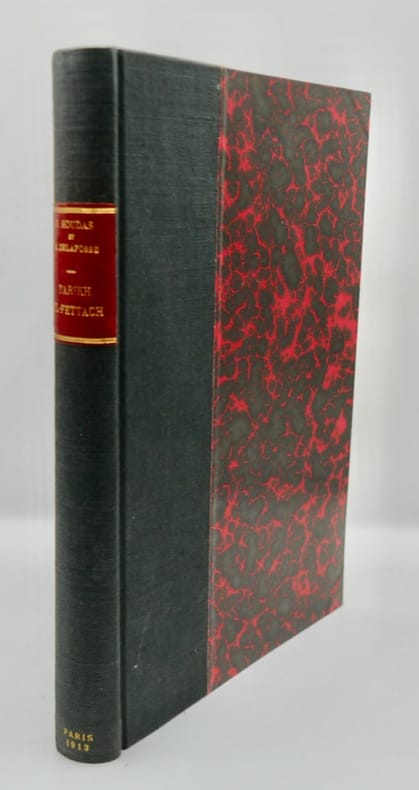
567775Paris, Ernest Leroux, éditeur 1913. Grand in-8, bradel, demi-toile noire, pièce de titre en basane rouge bordé d'un double filet doré, millésimé en queue du dos, plats granités, gardes marbrées, couverture et dos conservés, reliure moderne, XX-361pp, [2]ff., carte h.-t. (Documents arabes, relatifs à l'Histoire du Soudan). Édition originale de la traduction française. (Publications de l'école des Langues Orientales)
8vo. (12), 200 ff. Title with architectural woodcut border. 17th century vellum with ms. title to spine. An early merchants' guide to the measurements of the Mediterranean and Near East, this pocketbook for sixteenth-century Italian traders is one of the foremost sources for the study of the metrologies of Venice and her trading partners in the early sixteenth century. It enabled conversion between Venetian currency, weights and measures and units of other Italian city-states, European neighbours and more exotic locations in the Levant, North Africa, the Near and Middle East, including Constantinople, Aleppo, Tripoli, Damascus, Cyprus, Corfu, Rhodes, and Crete. Pasi's manual is invaluable as a record of the panoply of commodities traded in the Mediterranean at the beginning of the sixteenth century, including pearls, silks, wool, saffron, chestnuts, figs, galangal, vegetable oils, gold and silver. On fols. 3, 11, and 12, Pasi recorded the tariffs on pearls in Damascus, Aleppo, Cairo, Alexandria, Constantinople and Venice. It is very likely that the famous merchant Balbi carried a copy of this classic with him on his travels. First printed in Venice in 1503, and again in 1521, this 1540 edition appears to be the third and was followed by another in 1557. -- Some brownstaining to preliminary matter; a few contemporary ink marginalia slightly trimmed in the course of the 17th-century rebinding. On the whole an excellent clean copy. Very rare: the only copy of any edition to surface at auction within the last thirty years appears to be the Honeyman copy of the 1503 edition. Kress 51. Adams P 374. Smith, Rara Arithmetica, 79. Cf. Goldsmiths' 7 (1503 edition). R. A. Donkin, Beyond price. Pearls and pearl fishing: origins to the age of discoveries (Philadelphia, 1998), p. 138.
4to. 231, (1) pp. With a few woodcuts in the text. Contemp. full calf, leading edges and spine sumptuously gilt. All edges red. First edition; very rare. The best known, and most controversial, of Schickard's works: a treatise, with a lengthy introduction, about various Persian ruling dynasties, especially the Sasanians - editing a total of six out of seventeen genealogical charts found on a 45-foot Turkish manuscript scroll. The genealogies aimed to legitimise the Ottoman dynasty by tracing it back to Adam. Schickard (1592-1635) was one of the most learned men of his age, astronomer, professor of Hebrew, mathematician and orientalist. The scroll was brought to Germany by Veit Marchtaler of Ulm, who found it in a mosque during the sack of Fillek (Fülek) in Hungary. Marchtaler wished that the manuscript might not be simply forgotten, consulted in vain with various dragomans (whose versions he did not trust), and finally came across Schickard, who, though he had no Turkish or Persian, knew Arabic and immediately grasped the significance of the scroll. His detailed commentary quotes from various Hebrew and Arabic writings, including several extracts from the Qur'an: sura 21 (p. 60), 38 (p. 53 & 61), 27 (p. 77), 2 (p. 97), and 4 & 5 (p. 97-100). The translation is offered as a gift to the Emperor Ferdinand II until such time as the "autographum ipsum" be lodged in the imperial library. "Schickard was also the designer of Arabic type, which he engraved himself as copper matrices; they were cast by Theodoricus Werlin, and served to illustrate his 'Tarich'" (Smitskamp). - Browned throughout due to paper (as common); trimmed rather closely; final 2 leaves cropped at outer margin with loss of letters. One of three variants, this one without the 20-page appendix (corresponding with the copy in the Bodleian Library, Oxford). Provenance: "Nathan Wright of Englefield", Berkshire (cropped signature at head of title), probably Sir Nathan Wright (1654-1721), lawyer, appointed Lord Keeper in 1700 (cf. ODNB). Later in the collection of the Earls of Macclesfield (North Library at Shirburn Castle; 1860 bookplate, shelfmark 57.B.1). VD 17, 14:646680U. Wilson 203. ADB XX, 300. Smitskamp, PO 132e (note). OCLC 13604133.