Röhm, Hans, painter (1877-1956).MareMagnum

4 751 résultats
Small 8vo (143 x 110 mm). 32 ff. of sketches in coloured chalk pastels and charcoal on bluish-grey laid paper. Contemp. half cloth. Contains 19 pp. of sketches showing the Keferloh horse market (some dated September 14), the others mostly showing landscape views from the environs of Munich (captioned Herrsching, Großhesselohe, Grünwald, Solln, Karlsfeld, Allach etc.). Inside front cover has Röhm's autograph name and address in pencil. - The painter, etcher, and lithographer Röhm studied at Nuremberg and the Munich Academy (1898-1902) with Wilhelm von Diez war. In 1927 he became professor in Munich (cf. Thieme/Becker and Nürnberger Künstlerlexikon). - The Keferloh horse market (known as "Keferloher Montag") was the largest of its kind in the German Reich until the Second World War. - Binding somewhat stained and rubbed; interior very well preserved.
Folio (54.5 x 38 cm). Six tinted lithographs by Day & Haghe after "R.F.R.". Original drab wrappers. First edition in original wrappers. The large tinted lithographs show "walking", "ambling", "trotting", "cantering", "galloping", and "leaping". - Light spotting in the margins, one plate with a short tear in the margin. Spine worn, some soiling to wrappers.
2002377282002. Hardcover. Good. Hardcover/pub.2002/Gd.condition/445 pages - June 1967 and the making of the modern Middle East. HA337728 hardcover
116 pp. Original wrappers. 8vo. Treatise on the history of the Egyptian Communist party (Al-Hizb as-Suyu i al-Misri) and other communist organizations in Egypt from 1920 to 1979. As early as October 1920, merely three years after the Bolshevist October Revolution, the Egyptian Socialist Party constituted itself as the true representative of the Egyptian working class. The following year, the Party sent Hosni al-Arabi to Moscow to negotiate a possible reception into the Communist International, and in 1922, the name of the party was officially changed to "Egyptian Communist Party". After several splits, re-formations, and dissolvements, the Party was newly founded in 1975 after Anwar as-Sadat lifted the ban on the movement. - Well-preserved. OCLC 246522674.
8vo. 181, (3) pp., final blank f. With 20 engraved plates in original hand colour. Contemporary boards. First edition, issued in ten separate instalments. An entire chapter is dedicated to the Wahhabi Bedouin Arabs, their customs and costumes. The charming engravings in vibrant original hand colour are based on Castellan's 1812 "Moeurs", each plate containing several meticulous costume illustrations. - Spine sunned. Contemporary ownership "S. M. Mayer zu Klagenfurt" on title page; additional (partly deleted) ownership on flyleaf. Very clean altogether. Rare. Formerly in the Ottoman collection of the Swiss industrialist Herry W. Schaefer. Atabey 1333. OCLC 255511974. Not in Lipperheide, Colas, or Hiler.
150 pagine; 24 cm. Brossura editoriale. Ottimo
In-4°, pp. 11, (3b) con 2 cartine geogr.. Fasc. ed. a graffe.
Folio (250 x 350 mm). 16 pp. Original printed blue wrappers (edge brittle; broken at spine). Rare issue of this Ottoman journal devoted to the discussion of matters theological ("Religion and Knowledge") and political ("The Islamic World"). This issue, published just after the completion of the famous Hejaz Railway from Damascus to the Holy City of Medina, contains an article entitled "Open Letter to the Governor of Hejaz" ("Hicaz Vali Vekili'ne Acik Mektub / Hicaz Valisi Beyefendi'ye Acik Mektub", pp. 122f.) by Hüseyin Vassaf. In this article, the author makes bold suggestions to the Government of Hejaz for the administration of the next Hajj and recommends that the railway be maintained with care for the comfort of the prilgrims' travel: "We expect much from you. Avoid persecuting the people, as did some of your predecessors. Treat the pilgrims well and spare them the difficulties they are subjected to every year. Protect them from the bandits. Improve accommodation and transportation. Prepare waterways for pilgrims and build sufficent toilets. Even if they are poor, take good care of them. Instil in them a love for our state. Start preparing for this year's Hajj directly. Improve the living conditions of the people in the region. Reform the madrasas and schools. Fulfill all the requirements of the railways [...]". - A rare survival. OCLC 6333040.
Large octavo in pictorial pale blue wraps; 174 p. : ill. ; 24 cm. Arabic. Fikr siyasi =; Politics. Diplomats -- Iraq -- Biography. `Abd al-Wahhab, `Ata. Iraq -- Politics and government -- 2003- Political biography, Baghdad - Amman (2003-2006)
New English Paperback. Demy 8vo. (21 x 14 cm). In English and Turkish. 236 p., 1 b/w portrait of Redhouse frontispiece, b/w ills. Sir James W. Redhouse: The making of a perfect orientalist? = Sir James W. Redhouse: Mükemmel bir dogubilimcinin öyküsü? (American Board Library Occasional Publications No: 1). First published in the Journal of the American Oriental Society in 1979, and now revised and updated, Carter Findley's "The Making of a Perfect Orientalist?" is a scrupulously researched biography of the enigmatic nineteenth-century Turkish language scholar James W. Redhouse. Primarily embodied in two major dictionaries-A Lexicon, English and Turkish (1861) and A Turkish and English Lexicon (1890)-Redhouse's work established a crucial base for the further development of English-Turkish lexicography. Unparalleled at the time, his contributions remain vital today, forming the core of a number of bilingual English-Turkish dictionaries which still bear the Redhouse name. A brief overview of the press that published Redhouse's lexicons, as well as the reminiscences of two editors who helped revise them in the twentieth century, round out this provocative study of the life of James Redhouse.
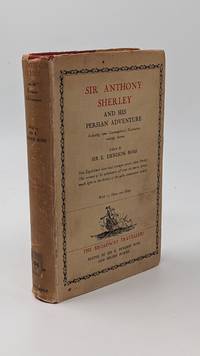
193321078London: George Routledge & Sons Ltd. 1933. Hardcover. Very Good in Very Good- dust jacket. Boards with light rubbing to extremities. DJ browned and with light chipping. ; "Few Englishmen have had stranger careers than Sherley. This account of his adventures all over the world throws much light on the history of the early seventeenth century." With 10 illustrations and maps. Chapters include: Early Adventures. The Journey into Persia. As Persian Ambassador. Without Employment. The Mission to Morocco. In the service of Spain. ; The Broadway Travellers; 8vo 8" - 9" tall; xxxviii 293 pages . George Routledge & Sons, Ltd hardcover
Engraved map, outline coloured. 730 x 260 mm. An antique map of the upper portion of the Red Sea, referred to on the map as the Sea of Arabia, stretching from the western Gulf of Aden to central Eritrea. This region, one of the most important shipping lanes in the world, also includes parts of the modern-day nations of Yemen, Djibouti, and Somalia. The work was originally included in Karl Müller's "Geographi Graeci minores", along with many other maps of the region. - The map is highly detailed, showing many settlements, mountains, wadis, and more. Most interestingly, Müller provides Ptolemaic coordinates for some of these features, and the map credits Agatharchides, Arthemidorus, Pliny, and Ptolemy as its sources. Place names given range from Arabic to Greek. Seven inset maps are provided, including one showing the full Red Sea. The map also includes a view of the "Pic de Bab-El-Mandeb" (the "gate of tears"), a mountain which lies above the straits at the entrance to the Red Sea.
8vo. 244 pp. With a colour frontispiece and 9 colour plates, all drawn after Hornby's original watercolour sketches. Contemporary giltstamped full cloth, spine and front edge repaired with green cloth in the 1990s, with 2 giltstamped spine labels taken over form the original spine. First edition. - Intriguing account by a woman traveller visiting the Sinai Peninsula in 1899 and Petra in 1901, her stops including Gaza, Jaffa, Jericho, Jerusalem, Port Said, and Suez. Hornby, who was not only a pioneer among woman travellers but also an ambitious mountaineer, created lovely watercolour sketches of her impressions during the journey, some of which are printed here. They show her tent in Ayn Musa, palm trees in Wady Ghurundel, Mount Serbal, Ras Sufsafeh, St. Catherine's monastery in Sinai, the Urn Tombs of Petra, the Siq passage leading up to the Al-Kazneh, Ad Deir, and Mount Hor from Bidebda. - Browned throughout with some foxing, more pronounced among first and last leaves. Bookplate of Peter Ward (d. 2004) of Purlieu in Upper Colwall, former intelligence officer in the Middle East and North Africa and fluent speaker of Arabic, to front pastedown; flyleaf shows remains of an earlier, removed bookplate and a pencil note regarding repairs to the book done in 1995. - No copy in auction records. A rare example of Arabian travel literature from the early 20th century featuring a female protagonist. OCLC 560058182.
8vo (150 x 214 mm). (2), LVIII, 560 pp. With 7 folding chromolithographed maps (one bound as a frontispiece) and 5 woodcut maps and plans in the text (some in colour). Early 20th century library cloth with title lettered to spine in gilt. Fifth edition. Stanley (1815-81) was a progressive Anglican priest and ecclesiastical historian who would go on to serve as Dean of Westminster from 1864 until his death. - "Stanley was able to make an extended tour of Egypt and the Holy Land in 1852 and 1853. Starting from Cairo he and his companions sailed up the Nile, which he found intolerably dull, but the great granite statues of Rameses and two other pharaohs at Thebes impressed him. They went as far south as Abu Simbel, but turned back to Cairo, climbed the pyramids, and then set out on camels for the Sinai peninsula, at that time visited only by the most intrepid of European travellers. In the monastery of St Catherine at the foot of Mount Sinai they found the great German scholar Tischendorf, who on a previous visit had discovered there an important biblical manuscript, the Codex Sinaiticus. After moving on to the Gulf of 'Aqabah, they turned up the defile that led to Petra, which Stanley pronounced to be a city not of bright colours, but of dull crimson, indigo, yellow, and purple. They reached Jerusalem on Easter eve 1853, from where they made expeditions to Nazareth, Damascus, Jericho, and the Dead Sea. The tour led to the publication of 'Sinai and Palestine' in March 1856, Stanley's powers of observation and description, together with the unfamiliarity of the places that he had visited, making the book an instant success. It reached a fourth edition within a year, and as late as 1881 was still being reprinted" (ODNB). - Occasional slight browning, but very well preserved in a later library binding. OCLC 3044873. Cf. Ibrahim-Hilmy II, 257. Not in Gay.
8vo. (4), 135, (3) pp. With 3 folding tables and 1 engraved plate. Later blue wrappers. Only edition of this introduction to Arabic, written by the Comte de Volney (1757-1820) as history professor at the newly-founded École normale, immediately after the end of the Terreur and his release from prison following the fall of Robespierre. In spite of its wide-ranging title, the book comprises essentially an Arabic grammar and a collection of Arabic proverbs; the long introductory chapter has been hailed a model of style. Volney had learned Arabic in 1782 in preparation of a long journey through Egypt and Syria. The work displays his ingenious method of simplifying the study of Arabic, Persian and Turkish by transliterating the alphabets into European characters. The tables give the Arabic alphabet, the conjugation of regular verbs, and instructions on how to write Arabic letters by hand, as well as the Arabic alphabet in European characters intended for merchants travelling to Asia and Africa. With a section of Arabian proverbs included as samples. - Pages 30-31 unopened. A good copy of this important work, untrimmed as issued. Gay 3429. Brunet V, 1351. Cioranescu 663767. Monglond III, 481. OCLC 21978700.
8vo. (2), 135, (3) pp. With 3 folding tables and 1 engraved plate. Contemporary wrappers with printed spine-label. Only edition of this introduction to Arabic, written by the Comte de Volney (1757-1820) as history professor at the newly-founded École normale, immediately after the end of the Terreur and his release from prison following the fall of Robespierre. In spite of its wide-ranging title, the book comprises essentially an Arabic grammar and a collection of Arabic proverbs; the long introductory chapter has been hailed a model of style. Volney had learned Arabic in 1782 in preparation of a long journey through Egypt and Syria. The work displays his ingenious method of simplifying the study of Arabic, Persian and Turkish by transliterating the alphabets into European characters. The tables give the Arabic alphabet, the conjugation of regular verbs, and instructions on how to write Arabic letters by hand, as well as the Arabic alphabet in European characters intended for merchants travelling to Asia and Africa. With a section of Arabian proverbs included as samples. - Untrimmed in the original grey temporary wrappers as issued; a few pages uncut. A good copy of this important work. Provenance: from the collection of the psychoanalyst and bibliophile Jacques Lacan (1901-81). Gay 3429. Brunet V, 1351. Cioranescu 663767. Monglond III, 481. OCLC 21978700.
80 x 27 cm. Ink and gold dust on paper. With large Tughra. Concerns an order of horses. The document was given to a British sailor whose family preserved it until recently.
Ink on paper. With large gilt Tughra. Ca. 55 x 28 cm. In original, addressed envelope. Pretty Ottoman document from the last months before the beginning of the Balkan Wars, concerning an arms factors. Includes the rare envelope. - Berat certificates were official documents presented as appointments for office, exemption certificates from a tax or duty, or accompanying the award of a medal or other honour. This example is meticulously calligraphed in black and gold ink.
33 x 44 cm (neat line). Pencil on paper. Charming dressage scene between an Arab in back view and two bridled Arabian horses with luxurious saddles and a backdrop of tents. The stallion on the left is carrying a round shield and a bow. The signing artist Charles Paris was probably an amateur and is not otherwise known. - Professionally restored. The upper and right margins show traces of tears and brittleness, probably due to old water damage. Browning and minor foxing overall. Some light spotting to the lower margin. The drawing is little affected by the paper flaws.
533203Paris, Paul Geuthner, 1943. In-4 br., XIX, 281 p., 22 planches d'illustr. photogr. et figures en noir montrant un grand nombre de sceaux. Index onomastique.
4to. 188 [i.e. 192] pp. Title printed in red and black. Modern moirée boards. First edition of "the first Sanskrit grammar to be published in Europe" (Smitskamp), produced by the Propaganda Press. The Sanskrit words are printed in Malayalam characters. With excerpts from the Bhagavad Gita ("Textus originalis libri Bhagavadam", 171-186). Paulinus à S. Bartholomaeo (J. P. Wesdin or Werdin, 1748-1806), a Discalced Carmelite from Lower Austria but active in India between 1776 and 1789, was "one of the inaugurators of Indian studies in the 18th century" (ibid.). "His many scholarly works earned him a reputation as an outstanding orientalist" (cf. Streit). "Ces différents ouvrages du P. Paulin étant recherchés, ont quelquefois été payés assez cher dans les ventes" (Brunet). - Slightly browned throughout with occasional professional repairs. A good copy in a modern, somewhat uncommonly coloured binding. Smitskamp, PO 214a (note). Vater/Jülg 332. Brunet IV, 446. Streit VI, 188. Zenker 2832. Wurzbach I, 170. OCLC 17209846.
195831671958 in-8, (26ff.), 110pp., nombreuses ill., br. Shiraz Musavi 1958,
8vo. XI, (1), 233, (1) pp. With a lithogr. frontispiece in original hand colour. Contemporary auburn calf with giltstamped rules to boards; leading edges gilt; spine rebacked. All edges gilt. First edition of this account of a Middle Eastern civil servant's visit to Britain in 1765, translated from the original Persian manuscript by James Edward Alexander. Born in India, Itesa Modeen learned Persian and entered the service of the British. When Shah Alam wanted to send letters and gifts to King George III in England it was decided that these would be taken by a British army officer, accompanied by Modeen as his translator and secretary. Modeen wrote a record of his journey recording the sights he saw and the excited reactions of Londoners to the unusual sight of a high class "Hindoostanee" (as he called himself) visitor. It was not until some 60 years later that his manuscript account was translated and published. The Mirza spent about almost three years on his trip to Europe, staying mostly in London but also visiting Scotland and Oxford, before returning to his native India. - Insignificant foxing to title and final leaf. From the library of Sir Richard Strachey (1817-1908), the Indian administrator and father of Lytton Strachey (his engr. armorial bookplate to pastedown); later in the collection of Christopher Jower (bookplate to flyleaf). OCLC 8868736.
2 stereoscopic images, c. 80 x 80 mm each, mounted on cardboard (177 x 88 mm) with printed captions. The portrait shows the seventy-odd-year-old Sheikh, wearing numerous medals on his burnous, before a door. Significantly superior specimen compared to the only other known set, that in the Keystone-Mast Collection of stereoscopic views in the California Museum of Photography.
4to. XIX pp., one blank page, 485, (1) pp. With photographic frontispiece, 46 photographic plates (1 of which double-page), 1 folding map of southern Arabia, and several photographic illustrations in the text. Publisher's full cloth with giltstamped title and ornament to spine. First edition. Travel account by the first European to cross the Rub' al-Khali (Empty Quarter) of Arabia from east to west, the Arabist, explorer, writer, and British colonial office intelligence officer St. John Philby (1885-1960), also known by his Arabian name "Sheikh Abdullah". Educated at Trinity College, Cambridge, he studied oriental languages and was a friend and classmate of Jawaharlal Nehru, later prime Minister of India. Philby settled in Jeddah and became famous as an international writer and explorer. He personally mapped on camelback what is now the Saudi-Yemeni border on the Rub' al Khali; in 1932, while searching for the lost city of Ubar, he was the first Westerner to visit and describe the Wabar craters. At this time, Philby also became Ibn Saud's chief adviser in dealing with the British Empire and Western powers. He converted to Islam in 1930. The personal contacts between the United States and Saudi Arabia were largely channeled through the person of Philby. - From the collection of the Dutch traveller and collector Ruud Verkerk. With 2 inserted colour photographs mounted on the plates facing p. 314 and 318, showing Verkerk standing beside rock inscriptions on the old fort at 'Uqla - south face, as well as standing before the Rock fort of 'Uqla, both dated in pencil 18 December 1997. Light damage to head of spine. Paper occasionally foxed and a slightly creased. Overall a good copy. Macro 1801. OCLC 4836861.