THÉVENOT (Jean).Livre Rare Book
1 365 résultats
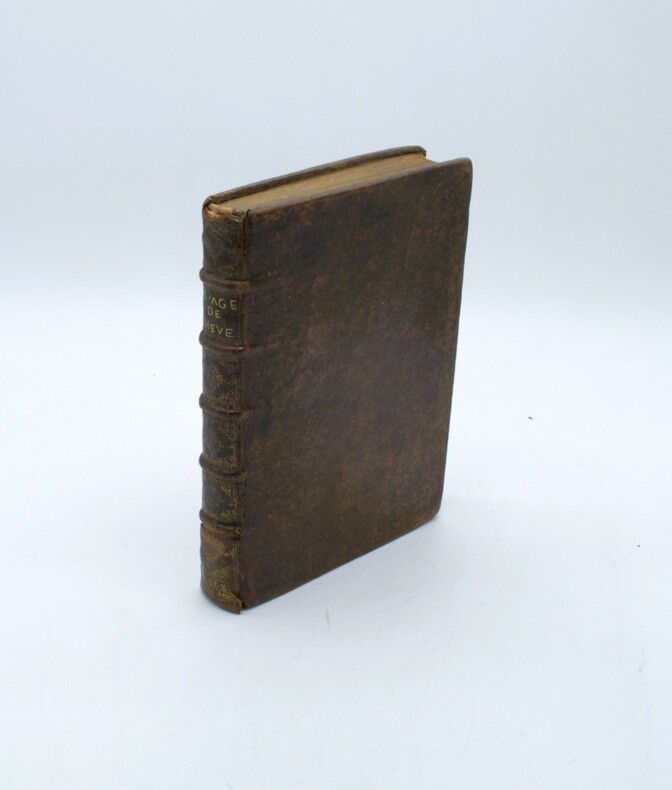
1664PHO-1635Paris, Claude Barbin, 1664. In-4, relié plein veau marbré époque, dos à nerfs orné avec titre, une coiffe manque et accroc à la coiffe en pied, le frontispice manque, réparation au dernier caisson, tache d’encre pages 86-91, quelques feuillets brunis.
11514LONDON Hutchinson & Co., no date (circa 1935): in8 toile bleue ed.FIRST EDITION/48th.Thousand 21.2 x 13.5cm, 317pp, frontis + 30 b&w photos, map,good
34 pages. Plus photographic plates and a large fold-out colour map, measuring approximately 16 x 21 inches (40 x 53cm). Original condition with blue wrappers, titles to front, and containing all the ads. This is a complete issue, seldom found in such good and original condition. This is a fascinating expedition report on the author's explorations in Arabia, which Predate his All-Important Book - Arabia Felix; Across the Empty Quarter of Arabia, published in 1931. Accompanied by a vivid and descriptive map, this narrative is an outstanding early report into the harsh savage regions of Arabia. Thomas undertook the exploration of the magnificent Rub' Al Khali in three journeys. The first camel journey of 600 miles through the south-eastern borderlands was made in the winter of 1927-1928, the second, travelling nortwards 200 miles from the central south to the edge of the sands, were undertaken under his own initiative, a part of his plan to explore the unkown south and also as a preliminary reconnaissance for a final desert crossing. The realization of that journey is the subject of this report. In order to make the journeys, Thomas grew a beard, donned Arab clothing, and lived as one of the Badus themselves. On completion of his second journey he entered into a secret arrangement, sealed with only 20 Pounds Sterling, with a member of his party, an influential member of the Rashid tribe, to bring him in the following winter, by caravan to a point in the desert where occasionally Murra tribesmen would come from the north, and that from there he would make his way by being passed from tribe to tribe! The author's captivating story of his third and successful pioneering exploration, includes notes on the tribes, geography, and extensive appendices on the natural history collections. The writer of this book was one of the most talented of the younger political officers in Mesopotamia during and after the War, and served in a similar capacity in Trans-Jordan, before being selected to fill the responsible post of Financial Advisor and Wazir to His Highness the Sultan of Muscat and Oman. He showed courage and resource in circumstances of much difficulty and great danger during and after the war in Mesopotamia. He performed two remarkable journeys over territory hitherto completely unknown. The first was along the Southeastern Borderlands of the Rub 'al Khali from near Ras al Had to Dhufar, the second from Dhufar for a distance of some two hundred miles inland. The two journeys, taken together, constitute the most important and most extensive piece of geographical exploration undertaken in any part of the world since the War.
24 pages. Plus photographic plates and a large fold-out colour map, measuring approximately 14 x 13 inches (36 x 33cm) Original condition with blue wrappers, titles to front, and containing all the ads. This is a complete issue, seldom found in such good and original condition. An outstanding early narrative on Arabia accompanied by a profusion of plates and a large fold out colour map. This report pre-dates Thomas' all-important books, including; ARABIA FELIX: Across The Empty Quarter of Arabia,first published in 1932 & THE ARABS, first published in 1937. The last of the great single-handed explorations of Arabia, begun more than a century earlier. And despite the relatively modern date, not an unworthy successor to Burckhardt and Richard Burton. Bertram Thomas represented the end of an epoch - the insightful traveler who made his exploration on foot, using his own resources. The author enjoys the distinction of being the only white man to have served as Prime Minister of an independent Arab state and the first white man to have crossed the great South Arabian Desert. On reporting on his famous book, The Arabs, T.E. Lawrence writes; "Thomas was Political Officer in Mesopotamia, Assistant British Representative in Transjordania, and the only white man ever to cross the great South Arabian Desert, a feat which T.E. Lawrence described as being finest thing in Arabian exploration. The author begins in the morn of history, when Arabia formed a barbarian wedge between Egypt and Sumer. He tells of the life and teachings of the Prophet Mohammed. He traces the wars of expansion, and the gradual disintegration of a great empire under the impact of Crusaders from Europe and Mongols from Asia. And not only does he give the story of their battles and victories, but of their social life, of the arts and sciences which came to flower under their stimulation, and which made the Arab civilization pre-eminent in its day. He takes us from the earliest stirrings of racial consciousness of a people down to the days of the Great War..." References T.E. Lawrence.
8vo., with a portrait frontispiece and 30 plates, half-title lightly spotted; original pale blue cloth, sides framed in black, backstrip lettered in black, backstrip mildly sunned else a very good, clean, firm copy. With a personal bookplate on front free endpaper
8vo., Eighteenth Edition, with portrait frontispiece and plates, small neat contemporary signature on front free endpaper; original red cloth, backstrip lettered in black, a remarkably bright, clean, crisp, copy. Thomas's account - arguably the best after Lawrence's own - was first published in the UK in 1925, a year after the US edition. O'Brien E013 (recording the twelfth to twenty-fourth editions).
1369433London: Hutchinson & Co, s.d. in-8, 318 pages, frontispice, 64 planches. Reliure percaline usagée, étiquette de bibliothèque, ex. de travail.
Very Good English Paperback. Pbo. Foolscap 8vo. (18 x 12,5 cm). In English. 557, [3] p. The Arabs. Their history, aims and challenge to industrialized world.
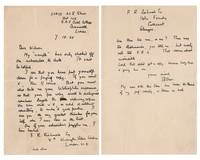
19250088521925. Letter. This 7 September 1925 autograph letter from T. E. Lawrence "of Arabia" to John G. Wilson "the most famous English bookseller of his time" a critical supporter of the legendary 1926 Subscriber's edition of Seven Pillars of Wisdom and one of the select few to receive a complimentary copy from Lawrence. The letter is noteworthy not only for the association but for timing and content as Lawrence was struggling to fill subscriptions for his magnum opus. <br /> <br /> your free copy shall be distinguished somehow beyond the ordinary copies I owe you the very greatest thanks for your help <br /> <br />The letter is addressed and dated at the top right of the first panel "338171 AC II Shaw Hut 105 R.A.F. Cadet College Cranwell Lincs. 7. IX. 25". Following Lawrence's salutation "Dear Wilson" the letter reads: <br />"My "sample" has only choked off one subscriber to date. It can't be helped. I see you have put yourself down for a paying copy. But you must also lend me your bibliophilic experience so that your free copy shall be distinguished somehow beyond the ordinary copies. We can write in it or add or subtract something to make it quite peculiar. I owe you the very greatest thanks for your help when I was low in the list. One of your subscribers puzzles me. I have booked <br />F. R. Richmond Esq. <br />8A Kensington Palace Gardens <br />London W. 8. <br />and also <br />F. R. Richmond Esq. <br />Holm Foundry <br />Cathcart <br />Glasgow. <br />Are these two men or one There were two Richmonds you told me: but surely not to F. R.'s. That seems almost incredible. Lord Bute didn't get a copy: because Lady Bute is giving him one:" <br />Following his valediction "yours sincerely" and signature "T E Shaw." there is a postscript: "My move to the Air Force has broken the thread of my proof-correcting & thrown me back." <br /> <br />Condition <br /> <br />The letter is written in black ink on a single sheet of laid watermarked "ORIGINAL BLACKFRIARS MILL" paper measuring 8.875 x 6.9375 inches folded once to form four 4.375 x 6.9375 inches panels. Lawrence wrote on the first and third of these panels. Condition is very good. The paper is complete with no loss tears or appreciable wear other than an additional horizontal fold from original posting. The paper shows light overall soiling to the first and fourth outer panels and perhaps a faint hint of spotting to the lower front panel. Lawrence's ink remains clear and unfaded. The letter is protected within a clear removable archival sleeve housed within a rigid crimson cloth folder. <br /> <br />Lawrence of Arabia <br /> <br />During the First World War Thomas Edward T. E. Lawrence 1888-1935 experienced a transformative odyssey as instigator organizer hero and tragic figure of the Arab Revolt against the Ottoman Empire which he began as an eccentric junior intelligence officer and ended as "Lawrence of Arabia. He spent the rest of his famously short life struggling to variously reconcile reject share and repress this indelible experience which was eventually recounted in his magnum opus Seven Pillars of Wisdom. <br /> <br />Hiding and writing in the R.A.F. <br /> <br />As part of his effort to evade his celebrity in August 1922 Lawrence enlisted in the Royal Air Force first under the name John Hume Ross and later Thomas Edward Shaw a name he used until his death. Hence from that time forward he seldom signed with his original surname. By December 1922 Lawrence had with a close circle of friends decided to produce 100 copies of the Seven Pillars at thirty guineas a copy if so many subscribers can be found. So September 1925 found Lawrence officially Aircraftsman Shaw residing in Hut 105 of the R. A. F. Cadet College at Cranwell trying to both duck and recount the events that had made him so uncomfortably famous. By the time Lawrence wrote this letter to Wilson in 9 September 1925 he was well into the elaborate preparation of and corresponding expenses for his famous Subscribers edition of Seven Pillars of Wisdom. Subscribers were fewer than had been hoped and Wilson was to prove of material help. <br /> <br />John Gideon Wilson <br /> <br />John Gideon Wilson 1876-1963 was manager of Bumpus bookshop "the most famous English bookseller of his time" and a significant even critical supporter of the famous 1926 Subscriber's edition of Seven Pillars of Wisdom. "Described as 'massively wise and unassumedly learned' this lovable man was endowed with a rare simplicity. In his shop Wilson might be found conversing with the poet laureate or wrapping up the purchase of a schoolboy. His assessment of authors and their books was quick and sure and his advice always valid was freely given to authors publishers and his fellow booksellers." Given his literate and approachable character and his commercial stature it seems no surprise that he and Lawrence found opportunity to collaborate. <br /> <br />More than just a friend and subscriber <br /> <br />Today when Subscriber's editions of Lawrence's magnum opus routinely command $six-figure sums it is almost prohibitively difficult to imagine any challenge in securing subscribers for the mere 202 copies eventually issued. But at the time Lawrence's expenses in producing the edition to his exacting and lavish specifications were extravagant and for much of 1925 he was genuinely concerned by a lack of anticipated subscriber commitments. It was to Wilson that Lawrence had turned earlier in the year when facing the prospect "that the plans for a thirty-guinea subscription edition had been over optimistic. By mid-March three months after the start of the project only twenty-six subscribers had been found" while estimated costs to produce the edition were proving higher than anticipated. Lawrence wrote to Wilson who was both manager of Bumpus bookshop in London and bookseller to the King asking if Wilson "would like to place twenty copies at the thirty guineas price." Six worrisome months later prospects had improved - due in no small part to Wilson. "By the middle of September" a week after Lawrence wrote this letter to him "Wilson had added a block of subscriptions and the total suddenly jumped to eighty." <br /> <br />Bookseller to the King <br /> <br />Indeed when completed by the binders in November 1926 Lawrence sent "the very first of these" to the Royal Library at Windsor which "had taken out a subscription" having placed the order through J. G. Wilson. For this copy Lawrence returned the advance cheque writing in advance explanation to Wilson ".it seems improper that Kings should buy and sell among their subjects." <br /> <br />Wilson was clearly a trusted figure; in 1928 when Lawrence was collaborating with Bruce Rogers on their famous rendering of Homer's Odyssey Wilson was one of the few trusted early with the knowledge that Lawrence was to be the translator. Following Lawrence's death in 1935 Wilson had a hand in the disposal of Lawrence's personal library from his beloved Clouds Hill cottage. <br /> <br />A doubly privileged recipient <br /> <br />Ultimately there were only 211 copies of the Subscriber's Edition of which 170 were complete copies 32 incomplete and 9 spoils. No two copies are identical. In addition to various differences in inclusion and placement of the many illustrations each copy was bound differently. Wilson would have a hand in selling an appreciable percentage of the 170 available for sale to subscribers. Speaking to his importance to the edition and as substantiated by this letter Wilson would personally receive not only one of the 32 incomplete copies that Lawrence gifted to friends and comrades from the Arab Revolt but also one of the 170 complete copies. <br /> <br />References: Wilson Lawrence of Arabia; ODNB; Richard Knowles Rickaro Books <br/><br/> unknown
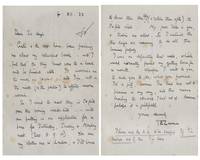
19230088591923. Letter. This 4 December 1923 autograph letter signed by T. E. Lawrence is noteworthy in multiple respects including: for referencing an important meeting about what would become the Subscribers issue of Seven Pillars of Wisdom; for being written to Lawrences great friend and patron Hugh Trenchard the head and father of the Royal Air Force; for highlighting the contradictions inherent to Lawrences supposedly anonymous enlistment in the R.A.F.; for being signed with Lawrences true name which he had already effectively abandoned. The letter is also replete with Lawrences characteristic liberties with punctuation and grammar which so amusingly belied his remarkable erudition. <br /> <br />Curtis & the rest have been pressing me about my reluctant book: and I feel that the thing must come to a head and be finished with. <br /> <br />The letter is written entirely in Lawrences hand on the first and third panels of a single folded sheet of 9 x 7 inches 22.86 x 17.78 cm watermarked Waverley Pen Vellum stationery folded once to make four 4.5 x 7 inches 11.43 x 17.78 cm panels. The letter is dated 4 . XII . 23 with the salutation Dear Sir Hugh. The body of the letter reads in full: Curtis & the rest have been pressing me about my reluctant book: and I feel that the thing must come to a head and be finished with. It worries me too much as it is: and Im not in the mood or the position to afford more worries. So I want to meet them in Oxford over the coming week-end . And am putting in an application for a pass for Saturday Sunday & Monday next. Dec. 8.9.10. You see my clothes are in London & Ill have to draw them there before & return them after the Oxford visit. My poor bike is gone & trains are slow. So I estimate the three days as necessary to do all the business properly. I was on defaulters last week which would normally prevent my getting leave for a month. Wherefore I write to you to ask you to do what you promised. Its a pity because Ive tried here not to presume in any way and this means breaking the standard I had set up. However perhaps it is justifiable. Lawrence signed TELawrence below his valediction yours sincerely. A two-line post script underlined follows: Please ask the A. G. to be careful. If Im kicked out of this Im done. <br /> <br />Condition <br /> <br />Condition is good plus Lawrences ink clear and distinct. The stationery is complete though spotted and with a horizontal and vertical fold bisecting each panel ostensibly from original mailing. Initials at the head of the first panel just below the date are plausibly those of Trenchard. The letter is protected in a clear removable archival sleeve housed within a rigid full blue Morocco goatskin folder with a gilt-printed front cover gilt-ruled turn-ins framing gray paper pastedowns within and an integral printed cardstock insert. <br /> <br />Lawrence of Arabia <br /> <br />During the First World War Thomas Edward T. E. Lawrence 1888-1935 experienced a transformative odyssey as instigator organizer hero and tragic figure of the Arab Revolt against the Ottoman Empire which he began as an eccentric junior intelligence officer and ended as "Lawrence of Arabia. He spent the rest of his famously short life struggling to variously reconcile reject share and repress this indelible experience which was eventually recounted in his magnum opus Seven Pillars of Wisdom. <br /> <br />The Father of the Royal Air Force <br /> <br />Father of the Royal Air Force Hugh Montague Trenchard First Viscount Trenchard 1873-1956 began his military career as a dashing cavalry officer full of high Victorian bravado who attracted the notice of his superiors for blunt words boundless energy and stern discipline of men under his command. At forty Trenchard asked for leave to learn to fly at his own expense and then joined the Royal Flying Corps which had been formed only months before. There his age and military experience saw him appointed to the staff and he recognized more quickly than most officers of his age the aeroplane's unlimited military potential. He would be indelibly associated with Britains air service for the rest of his life. Before the end of the First World War Trenchard was both appointed the first head of the new Royal Air Force and knighted. By 1919 Trenchard was created a baronet and was working to secure the foundations of an enduring independent RAF. <br /> <br />Trenchard and T. E . Shaw <br /> <br />Trenchard and T. E. Lawrence both worked with and for Winston S. Churchill who was respectively Secretary of State for War and Air appointed January 1919 and Colonial Secretary appointed February 1921. Perhaps Trenchards own impetuous inclinations and the experience of being both of and other in British society and institutions facilitated Trenchards friendship with T. E. Lawrence. That friendship proved critical for Lawrence and emblematic of the inherent contradictions between his inescapable fame and his fitful attempts to evade and ignore it. <br /> <br />At the beginning of January 1922 Lawrence wrote to Trenchard expressing a wish to join the R.A.F.: Its an odd request this hardly proper perhaps asking you to use your influence to get me past the Recruiting Officer! By July Churchill had released Lawrence from service and in August Lawrence enlisted first under the name John Hume Ross and later Thomas Edward Shaw a name he used until his death. Hence from that time forward he seldom signed with his original surname. <br /> <br /> Ive tried here not to presume in any way and this means breaking the standard I had set up. However perhaps it is justifiable. <br /> <br />As evident in this letter despite his pretensions to anonymity and protestations of humility as an enlisted Aircraftman Lawrence was not above calling in favors from the exalted Trenchard. Lawrences friendship with Trenchard was known to his superiors and often resented. <br /> <br />In the case of this letter Lawrence was going over the head of his local superiors to secure a pass in order to attend a meeting about publishing Seven Pillars of Wisdom. In this effort Lawrence was successful; Lawrence did meet in Oxford with Lionel Curtis referenced in this letter D. G. Hogarth and Alan Dawnay on 9 December 1923 where in Lawrences words the four decided to produce 100 copies of the Seven Pillars at thirty guineas a copy if so many subscribers can be found. Curtis was one of Lawrences most trusted friends and it was mainly Curtis and D. G. Hogarth who had persuaded Lawrence to rewrite Seven Pillars after the original manuscript was lost in 1919. <br /> <br />Specially bound in R.A.F. blue <br /> <br />When Lawrence finally published the famous Subscribers Edition of Seven Pillars of Wisdom in 1926 Trenchard was among the select few gifted a presentation copy Trenchards specially bound in R.A.F. blue. The edition would also be known as the Cranwell Edition because Lawrence was stationed at the Cranwell Cadet College founded by Trenchard when he completed it. <br /> <br />References: Wilson Lawrence of Arabia; ODNB; T. E. Lawrence: Correspondence with the Political Elite <br/><br/> unknown
In-8, tela editoriale (con fioriture), pp. XXIX,(3),396,(2), completo di tutte le tavole, i diagrammi, le carte, come da indice, compresa 1 grande carta geografica a colori più volte ripiegata del “South Arabian Desert”. “In the Qara Mountains: ‘Ain ar Rizat - Dhufar - Nejd - Along the southern fringe of the sands - A geographical note on Rub’ Al Khali, etc.”. Solo qualche rara e lieve fioritura, altrimenti ben conservato.
1369429Paris: Payot, 1946 in-8, 255 pp, 7 dessins, 13 photographies. Broché. (Bibliothèque historique).
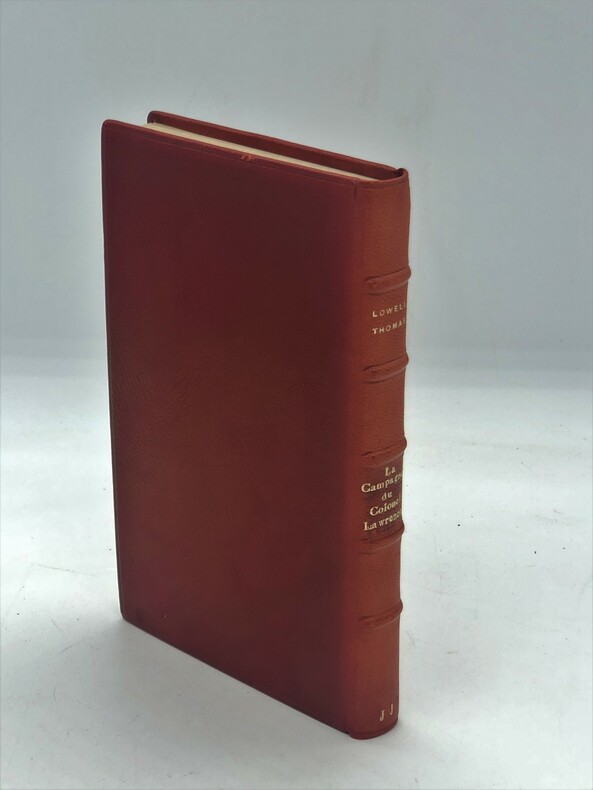
1933PHO-688Paris, Payot, 1933, in-8,plein chagrin rouge, dos à nerfs, insolé. 297pp, illustrations , bel exemplaire.
193330143Paris, Payot, (1933). Un vol. au format in-8 (222 x 143 mm) de 297 pp. Reliure de l'époque de plein cartonnage émeraude à l'imitation de chagrin, plats jansénistes, dos lisse orné de doubles filets dorés, titre doré, tranches mouchetées.
in-8°, 453 pages, 32 photographies hors texte de l"auteur, 8 cartes in texte et un index, relie avec jaquette illustree. Tres bel exemplaire. [P-32][NAN-1-]
in-16, 463 pages, broché. Tres bel exemplaire. [PO-1]
Two accounts in one issue, altogether 35 pages (27 on Thesiger's account). Plus photographic plates and a fold-out colour maps, measuring approximately 11 x 11 inches (28 x 28cm) and a fold-out sketch map, measuring approximately 13 x 7.5 inches (33 xx 19cm). Original condition with blue wrappers, titles to front, and containing all the ads. This is a complete issue, seldom found in such good and original condition. Thesiger has an immense ability to describe very vividly the life and ways of the people of the desert, and his writings shine with his clear attachment to them. Accompanied by a spectacular detailed fold-out color map, illustrating Thesiger's journey through western and northern Rub al Khali. This is Thesiger's first-hand account and pre-dates his book, "Arabian Sands", published in 1959 by Longmans. His account of the Arabian Sands and its people, its tribal warfare and ancient history, its daily life and landscape, is of such range and value, so supremely well written, that the book can confidently claim to be a classic of Arabian travel literature. Also included in this issue is an 8 page account by Philby, entitled "Two Notes from Central Arabia", accompanied by a fold-out sketch map of the Jabal Tuwaiq region of Arabia. Phibly provides an illuminating description of the pools of Aflaj and the Qariya ruin field, from his excursion in 1948 and his journey in 1918. Also included is a brief description of Phibly's map.
8 pages, plus photographic plates and a fold-out colour map, measuring approximately 11.5 x 8.5 inches (29 x 22cm). Original condition with blue wrappers, titles to front, and containing all the ads. This is a complete issue, seldom found in such good and original condition. This is a fascinating expedition report on Nuristan - the little known part of the Hindu Kush which lies inside Afghanistan to the north of Jalalabad along the Chitral border. Excerpt from the introduction: "Sir George Scott Robertson was the first European to visit this country, in 1889. Nuristan was then independent, and known as Kafiristan and its inhabitants as Kafirs. Kipling wrote his famous story "The Man Who Would Be King" about this country. Two important German Expeditions travelled extensively in Nuristan, and owing to that the Nuristans refer to all Europeans as Germans..." End Excerpt Wilfred Thesiger is perhaps the last, and certainly one of the greatest of the British travellers. Thesiger had the immense ability to describe very vividly the life and ways of the peoples and places he explored and visited. His work shines with his clear attachment to them. After leaving Arabia he travelled extensively in the Karakoram and the Hindu Kush (the setting of his meeting with Eric Newby immortalised in Newby's A Short Walk in the Hindu Kush), the mountains of Kurdistan and the marshlands of Iraq.
17 pages. Plus photographic plates and an extra large fold-out colour map, measuring approximately 17 x 25 inches (43 x 64cm). Original condition with blue wrappers, titles to front, and containing all the ads. This is a complete issue, seldom found in such good and original condition. Wilfred Thesiger has an immense ability to describe very vividly the life and ways of the people of the desert, the Bedu, and his work shines with his clear attachment to them. After leaving Arabia he travelled extensively in the Karakoram and the Hindu Kush (the setting of his meeting with Eric Newby immortalised in Newby's A Short Walk in the Hindu Kush), the mountains of Kurdistan and the marshlands of Iraq. But he says that none of these places moved him as did the deserts of Arabia. He spent five years in the region travelling on camels and on foot across some ten thousand miles of a vast empty land. What he found, as in his time with the people of the Iraq marshes which he described in his book "The Marsh Arabs", was a way on life on the threshold of destruction. The 20th century was very fortunate in being able to have a record of some of the glory it lost as seen through the eyes and camera of this very remarkable explorer.
36 pages. With a full-page sketch map and photographic plates.Does not have the map whic hwas published at alater date (the following year). Original condition with blue wrappers, titles to front, and containing all the ads. A complete issue, seldom found in such good and original condition. Wilfred Thesiger is perhaps the last, and certainly one of the greatest of the British travellers among the Arabs, his narrative is vividly written. These papers cover the five years in which Thesiger spent in and around the Empty Quarter, the half million square miles of one of the cruellest deserts in the world. The 20th century was very fortunate in being able to have a record of some of the glory it lost as seen through the eyes and camera of this very remarkable explorer. He was born in the British Legation in Addis Ababa in 1910, an event that was to shape the life of this extraordinary man and spent his first nine years in Ethiopia, or Abyssinia as it was then called. By the time he accompanied his parents back to England in 1919, the sight, sounds, wildness and raw savagery of the land had been instilled in him and a traveller was born. His return to Ethiopia in 1930 for the crowning of HIM Haile Selassie marked the beginning of his first hunting and exploration adventures into this highly dangerous country. Wilfred Thesiger has an immense ability to describe very vividly the life and ways of the people of the desert, the Bedu, and his work shines with his clear attachment to them. After leaving Arabia he travelled extensively in the Karakoram and the Hindu Kush (the setting of his meeting with Eric Newby immortalised in Newby's A Short Walk in the Hindu Kush), the mountains of Kurdistan and the marshlands of Iraq. But he says that none of these places moved him as did the deserts of Arabia. He spent five years in the region travelling on camels and on foot across some ten thousand miles of a vast empty land. What he found, as in his time with the people of the Iraq marshes which he described in his book The Marsh Arabs, was a way on life on the threshold of destruction.
10 pages. Plus a full-page sketch map and black and white photographic plates. Original condition with blue wrappers, titles to front, and containing all the ads. This is a complete issue, seldom found in such good and original condition. In 1952 and 1953, Thesiger had travelled in the Hindu Kush and Karakoram, in Chitral, Gilgit and Hunza, then he spent six months among the marshmen of southern Iraq, and in the summer of 1954, he set on another journey to Afghanistan where he lived in semi-submerged houses and travelled about in a canoe. From there he continued his journey in the Hazarajat, the original homeland of the Hazara people with mountains rising up to 17,000 feet and little visited by Europeans at the time. In his beautifully illustrated and fascinating account, Thesiger describes the geographical features of the Hazarajat, villages, and the Hazaras - Mongols who inhabit a large area in Central Afghanistan - including their appearance, products, and customs and manners. Illustrations show Farmstea in Deh Zangi on the southern slopes of Kuh-i-Baba, Hazara mountain village with watchtower and domed roofs, wedding party in Yakwalang, women weaving "barak" cloth on looms, also included here is a full-page sketch map showing Thesiger's route through the Hazarajat.
10 pages, including in-text sketch map. Plus photographic plates. Original condition with blue wrappers, titles to front, and containing all the ads. This is a complete issue, seldom found in such good and original condition. Travelling with his medicine boxes and his teams of canoemen around the junction between the Tigris and the Euphrates, Thesiger visited nearly every village in the Central Marshes and came to know intimately the people who inhabit this landscape of islands, lakes and waterways, living with them in their reed houses and sharing their unique way of life. He beautifully evokes the landscape and its teeming wildlife and vividly brings to life the many friends he made among the Marsh Arabs. His extraordinary photographs provide a stunning record of the last remnants of a people and their culture. Pre-dates his book, 'The Marsh Arabs', first published in 1964.
A spectacular detailed fold-out color map, measuring 11 x 11 inches (28 x 28cm), in original condition. The map is taken from "A Further Journey Across the Empty Quarter", published in June 1949 issue of the Royal Geographical Society, illustrating Thesiger's journey through western and northern Rub al Khali from November 1947 to May 1948. Wilfred Thesiger is perhaps the last, and certainly one of the greatest of the British travellers among the Arabs, his narrative is vividly written. After leaving Arabia he travelled extensively in the Karakoram and the Hindu Kush (the setting of his meeting with Eric Newby immortalised in Newby's A Short Walk in the Hindu Kush), the mountains of Kurdistan and the marshlands of Iraq. But he says that none of these places moved him as did the deserts of Arabia. He spent five years in the region travelling on camels and on foot across some ten thousand miles of a vast empty land. What he found, as in his time with the people of the Iraq marshes which he described in his book The Marsh Arabs, was a way on life on the threshold of destruction.
8°, con 36 ill. f.t. ed 8 cartine, leg. ed. cart. con sovracc.
8vo., Fifth Impression, with frontispiece, 68 plates on 46, 3 maps in the text and large folding map in red and black in pocket at end, free endpapers lightly browned; ivory cloth, backstrip lettered in gilt and black, a very good, bright, clean copy in unclipped dustwrapper. The author's first and most celebrated book, chronicling his years of travel after WWII 'without European companions and living as an Arab'. EARLY PRINTINGS ARE SCARCE IN THIS CONDITION.