1 359 résultats
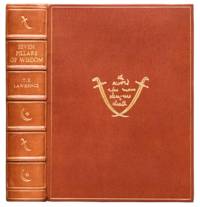
19230088591923. Letter. This 4 December 1923 autograph letter signed by T. E. Lawrence is noteworthy in multiple respects including: for referencing an important meeting about what would become the Subscribers issue of Seven Pillars of Wisdom; for being written to Lawrences great friend and patron Hugh Trenchard the head and father of the Royal Air Force; for highlighting the contradictions inherent to Lawrences supposedly anonymous enlistment in the R.A.F.; for being signed with Lawrences true name which he had already effectively abandoned. The letter is also replete with Lawrences characteristic liberties with punctuation and grammar which so amusingly belied his remarkable erudition. <br /> <br />Curtis & the rest have been pressing me about my reluctant book: and I feel that the thing must come to a head and be finished with. <br /> <br />The letter is written entirely in Lawrences hand on the first and third panels of a single folded sheet of 9 x 7 inches 22.86 x 17.78 cm watermarked Waverley Pen Vellum stationery folded once to make four 4.5 x 7 inches 11.43 x 17.78 cm panels. The letter is dated 4 . XII . 23 with the salutation Dear Sir Hugh. The body of the letter reads in full: Curtis & the rest have been pressing me about my reluctant book: and I feel that the thing must come to a head and be finished with. It worries me too much as it is: and Im not in the mood or the position to afford more worries. So I want to meet them in Oxford over the coming week-end . And am putting in an application for a pass for Saturday Sunday & Monday next. Dec. 8.9.10. You see my clothes are in London & Ill have to draw them there before & return them after the Oxford visit. My poor bike is gone & trains are slow. So I estimate the three days as necessary to do all the business properly. I was on defaulters last week which would normally prevent my getting leave for a month. Wherefore I write to you to ask you to do what you promised. Its a pity because Ive tried here not to presume in any way and this means breaking the standard I had set up. However perhaps it is justifiable. Lawrence signed TELawrence below his valediction yours sincerely. A two-line post script underlined follows: Please ask the A. G. to be careful. If Im kicked out of this Im done. <br /> <br />Condition <br /> <br />Condition is good plus Lawrences ink clear and distinct. The stationery is complete though spotted and with a horizontal and vertical fold bisecting each panel ostensibly from original mailing. Initials at the head of the first panel just below the date are plausibly those of Trenchard. The letter is protected in a clear removable archival sleeve housed within a rigid full blue Morocco goatskin folder with a gilt-printed front cover gilt-ruled turn-ins framing gray paper pastedowns within and an integral printed cardstock insert. <br /> <br />Lawrence of Arabia <br /> <br />During the First World War Thomas Edward T. E. Lawrence 1888-1935 experienced a transformative odyssey as instigator organizer hero and tragic figure of the Arab Revolt against the Ottoman Empire which he began as an eccentric junior intelligence officer and ended as "Lawrence of Arabia. He spent the rest of his famously short life struggling to variously reconcile reject share and repress this indelible experience which was eventually recounted in his magnum opus Seven Pillars of Wisdom. <br /> <br />The Father of the Royal Air Force <br /> <br />Father of the Royal Air Force Hugh Montague Trenchard First Viscount Trenchard 1873-1956 began his military career as a dashing cavalry officer full of high Victorian bravado who attracted the notice of his superiors for blunt words boundless energy and stern discipline of men under his command. At forty Trenchard asked for leave to learn to fly at his own expense and then joined the Royal Flying Corps which had been formed only months before. There his age and military experience saw him appointed to the staff and he recognized more quickly than most officers of his age the aeroplane's unlimited military potential. He would be indelibly associated with Britains air service for the rest of his life. Before the end of the First World War Trenchard was both appointed the first head of the new Royal Air Force and knighted. By 1919 Trenchard was created a baronet and was working to secure the foundations of an enduring independent RAF. <br /> <br />Trenchard and T. E . Shaw <br /> <br />Trenchard and T. E. Lawrence both worked with and for Winston S. Churchill who was respectively Secretary of State for War and Air appointed January 1919 and Colonial Secretary appointed February 1921. Perhaps Trenchards own impetuous inclinations and the experience of being both of and other in British society and institutions facilitated Trenchards friendship with T. E. Lawrence. That friendship proved critical for Lawrence and emblematic of the inherent contradictions between his inescapable fame and his fitful attempts to evade and ignore it. <br /> <br />At the beginning of January 1922 Lawrence wrote to Trenchard expressing a wish to join the R.A.F.: Its an odd request this hardly proper perhaps asking you to use your influence to get me past the Recruiting Officer! By July Churchill had released Lawrence from service and in August Lawrence enlisted first under the name John Hume Ross and later Thomas Edward Shaw a name he used until his death. Hence from that time forward he seldom signed with his original surname. <br /> <br /> Ive tried here not to presume in any way and this means breaking the standard I had set up. However perhaps it is justifiable. <br /> <br />As evident in this letter despite his pretensions to anonymity and protestations of humility as an enlisted Aircraftman Lawrence was not above calling in favors from the exalted Trenchard. Lawrences friendship with Trenchard was known to his superiors and often resented. <br /> <br />In the case of this letter Lawrence was going over the head of his local superiors to secure a pass in order to attend a meeting about publishing Seven Pillars of Wisdom. In this effort Lawrence was successful; Lawrence did meet in Oxford with Lionel Curtis referenced in this letter D. G. Hogarth and Alan Dawnay on 9 December 1923 where in Lawrences words the four decided to produce 100 copies of the Seven Pillars at thirty guineas a copy if so many subscribers can be found. Curtis was one of Lawrences most trusted friends and it was mainly Curtis and D. G. Hogarth who had persuaded Lawrence to rewrite Seven Pillars after the original manuscript was lost in 1919. <br /> <br />Specially bound in R.A.F. blue <br /> <br />When Lawrence finally published the famous Subscribers Edition of Seven Pillars of Wisdom in 1926 Trenchard was among the select few gifted a presentation copy Trenchards specially bound in R.A.F. blue. The edition would also be known as the Cranwell Edition because Lawrence was stationed at the Cranwell Cadet College founded by Trenchard when he completed it. <br /> <br />References: Wilson Lawrence of Arabia; ODNB; T. E. Lawrence: Correspondence with the Political Elite <br/><br/> unknown
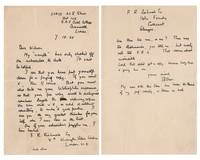
19250088521925. Letter. This 7 September 1925 autograph letter from T. E. Lawrence "of Arabia" to John G. Wilson "the most famous English bookseller of his time" a critical supporter of the legendary 1926 Subscriber's edition of Seven Pillars of Wisdom and one of the select few to receive a complimentary copy from Lawrence. The letter is noteworthy not only for the association but for timing and content as Lawrence was struggling to fill subscriptions for his magnum opus. <br /> <br /> your free copy shall be distinguished somehow beyond the ordinary copies I owe you the very greatest thanks for your help <br /> <br />The letter is addressed and dated at the top right of the first panel "338171 AC II Shaw Hut 105 R.A.F. Cadet College Cranwell Lincs. 7. IX. 25". Following Lawrence's salutation "Dear Wilson" the letter reads: <br />"My "sample" has only choked off one subscriber to date. It can't be helped. I see you have put yourself down for a paying copy. But you must also lend me your bibliophilic experience so that your free copy shall be distinguished somehow beyond the ordinary copies. We can write in it or add or subtract something to make it quite peculiar. I owe you the very greatest thanks for your help when I was low in the list. One of your subscribers puzzles me. I have booked <br />F. R. Richmond Esq. <br />8A Kensington Palace Gardens <br />London W. 8. <br />and also <br />F. R. Richmond Esq. <br />Holm Foundry <br />Cathcart <br />Glasgow. <br />Are these two men or one There were two Richmonds you told me: but surely not to F. R.'s. That seems almost incredible. Lord Bute didn't get a copy: because Lady Bute is giving him one:" <br />Following his valediction "yours sincerely" and signature "T E Shaw." there is a postscript: "My move to the Air Force has broken the thread of my proof-correcting & thrown me back." <br /> <br />Condition <br /> <br />The letter is written in black ink on a single sheet of laid watermarked "ORIGINAL BLACKFRIARS MILL" paper measuring 8.875 x 6.9375 inches folded once to form four 4.375 x 6.9375 inches panels. Lawrence wrote on the first and third of these panels. Condition is very good. The paper is complete with no loss tears or appreciable wear other than an additional horizontal fold from original posting. The paper shows light overall soiling to the first and fourth outer panels and perhaps a faint hint of spotting to the lower front panel. Lawrence's ink remains clear and unfaded. The letter is protected within a clear removable archival sleeve housed within a rigid crimson cloth folder. <br /> <br />Lawrence of Arabia <br /> <br />During the First World War Thomas Edward T. E. Lawrence 1888-1935 experienced a transformative odyssey as instigator organizer hero and tragic figure of the Arab Revolt against the Ottoman Empire which he began as an eccentric junior intelligence officer and ended as "Lawrence of Arabia. He spent the rest of his famously short life struggling to variously reconcile reject share and repress this indelible experience which was eventually recounted in his magnum opus Seven Pillars of Wisdom. <br /> <br />Hiding and writing in the R.A.F. <br /> <br />As part of his effort to evade his celebrity in August 1922 Lawrence enlisted in the Royal Air Force first under the name John Hume Ross and later Thomas Edward Shaw a name he used until his death. Hence from that time forward he seldom signed with his original surname. By December 1922 Lawrence had with a close circle of friends decided to produce 100 copies of the Seven Pillars at thirty guineas a copy if so many subscribers can be found. So September 1925 found Lawrence officially Aircraftsman Shaw residing in Hut 105 of the R. A. F. Cadet College at Cranwell trying to both duck and recount the events that had made him so uncomfortably famous. By the time Lawrence wrote this letter to Wilson in 9 September 1925 he was well into the elaborate preparation of and corresponding expenses for his famous Subscribers edition of Seven Pillars of Wisdom. Subscribers were fewer than had been hoped and Wilson was to prove of material help. <br /> <br />John Gideon Wilson <br /> <br />John Gideon Wilson 1876-1963 was manager of Bumpus bookshop "the most famous English bookseller of his time" and a significant even critical supporter of the famous 1926 Subscriber's edition of Seven Pillars of Wisdom. "Described as 'massively wise and unassumedly learned' this lovable man was endowed with a rare simplicity. In his shop Wilson might be found conversing with the poet laureate or wrapping up the purchase of a schoolboy. His assessment of authors and their books was quick and sure and his advice always valid was freely given to authors publishers and his fellow booksellers." Given his literate and approachable character and his commercial stature it seems no surprise that he and Lawrence found opportunity to collaborate. <br /> <br />More than just a friend and subscriber <br /> <br />Today when Subscriber's editions of Lawrence's magnum opus routinely command $six-figure sums it is almost prohibitively difficult to imagine any challenge in securing subscribers for the mere 202 copies eventually issued. But at the time Lawrence's expenses in producing the edition to his exacting and lavish specifications were extravagant and for much of 1925 he was genuinely concerned by a lack of anticipated subscriber commitments. It was to Wilson that Lawrence had turned earlier in the year when facing the prospect "that the plans for a thirty-guinea subscription edition had been over optimistic. By mid-March three months after the start of the project only twenty-six subscribers had been found" while estimated costs to produce the edition were proving higher than anticipated. Lawrence wrote to Wilson who was both manager of Bumpus bookshop in London and bookseller to the King asking if Wilson "would like to place twenty copies at the thirty guineas price." Six worrisome months later prospects had improved - due in no small part to Wilson. "By the middle of September" a week after Lawrence wrote this letter to him "Wilson had added a block of subscriptions and the total suddenly jumped to eighty." <br /> <br />Bookseller to the King <br /> <br />Indeed when completed by the binders in November 1926 Lawrence sent "the very first of these" to the Royal Library at Windsor which "had taken out a subscription" having placed the order through J. G. Wilson. For this copy Lawrence returned the advance cheque writing in advance explanation to Wilson ".it seems improper that Kings should buy and sell among their subjects." <br /> <br />Wilson was clearly a trusted figure; in 1928 when Lawrence was collaborating with Bruce Rogers on their famous rendering of Homer's Odyssey Wilson was one of the few trusted early with the knowledge that Lawrence was to be the translator. Following Lawrence's death in 1935 Wilson had a hand in the disposal of Lawrence's personal library from his beloved Clouds Hill cottage. <br /> <br />A doubly privileged recipient <br /> <br />Ultimately there were only 211 copies of the Subscriber's Edition of which 170 were complete copies 32 incomplete and 9 spoils. No two copies are identical. In addition to various differences in inclusion and placement of the many illustrations each copy was bound differently. Wilson would have a hand in selling an appreciable percentage of the 170 available for sale to subscribers. Speaking to his importance to the edition and as substantiated by this letter Wilson would personally receive not only one of the 32 incomplete copies that Lawrence gifted to friends and comrades from the Arab Revolt but also one of the 170 complete copies. <br /> <br />References: Wilson Lawrence of Arabia; ODNB; Richard Knowles Rickaro Books <br/><br/> unknown
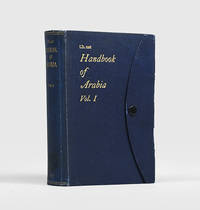
1916192452London: Admiralty War Staff Intelligence Division May 1916. A detailed intelligence handbook the folding maps in excellent condition First edition of this regional survey for the armed services published for official use only and compiled by the Arab Bureau's David Hogarth following his recruitment to naval intelligence in 1915. The four folding maps present Arabia's settlements tribal distribution and orographic and land-surface features. After general physical and social surveys chapters cover Bedouin tribes the Hejaz Asir Yemen Aden and the Hadhramaut Oman the Gulf coast Nejd Jebel Shammar the northern Nefud and Dahanah belts and settled tribes. The appendices comprise a system of transliteration from Arabic to English and an extensive glossary of topographical terms. "The sources from which this work has been compiled include native information obtained for the purpose since the outbreak of the war. This applies in particular to the strength and distribution of the Bedouin tribes and to their political relationships. Recent information from native sources has also been used for parts of the Red Sea littoral such as the little-known region of Asir" preliminary note. Volume II published the following year was concerned with detailed routes. The work was reissued in 1920. Octavo. With 15 photographic half-tone plates 4 folding colour maps in end pocket. Original blue cloth flap case metal stud-fastener spine and front cover lettered in gilt. Annotated bookplate of Royal Artillery Institution Woolwich. Shadow from old label on spine fold of front flap splitting at ends and consequently a little fragile ring stain on outer face of folded map another map with small pinhole couple of small splash marks: a very good copy indeed. hardcover
2 vols., 8vo., Second Edition thus, with fine portrait frontispiece (original tissue guard present), numerous plates (a number in collotype and a number folding), illustrations, maps and plans in the text and large folding coloured map mounted on cloth in pocket at end of first volume, neat contemporary signature on half-title of first volume, small sticker on front paste-downs; original dark green cloth, upper boards blocked in gilt and framed in blind, gilt backs, gilt tops, black endpapers, uncut, a sharp, bright, crisp, near fine copy in unclipped dustwrapper, the wrappers moderately sunned at backstrips. EDITION LIMITED TO 500 COPIES. With the trade ticket of WH Smith of Bournemouth on front paste-down. 'Lawrence had long admired Doughty's classic and was instrumental in getting the second English edition published by the fledgling firm of Jonathan Cape in conjunction with the Medici Society' (paraphrased from O'Brien). VERY SCARCE IN THIS CONDITION, AND ESPECIALLY IN THE DUSTWRAPPERS. O'Brien A013.
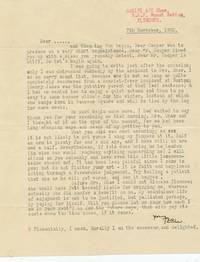
2464Lawrence refers to Charlotte Payne-Townshend Shaw reformer women's rights advocate and wife of author George Bernard Shaw. Lawrence writes to Charlotte's Shaw's doctor William Cooper who took care of Lawrence's broken wrist. In this upbeat letter with a literary reference to American author Henry James Lawrence gives an update on Charlotte as well as his own injured wrist. At the end he asks for the cost of the bill which he supposes Charlotte would have paid had she not become indisposed from an accident. In part "and then the fun began. Dear Cooper was to presume on a very short acquaintance. Dear Dr. Cooper lined you up with a class you probably detest. Dear Mr. Cooper is stiff. So let's begin again. I was going to write just after the occasion; only I was detracked suddenly by the accident to Mrs. Shaw.she is not so long or quite recovered from a scarlet-fever incident at Buxton; Henry James was the putative parent of that last sentence.she bumps down in Hanover square and will be tied by the leg for more weeks.I had wanted to say thank you for examining me that morning. Mrs. Shaw and I thought of it on the spur of the moment.What you had said was most assuring; as it is not likely to get worse I snap my fingers at it. Half an arm is plenty for one's old age and I have still and arm and a half. Nevertheless if fate does bring me to London No wise man would prophesy anything concerning me I will attend on you.It has been less painful.but do not flatter your art - it is faith and happiness acting through favorable judgement. Try telling a patient that she or he will get worse and see it happen! Before Mrs. Shaw I could not discuss finance; she would have felt herself liable for bringing me.My scandalous life of enjoyment is not to be justified but palliated perhaps by paying for itself.let me know how much I am in your debt ." The asterisk is actually the "@" symbol and points to another below the signature with the following explanation. "Financially I mean. Morally I am the assessor and delighted." In his hand he writes and signs "Yours T. E. Shaw." With envelope docketed by William Cooper explaining the letter. The letter is matted with envelope and printed photograph of Lawrence dressed in desert clothing as Lawrence of Arabia. Dr. Cooper explains that Lawrence "seeing two old people in difficulty with a car which wouldn't start he offered to help them but the handle hand crank of the car on a backfire hit him in the wrist & broke it." The incident occurred in March 1927 near Cranwell but since Lawrence did not take the needed time to allow the wrist to heal it never fully recovered. The letter shows Lawrence's wit and good humor about his own accident as well as his concern for his good friend Charlotte Shaw. unknown books
11 voll. cartonato azzurro della epoca. 10 voll. in-8. un vol. in-4 Atlas. Ritratto inciso 9 frontespizi incisi 50 mappe 23 tabelle ripiegate.Economics india arabia gulf africa america diderot rigobert bonne maps atlas arabic indian travels slavery colonialism Diderot
in-4. pp.16,358,4. Perg. Coeva. un legno nel testo con la sorgente del Nilo.
1917192206Calcutta: Superintendent Government Printing India 1917. With the loosely inserted index Second edition significantly expanded and revised from the first of 1915 including updated sections on Al Hasa and Nejd and the rule of the Saud dynasty as well as 22 additional route descriptions in the final section. The 20-page index tucked into the end band was issued only with a subset of copies. The first edition issued in March 1915 went through three small printings in a year but the outbreak of the Arab Revolt and the upswing in the Mesopotamian Campaign necessitated its revision. Chapters discuss history geography populations resources maritime issues and administration while also providing British intelligence on the Ottoman forces. On the "fighting qualities of local Arabs of Mesopotamia" the compilers observe that "for several years the Arabs have been very friendly towards the British and on several occasions prominent chiefs have come forward with suggestions of a British Protectorate" p. 90. The routes draw on a variety of sources including Lorimer reports by captains Shakespear and Leachman the Danish explorer Barclay Raunkiaer Lieutenant Arnold Wilson and recent intelligence supplied by Lieutenant-Colonel L. S. Newmarch Resident and Consul-General at Baghdad. In a reflection of the region's changing geopolitics the list of important personages is reduced from 25 in the first edition to only 11. Octavo. Folding heliozincographed map of Lower Mesopotamia in front pocket 3 folding tables errata slip tipped in facing p. 34; tables in text. With 20-page separate index loosely inserted in rear band. Original green diagonal-grain cloth wallet binding spine and front cover lettered in black. Title page with contemporary pencil ownership inscription of Lieutenant-Colonel Austin Romauld O'Flaherty officer commanding 33 British General Hospital Mesopotamia. General signs of use spine sunned small tidemarks internally short split along fold of map; index volume re-sewn: very good. hardcover
1935895London: Jonathan Cape 1935. First Trade Edition. Bound by Bayntun-Riviere. Fine. LAWRENCE T. E<br /> Seven pillars of wisdom: a triumph<br /> London. Jonathan Cape 1935. First trade edition.<br /> <p>Quarto. 672pp. With a photogravure portrait frontispiece of Lawrence from the plaster bust by Eric Kennington 53 plates four in colour and four folding maps. Bound by Bayntun-Riviere stamp-signed to front turn-in in contemporary gilt-tooled brown morocco A.E.G. marbled endpapers Housed in custom tan cloth slipcase. An immaculate copy.</p> <br /> <p>A handsomely bound copy of the first trade edition of Lawrence's magisterial account of the Arab Revolt during the First World War.</p> . Jonathan Cape unknown
1810PHO-1119Paris, Crapart, 1810. In-8, demi-basane bleu, dos lisse avec titre et date en pied, tranches jaunes (reliure postérieure). 4ff-viii-222pp-2ff
In-8°, (30 cc) compreso ritratto, antiporta e frontespizio, pp. 272, 4 carte ripiegate, legatura in pelle con titolo al dorso. Prima edizione. La prima parte di questo lavoro, intitolata Compendium theologiae mohammedicae arabice et latine, è un'edizione in arabo, con traduzione, di una piccola opera simile al Mukhtasar di Abû Suj ed è probabilmente la prima edizione stampata di un'opera islamica così essenziale in Occidente . La seconda parte è il contributo più importante di Reelant per una migliore comprensione dell'Islam in cui si propone di correggere molte credenze popolari con citazioni dal Corano e da altre fonti arabe. In-8°, (30 cc) including portrait, frontispice and title page, pp. 272, 4 engraved folded plates, binding in calf with title at the spine. First edition.The first part of this work, entitled Compendium theologiae mohammedicae arabice et latine is an edition in Arabic, with translation, of a small work similar to Abû Sujâ s Mukhtasar and is probably the first printed edition of such an essential Islamic work in the West. The second part is Reelant’ s most important contribution towards a better understanding of Islam in which he sets out to rectify many popular misbeliefs with quotations from the Coran and other Arabic sources.
In -Folio, piena pergamena con titolo manoscritto al dorso; (8), 448, 4 tavv.
Very Good Turkish, Ottoman (1500-1928) Contemporary 1/3 leather bdg. with cloth spine. Leather boards. Restored. Demy 8vo. (22 x 15 cm). In Arabic. [138] p. Slightly chipped extremities of papers. Occasionally stained on pages, wear on binding. Text is fine. Including 'kataba'. The routine, predictable, yet exhaustive nature of the journey Ottoman pilgrims endured may have discouraged them from recording their journeys. The route was relatively well-defined, and the caravan orderly and well-protected. Moreover, Ottoman pilgrims, unlike Christian travelers, were traveling across the lands of the same state, thus seeing people of the same Muslim culture, without needing to speak different languages, use different currencies, or negotiate borders between states. The uniqueness and peculiarity of a journey would motivate the traveler to record it and the result would be of interest to an audience. As for the Ottomans, if the texts which were composed to help future pilgrims with practical information are excluded, the majority of known narratives, are written by those authors such as Ahmed Fakih, Fevri, Evliya Çelebi, Nabi, and Shaikh Sinan er-Rûmî who undertook at least some parts of their journeys independently of the official caravan. Texts which seem to have been intended simply to provide practical information either on the stations or on the rites of the hajj or on both are defined as guidebooks. These texts appear not to be based on a particular pilgrimage journey, regardless of the fact that their authors might have performed the hajj. This manuscript starts with 'Bayân al-Menâzil Beyt Al-Sam wa al-Qabah' [i.e. Descriptions and stations from Damascus to Mecca] including a very detailed routes' list with their times hour by hour. 40 routes and hours probably by mounts and/or walking between Damascus and Mecca, Qaba. Other chapters of the text include rites and routes like "Farziyyat of Hajj, Ihram, Mukhrima, entry to Mecca-i Muqarrama, tawaf, Sa'y between Safa and Marwa, Arafat in Mecca, Muzdalifa from Arafat, Ef'al in Mina, Umra, Taawaf al-Vedâ, Qabr-i Sharif in Medina al-Munawwara, etc. Sheikh Sinan Al-Roumi's manasik al-hajj is one of the most important and famous ones in the hajj literature of the Islamic world. It was a mostly used reference book among Muslim pilgrims, especially in the Ottoman world. Calligrapher and copied by Ahmed b. Muhammed b. Suleyman. Text in black ink and important headings in red ink on paper with 'ahar'. A fine paper suitable for calligraphy. A very good example from the first half of the 18th century.
1773212288Copenhagen: Chez Nicolas Möller 1773. First edition in French with half-title. 24 plates two of which have hand-colored diacritical marks of Arabic text and initials; folding genealogical table; large fold-out map hand-colored in outline. 1 f. half-title i-xliii xliv-xlvi 1-372 pp. 1 vols. 4to. Full period raintree calf spine gilt boards tooled with floral border gilt. Short closed tear in folding map repaired some minor dampstaining in margins. Fine. First edition in French with half-title. 24 plates two of which have hand-colored diacritical marks of Arabic text and initials; folding genealogical table; large fold-out map hand-colored in outline. 1 f. half-title i-xliii xliv-xlvi 1-372 pp. 1 vols. 4to. With the large fold-out map of Yemen hand-colored in outline. <br/><br/>Account of the ill-starred Royal Danish expedition 1761-1767 to the Arabian Peninsula the first scientific expedition from which Niebuhr returned as the only survivor. Niebuhr only covered a small triangle of Yemen in his exploration but Palgrave stated it was his "intelligence and courage which first opened Arabia to Europe". The work was first published in German and then in this edition in French both were published in Copenhagen. Niebuhr was the source for Gibbon on Arabia. Gay 3589; Atabey 873; Freeth and Winstone pp. 61-89; not in Blackmer Chez Nicolas Möller unknown books
Very Good Turkish, Ottoman (1500-1928) In contemporary fine black 1/3 leather bdg. Decorated gilt to spine. Roy. 8vo. (23 x 16 cm). In Ottoman script (Old Turkish with Arabic letters). 112 p. Extremely rare first edition of this Nabi's first-hand account of Mecca, Medina and the Hejaz during his pilgrimage in the late 17th century. This is the most celebrated literary pilgrimage narrative written in Ottoman Turkish. Nabi (1642-1712) was one of the prominent Ottoman poets and is considered a foremost exponent of the didactic trend (hikem-i tarz) in Ottoman Turkish literature. Nabi, whose given name was Yusuf, was born in Urfa (then known as Ruha) in 1052/1642. In 1082/1671 he took part in the Ottoman military campaign in Poland, in the retinue of Müsahib Pasha, (1640-1686). Having spent thirteen years in Istanbul, Nabi desired to go on a pilgrimage to Mecca. He was personally ready to undertake a journey to the Hijaz and to set down an eloquent account of his journey, the experience of his lifetime. Accordingly, having achieved a position of good standing with his patrons, Müsahib Mustafa Pasha and Mehmed IV, Nabi revived his longstanding desire to perform the hajj. In 1089/1678, at around 37 years of age, he set out in a small private caravan from Istanbul, passing through Konya, Urfa, Damascus, Jerusalem and Cairo, where he joined the main Egyptian pilgrimage caravan. The work, which is one of the most successful examples of Ottoman insa (artistic prose), includes historical, sociological, geographical and autobiographical information. In his preliminary remarks, Nabi indicates that he had received governmental help for his journey. He relates that he first obtained leave for the hajj from his patron Musahib Mustafa Pasha, and then submitted a qasida to Mehmed IV, describing the sacred places. The sultan provided Nabi a letter of recommendation addressed to Abdurrahman Pasha (d. 1691), governor of Egypt, ordering him to enable Nabi to make a comfortable journey. Nabi traveled in a small private caravan, since the caravan extended its route to Nabi's homeland, Urfa, and spent about fifty days there. It appears that he generally followed the usual route of the pilgrimage caravan from Istanbul to Damascus, passing through Scutari, Kartal, Gebze, Hersek, Iznik, Eskisehir, Seyitgazi, Aksehir, Ilgin, Ladik, Konia, Eregli, Adana, Misis bridge, Payas, Antioche, Aleppo (with a long detour to Urfa (Edessa) and back to Aleppo via Aintab), Hama, Hims and the Kuteyfe strait. He was fascinated with the splendid architecture of the buildings, the bazaars and the mosques built side by side by Kurdish and Circassian rulers and the Nile when he arrived in Cairo. Nabi gives a general description of the city of Cairo, the Nile, the two reservoirs of the city, parklands, the Ahram hills and the immediate neighborhood of the city. In Mecca, Nabi visited the sacred sites enthusiastically and performed the hajj on 77 January 1679. He gives a moving account of his experience as a pious emotional pilgrim. It appears that Nabi stayed in Mecca for more than twenty days. Immediately after 1 Muharrem 1090/12 February 1679, he set out for Medina, presumably in the Damascus caravan. While in Medina, Nabi served at the tomb of the Prophet by lighting the candles since his name was on the honorary list of attendants who were determined by the central government to serve the sanctuaries in Mecca and Medina. Nabi regards these services as a testimony to the legitimacy of Ottoman rule. He summarizes his journey of return from Medina to Damascus and to Istanbul in a few general words. Özege 21267.; Not in OCLC.
158965324Antwerpen, Christophe Plantin, 1589. 8°. Mit Holzschn.-Druckermarke u. 43 (7 ganzs.) Textholzschnitten; 2 gefalt. Kupfertafeln u. eine Tintenzeichnung zusätzlich eingebunden. 8 Bll., 495 S. - Angeb. - Ders. De neglecta stirpium cultura atque earum cognitione libellus [...]. Carolus Clusius è Gallico Latinam faciebat. Ebda., 1589. 87 S., Blindgepr. Pgmt. d. Zt. m. durchzogenen Bünden, etw. späterem handschriftl. Rückenschild u. Rotschnitt.
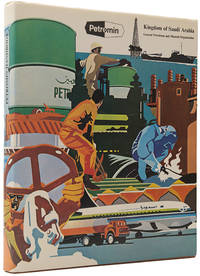
111289Riyadh Petromin 1977. . First edition. 4to 324 pp. illustrated throughout original brown cloth gilt pictorial dustwrapper a fine copy.<br /> Original issued in English as here French and Arabic this is a fine copy of the history of Petromin The General Petroleum and Mineral Organization from its foundation in 1962 up to 1977. The Kingdom's first national oil company Petromin was founded to develop petroleum and mineral resources to the optimum economic advantage of the Kingdom of Saudi Arabia guided by the Government.<br /> Riyadh, Petromin, 1977. hardcover
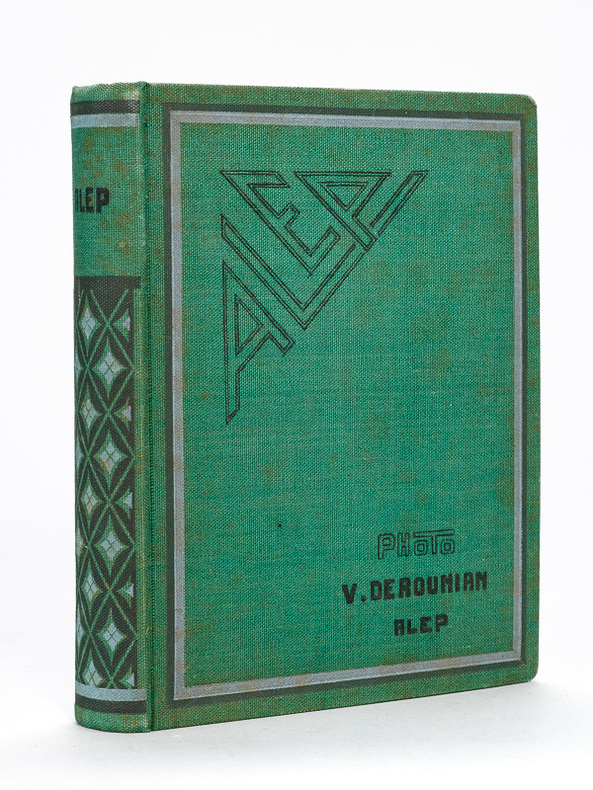
1 album pleine toile verte, format 21,5 x 18 cm, avec 22 photos format 17 x 11 cm, circa 1918-1937, Vartan Derounian Bel album en parfait état, réunissant 22 photographies par Vartan Dérounian, l'un des plus grands photographes arméniens du Proche-Orient de l'Entre-Deux-Guerres. Né à Arapkir en Turquie en 1888, décédé en 1954 à Beyrouth (Liban), Vartan Arounian y débute sa carrière de photographe chez les frères Sarafian en 1911. Il part à Karthoum où il forme son frère Agop. Etabli au Caire pendant la Première Guerre Mondiale, il travaille auprès du suisse Heinzelmann, photographe de la cour égyptienne du sultan d'Egypte et futur roi Fouad Ier. Sitôt la guerre terminée, Vartan et son frère Philippe reparte à Alep, où il épouse la fille du photographe Krikor Missirlian. Photographe reconnu, il se voit confier de nombreuses missions par le Haut-Commissariat français en Syrie et au Liban. Vartan Derounian quittera Alep pour Beyrouth en 1937. Français
Very Good Turkish, Ottoman (1500-1928) Original Ottoman cloth bdg. Cr. 8vo. (20 x 14 cm). In Ottoman script (Old Turkish with Arabic letters). 293 p., 17 b/w plates and 1 folding map, and 1 folding linguistic table (including alphabets used in India such as Sanskrit, Brahmi, Devanagari and their pronunciations in Latin and Arabic alphabets). Slightly loosed spine, skillfully repaired a part of the spine, fading and chipped on the board's extremities, slight stains on the plates. Overall a good copy. Extremely rare (with a map and the plate at the end of the book) first edition of this eye-witness travel account of the Indo-Islamic culture during the British Raj in the late 19th century, by the Hamidian period Turkish ambassador and scholar Sirvanî (1831-1890), who had written and translated three geographical books as well. Sirvânî completed his travel memoirs on his return from India to Constantinople, where he was sent as an ambassador by Sultan Abdulhamid II between 1877-1879. The narrative of his journey begins with the landing in India from Constantinople by ferry. He describes the splendid and fascinating British Indian cities, regions, and buildings such as Bombay, Poona, Dakkan, Udaipur, Baroda, Ajmer, Jaipur, Amber Fortress, Allahabad, Benares, Calcutta, Jaipur, Lucknow, Agra, Alexandre, Delhi, Nepal, Racputana, Indor, Sind, Bundelkhand, Datia, Chatarpur, Bina, Mihr, Bihar, Bengal, Ceylon, Aligarh, Sirhind, Lahore, Kashmir, Dekkan, Orissa, Avrang, Bijapur, Malia, Khandesh, Gujarat, Hugli, Madras, Maisur, Jehlam, Sialkot, Rawalpindi, Nevshar, Mardan, Swat (now in Pakistan), Beloojistan, Peshawar, Afghanistan, Kabul, Ghazna, Kandahar, Herat, Badakhshan, etc. This first-hand travel account offers an invaluable insight into the customs of Indian peoples living in the region as well as the onomastics and ethnography of India and Afghanistan. He met Sayyid Ahmed Khan, who was the founder of the Aligarh University which was famous as the Aligarh School (founded in 1877) among the Indian people. The Aligarh Movement was the push to establish a modern system of education for the Muslim population of British India, during the later decades of the 19th century. The work includes a large chapter of Mecca, where Sirvânî stayed for a long time. He gives detailed information on the Islamic pilgrimage (Haj) and the Arabian Peninsula in this chapter. OCLC 19769728, 1030091889 (Six copies worldwide).; Ihsanoglu, pp. 269-270.; Özege 7654.; Karatay I, 268.; TBTK 1438.
Very Good Turkish, Ottoman (1500-1928) Original wrappers. Foolscap 8vo. (17 x 12 cm). In Ottoman script (Old Turkish with Arabic letters). 152 p. Roumi: 1324 = Gregorian: 1906. Taken from a volume including multiple books. Spine is restored. A very good copy. First and only edition of this early and extensively rare book including a first-hand account of the topography and descriptions of Hejaz, Mecca, and other parts of Arabian Peninsula such as Taif and Yemen by Sadiq Sherif, who was the first person to take photographs of Mecca, Medina, and the Hajj in 1880 and 1881 as well. Sadiq Sherif was the grandson of Serif Abdulmuttalib, the Emîr of Mecca. This book written by Sherif was dedicated to 'the Progress and Union Society' [i.e. Ittihad ve Terakki Cemiyeti]. The book describes the way of administration and territorial division of Hejaz after giving some information of its geography, borders, tribes and natives, mountains, rivers, crops and products, and animals of this Ottoman 'vilâyat' [i.e. province]. Sherif gives detailed information on how and when the Ottoman Empire ruled Hejaz, the location of Mecca city, its borders, physical and social geography, crops in Mecca and around, its flora, fauna, demographic structure, 'nahiyes', Kâba's construction, and its history, sacred places around, Masjid-i Haram and other masjids, cemeteries, mountains, gifts by Ottoman caliphs to Kaba, 'Taif' area, people who were 'Emîr' of Mecca from the period of Mohammad, Wahhabism and its birth, etc. At the last, Sherif gives place to his personal letter (layihâ) including 49 articles. The letter was about the reforms that Hejaz needs and it was sent to the Ottoman 'sadâret' [i.e. prime ministry]. (Source: History of geographical literature during the Ottoman Empire, Edited by Ihsanoglu). Muhammad Sadiq Sherif Bey was the first person to take photographs of Mecca, Medina, and the Hajj in 1880 and 1881. Sadiq Bey trained as a military engineer after completing his studies in Cairo and at the École Polytechnique in Paris. It is not known when, or from whom, Sadiq Bey learned to take photographs but it was most probably through one of the resident photographers in Egypt. In 1861, prompted by the need to carry out more extensive military land surveys of the area between Wajh and Medina, Sadiq Bey made his first journey to Arabia. He took a camera along with his surveying equipment and took his very first photographs of Medina. In a series of articles published in the Egyptian Military Gazette in 1877, he refers to his early photography at Medina describing the use of a 'photographia'. Sadly, however, none of the photographs from this first journey has survived. In 1880 he was appointed as the treasurer of the Mahmal, the ornate cloth to cover the Ka'ba brought each year on a special litter to Mecca. He accompanied the Mahmal to Medina and Mecca from September 1880 until January 1881. Again equipped with his camera, he succeeded in producing the series of photographs that are now considered some of the earliest known photographs of the region, those of the Ka'ba, taken under great secrecy. Sadiq Bey published various accounts of his travels in Arabia in military journals, through the Emiry Grand Press in Cairo, but the 1880/81 series of photographs appear to have been issued separately for wider distribution through the Société Khédiviale de Géographie. The society's secretary, Dr. Frederic Bonola, advertised sets of photographs for sale. In January and April 1880 Sadiq Bey gave a talk and report to the society on his earlier 1861 expedition, and on 20 May 1881 he presented a report on his recent journey to Mecca; detailed accounts were published in the society's bulletins, numbers 9/10 and 12. (Source: Christie's). Özege 11888.; Karatay, TM II: 695.; MKAHTBK, II: 991.; OCLC 248374684 / 4082352.
Large Folio, measuring 56cm x 39cm (15.5 inches x 22 inches). Original printed wrappers. Text is in Italian. [6], 72, [2] pages, plus 7 engraved plates, 5 of which are double-page. Wrappers chipped at extremities, occasional foxing, otherwise in very good condition. Scarce valuable resource on Ptolemaic Egypt. A scarce account, rarely seen in original wrappers, Pieralisi's treatise is a noteworthy study of the late Hellenistic Nile Mosaic of Palestrina, which depicts Ptolemaic Egypt and dates to circa 100 B.C. The author, Don Sante Pieralisi, was a librarian of the Barberini Library in Rome with access to many early scholars' works. The mosaic's history and construction are described, followed by a presentation of some early and compelling theories of interpretation and dating, by such scholars as Barthelemy, Antonio Nibby, Carlo Fea, and Cassiano dal Pozzo (secretary to Francesco Barberini who was largely responsible for its restoration). Much history of ancient Egyptian life can be drawn from the mosaic scenes, including the Nile's yearly flooding, Nubian hunters, mythical or extinct creatures, Egyptian-Roman trade, contrasts between peasant dwellings and palatial life, the rise of magnificent walled cities guarded by Egyptian soldiers, etc. Remarkable engravings reproduce details of the historic masterpiece. The celebrated Nile mosaic dates to circa 100 B.C. during rule of the Ptolemaic Dynasty, the last dynasty of Ancient Egypt (305 BC to 30 BC) and forms an interesting connections between ancient Egyptian and Roman civilizations, and the its essence of its design has, for several centuries, been the center of much speculation. Shortly after publication, the observations by Don Sante Pieralisi accompanied the mosaic on display in the Palazzo Barberini, where it had been placed by Prince Barberini after restoration mid-seventeenth century. Equally interesting is a chapter dedicated to the Rosetta Stone, the ancient stele decree issued at Memphis, also during the Ptolemaic dynasty. The author relates details of the French expedition to Egypt which uncovered it in 1799, and the controversial repossession and transfer to England following the Capitulation of Alexandria. He further presents important details of the temples of Apis, Serapis, and Venus at Memphis, other hidden tombs of Memphis, and pertinent Egyptian rulers.
2 voll. in 8, pp. XXVI + 434 + (2); X + 474 + (2) con 8 tavv. f. t. inc. all'acquaf. e acquarellate e 9 tabelle. Scritta a penna all'occhiello. M. pl. coeva (dorso reataurato). Prima edizione di una delle piu' importanti grammatiche della lingua araba. De Sacy fu uno piu' importanti orientalisti del suo tempo. Una seconda edizione fu pubblicata nel 1831.
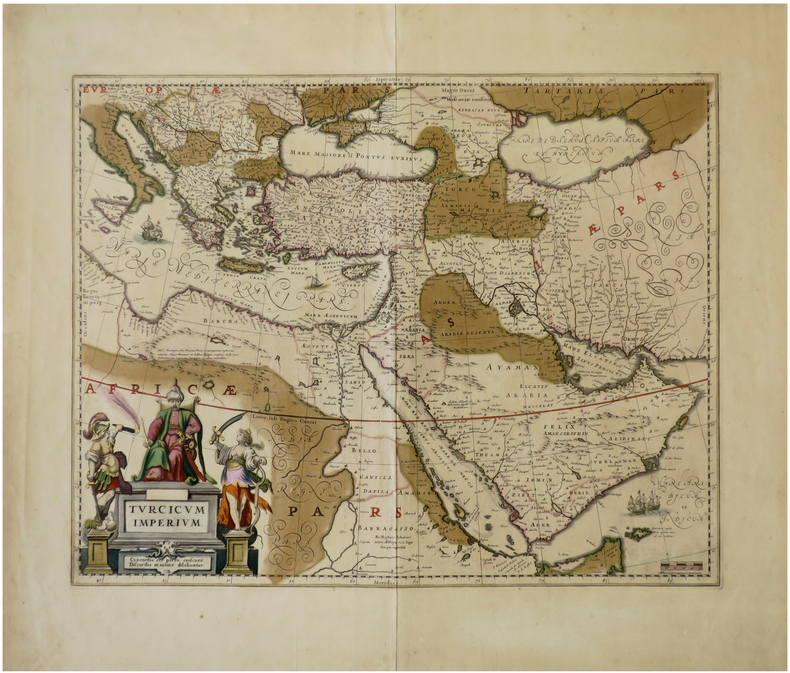
1640LBW-6792[Amsterdam, circa 1640]. 410 x 517 mm.
1930552451 album pleine toile verte, format 21,5 x 18 cm, avec 22 photos format 17 x 11 cm, circa 1918-1937, Vartan Derounian
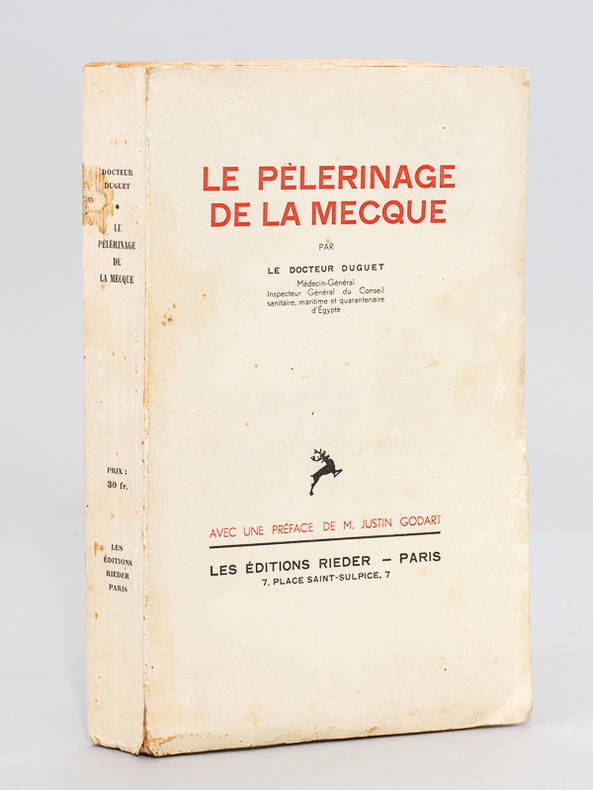
193257680Par le Docteur Duguet, Médecin Général, Inspecteur général du Conseil sanitaire, maritime et quarantenaire d'Egypte, avec une préface de Justin Godart, exemplaire su tirage ordinaire, 1 vol. in-8 br., Les Editions Rieder, 1932, XII-337 pp. avec 8 planches hors texte (16 photos de pèlerins et de Médine, La Mecque, Mina et Arafat)