1 365 résultats
9802Annales de l'Extrême-Orient et de l'Afrique, n° 102. Paris, Challamel, décembre 1886. In-4, broché.
73744Paris, Bernard Grasset, 1937. 14 x 19, 258 pp., 32 hors texte en héliogravure, reliure dos cuir, tranches mouchetées, bon état.
84968Paris, Albin Michel, 1964-1960-1975. 13 x 20, 3 volumes, 454 + 575 + 302 pages, broché + jaquette, bon état.
43353Paris, Arthème Fayard, 1952. 14 x 19, 156 pp., broché, bon état.
48880Québec, Editions Stanké, 1978. 15 x 23, 348 pp., broché, bon état.
45204Editions de la Boussole, 1997. 25 x 22, sans pagination, 68 illustrations en couleurs, 68 miniatures en N/B, reliure d'édition carton imprimé, état neuf.
105.423Paris, Albin Michel, 1956-1960. 13 x 20, 4 volumes, 460 + 446 + 575 + 596 pages, broché, très bon état.
183 p., 495 fig. n/b et coul. En français et néerlandais. Catalogue d'exposition, Bruxelles, Banque Bruxelles-Lamrt, 3 février-26 mars 199. Inv. Th 62
259 p., très nbr. ill. coul. Inv. 17332
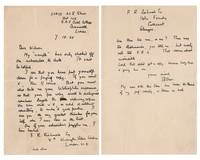
19250088521925. Letter. This 7 September 1925 autograph letter from T. E. Lawrence "of Arabia" to John G. Wilson "the most famous English bookseller of his time" a critical supporter of the legendary 1926 Subscriber's edition of Seven Pillars of Wisdom and one of the select few to receive a complimentary copy from Lawrence. The letter is noteworthy not only for the association but for timing and content as Lawrence was struggling to fill subscriptions for his magnum opus. <br /> <br /> your free copy shall be distinguished somehow beyond the ordinary copies I owe you the very greatest thanks for your help <br /> <br />The letter is addressed and dated at the top right of the first panel "338171 AC II Shaw Hut 105 R.A.F. Cadet College Cranwell Lincs. 7. IX. 25". Following Lawrence's salutation "Dear Wilson" the letter reads: <br />"My "sample" has only choked off one subscriber to date. It can't be helped. I see you have put yourself down for a paying copy. But you must also lend me your bibliophilic experience so that your free copy shall be distinguished somehow beyond the ordinary copies. We can write in it or add or subtract something to make it quite peculiar. I owe you the very greatest thanks for your help when I was low in the list. One of your subscribers puzzles me. I have booked <br />F. R. Richmond Esq. <br />8A Kensington Palace Gardens <br />London W. 8. <br />and also <br />F. R. Richmond Esq. <br />Holm Foundry <br />Cathcart <br />Glasgow. <br />Are these two men or one There were two Richmonds you told me: but surely not to F. R.'s. That seems almost incredible. Lord Bute didn't get a copy: because Lady Bute is giving him one:" <br />Following his valediction "yours sincerely" and signature "T E Shaw." there is a postscript: "My move to the Air Force has broken the thread of my proof-correcting & thrown me back." <br /> <br />Condition <br /> <br />The letter is written in black ink on a single sheet of laid watermarked "ORIGINAL BLACKFRIARS MILL" paper measuring 8.875 x 6.9375 inches folded once to form four 4.375 x 6.9375 inches panels. Lawrence wrote on the first and third of these panels. Condition is very good. The paper is complete with no loss tears or appreciable wear other than an additional horizontal fold from original posting. The paper shows light overall soiling to the first and fourth outer panels and perhaps a faint hint of spotting to the lower front panel. Lawrence's ink remains clear and unfaded. The letter is protected within a clear removable archival sleeve housed within a rigid crimson cloth folder. <br /> <br />Lawrence of Arabia <br /> <br />During the First World War Thomas Edward T. E. Lawrence 1888-1935 experienced a transformative odyssey as instigator organizer hero and tragic figure of the Arab Revolt against the Ottoman Empire which he began as an eccentric junior intelligence officer and ended as "Lawrence of Arabia. He spent the rest of his famously short life struggling to variously reconcile reject share and repress this indelible experience which was eventually recounted in his magnum opus Seven Pillars of Wisdom. <br /> <br />Hiding and writing in the R.A.F. <br /> <br />As part of his effort to evade his celebrity in August 1922 Lawrence enlisted in the Royal Air Force first under the name John Hume Ross and later Thomas Edward Shaw a name he used until his death. Hence from that time forward he seldom signed with his original surname. By December 1922 Lawrence had with a close circle of friends decided to produce 100 copies of the Seven Pillars at thirty guineas a copy if so many subscribers can be found. So September 1925 found Lawrence officially Aircraftsman Shaw residing in Hut 105 of the R. A. F. Cadet College at Cranwell trying to both duck and recount the events that had made him so uncomfortably famous. By the time Lawrence wrote this letter to Wilson in 9 September 1925 he was well into the elaborate preparation of and corresponding expenses for his famous Subscribers edition of Seven Pillars of Wisdom. Subscribers were fewer than had been hoped and Wilson was to prove of material help. <br /> <br />John Gideon Wilson <br /> <br />John Gideon Wilson 1876-1963 was manager of Bumpus bookshop "the most famous English bookseller of his time" and a significant even critical supporter of the famous 1926 Subscriber's edition of Seven Pillars of Wisdom. "Described as 'massively wise and unassumedly learned' this lovable man was endowed with a rare simplicity. In his shop Wilson might be found conversing with the poet laureate or wrapping up the purchase of a schoolboy. His assessment of authors and their books was quick and sure and his advice always valid was freely given to authors publishers and his fellow booksellers." Given his literate and approachable character and his commercial stature it seems no surprise that he and Lawrence found opportunity to collaborate. <br /> <br />More than just a friend and subscriber <br /> <br />Today when Subscriber's editions of Lawrence's magnum opus routinely command $six-figure sums it is almost prohibitively difficult to imagine any challenge in securing subscribers for the mere 202 copies eventually issued. But at the time Lawrence's expenses in producing the edition to his exacting and lavish specifications were extravagant and for much of 1925 he was genuinely concerned by a lack of anticipated subscriber commitments. It was to Wilson that Lawrence had turned earlier in the year when facing the prospect "that the plans for a thirty-guinea subscription edition had been over optimistic. By mid-March three months after the start of the project only twenty-six subscribers had been found" while estimated costs to produce the edition were proving higher than anticipated. Lawrence wrote to Wilson who was both manager of Bumpus bookshop in London and bookseller to the King asking if Wilson "would like to place twenty copies at the thirty guineas price." Six worrisome months later prospects had improved - due in no small part to Wilson. "By the middle of September" a week after Lawrence wrote this letter to him "Wilson had added a block of subscriptions and the total suddenly jumped to eighty." <br /> <br />Bookseller to the King <br /> <br />Indeed when completed by the binders in November 1926 Lawrence sent "the very first of these" to the Royal Library at Windsor which "had taken out a subscription" having placed the order through J. G. Wilson. For this copy Lawrence returned the advance cheque writing in advance explanation to Wilson ".it seems improper that Kings should buy and sell among their subjects." <br /> <br />Wilson was clearly a trusted figure; in 1928 when Lawrence was collaborating with Bruce Rogers on their famous rendering of Homer's Odyssey Wilson was one of the few trusted early with the knowledge that Lawrence was to be the translator. Following Lawrence's death in 1935 Wilson had a hand in the disposal of Lawrence's personal library from his beloved Clouds Hill cottage. <br /> <br />A doubly privileged recipient <br /> <br />Ultimately there were only 211 copies of the Subscriber's Edition of which 170 were complete copies 32 incomplete and 9 spoils. No two copies are identical. In addition to various differences in inclusion and placement of the many illustrations each copy was bound differently. Wilson would have a hand in selling an appreciable percentage of the 170 available for sale to subscribers. Speaking to his importance to the edition and as substantiated by this letter Wilson would personally receive not only one of the 32 incomplete copies that Lawrence gifted to friends and comrades from the Arab Revolt but also one of the 170 complete copies. <br /> <br />References: Wilson Lawrence of Arabia; ODNB; Richard Knowles Rickaro Books <br/><br/> unknown
2005137710ABC Millennium 2005 Livre en anglais. Ex-dono. In-4 cartonnage éditeur, 33 cm sur 25. 156 pages. Bon état d’occasion.
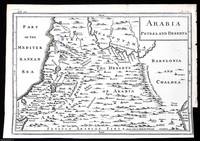
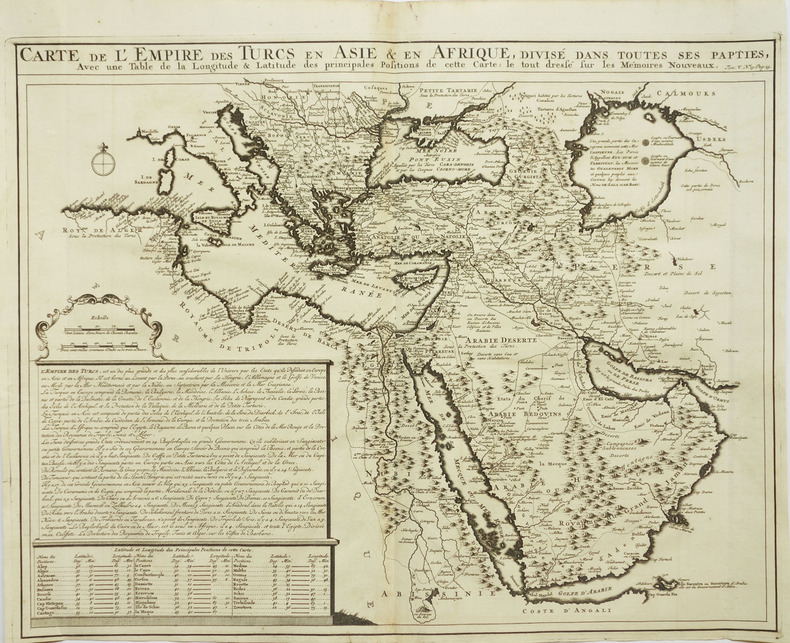
1748372049Printed for T. Osborne in Gray's Inn; A. Miller in the Strand; and J. Osborn in Paternoster Row London 1748. Unframed Print. Very Good Condition. This 1748 engraved map provides a detailed representation of Arabia Petraea the region covering parts of modern-day Jordan Sinai and northwestern Saudi Arabia and Arabia Deserta the vast desert lands of the Arabian Peninsula. It highlights key geographical features ancient trade routes and settlements reflecting the European understanding of the region at the time. The engraving was printed in London by T. Osborne A. Miller and J. Osborn.1 folding plate. Close cropped at the right margin. Size: 20 x 30 cms. Category: Universal History; PRINTS : Antiquarian Interest; Printed before 1800; Special Features. This item may require more postage than the rates shown for delivery outside the UK. If extra postage is required we will contact you before processing your order and you will be given the details and option to decline the extra cost. Printed for T. Osborne, in Gray's Inn; A. Miller, in the Strand; and J. Osborn, in Paternoster Row unknown
196496057Bonn: [Knauth], 1964. 112 S. MIt zahlr. s/w Abb. (= Kulturzentrum der Vereinigten Arabischen Republik in Bonn, 6). 22 cm. OBrosch.
2085in 12 broché faux-titre,titre,130 pages,1 feuillet de table,NRF Gallimard 1947 Très bon état
DJ lighly chipped ; 8vo; 128 pages
Aav, Marianne & Eeva ViljIn Pristine Condition. unknown
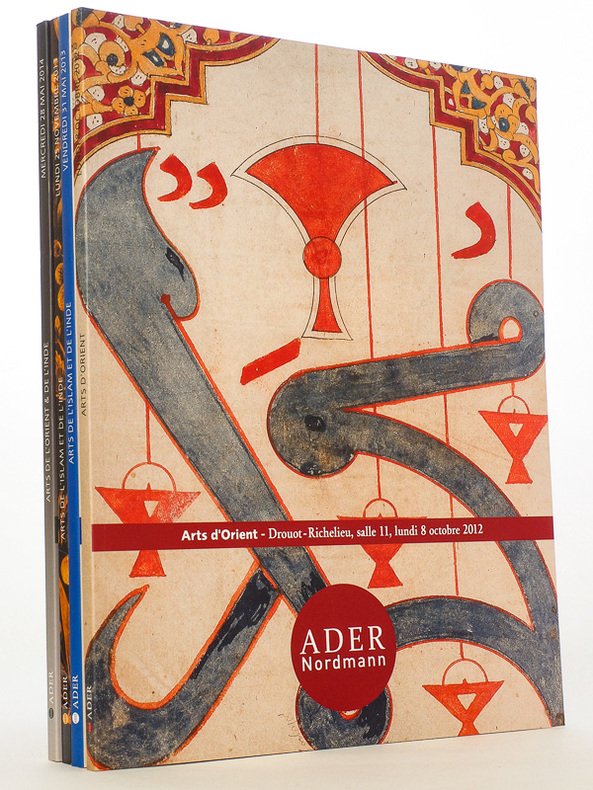
4 vol. in-4 br., couv. ill. couleurs, nombr. photos couleurs, Ader Société de Ventes Volontaires, Hôtel Drouot, Paris, 2012, 2013 et 2014, 95 pp., 109 pp. 107 pp. et 107 pp., pour 176, 251, 211 et 278 pièces proposées. Rappel de la liste des catalogues : Arts d'Orient, collection de M. et Mme X. et à divers, dont un salon syrien daté 1232H./1815 (8 octobre 2012) ; Arts de l'Islam et de l'Inde (31 mai 2013) ; Arts de l'Islam et de l'Inde (25 novembre 2013) ; Arts de l'Orient et de l'Inde (28 mai 2014) Très bon état pour ces catalogues aux belles illustrations couleurs. Prix pour l'ensemble. Français
2014509224 vol. in-4 br., couv. ill. couleurs, nombr. photos couleurs, Ader Société de Ventes Volontaires, Hôtel Drouot, Paris, 2012, 2013 et 2014, 95 pp., 109 pp. 107 pp. et 107 pp., pour 176, 251, 211 et 278 pièces proposées. Rappel de la liste des catalogues : Arts d'Orient, collection de M. et Mme X. et à divers, dont un salon syrien daté 1232H./1815 (8 octobre 2012) ; Arts de l'Islam et de l'Inde (31 mai 2013) ; Arts de l'Islam et de l'Inde (25 novembre 2013) ; Arts de l'Orient et de l'Inde (28 mai 2014)
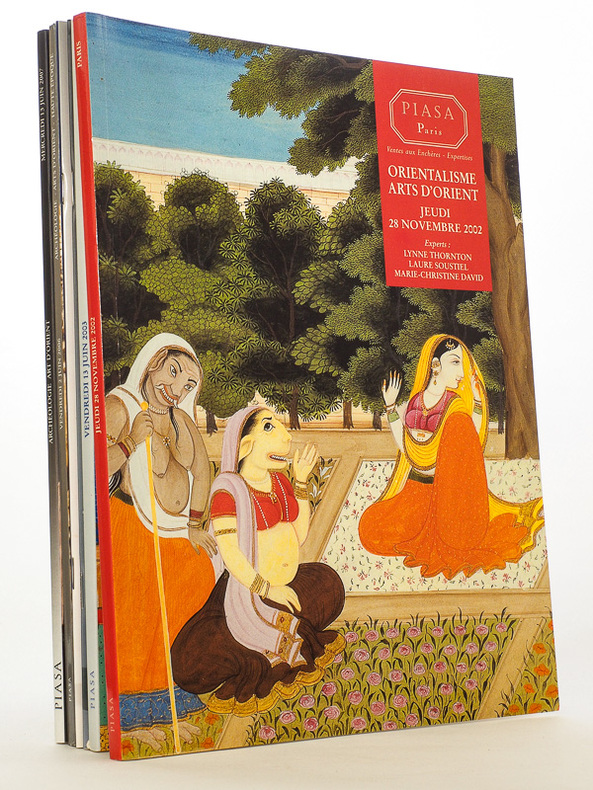
6 vol. in-4 br., couv. ill. couleurs, PIASA Paris, Drouot-Richelieu, 2002 à 2007, env. 60 à 80 pp. et de 250 à 330 réf. par catalogue. Rappel de la liste des catalogues : Orientalisme, art d'orient (28 novembre 2002) ; Archéologie, orientalisme, arts d'orient, Océanie, Haute époque (13 juin 2003) ; Archéologie, orientalisme, arts d'orient, Océanie, Haute époque (7 juin 2004) ; Art islamique, Antiques, Icônes, Haute époque (22 avril 2005) ; Archéologie, arts d'orient, Haute époque (2 juin 2006) ; Archéologie, Art d'Orient (13 juin 2007) Très bon état pour ce lot de beaux catalogues. Prix pour l'ensemble Français
2007509216 vol. in-4 br., couv. ill. couleurs, PIASA Paris, Drouot-Richelieu, 2002 à 2007, env. 60 à 80 pp. et de 250 à 330 réf. par catalogue. Rappel de la liste des catalogues : Orientalisme, art d'orient (28 novembre 2002) ; Archéologie, orientalisme, arts d'orient, Océanie, Haute époque (13 juin 2003) ; Archéologie, orientalisme, arts d'orient, Océanie, Haute époque (7 juin 2004) ; Art islamique, Antiques, Icônes, Haute époque (22 avril 2005) ; Archéologie, arts d'orient, Haute époque (2 juin 2006) ; Archéologie, Art d'Orient (13 juin 2007)
Very Good Turkish, Ottoman (1500-1928) In contemporary fine black 1/3 leather bdg. Decorated gilt to spine. Roy. 8vo. (23 x 16 cm). In Ottoman script (Old Turkish with Arabic letters). 112 p. Extremely rare first edition of this Nabi's first-hand account of Mecca, Medina and the Hejaz during his pilgrimage in the late 17th century. This is the most celebrated literary pilgrimage narrative written in Ottoman Turkish. Nabi (1642-1712) was one of the prominent Ottoman poets and is considered a foremost exponent of the didactic trend (hikem-i tarz) in Ottoman Turkish literature. Nabi, whose given name was Yusuf, was born in Urfa (then known as Ruha) in 1052/1642. In 1082/1671 he took part in the Ottoman military campaign in Poland, in the retinue of Müsahib Pasha, (1640-1686). Having spent thirteen years in Istanbul, Nabi desired to go on a pilgrimage to Mecca. He was personally ready to undertake a journey to the Hijaz and to set down an eloquent account of his journey, the experience of his lifetime. Accordingly, having achieved a position of good standing with his patrons, Müsahib Mustafa Pasha and Mehmed IV, Nabi revived his longstanding desire to perform the hajj. In 1089/1678, at around 37 years of age, he set out in a small private caravan from Istanbul, passing through Konya, Urfa, Damascus, Jerusalem and Cairo, where he joined the main Egyptian pilgrimage caravan. The work, which is one of the most successful examples of Ottoman insa (artistic prose), includes historical, sociological, geographical and autobiographical information. In his preliminary remarks, Nabi indicates that he had received governmental help for his journey. He relates that he first obtained leave for the hajj from his patron Musahib Mustafa Pasha, and then submitted a qasida to Mehmed IV, describing the sacred places. The sultan provided Nabi a letter of recommendation addressed to Abdurrahman Pasha (d. 1691), governor of Egypt, ordering him to enable Nabi to make a comfortable journey. Nabi traveled in a small private caravan, since the caravan extended its route to Nabi's homeland, Urfa, and spent about fifty days there. It appears that he generally followed the usual route of the pilgrimage caravan from Istanbul to Damascus, passing through Scutari, Kartal, Gebze, Hersek, Iznik, Eskisehir, Seyitgazi, Aksehir, Ilgin, Ladik, Konia, Eregli, Adana, Misis bridge, Payas, Antioche, Aleppo (with a long detour to Urfa (Edessa) and back to Aleppo via Aintab), Hama, Hims and the Kuteyfe strait. He was fascinated with the splendid architecture of the buildings, the bazaars and the mosques built side by side by Kurdish and Circassian rulers and the Nile when he arrived in Cairo. Nabi gives a general description of the city of Cairo, the Nile, the two reservoirs of the city, parklands, the Ahram hills and the immediate neighborhood of the city. In Mecca, Nabi visited the sacred sites enthusiastically and performed the hajj on 77 January 1679. He gives a moving account of his experience as a pious emotional pilgrim. It appears that Nabi stayed in Mecca for more than twenty days. Immediately after 1 Muharrem 1090/12 February 1679, he set out for Medina, presumably in the Damascus caravan. While in Medina, Nabi served at the tomb of the Prophet by lighting the candles since his name was on the honorary list of attendants who were determined by the central government to serve the sanctuaries in Mecca and Medina. Nabi regards these services as a testimony to the legitimacy of Ottoman rule. He summarizes his journey of return from Medina to Damascus and to Istanbul in a few general words. Özege 21267.; Not in OCLC.
Very Good Turkish, Ottoman (1500-1928) Paperback. With a pictorial cover. Large roy. 8vo. (23 x 18 cm). In Ottoman script [and French on the cover]. 355-442 pp., ills. Bilingual cover is written 'Medeniyet Ordusu Yemen çöllerinde' and 'L!Armee dans le Desert de Yemen' bilingual in Turkish with Arabic script and in French. [i.e. The Ottoman civilized army in the desert of Yemen]. Extremely rare.
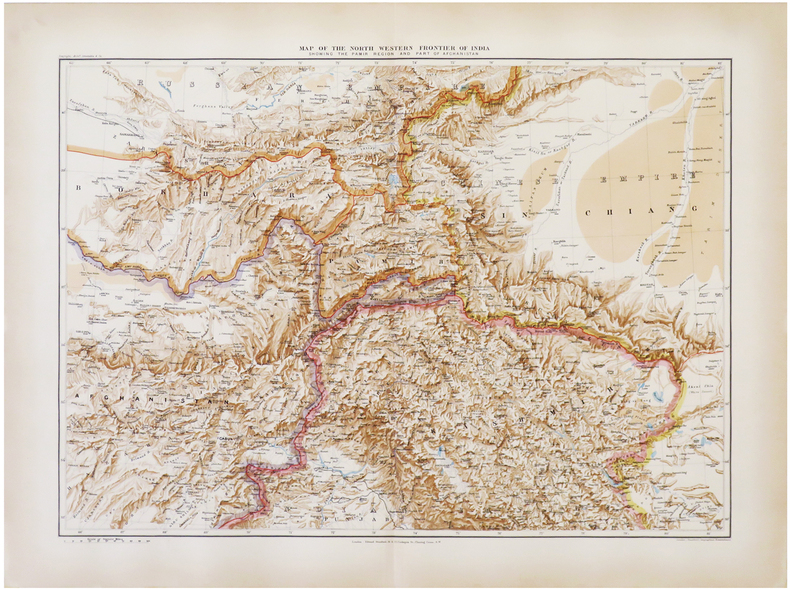
1896LBW-6821London, Edward Stanford, 1896. 470 x 640 mm.
Very Good Turkish, Ottoman (1500-1928) Contemporary 1/3 leather bdg. with cloth spine. Leather boards. Restored. Demy 8vo. (22 x 15 cm). In Arabic. [138] p. Slightly chipped extremities of papers. Occasionally stained on pages, wear on binding. Text is fine. Including 'kataba'. The routine, predictable, yet exhaustive nature of the journey Ottoman pilgrims endured may have discouraged them from recording their journeys. The route was relatively well-defined, and the caravan orderly and well-protected. Moreover, Ottoman pilgrims, unlike Christian travelers, were traveling across the lands of the same state, thus seeing people of the same Muslim culture, without needing to speak different languages, use different currencies, or negotiate borders between states. The uniqueness and peculiarity of a journey would motivate the traveler to record it and the result would be of interest to an audience. As for the Ottomans, if the texts which were composed to help future pilgrims with practical information are excluded, the majority of known narratives, are written by those authors such as Ahmed Fakih, Fevri, Evliya Çelebi, Nabi, and Shaikh Sinan er-Rûmî who undertook at least some parts of their journeys independently of the official caravan. Texts which seem to have been intended simply to provide practical information either on the stations or on the rites of the hajj or on both are defined as guidebooks. These texts appear not to be based on a particular pilgrimage journey, regardless of the fact that their authors might have performed the hajj. This manuscript starts with 'Bayân al-Menâzil Beyt Al-Sam wa al-Qabah' [i.e. Descriptions and stations from Damascus to Mecca] including a very detailed routes' list with their times hour by hour. 40 routes and hours probably by mounts and/or walking between Damascus and Mecca, Qaba. Other chapters of the text include rites and routes like "Farziyyat of Hajj, Ihram, Mukhrima, entry to Mecca-i Muqarrama, tawaf, Sa'y between Safa and Marwa, Arafat in Mecca, Muzdalifa from Arafat, Ef'al in Mina, Umra, Taawaf al-Vedâ, Qabr-i Sharif in Medina al-Munawwara, etc. Sheikh Sinan Al-Roumi's manasik al-hajj is one of the most important and famous ones in the hajj literature of the Islamic world. It was a mostly used reference book among Muslim pilgrims, especially in the Ottoman world. Calligrapher and copied by Ahmed b. Muhammed b. Suleyman. Text in black ink and important headings in red ink on paper with 'ahar'. A fine paper suitable for calligraphy. A very good example from the first half of the 18th century.