1 365 résultats
773701like new. unknown
773701-nnew. unknown
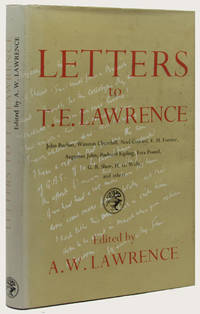
196431996London: Jonathan Cape 1964. First Edition Second impression. 8vo publisher's original gray boards lettered in gilt on the spine in the printed an decorated dustjacket. 216 pp. A very fine copy beautifully preserved and near as pristine. A VERY FINE COPY OF THE LETTERS TO T. E. LAWRENCE COLLECTED AND EDITED BY HIS BROTHER. SOON WOULD COME THE MOVIE VERSION OF 'LAWRENCE OF ARABIA' STARRING PETER O'TOOLE. In A. W. Lawrence's own words "In recent years my brother has been inadequately portrayed or mis-portrayed in books and on the stage and if he is made the subject of a film the limitations of that medium will at the best entail an extreme simplification of the character. As a corrective I am publishing some letters to him selected from the very large number preserved in the belief that they will throw light upon their recipient no less than upon their writers. To me at any rate his personality is reflected distinctly by the collection as a whole." <br> Among the writers of the letters will be found; A. J. Balfour Gertrude Bell Edmund Blunden Wilfrid Scawen Blunt Robert Bridges H. G. Wells John Buchan Winston Churchill Noel Coward E. M. Forster George B. Shaw Augustus John and Ezra Pound. A fascinating look into the times and the people that made it so historically significant. Jonathan Cape hardcover
As New As New English Original bdg. Dust wrapper. Folio. (34 x 24 cm). In English. 380 p., color and b/w ills. Architectureal achievements of King Abdul-Aziz in the honored area of Makkah, 1924-1953. "This book includes a general survey of the architectural accomplishments of King Abdul-Aziz in the Honored Area of Makkah. Those works include the Holy Kaba, the Al-Haram Mosque, the Zamzam Well, the Mosques, the Water Fountains, the Wells, the Water Dams, Road making, field opening and Airport construction projects, Road stops, Hospitals and others. This book records most of such works of restoration and building. It is also supported by pictures and drawings that shed some light on those projects".
This is a fine hardcover copy in a fine dust jacket with almost no wear. Completely clean inside and out. This survey, edited by David Revere McFadden, the Curator at the Cooper-Hewitt Museum of Design in New York, accompanied the exhibition there in 1982. With articles by McFadden, Ulf Hard Segerstad, Helena Dahlbeck Lutteman, Elisabet Stavenow-Hidemark, Erik Lassen, Jarno Peltronen, Peter Anker, Jan-Lauritz Opstad among others. The exhibition covered furniture, glass, ceramics, textiles and metalwork. 346 illustrations in color and black & white. Bibliography. Biographical notes on the designers. Still one of the best general works on Scandinavian design. 11" high X 9" wide, 287 pages. Large heavy book, foreign shipping will be extra. This book will be securely wrapped and packed in a sturdy box and shipped with tracking.
1948ARABIA016090George Allen & Unwin London. 1948. First edition. Octavo. 314 pages. Photographs and maps. A biography of the man who was Emir of Mecca and became engaged in Arab nationalism during the First World War.Fore-edge a bit spotted. Very good in very good price-clipped dustwrapper slightly rubbed at the edges a bit marked on the rear panel and with a few short closed tear to top edge. George Allen & Unwin, London. unknown
1964632651 vol. in-8 br., A. G. Nizet, Paris, 1964, 1964, 547 pp.
193088771Milano, Sperling & Kupfer, [1930]. XXVIII TextS. und 272 einfarb. Fototaf. in Kupfertiefdruck. (= Orbis Terrarum). 4to. 31cm. Braunes OLn.
1601In 12 broché,frontispice,332 pages,complet des 13 gravu- res Hors-texte sous serpentes(y compris le frontispice) Henri Plon éditeur 1872.couverture doublée
20047008Suomen Antiikki- ja Taidekirjat Ltd 2004. 2nd Edition. Softcover. Fine. Text in Finnish Swedish and English. 119 pp. Suomen Antiikki- ja Taidekirjat Ltd paperback
14685Collection of three original steel engravings of the Castle of the Sultan of Aden at Lahadj 2 Arabian men shaking hands and a camel on a voyage titled: "Chateau Du Saltan d'Aden a Lahadj" "Salut des Arabes" & "Chameau scelle pour le Voyage" from Picturesque Universe published by Firmin Didot in 1847. Size: 5" x 8.2." The first engraving shows a beautiful and picturesque view of the Sultan of Aden's Castle and surrounding countryside with depictions of palm trees and mountians. The second depicts a greeting between two Arab men who are seen shaking hands. And the final engraving depicts a camel in the desert. Some age related toning pin holes in the top margin and remenants of a sticker in the top right corner of first image.Third engraving with past staple marks and a 4cm paper loss along top edge not affecting image. Overall the engravings in very good condition. unknown books
19662091202133001753Kadokawashoten 1966. Soft Cover. Fine. Number of books: 1 Kadokawashoten paperback
19862090502113709227Not Available 1986. Soft Cover. Fine. The book is in fine condition. Not Available paperback
Light wear to DJ extremities with laminate peeling; Lavishly illustrated with numerous fold-outs. Photogravures; The Arts of Mankind; B&W and Color Illustrations; 4to 11" - 13" tall; 401 pages
New New Turkish Original bdg. Dust wrapper. 4to. (33 x 25 cm). In Turkish. 461 p., color ills. Kutsal mekanlarda kutsanmis örtüler. Topkapi Sarayi'ndan örneklerle Kâbe örtüleri.
New Arabic Original bdg. HC. Roy. 8vo. (24 x 17 cm). Edition in Arabic. [xLii], 619 p., ills. Dalil al-arshif al-'Uthmani: Fihris jami' li-watha'iq al-dawlah al-'Uthmaniyah fi? arshif ri'asat al-wuzara' al-Turkiyah. Translated into Arabic by Salih Sadawi. Preface by Halit Eren. The archival materials inherited from the Ottoman State constitute a unique fund of references as regards the history of all the regions and present nation states which were once part of the Ottoman world: Arab countries, the Balkans, the Mediterranean, North Africa, etc. The collections preserved at the Department of Ottoman Archives attached to the Directorate General of State Archives, Prime Ministry of the Republic of Turkey, are the State archives of the Ottoman Empire. This is the Arabic translation of the guidebook that was published by the Prime Ministry's Directorate General of State Archives in 2000. The Introduction gives information on the Ottoman state archive system, the evolution of the archive, the classifications of the collections. The book gives information on the contents of the collections of the Imperial Council, the Imperial Registry, the Sublime Porte, Yildiz Palace, the different departments of the State, the provincial archives; the third section describes the collections of maps, albums and photographs, collections transferred from personal archives and catalogues of documents contained in archives within and outside Turkey. The fourth section describes the administrative structure of the Directorate General of State Archives and the rules to be followed while doing research index is added to the guidebook.
Wear with chipping, staining, and open tears to price clipped DJ. Residue to endpapers. Front hinge started. Binding not tight ; Author Stark searches for the trail of Alexander the Great ; B&W Photographs; 8vo; 283 pages
35 pages. Plus photographic plates and a large fold-out color map, measuring approximately 8 x 14.5 inches (20 x 37cm). Original condition with blue wrappers, titles to front, and containing all the ads. This is a complete issue, seldom found in such good and original condition. Interesting narrative from a learned source, Sir Percy Cox, adviser to the Sultan of Oman and long term resident of the Persian Gulf. Cox outlines journeys undertaken from Abu Dhabi to Baraimi and along the fringe of Oman on the desert side, to the Jabal Akhdhar or Green Mountains - a distance of about 400 miles; and also his trip from Ras al Khaima to Baraimi and to the coast at Shinas, along it to Sohar. Features descriptions of Oman's capital - Muscat, the Trucial coast, its principalities and the Great Pearl Bank, local fauna, 'the music of the sands,' Ras al Khaima, stronghold of the Jowasmi pirates, and most interestingly perhaps, encounters with local sheikhs. Accompanied by photographic plates and a large fold-out colour map, this narrative also includes comments and notes by veteran Arabia explorers such as H. St. J.B. Philby.
Two reports on Persia altogether 45 pages including a full-page sketch map, plus 2 large fold-out colour maps. In original condition with blue wrappers, titles to front, and containing all the ads. This is a complete issue, seldom found in such good and original condition. The first report: 24 pages, including a full-page sketch map, plus a large fold-out color map measuring 18.5 inches x 8.5 inches (47cm x 22cm). This is an exceptional expedition report on the Karun River and the commercial geography of south-west Persia, that pre-dates the authors all-important book, "Persia and the Persian Question", first published in 1892. The book is one of the most important books on Persia; dealing with every aspect of Persia, political, archaeological, cultural, etc., its great strength is its topographical section. As Ghani says, "his powers of observation and analysis were extraordinary; no detail ever escaped him. His book can still be used as a topographical guide for travel in Iran." Ghani 87. This makes this report a highly valuable important primary resource. The second report: 21 pages, plus a large fold-out color map, measuring approximately 13 inches x 21 inches (33 cm x 53 cm). Featuring first hand observations of nomadic Bakhtiari tribes, Lynch's chronology recounts his nineteenth century journey in Persia, which he delineates on a large colour map, showing his route from the ancient fortress city Shushter in the Khuzestan province, to Ispahan (Esfahan). Early adventure in West and Central Iran, comprising river-crossings, summit climbs, and destitute villages.
Title: Jauf and the North Arabian Desert. Author: H. St. J. B. Philby Publisher: London: Edward Stanford, Royal Geographical Society, 1923. Item is in Original Condition, with Blue Wrappers - As Issued, Complete with All the Ads! Notes & Condition: Philby recounts a journey made in 1922 together with railway engineer Major Holt, through Jordan to Jauf [Al Jawf Region, Al-Jouf] and into Iraq as far as Karbala, for the purpose of investigating the area's unstable political situation, and to examine possibilities of building a railway in the Wadi Sirhan valley. Beginning with a fascinating summary of a most unstable government indeed, Philby describes an ongoing power struggle between two dynasties, inter-tribal raids, a slave governor being murdered, betrayals and quarrels over land, so forth. The pair travelled to Medina, to the volcanic lava field of Harrat al-Shamah where they found some Safaitic inscriptions on stone, then to Sakaka where they stayed for nine days, and eventually arriving at the Al-Ukhaidir Fortress and the city of Karbala [Iraq], to be hosted by the Arab governor. Choosing a safe route was imperative as rebel holdings were prolific, particularly in the Al-Jawf Region. Once their mission was accomplished they made their way north for Ramadi, from where a flight would take them back to Amman. Interesting accounts describe inhospitable places and encounters, most notably the house of Sha'lan whose members were able to impede the expedition for some time. Philby's observations further include the important village of Kaf and its citizens, the Quraiyat salt -pans which are worked by the Badawin [Bedouins]; the plain of Ithra and its settlement of the black tents of the Ruwalla; the vast, dazzling, white salt marsh of Nuqrat al Hadhaudha, the prominent landmark of Kharana; Shaib Shanmari and in Jauf itself, the great medieval Arab fortress of Qasr Marid, the ruins of the hamlets of Suq and Suq al Hattab, the Safaitic inscriptions at Harrat; at the Sultan's invitation, a visit to Sakaka; the oasis of Qara; Suluba; the wells of Abal Dufuf; the magnificent ruins of Ukhaidir; Abu Dibis and Amadi. Photographic plates provide excellent visuals from the journey. Philby's account is accompanied by a large highly detailed fold-out colour map and a report by Major A. L. Holt titled, "The Future of the North Arabian Desert," which outlines his work in terms of developing communications through the desert, and a compelling argument promoting the desert as an important trade route. Holt accompanied Philby on his extraordinary Arabian adventure. At the time of this expedition, Philby was chief head of the Secret Service in Mandatory Palestine (since November 1921), working with T. E. Lawrence and meeting his American counterpart, Allen Dulles. 8vo. Two reports, 39 pages combined, plus a large fold-out colour map measuring approximately 59 x 34 cm, and photographic plates for illustration. Original condition with blue wrappers, titles to front, and containing all the ads. This is a complete issue, seldom found in such good and original condition. Excerpt from the text: "We left Amman on 10 March 1922... my personal preference... camels over mechanical transport in the real desert... in country where no organized route exists" "... The introduction of modern firearms has been a curse and veritable scourge to Arabia and its independent, individualistic denizens... the Arab social code of raid and rapine has not shown any signs as of yet of adjusting itself..." "... the northern desert of Arabia is at the present moment unsafe in the widest sense of the term - unsafe for the innocent traveller, the merchant, and the shepherd - there are already signs of a welcome change in the south, where Ibn Sa'ud has created a well-knit polity on a religious basis and has found himself strong enough to prohibit tribal raiding within his borders." "Our reception by the authorities of Kaf was cordial enough though guarded.... We were not allowed to visit the natural fortress ... called Qasr Sa'idi... a small guard of some twenty-five men with machine guns... Kaf is commanded by this eminence..." "... within a month of our sojourn at Jauf, we heard of the downfall of the house of Sha'lan at the hands of Ibn Sa'ud. As rulers they were detested by their own people, whom they treated with insolent harshness..." "Every human seen in the desert is an enemy, and the weaker party must make its best speed away if it would escape death." End Excerpt. Harry St John Bridger Philby, Order of the Indian Empire (CIE) (1885-1960), also known as Jack Philby or Sheikh Abdullah, was a British Arabist, explorer, writer, colonial office intelligence officer, and adviser to the first monarch of Saudi Arabia. Philby joined the British Foreign Service in 1917 and was the first European to visit the southern desert of Arabia. He was the first European to enter Abha, the capital of Najran, the frontier district between the Wahhabis and the Yemenites, and the second to visit Shabwa, although he was the first to explore the ruins where he discovered the great temple of Astarte. During Philby's explorations of Arabia, he came into contact with Ibn Saud, and was greatly influenced by the Wahabi ideology and culture, converting to Islam and renouncing his faith in Christianity.
Notes & Condition: Philby, a famed Arabian explorer and father of master spy Kim Philby, renounced British policy, became a Moslem, and joined the Wahabis. This expedition report Predates Philby's Book, entitled, Sheba's Daughters, Being a Record of Travel in Southern Arabia, With an Appendix on the Rock Inscriptions by A.F.L.Beeston, First Published in 1939. The account of a journey made by the author, Ibn Saud’s official adviser, from the King’s camp on the Mecca to Riyadh road to the Indian Ocean. Philby was the first European to enter Abha, the capital of Najran, the frontier district between the Wahhabis and the Yemenites, and the second to visit Shabwa, although he was the first to explore the ruins where he discovered the great temple of Astarte. An excellent account of Philby's travels in southern Arabia, particularly the Hadhramaut in 1936. The longest of Philby's journeys, ostensibly to map the new frontier with Yemen. Until the 1930's the highlands of south-west corner of Arabia were among the world's few remaining lands not fully explored or charted. Into that region Philby, author and explorer, made two journeys, the first in 1932, and the second in 1936 and 1937. This important Arabian Expedition is an account of exploration, containing valuable material on the Yemeni-Saudi borders, and excellent quality photographs taken for the first time in that area by a European. This narrative was published within two complete monthly issues, July and August, of the Geographical Journal.This is August issue only, 26 pages, plus black and white photographic plates and a large fold-out colour map measuring approximately 14 x 24 inches (35 x 61cm). This issue is in original condition with blue wrappers, titles to front, and containing all the ad, seldom found in such good and original condition.
16 pages, including a full-pages sketch map. Plus photographic plates. Original condition with blue wrappers, titles to front, and containing all the ads. This is a complete issue, seldom found in such good and original condition. In this fascinating report the author discusses the demarcation of the Turco-Persian Boundary and the three main efforts to settle it, which had each been interrupted by a great European war. Illustrations include the Karun, Kushk-I-Basri, North of Mohammerah, Proceeding to the First Boundary Pillar up River from Mohammerah, Crossing the Karha at Kut Saivid Ali, Commission searching for the Shatt Al Ama, Bakuba on the Diyala, Kurds and survey Khalassis, Commission crossing the Zab and Caravan on the March in the Tavila District.
50 pages, in two consecutive issues as published. Plus photographic illustrations, and a fold-out color map measuring approximately 9 x 7.5 inches (23 x 19cm). Original condition with blue wrappers, titles to front, and containing all the ads. Two complete issues, seldom found in such good and original condition. The famous author's groundbreaking explorations between Upper Swat and the Indus in 1926 are passionately recounted by him in this preliminary report. During the archaeological tour of Graeco-Buddhist remains in Swat (now in the far north of Pakistan), Stein located Alexander's trail and traced it to Pir Sar at a bend in the Indus. Stein's main object was indeed to personally follow the track of Alexander the Great in the region, as far as it was accessible outside of Afghanistan. Prior to the discussion of the exploits described in this work, this region was beyond the administrative border of the Indian North-West Frontier, and was inaccessible to Europeans. This is the first major Western account of these areas. Stein's account pre-dates his important book by two years, "On Alexander's Track to the Indus. Personal Narrative of Explorations on the North-West Frontier of India," first published in 1929. Aurel Stein's surveys were inspired by archaeological and historical interests, and his fascination with the cultures of Cental Asia. Trained as an Orientalist and archaeologist, he planned several expeditions to the interior of Asia and used Sanskrit, Persian, Chinese, Turkish, Greek and Latin as scholarly tools to unlock the geographical puzzles, in the process making valuable topographical surveys and penned down his experiences in his famous books. The routes and battlefields of Alexander’s campaign in the east had been a long-standing interest of Stein’s and whilst surveying for the Indian Government on the North-West frontier he was able to indulge his fascination. (Yakushi S336).
8vo. Two reports together in one issue, 23 pages combined, plus sketch illustrations, one which is a fold-out and a fold-out colour map, measuring approximately 13 x 14 inches (33 x 36cm). Original condition with blue wrappers, titles to front, and containing all the ads. This is a complete issue, seldom found in such good and original condition. Dealing specifically with the construction of a railway from Sukkur in today's Pakistan to Kandahar in Afghanistan, in the late 1870s during "The Great Game", Sir Temple gives an explicit account of the progress of construction, and of the geography, illustrating the region with sketches which were prepared on the spot by Lieutenant Goerge Temple of the British Navy. The immense undertaking is further illustrated with a striking colour fold-out map showing railways constructed and in operation, and other tracts proposed. Consisting of the important Bolan Pass railway, and the Sindh-Peshin railway where the Harnai line and the Quetta loop line meet, the tracks were forged through low range hills, an arid desert, the Pishinaleey of Pishin, and the Bolan Pass of the Toba Kakar Range in Balochistan - a pass which has always occupied an important place in the history of British campaigns in Afghanistan. Captain R. Beavan was Assistant-Superintendent of the Survey of India, and presents in his account a scientific assessment of the rivers, desert regions and valleys in Afghanistan, between Kandahar and Girishk, the latter being 75 miles northwest and originally built around a fort which was twice taken and abandoned by British forces.
36 pages. With a full-page sketch map and photographic plates.Does not have the map whic hwas published at alater date (the following year). Original condition with blue wrappers, titles to front, and containing all the ads. A complete issue, seldom found in such good and original condition. Wilfred Thesiger is perhaps the last, and certainly one of the greatest of the British travellers among the Arabs, his narrative is vividly written. These papers cover the five years in which Thesiger spent in and around the Empty Quarter, the half million square miles of one of the cruellest deserts in the world. The 20th century was very fortunate in being able to have a record of some of the glory it lost as seen through the eyes and camera of this very remarkable explorer. He was born in the British Legation in Addis Ababa in 1910, an event that was to shape the life of this extraordinary man and spent his first nine years in Ethiopia, or Abyssinia as it was then called. By the time he accompanied his parents back to England in 1919, the sight, sounds, wildness and raw savagery of the land had been instilled in him and a traveller was born. His return to Ethiopia in 1930 for the crowning of HIM Haile Selassie marked the beginning of his first hunting and exploration adventures into this highly dangerous country. Wilfred Thesiger has an immense ability to describe very vividly the life and ways of the people of the desert, the Bedu, and his work shines with his clear attachment to them. After leaving Arabia he travelled extensively in the Karakoram and the Hindu Kush (the setting of his meeting with Eric Newby immortalised in Newby's A Short Walk in the Hindu Kush), the mountains of Kurdistan and the marshlands of Iraq. But he says that none of these places moved him as did the deserts of Arabia. He spent five years in the region travelling on camels and on foot across some ten thousand miles of a vast empty land. What he found, as in his time with the people of the Iraq marshes which he described in his book The Marsh Arabs, was a way on life on the threshold of destruction.