1 365 résultats
2024SONG1913645630Paul Holberton Publishing 2024-09-19. 1. hardcover. Used: Good. 9.84x0.04x12.20. Buy with confidence. Excellent Customer Service & Return policy. Paul Holberton Publishing hardcover
1990113376Plon 1990 Plon, 1990, 510 p., broché, une petite étiquette (ex-libris) contrecollée à la page de garde, bon état.
1978125485Plon, coll. « Terre humaine » 1978 Achevé d’imprimé des années 1980. Nouvelle édition revue, corrigée et augmentée de débats critiques. In-8 relié 20,30 cm sur 13,4. 463 pages + table. Avec 32 photographies Hors-texte et 8 Cartes in texte et un index. Annotation sur page de faux-titre. Jaquette en bon état. Bon état d’occasion.
New English Paperback. Pbo. 4to. (29 x 22 cm). In English. 243 p., color and b/w ills. Contents: Kadir Topbas "Introduction" / Ilber Ortayli "Introduction" / Hilmi Aydin "Preface" / Seyit Ali Kahraman "Imperial surre" / Sevgi Agca "Tradition of imperial surre" / Sibel Alparslan Arca "Embroidered clothes sent to Haremeyn" / Selin Ipek "Religious fabrics in the Topkapi Palace Museum sent to Mecca and Medina" / Emine Bilirgen "Precious objects in the Imperial Treasury related with sacred places" / Merve Cakir "Hajj travel books and and the travel book of Al-Hajj Ibrahim Efendi" / Senay Eren "The travel book of the surre procession captain" / Catalogue / Catalogue texts / Glossary. This book is prepared for the "Imperial Surre" exhibition organized by the Ministry of Culture and Tourism General Directoratefor Cultural Heritage and Museums, and Istanbul Metropolitan Municipality, Istanbul Culture and Art Works Co., in Topkapi Palace Museum on 16 April - 25 May 2008.
1 vol. in-4 reliure demi-toile grise, couvertures conservées, Pubblicazioni della studium biblicum franciscanum n°14, Tipografia dei PP. Francescani, Gerusalemme, 1962, XXXII-590 pp. avec 47 planches et Bibliothèque archéologique et historique, Tome XLI, Librairie Orientaliste Paul Geuthner, Paris, 1946, 112 pp. avec 4 planches hors texte (dont 2 dépliantes) Bel exemplaire bien relié réunissant l'étude en italien du père Testa avec l'étude savante d'André Dupont-Sommer Italien
In -Folio, piena pergamena con titolo manoscritto al dorso; (8), 448, 4 tavv.
8vo. Two reports together in one issue, 23 pages combined, plus sketch illustrations, one which is a fold-out and a fold-out colour map, measuring approximately 13 x 14 inches (33 x 36cm). Original condition with blue wrappers, titles to front, and containing all the ads. This is a complete issue, seldom found in such good and original condition. Dealing specifically with the construction of a railway from Sukkur in today's Pakistan to Kandahar in Afghanistan, in the late 1870s during "The Great Game", Sir Temple gives an explicit account of the progress of construction, and of the geography, illustrating the region with sketches which were prepared on the spot by Lieutenant Goerge Temple of the British Navy. The immense undertaking is further illustrated with a striking colour fold-out map showing railways constructed and in operation, and other tracts proposed. Consisting of the important Bolan Pass railway, and the Sindh-Peshin railway where the Harnai line and the Quetta loop line meet, the tracks were forged through low range hills, an arid desert, the Pishinaleey of Pishin, and the Bolan Pass of the Toba Kakar Range in Balochistan - a pass which has always occupied an important place in the history of British campaigns in Afghanistan. Captain R. Beavan was Assistant-Superintendent of the Survey of India, and presents in his account a scientific assessment of the rivers, desert regions and valleys in Afghanistan, between Kandahar and Girishk, the latter being 75 miles northwest and originally built around a fort which was twice taken and abandoned by British forces.
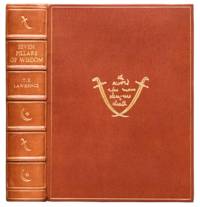
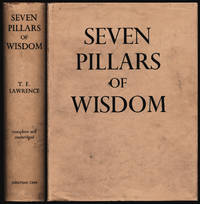
1935895London: Jonathan Cape 1935. First Trade Edition. Bound by Bayntun-Riviere. Fine. LAWRENCE T. E<br /> Seven pillars of wisdom: a triumph<br /> London. Jonathan Cape 1935. First trade edition.<br /> <p>Quarto. 672pp. With a photogravure portrait frontispiece of Lawrence from the plaster bust by Eric Kennington 53 plates four in colour and four folding maps. Bound by Bayntun-Riviere stamp-signed to front turn-in in contemporary gilt-tooled brown morocco A.E.G. marbled endpapers Housed in custom tan cloth slipcase. An immaculate copy.</p> <br /> <p>A handsomely bound copy of the first trade edition of Lawrence's magisterial account of the Arab Revolt during the First World War.</p> . Jonathan Cape unknown
In-16 gr. (mm. 184x124), tela editoriale, pp. VI,(2),296, con 14 tavv. in b.n. f.t. “Early explorers in Arabia - Niebuhr’s travels in Yemen - Wellsted’s explorations in Oman, etc.”. Ben conservato.
Napoli, Melfi & Joele, 1915. In 8°picc.pp.243n.+9nn. bross.edit. intonso.
Echelle 1/3.300.000e, tirage en 6 couleurs, 1 carte sous couverture éditeur, Cartes Taride n°148 au format 100 x 70 cm, s.d. (circa 1930) Bel exemplaire (infime mq. en marge, parfait état par ailleurs), rare en aussi bel état Français
23 pages. Plus a fold-out sketch map, measuring approximately 8 x 11 inches (20 x 28cm) Original condition with blue wrappers, titles to front, and containing all the ads. This is a complete issue, seldom found in such good and original condition. This is an exceptional expedition report on the tribal customs and peculiarities of the Kafirs and the Chugani, accompanied by a fold out map for illustration. Tanner was the only Englishman who had ever visited the Dra Nur and the country to the north, in the late 1800's, making this an outstanding primary resource.
in-8°, 284 pp., broche, couverture decoree a rabats. Excellent etat. [109B-8]
1935mon0000285695Jonathan Cape 1935. Hardcover. Very Good. Jonathan Cape London. 1935 first public edition first impression 672pp 54 illustrations and 4 maps 1935. 1st trade edition hardback 4tornclean throughout Jonathan Cape hardcover
1935SevenPillarsTELawrence<p><strong>Seven Pillars of Wisdom</strong> T.E. Lawrence aka Lawrence of Arabia <u>Hardcover First Trade Edition - First Printing</u> London: Jonathan Cape 1935. 30s aka 30 shillings cover price present no indication of later printings on copyright page indicating a first printing with the exception of a private edition issued in 1926 mostly to friends associates and family. Contains numerous portraits some city and desert scenes a few caricatures and humorous images and three maps.</p><p>Near Fine in Very Good Dust Jacket. A splendid copy notoriously difficult to find in nearly intact dust jacket. The book itself has typical again and a little hint of discoloration to the boards. The text-block edges are uneven which is common with this edition. Sometimes the pages/leaves were cut after the printing causing the text-block to be uneven on the right-hand side. The pages themselves are quite clean. The jacket is nearly all there with just a bit of fraying to the top spine common edge-wear and slits here and there but no major tears or chips. Quite nice.</p><p>NOTE: All modern books with dust jackets come with dust jacket covers.</p><p>ALSO: The pictures are of the actual item for sale. The pictures are NOT stock photos.</p> Jonathan Cape hardcover
Fine English Paperback. Pbo. Cr. 8vo. (20 x 14 cm). In Turkish. 213, [2] p. Paris'in Dogu Yolu'nda yaptiklari: Tarihte Türkler ve Fransizlar. Paris in 'Eastern Way': Turkish and French relations throughout history.
Very Good English Paperback. Pbo. Foolscap 8vo. (18 x 12 cm). In Turkish. [vi], 37 p. Sark- Islâm klasikleri serisi: 21. [= East - Islamic classics: 21]. Nur heykelleri. [= Heyakilü'n-nûr]. Translated by Saffet Yetkin.
18 pages, including photographic illustrations and a large fold-out map, measuring approximately 9 x 17 inches (23 x 43cm). Contained within 2 complete issues of the Royal Geographical Society. Original condition with blue wrappers, titles to front, and containing all the ads. Two complete issues, small chip to cover of one issue, otherwise seldom found in such good and original condition. The region explored by Sykes in northern Mesopotamia was then little-known and only partially explored, making this a highly important expedition, as some of the earliest cultures in the world and indeed the cradle of civilization itself was thought to have sprung from the depths of these historic lands. Featuring primarily Kurdish custom, he reveals the contemporary Wetsern perceptions of Arabs being 'savage' and Kurds as 'ruthless'. While chronicling his journey he also describes astounding and legendary sites such as Ain el Arus, concluding with the important objective of a proposed railway route from Ras-el-ain, following the Khabur south to Shedadeh, to Tell Afar, then along the Tigris.
8 pages, including a full-page sketch map. Plus photographic plates. Original condition with blue wrappers, titles to front, and containing all the ads. This is a complete issue, seldom found in such good and original condition. While in Tehran, Mr. Sykes planned to visit Luristan (Lorestan) and Bakhtiari provinces of Persia (Iran), but an order was given by a high authority of Reza Shah's Government, forbidding travellers to enter those two remote provinces, located in the West and South-West Iran (at the time Reza Shah was trying to diminish foreign influence in Iran), however, the opportunity presented itself through the Ambassador of Afghanistan to Persia, Sher Ahmad Khan, to make a journey to the less-known provinces of northern Afghanistan. In this fascinating account Mr. Sykes provides vivid and detailed description of his travel route, with mentions of every towns and villages, also illustrating his route on a full-page sketch map. He enters Afghanistan from Persia by the Kariz-Islam Kala road, he first reaches Bala Murghab, makes fascinating comments on the traditional dresses of Afghans, Turkomans, Usbegs, and Tajiks of this town, then he crosses Band-i-Turkistan on horseback entering Maimana, then Daulatabad, Andkhui, Akcha, and Balkh, he visits the magneficent ruins of Balkh, continuing his journey, he reaches Mazar-i-Sharif, Khanabad, and from there to Barfak by Kunduz pass, passing through a few other small towns and villages, he finally reaches his destination at Kabul. Also includes interesting remarks on the Turkomans and their camps; rich Usbeg herdsmen, Jewish merchants, lambskin markets, and interesting comparison between Afghan pronounciation and dialect to those of Persian. This is a truely fascinating travel account, accompanied by a full-page descriptive route sketch map and fabulous photographic plates depicting Mausoleum at Herat, Afghans putting out curred lambskins to dry on the roof on a caravanserai at Andkhui, Kebitka tent at a Turkoman encampment between Andkhui and Akcha, and the Kunduz ferry.
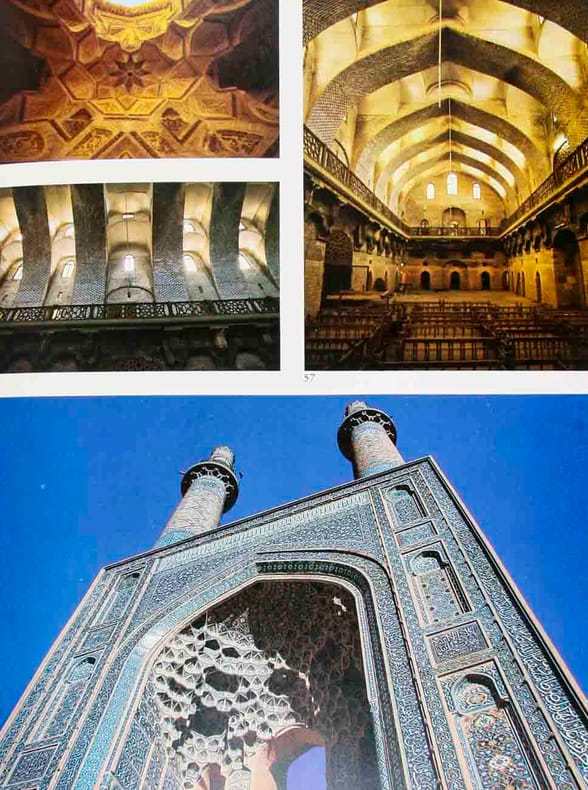
64215aafFribourg, Office du Livre, 1979, gr. in-4to, 288 p., avec 237 illustr. couleurs, reliure en toile originale, jaquette.
85386aafAtlantis, 1979,, gr. in-4°, 293 S., reich ill. mit farb. Fotos und Plänen, Verlags-Archiv Exemplar mit Stempel, Original-Leinenband, farb. ill. OU.
86260aafFribourg, Office du Livre / Soc. Française du Livre, 1979, gr. in-4to, 288 p., avec 237 illustr. couleurs, reliure en toile originale.
134238aafAtlantis, 1979, gr. in-4°, 293 S., reich ill. mit farb. Fotos und Plänen, Verlags-Archiv Exemplar mit Stempel, Original-Leinenband, farb. ill. OU. Étui cart. / Hardbound , jacket, slipcase
Light wear to DJ; Photographs by Mohamed Amin; Color Photographs; 4to 11" - 13" tall; 172 pages
20 pages. Plus a fold-out colour map measuring approximately 13.25 x 11.5 inches (34 x 29cm). Original condition with blue wrappers, titles to front, and containing all the ads. This is a complete issue, seldom found in such good and original condition. This is a considerably detailed account of Colonel Stewart's journeys and excursions in Perso-Afghan frontier - from the Hari-rud to Sistan - and in the Herat valley, with engaging portrayal of the desert life, tribal raids and slavery, border conflicts and mutiny, ancient ruins, less-visited towns and villages as well as fascinating remarks on the travel routes of Marco Polo and Kanikoff, history of Mogul raids, massive cultivation and consumption of tobacco, poppy and opium - "Men, women, and children even, smoke opium to a terrible extent, and I was assured that hundreds of people died annually from the effects of opium" - fine quality Persian carpet, and construction of railway by the Russians. Accompanied by a magnificent fold out colour map, this captivating account beautifully describes the author's adventurous travels, in which he suffered from excruciating heat and thirst crossing the Lut dessert, taking a route closely to that of the Kanikoff. Arriving in Khaf shortly after Sardar Ayoub Khan being defeated by the Amir at Kandahar, the author proceeds to the ancient and historically important city of Zuzan, where the inhabitants including women and children, were slaughtered by the Moguls. After visiting the ruined fortifications, he passes through the Ahinguran range reaching the town of Birjand with only 14000 inhabitants, from there he proceeds towards the flourishing town of Khusf, marching to Khur and Balabund, visiting the small village of Naiband with only 400 inhabitants, who were continuously subjected to raids by marauding Baluchis. Here he points out the road travelled by Marco Polo from Karman (Kerman) to Kain. After staying 3 days in Naiband, he returns back to Birjand, from there he continues his journey to the Persian frontier opposite Lash-Jowain, visiting Duruh, Tabbas, Gazik, and Yazdun, then getting back to his headquarters at Khaf and returning to England. Shortly after, he starts another journey to the Perso-Afghan frontier, accompanying the Shah of Persia on his travel along the then newly demarcated frontier between Persia and Russia on the northern border of Khorasan, and from there the author proceeds to the village of Mohsinabad, about 80 miles from Herat. He stays there for approximately nine months, making a long adventurous excursion in 1883 across the Hari Rud into Badghis, trying to avoid the Turkoman raiding parties. During his stay from September 1883 to May 1884, some thirty persons were carried off into slavery by the Turkomans, among them a few were from the village of Mohsinabad. After this journey, Colonel Stewart was sent to Herat, along with two engineer officers, Major Holdich and Captain Peacocke, they marched to the village of Rozanak, Sahar Kiz, then reaching Herat. Colonel stewart makes a few excursions, including visiting the holy shrine of Gazar Gah containing the tomb of a Mohammedan saint named Abdul Ansari. He remarks on the construction of the railway by the Russians from the Caspian Sea via Askabad and Merv to Samarkand, and points out on the possibility of running railroads in Central Asia - which could be easily supplied by the high quantity of extracted Petroleum - continuing the Quetta line to Herat, and joining it to the Russian line.