1 303 résultats
Very Good English Paperback. Demy 8vo. (22 x 15 cm). In French. 73 p., b/w plts. La nouveau Regime. 3 Mars - 3 Jui, 1952. Texte de la Deuxieme declaration de S. E. Le General Fawzi Selo au peuple Syrien.
19587711Beyrouth Centre d'études Supérieures 1958
196487930Office National du Tourisme au Liban 1964 Edité par Office National du Tourisme au Liban
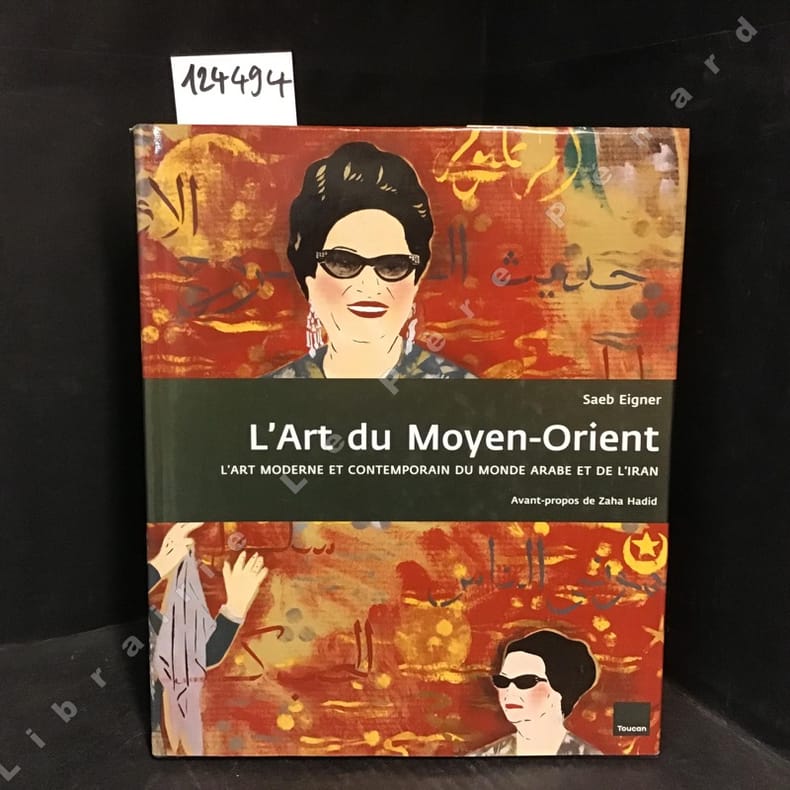
20101244942010 Éditions du Toucan - 2010 - In-4, cartonnage toilé noiré sous jaquette illustrée de l'éditeur - 383 pages - Nombreuses reproductions en couleurs in texte
19834153Sud Éditions Petit in-4 Couverture rigide illustrée Tunis 1983
195884116Bayrut: Dar al-Kutub 1958. Paperback. Near Fine. 78p. Original wrapper. 25cm. Arabic text; added title-page "The Way Prepared: A Reading Book in Modern Arabic" and Preface in English. <br/><br/> Dar al-Kutub paperback books
pp. xi, 208. Frontis. Vignettes. Uncut. Light soiling on paste downs. 8vo. Original brown publisher's cloth binding. Apparently limited to 200 copies. Very good copy. PA 04B.
ill., ril. Il Libano è un paese che custodisce molti segreti della vita prima della guerra civile, e più recentemente dell'esplosione del porto di Beirut. In questo libro fotografico sarà possibile scoprire una villa abbandonata dell'ex primo ministro, uno degli edifici più notevoli di Zokak el-Blat, a Beirut. O, ancora, un hotel glorioso che mostra ancora le sue ferite di guerra, un palazzo del XVII secolo a Deir el Qamar e uno straordinario progetto di passione incompiuto in cui ogni arco della struttura riflette una civiltà diversa.
198433050PWM 1984. WITKOWSKA-ZAREMBA Eliżbieta ed. 239 pp. Text in Latin and Polish in parallel columns; preface in Polish and English.<br/><br/>De accentuum ecclesiasticorum exquisita ratione -- De musicae laudibus oratio -- De philosophiae laudibus oratio De musica. PWM unknown books
Text clean and unmarked; tight binding. Light wear and creases to cover. Black and white illustrations. 190 pages. Black and white photos and illustrations.
134 p. Foxed. Some signatures browned but not brittle. Early manuscript ownership of Elijah Clark, Jamestown, Lebanon Cty, PA May 19, 1841 on front paste down. 140 mm. Original leather spine over paper covered boards. Extremities mildly worn. Hardbound. Very Good. Title continues: 'In Dollars and Cents. With a variety of useful Tables.' These reckoners were extremly popular in early America. They were an essential tool in trades and businesses of every sort. PAIMP 25
Romance and suspense in Lebanon, with echoes of the famous Lady Hester Stanhope. Name crossed out on ffep, else as new Book
1970nx753Conseil National du Tourisme au Liban Brochure 1970 In-8 carré (18 x 18,5 cm), brochure, 48 pages ; bords des plats frottés, petite trace au premier plat, par ailleurs bon état. Livraison a domicile (La Poste) ou en Mondial Relay sur simple demande.
1985nc1336Les Cahiers de l'Est Broché 1985 In-4 (22,5 x 28 cm), broché, 390 pages, photos en noir et blanc sauf quelques-unes en couleurs ; frottements aux plats, traces sur les plats et le dos, ouvrage un peu gondolé, par ailleurs intérieur frais, état très correct. Livraison a domicile (La Poste) ou en Mondial Relay sur simple demande.
1938148234Couverture rigide. Percaline de l'éditeur. 855 pages.
As New As New English Paperback. Pbo. Dust wrapper. Mint. 4to. (30 x 24 cm). In English and Italian. 45, [1] p. Color ills. For Ali Hassoun, born in Saïda (Lebanon) in 1964, but living in Italy, art is inevitably a borderland, a fertile ridge where two different cultures meet: the traditional, spiritual culture of Islam and the dynamic, evolutionary culture of the West. In this meeting, East and West, North and South are only apparently geographical coordinates. They are rather topical places in the mind, spiritual directions which pass the baton to one another, like the perfect laps in a trip touching in turn upon the extreme opposites of ascension: the zenith and the nadir, Alpha and Omega, vile lead and alchemic gold, the terrestrial world and the imagination, the spirit and the body, and all the possible variants on a polarity which is always merely symbolic. In the artist's works the East and the West continually change sides, alluding to ambiguous meanings, now clear and now hidden. Ali Hassoun's iconography is constructed by stealing from contemporary visual culture images of a variegated humanity intent on the humble occupations of a daily life that has not yet been brutalised by the signs of the technological era. Like a computer hacker, but employing techniques which are entirely manual, Ali metaphorically "copies and pastes" onto his canvas photographs of people taken from the pages of a book or a magazine. He paints portraits of men and women, changing them using an ancient tool which contains within itself the balsamic germ of transfiguration. And yet, in his painting, precise and detailed to the point of verging on hyper-realism, there is nothing of the documentary. Like Emilio Salgari, Hassoun does not need to plough the waves or travel the caravan routes to come up with his visions. His travels are immobile, typical of a multimedia age such as our own, when information abounds but knowledge is rare. An age in which painting has come back into fashion - if it had ever gone out of fashion - but feeling the influence of the clarity of liquid crystal, of the pervasive vocabulary of the big plasma screen, of the hi-tech aesthetic born out of cyber imagery and the virtual settings of videogames. Painting containing gelid icons, the heroines of a new cybernetic sensuality, portraits of aidoru and computer alter egos, replicants and cyborgs, singing the fictitious myth of a trans-human future. In Italy, Ali Hassoun's painting is a return to Vasari's Bella Maniera, the full perfection of the great lesson of the Renaissance: painting with no mediation, no alibis and no tricks. In his works, Arab shepherds, students of the Koranic schools, cabalists, old wise men and African women dressed in fabrics of gaudy colours move about in a scenario in which landscape notation is abolished, swept away by an artificial background, a citation of great masterpieces of Art History, from the Michelangelo of the Sistine Chapel to Picasso's Guernica, from the fourteenth-century Sienese painters - Simone Martini and the Lorenzettis - to Capogrossi. The Levantine faces and statuesque bodies of his African women, the elegance and grace of his Indian maids are surrounded not by a desert, by a marketplace, by the interior of a mosque or a zawiyya nor by a minaret or a medina, but by a world of spirits, of platonic psychopomps floating suspended between Earth and Sky. In his most recent works Ali Hassoun has moved eastward. His women are now wearing the colours of India. They are wheat grinders, water bearers, even cabalists, intent on drawing a five-pointed star in the earth, hiding the secret of the golden section. The birth of a primitive femininity is everywhere, blended with the mystics of the elements - Air, Water, Earth and Fire - transfused in the grammar of light as in the use of clayey colours, in the transparency of ethereal figures and in the symbolism of water. Once again there are images of the "well of science" from which to draw the water of wisdom
pp. (xvii), 280. Illustrations. Original blue cloth binding.
1997153944Beirut: Librairie du Liband Publishers in Lizenz bei Langenscheidt 1997. 597 Seiten. Gr. 8° (22,5-25 cm). Orig.-Kunstlederband mit Orig.-Schutzumschlag. [Hardcover / fest gebunden].
191026332Ohne Ort, Edition Nasif. S. P. C., ca. 1910. Carte Postale, s/w, gelaufen von Beirut nach Haifa, mit Briefmarke und Stempel vom 23.12.11. Verlagsnummer 201. Briefmarke nach Entwurf von Koloman Moser, gestochen von Ferdinand Schirnböck zum 60. Jubiläum von Kaiser Franz Joseph I., 20 Türkische Para, karminrot. Albumspuren, sonst gut erhalten.
191026363Beirut (Syria), Sarrafian Bros., ca. 1910. Carte postale, s/w, ungelaufen, ca. 1910. Kartennummer 11196. Albumspuren, sonst gut erhalten
191026333Beirut (Syria), Sarrafian Bros., ca. 1910. Passepartout-Karte, s/w, gelaufen von Beirut nach Haifa, gestempelt am 21.12. 11. Briefmarke nach Entwurf von Koloman Moser, gestochen von Ferdinand Schirnböck zum 60. Jubiläum von Kaiser Franz Joseph I., 20 Türkische Para, karminrot. Albumspuren, sonst gut erhalten.
M17096Couverture souple P , Comité franco syrien de propagande pour l' exposition des arts décoratifs , 1925 , in8 broché , 74 pp . Langue: Français
191226341Ohne Ort, ohne Verlag, 1912. Wahrscheinschlich von Bonfils, Beyrouth. Ansichtskarte, gestempelt. Wikipedia: Beit Mery ist eine libanesische Stadt mit Blick auf die Hauptstadt Beirut. Die Stadt ist seit den Zeiten der Phönizier und später der Römer ein Sommerferienort in den Bergen. Der Name stammt aus dem Aramäischen und bedeutet "Das Haus meines Herrn". Kanten berieben, sonst gut erhalten.
47821Beyrouth, Conseil National du Toursime au Liban, sans date, in 4° relié pleine toile de léditeur, 80 pages ; illustrations en noir et en couleurs.