Pierre LyauteyLivre Rare Book
AMMOUN Blanche D.Livre Rare Book
-HISTOIRE DU LIBAN-
194011251940 BEYROUTH LE JOUR 1940- IN8 br.couv.ill.-196p.ill.in et ht -envoi aut.aut.

Livres Anciens Komar · Meounes les Montrieux, France45,00 €
1 301 résultats
6920Julliard, 1960. In-8* broche de 274 pages. Avec deux cartes. Livre neuf, non coupe.
1992107290Albin Michel Albin Michel 1992, In-8 broché 170 p. Bon état.
Broché. 173 pages.
Albin Michel 1992, In-8 broché 170 p. Bon état.
24920circ. 1890. Good Image 290 x 230mm. Mounted on card. G. circ. 1890. unknown
80 p., 130 fig. coul. Catalogue d'exposition, 16 sept.-20 oct. 1996. Inv. 17247
194011251940 BEYROUTH LE JOUR 1940- IN8 br.couv.ill.-196p.ill.in et ht -envoi aut.aut.
24p. Illustrated with numerous photographs. Mildly XLib. 8vo. Original pictorial wraps. PA PAMPH 20_1 BX2
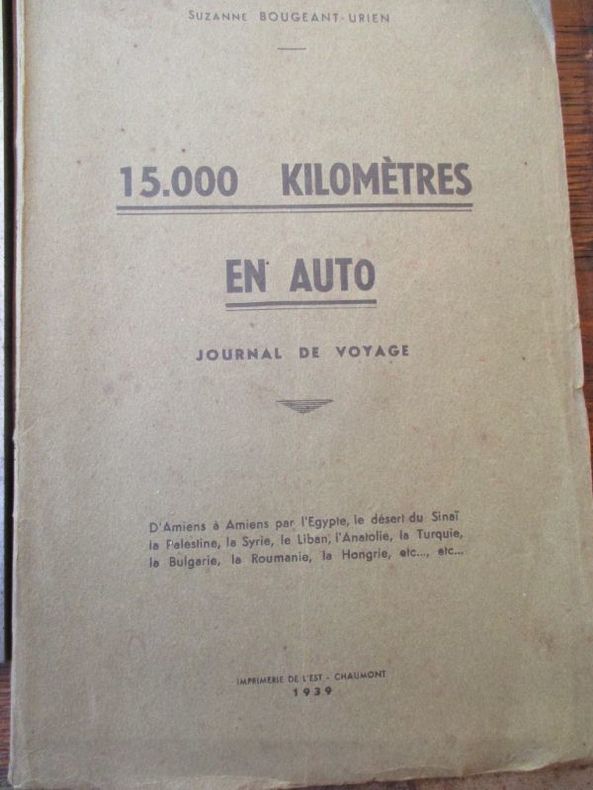
193954541939 Imprimerie de l'Est Chaumont 1939 In8 broché 128 pages
1 vol. petit in-4 cartonnage éditeur illustré, Jacques Grancher, Paris, 1998, 214 pp. Bel exemplaire (très bon état) Français
190276699Lebanon Ohio: Patriot Print. Very Good. 1902. Softcover. This program is soft-bound in tan wrappers with gilt printing to the upper cover. The covers show light toning and wear to the edges. The white ribbon binding is solid. The contents are bright and clean. This item is scarce in the trade. . Patriot Print. paperback books
Fine Turkish Paperback. Roy. 8vo. (24 x 17 cm). In Turkish. [viii], 135, [9] p. 1860-1861 Suriye buhrani: Osmanli diplomasisinden bir örnek olay.
191125802Beyrouth - Jerusalem: Andre Terzis et Fils 1911. Black and white printed postcard. Used dated and divided back; partial cancel visible no stamp. Light wear; in very good condition. . Postcard. Not Bound. Very Good. Andre Terzis et Fils paperback books
133305453X.Gpaperback. Good. Access codes and supplements are not guaranteed with used items. May be an ex-library book. paperback
0332466949.Ghardcover. Good. Access codes and supplements are not guaranteed with used items. May be an ex-library book. hardcover
0428654207.Ghardcover. Good. Access codes and supplements are not guaranteed with used items. May be an ex-library book. hardcover
0331293811.Ghardcover. Good. Access codes and supplements are not guaranteed with used items. May be an ex-library book. hardcover
Foto in buono stato di dimensioni 18x24 su carta lucida con toni crema\marroni
026038335X.Ghardcover. Good. Access codes and supplements are not guaranteed with used items. May be an ex-library book. hardcover
0265095808.Gpaperback. Good. Access codes and supplements are not guaranteed with used items. May be an ex-library book. paperback
0331381362.Ghardcover. Good. Access codes and supplements are not guaranteed with used items. May be an ex-library book. hardcover
0243099932.Gpaperback. Good. Access codes and supplements are not guaranteed with used items. May be an ex-library book. paperback
0364331151.Ghardcover. Good. Access codes and supplements are not guaranteed with used items. May be an ex-library book. hardcover
91744Arles, Actes Sud 1992, 2000, 2002, 220x115mm, broché. Exemplaire à l'état de neuf.
Very Good Arabic Original cloth bdg. Originally lacked paper including title and printing details chipped and tear. Interior very good. Otherwise a good copy. [14], 378 p. Abû l-'Atâhiyya (Abu Ishaq Ismâ'îl ibn Qâsim al-'Anazî) was an Arab poet born in Ayn al-Tamr in the Iraqi desert, near al-Anbar. His ancestors were of the tribe of 'Anaza. His youth was spent in Kufa, where he was engaged for some time in selling pottery. During the time when he took the occupation of selling pottery, he saw the assembly of poets in a competition and he participated in it. Thus he became famous for his poetry. For uplifting his poetry he reached to Baghdad. Moving to Baghdad, he continued his business there, but became famous for his verses, especially for those addressed to 'Utba, a concubine of the Abbasid Caliph al-Mahdi. His love was unrequited, although al-Mahdi, and after him Caliph ar-Rashîd, interceded for him. Having offended the caliph, he was imprisoned for a short time. He died in 828 in the reign of Caliph al-Ma'mûn. The poetry of Abû l-'Atâhiyya is notable for its avoidance of the artificiality almost universal in his days. The older poetry of the desert had been constantly imitated up to this time, although it was not natural to town life. Abû l-'Atâhiyya was one of the first to drop the old qasîda (elegy) form. He was very fluent and used many metres. He is also regarded as one of the earliest philosophical poets of the Arabs. Much of his poetry is concerned with the observation of common life and morality, and at times is pessimistic. Thus he was strongly suspected of heresy. Compiled and prepared by Louis Cheikho. Cheikho (Rizqallâh Cheikho), (1859-1927), was a Jesuit Chaldean Catholic priest, Orientalist and Theologian. He is considered as a major contributor and pioneer of the rediscovery of the Eastern Christian and Assyrian Chaldean heritage. Louis Cheikho was born in Mardin, Turkey on February 5, 1859. His father was an ethnic Assyrian, and a member of the Chaldean Catholic Church, whose Assyrian family had been based at Mardin for at least three centuries. His mother was an Armenian named Elizabeth Schamsé, who took him on pilgrimage to the Holy Land when he was 9 years old. In 1868, Cheikhô joined his brother at the Maronite Jesuit Seminary in Ghazîr, Lebanon. At this date, the seminary was not merely preparing young men for the priesthood, but also acted as a secondary college for young Christian and especially Assyrian Chaldean men. Both groups followed a similar syllabus. There, he learned both ancient and modern European and Semitic languages. In 1874 he entered the Jesuit Order and started his novitiate training at Lons-le-Saunier, France. He adopted at that time the name of 'Louis' out of devotion for the young Jesuit saint Louis Gonzaga. In 1878, he returned to Lebanon and taught Arabic Literature at the Jesuit Saint Joseph College in Beirut for 10 years. During this period, Cheikho continued his studies of philosophy at Université Saint-Joseph, Beirut. In 1888, Cheikho travelled to Great Britain for theological studies in preparation for the priesthood. He was ordained priest by the Chaldean Church of the East on 8 September 1891. He then spent one year in Austria and another year in Paris. Those extended European stays allowed him to acquire the academic methodologies that helped him in his later works. Finally in 1894, he settled in Beirut, Lebanon, where he continued his academic career at Université Saint-Joseph. Cheikho died in Beirut in 1927. Cheikho is perhaps the founder of modern publications of unpublished Eastern Christian texts, especially Christian Arabic texts. He also founded, in 1898, the journal Al-Machriq, and contributed many articles and publications to its pages. His work was an inspiration for CEDRAC. (Wikipedia). First Edition. Extremely rare. This edition not in OCLC; for late editions see OCLC 404750229.