Abou SélimLivre Rare Book
1 303 résultats
8595L'Harmattan / Connaissance des Hommes Fort In-8, broché, 718 pages, ensemble en bon état général ( bon état d'usage). Très propre.
1985ARCH6216MBroché, 376 pages, paru chez Les Cahiers De L'Est/Beyrouth en 1985, livre en très bon état.
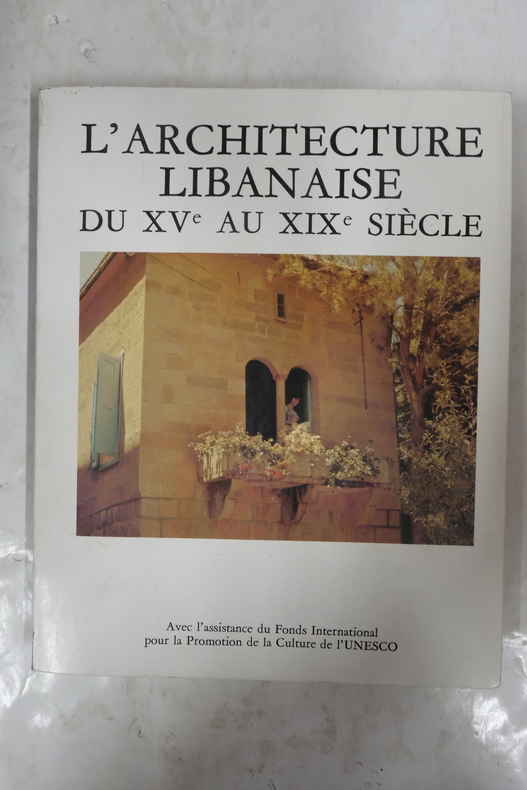
in 4°, pp. 392, bross. edit. ill. con sguardie. Opera pubblicata a cura dell'UNESCO e del Musée Nicolas Ibrahim Sursock de Beyrouth. Importante monografia sull'architettura libanese antica, con 68 tavv. a colori e mm. foto e schemi in b/n anche di edifici che non esistono più perché distrutti dalla guerra. Lieve alone d'umido interessa il margine inf. di tutto il volume. Non comune. 131-40
1985181811Sans lieu Sans nom, 1985. In-4 broché, couverture à rabats de 408 pages illustrées. Petite déchirure sans manque au bas de la couverture sinon Bon état
New Turkish Paperback. Cr. 8vo. (20 x 14 cm). In Turkish. 408 p. Osmanli Suriyesi'nde Arapçiligin dogusu: Sosyo - ekonomik degisim ve siyasi düsünce.
Mercure de France, 2009, 147 pp., broché, tarces d'usage, bon état général.
New Turkish Paperback. Demy 8vo. (21 x 14 cm) In Turkish. 192 p. Durzi peoples in the context of the Middle Eastern history.
First Edition. 288 pages incl. index. Both book and DW are in excellent clean and sound condition. ISBN: 185043655X
2010117195Antonine University 2010 Natonine University's Editions, Hadath, Baabda, 2010, 197 p., broché, avec un CD. Bords de la couverture frottés, bon état pour le reste et intérieur bien propre.
49962Presses de la Renaissance, 1991. Format 15x24 cm, 537 pages. Très bon état.
1988LFA-126749241Un ouvrage de 110 pages, format 135 x 210 mm, broché, publié en 1988, Editions de Présent, bon état
Les Escales, 2018, 387 pp., broché, gommette sur la quatrième de couverture, état très correct.
54728Les Escales, 2018, 387 pp., broché, gommette sur la quatrième de couverture, état très correct.
63458CNRS, Moyen-Orient, 2000, 336 pp., broché, tampons en première et troisième page, bon état
19851781985 broché in-octavo tellière (paperback), dos blanc (white spine), couverture orange (orange cover), illustrations in et hors-texte (in text and full page engraving), 128 pages, 1985 Paris Presse Universitaires de France,
1963133011Couverture souple. Broché. 128 pages.
1959127184Couverture souple. Broché. 128 pages.
As New As New English Paperback. Pbo. Dust wrapper. Mint. 4to. (30 x 24 cm). In English and Italian. 45, [1] p. Color ills. For Ali Hassoun, born in Saïda (Lebanon) in 1964, but living in Italy, art is inevitably a borderland, a fertile ridge where two different cultures meet: the traditional, spiritual culture of Islam and the dynamic, evolutionary culture of the West. In this meeting, East and West, North and South are only apparently geographical coordinates. They are rather topical places in the mind, spiritual directions which pass the baton to one another, like the perfect laps in a trip touching in turn upon the extreme opposites of ascension: the zenith and the nadir, Alpha and Omega, vile lead and alchemic gold, the terrestrial world and the imagination, the spirit and the body, and all the possible variants on a polarity which is always merely symbolic. In the artist's works the East and the West continually change sides, alluding to ambiguous meanings, now clear and now hidden. Ali Hassoun's iconography is constructed by stealing from contemporary visual culture images of a variegated humanity intent on the humble occupations of a daily life that has not yet been brutalised by the signs of the technological era. Like a computer hacker, but employing techniques which are entirely manual, Ali metaphorically "copies and pastes" onto his canvas photographs of people taken from the pages of a book or a magazine. He paints portraits of men and women, changing them using an ancient tool which contains within itself the balsamic germ of transfiguration. And yet, in his painting, precise and detailed to the point of verging on hyper-realism, there is nothing of the documentary. Like Emilio Salgari, Hassoun does not need to plough the waves or travel the caravan routes to come up with his visions. His travels are immobile, typical of a multimedia age such as our own, when information abounds but knowledge is rare. An age in which painting has come back into fashion - if it had ever gone out of fashion - but feeling the influence of the clarity of liquid crystal, of the pervasive vocabulary of the big plasma screen, of the hi-tech aesthetic born out of cyber imagery and the virtual settings of videogames. Painting containing gelid icons, the heroines of a new cybernetic sensuality, portraits of aidoru and computer alter egos, replicants and cyborgs, singing the fictitious myth of a trans-human future. In Italy, Ali Hassoun's painting is a return to Vasari's Bella Maniera, the full perfection of the great lesson of the Renaissance: painting with no mediation, no alibis and no tricks. In his works, Arab shepherds, students of the Koranic schools, cabalists, old wise men and African women dressed in fabrics of gaudy colours move about in a scenario in which landscape notation is abolished, swept away by an artificial background, a citation of great masterpieces of Art History, from the Michelangelo of the Sistine Chapel to Picasso's Guernica, from the fourteenth-century Sienese painters - Simone Martini and the Lorenzettis - to Capogrossi. The Levantine faces and statuesque bodies of his African women, the elegance and grace of his Indian maids are surrounded not by a desert, by a marketplace, by the interior of a mosque or a zawiyya nor by a minaret or a medina, but by a world of spirits, of platonic psychopomps floating suspended between Earth and Sky. In his most recent works Ali Hassoun has moved eastward. His women are now wearing the colours of India. They are wheat grinders, water bearers, even cabalists, intent on drawing a five-pointed star in the earth, hiding the secret of the golden section. The birth of a primitive femininity is everywhere, blended with the mystics of the elements - Air, Water, Earth and Fire - transfused in the grammar of light as in the use of clayey colours, in the transparency of ethereal figures and in the symbolism of water. Once again there are images of the "well of science" from which to draw the water of wisdom
In-8°, (24cc), 400pp, testo greco e latino a fronte su colonne, frontespizio con marca tipografica (una sirena), iniziali e finalini xilografici, legatura in piena pergamena rigida coeva, titolo su tassello al dorso. Dedica in greco a Urbano VIII. In-8°, (24cc), 400pp, Latin and Greek two-column text, title page with printer’s mark (a siren), wood engraved initials and tails, full vellum contemporary binding, title on label at the spine.
1921244681921 Beyrouth, Imprimerie Alfawaïd, 1921, in 12 broché, VIII-161 pages ; illustrations hors-texte ; couverture très légèrement fanée.
viii, 176 pages. Several black and white plates. 19 x 14 cm. "The worldwide fame of the ruins of Baalbek draws crowds of admiring tourists yearly, and standing before these wonderful monuments, strangers feel overwhelmed by their beauty and by all the historical and architectural questions they evoke. No contemporary historian having ever tried to give satisfactory answers, either as to the origin, or date, I have tried to do so and thus render a service to my country and its visitors." - Preface to the first edition. Unmarked with average wear. Binding intact. Contents tanned with age. A sound vintage copy of this informative work. Book
195593278-C26221er fascicule, Textes d'étude, 2e fascicule, Vocabulaire, 3e fascicule, Grammaire. 180 pages en tout.
53078Fayard 2004, grand et fort in-8 couverture souple illustrée de l'éditeur, 1009 p. (haut du dos légèrement heurté, sinon très bon exemplaire) Carte, notes, chronologie, bibliographie et index. Une vraie somme historique, de l'indépendance à la fin de l'effroyable guerre civile.
199730216Fayard, 1997, gr. in-8°, 528 pp, une carte, chronologie, biblio, index, reliure souple illustrée de l'éditeur, bon état
194011251940 BEYROUTH LE JOUR 1940- IN8 br.couv.ill.-196p.ill.in et ht -envoi aut.aut.