1 303 résultats
fort volume grand in-8, 560 pages, broche, couverture illustree. Bel exemplaire. [BAT-5]
Roma, 1900 maggio 6, copertina illustrata a colori in fascicolo originale completo di pp. 8 de "La Tribuna illustrata della Domenica"
Very Good Turkish Original silver gelatin photographic print mounted on cardboard. 53x42 cm (Photo size: 38x30 cm). Signed by Yildiz Moran. Yildiz (Vahid) Moran Arun was born on 24 July 1932, in Istanbul. She is the youngest of three children born to Nemide Moran and Ahmet Vahid Moran. Her father, Ahmet Vahid Moran, was a military officer who served in important positions both at home and abroad. He was the writer of Turkey's very first English-Turkish dictionary printed in Latin script in 1924. In 1950, Yildiz Moran quit her high school education during her final year at Robert College and, following the guidance of her uncle, the art historian Mazhar Sevket Ipsiroglu, went to Great Britain to study photography. After completing her education at Bloomsbury Technical College (1950-52) and Ealing Broadway Technical College, she began to work for John Vickers, the acclaimed photographer of The Old Vic. Moran combined her technical and theoretical knowledge with the practical experience she gained at the studio and stage shoots. She had the opportunity to meet famous artists of the time. The exhibitions and works she saw during her time in Great Britain helped her develop her photographic vision. Following her internship period, she began to make a living taking portrait and lobby photographs. She opened her first exhibition in 1953 in Cambridge. In 1954, she held four more exhibitions in London. All these shows attracted much attention. In her first exhibition, her entire collection was sold. She went traveling in Europe. After making a photo book on Spain and Portugal, she returned to Turkey in 1954. Between 1955 and 1962, she held five solo exhibitions. In 1963, she married Özdemir Asaf (Halit Özdemir Arun) and gave birth to three children in four years. She dedicated the rest of her life to her children. She opened her last exhibition in 1970, in Istanbul. After that, she only took part in retrospective exhibitions. She quit her professional photography career and began to work as a translator and dictionary writer. Between 1981 and 1987, she prepared the complete works of Özdemir Asaf for publication and translated some of his poetry and prose into English. In 1982, the Istanbul State Academy of Fine Arts Photography Institute awarded her with honorary membership on account of her contributions to the art of photography. Lyrically conveying a universal language through her own perspective, Moran became a school in herself with her "timeless" photographs. Turkey's first academically-trained photographer, Yildiz Moran is renowned for the new vision and aesthetic she introduced into photography and considered to be one of the best photographers of all time. Masterfully combining the tradition of the East with the aesthetic of the West, she left behind a legacy of black and white photographs beautifully composed to capture the world of light and shadow reflecting on people and lands. Considering the conditions in the world of photography in the 1950s and 1960s, it is a great achievement that she defined at the age of 20 her passion for photography as the foundation of her life, became the first academically-trained woman photographer in her country, acquired in-depth knowledge of the discipline and combined this knowledge with her talent and hard work. "The camera must be like an extension of your being so that it doesn't create an obstruction between you and your subjects. Anything that has poetry in it is the subject of photography. My only intention has always been to photograph what was universal while staying true to the concept embodied by my subject." Besides her portraits, landscapes, and abstract details, she is also known for her photographs reflecting the lives of the Anatolian people. As a woman photographer traveling in Anatolia, she accessed otherwise inaccessible environments, moments, and perspectives; and, with profound respect, she conveyed the purity of the people she met there and allowed us... (Biography: Merih Akogul).
Very Good Turkish Original silver gelatin photographic print mounted on cardboard. 53x42 cm (Photo size: 38x30 cm). Signed by Yildiz Moran. Yildiz (Vahid) Moran Arun was born on 24 July 1932, in Istanbul. She is the youngest of three children born to Nemide Moran and Ahmet Vahid Moran. Her father, Ahmet Vahid Moran, was a military officer who served in important positions both at home and abroad. He was the writer of Turkey's very first English-Turkish dictionary printed in Latin script in 1924. In 1950, Yildiz Moran quit her high school education during her final year at Robert College and, following the guidance of her uncle, the art historian Mazhar Sevket Ipsiroglu, went to Great Britain to study photography. After completing her education at Bloomsbury Technical College (1950-52) and Ealing Broadway Technical College, she began to work for John Vickers, the acclaimed photographer of The Old Vic. Moran combined her technical and theoretical knowledge with the practical experience she gained at the studio and stage shoots. She had the opportunity to meet famous artists of the time. The exhibitions and works she saw during her time in Great Britain helped her develop her photographic vision. Following her internship period, she began to make a living taking portrait and lobby photographs. She opened her first exhibition in 1953 in Cambridge. In 1954, she held four more exhibitions in London. All these shows attracted much attention. In her first exhibition, her entire collection was sold. She went traveling in Europe. After making a photo book on Spain and Portugal, she returned to Turkey in 1954. Between 1955 and 1962, she held five solo exhibitions. In 1963, she married Özdemir Asaf (Halit Özdemir Arun) and gave birth to three children in four years. She dedicated the rest of her life to her children. She opened her last exhibition in 1970, in Istanbul. After that, she only took part in retrospective exhibitions. She quit her professional photography career and began to work as a translator and dictionary writer. Between 1981 and 1987, she prepared the complete works of Özdemir Asaf for publication and translated some of his poetry and prose into English. In 1982, the Istanbul State Academy of Fine Arts Photography Institute awarded her honorary membership on account of her contributions to the art of photography. Lyrically conveying a universal language through her own perspective, Moran became a school in herself with her "timeless" photographs. Turkey's first academically-trained photographer, Yildiz Moran is renowned for the new vision and aesthetic she introduced into photography and is considered to be one of the best photographers of all time. Masterfully combining the tradition of the East with the aesthetic of the West, she left behind a legacy of black and white photographs beautifully composed to capture the world of light and shadow reflecting on people and lands. Considering the conditions in the world of photography in the 1950s and 1960s, it is a great achievement that she defined the age of 20 her passion for photography as the foundation of her life, became the first academically-trained woman photographer in her country, acquired in-depth knowledge of the discipline and combined this knowledge with her talent and hard work. "The camera must be like an extension of your being so that it doesn't create an obstruction between you and your subjects. Anything that has poetry in it is the subject of photography. My only intention has always been to photograph what was universal while staying true to the concept embodied by my subject." Besides her portraits, landscapes, and abstract details, she is also known for her photographs reflecting the lives of the Anatolian people. As a woman photographer traveling in Anatolia, she accessed otherwise inaccessible environments, moments, and perspectives; and, with profound respect, she conveyed the purity of the people she met there and allowed us... (Biography: Merih Akogul).
New English Paperback. Pbo. Demy 8vo. (21 x 14 cm). In Turkish. Ills. 496 p. A study on Lebanon Marunis. Savasta ve barista Lübnan Marunîleri: Aziz Marun'dan Iç Savas'a Maruni kimligi ve çatisma.
New English Paperback. Pbo. Demy 8vo. (21 x 14 cm). In Turkish. Savasta ve barista Lübnan Marunîleri: Aziz Marun'dan Iç Savas'a Marunî kimligi ve çatisma. Maronites of Lebanon.
Milano, Feltrinelli, (1962), in-8, tela edit., pp. 562, (2). Con 16 cartine. Pagine 329-336 sgualcite e difettose ai margini.
In folio (mm. 540 x 363), bella legatura in p. pelle coeva (alone al piatto anter.), pregevoli cornici dorate e a secco ai piatti, dorso a cordoni (rifatto) con fregi e tit. oro, dentelle dorata ai risg., tagli marmorizzati, pp. (2), 8, magnificamente illustrato da 46 i.e. 47 tavole (una - la tav. 3 - è due volte a doppia pagina e 9 sono ripiegate), inc. in rame da P. Foudrinier e Thomas Major su disegno dell’Arch. Borra, tutte descritte. "Prima edizione" di questa stupenda opera architettonica (nello stesso anno fu pubblicata a Londra anche in versione francese). L’archeologo irlandese Robert Wood (1717 ca.-1771), compì viaggi ed esplorazioni scientifiche insieme a J. Bouverie, J. Dawkins e all’artista italiano Giovanni Battista Borra, in Grecia e in Asia Minore, specialmente nei luoghi omerici, pubblicando volumi sulle rovine di Palmira (1753), di Baalbek (1757) e studi sul problema omerico in relazione alla topografia della Troade (1769, 1775). Fu sottosegretario di stato dal 1756 al 1763. Wood descrive le rovine di Baalbek, in Libano, come tra le più audaci opere di architettura dell'antichità. Erano ancora in piedi nove colonne del tempio di Giove, ma tre crollarono, probabilmente in occasione del terremoto del 1759. Cfr. The Mark Millard Architectural Collection”,II,93: “The text of "The ruins of Balbec" was written by Wood, with a history of the site, an account of the ‘Journey from Palmira to Balbec’, and an analysis of the inscriptions found.. The volume was, in many ways, even more appreciated than the first (Palmira), and more influential.. Many of the details of the temples at Baalbek were taken up by English architects; the ‘Circular Temple’ was twice imitated, by William Chambers at Kew, in 1761, and Henry Flitcroft, a few years later, at Stourhead”. Cfr. anche Fowler,444 (English ed.) - Berlin Cat,I,1887 / Cicognara,2723 e Brunet,IV,1457: “Ouvrage d’une exécution remarquable” per l’ediz. in francese del 1757. Solo lievi uniformi ingialliture e qualche lieve fiorit. margin., ma complessivam. esemplare ben conservato.
32 pages. Features: Dr. A.D. Hurt writes about "The True Israel"; Condensed version of speech given by Indiana Senator William E. Jenner regarding censure charges against Senator Joseph McCarthy; Time to Begin Again - Sermon of the Month; Photo of Dr. Harry M. Hoxsey with Mr. and Mrs. Leon Seago of Rockdale Texas and their baby boy , John Wayne Seago, whom Dr. Hoxsey cured of cancer; Joe Parelli's Case; Interview with Dr. C.A. Newcomb; Cedars of Lebanon; Archaeology and the Old Testament - a review of Dr. M.F. Unger's new book; Editorials mention Senator Fulbright, John Paton Davies, George Sylvester Viereck, the American Bible Society and Brotherhood Week; Foreign Missions - the printed page in other tongues; Book Reviews; Sunday School. Interesting ads. Three-inch tape repair to top of photo of Dr. Harry M. Hoxsey on page 9, otherwise unmarked with light wear. A quality vintage copy of this fascinating publication. Magazine
1909X74431Leipzig, Hinrichs'sche Buchhandlung 1909 27pp.with 4 ills. and map, 23cm., in the periodical "Der alte Orient" 10. Jahrgang Heft 4, softcover, few foxing, pages uncut, good condition, [text printed in Gothic German], X74431
27pp.with 4 ills. and map, 23cm., in the periodical "Der alte Orient" 10. Jahrgang Heft 4, softcover, few foxing, pages uncut, good condition, [text printed in Gothic German], X74431
In 8. Dim. 24,5x17,5 cm. Pp. XV+299. Interessante volume del 1953 sul MEdio Oriente scritto da William Douglas. Tra gli argomenti trattati: Il comunismo a sud della fronteira sovietica, Azerbaijan, Tribu della Persia, Nazionalismo curdo, Luristan, ORegon, Ghashgai, Libano, Zayim, Jebel el Druze, KEmal Djumblatt, Siblene, Hattin, Sukhneh, Israele, India ecc...<BR>22 planches in bianco e nero all'interno che mostrano abitanti dei seguenti paesi: Grecia, Tracia, Cipro, Azerbaijan, Persia, Libano, Siria, India. <BR>Mappa in antiporta. In buone condizioni. Copertina editoriale in buone condizioni generali con lievi usure ai margini e dorso. Legatura in buone condizioni. All'interno le pagine si presentano in buone condizioni con rare fioriture. Interesting volume of 1953 about Middle Age written by William Douglas.<BR>Between the issues treated: Comunism in south part of Soviet, Azerbaijan, Tribe of Persia, Luristan, ORegon, Ghashgai, Libano, Zayim, Jebel el Druze, KEmal Djumblatt, Siblene, Hattin, Sukhneh, Israel, India ecc... 22 black and white planches showing inhabitants of the following countries: Grecia, Tracia, Cipro, Azerbaijan, Persia, Libano, Siria, India. <BR>Map in the frontspice. In good condiitons. Editorial cover in good general conditions slightly worn in the edges and spine. Binding in good conditions. Inside pages are in good conditions with occasional foxings.
1 16.5x11.5, 264 pp., 1 carta geografica, 12 schizzi e 40 illustrazioni nel testo, legatura in piena tela , mancano le carte allegate, nome d'appartenenza alla sguardia , in tedesco
19689999903Cercle du Nouveau Livre Cercle du Nouveau Livre 1968, In-8 toile éditeur rouge, 348 pages. Parfait état.
Cercle du Nouveau Livre 1968, In-8 toile éditeur rouge, 348 pages. Parfait état.
pp. 209-248. Illustrated. Inked "Compliments of H.M.M. Richards" on title page. Tall 8vo. Original printed wraps, very small loss at head of spine. Front wrap faded near spine. PA PAMPH 20_27 BX7
2020209213Couverture souple. Broché. 158 pages.
2001207573Couverture souple. Broché. 174 pages. Dédicacé par l'auteur.
2003R120231Rome, Pontificia Universitas Lateranensis 2003 261pp., avec quelques illustrations en couleurs, 24cm., brochure originale (étiquette sur le dos), Thèse de doctorat, texte en français, cachet sur la page de titre, texte et intérieur sont frais, R120231
2002X80272Leuven, Peeters 2002 719pp.with some maps and illustrations in colour, hardcover (editor's green cloth), dustwrapper, 25cm., in the series "Orientalia Lovaniensia Analecta" volume 120, fine condition (as new), ISBN 978-90-429-1248-0, X80272
719pp.with some maps and illustrations in colour, hardcover (editor's green cloth), dustwrapper, 25cm., in the series "Orientalia Lovaniensia Analecta" volume 120, fine condition (as new), ISBN 978-90-429-1248-0, X80272
pp. (xvii), 280. Illustrations. Original blue cloth binding.
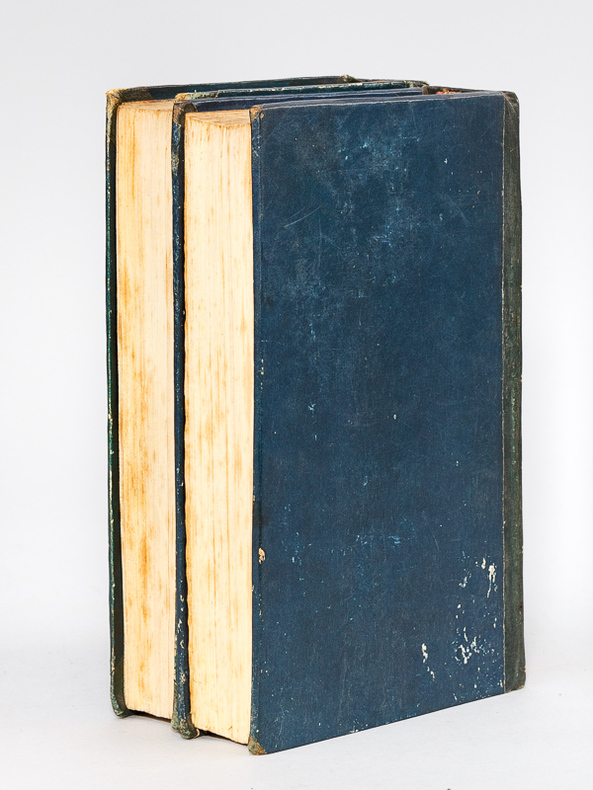
1787585531 vol. in-8 reliure début XIXe demi-basane verte, Chez Volland, Desenne, Paris, 1787, Tome I : 14 pp., 1 f. (errata et avis au relieur), 383 pp. avec 2 cartes dépliantes ; Tome II : 6 pp., 1 f. (errata), 458 pp. et 2 ff. n. ch. (approbation) avec 3 planches hors texte (dont deux dépliantes)