Wilhelm JordanBiblio.com

16 988 résultats
0332197441.Ghardcover. Good. Access codes and supplements are not guaranteed with used items. May be an ex-library book. hardcover
0366144111.Ghardcover. Good. Access codes and supplements are not guaranteed with used items. May be an ex-library book. hardcover
0366143891.Gpaperback. Good. Access codes and supplements are not guaranteed with used items. May be an ex-library book. paperback
ria9783743369832_inpPaperback. New. New Book; Fast Shipping from UK; Not signed; Not First Edition; N/A paperback
ria9783743369849_inpPaperback. New. New Book; Fast Shipping from UK; Not signed; Not First Edition; N/A paperback
033199819X.Ghardcover. Good. Access codes and supplements are not guaranteed with used items. May be an ex-library book. hardcover
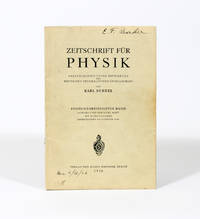
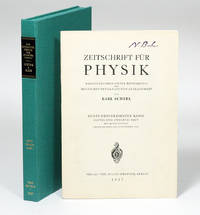
19261276Berlin: Julius Springer 1926. 1st Edition. Soft cover. Very Good. FIRST EDITION IN ORIGINAL WRAPPERS of the famous "three-man paper" the first complete self-consistent description of quantum mechanics. "In 1925 after an extended visit to Bohr's Institute of Theoretical Physics at the University of Copenhagen Heisenberg tackled the problem of spectrum intensities of the electron taken as an anharmonic oscillator a one-dimensional vibrating system. His position that the theory should be based only on observable quantities was central to his paper of July 1925 "Über quantentheoretische Umdeutung kinematischer und mechanischer Beziehungen" "Quantum-Theoretical Reinterpretation of Kinematic and Mechanical Relations". Heisenberg's formalism rested upon noncommutative multiplication; Born together with his new assistant Pascual Jordan realized that this could be expressed using matrix algebra which they used in a paper submitted for publication in September as "Zur Quantenmechanik" "On Quantum Mechanics". By November Born Heisenberg and Jordan had completed "Zur Quantenmechanik II" "On Quantum Mechanics II" colloquially known as the "three-man paper" which is regarded as the foundational document of a new quantum mechanics" Britannica's Guide to the Nobel Prizes. Particle Physics: One Hundred Years of Discoveries: "Development of matrix formalism for the Heisenberg quantum mechanics. Systems with arbitrary many degrees of freedom." Provenance: With ownership signature on front wrapper of E.F. Barker noted American physicist who worked primarily at the University of Michigan. IN: Zeitschrift für Physik Band 35 February 1926 pp. 557-615. Berlin: Julius Springer 1926. Octavo original wrappers; custom box. A few creases to wrappers chips to spine. RARE in original wrappers. Julius Springer paperback books
192846031Berlin 1928. unknown books
192845430Berlin, Springer, 1928. 8vo. In ""Zeitschrift für Physik"" bd. 47. Entire volume offered. In contemporary half cloth with marbled boards. Library stamp to front free end-paper. A fine and clean copy. Pp. 151-173. [Entire volume: VII, (1), 914 pp.].
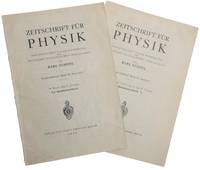
19266575Berlin: Springer 1926. First edition. <p>First edition extremely rare offprints of the two papers that founded matrix mechanics. Building on Heisenberg's demand that quantum theory be formulated in terms of observable quantities Max Born recognised that Heisenberg's rule of combination was in effect matrix multiplication. The first offprint Born-Jordan introduced the new formalism and established the non-commutative relation between position and momentum. The second the celebrated "Three-Man Paper" Born-Heisenberg-Jordan gave the first sustained presentation of quantum mechanics in matrix language recasting physical quantities as matrices and applying Hamilton's equations. In its closing section Jordan extended the method to the electromagnetic field-an early step towards quantum electrodynamics.</p>. The Birth of Modern Quantum Mechanics. <p>First edition extremely rare offprints of Born and Jordan's explication of Heisenberg's quantum mechanics - in their joint paper On Quantum Mechanics which introduced matrix mechanics to the world - and the more detailed sequel with Heisenberg himself the famous "three-man paper" which was the first comprehensive exposition of quantum mechanics in matrix language. Quantum mechanics first emerged in Heisenberg's 'Uber quantentheoretische Umdeutung kinematischer und mechanischer Beziehungen' 'Quantum-theoretical reinterpretation of kinematic and mechanical relations' published on 18 September 1925. In that paper "Heisenberg 1901-76 points out that on the atomic level the orbits of electrons and their period of revolution are not measurable but that theory should be based only on quantities that can at least in principle be experimentally observed. He went on to replace the usual position x of a point-like particle by an 'ensemble of quantities' xmn and proposed a rule for the multiplication of such ensembles . After Pauli's approval Heisenberg gave the paper to Born 1882-1970. He asked him to study it and in case he agreed to forward it to a journal for publication . Only some days later Born studied the paper. He was impressed sent the paper off for publication and began to think about more formal aspects of Heisenberg's approach. The multiplication rule Heisenberg had used for his ensembles seemed vaguely familiar to him and then he realized that this was the rule of matrix multiplication. The ensembles could be taken as matrices which were well studied by mathematicians. It was well known that in general matrix multiplication is not commutative i.e. the result of a product depends on the order in which the factors are written. For the matrices x of position and p of momentum this means that the elements of the matrix px are not necessarily equal to those of the matrix xp. Born conjectured that the commutator px − xp was equal to h/i times the unit matrix 1 although he could show that property only for the diagonal elements of the commutator. For the general proof he asked the help of Jordan 1902-80 who found it within two days . Born and Jordan began to work out quantum mechanics in matrix notation on the basis of Heisenberg's ideas. Born . left the actual writing of their paper On Quantum Mechanics to Jordan. Heisenberg Jordan and Born now began a collaboration - mostly by correspondence - in which they worked out a comprehensive exposition of quantum mechanics. Their publication On Quantum Mechanics II is usually referred to as the 'three-men paper' Drei-Männer-Arbeit. It contains the fundamental assumptions of the theory i.e. the reinterpretation of physical quantities as matrices with their special multiplication laws or 'commutation relations' and Hamilton's equations written down for these quantities . Moreover it presents a systematic way for the solution of these equations and there is a discussion of perturbation theory and of several examples. The three men were together in Göttingen for only about two weeks before Born who had written the mathematical part departed for the United States and left the final editing to Heisenberg and Jordan both twenty-three years old at the time. The paper was completed in mid-November. Its last section carries the title 'Coupled Harmonic Oscillators. Statistics of Wave Fields'. It was written by Jordan alone and practically no notice was taken of it at that time. Now it is recognized as the first description of the electromagnetic field in terms of quantum mechanics and thus as the very first step towards quantum electrodynamics" Brandt pp. 155-157. RBH lists only the Plotnick copies Christie's NY 2002.</p> <br /> <p>"Even those intimately familiar with matrix mechanics as we now understand it will find Heisenberg's 1925 paper daunting. But happily this obscurity is much less true of the article by Born and Jordan that followed Heisenberg's by about two months in the next volume of Zeitschrift für Physik and largely reformulated his theory in terms of matrix operations.</p> <br /> <p>"It happened that while or shortly after reading Heisenberg's manuscript before it was submitted for publication in July of 1925 Born quickly realized that the noncommutativity that Heisenberg had discovered could be interpreted as matrices which in general do not commute. After Pauli declined Born was able to induce his 23-year-old assistant Pascual Jordan who had studied with the mathematician Courant to help him with the mathematics of the theory. They immediately began their very lucid reformulation of Heisenberg's paper which they worked up in those two months opening with an introduction to the properties of matrices including their noncommutativity and adopting Heisenberg's assumption from the correspondence principle that Hamilton's equations of motion apply in the quantum theory a well as classically. In short order they discovered the operator or matrix expression xp - px = h/2piI. With the Hamiltonian in hand they could obtain an expression for the time dependence of an operator and using Hamilton's laws of motion treat a problem like the harmonic oscillator. Application was made to the one-dimensional oscillator from which the now familiar result E = n ½hw was obtained and the simple rotor was treated as well. The paper is a tour de force succinct and clear. It is not at all hard to see why Born always felt that he and Jordan should have been given something like equal credit for the discovery of matrix mechanics which was never the case. The details of the paper which hinted at the role of Hermitian bilinear or quadratic forms in representing observables though the specific language of Hermitian operators on a Hilbert space was not yet used were mostly the work of Jordan .</p> <br /> <p>"The third paper this one by all three Born Heisenberg and Jordan BHJ . submitted eight weeks after Born and Jordan's paper introduced the language of Hermitian forms quite explicitly . Perhaps the most startling discovery by Heisenberg and more explicitly by Born and Jordan was that the products xp and px were different that is that as 'operators' x and p do not commute in quantum mechanics. Thus a quantity like p x = px - xp came in the BHJ paper to be known as a 'commutation rule' or 'commutation relation' after the common notion of commutativity. In this paper we also find the general expression for the time dependence of a dynamical variable or as the authors put it 'any quantum mechanical quantity' in terms of the commutator with the Hamiltonian which is equivalent to giving the time dependence of an operator in what we know as the 'Heisenberg picture'. Throughout the development emphasis is placed on the canonical transformations that lead to a diagonal matrix representing the dynamical variable typically the energy the Hamiltonian.</p> <br /> <p>"Another important application found in the BHJ paper is to time-dependent perturbation theory. An examination of their chapter 2 reveals the equations for the energy eigenvalues in first- and higher-order perturbation theory in a fairly transparent form for even the modern reader and in the same chapter degenerate perturbation theory is treated by diagonalizing a submatrix of the perturbing interaction involving the degenerate states.</p> <br /> <p>"In the next chapter of the paper the challenging problems of continuous spectra involving continuous matrices are addressed although in a less than mathematically rigorous way therefore leaving some unanswered questions. It is worth noting that Heisenberg was not entirely comfortable with Born and Jordan's casting the theory in what for the time was a fairly sophisticated mathematical form. He wrote Pauli saying that: 'I am pretty unhappy about the whole theory and thus was glad that you were so completely on my side in your views on mathematics and physics. Here Göttingen I'm in an environment that thinks the exact opposite and I do not know if I'm not just too stupid to understand mathematics.' In the same vein Pauli wrote Ralph Kronig that 'one must next attempt to free Heisenberg's mechanics from the Göttingen torrent of erudition.' Of course these two founders of quantum mechanics would soon be proved wrong .</p> <br /> <p>"The BHJ paper was titled 'On quantum mechanics. II' thus deliberately announcing it as the successor to the Born-Jordan paper rather than of Heisenberg's original work. Hilbert . since 1895 had been at Göttingen where all three authors BHJ were working at the time - before Heisenberg's move to Leipzig. It is in this paper BHJ that Jordan provided the first sketch of transformation theory . On the other hand although dynamical variables are transformed the states have not yet emerged as vectors in Hilbert space. But the relationship of these results to the eigenvalues of Hermitian operators are clearly spelled out and Hilbert's work is cited.</p> <br /> <p>"One of the most important aspects of the paper is to be found in its chapter 4 'Physical applications of the theory' the introductory section of which is titled 'Laws of conservation of momentum and angular momentum: intensity formulae and selection rules.' Here we see the angular momentum algebra for the first time using the new commutation rules which were obtained directly from the commutators of p and x . Here are to be found the standard expressions for the commutators involving the angular momentum operators not using that term of course the matrix elements of the angular momentum operators . and implicitly the 'ladder operators' for angular momentum . Although the paper was submitted in November 1925 the advance over Heisenberg's original paper from the end of July is enormous. Among other things it led directly to Pauli's treatment of the hydrogen atom. In all the early papers including those of Heisenberg of Born and Jordan of BHJ and even of Dirac the problem of the hydrogen atom was ducked as being too difficult in favor of the harmonic oscillator or the simple rotor for example" Purrington pp. 59-62.</p> <br /> <p>"The endeavours of Born Heisenberg and Jordan led to the development of the theory of matrix mechanics which was applicable to all types of multiply periodic systems to nondegenerate and degenerate ones and in principle even to aperiodic systems. In addition the authors realized that the matrix equations had a simpler structure than the corresponding classical equations . the discussion of conservation laws also appeared to be considerably more elementary. The three authors succeeded in presenting the theory in a finished and compact form" Mehra p. 92.</p> <br /> <p>In the last chapter of the three-man paper Jordan introduced the process of 'second quantization' the first attempt at a quantum-mechanical treatment of the electromagnetic field thinking of the electromagnetic field in terms of quanta is 'first quantization'; that picture has to treated using quantum mechanics hence 'second quantization'. "Jordan himself rated his calculation as 'almost the most important contribution I ever made to quantum mechanics' . Jordan's original approach to second quantization not Dirac's became the standard procedure among researchers and in textbooks to formulate quantum field theory" Dittrich. Jordan tends to be overlooked today due to his Nazi-era writings that praised Hitler's regime. Some feel that this probably prevented him from being awarded the Nobel Prize in 1954 jointly with Born and Bothe. Heisenberg received the Nobel Prize in 1932 "for the creation of quantum mechanics".</p> <br /> <p>Brandt The Harvest of a Century 2009. Dittrich 'The cofounder of quantum field theory: Pascual Jordan' The European Physical Journal H 40 2015 pp. 241-260. Mehra The Historical Development of Quantum Theory vol. III 1982 see Chapter III for a full account of the three-man paper. Purrington The Heroic Age. The Creation of Quantum Mechanics 1925-1940 2018.</p> <br/> <br/> Two vols 8vo 228 x 156 mm. I. Offprint from: Zeitschrift für Physik Bd. 34 Heft 11/12 28 November 1925; II. Offprint from: Zeitschrift für Physik Bd. 35 Heft 8/9 4 February 1926. Berlin: Springer 1925 -1926. Springer unknown
a94162Berlin 1925 first edition. Springer. Thick octavo hardcover. 3/4 Grey cloth with yellow marbled boards. Gilt spine letters. Volume 34 of Zeitschrift fur Physik. 953p. Born and Jordan article on pages 858-888. Many other important articles in this volume by Otto Hahn Lise Meitner M Laue Reiche Smekal others in the volume as well. Near Fine just slight wear binding very secure; hinges not cracked; no owner marks; not exlib. No owner marks.Together with the work of Werner Heisenberg this paper helped define Quantum Mechanics. Pictures available on request. . hardcover
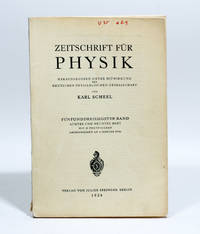
19262822Berlin: Julius Springer 1926. 1st Edition. original wrappers. Very Good. FIRST EDITION IN ORIGINAL WRAPPERS of the famous "three-man paper" the first complete self-consistent description of quantum mechanics. "In 1925 after an extended visit to Bohr's Institute of Theoretical Physics at the University of Copenhagen Heisenberg tackled the problem of spectrum intensities of the electron taken as an anharmonic oscillator a one-dimensional vibrating system. His position that the theory should be based only on observable quantities was central to his paper of July 1925 "Über quantentheoretische Umdeutung kinematischer und mechanischer Beziehungen" "Quantum-Theoretical Reinterpretation of Kinematic and Mechanical Relations". Heisenberg's formalism rested upon noncommutative multiplication; Born together with his new assistant Pascual Jordan realized that this could be expressed using matrix algebra which they used in a paper submitted for publication in September as "Zur Quantenmechanik" "On Quantum Mechanics". By November Born Heisenberg and Jordan had completed "Zur Quantenmechanik II" "On Quantum Mechanics II" colloquially known as the "three-man paper" which is regarded as the foundational document of a new quantum mechanics" Britannica's Guide to the Nobel Prizes. <br /> <br /> Particle Physics: One Hundred Years of Discoveries: "Development of matrix formalism for the Heisenberg quantum mechanics. Systems with arbitrary many degrees of freedom."<br /> <br /> IN: Zeitschrift für Physik Band 35 February 1926 pp. 557-615. Berlin: Julius Springer 1926. Octavo original wrappers. Small chip at base of spine. "Born Heisenberg 35" in pencil on spine. Volume/issue number written in ink at top of front wrapper. <br /> <br /> One of the foundational papers in quantum mechanics rare in original wrappers. Julius Springer unknown
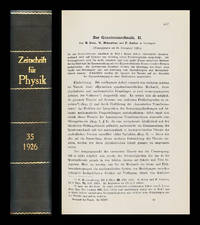
19261443Berlin: Vieweg und Springer 1926. 1st Edition. Bound FIRST EDITION OF BORN HEISENBERG & JORDAN'S "MONUMENTAL" THREE-MAN PAPER ‘ON QUANTUM MECHANICS II' THE FIRST COMPLETE STATEMENT OF MATRIX MECHANICS Peacock Quantum Revolution 52. Handsomely rebound. See details below. <br /> <br /> In this work Born Heisenberg and Jordan extend the methods Heisenberg presented in his initial 1925 paper and apply them to a number of important problems. "This paper definitively set forth and first named matrix mechanics — the version of quantum mechanics based on the algebraic manipulation of matrices that represent observable quantities such as position momentum and energy. Detailed calculations showed that the new matrix mechanics was very successful in predicting the anomalous Zeeman Effect other forms of line splitting and line intensities. The three authors even produced a new derivation of Planck's Law" ibid. <br /> <br /> In the early 1920s there were fundamental difficulties in atomic physics. The quantum theory of atomic structure founded by Bohr and largely developed by Bohr and Sommerfeld did not describe the properties of complicated atoms and molecules. "In spite of its high-sounding name and its successful solutions of numerous problems in atomic physics ‘quantum theory' and especially the ‘quantum theory' of polyelectronic systems prior to 1925 was from the methodological point of view a lamentable hodgepodge of hypotheses principles theorems and computational recipes rather than a logical consistent theory. Every single quantum-theoretic problem had to be solved first in terms of classical physics; its classical solution had then to pass through the mysterious sieve of the quantum conditions or as it happened in the majority of cases the classical solution had to be translated into the language of quanta in conformance with the correspondence principle <br /> <br /> In short quantum theory still lacked two essential characteristics of a full-fledged scientific theory conceptual autonomy and logical consistency" Jammer The Conceptual Development 196. The work of Heisenberg Born and Jordan rectified these issues and marked the "starting point for the new quantum mechanics" also called matrix mechanics DSB. <br /> <br /> Heisenberg published his initial paper formulating his new quantum theory in 1925 but without reference to matrices. "Later the same year Max Born and Pascual Jordan published a second paper that introduced the matrix formulation for the special case of one degree of freedom" History of Physics: The Wenner Collection. <br /> <br /> Finally in early 1926 all three scientists collaborated on a third paper this ‘three-man paper' and extended the theory to an arbitrary number of degrees of freedom. In its final form they argued Heisenberg's formulation of the new quantum theory is a matrix algebra of quantum operators that "predicts the radiation resulting from electron state transitions between energy shells in the atom without reference to how the transitions occur" ibid. CONDITION & DETAILS: Berlin: Vieweg und Springer. Large 8vo. 9 x 6 inches; 225 x 150mm. pp. 557-722. Two stamps on the title page; no other markings inside or out. Full volume handsomely rebound in black cloth gilt ruled and lettered at the spine. Tightly and solidly bound. Bright and clean throughout. Very good to near fine condition . Vieweg und Springer hardcover
192846031Berlin 1928. unknown
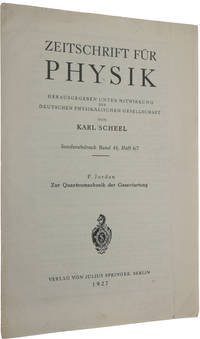
19275424Berlin: Springer 1927. First edition. <p>First edition extremely rare offprint of this important paper in which Jordan introduces his approach to quantum field theory independent of Dirac's and also gives his formulation of Fermi-Dirac statistics which he had developed earlier than both Fermi and Dirac. "Pascual Jordan is the unsung hero among the creators of quantum mechanics" Schweber QED and the men who made it.</p>. <p>ANTICIPATING DIRAC ON QUANTUM FIELD THEORY AND FERMI AND DIRAC ON THEIR STATISTICS</p> . <p>First edition extremely rare offprint of this important paper in which Jordan introduces his approach to quantum field theory independent of Dirac's and also gives his formulation of Fermi-Dirac statistics which he had developed earlier than both Fermi and Dirac. "Pascual Jordan is the unsung hero among the creators of quantum mechanics. Major portions of the two papers he co-authored with Born and Heisenberg that elaborated matrix mechanics following Heisenberg's initial insight were Jordan's contribution. Similarly he was responsible for laying the foundations of quantum field theory" Schweber pp. 5-6. "Before the end of the year 1925 Jordan had submitted a single author paper. This papercontained what is nowadays known as the Fermi-Dirac statistics; however it encountered an extremely unfortunate fate after its submission because it landed on the bottom of one of Max Born's in his role as the editor of the Zeitschrift für Physik suitcases on the eve of an extended lecture tour to the US where it remained for about half a year. When Born discovered this mishap the papers of Dirac and Fermi were already in the process of being published. This paper by Jordan was never published but he further developed its contents and this extended piece of work Zur Quantenmechanik der Gasentartung 'On the quantum mechanics of gas degeneracy' was published by Jordan in 1927" Mactutor. "Jordan was the earliest and most ambitious visionary of the quantum field theory program: long before this became commonly accepted in the second half of the twentieth century he saw in quantum field theory a unified basis for all of modern physics" Lehner p. 272. The present paper "already defines Jordan's program: a unified quantum field theory for matter and radiation. Particles and waves are only two different aspects of the same underlying quantum field both in the case of light and in the case of matter" ibid. pp. 280-281. No copies in auction records. Not on OCLC.</p> <br /> <p>"The year 1925 was a bright start for the 22-year-old Jordan. After the submission of the joint work with Max Born on Matrix Mechanics in which the p-q commutation relation appeared for the first time there came the famous 'Dreimännerarbeit' with Born and Heisenberg in November of the same year only to conclude the year's harvest with a paper by him alone on the 'Pauli statistics'. Jordan's manuscript contained what is nowadays known as the Fermi-Dirac statistics; however it encountered an extremely unfortunate fate after its submission . In the words of Max Born a quarter of a century later: 'I hate Jordan's politics but I can never undo what I did to him . When I returned to Germany half a year later I found the paper on the bottom of my suitcase. It contained what one calls nowadays the Fermi-Dirac statistics. In the meantime it was independently discovered by Enrico Fermi and Paul Dirac. But Jordan was the first'" Schroer pp. 2-3. "The year 1927 was the most fruitful in Jordan's career . The second paper submitted in July 1927 offered here was inspired by Dirac's field-theoretic transcription of the quantum mechanical multi-particle configuration space for Schrödinger's formalism 'high dimensional abstract space' to the quantization of Schrödinger waves in ordinary space. Jordan sets out to do something analogous for 'Fermi's instead of Einstein's gas'. He develops what he refers to as the 'Pauli-statistics' probably using material from his ill-fated 1925 manuscript which ended in Born's suitcase and uses the quantized spacetime field formulation to compute the density fluctuations in a Fermi gas" ibid. p. 4.</p> <br /> <p>"As he claimed in the present paper p. 480 and in a letter to Schrödinger his occupation with the quantum theory of the ideal gas had suggested this further application of the theory of quantized waves. Jordan writes in the letter:</p> <br /> <p>'Then your hydrogen paper i.e. 'Quantisierung als Eigenwertproblem Zweite Mitteilung' gave hope that by following up this correspondence also the non-ideal gas could be represented by quantized waves - that therefore a complete theory of light and matter could be derived in which as an essential ingredient this wave field itself operates in a quantum non-classical way'.</p> <br /> <p>"Jordan saw Schrödinger's wave-functions as a generalization of the simple plane waves that he had quantized in the 'Dreimännerarbeit' and interpreted as the quantum mechanical representation of the Bose-Einstein ideal gas; he was convinced that the quantization of these wave-functions was the method necessary to apply quantum mechanics to the case of several interacting particles. In the letter to Schrödinger Jordan gives two reasons why he did not pursue this program immediately: The problem to account for Fermi-Dirac statistics since it seemed that the wave picture would always lead to Bose-Einstein statistics and the reservations of his colleagues Heisenberg Pauli and Born" Lehner p. 276.</p> <br /> <p>Although Jordan had introduced the idea of a quantized field at the end of the 'Dreimännerarbeit' it "only came to the attention of a wider group of physicists through Paul Dirac's 'The quantum theory of emission and absorption of radiation.' Paradoxically the notion of quantizing a field appears nowhere in the paper . Dirac explicitly denied that the 'wave function of the light quanta' is the same as the electromagnetic field. He also argued that while an ensemble of light quanta can be associated with a light wave there is no such physical wave associated with an ensemble of matter particles such as electrons. Therefore he did not see the quantization procedure as an explanation of the quantum nature of radiation. It was to him only an elegant way to take into account the Bose statistics of light quanta. Since electrons do not obey Bose statistics the procedure is not applicable to them. Dirac maintained particle number conservation for light quanta by introducing a 'sea' of zero-momentum light quanta. This is another piece of evidence that for Dirac the particle concept was primary.</p> <br /> <p>"Unlike Jordan's earlier attempt Dirac's theory was greeted with enthusiasm since it first derived the link between quantum mechanics and Einstein's theory of absorption and emission and so offered a quantum-mechanical representation of the interaction of matter and radiation. Today Dirac's paper is often seen as the seminal work for quantum field theory. This is somewhat ironic as Dirac explicitly rejected the idea that his method was to be understood as the quantization of the classical field. Jordan thought for the rest of his life that he did not get due credit for his work:</p> <br /> <p>'It has always saddened me somehow that the attack on the light-quantum problem already contained in our Dreimännerarbeit was rejected by everyone for so . until Dirac took up the idea from which point onward he was the only one cited in this connection.'</p> <br /> <p>"Instigated by Dirac's success Jordan quickly returned to the theory of the quantized field. However what he did was in conflict with Dirac's ideas and a clear continuation of his earlier program based on the principle of symmetry of representations. Therefore his first paper offered here explicitly rejected Dirac's assessment that the ideal gas obeying Fermi statistics cannot be represented by a wave field. Jordan observed that in the case of Bose-Einstein statistics the number operator has arbitrary integer eigenvalues while in the case of Fermi-Dirac statistics the number operator can only have eigenvalues 0 or 1. He now constructed an algebra of field operators that yield these eigenvalues for the number operator using Pauli's spin matrices. This construction was made possible by Jordan's concept of conjugate variables that was more general than Dirac's: While Dirac relied on commutation relations of the standard form </p> <br /> <p>pq − qp = −ih </p> <br /> <p>Jordan's transformation theory relied on a more general notion of conjugate variables motivated by the need to represent angle and angular momentum as conjugate variables and allowed for a generalization of these commutation rules. However as Darrigol has pointed out Jordan's actual calculations were full of mistakes . What had gotten lost in the imprecisions were the correct phase relations between the creation and annihilation operators. Only in the fall of 1927 Jordan would return to the topic and with the help of Eugene Wigner present the correct algebra now called Jordan-Wigner second quantization using anti-commutation relations. </p> <br /> <p>"Despite its technical flaws the offered paper already defines Jordan's program: a unified quantum field theory for matter and radiation. Particles and waves are only two different aspects of the same underlying quantum field both in the case of light and in the case of matter:</p> <br /> <p>'Despite the validity of the Pauli instead of Bose statistics for electrons the results achieved so far leave hardly a doubt that a quantum-mechanical wave theory of matter can be formulated in which electrons are represented as quantized waves in ordinary three-dimensional space and that the natural formulation of the quantum theory of the electron will have to be achieved by comprehending light and matter on equal footing as interacting waves in three-dimensional space. The fundamental fact of electron theory the existence of discrete electrical particles thus manifests itself as a characteristic quantum phenomenon namely as equivalent to the fact that matter waves only appear in discrete quantized states' p. 480.</p> <br /> <p>"Jordan pointed out that the anti-symmetrical wave-functions that Heisenberg and Dirac had constructed for many-particle systems were therefore not at all physical waves but simply 'a special case of the general probability amplitudes which have to be used as a mathematical tool for the description of the statistical behavior of quantized light and matter waves' p. 480. These quotes show clearly the difference in perspective between Jordan and Dirac: Unlike Dirac Jordan treated second quantization of the Schrödinger wave function as the quantization of a physical field and saw this procedure as an explanation of the corpuscular character of matter. Unlike Schrödinger however Jordan did not attempt to find an objective physical description behind the mathematical formalism. Transformation theory to him still implied that neither the particle nor the wave description were fundamental and therefore neither picture could be used to construct a complete description of objective reality" Lehner pp. 278-281.</p> <br /> <p>Pascual Jordan 1902-80 was born in Hannover. His family name of Spanish origin was originally Jorda. He enrolled in the Technical University of Hannover in 1921 where he studied zoology mathematics and physics but moved to the University of Göttingen in 1923. Göttingen was then at the zenith of its powers in mathematics and the physical sciences under the leadership of David Hilbert and Arnold Sommerfeld. At Göttingen Jordan became an assistant to the mathematician Richard Courant for a time and then studied under the physicist Max Born for his doctorate. Germany's defeat in the First World War and the Treaty of Versailles had a profound effect on Jordan's political beliefs. He believed the Treaty to be unjust and became increasingly nationalistic. In 1933 Jordan joined the Nazi party like Philipp Lenard and Johannes Stark and moreover joined an SA unit. He supported the Nazis' nationalism and anti-communism while remaining a defender of Einstein and other Jewish scientists. Jordan seemed to hope that he could influence the new regime; one of his projects was attempting to convince the Nazis that modern physics developed as represented by Einstein and especially the new Copenhagen brand of quantum theory could be the antidote to the 'materialism of the Bolsheviks'. Had Jordan not joined the Nazi party it is possible that he would have won the Nobel Prize in Physics for his work with Max Born on the foundations of matrix mechanics - Born shared the 1954 Nobel Prize with Walther Bothe the prize can be shared by up to three people. Pauli declared Jordan to be 'rehabilitated' to the West German authorities some time after the war allowing him to regain academic employment after a two-year period. He then recovered his full status as a tenured professor in 1953. </p> <br /> <p>Lehner 'Mathematical foundations and physical visions: Pascual Jordan and the field theory program' pp. 272-293 in: Mathematics meets Physics Schloter & Schneider eds. 2011. Schroer 'Pascual Jordan glory and demise and his legacy in contemporary local quantum physics' arXiv:hep-th/0303241 2003. Schweber QED and the men who made it 1994.</p> <br/> <br/> 8vo 228 x 155mm pp. 473-480. Original printed wrappers a little soiled and creased. Springer unknown
192845430Berlin Springer 1928. 8vo. In "Zeitschrift für Physik" bd. 47. Entire volume offered. In contemporary half cloth with marbled boards. Library stamp to front free end-paper. A fine and clean copy. Pp. 151-173. Entire volume: VII 1 914 pp. <br/><br/><em>First printing of this significant paper. "Following Dirac's precedent Jordan Heisenberg and Pauli developed the relativistic quantum electrodynamics. This theory occupied physicists for a good twenty years before it became clear that in spite of all the doubts and disappointments one of the most precise physical theories had been discovered." DSB"It was evident from the beginning that a proper quantum treatment of the electromagnetic field had to somehow incorporate Einstein's relativity theory which had grown out of the study of classical electromagnetism. This need to put together relativity and quantum mechanics was the second major motivation in the development of quantum field theory.Pascual Jordan and Wolfgang Pauli showed in 1928 that quantum fields could be made to behave in the way predicted by special relativity during coordinate transformations". </em> hardcover
139636725X.Ghardcover. Good. Access codes and supplements are not guaranteed with used items. May be an ex-library book. hardcover
1391486765.Gpaperback. Good. Access codes and supplements are not guaranteed with used items. May be an ex-library book. paperback
1c515Dannersche Mühlhausen 1901-1905/1907/1908/1911. zus. ca. 300 S. brosch. etwas fl. Beilage zum Jahresbericht des Gymnasiums in Mühlhausen i. Thür. Enthalten u.a.: Zur Verfassungsgeschichte der Stadt Mühlhausen in Thüringen/Das Ende Thomas Münzers/Die Salzburger Emigranten in Mühlhausen/Ein Mühlhäuser Geschütz/Aus der Franzosenzeit II/Von dem eigentlichen Alter der ältesten Statutorum der Reichsstadt Mühlhausen/Miscellen zur Geschichte Heinrich Pfeifers/Johannes Laue Prediger zu Mühlhausen / Aus der Geschichte der Musik in Mühlhausen / Geschichte des städtischen Gymnasiums - unknown
ria9783112498897_inpHardcover. New. New Book; Fast Shipping from UK; Not signed; Not First Edition; N/A hardcover
1990367Geol. Jahrb. Reihe A 121. Hannover. 1990. Pp. 323 many illus. on 29 pls. 26 illus. in text 5 tabs. refs. Orig. stiff wrs. - Contains 8 papers. [Geol. Jahrb., Reihe A, 121.] Hannover. unknown
192743609Berlin, Julius Springer, 1927. 8vo. Entire volume 45 of ""Zeitschrift für Physik"" bound in a red-brown contemporary half cloth with gilt title to spine. Library stamp to title-page. Corners and lower capital bumped, hinges a bit weak. An overall fine and clean copy. Pp. 751-765"" 766-775. [Entire volume: VII, (1), 910 pp.].
192745149Berlin, Julius Springer, 1927. 8vo. Entire volume 45 of ""Zeitschrift für Physik"" bound in a black contemporary half cloth with gilt lettering to spine. Library stamp to free front end-paper. An overall fine and clean copy. Pp. 751-765"" 766-775. [Entire volume: VII, (1), 910 pp.].
192749120Berlin, Julius Springer, 1927. 8vo. Entire volume 45 of ""Zeitschrift für Physik"" bound in contemporary half cloth with gilt title to spine. Library stamp to title-page. Corners and lower capital bumped, hinges a bit weak. An overall fine and clean copy. Pp. 751-765"" 766-775. [Entire volume: VII, (1), 910 pp.].
19272348Berlin: Julius Springer 1927. First edition. Original wrappers. Fine. FIRST EDITION IN ORIGINAL WRAPPERS of Jordan and Klein's introduction of the "second quantization"; one of the founding papers of quantum field theory. FROM THE LIBRARY OF NIELS BOHR with his stamp on the front wrapper. In Jordan's "paper with Klein written while the two of them were in Copenhagen in the spring of 1927 a generalization of Dirac's treatment of bosons was given to allow for the interaction of the bosons with one another. Their point of departure was a Schrödinger equation for the field operator containing a nonlinear term to account for the interaction of the field itself. "The equivalence of this description with that using symmetric wave functions in configuration space was established. The 'particles' that emerged from the imposition of the quantum condition commutation rules on the field variables thus obeyed Bose statistics. Heisenberg found the results of Jordan and Klein very attractive. In his interview with Kuhn and Heilbron in 1963 he recalled: 'I liked it very much because now I could see "All right. There is an entirely different picture to start with the wave picture and if I quantize that picture--that is if I make this picture open to the same restriction as the particle picture--then the two pictures become equivalent." That is exactly what I wanted' Heisenberg 1963 session 8 p. 21. "Bohr at the Solvay meeting of 1927 saw Jordan and Klein's work as supporting his views of complementarity. Pauli at that same congress welcomed the formulation since it allowed to formulate the quantum theoretic description of an assembly of bosons entirely in 3-dimensional space. "In a letter to Kronig in November 1927 Pauli described the work of Jordan and Klein as 'wirklich schön' really beautiful. In fact the Jordan and Klein paper converted Pauli to the Jordan viewpoint about the quantization of matter fields. The article by Jordan and Klein made clear to both Heisenberg and Pauli who were then collaborating on a general theory of relativistic quantized fields how to proceed in describing the interaction between the electromagnetic field and charges. Pauli who up to that time had been reluctant to accept Jordan's views on quantization of matter fields embraced Jordan's viewpoint. After the publication of the Jordan-Klein article Pauli and Heisenberg agreed that the quantization of matter fields was the correct approach. In December 1927 Heisenberg could write Bohr that the important work of Jordan and Klein had been the stimulus of his thinking long and hard on the formulation of relativistic quantum mechanics and that he and Pauli were making good progress" Schweber QED and the Men Who Made It: Dyson Feynman Schwinger and Tomonaga pp.35-37. Also included is Jordan's paper: Über Wellen und Korpuskeln in der Quanenmechanik pp. 766-775. Provenance: From the library of Niels Bohr with his stamp on the front wrapper. IN: Zeitschrift Für Physik Band 45 18 November 1927 pp. 751-765. Berlin: Julius Springer 1927. Octavo original wrappers; custom box. A touch of edgewear. A FINE COPY rare in original wrappers. Julius Springer unknown books