[PHOTOGRAPHY - IRAQ AND PERSIA].Biblio.com
1 145 résultats
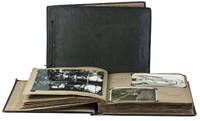
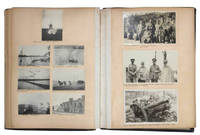
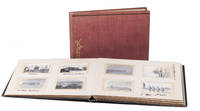
1917ABC_48426Iran and Iraq 1917. Contemporary cloth one album in in red and one in grey with 'Kodak' lettered in gold on the front board and a black classical meander border tooled near the foot. The albums are kept together by a black ribbon. Oblong 8vo ca. 15.5 x 20 cm. With 191 resp. 95 and 96 gelatin silver prints all ca. 4 x 6 cm. 2 volumes. Remarkable set of Kodak photo albums with nearly 200 photographs of military life and the oil industry in Iran and Iraq in the early 20th century. The photographs were most likely taken by the compiler of the albums and show scenes from his daily life. Most of them are captioned. Included are images of Persian oil fields Abu Zenema Sinai coast Port Sudan Bushehr Basra various locations along the Tigris Euphrate and Shatt al-Arab rivers Ashwaz and Shush. The photographs also show locals involved in various activities including races shark hunting and selling wares. The compiler of the album was likely a British soldier who was stationed in Basra and other locations in Iran and Iraq after the First World War.The edges and corners of both albums are slightly scuffed with a few light stains on the back board of the red album. The paper on which the photographs are mounted is slightly browned ten of the photos have either creased corners or a damaged surface some photographs a little loose within their windows missing a photo on the final page of the red album. Otherwise in good condition. hardcover
1928I3OEKR47KBBKIraq plus Malta and Egypt 1928. The photos mounted with paper corner-mounts in two contemporary cloth-covered albums the larger with padded boards covered in alligator-skin patterned dark green cloth with the photographs on both sides of 24 dark grey album leaves each leaf with a glassine paper guard-leaf embossed with a spider-web pattern bound in before it; the smaller covered in black cloth with a grey-white bird in a cloud painted on the front board and the word snaps with the photographs on both sides of leaves 2-35 & 51-52 of 54 light brown album leaves. Oblong albums 25 x 34.5 cm & 21.5 x 28.5 cm. Two albums containing about 275 silver halide photographic gelatin prints 6 x 8.5 cm to 16 x 21.5 cm assembled and mostly taken by a British Royal Air Force pilot while stationed in Iraq and then briefly Malta with a visit to Egypt. A collection of about 275 photographs made by an RAF pilot Sergeant William Reynish during his service in Iraq ca. 1928-1933 and Malta 1933 and during a brief visit to Egypt. Most have captions written on the album leaves clearly identifying the scenes. Some photos show scenes of daily life in Iraq Bagdad Hinaidi Mosul and other cities as well as the surrounding countryside with local people shops buildings landscapes ruins monuments etc. Others show the British troops and their activities vehicles airplanes including crashed ones etc. The portraits include an unidentified sheik with a falcon and an Arabic man smoking a hookha water pipe. The Kurdish Sheik Mahmud Barzanji of Sulaimaniyah rebelled against the Iraqi army around June 1930 but the RAF bombed his people's villages from September 1930 to April 1931 when he finally surrendered to Major W.C.F.A. Wilson administrative inspector at Mosul. Several photographs cover the sheik and his surrender.The surviving corner mounts show that three photographs have been removed from the album. A few photographs are slightly blurry or faded but most are very sharp and in very good condition. The inside front hinge of one album has broken but the albums are otherwise in good condition. A wealth of informative images from pre-War Iraq most clearly identified in the captions. hardcover
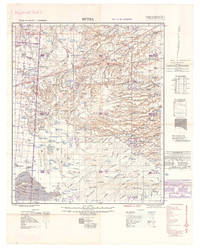
1942L7VCIV4N38L2UK Government: Survey Directorate HQ Tenth Army / Indian Field Survey Co. 1942. 42 chromolithographed topographic maps of parts of Iraq made from aerial photographs during World War II on a scale of 1:100000 and 1:253440 a quarter-inch to a mile. 68 x 50.5 cm & 60 x 47 cm. An impressive collection of Iraq maps compiled from the most current aerial photography and produced by the British Army for use in the Persian theatre of war during World War II. The cities and regions covered include Ain Sifni Aqra Tel Afar Salman Pak BaQuba Sumaika Penjwin Halabja Baghdad Kirkuk Dulaim Erbil and Mosul divisions.Previously folded. Generally well-preserved. Survey Directorate HQ Tenth Army / Indian Field Survey Co., unknown
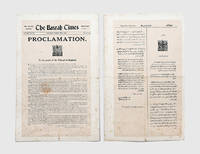
1917178262Basrah: The Basrah Times 1917. Empire and Pan-Arabism Two leaves from the first and only issue of the Basrah Times 20 March 1917 printing Sir Frederick Stanley Maude's appeal to the people of Baghdad province issued nine days after the British capture of the city. The proclamation marks a turning point in the First World War exemplifies imperial rhetoric and foreshadows the tensions between colonial authority and national aspiration that shaped the following decade in Iraq. Although Basrah fell in November 1914 Baghdad was secured only after a further two and a half years of campaigning. Maude drove the advance restoring supply lines and winning successive engagements at Hayy Dahra and Kut before the final assault. The proclamation presents the British not as conquerors but as liberators promising renewal after centuries of foreign rule and invoking the recent success of the Arab Revolt under Sharif Hussein as a model of independence and unity. Yet this balance between nationalist promise and imperial control proved unstable: the post-war Mandate endured only until the revolt of 1920 forced political transition culminating in Faisal's election as king in 1921. Two sheets each approximately 440 x 285 mm laid down on thick card framed and glazed. Text in English and Arabic. Sheets toned and with creases from old folds minor foxing a few short tears one small hole to centre of one sheet affecting one letter: a very good set. unknown
1920276768Berlin: Reimer / Vohsen 1920. XII, 164 Seiten, mit 44 Abbildungen im Text und 65 Tafeln, davon 4 in Kupfer-, Licht- und Farbendruck. 4° HLdr. *2 Taf gebräunt, unteres Kapital minimal berieben, schönes Expl.* eins von insgeamt 315 Expl.*.
209 issues bound in 202. Quarto. Illustrated throughout. Original pictorial wrappers. Includes many folded posters, loosely inserted. In excellent condition, exceptionally well preserved. ~ First edition. Extremely rare, complete collection of great political and historical interest. Contains: "L'Opinion de Bagdad. Revue politique bimensuelle", issues 1-86 (1972-1976). [AND:] "L'Irak aujourd'hui. Revue politique bimensuelle", issues 1-123 in 116 parts (1976-1981).
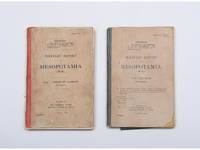
1922173026London: HMSO Press Harrow & Harrison & Sons Ltd 1922 1923 & 1923 1924. Background intelligence on Faisal's Iraq First editions of two regional sitreps issued after the 1920 Iraqi Revolt and Faisal's installation in 1921 prepared for British officials administering the new monarchy. Both are rare - print runs of 1375 likely with fewer distributed - with only five and four institutional copies traced. Each is marked Provisional and Confidential; Area 1 is additionally stamped "secret" in a contemporary hand. The projected 10-volume series was never completed and surviving instalments sometimes titled Military Report on Iraq are scarce. Compiled at short notice on the model of Naval Intelligence Division geographical handbooks the reports provide concise local intelligence: historical and geographical survey then climate resources ethnography tribal structure leading figures communications transport and routes with technical appendices. Area 1 Northern Jazirah covers northern Iraq and adjacent Turkey and Syria stressing weak British influence and the prestige lost through unchecked tribal raiding after 1919. Its core is a detailed tribal analysis supplemented by contemporary intelligence annotations on succession disputes and political loyalties. Area 7 Tigris surveys the settled agricultural belt from Kut to Qurnah and the Shatt al-Arab reflecting greater stability and asserting that firm but protective rule could secure order. Detailed appendices describe estates shaikhs armed retainers and agricultural practice. Together the volumes offer granular evidence of British intelligence gathering during the improvised creation of the Iraqi state in the early 1920s. 2 vols octavo. Area 1 pp. viii 240 with a folding table and numerous tables to the text; Area 7 pp. ii 184 3 folding many to the text. Both in original greyish yellow printed boards cloth backstrips first with reddish orange spine the second greyish green. Both volumes in field service condition and lacking the maps called for spines sunned and chipped some repairs "Mespots" added in white ink boards rubbed and lightly stained hinges occasionally cracked with some repairs and a little play but the internal binding sound; contents toned but generally clean; for such fragile productions both remain surprisingly well preserved very good. hardcover
1930276713Berlin: Reimer / Vohsen 1930. VII, 110 S.240 Textbildern und 47 Tafeln. 4° Ln.mS.
1871PHO-1755Paris, Imprimerie Impériale & Nationale, 1871-1930, 7 vol. (sur 9, manque tome 2 & 3) In-8°, brochage éditeur. Édition bilingue : Texte arabe avec traduction française en regard, Tome I, (1871), 2ff.-XII-408pp.,Tome IV, (1914), 2ff,VII_XI ,480pp., Tome V(1928); 3ffnch.-VI-515 pp; Tome VI (1928) ;3ffnch.-IX-518 ;Tome VII (1929); 3ffnch.-X-438 pp; Tome VIII (1930); 3ffnch-X-446 pp.; Tome IX (1930) ,3ffnch.-VI-299 pp. , en fin d’ouvrage , notes et variantes, correction ainsi que la table des matières .Manque les tomes 2/3 , petits défauts de reliure.
1945191029Baghdad: Iraqi Army Press c.1945. for the benefit of the Arabic language First edition with over 12000 words printed under the auspices of the Lexicon Committee of the Iraqi Ministry of Defence. The first and second world wars were catalysers for the sharp increase in the production of new Arabic glossaries and dictionaries for officers and soldiers stationed in the Middle East. In the early 1940s special attention was paid to technical dictionaries issued by governments and ministries rather than colloquial phrasebooks produced for individuals aiming at translation consistency and standardization. The dictionary was printed "to collect collate and preserve.the words employed by the late Prof. Abdul-Masih Wazir in his numerous translations of English military publications". Wazir was director of the translation department of the Iraqi Ministry of Defence in 1923-43. It also provided "an easy means of reference for the use of the translators of English military writings". The loose-leaf format was designed to facilitate revision. Octavo 160 x 105 mm. Text in Arabic and English. Issued as 21 pamphlets numbered 1-18 and 18A-20 roughly one per alphabet letter. Original brown cloth yellow stamped paper boards bootlace stitching. Extremities a little rubbed small paper loss on lower outer corner of rear cover contents toned but clean: a very good copy. R. Mairs Arabic Dialogues 2025. hardcover
26975'Published by Survey Directorate G.H.Q. Paiforce 1944. All one page 20 x 33cms some stained but texts clear and complate. 1. Index map of Iraq and Iran for a 1:100000 scale survey series produced by the British military command PAIFORCE during World War II. All 20 x 32.5cm a couple sl. stained mainly good condition.1.Four Index maps of Iraq and Iran ¼ series I.D.R./X.D.R./G.S.G.S. 9002 3919 nos. 1-42.Index map of Iraq and Iran for a 1:100000 scale survey series produced by the British military command PAIFORCE during World War II. Index Map of 'Irq rn 1:100000 Series I.D.R. 9003'.3.Four Index Maps of places/areas of IRAN:a. Ahwaz 1:10000 series 1D MISC/563 to 573 stamped 11 June 1944b. Askaran and Sanandaj N.W. 1:25000 series …9005 stamped 25 June 1944c. Gach-I-Sar 1:50000 series stamped 11 June 1944d. Khurramshahr Abandan 1:12500 series4.Six Index Maps of places/areas of IRAQ all 1:25000 series ID 9005:a. Ba'qubab. Faidahc. Haffad. Hindiyae. Falluja f. MoselNo reference to other copies yet found. 'Published by Survey Directorate, G.H.Q. Paiforce [1944] unknown
1948276712Hamburg: Eckardt & Messtorff 1948. II, 290 S. 55 Textbildern und 33 Tafeln, 5 Luftbildaufnahmen und 5 Karten lt. Titelbl. <richtig 1> 4° HLN.
112648Government of Iraq 1929. . Revised and enlarged edition. Folio 34.5 x 21.5 cm. approx. iv 34pp. photographic frontispiece 8 folding maps coloured in outline scale 1 inch = 15.78 miles 1: 100000 original red cloth lettered in gilt on upper cover a very good copy.<br /> Maps include Baghdad and Environs The Environs of Basrah and several road maps to Southern and Northern Iraq.<br /> Government of Iraq, 1929. hardcover
Very Good Arabic Original cloth bdg. Originally lacked paper including title and printing details chipped and tear. Interior very good. Otherwise a good copy. [14], 378 p. Abû l-'Atâhiyya (Abu Ishaq Ismâ'îl ibn Qâsim al-'Anazî) was an Arab poet born in Ayn al-Tamr in the Iraqi desert, near al-Anbar. His ancestors were of the tribe of 'Anaza. His youth was spent in Kufa, where he was engaged for some time in selling pottery. During the time when he took the occupation of selling pottery, he saw the assembly of poets in a competition and he participated in it. Thus he became famous for his poetry. For uplifting his poetry he reached to Baghdad. Moving to Baghdad, he continued his business there, but became famous for his verses, especially for those addressed to 'Utba, a concubine of the Abbasid Caliph al-Mahdi. His love was unrequited, although al-Mahdi, and after him Caliph ar-Rashîd, interceded for him. Having offended the caliph, he was imprisoned for a short time. He died in 828 in the reign of Caliph al-Ma'mûn. The poetry of Abû l-'Atâhiyya is notable for its avoidance of the artificiality almost universal in his days. The older poetry of the desert had been constantly imitated up to this time, although it was not natural to town life. Abû l-'Atâhiyya was one of the first to drop the old qasîda (elegy) form. He was very fluent and used many metres. He is also regarded as one of the earliest philosophical poets of the Arabs. Much of his poetry is concerned with the observation of common life and morality, and at times is pessimistic. Thus he was strongly suspected of heresy. Compiled and prepared by Louis Cheikho. Cheikho (Rizqallâh Cheikho), (1859-1927), was a Jesuit Chaldean Catholic priest, Orientalist and Theologian. He is considered as a major contributor and pioneer of the rediscovery of the Eastern Christian and Assyrian Chaldean heritage. Louis Cheikho was born in Mardin, Turkey on February 5, 1859. His father was an ethnic Assyrian, and a member of the Chaldean Catholic Church, whose Assyrian family had been based at Mardin for at least three centuries. His mother was an Armenian named Elizabeth Schamsé, who took him on pilgrimage to the Holy Land when he was 9 years old. In 1868, Cheikhô joined his brother at the Maronite Jesuit Seminary in Ghazîr, Lebanon. At this date, the seminary was not merely preparing young men for the priesthood, but also acted as a secondary college for young Christian and especially Assyrian Chaldean men. Both groups followed a similar syllabus. There, he learned both ancient and modern European and Semitic languages. In 1874 he entered the Jesuit Order and started his novitiate training at Lons-le-Saunier, France. He adopted at that time the name of 'Louis' out of devotion for the young Jesuit saint Louis Gonzaga. In 1878, he returned to Lebanon and taught Arabic Literature at the Jesuit Saint Joseph College in Beirut for 10 years. During this period, Cheikho continued his studies of philosophy at Université Saint-Joseph, Beirut. In 1888, Cheikho travelled to Great Britain for theological studies in preparation for the priesthood. He was ordained priest by the Chaldean Church of the East on 8 September 1891. He then spent one year in Austria and another year in Paris. Those extended European stays allowed him to acquire the academic methodologies that helped him in his later works. Finally in 1894, he settled in Beirut, Lebanon, where he continued his academic career at Université Saint-Joseph. Cheikho died in Beirut in 1927. Cheikho is perhaps the founder of modern publications of unpublished Eastern Christian texts, especially Christian Arabic texts. He also founded, in 1898, the journal Al-Machriq, and contributed many articles and publications to its pages. His work was an inspiration for CEDRAC. (Wikipedia). First Edition. Extremely rare. This edition not in OCLC; for late editions see OCLC 404750229.
1940L7VDM2ALRS81UK Government: Geographical Section General Staff War Office 1940. 2 topographic maps colour-printed. Scale 1:500000. 820 x 640 mm and 770 x 648 mm. Previously folded. Marked "Iraq Desert Sheet 1" and "Sheet 2". Generally well preserved. Compiled from 1930s surveys and produced by the British 512 Army Field Survey Company Royal Engineers for use in the Persian war theatre. These consecutive maps cover the south-western area of Iraq including Rutba and Fallujah with parts of Saudi Arabia Jordan and Syria approximately the area between 31° and 33°30 N and 39° and 44° E.Previously folded. Marked "Iraq Desert Sheet 1" and "Sheet 2". Generally well preserved. Geographical Section, General Staff, War Office, unknown
1969q5r1030b81969. Ca. 180 orig. s/w Vintage auf Barytpapier, ca. 17, 6 x 23,2 cm und ca. 80 orig. Farb-Abzüge, ca. 13 x 18 cm . Die Aufnahmen wurden mit einer Leica-Mittelformat-Kamera gemacht und enstanden während einer Studienreise März-April 1969 durch die Gebiete des heutigen Irak und Iran. Der Photograph ist unbekannt. Alle Photos sind mittels Photoecken auf Photo-Karton befestigt. Die Pappen sind in vier Ringbücher abgeheftet. Die Photos sind sauber und unbeschädigt und können getrost als wichtige Dokumente der Kunst- und Kulturgeschichte des Mittleren Ostens bezeichnet werden. Sehr guter Zustand. ca. 1800 gr. Aus dem gleichen Bestand wird separat eine Serie angeboten, die wahrschscheinlich für eine Ausstellung vorbereitet war. Weitere Informationen auf Anfrage. Bildrechte beim Verlag IL. 4° [7 Warenabbildungen] Ringbuchheftung
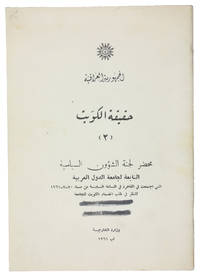
1961ABC_47301Baghdad: Wizarat al-Kharijiyah = Ministry of Foreign Affairs 1961. Original printed wrappers stapled. 8vo. Arabic text. First edition of the second of two rare pamphlets published by the Iraqi government opposing the independence of Kuwait. The first pamphlet published in English and Arabic outlined Kuwait's historical connection to Iraq and analysed its "imperialist relations" with Britain. This second one in Arabic throughout prints the minutes of the Political Affairs Committee of the Arab League which met in Cairo on 20 July 1961 to consider Kuwait's request to join the League.Kuwait emerged as an independent state in June 1961 after sixty-two years as a British protectorate. With a new constitution it held its first parliamentary elections in 1963 thereby becoming the first Arab state in the Gulf to establish a parliament. Such political developments married with growing wealth and modernisations in health culture and finance helped to make Kuwait the most prosperous state in the Arabian Peninsula.The Iraqi government argued that the move toward independence was a continuation of Kuwait's relationship with Britain albeit under a new guise. Furthermore they felt that the historical links between Iraq and Kuwait entitled the former to control over the latter and one suspects a share of its growing wealth. This position partly detailed in the pamphlet led to a point of crisis with Iraq threatening invasion. To the relief of Kuwait the Iraqis were eventually deterred by the Arab League's promise of military opposition.The wrappers are a little dusty two thick black lines on the front wrapper seemingly erasing a stamp another stamp partially visible on the back wrapper most likely a bookseller's name and address "Baghdad" is legible. Internally clean and bright. Overall in very good condition.l Jisc LibraryHub 1 copy BL; WorldCat 219629380 3 copies. Wizarat al-Kharijiyah [= Ministry of Foreign Affairs], unknown
Very Good Turkish, Ottoman (1500-1928) In contemporary black cloth. Roy. 8vo. (24 x 17 cm). In Ottoman script (Old Turkish with Arabic letters). Occasionally minor stains and fading on pages. Otherwise a good copy. 384 p. It is a rare book written after the Constitutional Monarchy at the request of the Unionists to make propaganda about Kurds. It is one of the early detached texts about Kurds written in the Ottoman period. Upon the request of the Ittihad ve Terakki [i.e. Union and Progress] leaders, he began to work in 1912 for the newly established National Security Organization (Teskilât-i Mahsusa). He then continued his intelligence work with the IAMM and AMMU, in the name of which he did his fieldwork on the Anatolian Kurds and Turcoman (Turkmen) tribes. Habil Adem's (his pseudonym means in English 'Abel Adam') writing reflect -even more openly than those of his colleague Baha Said- the unionist ambition to collect the data considered necessary for its politics of social and demographic engineering, such as information on basic demographic realities, as well as social and cultural aspects. The obvious aim of this publication was to create public knowledge favorable to the nationalization project. His book on the Kurds, printed in 1918, immediately after WW 1, under the pseudonym of a fictitious German orientalist (Dr. Friç), allegedly only translated by Habil Adem, elaborated on a thesis that would gain leverage in the early Turkish Republic and become very prominent in the 1930s, namely that the Kurds were actually Turks and the Kurdish as an independent language did not exist. In the book's section on the religion of the Kurds, he makes two distinctions such as Muslim and non-Muslim Kurds and Sunni and Shiite Muslim Kurds. (Source: Writing Religion: The Making of Turkish Alevi Islam; Dressler, Marcus). Pelister worked in the translation office of the General Directorate of Security since 1908 and in the Turkmen Branch of the General Directorate of Tribes and Immigrants from 1913, and he personally assigned him to Talat Pasha, (1874-1921). He was very good at speaking English, German, and French languages, thus, he was involved in researches related to the Kurdish and Turkmen tribes with some delegations in Ottoman Turkey in Asia. The German original of this book never existed, neither did Dr. Fritsch from the Berlin Academy of Science. Years later, Celadet Bedirxan, a Kurdish intellectual, explained the mistakes that Naci Ismail made intentionally or unknowingly on the Kurdish culture, population, history, folklore, and language, with the letters he wrote to Mustafa Kemal and drew Mustafa Kemal's attention. This book was written probably by a commission with corrigenda and footnotes by Pelister. The book generally focuses on the historical geography of the Kurds. There is an effort to Turkify in the part that talks about the origins of the Kurds. In the introduction, detailed information about Iranian and Iraqi Kurds is given and Sharafnâma is criticized. Although detailed information is available on many Kurdish tribes (Leks, Sividis, Arukhs, etc) in Anatolia and Mesopotamia, most of these are dubious. Only three institutional copies in OCLC: 977638243 (University of Toronto Robarts Library), 949451620 (Bogaziçi Library), and 164856325 (Bayerische Staatsbibliothek of Germany).; Özege 11517.; TBTK 11113. First Edition.
1912JBDEH1HAEOMM1912. 1/4 leather album. 4to. Approximately 120 mounted usually 2-4 to a page snap shots ranging in size from 60 x 40 mm to 120 x 100 mm. Brief captions in black ink under almost all the photos. The first half of the photos show middle class life in Edwardian England. The second and more interesting half of the photos are snap shots that appear to have been taken by a British officer and include military subjects scenes of Baghdad and the Euphrates and views of the Bosporus.An early 19th century photograpic impression of middle class life in England and the military in Iraq Some photos are faded or have minor spots or light streaks. Wretched-looking lacking backstrip with covers worn discolored and detached. hardcover
208099S.l., s.d. (1929) 2 vol. in-4, [52] et 35 ff. de papier fort, regroupant 194 tirages photographiques généralement de format 12,5 x 17 cm, et 61 reproductions de dessins, demi-percaline (cerise / verte) à coins, traces de rubans (reliure de l'époque). Manque le dos du volume I.
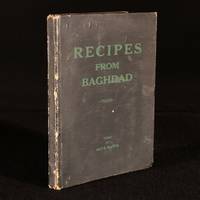
1946966F11Baghdad: The Indian Red Cross 1946 . First edition. Cloth. Good. 9" by 7". Suad Salim. The first edition of this very scarce mid 20th century cookery work presenting recipes hailing from Baghdad and Iraq. A vanishingly scarce first edition.With a folding table of weights and measures and a small number of vignette illustrations by Suad Salim.A very scarce cookery work presenting recipes popular in Iraq in the 1940s adapted for English tastes. With instructions for making various liqueurs Kubba Lebania Yuen Tsi Khankar Bakmadi and various other dishes.With an introduction from Her Majesty the Queen Mother of Iraq this work is edited by May H. Beattie with the assistance of Bedia Afnan Renée Al Kabir Helen Gaudin and Ann Walter.With bookplate of Martin and Pamela Finch to front free endpaper. They were antiquarian booksellers with an interest in antiquarian gastronomy.With a former owner's inscription to front free endpaper. In the publisher's original paper covered boards. Handling marks to boards. Rubbing to back strip head and tail and joints. Tail of front joint starting with board firmly held. Inscription and bookplate to front pastedown. Internally firmly bound. Pages lightly age toned due to paper type but generally clean with only the odd spot. Good The Indian Red Cross hardcover
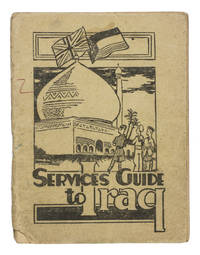
1942ABC_47444Baghdad: PAI force G. H. Q. Welfare Committee 1942. Original publisher's beige printed paper wrappers. 14.5 x 11 cm. With two full-page maps of Iraq and Baghdad on page 24 and 25 and a full-page map of the "Baghdad Amenities area" on the back wrapper. Further with 6 pages of advertisements serving as endleaves. A very rare guide intended for British armed forces stationed in Iraq during the Second World War. It was probably handed to the soldiers soon after arrival. Works like these were often discarded when they were no longer needed. As such there are usually few of them left. This particular military guide is likewise extremely rare. We have only been able to find 3 other copies 2 of which are located at the Imperial War Museum in London.The Services guide to Iraq was probably published by the welfare committee of the British PAI force which is short for "Persia and Iraq Force". The British were stationed here to prevent Nazi Germany from invading the region for oil among other reasons. The guide was meant to teach the soldiers the basics of finding their way in this new country. It explains where to go for sports music religion legal aid education the costs of sending letters home and how to recognize and prevent various tropical diseases. It also aims to instill some cultural awareness in the reader: included is an excerpt of a work about the history of Iraq by Seton Lloyd 1902-1996 archaeologist and then curator at the Baghdad museum.The paper wrappers are torn at the bottom of the spine with some loss of material barely affecting the integrity of the binding a small stain and two small pen marks in red and green on the front wrapper. Somewhat browned throughout. Otherwise in good condition.l Not in WorldCat. PAI force G. H. Q. Welfare Committee, unknown
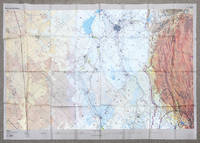
2002162482London: DGIA Ministry of Defence 2002. First edition stretching from Baghdad to Basrah and showing all of Kuwait. The sheet was likely issued to RAF pilots in the run up to the Iraq War and is printed on rayon for ease of use and durability. These charts produced by the Defence Geographic and Imagery Intelligence Agency feature many warnings about flying within controlled airspace in Iraq and Saudi Arabia. The RAF flew many missions over this region in the lead-up to the Second Gulf War and in Operation Telic. "The first documented intimations of UK involvement in the operation that became Telic can be traced to March 2002. In May the Chief of the Defence Staff CDS was advised of a potential RAF contribution to a future operation in Iraq comprising 88 fast jets and 38 support platforms - more aircraft than the RAF had deployed on a single operation since the First Gulf War and more in all probability than it will ever deploy again" Ritchie p. 5. A formal plan was drafted in August to overwhelm Hussein's government through multiple co-ordinated fronts of which the RAF's role was to eradicate the enemy air force destroy equipment support ground forces and strike important targets to shock the Iraqi people. According to the key there was another sheet issued charting northern Iraq. Single sheet of rayon 912 x 1300 mm colour map with key on recto and verso. Sometime folded and thinning along lines: a near-fine copy. Sebastian Ritchie "The Royal Air Force in Operation Telic: Offensive Air Power March-April 2003" 2021. unknown
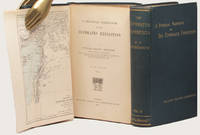
188833602London: Kegan Paul Trench & Co. 1888. 2 volumes. First Edition. With pleasing provenance. With a fine map showing the Tigris and Euphrates rivers and the surrounding geography of the Middle East. Thick 8vo publisher's original dark green cloth the upper covers and spines lettered in gilt original green endleaves. xv 447 32 publisher's catalogue; vii 492 pp. A very bright and pleasing set as fine as can be expected. FIRST EDITION OF THIS ELUSIVE AND SIGNIFICANT WORK. Ainsworth's excellent account of the Euphrates expedition to which he was appointed surgeon and geologist. The expedition was intended to "examine the feasibility of opening up the Mesopotamian rivers to steam navigation as a new route to India as well as asserting British political presence in the area promoting British commercial ties and gathering scientific and archaeological data" ODNB.<br> This is arguably the fullest contemporary account of the expedition as the fraught publication history of Chesney's account meant that his 'NARRATIVE.London 1868 was ultimately less detailed than intended.<br> This copy was owned by John Brinton who was elected member of parliament for Kidderminster in 1880 but accepted the Chiltern Hundreds next month because he was holding a government contract at the time. He was reelected without opposition and held the seat until 1886. In 1887 he presented Brinton Park to Borough of Kidderminster. He became High Sheriff of Worcestershire in 1889 and was an Alderman of the County Council from 1890. His attractive engraved plate is at each pastedown. Kegan Paul, Trench & Co. hardcover
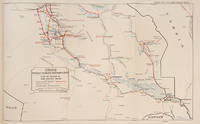
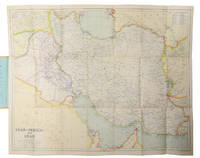
1930L6CC0NQYKB25London: George Philip & sons 1930. Colour printed map 54 x 68 cm with yellow covers 19.5 x 11 cm. Map of Iran Iraq and parts of the surrounding countries including modern Kuwait Bahrain Qatar and the UAE in the 1930s published in the series "Philips' authentic imperial maps for tourists & travellers". Published in the early years of the discovery of oil in the Middle East the map shows roads and railways but also caravan routes submarine cables and oil pipelines.Slightly soiled in very good condition. George Philip & sons, unknown