1 159 résultats
68901Bruxelles, Office Belge du Commerce Extérieur, 1951. 22 x 30, 11 pp., quelques illustrations en N/B, 1 carte, broché, bon état (petite étiquette papier du collége jésuite Saint Stanislas à Mons).
199819151CBBern, eFeF-Verl., 1998. 8°, 190 S., farbig illustr. original Kartonage (Paperback), Erstausgabe Einband ein wenig lichtspurig und berieben, sonst schönes, sauberes Exemplar.
365( Paris ) ( Jean-Claude Lattès ) ( 1991 ) 1 vol. ( 22.5 x 14.5 cm ) ( poids = 590 g ) 370 pp. . Manque le titre . Comprend : Préface De la violence , Avertissement , Chronologie , Première partie : Le régime baassiste , Seconde partie : La légalisation du Baas . Demi-basane couleur chamois . Dos à 5 faux nerfs , p. de titre et p. avec nom de l' auteur . Plats papier marbré . Ex-libris Claude Delaby contrecollé au contreplat . Une petite tâche au dos en pied . Manque le titre , notre exemplaire commençant avec la Préface .
20041253402Hildesheim ; Zürich ; New York : Olms, 2004. 303 S. ; 22 cm Gebundener Originalleinenband mit Umschlag
223 p., nbr. ill. n/b et coul. Inv. 19974
100135518Albin Michel / Plon / Fayard 510 pages in8. Sans date. Broché. 10 volume(s). 510 pages. 10 livres sur le moyen-orient géopolitique: Guerre du Golfe : le dossier secret (salinger) + Le Rêve brisé : Histoire de l'échec du processus de paix au Proche-Orient (1995-2002) (enderlin) + La guerre des Bush : Les secrets inavouables d'un conflit (laurent eric) + Au nom d'Oussama Ben Laden... (jacquard roland) + L'infiltree (anonyme) + Visage Vole - Avoir Vingt Ans a Kaboul (latifa) + Génération Intifada (Bucaille) + Que veulent les arabes ? (fereydoun hoveyda) + Génocide en Irak : La Campagne d'Anfal contre les Kurdes (middle east watch) + Un printemps arabe (Benoist-Méchin)
Fine Turkish Paperback. Cr. 8vo. (20 x 14 cm). In Turkish. 296, [18] p., b/w plates. 1946 Mehabad Kürt Cumhuriyeti. Translated by M. Emin Bozarslan.
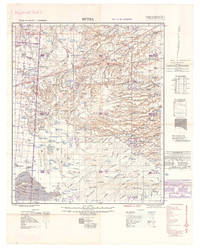
1940L7VDM2ALRS81UK Government: Geographical Section General Staff War Office 1940. 2 topographic maps colour-printed. Scale 1:500000. 820 x 640 mm and 770 x 648 mm. Previously folded. Marked "Iraq Desert Sheet 1" and "Sheet 2". Generally well preserved. Compiled from 1930s surveys and produced by the British 512 Army Field Survey Company Royal Engineers for use in the Persian war theatre. These consecutive maps cover the south-western area of Iraq including Rutba and Fallujah with parts of Saudi Arabia Jordan and Syria approximately the area between 31° and 33°30 N and 39° and 44° E.Previously folded. Marked "Iraq Desert Sheet 1" and "Sheet 2". Generally well preserved. Geographical Section, General Staff, War Office, unknown
009237Barcelona, Selbstverlag, 2018. Leporello binding 22 x 16,5 cm 0
20061345473PN. New. 2006. Soft Cover. PN paperback
19787632Ausstellungskatalog Prähistorische Staatssammlung, München u.a. Mainz, Philipp von Zabern, (1978). Kl.-4to. Mit zahlreichen, teils farbigen Abbildungen. 228 S. Illustrierter Or.-Pp. [5 Warenabbildungen]
84130aafBasel, Antikenmuseum Basel/ Bonn, Sammlung Ludwig/ Milano, Skira editore/ Wien, Kunsthistorisches Museum, 2003, gr. in-4to, 341 p., rich. illustr. avec des belles photogr. en couleur, cartonnage original illustr.
in-8°, 317 pp., broche, couverture illustree à rabats. Bel exemplaire. [GE-2]
Very Good Turkish, Ottoman (1500-1928) In contemporary black cloth. Roy. 8vo. (24 x 17 cm). In Ottoman script (Old Turkish with Arabic letters). Occasionally minor stains and fading on pages. Otherwise a good copy. 384 p. It is a rare book written after the Constitutional Monarchy at the request of the Unionists to make propaganda about Kurds. It is one of the early detached texts about Kurds written in the Ottoman period. Upon the request of the Ittihad ve Terakki [i.e. Union and Progress] leaders, he began to work in 1912 for the newly established National Security Organization (Teskilât-i Mahsusa). He then continued his intelligence work with the IAMM and AMMU, in the name of which he did his fieldwork on the Anatolian Kurds and Turcoman (Turkmen) tribes. Habil Adem's (his pseudonym means in English 'Abel Adam') writing reflect -even more openly than those of his colleague Baha Said- the unionist ambition to collect the data considered necessary for its politics of social and demographic engineering, such as information on basic demographic realities, as well as social and cultural aspects. The obvious aim of this publication was to create public knowledge favorable to the nationalization project. His book on the Kurds, printed in 1918, immediately after WW 1, under the pseudonym of a fictitious German orientalist (Dr. Friç), allegedly only translated by Habil Adem, elaborated on a thesis that would gain leverage in the early Turkish Republic and become very prominent in the 1930s, namely that the Kurds were actually Turks and the Kurdish as an independent language did not exist. In the book's section on the religion of the Kurds, he makes two distinctions such as Muslim and non-Muslim Kurds and Sunni and Shiite Muslim Kurds. (Source: Writing Religion: The Making of Turkish Alevi Islam; Dressler, Marcus). Pelister worked in the translation office of the General Directorate of Security since 1908 and in the Turkmen Branch of the General Directorate of Tribes and Immigrants from 1913, and he personally assigned him to Talat Pasha, (1874-1921). He was very good at speaking English, German, and French languages, thus, he was involved in researches related to the Kurdish and Turkmen tribes with some delegations in Ottoman Turkey in Asia. The German original of this book never existed, neither did Dr. Fritsch from the Berlin Academy of Science. Years later, Celadet Bedirxan, a Kurdish intellectual, explained the mistakes that Naci Ismail made intentionally or unknowingly on the Kurdish culture, population, history, folklore, and language, with the letters he wrote to Mustafa Kemal and drew Mustafa Kemal's attention. This book was written probably by a commission with corrigenda and footnotes by Pelister. The book generally focuses on the historical geography of the Kurds. There is an effort to Turkify in the part that talks about the origins of the Kurds. In the introduction, detailed information about Iranian and Iraqi Kurds is given and Sharafnâma is criticized. Although detailed information is available on many Kurdish tribes (Leks, Sividis, Arukhs, etc) in Anatolia and Mesopotamia, most of these are dubious. Only three institutional copies in OCLC: 977638243 (University of Toronto Robarts Library), 949451620 (Bogaziçi Library), and 164856325 (Bayerische Staatsbibliothek of Germany).; Özege 11517.; TBTK 11113. First Edition.
Very Good Arabic Original cloth bdg. Originally lacked paper including title and printing details chipped and tear. Interior very good. Otherwise a good copy. [14], 378 p. Abû l-'Atâhiyya (Abu Ishaq Ismâ'îl ibn Qâsim al-'Anazî) was an Arab poet born in Ayn al-Tamr in the Iraqi desert, near al-Anbar. His ancestors were of the tribe of 'Anaza. His youth was spent in Kufa, where he was engaged for some time in selling pottery. During the time when he took the occupation of selling pottery, he saw the assembly of poets in a competition and he participated in it. Thus he became famous for his poetry. For uplifting his poetry he reached to Baghdad. Moving to Baghdad, he continued his business there, but became famous for his verses, especially for those addressed to 'Utba, a concubine of the Abbasid Caliph al-Mahdi. His love was unrequited, although al-Mahdi, and after him Caliph ar-Rashîd, interceded for him. Having offended the caliph, he was imprisoned for a short time. He died in 828 in the reign of Caliph al-Ma'mûn. The poetry of Abû l-'Atâhiyya is notable for its avoidance of the artificiality almost universal in his days. The older poetry of the desert had been constantly imitated up to this time, although it was not natural to town life. Abû l-'Atâhiyya was one of the first to drop the old qasîda (elegy) form. He was very fluent and used many metres. He is also regarded as one of the earliest philosophical poets of the Arabs. Much of his poetry is concerned with the observation of common life and morality, and at times is pessimistic. Thus he was strongly suspected of heresy. Compiled and prepared by Louis Cheikho. Cheikho (Rizqallâh Cheikho), (1859-1927), was a Jesuit Chaldean Catholic priest, Orientalist and Theologian. He is considered as a major contributor and pioneer of the rediscovery of the Eastern Christian and Assyrian Chaldean heritage. Louis Cheikho was born in Mardin, Turkey on February 5, 1859. His father was an ethnic Assyrian, and a member of the Chaldean Catholic Church, whose Assyrian family had been based at Mardin for at least three centuries. His mother was an Armenian named Elizabeth Schamsé, who took him on pilgrimage to the Holy Land when he was 9 years old. In 1868, Cheikhô joined his brother at the Maronite Jesuit Seminary in Ghazîr, Lebanon. At this date, the seminary was not merely preparing young men for the priesthood, but also acted as a secondary college for young Christian and especially Assyrian Chaldean men. Both groups followed a similar syllabus. There, he learned both ancient and modern European and Semitic languages. In 1874 he entered the Jesuit Order and started his novitiate training at Lons-le-Saunier, France. He adopted at that time the name of 'Louis' out of devotion for the young Jesuit saint Louis Gonzaga. In 1878, he returned to Lebanon and taught Arabic Literature at the Jesuit Saint Joseph College in Beirut for 10 years. During this period, Cheikho continued his studies of philosophy at Université Saint-Joseph, Beirut. In 1888, Cheikho travelled to Great Britain for theological studies in preparation for the priesthood. He was ordained priest by the Chaldean Church of the East on 8 September 1891. He then spent one year in Austria and another year in Paris. Those extended European stays allowed him to acquire the academic methodologies that helped him in his later works. Finally in 1894, he settled in Beirut, Lebanon, where he continued his academic career at Université Saint-Joseph. Cheikho died in Beirut in 1927. Cheikho is perhaps the founder of modern publications of unpublished Eastern Christian texts, especially Christian Arabic texts. He also founded, in 1898, the journal Al-Machriq, and contributed many articles and publications to its pages. His work was an inspiration for CEDRAC. (Wikipedia). First Edition. Extremely rare. This edition not in OCLC; for late editions see OCLC 404750229.
Very Good Arabic Original hand-colored map on tissue paper. 23x19 cm. In Ottoman script and Arabic. No scale. Manuscript notes of toponyms. The manuscript shows Egypt, Ethiopia, Sudan, the Red Sea along the line of Red Sea shores. Manuscript notes show that the map was used for military purposes in the last Ottoman Imperial period. Habesh Eyalet, Ethiopia in northeast Africa was conquered by Özdemir Pasha in 1557. His son, Osman Pasha, transformed the region into an eyalet, which remained under Ottoman suzerainty until the early 19th century when Egypt assumed its administration. (Source: Pashas, Begs, Effendis: A historical dictionary of titles and terms in the Ottoman Empire, Bayerle, Gustav.).
208099S.l., s.d. (1929) 2 vol. in-4, [52] et 35 ff. de papier fort, regroupant 194 tirages photographiques généralement de format 12,5 x 17 cm, et 61 reproductions de dessins, demi-percaline (cerise / verte) à coins, traces de rubans (reliure de l'époque). Manque le dos du volume I.
1920901183AGum 1920. Lithographie, Blattmaß: 35 x 41,5 cm (quer). Bildmaß: 19 x 24 cm (quer).
Very Good Arabic Original chromo-lithograph map in brown tones. On a special paper with an ongoing blindstamped "Regestre Robur" during the borders. Folded. 70x100 cm. In Arabic. Scale: 1 /1.000.000. Chipped on margins, split on folded traces. Slight discoloration and one stain on lower margin. Otherwise a good copy. An attractive and detailed map of Syria shows the capital (as Aleppo n that map), other cities like Damascus, Raqqa, Homs, Latakia, Ayn al-Arab, Idlib, Hama, Deir Ez-Zor, Jarabulus, et alli. And it shows Turkey on the north (as Turkey containing Hatay and Alexandrette), The Mediterranean shores of the land as well as Lebanon and Palestine (and Jerusalem) on the west, Sharq al-Urdun (Jordan) and Iraq on the south and east. It's very detailed on showing the roads spread throughout the land like railways and ancient roads from the Roman period. Additionally this roads can be followed to the other Arabic countries and regions on the map. This map was calligraphed by Kamel Al-Baba, (1905-1991), who was a Lebanese contemporary / modern calligrapher. He is the son of famous calligrapher Mokhtar Al-Baba. Cannot be found in WorldCat.; Not in Library of Congress Map Collection. Very scarce.
Very Good Arabic Original hand-colored map on tissue paper. 23x19 cm. In Ottoman script and Arabic. No scale. Manuscript notes of toponyms. It shows Baghdad, Deir Al-Zor, Kirkuk, Mosul, Syria, borders of Ajamistan (Iran), etc. Manuscript notes show that the map was used in military purposes in the last Ottoman Imperial period.
Very Good English Original five photographs. Standard photograph size. Kotah Bridge - 426.; Palm trees forest, Basrah.; Golden doms of Kazimain, Baghdad.; Iraqi desert police - 105.; Arrival of mail boat in Baghdad.
1373614Paris: La revue française de l'élite européenne, 1950 in-4, 116 pages., illustrations. Broché. Numéro consacré au Moyen Orient (Irak, Syrie, Arabie Saoudite, Liban).
1369152Paris: Musée de l'Homme, Museum National d'Histoire Naturelle, 1963 in-4, nombreuses illustrations. Broché, bon état, cachet. Sommaire: Joseph CHELHOD, Pélerinage à Kadzimain, lieu saint de l'Islam. - Françoise GIRARD, Plats en bois sculpté des îles Salomon. - Guy de BRAUCHENE, Une statuette ouest-africaine. - Jean-François VINCENT, Dot et monnaie de fer chez les Bakwélé et les Djem. - Elie VERNIER - Bambous gravés malgaches. - Louis BERTHE, Une mission en Indonésie. - Robert GESSAIN, Sénégal Oriental 1963. - Jacques MILLOT, Le congrès de Santo Tirso. Les musées ethnographiques du Portugal.
Fine English Paperback. Pbo. Roy. 8vo. (24 x 117 cm). In English and Turkish. [Lxvii], 432 p. A bibliography on Iraqi Turks.= Irak ürkleri bibliyografyasi.