108 résultats
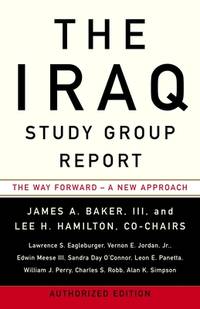
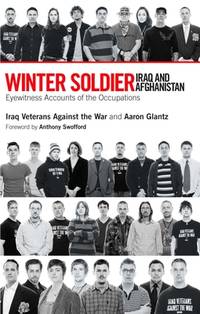
2008Q-1931859655Haymarket Books 2008-09-01. Paperback. New. New. In shrink wrap. Looks like an interesting title! Haymarket Books paperback
0996245774.Ghardcover. Good. Access codes and supplements are not guaranteed with used items. May be an ex-library book. hardcover
1904864848.Gpaperback. Good. Access codes and supplements are not guaranteed with used items. May be an ex-library book. paperback
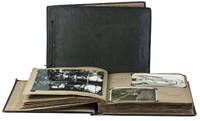
1928I3OEKR47KBBKIraq plus Malta and Egypt 1928. The photos mounted with paper corner-mounts in two contemporary cloth-covered albums the larger with padded boards covered in alligator-skin patterned dark green cloth with the photographs on both sides of 24 dark grey album leaves each leaf with a glassine paper guard-leaf embossed with a spider-web pattern bound in before it; the smaller covered in black cloth with a grey-white bird in a cloud painted on the front board and the word snaps with the photographs on both sides of leaves 2-35 & 51-52 of 54 light brown album leaves. Oblong albums 25 x 34.5 cm & 21.5 x 28.5 cm. Two albums containing about 275 silver halide photographic gelatin prints 6 x 8.5 cm to 16 x 21.5 cm assembled and mostly taken by a British Royal Air Force pilot while stationed in Iraq and then briefly Malta with a visit to Egypt. A collection of about 275 photographs made by an RAF pilot Sergeant William Reynish during his service in Iraq ca. 1928-1933 and Malta 1933 and during a brief visit to Egypt. Most have captions written on the album leaves clearly identifying the scenes. Some photos show scenes of daily life in Iraq Bagdad Hinaidi Mosul and other cities as well as the surrounding countryside with local people shops buildings landscapes ruins monuments etc. Others show the British troops and their activities vehicles airplanes including crashed ones etc. The portraits include an unidentified sheik with a falcon and an Arabic man smoking a hookha water pipe. The Kurdish Sheik Mahmud Barzanji of Sulaimaniyah rebelled against the Iraqi army around June 1930 but the RAF bombed his people's villages from September 1930 to April 1931 when he finally surrendered to Major W.C.F.A. Wilson administrative inspector at Mosul. Several photographs cover the sheik and his surrender.The surviving corner mounts show that three photographs have been removed from the album. A few photographs are slightly blurry or faded but most are very sharp and in very good condition. The inside front hinge of one album has broken but the albums are otherwise in good condition. A wealth of informative images from pre-War Iraq most clearly identified in the captions. hardcover
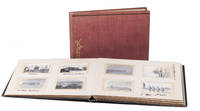
1917ABC_48426Iran and Iraq 1917. Contemporary cloth one album in in red and one in grey with 'Kodak' lettered in gold on the front board and a black classical meander border tooled near the foot. The albums are kept together by a black ribbon. Oblong 8vo ca. 15.5 x 20 cm. With 191 resp. 95 and 96 gelatin silver prints all ca. 4 x 6 cm. 2 volumes. Remarkable set of Kodak photo albums with nearly 200 photographs of military life and the oil industry in Iran and Iraq in the early 20th century. The photographs were most likely taken by the compiler of the albums and show scenes from his daily life. Most of them are captioned. Included are images of Persian oil fields Abu Zenema Sinai coast Port Sudan Bushehr Basra various locations along the Tigris Euphrate and Shatt al-Arab rivers Ashwaz and Shush. The photographs also show locals involved in various activities including races shark hunting and selling wares. The compiler of the album was likely a British soldier who was stationed in Basra and other locations in Iran and Iraq after the First World War.The edges and corners of both albums are slightly scuffed with a few light stains on the back board of the red album. The paper on which the photographs are mounted is slightly browned ten of the photos have either creased corners or a damaged surface some photographs a little loose within their windows missing a photo on the final page of the red album. Otherwise in good condition. hardcover
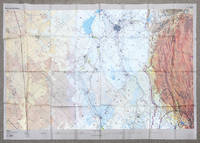
2002162482London: DGIA Ministry of Defence 2002. First edition stretching from Baghdad to Basrah and showing all of Kuwait. The sheet was likely issued to RAF pilots in the run up to the Iraq War and is printed on rayon for ease of use and durability. These charts produced by the Defence Geographic and Imagery Intelligence Agency feature many warnings about flying within controlled airspace in Iraq and Saudi Arabia. The RAF flew many missions over this region in the lead-up to the Second Gulf War and in Operation Telic. "The first documented intimations of UK involvement in the operation that became Telic can be traced to March 2002. In May the Chief of the Defence Staff CDS was advised of a potential RAF contribution to a future operation in Iraq comprising 88 fast jets and 38 support platforms - more aircraft than the RAF had deployed on a single operation since the First Gulf War and more in all probability than it will ever deploy again" Ritchie p. 5. A formal plan was drafted in August to overwhelm Hussein's government through multiple co-ordinated fronts of which the RAF's role was to eradicate the enemy air force destroy equipment support ground forces and strike important targets to shock the Iraqi people. According to the key there was another sheet issued charting northern Iraq. Single sheet of rayon 912 x 1300 mm colour map with key on recto and verso. Sometime folded and thinning along lines: a near-fine copy. Sebastian Ritchie "The Royal Air Force in Operation Telic: Offensive Air Power March-April 2003" 2021. unknown
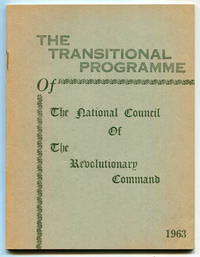
1963018584<p>Baghdad Iraq: The Ministry of Guidance 1963. First Edition. Softcover. Very Good-. Wraps; First Edition; 36pp; Covers age-toned text unmarked binding is tight VG- condition. Scarce vintage pamphlet related to the Ramadan Revolution in Iraq in February 1963 which was a military coup by the Iraqi branch of the Ba'ath Party which overthrew Prime Minister Abdul-Karim Qasim on February 8 1963 the 14th day of Ramadan. The booklet outlines the transitional program of The National Council of the Revolutionary Command. This particular government lasted approximately nine months.</p> The Ministry of Guidance paperback
1943IRAQ029525The Golden Cockerel Press London. 1943. First edition. Published by Permission of the War Office. Royal octavo. 127 pages. Photographs; endpaper map of the Levant-Caspian Front by the author. One of 500 numbered copies. Quarter blue morocco raised bands lettered in gilt. Top edge gilt. A sequel to The Golden Carpet a description of the British occupation of Baghdad. Some tanning to endpapers from the binder's glue. Very good indeed. The Golden Cockerel Press, London. hardcover
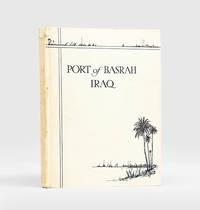
1935190813London: Printed by Waterlow & Sons Limited c.1935. First edition of this history and description of the port's operations with two maps showing the main wharves and estates as well as the proposed site for a new dock. Quarto. With 2 colour folding maps illustrations in text. Original boards front cover lettered and illustrated in black printer's label on front pastedown. Christmas 1947 gift inscription on first blank. Very good indeed. hardcover
20071575Tacoma WA: Springtide Press 2007. Limited edition. Very Good. No. 37 of 55 copies. Approx. 17-1/2" x 14". Broadside. Delicate sand-colored laid paper printed in brown with mustard ornaments. Center fold line few faint creases. An original poem by Saadi Yousef from "Without an Alphabet Without a Face" printed by Jessica Spring the proprietor of Springtide Press. It is part of the "Mutanabbi Street Starts Here" project which drew on broadside contributions from a variety of printers to commemorate the 2007 bombing of the historic book market in Baghdad.OCLC notes one copy at Indiana University and we find copies in two locations at the University of Washington. Springtide Press unknown
191938949London: Cassell & Co. Ltd. 1919. Two vols. 8vo. ix 1 294; vi 311 1 pp. Frntsp. photos both vols. 14 plates 19 maps & plans most folding. Blue linen blue illust. lozenge on frnt cvr blue lettrng & decrtn lght toning to endpapers mnr shlfwr still a VG- set. First edition 4th printing of this informative eyewitness account of the Mesopotamian war against the Ottoman Empire during World War I. It includes an extensive account of the disastrous Battle of Dujaila during the Samarrah Offensive which resulted in Aylmer being replaced as field commander. Cassell & Co., Ltd., unknown
45141220-nnew. unknown
45141220like new. unknown
1023096749.Ghardcover. Good. Access codes and supplements are not guaranteed with used items. May be an ex-library book. hardcover
50191374like new. unknown
1015702929.Ghardcover. Good. Access codes and supplements are not guaranteed with used items. May be an ex-library book. hardcover
2006Q-0307386562Vintage 2006-12-06. Paperback. New. New. In shrink wrap. Looks like an interesting title! Vintage paperback
20061345082PN. New. 2006. Soft Cover. md . PN paperback
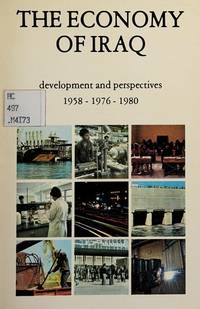
21371Paper bound French flaps edition not stated illustrated with numerous statistical tables 191pp includes appendices. As new. 270 grams. All books in stock and available for immediate shipment from Winnipeg Manitoba. unknown
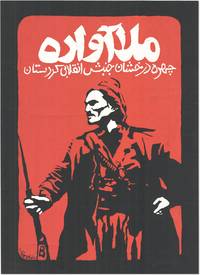
199083129Kurdistan: New Organization 1990's. Original silkscreened poster 63.5cm x 46cm printed in red and white on heavy black paper. Slight wear to edges almost neglible and some minor surface cracking to the very heavily applied paint are the only things that could be considered defects. A very good example. <br /> <br /> An exceptionally striking image printed in dramatic red and white onto black card depicting a heavily armed figure in traditional Kurdish dress beneath the legend in Kurdish:<br /> "The Displaced Mullah; The Shining Face of Revolutionary Kurdistan"<br /> <br /> The figure depicted is in all likelihood a stylized portrait of Mahmoud Barzanji a national Kurdish hero from the unrest of the early 20th century who became the first King of Kurdistan and was appointed Governor of the region by the British after the formation of the Kurdistan Protectorate after WW1. Barzanji not universally popular in Southern Kurdistan was a leader of considerable energy and ambition which far outstripped British plans for his 'control' of the region. The British and Barzanji came into direct conflict when he began arresting and imprisoning British officials who put up any opposition to his plans and embarking upon a localised uprising. The British predictably enough put a stop to his ambitions by ambushing him on the Sulamaniah road wounding him and then graciously commuting his death sentence to one of imprisonment in the British stronghold of Lahore in India where Barzanji was kept prisoner until 1922.<br /> The other possibility and with a stronger resemblance is that the poster depicts Simko Shakik early 20th century warlord and revolutionary who aside from massacring Armenians and Assyrians for the greater good of Kurdistan also led a rebellion against Iran. Although not conspicuously working from a Kurdish nationalist perspective modern critical thought suggests that Shikak should be placed "within the confines of Kurdish ethno-nationalism" Kamal Soleimani; "The Kurdish image in statist historiography: the case of Simko" 2017. Shikak himself was mainly interested in plunder and what he no doubt considered 'punitive justice against' basically anyone who sought to extert power over him or as a secondary consideration other Kurds; the results of his aggressive energy and willingness to fight anybody however are historically considered evidence of his benefit to Kurdish freedoms. No other examples of this poster can currently be traced in trade or institutional database. New Organization unknown
24124Without date or place but apparently written in Mesopotamia in late 1916. This poem is said to be an earlier work by ‘A Tommy’ the pseudonymous author of the collection ‘If I Goes West’ published in London by Harrap in 1918. WorldCat has no entries to support a second claim: that the present poem was published in 1917 with the subtitle ‘Verses written by a “Tommy†who has fought suffered and triumphed in Mesopotamia and is still on active service there’. While there is no indication that the poem has ever been published in its entirety extracts from it appeared in ‘The Bystander’ 27 November 1916; and ‘The Near East’ 6 July 1917; the latter headed ‘An Alphabet from Mesopotamia’ being preceded by the following: ‘A member of our Fighting Forces in Mesopotamia has composed some verses which he entitles “ The Alphabet of Mesopotamia.†Through the kindness of a correspondent we are allowed to reproduce here some specimens’. There may also be a reference in Catherine W. Reilly’s 1978 bibliography ‘English Poetry of the First World War’. Duplicated typescript titled ‘ALPHABET OF MESOPOTAMIA.’ 2pp foolscap 8vo. Text complete on two leaves of air mail paper glued together. Apparently contemporary and with the look of an item that has been handed around the mess room. Twenty-six four-line stanzas: one for each letter of the alphabet apart from a joint stanza for S and T and ending with an ‘ENVOI’. The first stanza reads: ‘ “A†Was an apple that grew so they say In the Garden of Eden down Qurnah way Till Eve came along and ate it one day And got thrown out of Mesopotamia.’ The poem includes the following stanzas: ‘ “F†Stands for Fritz who flies in the sky To bring down the brute we’ve many a try But the shells that we shoot seem to all pass him by And fall --- on Mesopotamia.’ ‘ “J†Is the jam with the label that lies And states that in Paris it won the first prize But out here we use it for catching the flies That swarm in Mesopotamia.’ ‘ “U†Is the Lake we call Umm-el-Brahm And guards our flanks from all possible karm sic And waters Gorringe’s Barley Farm In the middle of Mesopotamia.’ ‘ “V†Is the Victory we won at Dujailah I heard of it first from a friend who’s a sailor Who read it in Reuter’s on board a mahela On the Tigris in Mesopotamia.’ ‘ “W†Stands for the wonder and pain With which we regard the infirm and insane Old Indian Generals who guide the campaign Which we’re waging in Mesopotamia.’ ‘ “Y†Is the yearning we feel every day For a passage to Basra and thence to Bombay If we get there we’ll see that we stay right away From this wilderness - Mesopotamia.’ Without date or place, but apparently written in Mesopotamia in late 1916. unknown
20061345438PN. New. 2006. Soft Cover. PN paperback
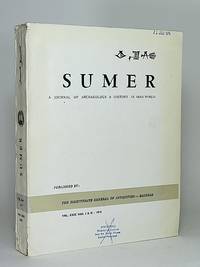
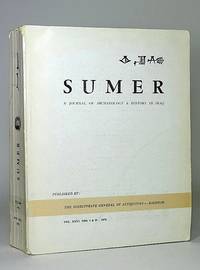
19654202Baghdad Directorate General of Antiquities Republic of Iraq 1965. 1st Edition . Soft cover. . ~ ~ NOTE: THE PRICE OF THIS BOOK IS CURRENTLY REDUCED! ~ ~ . Quarto. Two parts in one volume. Pp. 144; 323. Plus numerous plates plans maps and tables many of which are folding. A title-page to each part. Bound in the original publisher's printed wrappers bottom of spine worn. In fine internal condition. - - FIRST EDITION. In English and Arabic respectively. FOLIO-3 IN <br/> <br/> Baghdad, Directorate General of Antiquities, Republic of Iraq paperback
19733920Baghdad Directorate General of Antiquities Republic of Iraq 1973. 1st Edition . Soft cover. . ~ ~ NOTE: THE PRICE OF THIS BOOK IS CURRENTLY REDUCED! ~ ~ . Quarto. Two parts in one volume. Pp. 126; 310. Plus numerous plates plans maps and tables many of which are folding. A title-page to each part. Bound in the original publisher's printed wrappers slightly worn at edges stamps on cover. In fine condition. ~ FIRST EDITION. In English and Arabic respectively. FOLIO-3 IN <br/> <br/> Baghdad, Directorate General of Antiquities, Republic of Iraq paperback
19703917Baghdad Directorate General of Antiquities Republic of Iraq 1970. 1st Edition . Soft cover. . ~ ~ NOTE: THE PRICE OF THIS BOOK IS CURRENTLY REDUCED! ~ ~ . Thick quarto. Two parts in one volume. Pp. 257; 428. Plus numerous plates plans maps and tables many of which are folding. A title-page to each part. Bound in the original publisher's printed wrappers slightly rubbed at edges. In fine condition. ~ FIRST EDITION. In English and Arabic respectively. FOLIO-3 IN <br/> <br/> Baghdad, Directorate General of Antiquities, Republic of Iraq paperback