Hiroshige, UtagawaBiblio.com
153 résultats
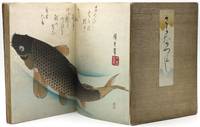
191110476Tokyo: Daikokuya 1911. Second-hand hardcover. <p>Hiroshige Utagawa artist Uozukushi Every Variety of Fish. Reprint Daikokuya: Tokyo Meji 44 1911. 240x175mm cloth bds lepperollo oblong colour wood block prints 240x350mm In Japanese. Near Fine</p> <p><br /> <br /> æŒå·åºƒé‡ HIROSHIGE Utagawa born AndÅ TokutarŠ安藤 徳太郎 1797-1858<br /> <br /> ã•ã‹ãªã¤ãã— Uo Zukushi Shoal of Fishes<br /> <br /> Tokyo : 大黒屋 Daikokuya Meji 44 1911. First and only edition thus; illustrations first published TenpÅ 3-4 1832-3 and TenpÅ 11-13 1840-42<br /> <br /> 240x175mm tatami mat style boards illustrated colour title label accordion or lepperello folding horizontal chÅ«ban album cream handmade paper seven nishiki-e woodblock engraved illustrations with kirazuri silver mica decoration. Boards faintly soiled edges lightly frayed; hinges fragile first fold neatly split; remnants of bookseller ticket to front paste-down; faint age toning and soiling not affecting the illustrations.<br /> <br /> ¶ Hiroshige is widely considered the last of the grand master printers of the Ukiyo-e tradition. In 1832-4 TenpÅ 3-4 he produced a series of ten illustrations of fish with accompanying culinary herbs and vegetables together with poems published by Eijudo. A decade later a series of a further ten illustrations were produced by Yamasho. The illustrations were then reproduced commercially bearing publisher and censor stamps. Together the two untitled series are known as "Large Fish" or "Shoal of Fishes" or "Every Variety of Fish". <br /> <br /> The illustrations here are a selection from both series: Carp Koi swimming amongst reeds circa 1840-42 TenpÅ 11-13 poem by Makuzu; Abalone Awabi or Tokobushi Needlefish Sayori and Peach Blossoms circa 1832-3 TenpÅ 3-4 poems by Kumogaki Fujimi and Miwagaki Mimiki; Black Sea Bream Kurodai Small Sea Bream Kodai Asparagus shoots and Japanese Peppercorns Sansho circa 1832-33 TenpÅ 3-4 poems by Tomigaki Uchiyasu and Echigo Kawabukuro Kaôan hôshi Kaôan hôshi from Kawabukuro in Echigo Province; Lobster Ise ebi and Prawn Ama ebi circa 1832-33 TenpÅ 3-4 poems by Shimotsuke Edozaki Ryokujuen Motoari Ryokujuen Motoari from Edozaki in Shimotsuke Province and Nen'an Machikado; Flying fish Tobiuo White Croaker Ishimochi Guchi or Shiroguchi and a lily circa 1840-42 TenpÅ 11-13 poem by Toshigaki Maharu; Gurnard Kanagashira Right-Eye Flounder Konoa-garei and Bamboo Grass Sasa circa 1832-33 TenpÅ 3-4 poems by Shimotsuke Edozaki Ryokujuen Motoari Ryokujuen Motoari from Edozaki in Shimotsuke Province and Jakuyakutei Chikuson; and Japanese Sea Perch Suzuki and Red Bream Kaneme-tai and shiso leaves circa 1840-42 TenpÅ 11-13 poem by Atsugaki. <br /> <br /> To the front paste down is a calligraphic inscription 御ã†ã¤ãã—ã¿ã®æ³¢ Waves of Imperial Beauty by Maresuke Nogi 1859-1912 a Meiji era career military man in the Japanese Imperial Army. A general in the first Sino-Japanese War 1894-5 the invasion of Taiwan and the Russo-Japanese War 1904-5 he was feted as a national hero for his role in the capture of Port Arthur. He was also a man of letters and a renowned Kanshi poet a form of Han Chinese poetry popular amongst the Japanese elite during his life. Several of his poems were very popular during the early decades of the Twentieth century. In 1912 Nogi and his wife committed ritual suicide by seppuku shortly after the death of Emperor Meiji in accordance with the samurai practice of following one's master into death. At the time Nogi became a public symbol of loyalty and sacrifice and there are several Shinto shrines to his memory in Tokyo and Kyoto.<br /> <br /> Daikokuya was a multi-generational publisher of ukiyo-e prints illustrations and later illustrated books from 1764-1931 in Edo/Tokyo. Artists published during the nineteenth century include Utagawa Hiroshige. Daikokuya were quite successful during the late Meji era publishing many illustrated works relating to the Russo-Japanese War; perhaps explaining the inscription by Nogi.<br /> <br /> Rare. A lovely copy.<br /> <br /> § OCLC records no holdings. NIJL holds one copy.<br /> <br /> </p> Daikokuya unknown
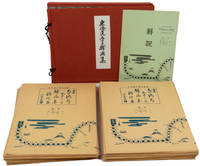
19640049822 Hitotsubashi Kanda Tokyo Japan: Shuei-Sha Publishing Co Ltd 1964. Limited Edition . No Binding. Near Fine. Elephant Folio - over 15 - 23" tall. Ando Hiroshige. In white vinyl clamshell box titles to top cover and spine in blue inks. 24 superbly printed colour plates loose as issued each mounted in a paper folder with plate number and title in green to lower corner plates are bright and unmarked 3735 cm either folio or oblong with a 4 pp red paper contents list and a 20 pp cream loose folder containing an introduction biography and plate listing with description in both Japanese and English. Titles include Soto to Uchi Tokaido 53-Tsugi No Uchi Kiso Kaido 69 Tsubaki ni Kotori etc. Housed in a cardboard boz with corners gone titles to spine and top cover. Stunning colour plates! These 24 plates make up the Hiroshige 24 Masterpieces which were part 4 of a broader set of Japanese woodblock illustrations. Utagawa Hiroshige was a Japanese ukiyo-e artist and one of the last great artists in that tradition. He was also referred to as Ando Hiroshige an irregular combination of family name and art name and by the art name of Ichiyusai Hiroshige. See Wiki for a full Bio. <br/> <br/> Shuei-Sha Publishing Co Ltd unknown
1970224245London: Robert Sawers 1970. Limited. hardcover. fine. Hiroshige. 1 page of introductory text by Jack Hillier followed by the collection of 21 finely printed plates each mounted with wheat paste and matted within an individual paper folder. The folders measure 9.5 x 13 inches and the prints are approximately 4.5 x 9.5 inches. 4to plates loose as issued in blue cloth portfolio with bone closures. London: Robert G. Sawers circa 1970. First and only edition -- number 15 of 250. A very fine unread copy as new in the original cardboard mailing box. Scarce.<br/> <br/> Intended for Edo era release these sketches were never published until Robert Sawers produced this rather lavish collection in the early 1970s. Strictly limited to 250 sets each print is numbered in pencil on rear of woodblock and rear of folder.<br/> <br/> Robert Sawers unknown
1970224245London: Robert Sawers 1970. Limited. hardcover. fine. Hiroshige. 1 page of introductory text by Jack Hillier followed by the collection of 21 finely printed plates each mounted with wheat paste and matted within an individual paper folder. The folders measure 9.5 x 13 inches and the prints are approximately 4.5 x 9.5 inches. 4to plates loose as issued in blue cloth portfolio with bone closures. London: Robert G. Sawers circa 1970. First and only edition -- number 15 of 250. A very fine unread copy as new in the original cardboard mailing box. Scarce.<br/><br/> Intended for Edo era release these sketches were never published until Robert Sawers produced this rather lavish collection in the early 1970s. Strictly limited to 250 sets each print is numbered in pencil on rear of woodblock and rear of folder.<br/><br/> Robert Sawers unknown books
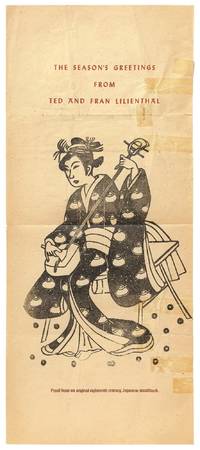
1940527378San Mateo California: The Quercus Press 1940. Unbound. Near Fine. First edition by this publisher. Pictorial broadside printed on recto only and folded twice horizontally as issued measuring 21 1/2 inches by 9 1/4 inches illustrated with a woodcut printed in black on recto only with lettering printed in red printed on laid paper with no watermark. Very good with glassine tape mends some foxing and tiny tears but the striking Japanese woodblock print is quite fresh and bright. The original woodblock print depicting a Japanese woman dressed in a kimono seated on a stool playing a musical stringed instrument. The woodblock image measuring circa 11 inches by 8 inches is printed by Ted and Fran Lilienthal at the Quercus Press from an original eighteenth century Japanese woodblock The upper and lower margins are printed in red with the following information: "Proof from an original eighteenth century Japanese woodblock" publisher's statement in lower margin beneath the woodblock print. The upper margin states: "THE SEASONS GREETINGS/ FROM/ TED AND FRAN LILIENTHAL." Unrecorded by OCLC which lists no citation for this publication.<br /> <br /> Theodore Max Lilienthal 1893-1972 in 1924 with Leon Gelber established the Gelber-Lilienthal Book Shop in San Francisco and a publishing company under the imprint Lantern Press. Mr. and Mrs. Theodore Max Lilienthal with Mrs. William C. Van Antwerp later established The Quercus Press in San Mateo California; in 1940 the press began using the Albion Press that once belonged to William Morris press was acquired from the estate of Dr. J. W. Bartlett of New York. Issued as a Season's Greetings from Ted and Fran Lilienthal. [The Quercus Press] unknown
19842080502106915144Not Available 1984. Soft Cover. Fine. The book is in fine condition. Not Available paperback
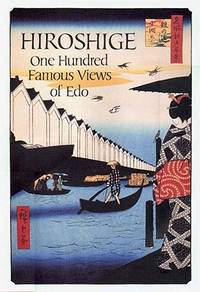
198667827Museum / Braziller. New. 1986. Hardcover. 0807611433 . FREE UPGRADE to Courier/Priority Shipping Upon Request - IN STOCK AND IMMEDIATELY AVAILABLE FOR SHIPMENT - FLAWLESS COPY BRAND NEW PRISTINE NEVER OPENED - Originally published 1986. 256 pages ; 4.3 pounds; 119 full color plates. -- This final series of woodblock prints by the celebrated 19th century Japanese artist Utagawa Ando Hiroshige is considered to be the finest example of his masterwork. Each plate is accompanied by a commentary that discusses its artistic and cultural interest in detail. The brilliant ukiyo-e printmaker revealed the panorama of his citys Edo which is now named Tokyo activities with subtle and vivid visual anecdotes. The 100 scenes are really vignettes of life in all seasons from many points of view. --Hiroshige's One Hundred Famous Views of Edo actually composed of 118 splendid woodblock landscape and genre scenes of mid-nineteenth century Tokyo is one of the greatest achievements of Japanese art. The series contains many of Hiroshige's best-loved and most extraordinary prints. Like Venice and Florence in the 14th and 15th centuries or Paris in the age of the Impressionists the city of Edo with its superb landmarks and its festive display of elegant urban life exerts a special and compelling fascination. Hiroshige revealed the panorama of his city's activities with subtle and vivid visual anecdotes: fireworks seen from the river fashionable geishas on parade the kabuki district at night intimate moments in the gardens and teahouses. It is a tour de force of artistic vision and printmaking craftsmanship. This edition has been reproduced from an exceptionally fine first-edition set in the Brooklyn Museum of Art to insure maximum fidelity to the original prints. Henry Smith ex-plains the world of Edo in its twilight before the Meiji Restoration and the beginnings of a modern urban society. Each plate is accompanied by a commentary that discusses its artistic and cultural interest in detail. For anyone interested in Japan the One Hundred Famous Views of Edo is perhaps the finest guide and one of the greatest legacies imaginable. -- with a bonus offer-- . Museum / Braziller hardcover
19212092902138301505Shin Ei Do 1921. Soft Cover. Fine. Number of pages: 70 sheets Size: 16x24cm Shin Ei Do paperback
19792092902139203266Kosaisha 1979. Soft Cover. Fine. The book is in fine condition. Kosaisha paperback
19772092902138300465Kyodo News Publishing Office 1977. Soft Cover. Fine. Number of pages: 21 illustrations Size: 46cm Kyodo News Publishing Office paperback
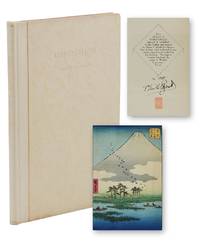
1938140948719Sydney: Self Published; printed by Beacon Press 1938. First Edition. Near Fine. First edition limited issue copy #115 of 200 signed and sealed by the author Barnett on colophon at rear. 45 3 pp. printed on laid paper illustrated with 20 brilliant color woodblock prints after Hiroshige tipped to sheets. Bound in publisher's textured cream paper-covered boards over quarter art vellum titled and ruled in gilt color pictorial endpapers blue ribbon marker. Near Fine with light wear and yellowing to covers several small chips to upper and lower board edges and light bleed-through from glue used to affix prints. Contents lightly toned binding tight. In a possibly original acetate jacket clouded and yellowed and somewhat chipped at fold ends.<br /> <br /> <p>An exquisite and lovingly-designed book by the Australian bookplate collector Percy Neville Barnett. Barnett took great care over the twenty or so limited edition books he published pasting the prints in himself. Hiroshige is a paean half in verse to the great ukiyo-e master renowned for his landscapes and night scenes: "Made the whole world seem more mellow / With your lovely soothing color / Hiroshige! Hiroshige! Self Published; printed by Beacon Press unknown
19172092902138301591Darumaya Bookstore 1917. Soft Cover. Fine. Number of pages: 1 book Size: 17x24cm Darumaya Bookstore paperback
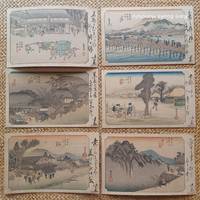
1963219837Tokyo.: 美術社. Bijutsusha. 1963 -1965. Fifty five charming colour woodblock prints 18.4 x 25.7cm complete including commentary in twenty seven envelopes 26.5 x 35cm booklet 16pp presented in a slipcase with two cord ties. Envelope number 17 is duplicated but the contents of the 16th part is inside one. The set being complete. Minor browning inside slipcase but otherwise in excellent condition. This beautiful collection presents Utagawa Hiroshige’s celebrated woodblock prints of the Tokaido route. Each print was produced using traditional methods of woodblock carving and printing. In the foreword the publisher notes that this collection represents the first publication of Hiroshige’s Tokaido prints issued after the end of the Pacific War. <br> <br>The set was sold by subscription over 27 monthly instalments between 1963 and 1965 as the cost of purchasing the complete collection at once would have been beyond the reach of many members of the public at that time. An interpretive booklet included with the set provides background on Hiroshige’s work and on the techniques of woodblock print production together with short descriptions of each print. <br> <br>The publisher’s remarks suggest a renewed sense of pride in Japan’s traditional culture in the post-war period and a desire among the public to reconnect with and possess examples of this artistic heritage. . 美術社. [Bijutsusha]. unknown
19062090502113709395Not Available 1906. Soft Cover. Fine. The book is in fine condition. Not Available paperback
19721805300026Tokyo : Shueisha Co 1972. Hardcover. Very Good. Folio 43 cm. Tan cloth. Held in grey cloth portfolio case with 2 bone ties. 133 xiii pages chiefly illustrations 55 color plates. Tissue guards. A gorgeous limited edition reproduction of the work of Hiroshige. Masterpieces of Ukiyo-e prints. Special series vol. 1. Summary in English. Edited by Zauho Press. This is an oversized or heavy book which requires additional postage for international delivery outside the US. [Tokyo] : Shueisha Co hardcover
19731805300032Tokyo : Shueisha Co 1973. Hardcover. Very Good. Folio 43 cm. Tan cloth. Held in black cloth portfolio case with 2 bone ties. xiii 115-96 pages 46 leaves of plates : chiefly color illustrations. A gorgeous limited edition reproduction of the work of Hokusai. Masterpieces of Ukiyo-e prints. Special series vol. 2. Summary in English. "English adaptation by Yuko Ochi and Patrick Cafferkey"--Page viii. Edited by Zauho Press. This is an oversized or heavy book which requires additional postage for international delivery outside the US. [Tokyo] : Shueisha Co hardcover
19792091502135308258Kosaisha 1979. Soft Cover. Fine. Number of books: 1 box Kosaisha paperback
19305585Tokyo Yuyudo C1930 Une magnifique estampe sur bois reproduisant l'une des célèbres illustrations d'Hiroshige issues de la collection « Cent vues célèbres d'Edo ». Cette estampe représente le temple Komagata-do et le pont Azuma. Publiée à l'origine par Uoei en 1857, cette reproduction est l'uvre de Yuyudo. Bien qu'elle ne porte pas de date, elle date probablement des années 1930. Bien qu'il s'agisse d'une reproduction, il s'agit d'une véritable copie sur bois (et non d'une impression numérique ou lithographique moderne). En excellent état, elle est simplement collée dans un passe-partout, mais peut être retirée pour être encadrée. Le temple Komagata-do est situé sur un terrain triangulaire près du pont Komagata, dans le quartier de Kaminarimon 2-chome, arrondissement de Taito. À l'origine, il s'agissait d'un temple de style entrepôt situé sur les berges de la rivière à Komagata 1-chome, abritant un Bato Kannon (Kannon à tête de cheval). Les habitants d'Edo prononcent le nom du temple Komagata-do « Komando ». L'illustration, peut-être inspirée du célèbre poème de la geisha Takao, « Tu es maintenant près de Komagata, chantant le coucou », représente un coucou volant dans le ciel. La reproduction du ciel pluvieux de mai est magnifique et met en valeur le talent de l'imprimeur. L'image montre le pont Azuma depuis le toit du temple Komagata-do, représentant les maisons sur la rive de la rivière Honjo de l'autre côté. Le mur blanc appartient à la résidence inférieure de Hosokawa Notonokami. Un drapeau rouge est visible au premier plan. Il s'agit du drapeau-enseigne d'un magasin général appelé « Hyakusuke », situé en face du Komagata-do, qui vendait du rouge à lèvres et de la poudre pour le visage. Il était conçu pour être visible de loin, mettant en avant le rouge à lèvres qu'ils vendaient. C'était une enseigne très accrocheuse à l'époque. 34 cm x 23 cm. Le passe-partout mesure 49 cm x 34 cm.
19305585Tokyo: Yuyudo C1930. A beautiful woodblock print reproducing one of Hiroshige's famous illustrations from the collection "One Hundred Famous Views of Edo." This print shows Komagata-do Temple and Azuma Bridge. Originally published by Uoei 1857 this reproduction is by Yuyudo. Although undated it is likely from the 1930's. Although a reproduction it is a genuine woodblock copy not a modern digital or lithographic print. In excellent clean condition it is loosely tipped into a card folder / passe partout but can be removed for framing. Komagata-do Temple is located in the triangular plot of land near Komagata Bridge in Kaminarimon 2-chome Taito Ward. Originally it was a storehouse-style temple located on the riverbank in Komagata 1-chome enshrining a Bato Kannon Horse-Headed Kannon. Edoites pronounce Komagata-do Temple as "Komando." The illustration perhaps inspired by the famous poem by the geisha Takao "You are now near Komagata singing the cuckoo" depicts a cuckoo flying in the sky. The print of the rainy May sky is magnificent showcasing the skill of the printer. The picture shows Azuma Bridge from the roof of Komagata-do Temple depicting houses on the Honjo riverbank on the other side. The white wall belongs to the lower residence of Hosokawa Notonokami. A red flag is visible in the foreground. This is the signboard flag of a general store called "Hyakusuke" located across the street from Komagata-do which sold rouge and face powder. It was designed to be visible from a distance featuring the rouge they sold. It was a very eye-catching signboard at the time. 34cm x 23cm. Passe partout is 49cm x 34cm. . Une magnifique estampe sur bois reproduisant l'une des célèbres illustrations d'Hiroshige issues de la collection « Cent vues célèbres d'Edo ». Cette estampe représente le temple Komagata-do et le pont Azuma. Publiée à l'origine par Uoei en 1857 cette reproduction est l'œuvre de Yuyudo. Bien qu'elle ne porte pas de date elle date probablement des années 1930. Bien qu'il s'agisse d'une reproduction il s'agit d'une véritable copie sur bois et non d'une impression numérique ou lithographique moderne. En excellent état elle est simplement collée dans un passe-partout mais peut être retirée pour être encadrée. Le temple Komagata-do est situé sur un terrain triangulaire près du pont Komagata dans le quartier de Kaminarimon 2-chome arrondissement de Taito. À l'origine il s'agissait d'un temple de style entrepôt situé sur les berges de la rivière à Komagata 1-chome abritant un Bato Kannon Kannon à tête de cheval. Les habitants d'Edo prononcent le nom du temple Komagata-do « Komando ». L'illustration peut-être inspirée du célèbre poème de la geisha Takao « Tu es maintenant près de Komagata chantant le coucou » représente un coucou volant dans le ciel. La reproduction du ciel pluvieux de mai est magnifique et met en valeur le talent de l'imprimeur. L'image montre le pont Azuma depuis le toit du temple Komagata-do représentant les maisons sur la rive de la rivière Honjo de l'autre côté. Le mur blanc appartient à la résidence inférieure de Hosokawa Notonokami. Un drapeau rouge est visible au premier plan. Il s'agit du drapeau-enseigne d'un magasin général appelé « Hyakusuke » situé en face du Komagata-do qui vendait du rouge à lèvres et de la poudre pour le visage. Il était conçu pour être visible de loin mettant en avant le rouge à lèvres qu'ils vendaient. C'était une enseigne très accrocheuse à l'époque. 34 cm x 23 cm. Le passe-partout mesure 49 cm x 34 cm. Yuyudo unknown
1976mon0003427031Shueisha Co. Ltd. 1976. Hardcover. Like New. . Japanese language text. Profusely illustrated. Full page full color plates. Shueisha Co. Ltd. hardcover
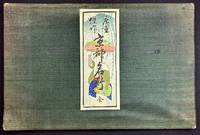
1935H41217Osaka: Hanga Geijutsu Kyokai 1935. Hardcover. Very good. 15.75 x 10.5 inches 27 x 40 cm silk bound oblong folio with 10 color woodcut illustrations of famous scenes in Kyoto accordion folded. Information on publication taken from OCLC their number 897119182. Light wear to binding some light bumping to outer corners of plates. Hanga Geijutsu Kyokai hardcover
19912081402109800524Koku kuchi shoten 1991. Soft Cover. Fine. Volume: 1 Koku kuchi shoten paperback
1975mon0003426165Shueisha 1975. Hardcover. Very Good. . Japanese language text. Profusely illustrated including large full-color plates. Shueisha hardcover
1975mon0003426163Shueisha 1975. Hardcover. Very Good. . Japanese language text. Profusely illustrated including large full-color plates. Fine in slipcase. Shueisha hardcover
19081797SSTokyo: Fujisawa Mankado 1908. Postcards in custom photo album. Postcards Very Good. Hiroshige. Interesting variation to present Hiroshige's work. All postcards except one have actually a stamp and have been sent and cancelled.<br /> --- --- ---<br /> <br /> Tokyo Fujisawa Mankado July 1908 sold in custom photo album 9.25" x 7.25" on first page are one cut-out map with all stations in Japanese one paper strip with name of stations 53 postcards 5.5" x 3.5. All postcards have a handwritten address. All except one have actually a stamp and have been sent and cancelled.<br /> <br /> Front board of album is separated spine repaired book block solid post cards very good. Fujisawa Mankado unknown