Livre Rare Book
150 résultats
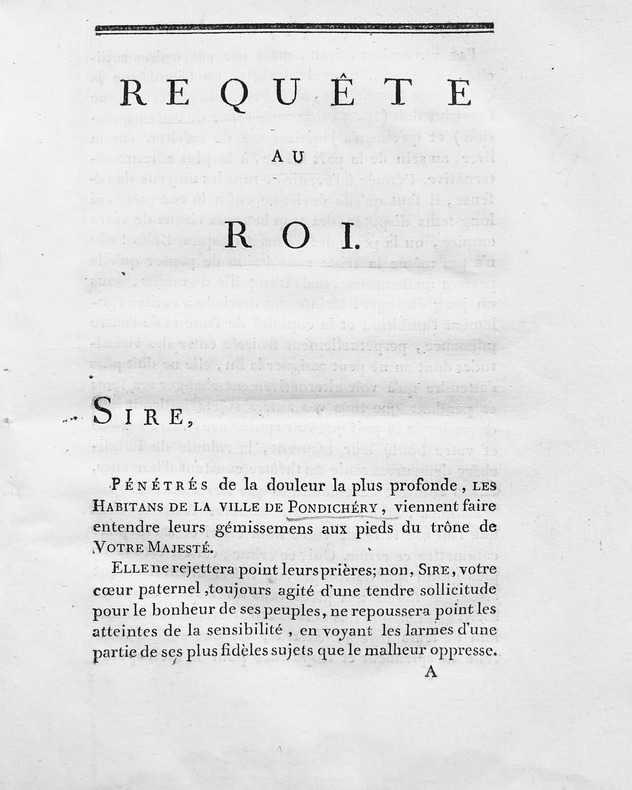
1790LBW-7651Paris, P. F. Didot, 1790. In-4 de 4 pp.; broché, sans couverture.
175626463Paris Antoine Boudet 1756 In-12 troisième trimestre 1756, 190 pp chaque mois
1790LBW-7767Paris, P. Fr. Didot le jeune, 1790. In-4 de 26 pp.; cartonnage de papier marbré vert, pièce de titre rouge (reliure moderne).
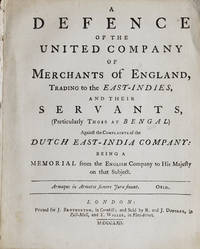
1762239716London: Printed for J. Brotherton in Cornhill; and sold by R. and J. Dodsley in Pall-Mall and T. Waller in Fleet Street 1762. First edition. 4 71 pp. Errata slip tipped to blank verso of second leaf. LACKING folding diagram. 1 vols. 4to. Removed. First two leaves detached. First edition. 4 71 pp. Errata slip tipped to blank verso of second leaf. LACKING folding diagram. 1 vols. 4to. Dunning's brilliant defence of the British East India Company against charges brought by the Dutch marked the beginning of his career as barrister and politician. " . of Dunning's great distinction as a lawyer there is no doubt. The obituary in the Gentleman's Magazine referred not purely conventionally to his 'amazing powers' . Shelburne wrote that 'all parties allowed him to be at the head of the bar . The only doubt was whether he excelled most at equity or common law. There was none as to anybody's coming up to him in either' . " ODNB. Kress 6007; Goldsmith 9776; Higgs 2737; ESTC T97097 Printed for J. Brotherton, in Cornhill; and sold by R. and J. Dodsley, in Pall-Mall, and T. Waller, in Fleet Street unknown
1798319520London: Henry Hughes 1798. First edition. Folding map frontispieces plates. xv 263 9 index; x 374 12 pp. 2 vols. 4to 11 x 9 inches. Contemporary full tan calf rebacked retaining original boards lower corner of Vol. I repaired. 19th-century ownership inscriptions to first blanks 1-inch tear to map near mount some thumb soiling and scattered spotting. First edition. Folding map frontispieces plates. xv 263 9 index; x 374 12 pp. 2 vols. 4to 11 x 9 inches. "This tireless naturalist and antiquary reached out to the ends of the world to gather in knowledge" Cox. <br /> These are volumes one and two on India and Ceylon of an intended 14-volume series entitled "Outlines of the Globe." Welshman Pennant died in 1798 the year of publication and only two more volumes China and Japan were published after his death by his son. ESTC T145966; Cox I p. 307 Henry Hughes unknown
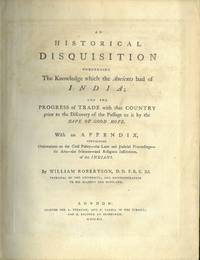
1792245340Maestricht: Roux & Compagnie 1792. First edition was London 1791. With 2 large folding maps of south and southeast Asia the first encompassing the classical references in Robertson's text the second of the region according to Ptolemy. xii 501 pp. 1 vols. 8vo. Contemporary quarter calf and boards new endpapers. Bookplate. Very good. First edition was London 1791. With 2 large folding maps of south and southeast Asia the first encompassing the classical references in Robertson's text the second of the region according to Ptolemy. xii 501 pp. 1 vols. 8vo. A translation into French of Robertson's Historical Disquisition Concerning the Knowledge which the Ancients had of India. Robertson was also the author of The History of America 1777. Lowndes 1571 Roux & Compagnie unknown
179177381London 1791. Stor 4to. Samtidig bind med marmorerte dekler. Ryggstripen mangler. ix 364 12 s. Med to store kobberstukne foldekart. Large 4to. Contemporary binding with marbled covers. Spine lacking. ix 364 12 pp. With two large folding copper engraved maps. Engelsk. unknown
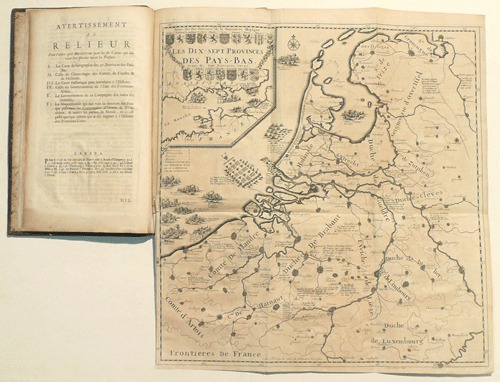
17010039521701 Amsterdam, Jean Malherbe, 1701. Grand in-4 oblong (197 X 314 mm) basane brune, dos cinq nerfs, caissons dorés ornés aux petits fers, titre doré, tranches mouchetées en rouge (Reliure de l'époque) ; (4) ff. de titre, préface, avis au relieur et errata, (1) carte dépliante, (4) planches dépliantes, (1) mappemonde dépliante, 109 pages, (1) page d'achevé d'imprimer, (1) f. de privilège. Épidermures sur les plats, fentes aux mors, coiffes arrachées, coins élimés, ors du titre en grande partie effacés. Ex-libris manuscrit ancien biffé, cachet encre violette sur le premier feuillet blanc et le titre.
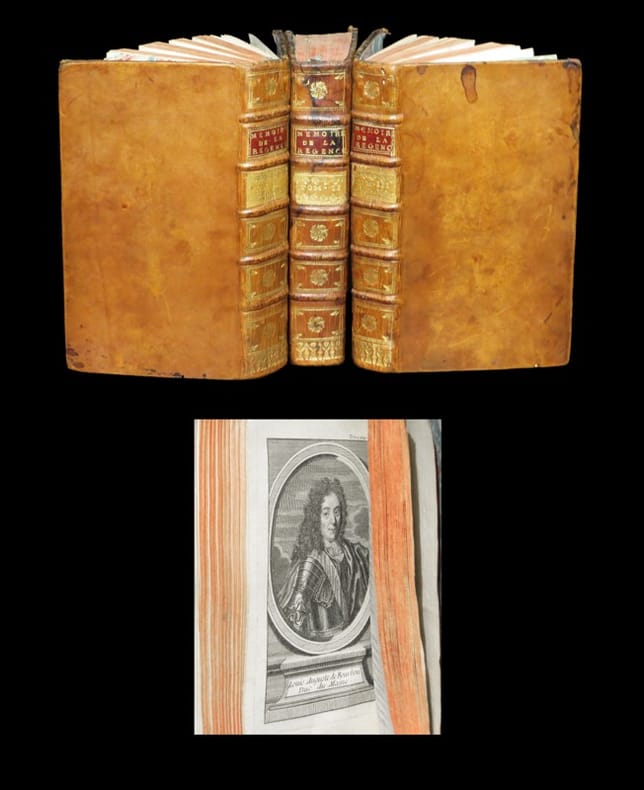
174231159A La Haye, chez Jean van Duren, 1736. 3 vol. au format in-12 (168 x 103 mm) de 2 ff. bl., 1 frontispice gravé n.fol., 16 ff. n.fol., 408 pp. et 2 ff. bl. ; 2 ff. bl., 1 f. n.fol., 404 pp. et 2 ff. bl. ; 2 ff. bl., 3 ff. n.fol., 322 pp., 7 ff. n.fol. et 2 ff. bl. Reliures de l'époque de plein veau glacé et marbré blond, plats jansénistes, dos à nerfs ornés de filets gras à froid, caissons d'encadrement dorés, filets en pointillés dorés, roulettes dorés, larges fleurons dorés, pièces de titre de maroquin acajou, pièces de tomaison de maroquin fauve, titre doré, tomaison dorée, palette dorée en queue, roulette dorée sur les coupes, tranches saumon.
1796398421796. The archive comprises: 1. Autograph letter signed "John Canning." Bifolium 13 x 8 1/4 inches 21 lines in fine Malay Jawi with Arabic opening formula docketed "Calcutta 10 Dec 1796"; octagonal red-wax armorial seal of the Canning family. Letter requests that local rulers receive Capt. Hogan "as our agent. to conclude a treaty advantageous to both sides" dated 22 Jumada II 1211 / 10 Dec 1796. 2. to 5. 4 Paper wrappers. English addresses in a copperplate hand & parallel Jawi headings each with intact Canning seal. Addressed to the Sultan of Magindanao King of Mempawah Borneo King of Bali Sultan of Borneo. 6. to 8. 3 Yellow-silk diplomatic covers. Golden satin sleeves with paper address bands in two languages; two remain unopened and sealed. Addressed to the Sultan of Johor unopened King of Sumbawa unopened Sultan of Sulu wrapper only. An exceptional archive uniting British Malay and Islamic manuscript traditions that captures the East India Company’s first concerted overtures to the island-states of Southeast Asia.<br/> <br/> Drafted in the wake of the Dutch East India Company's collapse and the French Revolutionary Wars this archive documents the East India Company's first concerted diplomatic overtures to the maritime courts of the Malay world. With Dutch control unraveling after the 1795 Batavian Revolution Britain saw a strategic opportunity to enter the lucrative Spice Island trade. Lacking on-the-ground alliances the Company turned to private initiative: Captain Michael Hogan an Irish-American merchant and former convict transport captain was enlisted as unofficial envoy aboard his ship Marquis Cornwallis. The diplomatic texts were composed by Captain John Goodall Canning then Harbour-Master of the port in refined court Malay using Jawi script the Islamic-inflected lingua franca of diplomacy from Aceh to Sulu. In keeping with regional tradition the letters open with Islamic invocation and florid honorifics followed by carefully phrased expressions of friendship and commercial intent. The surviving autograph letter fixes the date of the mission and declares its purpose: "to plant affection and concord and if Your Highness deem it good to enter with us into a compact benefiting both realms." After disembarking convicts in Port Jackson Sydney in February 1796 the Marquis Cornwallis passed northward through Torres Strait calling at New Guinea the Moluccas and ports across the Java Sea almost certainly delivering these and parallel documents en route. The silk wrappers signal the elevated diplomatic status of the messages which were meant to be presented in person by Hogan and opened only in the presence of the addressee. The present archive offers a rare and vivid glimpse into the hybrid ceremonial linguistic and political world of early modern Southeast Asia and into the improvisational diplomacy of the Company at the edge of empire. unknown
1778223135London.: Printed for John Nourse. 1778-1880. Third Edition"revised by the author" of Volume I; first edition of Volume II Part I only lacking Part II. Two volumes 23 maps plans or views of 36 most folding: iv 436pp xcvii Index iii Errata Errata in the Index Directions for the Binder to Place the Maps; ii 365pp contemporary calf boards re-backed boards scored and scuffed 28.3 x 22 cms several of the maps with small fold splits no loss some offsetting the folding views of Calcutta and Bengal particularly fine the large folding "General Map of Indostan" in the first volume heavily spotted affecting the facing leaf several old paper repairs and inked corrections in an early hand with the armorial bookplates of Joseph Cator a prominent merchant and administrator with the East India Company and of Peter Cator his son founder of the Cator Prize and of Bertie Peter Cator and of Kelham Hall a handsome example lacking the second part of Volume II in good condition. Foundational work written by Robert Orme an official and historiographer for the British East India Company EIC with a noteworthy family provenance. The text chronicles the geopolitical struggles and military conflicts that paved the way for British dominance over the Indian subcontinent. <br> <br>The Cator family built a legacy of immense wealth regional development and colonial influence spanning three generations. Joseph Cator 1733–1818 laid the financial foundations as a wealthy "nabob" and high-ranking East India Company official in Calcutta. His 1780 marriage to Diana Bertie daughter of Sir Albemarle Bertie successfully elevated the family into the British aristocracy allowing him to return to England and manage expanding Kent estates like Beckenham Place Park. His son Peter Cator 1796–1873 leveraged this land inheritance during the mid-19th-century railway boom. Alongside his brother Peter transformed these holdings into the upmarket Cator Estate across Blackheath and Beckenham while also working as a lawyer and establishing educational scripture prizes in Madras. This colonial and legal influence continued with his descendant Sir Ralph Bertie Peter Cator 1861–1945 who served the British Empire as a prominent colonial judge holding key judicial appointments as the First Judge of British East Africa and later in the High Court of Constantinople. . Printed for John Nourse. hardcover
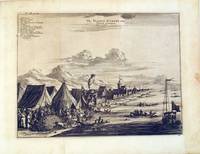
173221951London: Printed for Awnsham and John Churchill 1732. Very good condition. Copper engraved view of the Indian Coromandel coast pearl fishing port Tuticorin or Thoothukudi. A numbered key at the upper left describes the various buildings and people including; "Governors house" "a Heap of Pearle Oyster Shells" "Marchants of divers Nations" and "Tents where all sorts of provisions are sold while ye Pearle Fishery Continues". <br /> <br /> A view of the coastline showing pearl fishermen unloading oysters in front of the provision tents as traders look on. European buildings and many boats pulled up along the shore recede into the distance. From Awnsham & John Churchill's "A Collection of Voyages and Travels" engraved by Johannes Kip. Image 14 1/2 x 11" on paper 19 1/4 x 14". Two small chips at left edge. Strong impression bright and clean. Printed for Awnsham and John Churchill unknown
1792911831792. London. 1792. Dark green cloth gilt type to spine. Sugar report 64 pages followed by six appendices 1789-1790; together with "Thanks to Lord Cornwallis and the Officers Serving in India" and debate 1793 161 pages;"Regulations Proposed to form the By-Laws" 27 pages; "The Debates at the East India House on the 18th of June 1794 on the Consideration of the Report of the Committee of By-Laws and on Mr Twining's Motion . . . " reported by William Woodfall with an Appendix containing letters etc. necessary to elucidate the subject 1794 52 pages; "The Debates at the East India House on Wednesday the 21st of January 1795 on the mode of forming into a by-law Mr Twining's motion . . . which had been carried by Ballot and also on the subject of the Company's Shipping" reported by William Woodfall 1795 134 pages. Corners a little bumped spine and margins of boards sl. damp-mottled edges of boards rubbed. A few marks in blue and red pencil to title-page of Sugar Report. hardcover
1796ABC_49403Various places including Saudi Arabia and Yemen 1796. Contemporary or slightly later half black morocco marbled boards. Small folio ca. 19 x 30.5 cm. English manuscript on watermarked paper. With a loosely inserted manuscript map titled A Chart shewing the Track of HMS Ship Myrtle of the Bay of Biscay and Portugal and a hand-coloured manuscript signal chart. A detailed description of the voyage of the East India company vessel the Swift from 1794-1795 featuring visits to both Saudi Arabia and Yemen. Twelve pages of observations are dedicated to Jeddah alone witnessed at the height of the influx of pilgrims during the Hajj followed by a description of Mocha also Mokha in Yemen. Other ports visited include those of Brazil South Africa India the Nicobar Islands Malaysia and Sri Lanka.Jeddah the author says "has a very pleasant appearance as you approach it from the sea . The houses are all of stone of the coral kind." However as the Swift had arrived in the midst of the Hajj and its crew found provisions difficult to acquire as thousands of pilgrims poured into Jeddah: "It is astonishing the number of Mahometans arriving from all parts of the world to attend the yearly ceremony at Mecca called Hadgi from thence to Medina." Several accounts are given of particular Muslim practices through occasionally somewhat confused British eyes: "When near Geddah all the Pilgrims going their first journey altered their dress assuming what is called the Ihhram a piece of linnen ! which is wrapped round the loins leaving the rest of the body naked in this state they proceed through the rest of the pilgrimage till they have visited the Kaaba at Mecca; the other garment they are then suffered to wear is a cloth of linen over their shoulders. . Some of them carry a trade of muslins and some other little articles which if they are not robbed by the Bedouins wild Arabs they make out tolerably well . The landing of the pilgrims with their wives and household utensils would have been an excellent view for the inimitable Hogarth."The Swift appears to be one of the ships which accompanied the Suffolk a 64-gun ship to escort a convoy to India under the command of Captain Peter Rainier 1741-1808 later Admiral of the Blue and namesake of Mount Rainier. This particular voyage was in itself notable as a trial for the implementation of a citrus diet for sailors to ward off scurvy which was ultimately successful and became Admiralty policy the following year. On the first page of the account we find the following: "The beer being expended ordered the Company to be served wine mixed with 1oz of sugar and oz of lemon juice to every pint it was very nice tipple."The boards show mild traces of use. With a few small smudges on some of the leaves. Otherwise in excellent condition. hardcover
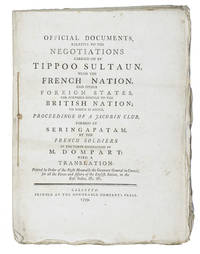
1799ABC_45147Calcutta: Honorable Companys Press 1799. Never bound but side stitched through 3 holes. Super Royal 4to 33.5 x 25 cm. A British propaganda publication printed in Calcutta transcribing secret documents that the British supposedly found in the palace of Seringapatam: primarily Tipu Sultans correspondence with the French considered a betrayal of the British. Tipu Sultan 1750-1799 ruler of the Kingdom of Mysore in southern India took part in a long-standing military feud with the British but made peace with them in 1792. When the French under Napoleon made a push for India in 1798 the British attacked Tipus forces once again starting the Fourth Anglo-Mysore War and eventually killing Tipu Sultan in the attack on Seringapatam. He had a fearsome reputation as the Tiger of Mysore and the present publication attempts to discredit him as a traitor. His supposed affiliation with the French Jacobin Club would have especially concerned British readers. Most of the correspondence between Tipu Sultan the French and their allies including Zaman Shah Durrani ruler of what was to become Afghanistan is printed in parallel columns in English and French. Also included is the text of a letter from Tipu Sultan printed letterpress in Persian in the nastaliq script: 9 lines of type apparently set in the nastaliq type cut under the direction of Charles Wilkins 1749-1836 who served the East India Company in India and became their leading orientalist. It was first used at Calcutta in 1781. The only earlier type for the script that has been clearly documented is thought to have been cut in the 1590s for the Propaganda Fide in Rome who used it around 1633. Neil Benjamin Edmonstone translated the Persian and G.G. Keble the French. Although the book is a true very large quarto point holes along the fold at the head and deckles at the foot and fore-edge the chainlines are vertical though one would not expect sheets this large to be made in double moulds the usual reason for chainlines parallel to the long axis of the sheet.In good condition. Wholly untrimmed and with most bolts unopened and the point holes present.l Shaw Printing in Calcutta 359; Shaw SABREB sab00086; not in Cat. East-India Comp. Honorable Companys Press, unknown
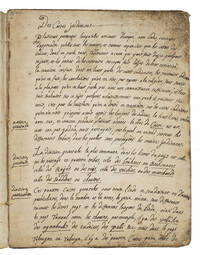
1743ABC_45492Karaikal 1743. Blue mottled stiff paper wrappers. 4to ca. 24 x 18.5 cm. Manuscript written in dark brown ink on beige laid paper. French manuscript written in Karaikal French India since 1739 which gives a detailed explanation of the Indian caste system: the author explains in the beginning of the text that the French people are ill-informed about it. To illustrate the Indian caste system the anonymous author tells lively anecdotes and makes comparisons with French social classes and parallels to biblical stories. The author not only describes the details of the four castes Brahmin Raj Vaisya and Sudra including their hierarchy and advantages the purpose of this social structure and the experience of those who lose their caste. He goes further speculates about the way different cultures criticize each others morals. He argues that all nations criticize each other in some way simply because the habits of cultures differ each with its own good reasons. He also wrote about the extent of superstition in the customs of Indian people for example the beliefs surrounding cows. He concludes that not all their customs are superstitious. The author clearly views Indian cultural practices with a certain gentleness.Somewhat worn at the extremities and spine slightly foxed on the front paste-down and a little dust soiled on the first page. Otherwise in good condition. unknown
1790109371à Paris, chez Desenne, libraire, au Palais-Royal 1790 2 volumes en 1 tome. In-8 20,5 x 13 cm. Reliure postérieure XIXe siècle demi-basane bleu-marine à petits coins, dos lisse orné de filets dorés, 192-144 pp., table. Ex-libris Marquis de Monteynard. Exemplaire en très bon état.
1766122977à Amsterdam, et se trouve à Paris, chez Boudet, Desaint 1766 2 volumes. In-16 17 x 9,5 cm. Reliures de l’époque veau havane marbré, dos à nerfs encadrés de fers dorés, pièces de tomaison maroquin vert, LXIII-466-388 pp., glossaire des noms persans et indiens, table des matières. Ex-librisBibliothèque de Mr le Cte Vimar. Reliures légèrement frottées; coins légèrement émoussés, une coiffe de tête arasée, intérieur frais.
1774102158Sans lieu (Genève), 1774, in-8°, viii-344 pp, reliure plein veau marbré, dos lisse orné de caissons et fleurons dorés, pièces d'auteur et de titre basane rouge et verte, coupes filetées (rel. de l'époque), coiffe sup. lég. abîmée, traces de mouillure ancienne sur la tranche, état correct
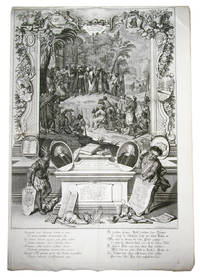
1730ABC_47423Augsburg 1730. 86 x 59 cm. Copperplate engraving. A grand engraving commemorating the achievements of the August Protestant Church in India features various scenes and elements. In the background there are mountains palm trees houses and people including a Chinese person. The foreground shows deciduous and palm trees with a lit grotto holding an idol inscribed with "Brama". In front of the grotto an evangelical missionary preaches to a large congregation of natives while holding a book of music in his left hand and pointing to Brama with his right hand. The missionary wears a turban a priest's cloak and has flappers. The audience under the hill is depicted in interesting groups with some closer to us appearing larger and clearer. At the bottom of the engraving there is an art altar with several books including the "Biblia Malabarica" "Catechism Malabaricus" and the hymnal "Liber Cantion. Malabar." The engraving was made by the German engraver painter draughtsman and art publisher Johann Elias Ridinger 1698-1767. He trained in Ulm and Augsburg under Christoph Resch and Johann Falch and learned engraving from Georg Philipp Rugendas. Ridinger later spent three years in Regensburg where he developed his style through coursing and visits to the riding school. His ornamental works show Rococo stylistic tendencies and he founded his own publishing house in Augsburg. His precise and tasteful drawings were highly regarded and transferred to decoration porcelain and ceramics.With two minor tears one partly repaired the other one not affecting the engraving. Overall in very good condition.l Thienemann Leben und Wirken des unvergleichlichen Thiermalers und Kupferstechers Johann Elias Ridinger 913; Thienemann "Nachträge Zusätze und Berichtigungen C. L. zu : Leben und Wirken des unvergleichlichen Thiermalers und Kupfer stechers Johann Elias Ridinger etc." in Archiv für die zeichnenden Künste 5 1859 pp. 148-149. unknown
17305023<p>Copperplate engraving 83.5 x 55.5 cm 1 folio. Fold marks minor edge wear otherwise a very good copy in very crisp dark impression.<br /></p><p>Rare large-format engraved print produced in 1730 as part of the celebrations of the 200th anniversary of the Augsburg Confession 1530 one of the foundational documents of Lutheranism. The subject of the print is the famous Tranquebar Mission in southern India which was established by King Frederick IV of Denmark 1671-1730 and led by the German missionaries Bartholomäus Ziegenbalg 1682-1719 and Heinrich Plütschau 1676-1752 who are noted for having translated the Bible into Tamil and arranged for its printing.</p><p>The engraving executed by Johann Jacob Kleinschmidt after a design by Elias Riedinger is a splendid example of 18th-century Augsburg printmaking. It takes as its compositional conceit a church altar surmounted by a framed retable. The image above the altar depicts the German missionaries preaching to an audience of natives; in the background of this scene can be glimpsed a statue of 'Biruma oder Brama' Brahma. The elaborately carved frame of the retable is enlivened with vignettes illustrating the successes of the Lutheran mission e.g. an Indian smashing an idol a native being baptized a domesticated elephant symbolizing the people under God's yoke etc.</p><p>Placed atop the altar are oval portraits of Ziegenbalg and Plütschau their names written in Tamil and the books they translated an Indian bible an Indian catechism and an Indian hymnal. A map of southern India hangs on the front face of the altar. Flanking the altar are two young natives: the boy on the left holds the Danish Royal arms and the boy on the right displays the architectural plan of the New Jerusalem Church in Tranquebar built by the Germans and dedicated in 1719. In front of the altar are fallen symbols of the old dispensation. At the foot of the sheet is a poem in Latin and German celebrating the expansion of the Lutheran faith to all corners of the world.</p><p>The engraving is one of several quite ambitious broadside prints produced in Augsburg to commemorate the bicentennial of the Augsburg Confession some of which apparently reproduced paintings executed for the occasion. These rather disparate graphic productions were collected by Johann Michael Roth in 1730/31 and released as a small-edition composite volume with an added engraved title page reading <i>Augspurgisches Iubel-Gedächtnüs</i>. The contents of this rather odd production vary greatly from copy to copy. Kleinschmidt's <i>Vorstellung der Evangelisch-Ost-Indischen Kirche</i> engraving apparently was a commercial success because in 1736 citing demand he released a small-format version of the work its composition slightly altered.</p><p>OCLC locates U.S. examples of the <i>Augspurgisches Iubel-Gedächtnüs</i> at Illinois Duke Getty Stanford Princeton Yale Harvard Emory Concordia Seminary and Cal. State Sutro. The Getty copy includes Kleinschmidt's <i>Vorstellung der Evangelisch-Ost-Indischen Kirch</i> but it is not clear which other examples include this engraving.</p><p>Drugulin <i>Historischer Bilderatlas</i> 4112; S. Neill <i>A History of Christianity in India</i>.</p> Kleinschmidt
179936399London: Printed for A. Strahan; T. Cadell Jun. and W. Davies 1799. The Third Edition. Leather bound. Incomplete. Octavo. 1 viii 441 pages 1 page blank 20 pages Index 1 page advertisement 1 page blank 1. Large folding map approx. 20" x 16" in front is present. Missing the second folding map possibly not bound in. Marbled polished calf leather binding with red leather title label on the spine. Restored at one point in time. Both boards neatly reattached to the binding. Newer leather visible on the outer joints. Hinges are in good condition. Leather spine lightly faded and scuffed. Small hole in the upper right text margin from the title page disappearing by page 8. Map is not affected. Light toning to the map with a very tiny closed tear on the far left margin not affecting the content. The second called for map is missing. Text is lightly toned throughout. Previous owner signature top of the title page. Armorial bookplate of "W. D. Griswold Smith" on the front paste down. The bookplate is mostly covering up an earlier owner name in pencil. Incomplete due to a missing map. Printed for A. Strahan,; T. Cadell Jun. and W. Davies unknown
177521539Paris 1775. Very good condition. Detailed copper engraved map of northern India from Perse Persia Kabul and Tibet in the north down to the River Ganges and the Golphe du Sindi. From Prevost's "L'Histoire Generale des Voyages". With two decorative cartouches.<br /> <br /> Bellin 1703 - 1772 one of the most noted French mapmakers of the 18th century was named the hydrographer chief cartographer to the French Navy and later the Official Hydrographer to the French King.<br /> <br /> Folding 13 3/4 x 9 1/2". Strong impression very clean. unknown
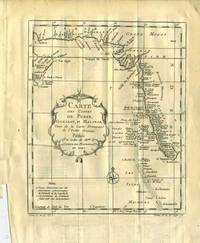
177521547Paris 1775. Very good condition. Detailed copper engraved map of the Persian Gulf and western India from Perse Persia and Grand Mogol in the north down to the tip of India including the Maldives. From Prevost's "L'Histoire Generale des Voyages". With decorative cartouche and compass rose.<br /> <br /> Bellin 1703 - 1772 one of the most noted French mapmakers of the 18th century was named the hydrographer chief cartographer to the French Navy and later the Official Hydrographer to the French King.<br /> <br /> Folding 8 1/2 x 10 1/2". Strong impression very clean. unknown
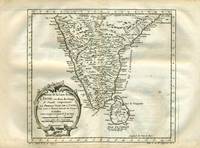
177521540Paris 1775. Very good condition. Detailed copper engraved map of southern India from Bombay down to the tip of the continent and showing the Isle de Ceylan. The Coste de Coromandel and the Golfe de Bengal shown along the east coast. From Prevost's "L'Histoire Generale des Voyages". With a decorative cartouche at the lower left.<br /> <br /> Bellin 1703 - 1772 one of the most noted French mapmakers of the 18th century was named the hydrographer chief cartographer to the French Navy and later the Official Hydrographer to the French King.<br /> <br /> Strong impression very clean. unknown