150 résultats
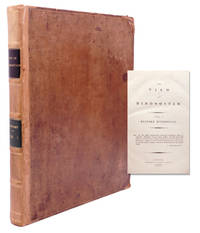
1796ABC_49403Various places including Saudi Arabia and Yemen 1796. Contemporary or slightly later half black morocco marbled boards. Small folio ca. 19 x 30.5 cm. English manuscript on watermarked paper. With a loosely inserted manuscript map titled A Chart shewing the Track of HMS Ship Myrtle of the Bay of Biscay and Portugal and a hand-coloured manuscript signal chart. A detailed description of the voyage of the East India company vessel the Swift from 1794-1795 featuring visits to both Saudi Arabia and Yemen. Twelve pages of observations are dedicated to Jeddah alone witnessed at the height of the influx of pilgrims during the Hajj followed by a description of Mocha also Mokha in Yemen. Other ports visited include those of Brazil South Africa India the Nicobar Islands Malaysia and Sri Lanka.Jeddah the author says "has a very pleasant appearance as you approach it from the sea . The houses are all of stone of the coral kind." However as the Swift had arrived in the midst of the Hajj and its crew found provisions difficult to acquire as thousands of pilgrims poured into Jeddah: "It is astonishing the number of Mahometans arriving from all parts of the world to attend the yearly ceremony at Mecca called Hadgi from thence to Medina." Several accounts are given of particular Muslim practices through occasionally somewhat confused British eyes: "When near Geddah all the Pilgrims going their first journey altered their dress assuming what is called the Ihhram a piece of linnen ! which is wrapped round the loins leaving the rest of the body naked in this state they proceed through the rest of the pilgrimage till they have visited the Kaaba at Mecca; the other garment they are then suffered to wear is a cloth of linen over their shoulders. . Some of them carry a trade of muslins and some other little articles which if they are not robbed by the Bedouins wild Arabs they make out tolerably well . The landing of the pilgrims with their wives and household utensils would have been an excellent view for the inimitable Hogarth."The Swift appears to be one of the ships which accompanied the Suffolk a 64-gun ship to escort a convoy to India under the command of Captain Peter Rainier 1741-1808 later Admiral of the Blue and namesake of Mount Rainier. This particular voyage was in itself notable as a trial for the implementation of a citrus diet for sailors to ward off scurvy which was ultimately successful and became Admiralty policy the following year. On the first page of the account we find the following: "The beer being expended ordered the Company to be served wine mixed with 1oz of sugar and oz of lemon juice to every pint it was very nice tipple."The boards show mild traces of use. With a few small smudges on some of the leaves. Otherwise in excellent condition. hardcover
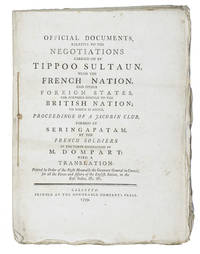
1799ABC_45147Calcutta: Honorable Companys Press 1799. Never bound but side stitched through 3 holes. Super Royal 4to 33.5 x 25 cm. A British propaganda publication printed in Calcutta transcribing secret documents that the British supposedly found in the palace of Seringapatam: primarily Tipu Sultans correspondence with the French considered a betrayal of the British. Tipu Sultan 1750-1799 ruler of the Kingdom of Mysore in southern India took part in a long-standing military feud with the British but made peace with them in 1792. When the French under Napoleon made a push for India in 1798 the British attacked Tipus forces once again starting the Fourth Anglo-Mysore War and eventually killing Tipu Sultan in the attack on Seringapatam. He had a fearsome reputation as the Tiger of Mysore and the present publication attempts to discredit him as a traitor. His supposed affiliation with the French Jacobin Club would have especially concerned British readers. Most of the correspondence between Tipu Sultan the French and their allies including Zaman Shah Durrani ruler of what was to become Afghanistan is printed in parallel columns in English and French. Also included is the text of a letter from Tipu Sultan printed letterpress in Persian in the nastaliq script: 9 lines of type apparently set in the nastaliq type cut under the direction of Charles Wilkins 1749-1836 who served the East India Company in India and became their leading orientalist. It was first used at Calcutta in 1781. The only earlier type for the script that has been clearly documented is thought to have been cut in the 1590s for the Propaganda Fide in Rome who used it around 1633. Neil Benjamin Edmonstone translated the Persian and G.G. Keble the French. Although the book is a true very large quarto point holes along the fold at the head and deckles at the foot and fore-edge the chainlines are vertical though one would not expect sheets this large to be made in double moulds the usual reason for chainlines parallel to the long axis of the sheet.In good condition. Wholly untrimmed and with most bolts unopened and the point holes present.l Shaw Printing in Calcutta 359; Shaw SABREB sab00086; not in Cat. East-India Comp. Honorable Companys Press, unknown
1796398421796. The archive comprises: 1. Autograph letter signed "John Canning." Bifolium 13 x 8 1/4 inches 21 lines in fine Malay Jawi with Arabic opening formula docketed "Calcutta 10 Dec 1796"; octagonal red-wax armorial seal of the Canning family. Letter requests that local rulers receive Capt. Hogan "as our agent. to conclude a treaty advantageous to both sides" dated 22 Jumada II 1211 / 10 Dec 1796. 2. to 5. 4 Paper wrappers. English addresses in a copperplate hand & parallel Jawi headings each with intact Canning seal. Addressed to the Sultan of Magindanao King of Mempawah Borneo King of Bali Sultan of Borneo. 6. to 8. 3 Yellow-silk diplomatic covers. Golden satin sleeves with paper address bands in two languages; two remain unopened and sealed. Addressed to the Sultan of Johor unopened King of Sumbawa unopened Sultan of Sulu wrapper only. An exceptional archive uniting British Malay and Islamic manuscript traditions that captures the East India Company’s first concerted overtures to the island-states of Southeast Asia.<br/> <br/> Drafted in the wake of the Dutch East India Company's collapse and the French Revolutionary Wars this archive documents the East India Company's first concerted diplomatic overtures to the maritime courts of the Malay world. With Dutch control unraveling after the 1795 Batavian Revolution Britain saw a strategic opportunity to enter the lucrative Spice Island trade. Lacking on-the-ground alliances the Company turned to private initiative: Captain Michael Hogan an Irish-American merchant and former convict transport captain was enlisted as unofficial envoy aboard his ship Marquis Cornwallis. The diplomatic texts were composed by Captain John Goodall Canning then Harbour-Master of the port in refined court Malay using Jawi script the Islamic-inflected lingua franca of diplomacy from Aceh to Sulu. In keeping with regional tradition the letters open with Islamic invocation and florid honorifics followed by carefully phrased expressions of friendship and commercial intent. The surviving autograph letter fixes the date of the mission and declares its purpose: "to plant affection and concord and if Your Highness deem it good to enter with us into a compact benefiting both realms." After disembarking convicts in Port Jackson Sydney in February 1796 the Marquis Cornwallis passed northward through Torres Strait calling at New Guinea the Moluccas and ports across the Java Sea almost certainly delivering these and parallel documents en route. The silk wrappers signal the elevated diplomatic status of the messages which were meant to be presented in person by Hogan and opened only in the presence of the addressee. The present archive offers a rare and vivid glimpse into the hybrid ceremonial linguistic and political world of early modern Southeast Asia and into the improvisational diplomacy of the Company at the edge of empire. unknown
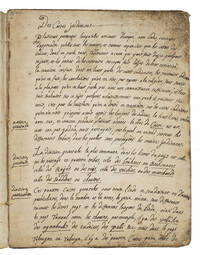
1743ABC_45492Karaikal 1743. Blue mottled stiff paper wrappers. 4to ca. 24 x 18.5 cm. Manuscript written in dark brown ink on beige laid paper. French manuscript written in Karaikal French India since 1739 which gives a detailed explanation of the Indian caste system: the author explains in the beginning of the text that the French people are ill-informed about it. To illustrate the Indian caste system the anonymous author tells lively anecdotes and makes comparisons with French social classes and parallels to biblical stories. The author not only describes the details of the four castes Brahmin Raj Vaisya and Sudra including their hierarchy and advantages the purpose of this social structure and the experience of those who lose their caste. He goes further speculates about the way different cultures criticize each others morals. He argues that all nations criticize each other in some way simply because the habits of cultures differ each with its own good reasons. He also wrote about the extent of superstition in the customs of Indian people for example the beliefs surrounding cows. He concludes that not all their customs are superstitious. The author clearly views Indian cultural practices with a certain gentleness.Somewhat worn at the extremities and spine slightly foxed on the front paste-down and a little dust soiled on the first page. Otherwise in good condition. unknown
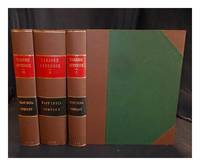
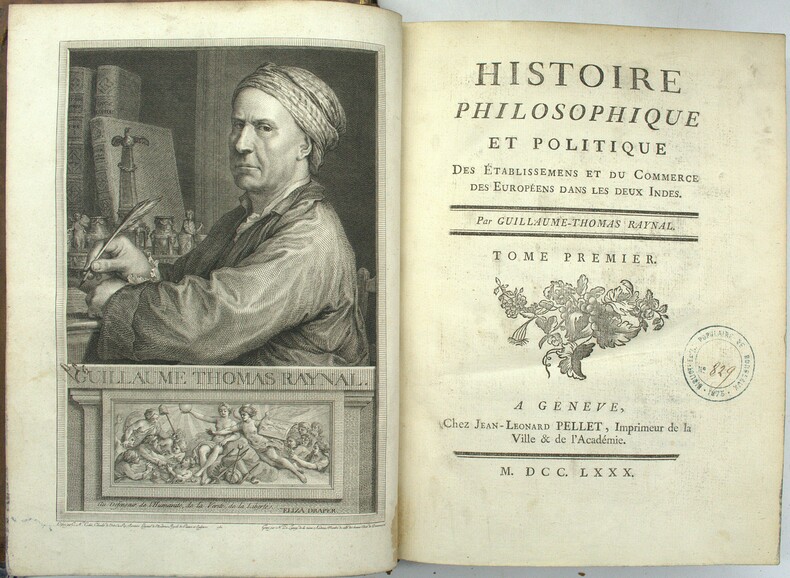
1775AMO-3759A Genève, chez les libraires associés, 1775 3 volume in-4 (26 x 20 cm) de (4)-IV-III-VIII-719, (4)-VIII-662 et (4)-VIII-658 pages. Portrait de l'auteur en frontispice du premier volume (dessiné par Cochin et gravé par L. Le Grand). Au tome I : 1 gravure hors-texte (livre I) + 1 grande carte repliée + 1 bandeau à l'eau-forte par Marillier + 1 gravure hors-texte (livre IV). Au tome II : 1 gravure hors-texte (livre VII) + 2 cartes repliées + 1 bandeau à l'eau-forte par Marillier + 1 gravure hors-texte (livre X). Au tome III : 1 gravure hors-texte (livre XIV) + 1 carte repliée + 1 bandeau à l'eau-forte par Marillier + 1 gravure hors-texte (livre XV) + 1 gravure hors-texte (livre XVIII). Soit 1 portrait, 7 gravures hors-texte (avant la lettre), 3 bandeaux et 4 cartes. Collationné complet. Reliure de l'époque plein veau caramel, dos à nerfs orné aux petits fers, pièce de titre de maroquin rouge, pièce de tomaison de maroquin olive. Reliures très décoratives et solides. Usures de surface sur les plats du premier et deuxième volume (épidermures stoppées), petits manques de cuir et petite galerie sans gravité, petites piqûres de vers en queue du dos du premier volume. Malgré ces quelques défauts l'ensemble reste très décoratif et parfaitement solide. Intérieur très frais. A noter une mouillure en marge intérieure des trois premiers feuillets du premier volume et les derniers feuillets du même volume avec mouillure marginale saine (à quelques feuillets seulement). Exemplaire relié à l'époque aux armes (en queue) d'un membre de la famille de Damas (?) ou d'Aubusson (?). Première édition au format in-quarto. Cette édition est bien complète en 3 volumes in-quarto (il n'y a pas d'atlas pour cette édition). Elle reprend le corpus de l'édition en 7 volumes in-8, avec les passages supprimés réintégrés ici au bas des pages sous forme de variantes. La première édition de ce magistral ouvrage a paru pour la première fois en 1770. "Véritable encyclopédie de l’anticolonialisme au XVIIIe siècle" ce texte entre dans la catégorie des "Voyages philosophiques" et représente un prétexte à des réflexions sur la "loi naturelle" et dénonce tout à la fois despotisme, cléricalisme, esclavage et colonialisme. L'ouvrage est toujours décrit par les commentateurs comme une « machine de guerre » contre le pouvoir en place. Pour la rédaction de cette encyclopédie Raynal eut recours à la collaboration de nombreux informateurs et collaborateurs écrivains tels que le Baron d'Holbach ou Diderot, à qui on attribue une part importante des textes. Interdite en 1772, l’Histoire des deux Indes sera à nouveau publiée par l’abbé Raynal dans une nouvelle édition en 1774 qui est immédiatement mise à l’Index par le clergé. C’est en 1780 qu’il publie sa troisième édition de l'Histoire des deux Indes, encore plus virulente que les deux précédentes et qu’il avoue implicitement comme étant de lui en y faisant graver son portrait en frontispice. Condamné par le Parlement de Paris, l’ouvrage est brûlé par le bourreau en place publique, ce qui lui assure un succès considérable. L’Histoire des deux Indes a également été l’occasion de la Lettre apologétique de l’abbé Raynal à Monsieur Grimm (1781) de Diderot (qui aurait écrit au moins un tiers de l'ouvrage, selon Grimm). Dans cette lettre Diderot écrit : « Raynal est un historien comme il n'y en a point encore eu, et tant mieux pour lui, et tant pis pour l'histoire. Si l'histoire avait, dès les premiers temps, saisi et traîné par les cheveux les tyrans civils et les tyrans religieux, je ne crois pas qu'il en fussent devenus meilleurs; mais ils en auraient été plus détestés, et leurs malheureux sujets en seraient peut-être devenus moins patients... Le livre que j'aime et que les rois et leurs courtisans détestent, c'est le livre qui fait naître des Brutus... » Dans notre exemplaire une note manuscrite de l'époque révolutionnaire indique : "Le Parlement de Paris proscrivit, le 25 mai 1781, l'Histoire philosophique de l'abbé Raynal, et ordonna que cet ouvrage fût brûlé. Il décréta même l'auteur de prise de corps. L'abbé Raynal se vit donc forcé de s'enfuir précipitamment de France. Le 15 août 1790, l'Assemblée nationale, sur la rédaction proposée par les députés Voidel et Maloüet, annula, comme contraire aux droits naturels et imprescriptibles de l'homme, le décret lancé par le Parlement de Paris contre l'abbé Raynal et son Histoire philosophique (v. Oeuvres d'André Chénier, 2e vol., p. 119)." (note manuscrite ancienne sur le faux-titre du premier volume). "It became a key text of the American Revolution, and Raynal became a correspondent of Franklin, Jefferson, and Adams." "Un des ouvrages clefs de la crise de l'Ancien Régime" (Michel Delon, in En Français dans le texte) "Celui qui abdique lâchement sa liberté, se voue au remords et à la plus grande misère qu’un être pensant et sensible puisse éprouver. S’il n’y a, sous le ciel, aucune puissance qui puisse changer mon organisation et m’abrutir, il n’y en a aucune qui puisse disposer de ma liberté. [...] L'esclavage est l'état d'un homme qui, par la force ou des conventions, a perdu la propriété de sa personne, et dont un maître peut disposer comme de la chose. [...] La liberté est la propriété de soi; on distingue trois sortes de libertés: la liberté naturelle, la liberté civile, la liberté politique; c'est-à-dire la liberté de l'homme, celle du citoyen et celle d'un peuple. [...] L'homme est aux prises avec la nature; sans cesse il la modifie, et sans cesse il est modifié. [...]." (extraits). Provenance : A. Leclerc, 1885 (étiquette). Armes dorées en queue des dos (mariage - non identifiées - non reconnu par O.H.R. qui les cite pourtant sous la planche n°888, figure n°3). Armoiries peut-être d'une ancienne famille de Bourgogne ? (provenance bourguignonne pour les volumes concernés). Par ailleurs O.H.R. les mentionne sur une Histoire de Bourgogne), peut-être les armes d'une branche de la famille de Damas (à la croix ancrée) ou d'Aubusson. Les présents volumes de Raynal ont été acquis également en Bourgogne ce qui laisserait supposer l'hypothèse "de Damas" plus pertinente. Références : A. Feugère, Bibliographie critique de l'abbé Raynal, 40 ; En français dans le texte, 166 ; Bel exemplaire relié aux armes à l'époque de cet ouvrage très important du Siècle des Lumières, dans son format le plus majestueux.
1777390089London : East India Company 1777. 1st edition. Hardcover. Finely bound in modern half tan buckram over contrasting fine ribbed-cloth boards. Particularly well-preserved; tight bright clean and strong. Further scans images and additional bibliographical material available on request. Physical description 3 v. Subjects; Appendix. East India Company. Tanjore. London : East India Company hardcover
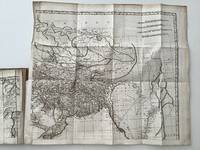
180019106AB1800. Paris Poignee An VIII 1800 Four large folding engraved maps six engraved foloding maps and one plan. The four large folding engraved maps are forming the 'Carte de L'Indostan ou de L'Empire Mogol' the oulines contemporary hand-coloured. First French edition with maps revised by Jean Nicholas Buache incorporating the four maps that compose Rennell's "second great work. the construction of the first approximately correct map of India" DNB. "The Father of Indian Surveying" Gole "Early Maps of India" Rennell charted the currents through the India Ocean and around Africa and later surveyed the Indian interior. He recognized Europe's growing fascination with India: "As almost every particular relating to Hindoostan is become an object of popular curiosity it can hardly be deemed superfluous to lay before the public an improved system of its geography" Rennell Preface. With Rennell's first map of Hindoostan the result of 500 separate surveys and stretching from the Himalayas in the north to Ceylon in the south and the "Great Sandy Deserts" in the west. Born in Chudleigh in Devon England James Rennell who was to become one of the mosst celebrated cartographers of his time joined the British Navy as a midshipman at the age of 14. Amidst the Seven Years' War 1756-1763 he travelled the world and learned marine surveying and hydrography. This led to his appointment at age 24 as surveyor of the British East India Company's dominions in Bengal. In 1765 Rennell began surveying India. By this time the British East India Company had maintained its foothold on the region for over one hundred years but it was still another century before Queen Victoria would set her eyes eastward and Rennell's explorations and accounts helped to fill that gap in time. Rennell combined data from British Army columns with Ain-e-Akbari 1598 a translation of Islamic geography of the empire which helped him acquire information about old divisions he therefore subdivided the country according to the Mughal provinces of 'subas'. unknown
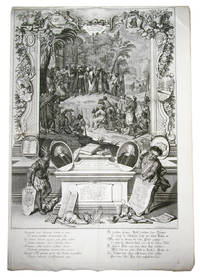
1730ABC_47423Augsburg 1730. 86 x 59 cm. Copperplate engraving. A grand engraving commemorating the achievements of the August Protestant Church in India features various scenes and elements. In the background there are mountains palm trees houses and people including a Chinese person. The foreground shows deciduous and palm trees with a lit grotto holding an idol inscribed with "Brama". In front of the grotto an evangelical missionary preaches to a large congregation of natives while holding a book of music in his left hand and pointing to Brama with his right hand. The missionary wears a turban a priest's cloak and has flappers. The audience under the hill is depicted in interesting groups with some closer to us appearing larger and clearer. At the bottom of the engraving there is an art altar with several books including the "Biblia Malabarica" "Catechism Malabaricus" and the hymnal "Liber Cantion. Malabar." The engraving was made by the German engraver painter draughtsman and art publisher Johann Elias Ridinger 1698-1767. He trained in Ulm and Augsburg under Christoph Resch and Johann Falch and learned engraving from Georg Philipp Rugendas. Ridinger later spent three years in Regensburg where he developed his style through coursing and visits to the riding school. His ornamental works show Rococo stylistic tendencies and he founded his own publishing house in Augsburg. His precise and tasteful drawings were highly regarded and transferred to decoration porcelain and ceramics.With two minor tears one partly repaired the other one not affecting the engraving. Overall in very good condition.l Thienemann Leben und Wirken des unvergleichlichen Thiermalers und Kupferstechers Johann Elias Ridinger 913; Thienemann "Nachträge Zusätze und Berichtigungen C. L. zu : Leben und Wirken des unvergleichlichen Thiermalers und Kupfer stechers Johann Elias Ridinger etc." in Archiv für die zeichnenden Künste 5 1859 pp. 148-149. unknown
1717576<p>Autograph letter 2pp. folded signed "G. Johnstone" to Sir David Dundas contemporary ink stain not affecting text marginal toning 17 September 1774</p><p>The autograph letter from George Johnstone the Director of the East India Company regarding George Vansittart 1745-1825 "quitting the service of the East India Company". The letter goes on to discuss Warren Hastings the Treaty of Banaras and reformations. Beginning with a politically motivated embezzlement:</p><br /><p>"You will now judge what reformations are likely to take place under such a General who in a very inferior station cut out with 100000£ and endeavoured to support evidence on the reform action attempted by General Claverings besides furthering by his own confession in a manner so very unworthy a public officer…". General Clavering was appointed Commander in Chief in India in 1774 shortly after Warren Hastings was appointed Governor General. By the 1770s Hastings had already made many political enemies in the East India Company. </p><br /><p>The letter goes on to state: </p><p>"I am not surprised that Mr. Hastings and his friends should wish for a success for the only person who was privy to the Treaty at Banaras for exterpating the Rohilla… but why Pitt should adopt him I shall never wonder more." </p><br /><p>The Treaties of Banaras of 1773 was an agreement regulating relations between the British Government of Bengal and the ruler of the Muslim state of Oudh modern day Ayodya. Warren Hastings ceded Allahabad and Kora to the states ruler and promised to support him against the menacing Afghan Rohillas in return for cash payments. This move designed to strengthen Oudh as a buffer state between Bengal and the Marathas led to the Rohilla War of 1774 which later became a major factor in Hastings's impeachment 1788–95.</p><br /><p>The mention of Pitt is referring to Prime Minister William Pitt's Regulating Act of 1773. The Act was intended to overhaul the management of the East India Company's rule in India. Although it was not a long term solution to the concerns over the company's affairs it marked the first step towards parliamentary control over the company and centralised administration in India. </p><br /><p>George Johnson was an officer of the Royal Navy who served during the War of Austrian Succession the Seven Years War and the American War of Independence rising for a time to the position of Commodore of a squadron. Adaptable in his career Johnson also served as a member of Parliament a member of the Carlisle Peace Commission a Director of the East India Company and the first Governor of West Florida from 1763 until 1767. Early in his service he revealed both the positive and negative aspects of his character. He was praised for his bravery when confronting the enemy but censured for disobedience. He rose through the ranks to his own commands and had some success with small cruisers against privateers. Throughout his life he rotated between his political career and his service in the Royal Navy. He became a director of the East India Company towards the end of his life before illness forced him to retire from business and politics shortly before his death in 1787.</p><br /><p>An important letter revealing the Director of the East India Company's concern over the actions of Warren Hastings. </p>
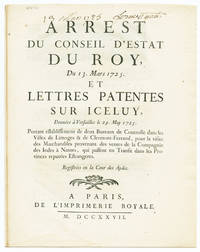
1729WRCAM37441Paris: de l'Imprimerie Royale 1729. 20pp. Quarto. Contemporary inscription. Very minor foxing. Fine. A very rare decree confirming the privileges of the Compagnie des Indes. This Arrest was "prompted by the unloading from a Dutch boat coming from Alexandria and the public sale in Dunkirk a free port of a certain quantity of coffee. The interesting legal point is here raised as to the validity of the Company's privileges in this case as regards its coffee monopoly in a free port" - Maggs. Wroth does not cite any locations for this title only mentioning that it had been reprinted in LE COMMERCE DE L'AMÉRIQUE Avignon 1764. OCLC cites only a single copy at the James Ford Bell Library. <br> <br> From the library of Cardinal Etienne Charles de Lomenie de Brienne 1727-1794 Minister of Louis XVI Archbishop of Toulouse and of Sens. A friend of Voltaire and a member of the Académie Française Brienne wielded significant power as as head of the Finance Ministry which earned him many enemies. He died in prison during the French Revolution despite having renounced Catholicism in 1793 presumably as an attempt to save his life. MAGGS FRENCH COLONISATION OF AMERICA 346 this copy. WROTH ACTS OF FRENCH ROYAL ADMINISTRATION 1187. OCLC 47820819. de l'Imprimerie Royale unknown books
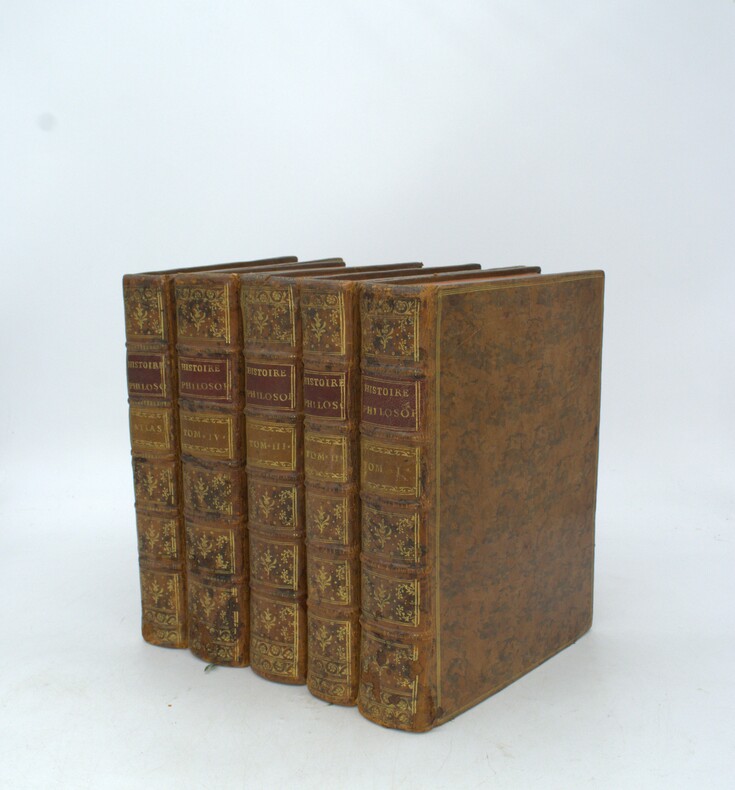
1780PHO-1926Genève, Pellet, 1780, 5 volumes in-4, 4 de texte et un atlas in-4, Texte ; portrait, XVI, 741 pp., 1 pl.; front., (2 ff.), VIII, 485 pp.; front., XV, 629 pp.; front., (2 ff.), VIII, 770 pp., (1 f.), Atlas ; 2f., 28pp. ; illustré complet des 50 cartes (chiffrées 1-49 et 17 bis) ; quelques cartes mal chiffrées et 23 tableaux de statistiques in fine, la plupart dépliants. Rousseurs éparses, feuillets légèrement brunis par places. Tampons humides "Bibliothèque populaire de Bordeaux". Reliure Texte ; Basane fauve marbrée de l'époque, dos à nerfs ornés, triple filet doré encadrant les plats, Atlas ; veau brun marbré de l'époque, dos à nerfs orné, fleurons tulipes entre caissons, tranches marbrées, filet à froid encadrant les plats, double filet doré sur coupes 2 coiffes arasées, une arrachée, petits chocs à 2 autres, frottements et épidermures, coins très émoussés, mors fendillés aux entrées, coins émoussés, tranches marbrées (atlas).
1777390092London : East India Company 1777. 1st edition. Hardcover. Finely bound copies in modern half tan buckram over contrasting fine-ribbed cloth boards. Title page repaired. Particularly well-preserved; tight bright clean and strong. Further scans images and additional bibliographical material available on request. Physical description; 2 volumes. Contents; Vol. 1. Containing orders of the Court of Directors and minutes of Council entered on consultations -- Vol. 2. Containing letters from different persons respecting the above transactions. Subjects; Pigot George Baron 1719-1777. Chennai India History ; Sources. Madras India. Thanjavur India : District History Early works to 1800. London : East India Company hardcover
1798319520London: Henry Hughes 1798. First edition. Folding map frontispieces plates. xv 263 9 index; x 374 12 pp. 2 vols. 4to 11 x 9 inches. Contemporary full tan calf rebacked retaining original boards lower corner of Vol. I repaired. 19th-century ownership inscriptions to first blanks 1-inch tear to map near mount some thumb soiling and scattered spotting. First edition. Folding map frontispieces plates. xv 263 9 index; x 374 12 pp. 2 vols. 4to 11 x 9 inches. "This tireless naturalist and antiquary reached out to the ends of the world to gather in knowledge" Cox. <br /> These are volumes one and two on India and Ceylon of an intended 14-volume series entitled "Outlines of the Globe." Welshman Pennant died in 1798 the year of publication and only two more volumes China and Japan were published after his death by his son. ESTC T145966; Cox I p. 307 Henry Hughes unknown
1798319520London: Henry Hughes 1798. First edition. Folding map frontispieces plates. xv 263 9 index; x 374 12 pp. 2 vols. 4to 11 x 9 inches. Contemporary full tan calf rebacked retaining original boards lower corner of Vol. I repaired. 19th-century ownership inscriptions to first blanks 1-inch tear to map near mount some thumb soiling and scattered spotting. First edition. Folding map frontispieces plates. xv 263 9 index; x 374 12 pp. 2 vols. 4to 11 x 9 inches. "This tireless naturalist and antiquary reached out to the ends of the world to gather in knowledge" Cox. <br/>These are volumes one and two on India and Ceylon of an intended 14-volume series entitled "Outlines of the Globe." Welshman Pennant died in 1798 the year of publication and only two more volumes China and Japan were published after his death by his son. ESTC T145966; Cox I p. 307 Henry Hughes unknown books
17305023<p>Copperplate engraving 83.5 x 55.5 cm 1 folio. Fold marks minor edge wear otherwise a very good copy in very crisp dark impression.<br /></p><p>Rare large-format engraved print produced in 1730 as part of the celebrations of the 200th anniversary of the Augsburg Confession 1530 one of the foundational documents of Lutheranism. The subject of the print is the famous Tranquebar Mission in southern India which was established by King Frederick IV of Denmark 1671-1730 and led by the German missionaries Bartholomäus Ziegenbalg 1682-1719 and Heinrich Plütschau 1676-1752 who are noted for having translated the Bible into Tamil and arranged for its printing.</p><p>The engraving executed by Johann Jacob Kleinschmidt after a design by Elias Riedinger is a splendid example of 18th-century Augsburg printmaking. It takes as its compositional conceit a church altar surmounted by a framed retable. The image above the altar depicts the German missionaries preaching to an audience of natives; in the background of this scene can be glimpsed a statue of 'Biruma oder Brama' Brahma. The elaborately carved frame of the retable is enlivened with vignettes illustrating the successes of the Lutheran mission e.g. an Indian smashing an idol a native being baptized a domesticated elephant symbolizing the people under God's yoke etc.</p><p>Placed atop the altar are oval portraits of Ziegenbalg and Plütschau their names written in Tamil and the books they translated an Indian bible an Indian catechism and an Indian hymnal. A map of southern India hangs on the front face of the altar. Flanking the altar are two young natives: the boy on the left holds the Danish Royal arms and the boy on the right displays the architectural plan of the New Jerusalem Church in Tranquebar built by the Germans and dedicated in 1719. In front of the altar are fallen symbols of the old dispensation. At the foot of the sheet is a poem in Latin and German celebrating the expansion of the Lutheran faith to all corners of the world.</p><p>The engraving is one of several quite ambitious broadside prints produced in Augsburg to commemorate the bicentennial of the Augsburg Confession some of which apparently reproduced paintings executed for the occasion. These rather disparate graphic productions were collected by Johann Michael Roth in 1730/31 and released as a small-edition composite volume with an added engraved title page reading <i>Augspurgisches Iubel-Gedächtnüs</i>. The contents of this rather odd production vary greatly from copy to copy. Kleinschmidt's <i>Vorstellung der Evangelisch-Ost-Indischen Kirche</i> engraving apparently was a commercial success because in 1736 citing demand he released a small-format version of the work its composition slightly altered.</p><p>OCLC locates U.S. examples of the <i>Augspurgisches Iubel-Gedächtnüs</i> at Illinois Duke Getty Stanford Princeton Yale Harvard Emory Concordia Seminary and Cal. State Sutro. The Getty copy includes Kleinschmidt's <i>Vorstellung der Evangelisch-Ost-Indischen Kirch</i> but it is not clear which other examples include this engraving.</p><p>Drugulin <i>Historischer Bilderatlas</i> 4112; S. Neill <i>A History of Christianity in India</i>.</p> Kleinschmidt
1742GITaz288A Luques de l'Imprimerie d'Antoine Rossi 1742. In-8 (17,5cm x 11cm) imprimé sur 2 colonnes XXXIV 377pp. Pleine basane havane, dos à nerfs orné de compartiments dorés, pièce de titre grenat, tranches rouges, rel époque. Bon état.
1780PHO-2003Genève, Jean-Léonard Pellet, 1780. 5 volumes in-4, 4 volumes de texte (25,5x20cm) et 1 Atlas (25,5x22cm), portrait, XVI, front.,741 pp., front., (2 ff.), VIII, 485 pp.; front., XV, 629 pp.; front., (2 ff.), VIII, 770 pp., (1 f.); 22 pp., (1 f. bl.), 50 cartes (49+17bis) et 23 tableaux. Relié plein veau marbré époque, dos à nerfs orné avec tomaison et pièce de titre grenat, filets aux plats, tranches rouges, frottements aux charnières, petites épidermures au dos, qlqs feuillets légèrement brunis. Bel exemplaire en reliure uniforme
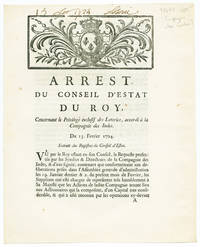
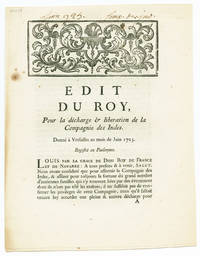
1724WRCAM34684Paris 1724. 4pp. Quarto on a folded folio sheet. Very minor foxing. Contemporary inscription. Near fine. A French law granting the exclusive right to organize lotteries to the speculative "Compagnie des Indes" France's leading West Indian commercial concern. Not in Wroth; OCLC locates only two copies at Yale and the University of Minnesota. Rare. <br> <br> This copy is from the library of Cardinal Etienne Charles de Lomenie de Brienne 1727- 94 Minister of Louis XVI Archbishop of Toulouse and of Sens. A friend of Voltaire and member of the Académie Française Brienne wielded significant power as head of the Finance Ministry which earned him many enemies. He died in prison during the French Revolution despite having renounced Catholicism in 1793 presumably as an attempt to save his life. MAGGS FRENCH COLONISATION OF AMERICA 294 this copy. OCLC 47646033. unknown books
1788WRCAM47799Paris 1788. 103124pp. plus folding letterpress table. Quarto. Contemporary blue paper wrappers stitched. Minor wear and soiling. Near fine. Memorial of the French East India Company freshly reconstituted in 1785 after its liquidation in 1769. Twenty-four pages of tables provide a detailed accounting of the Compagnie's commercial activities from 1769 through 1777 while the text advocates the importance of the Compagnie and details its further activities to date. Fewer than ten copies are located in OCLC. unknown books
1764WRCAM47798Paris 1764. 275pp. Quarto. Contemporary marbled wrappers stitched. Very minor soiling and wear. Near fine. A defense of the Sieur de la Selle and an account of his service with the Compagnie des Indes in India during the Seven Years' War. Only one copy located in OCLC at the Bibliothèque Nationale in France. unknown books
178015<p>First Rare edition in Italian of William Bolts Historical political and cultural treatise on Bengal</p><p>Bolts William. <em>Stato civile politico e commerciante del Regno di Bengala ovvero Storia delle conquiste e dell'amministrazione della compagnia inglese in quelle contrade</em> <em>che vengono a formare i tomi 19. e 20. in seguito della Storia filosofica e politica dell'abate Rainal. </em><em>Tomo primo -secondo.</em> sl se 1780.</p><p>8vo 180 x 120 mm modern quarter calf binding boards enriched by handcoloured paper vol 1: pp. 2 199 1 signature pigreco1 A-L8 M12. M12v blank vol 2: pp. 2 208 2 signature π¹ A-N⸠χ¹; at the end folded map "<em>Carta di Bengala . formata secondo il piano preso su i luoghi da W. Bolts</em>" signed "<em>Bart.o Nerici sc. Lucae</em>"</p><p>Big folded Map of Bengal</p><p>Rare First Edition in Italian of William Bolts most important work on denunciation of the activities of the East India Company in the Indian region of Bengal published for the First Time in 1772 under the title "<em>Considerations on India Affairs</em>" and formed by two volumes.</p><p>Vol 1 is dedicated to an excursus on history and costumes of Bengal while in the second he attacked the administration of the East India Company in Bengal; and in particular he complained of the arbitrary power exercised by the authorities and of his own deportation. The observations and experiences he records still offer a unique resource for scholars inquiring into the nature of Company rule in Bengal.</p><p>William Bolts 1738–1808 was a Dutch-born British merchant active in India. He began his career as an employee of the East India Company and subsequently became an independent merchant. He is best known today for his 1772 book <em>Considerations on India Affairs</em> translated in French in 1775 and in Italian in 1780 which detailed the administration of the East India Company in Bengal which began shortly after their victory at Plassey in 1757. Throughout his life Bolts continued to propose and execute various trading ventures on his own behalf and in conjunction with various commercial and governmental partners. The ventures of individual traders like Bolts did much to spur governments and large corporations into the expansion of their own interests.</p><p>Condition: Very good copy printed on strong paper.</p><p>Provenance: I. Ownership stamp "<em>Colonnello Oro Vincenzo S- Angelo Le Fratte Anno 1923</em>" at title page last page of each volume and on <em>verso</em> of map</p>
173622908Paris Grégoire-Antoine-Dupuis 1736 2 parties en 1 vol. in-12 veau brun jaspé, dos à nerfs orné, pièce de titre fauve, tranches rouges [Rel. de l'époque], lég. rest., qqs mouill. marg
1727WRCAM40676Paris 1727. 8pp. Quarto on a folded folio sheet. Very minor foxing. Light soiling along spine edge; minor dampstaining along bottom edge. Contemporary inscription. Very good. A French royal decree establishing two offices to control the inspection of goods from the Compagnie des Indes. "The Compagnie des Indes flourished from 1726 to 1746 paying handsome dividends and bringing wealth to the ports of Bordeaux Nantes Marseille and in particular its home port of Lorient L'Orient although it lost its rights in the western hemisphere. It established trading offices in many parts of India also Canton Yemen Persia Basra and North Africa. The main sources of its wealth were porcelain wallpapers lacquer and tea from China cotton and silk cloth from China and India coffee from Mocha Yemen pepper from Mahé South India gold ivory and slaves from West Africa" - Shakespeare. A variant and unrecorded issue of Wroth 1096 "which cites the 'Lettres Patentes' only of which but one copy is known to exist that in the New York Public Library whereas no edition of the 'Arrest' itself seems to be known" - Maggs. OCLC locates only one copy at the John Carter Brown Library. Rare. <br> <br> From the library of Cardinal Etienne Charles de Lomenie de Brienne 1727-94 Minister of Louis XVI Archbishop of Toulouse and of Sens. A friend of Voltaire and a member of the Académie Française Brienne wielded significant power as head of the Finance Ministry which earned him many enemies. He died in prison during the French Revolution despite having renounced Catholicism in 1793 presumably as an attempt to save his life. MAGGS FRENCH COLONISATION OF AMERICA 309 this copy. WROTH ACTS OF FRENCH ROYAL ADMINISTRATION 1096 ref. OCLC 79795021. Howard Shakespeare "The Compagnie des Indes" in the JOURNAL OF THE INTERNATIONAL BOND & SHARE SOCIETY February 1997. hardcover books
1725WRCAM40677Paris 1725. 12pp. Quarto. Unbound folded sheets. Minor foxing. Light soiling along spine edge. Contemporary inscription. Very good. A French royal decree releasing the Compagnie from some of its debts an important step in its reorganization. In 1721 the Compagnie had declared bankruptcy and was reorganized after the Mississippi Bubble burst. "This decree discharges the Compagnie des Indes of a large number of financial burdens which had been weighing on it for a number of years" - Maggs. Wroth locates only one copy at NYPL; OCLC identifies three more copies. Scarce. <br> <br> From the library of Cardinal Etienne Charles de Lomenie de Brienne 1727-94 Minister of Louis XVI Archbishop of Toulouse and of Sens. A friend of Voltaire and a member of the Académie Française Brienne wielded significant power as head of the Finance Ministry which earned him many enemies. He died in prison during the French Revolution despite having renounced Catholicism in 1793 presumably as an attempt to save his life. MAGGS FRENCH COLONISATION OF AMERICA 311 this copy. WROTH ACTS OF FRENCH ROYAL ADMINISTRATION 1101. OCLC 62370774. unknown books
1723WRCAM40668Paris 1723. 4pp. Quarto on a folded folio sheet. Light dampstaining and soiling. Contemporary inscription. Very good. A French royal decree pertaining to the rights of the Compagnie des Indes regarding taxes in New France. In 1721 the Compagnie had declared bankruptcy and was reorganized after the Mississippi Bubble burst. Wroth records only the copy at NYPL and OCLC adds two more at Harvard and the John Carter Brown Library. Rare. <br> <br> From the library of Cardinal Etienne Charles de Lomenie de Brienne 1727-94 Minister of Louis XVI Archbishop of Toulouse and of Sens. A friend of Voltaire and a member of the Académie Française Brienne wielded significant power as head of the Finance Ministry which earned him many enemies. He died in prison during the French Revolution despite having renounced Catholicism in 1793 presumably as an attempt to save his life. WROTH ACTS OF FRENCH ROYAL ADMINISTRATION 991. MAGGS FRENCH COLONISATION OF AMERICA 258 this copy. unknown books